lock FIAT DUCATO 2015 3.G Repair Manual
[x] Cancel search | Manufacturer: FIAT, Model Year: 2015, Model line: DUCATO, Model: FIAT DUCATO 2015 3.GPages: 387, PDF Size: 20.76 MB
Page 224 of 387
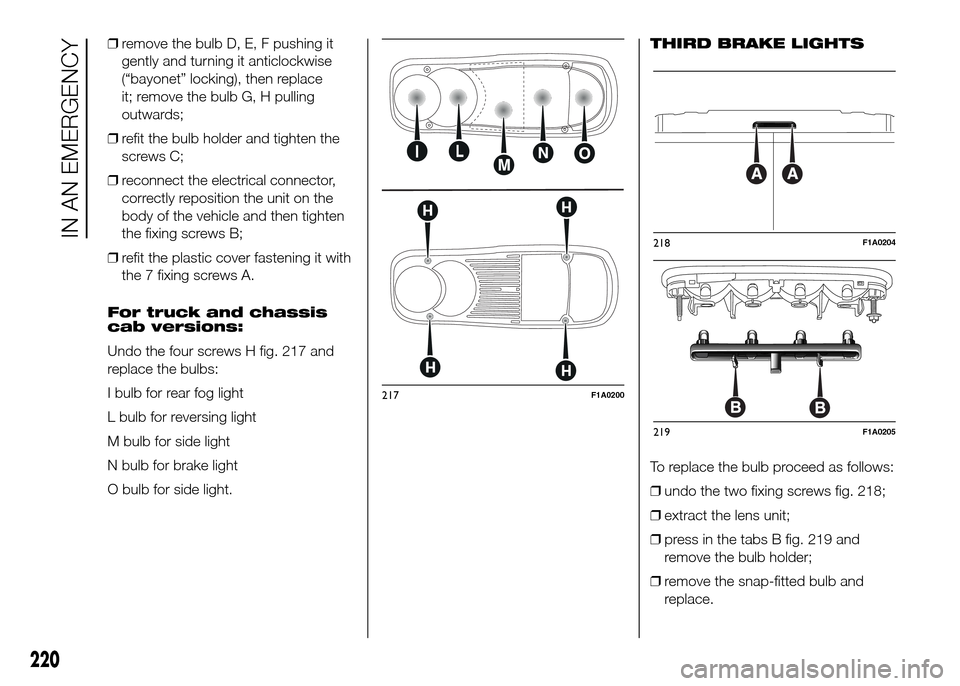
❒remove the bulb D, E, F pushing it
gently and turning it anticlockwise
(“bayonet” locking), then replace
it; remove the bulb G, H pulling
outwards;
❒refit the bulb holder and tighten the
screws C;
❒reconnect the electrical connector,
correctly reposition the unit on the
body of the vehicle and then tighten
the fixing screws B;
❒refit the plastic cover fastening it with
the 7 fixing screws A.
For truck and chassis
cab versions:
Undo the four screws H fig. 217 and
replace the bulbs:
I bulb for rear fog light
L bulb for reversing light
M bulb for side light
N bulb for brake light
O bulb for side light.
.
THIRD BRAKE LIGHTS
To replace the bulb proceed as follows:
❒undo the two fixing screws fig. 218;
❒extract the lens unit;
❒press in the tabs B fig. 219 and
remove the bulb holder;
❒remove the snap-fitted bulb and
replace.
217F1A0200
218F1A0204
219F1A0205
220
IN AN EMERGENCY
Page 225 of 387
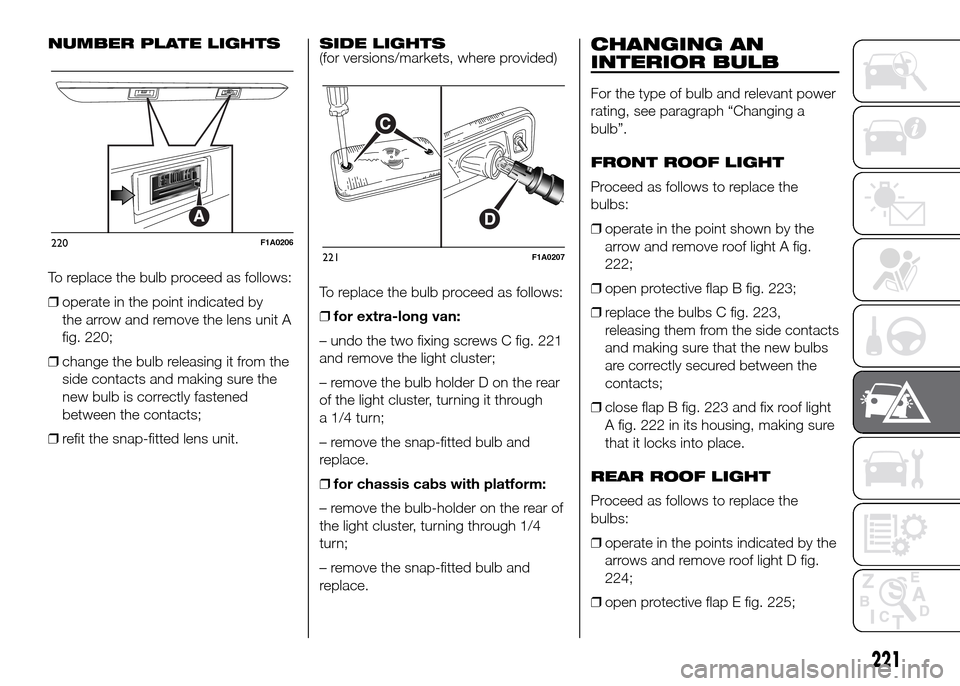
NUMBER PLATE LIGHTS
To replace the bulb proceed as follows:
❒operate in the point indicated by
the arrow and remove the lens unit A
fig. 220;
❒change the bulb releasing it from the
side contacts and making sure the
new bulb is correctly fastened
between the contacts;
❒refit the snap-fitted lens unit.SIDE LIGHTS
(for versions/markets, where provided)
To replace the bulb proceed as follows:
❒for extra-long van:
– undo the two fixing screws C fig. 221
and remove the light cluster;
– remove the bulb holder D on the rear
of the light cluster, turning it through
a 1/4 turn;
– remove the snap-fitted bulb and
replace.
❒for chassis cabs with platform:
– remove the bulb-holder on the rear of
the light cluster, turning through 1/4
turn;
– remove the snap-fitted bulb and
replace.CHANGING AN
INTERIOR BULB
For the type of bulb and relevant power
rating, see paragraph “Changing a
bulb”.
FRONT ROOF LIGHT
Proceed as follows to replace the
bulbs:
❒operate in the point shown by the
arrow and remove roof light A fig.
222;
❒open protective flap B fig. 223;
❒replace the bulbs C fig. 223,
releasing them from the side contacts
and making sure that the new bulbs
are correctly secured between the
contacts;
❒close flap B fig. 223 and fix roof light
A fig. 222 in its housing, making sure
that it locks into place.
REAR ROOF LIGHT
Proceed as follows to replace the
bulbs:
❒operate in the points indicated by the
arrows and remove roof light D fig.
224;
❒open protective flap E fig. 225;
220F1A0206221F1A0207
221
Page 226 of 387
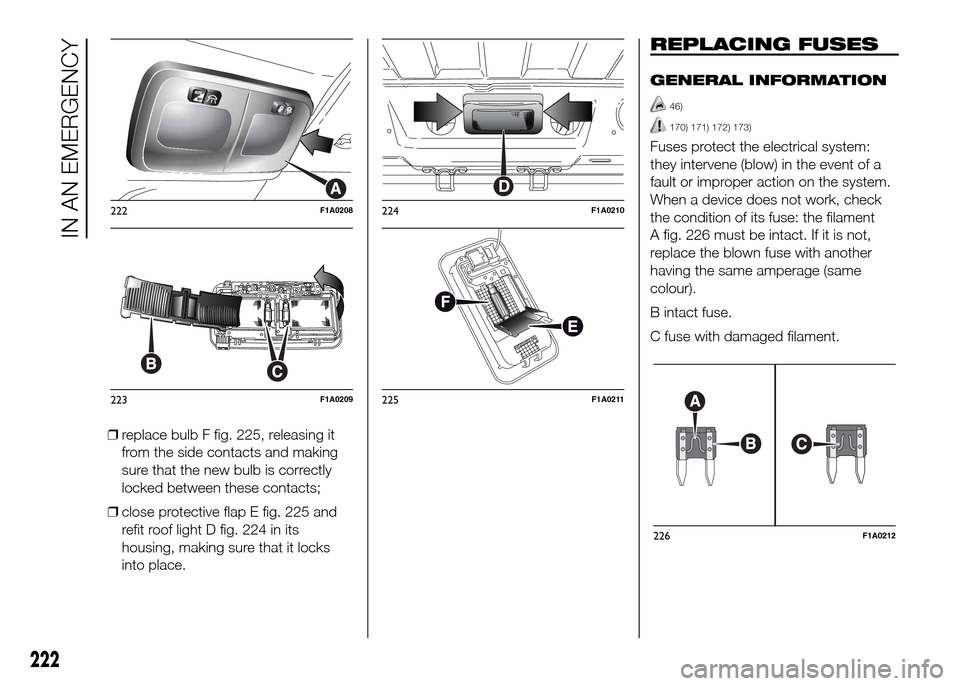
❒replace bulb F fig. 225, releasing it
from the side contacts and making
sure that the new bulb is correctly
locked between these contacts;
❒close protective flap E fig. 225 and
refit roof light D fig. 224 in its
housing, making sure that it locks
into place..
REPLACING FUSES
GENERAL INFORMATION
46)
170) 171) 172) 173)
Fuses protect the electrical system:
they intervene (blow) in the event of a
fault or improper action on the system.
When a device does not work, check
the condition of its fuse: the filament
A fig. 226 must be intact. If it is not,
replace the blown fuse with another
having the same amperage (same
colour).
B intact fuse.
C fuse with damaged filament.
222F1A0208
223F1A0209
224F1A0210
225F1A0211
226F1A0212
222
IN AN EMERGENCY
Page 227 of 387
FUSE LOCATION
The vehicle fuses are grouped in three
control units located on the dashboard,
passenger compartment right pillar
and engine compartment.
Fuse box on the
dashboard
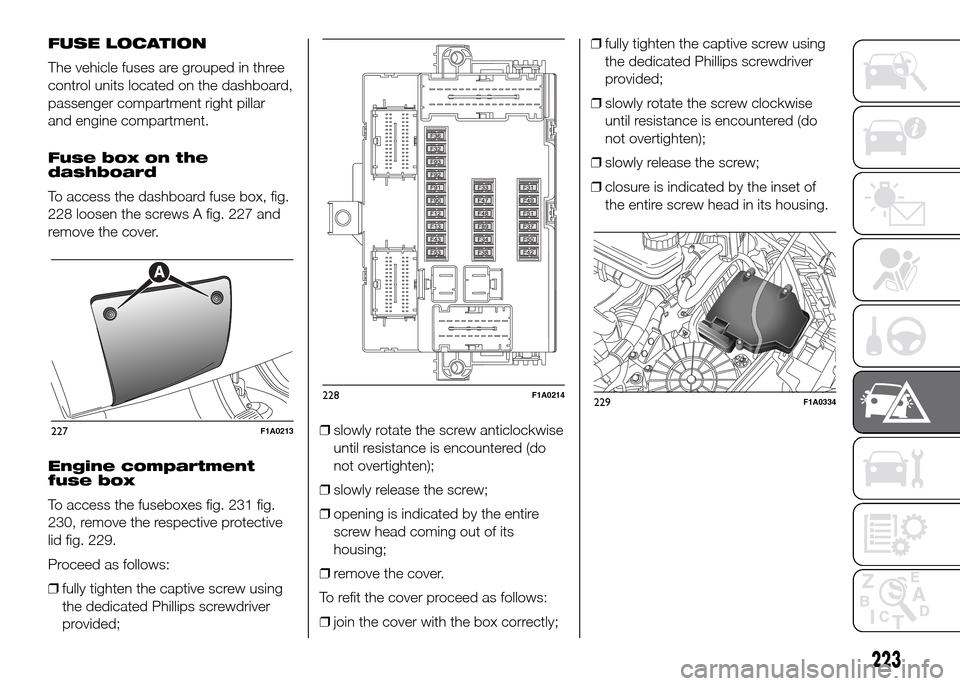
To access the dashboard fuse box, fig.
228 loosen the screws A fig. 227 and
remove the cover.
Engine compartment
fuse box
To access the fuseboxes fig. 231 fig.
230, remove the respective protective
lid fig. 229.
Proceed as follows:
❒fully tighten the captive screw using
the dedicated Phillips screwdriver
provided;❒slowly rotate the screw anticlockwise
until resistance is encountered (do
not overtighten);
❒slowly release the screw;
❒opening is indicated by the entire
screw head coming out of its
housing;
❒remove the cover.
To refit the cover proceed as follows:
❒join the cover with the box correctly;❒fully tighten the captive screw using
the dedicated Phillips screwdriver
provided;
❒slowly rotate the screw clockwise
until resistance is encountered (do
not overtighten);
❒slowly release the screw;
❒closure is indicated by the inset of
the entire screw head in its housing.
227F1A0213
228F1A0214229F1A0334
223
Page 230 of 387
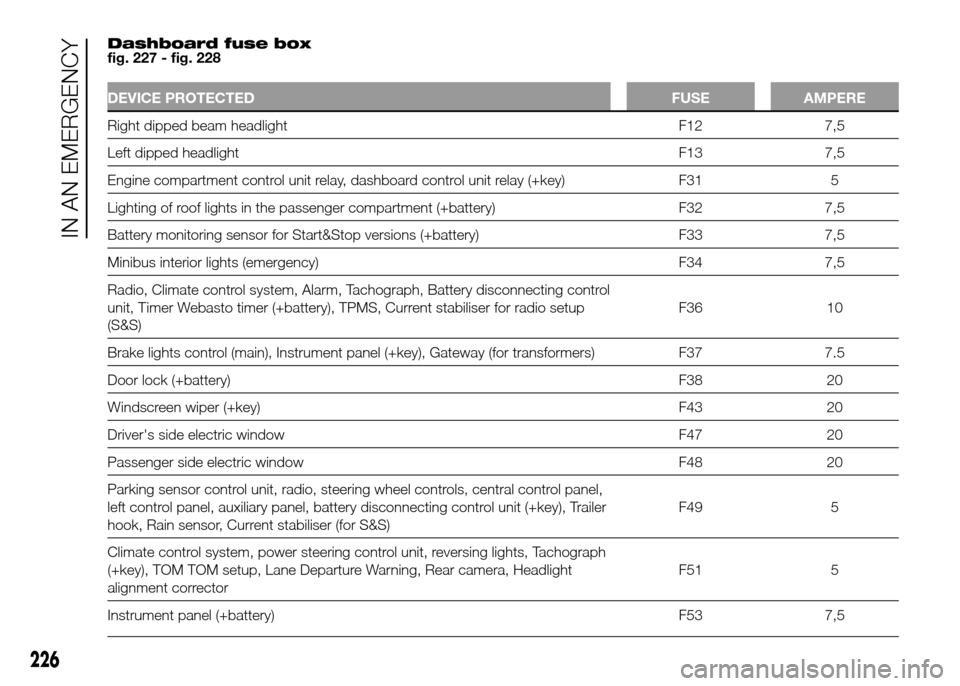
Dashboard fuse box
fig. 227 - fig. 228
DEVICE PROTECTED FUSE AMPERE
Right dipped beam headlight F12 7,5
Leftdipped headlight F13 7,5
Engine compartment control unit relay, dashboard control unit relay (+key) F31 5
Lighting of roof lights in the passenger compartment (+battery) F32 7,5
Battery monitoring sensor for Start&Stop versions (+battery) F33 7,5
Minibus interior lights (emergency) F34 7,5
Radio, Climate control system, Alarm, Tachograph, Battery disconnecting control
unit, Timer Webasto timer (+battery), TPMS, Current stabiliser for radio setup
(S&S)F36 10
Brake lights control (main), Instrument panel (+key), Gateway (for transformers) F37 7.5
Door lock (+battery) F38 20
Windscreen wiper (+key) F43 20
Driver's side electric window F47 20
Passenger side electric window F48 20
Parking sensor control unit, radio, steering wheel controls, central control panel,
left control panel, auxiliary panel, battery disconnecting control unit (+key), Trailer
hook, Rain sensor, Current stabiliser (for S&S)F49 5
Climate control system, power steering control unit, reversing lights, Tachograph
(+key), TOM TOM setup, Lane Departure Warning, Rear camera, Headlight
alignment correctorF51 5
Instrument panel (+battery) F53 7,5
226
IN AN EMERGENCY
Page 238 of 387
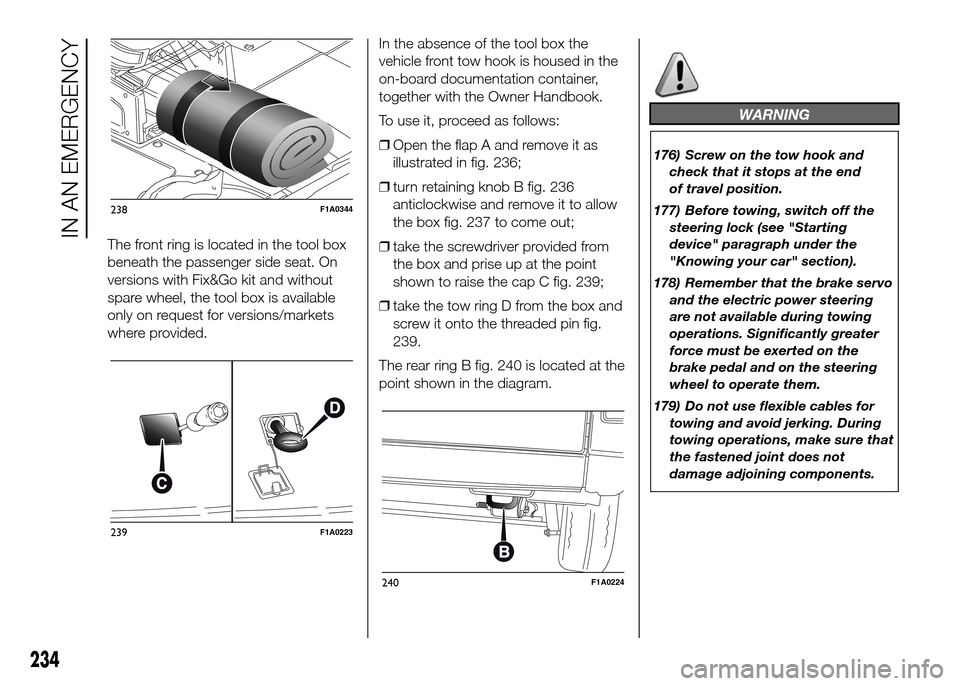
The front ring is located in the tool box
beneath the passenger side seat. On
versions with Fix&Go kit and without
spare wheel, the tool box is available
only on request for versions/markets
where provided.In the absence of the tool box the
vehicle front tow hook is housed in the
on-board documentation container,
together with the Owner Handbook.
To use it, proceed as follows:
❒Open the flap A and remove it as
illustrated in fig. 236;
❒turn retaining knob B fig. 236
anticlockwise and remove it to allow
the box fig. 237 to come out;
❒take the screwdriver provided from
the box and prise up at the point
shown to raise the cap C fig. 239;
❒take the tow ring D from the box and
screw it onto the threaded pin fig.
239.
The rear ring B fig. 240 is located at the
point shown in the diagram.
WARNING
176) Screw on the tow hook and
check that it stops at the end
of travel position.
177) Before towing, switch off the
steering lock (see "Starting
device" paragraph under the
"Knowing your car" section).
178) Remember that the brake servo
and the electric power steering
are not available during towing
operations. Significantly greater
force must be exerted on the
brake pedal and on the steering
wheel to operate them.
179) Do not use flexible cables for
towing and avoid jerking. During
towing operations, make sure that
the fastened joint does not
damage adjoining components.
238F1A0344
239F1A0223
240F1A0224
234
IN AN EMERGENCY
Page 243 of 387
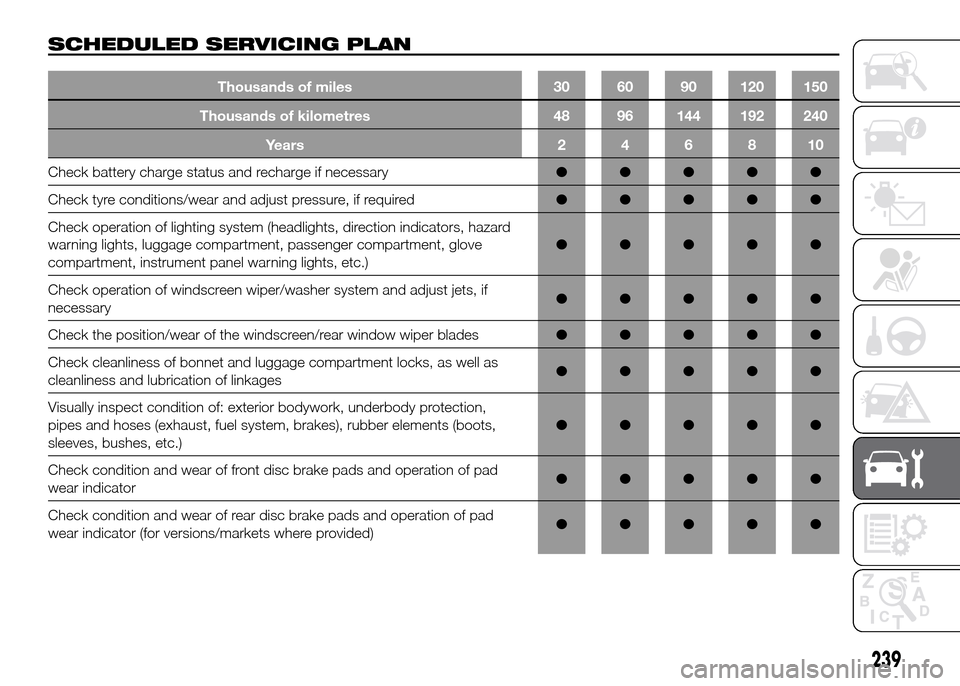
SCHEDULED SERVICING PLAN
Thousands of miles 30 60 90 120 150
Thousands of kilometres 48 96 144 192 240
Years246810
Check battery charge status and recharge if necessary●●●●●
Checktyre conditions/wear and adjust pressure, if required●●●●●
Check operation of lighting system (headlights, direction indicators, hazard
warning lights, luggage compartment, passenger compartment, glove
compartment, instrument panel warning lights, etc.)●●●●●
Check operation of windscreen wiper/washer system and adjust jets, if
necessary●●●●●
Check the position/wear of the windscreen/rear window wiper blades●●●●●
Check cleanliness of bonnet and luggage compartment locks, as well as
cleanliness and lubrication of linkages●●●●●
Visually inspect condition of: exterior bodywork, underbody protection,
pipes and hoses (exhaust, fuel system, brakes), rubber elements (boots,
sleeves, bushes, etc.)●●●●●
Check condition and wear of front disc brake pads and operation of pad
wear indicator●●●●●
Check condition and wear of rear disc brake pads and operation of pad
wear indicator (for versions/markets where provided)●●●●●
239
Page 246 of 387
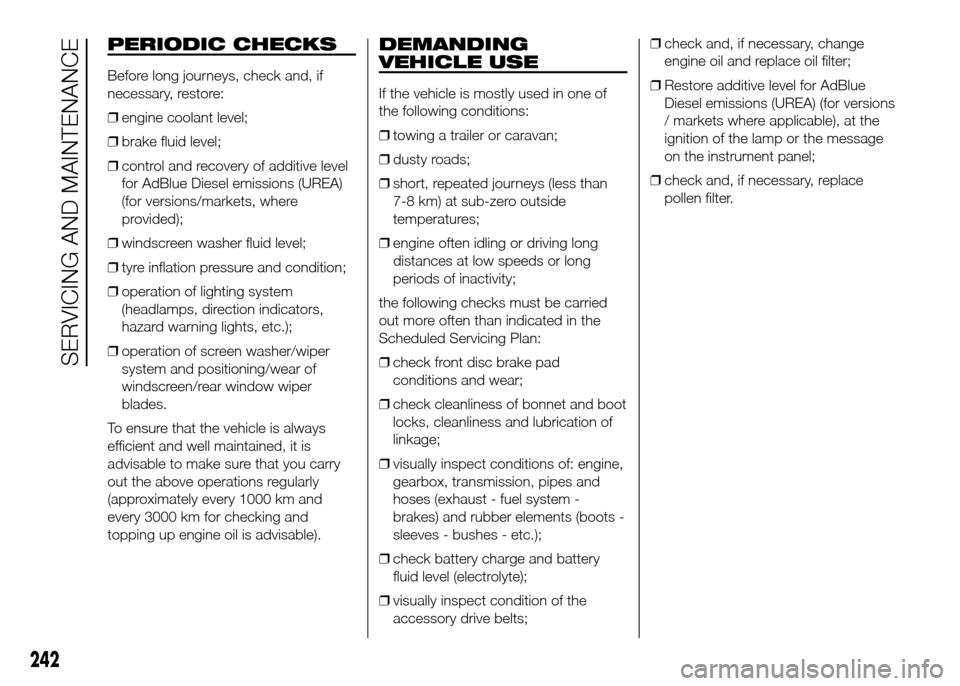
PERIODIC CHECKS
Before long journeys, check and, if
necessary, restore:
❒engine coolant level;
❒brake fluid level;
❒control and recovery of additive level
for AdBlue Diesel emissions (UREA)
(for versions/markets, where
provided);
❒windscreen washer fluid level;
❒tyre inflation pressure and condition;
❒operation of lighting system
(headlamps, direction indicators,
hazard warning lights, etc.);
❒operation of screen washer/wiper
system and positioning/wear of
windscreen/rear window wiper
blades.
To ensure that the vehicle is always
efficient and well maintained, it is
advisable to make sure that you carry
out the above operations regularly
(approximately every 1000 km and
every 3000 km for checking and
topping up engine oil is advisable).
DEMANDING
VEHICLE USE
If the vehicle is mostly used in one of
the following conditions:
❒towing a trailer or caravan;
❒dusty roads;
❒short, repeated journeys (less than
7-8 km) at sub-zero outside
temperatures;
❒engine often idling or driving long
distances at low speeds or long
periods of inactivity;
the following checks must be carried
out more often than indicated in the
Scheduled Servicing Plan:
❒check front disc brake pad
conditions and wear;
❒check cleanliness of bonnet and boot
locks, cleanliness and lubrication of
linkage;
❒visually inspect conditions of: engine,
gearbox, transmission, pipes and
hoses (exhaust - fuel system -
brakes) and rubber elements (boots -
sleeves - bushes - etc.);
❒check battery charge and battery
fluid level (electrolyte);
❒visually inspect condition of the
accessory drive belts;❒check and, if necessary, change
engine oil and replace oil filter;
❒Restore additive level for AdBlue
Diesel emissions (UREA) (for versions
/ markets where applicable), at the
ignition of the lamp or the message
on the instrument panel;
❒check and, if necessary, replace
pollen filter.
242
SERVICING AND MAINTENANCE
Page 251 of 387
ENGINE OIL
48)
Check the oil level a few minutes (about
5) after the engine has stopped, with
the vehicle parked on level ground.
Check the level is within the MIN. and
MAX. marks on the dipstick B fig. 241 -
fig. 242 - fig. 243 - fig. 244.
The range between the MIN and MAX
marks corresponds to about 1 litre
of oil.
If the oil level is near or under the MIN
line, add oil through the filler A fig. 241 -
fig. 242 - fig. 243 - fig. 244 until it
reaches the MAX line.
The oil level must never exceed the
MAX mark.
Engine oil consumption
The maximum engine oil consumption
is usually 400 grams every 1000 km.
When the vehicle is new, the engine
needs to be run in, therefore the engine
oil consumption can only be considered
stabilised after the first 5,000–6,000
km.
IMPORTANT The oil consumption
depends on driving style and the
conditions under which the vehicle is
used.IMPORTANT After adding or changing
the oil, let the engine run for a few
seconds and wait a few minutes after
switching it off before checking the
level.
IMPORTANT Always top up using
engine oil of the same specifications as
that already in the engine.
ENGINE COOLANT
49)187)
The coolant level must be checked
when the engine is cold and must
range between the MIN and MAX
marks on the reservoir.
If the level is to low, operate as follows:
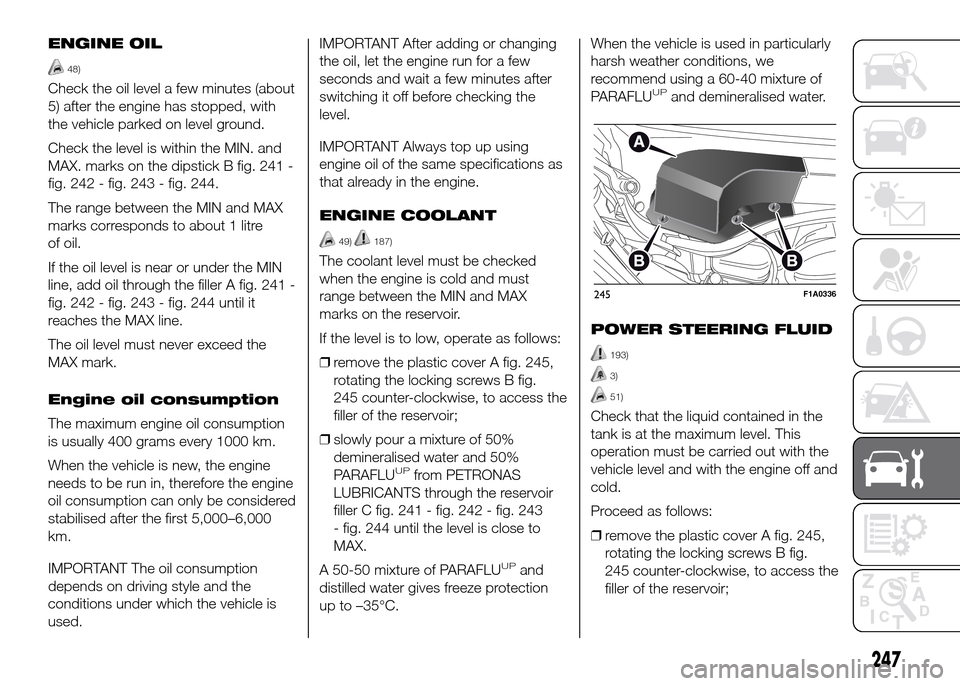
❒remove the plastic cover A fig. 245,
rotating the locking screws B fig.
245 counter-clockwise, to access the
filler of the reservoir;
❒slowly pour a mixture of 50%
demineralised water and 50%
PARAFLU
UPfrom PETRONAS
LUBRICANTS through the reservoir
filler C fig. 241 - fig. 242 - fig. 243
- fig. 244 until the level is close to
MAX.
A 50-50 mixture of PARAFLU
UPand
distilled water gives freeze protection
up to –35°C.When the vehicle is used in particularly
harsh weather conditions, we
recommend using a 60-40 mixture of
PARAFLU
UPand demineralised water.
POWER STEERING FLUID
193)
3)
51)
Check that the liquid contained in the
tank is at the maximum level. This
operation must be carried out with the
vehicle level and with the engine off and
cold.
Proceed as follows:
❒remove the plastic cover A fig. 245,
rotating the locking screws B fig.
245 counter-clockwise, to access the
filler of the reservoir;
245F1A0336
247
Page 252 of 387
❒check that the fluid level is up to the
MAX mark on the dipstick attached
to the reservoir cap F fig. 241 -
fig. 242 - fig. 243 - fig. 244 (use the
level shown on the 20°C side of
the dipstick to check when cold).
If the level of the fluid in the tank is
lower than the specified level, top up
using only one of the products
indicated in the "Fluid and lubricants"
table in the "Technical specifications"
section, proceeding as follows:
❒Start the engine and wait for the fluid
level in the tank to stabilise.
❒With the engine running, turn the
steering wheel from right to left
fully several times.
❒Top up the fuel to the MAX level and
then retighten the cap.
WINDSCREEN/REAR
WINDOW WASHER FLUID
188) 189)
To add fluid:
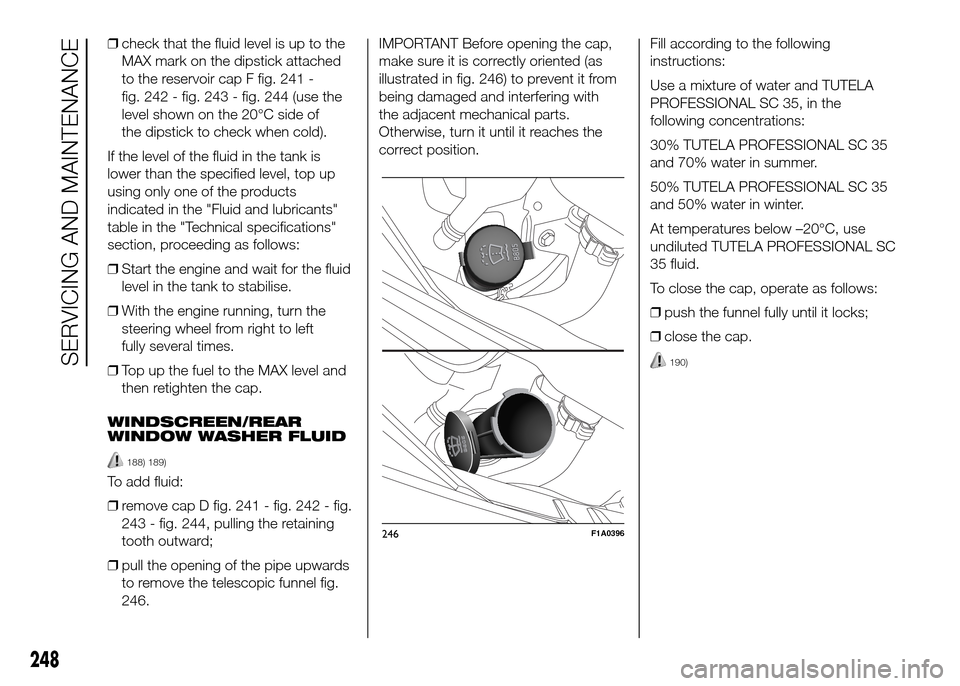
❒remove cap D fig. 241 - fig. 242 - fig.
243 - fig. 244, pulling the retaining
tooth outward;
❒pull the opening of the pipe upwards
to remove the telescopic funnel fig.
246.IMPORTANT Before opening the cap,
make sure it is correctly oriented (as
illustrated in fig. 246) to prevent it from
being damaged and interfering with
the adjacent mechanical parts.
Otherwise, turn it until it reaches the
correct position.Fill according to the following
instructions:
Use a mixture of water and TUTELA
PROFESSIONAL SC 35, in the
following concentrations:
30% TUTELA PROFESSIONAL SC 35
and 70% water in summer.
50% TUTELA PROFESSIONAL SC 35
and 50% water in winter.
At temperatures below –20°C, use
undiluted TUTELA PROFESSIONAL SC
35 fluid.
To close the cap, operate as follows:
❒push the funnel fully until it locks;
❒close the cap.
190)
246F1A0396
248
SERVICING AND MAINTENANCE