heating FIAT DUCATO 2015 Owner handbook (in English)
[x] Cancel search | Manufacturer: FIAT, Model Year: 2015, Model line: DUCATO, Model: FIAT DUCATO 2015Pages: 367, PDF Size: 19.73 MB
Page 93 of 367
TPMS (Tyre
Pressure
Monitoring System)
(for versions/markets, where
provided)
69) 70) 71) 72) 73) 74) 75) 76) 77)
DESCRIPTION
The tyre pressure monitoring
system (TPMS) warns the driver of
low tyre pressure on the basis of
the cold inflation pressure
prescribed for the vehicle.
Changes in outside temperature
may cause tyre pressure to vary.
This means that a decrease in the
outside temperature corresponds
to a decrease in the tyre pressure.
Tyre pressure must always be
adjusted according to the cold
inflation pressure. Cold tyre inflation
pressure is the tyre pressure after
letting the vehicle stand for at least
three hours or a travel shorter
than 1.6 km after an interval of
three hours.
The cold tyre inflation pressure
must not exceed the maximum
inflation pressure value printed on
the side of the tyre.The tyre pressure also increases
while driving the vehicle: this is
a normal condition and does not
require any adjustment of the
pressure.
The TPMS continues to advise the
driver of the low tyre pressure
condition until this is corrected; the
warning continues until the
pressure corresponds or exceeds
the pressure prescribed for the cold
tyres. When the tyre low pressure
control warning light
switches on
constantly, the inflation pressure
must be adjusted until it reaches
the pressure prescribed for cold
tyres. After the automatic update of
the system, the tyre pressure
control warning light switches off.
You may need to drive the vehicle
for about 20 minutes at a speed
higher than 20 km/h to allow the
TPMS to receive this information.NOTE
❒The TPMS does not replace the
normal tyre maintenance service and
does not indicate any fault in a tyre.
❒Therefore, the TPMS should not be
used as pressure switch while
adjusting the tyre inflation pressure.
❒Driving with insufficient tyre pressure
causes their overheating and can
result in tyre failure. The low inflation
pressure reduces fuel efficiency
and tyre tread life and may also affect
handling and braking performance
of the vehicle.
❒The TPMS does not replace the
correct tyre maintenance. It is up to
the driver to maintain the correct tyre
pressure level measuring it with a
suitable pressure switch. This is
necessary even if the decrease in the
inflation pressure value does not
cause the tyre pressure control
warning light to switch on.
❒The TPMS warns the driver of any
condition of insufficient tyre pressure
If this drops below the insufficient
pressure limit for any reason including
low temperature and normal
pressure loss of the tyre.
❒The seasonal temperature changes
affect tyre pressure.
89
Page 117 of 367
KNOWING THE INSTRUMENT PANEL
This section of the booklet gives
you all the information you need to
understand, interpret and use
the instrument panel correctly.CONTROL PANEL AND
INSTRUMENTS ...............................114
DISPLAY ........................................120
TRIP COMPUTER ...........................129
WARNING LIGHTS AND
MESSAGES ....................................132
- LOW BRAKE FLUID/HANDBRAKE
ENGAGED .......................................... 132
- EBD FAILURE .................................. 133
- AIRBAG FAILURE ............................. 133
- SEAT BELTS NOT FASTENED .......... 134
- ENGINE COOLANT TEMPERATURE
TOO HIGH .......................................... 135
- LOW BATTERY CHARGE ................. 135
- LOW ENGINE OIL PRESSURE ......... 136
-ENGINE OIL DETERIORATED ........... 136
-INCOMPLETE DOOR/LOAD
COMPARTMENT CLOSURE ............... 137
- POWER STEERING FAILURE ........... 137
-SELF-LEVELLING SUSPENSION
FAILURE ............................................. 137
- INJECTION/EOBD SYSTEM
FAILURE ............................................. 139
- ABS FAILURE ................................... 140
-FUEL RESERVE ................................ 140
- GLOW PLUG HEATING/GLOW
PLUG HEATING FAILURE ................... 141
- WATER IN DIESEL FILTER ................ 141
-VEHICLE PROTECTION SYSTEM
FAILURE - FIAT CODE ........................ 142
- REAR FOG LIGHTS .......................... 142
-GENERIC FAILURE INDICATION ....... 142
-DPF (PARTICULATE FILTER)
CLEANING UNDERWAY ..................... 144
-WORN BRAKE PADS ........................ 145
-DRIVING ADVISOR ........................... 146
- TPMS ............................................... 147
- DIPPED HEADLIGHTS ..................... 148- FOLLOW ME HOME ........................ 148
- LEFT-HAND DIRECTION INDICATOR
............................................................ 148
- RIGHT-HAND DIRECTION
INDICATOR ........................................ 149
-FOG LIGHTS ..................................... 149
- CRUISE CONTROL .......................... 149
-SPEED LIMITER ................................ 149
- AUTOMATIC MAIN BEAM
HEADLIGHTS ..................................... 150
- MAIN BEAM HEADLIGHTS .............. 150
-EXTERIOR LIGHTS FAULT ................ 151
-BRAKE LIGHT FAILURE .................... 151
-MAIN BEAM AUTOMATISM FAULT ... 152
-POSSIBLE ICE ON ROAD ................. 152
-SPEED LIMIT EXCEEDED ................. 152
-SCHEDULED SERVICING ................. 152
-DRIVING ADVISOR SYSTEM
FAILURE ............................................. 153
-TRAFFIC SIGN RECOGNITION
FAILURE ............................................. 153
-LIMITED RANGE ............................... 153
-START&STOP SYSTEM
ACTIVATION/DEACTIVATION .............. 154
-START&STOP FAILURE .................... 154
113
Page 118 of 367
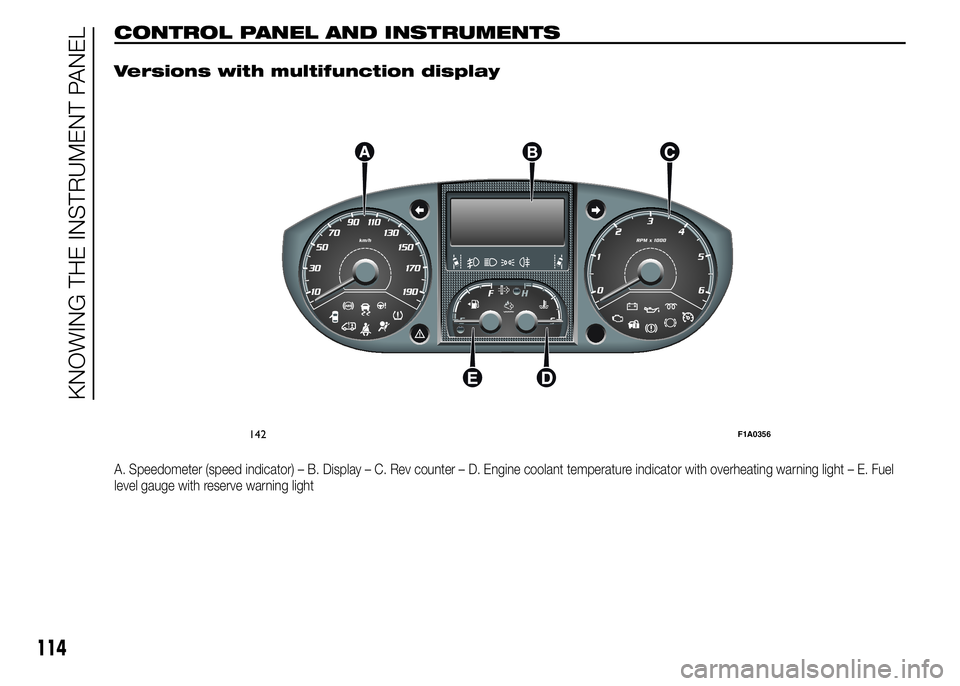
CONTROL PANEL AND INSTRUMENTS.
Versions with multifunction display
A. Speedometer (speed indicator) – B. Display – C. Rev counter – D. Engine coolant temperature indicator with overheating warning light – E. Fuel
level gauge with reserve warning light
142F1A0356
114
KNOWING THE INSTRUMENT PANEL
Page 119 of 367
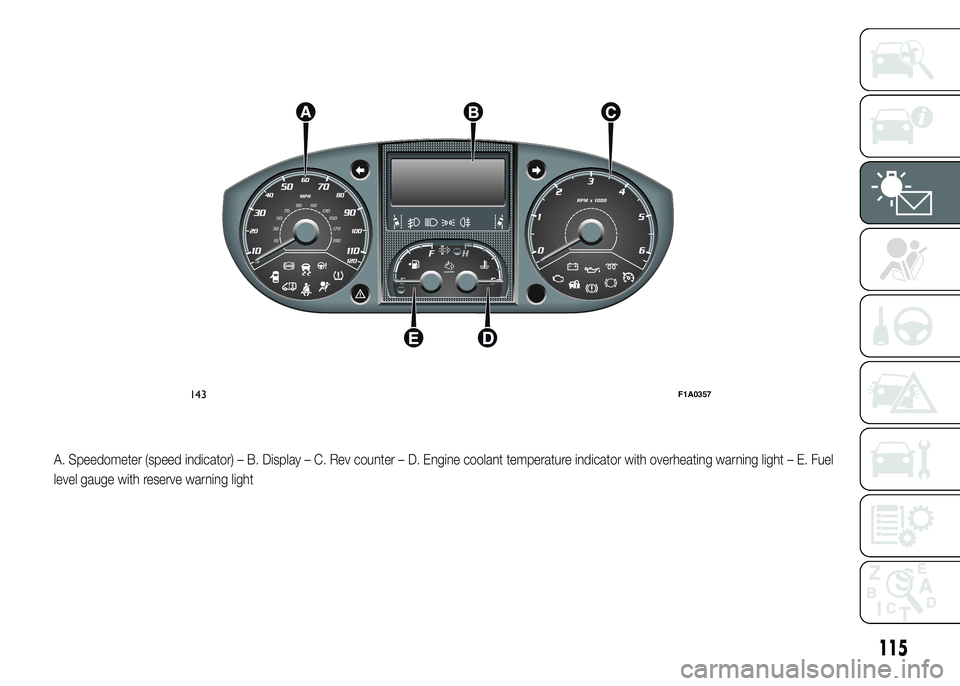
A. Speedometer (speed indicator) – B. Display – C. Rev counter – D. Engine coolant temperature indicator with overheating warning light – E. Fuel
level gauge with reserve warning light
143F1A0357
115
Page 120 of 367
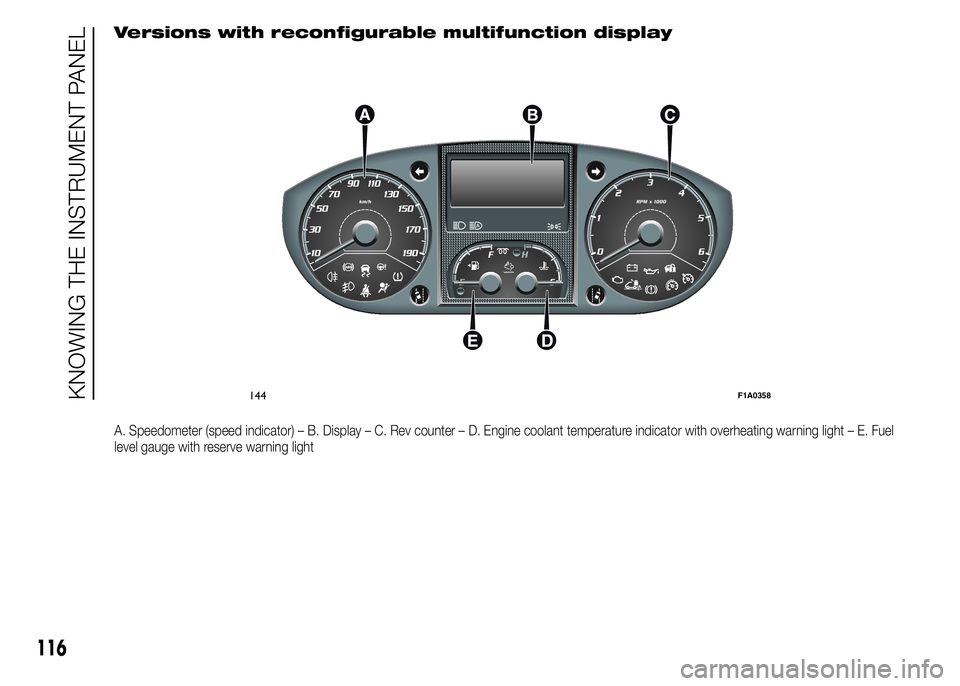
Versions with reconfigurable multifunction display
A. Speedometer (speed indicator) – B. Display – C. Rev counter – D. Engine coolant temperature indicator with overheating warning light – E. Fuel
level gauge with reserve warning light
144F1A0358
116
KNOWING THE INSTRUMENT PANEL
Page 121 of 367
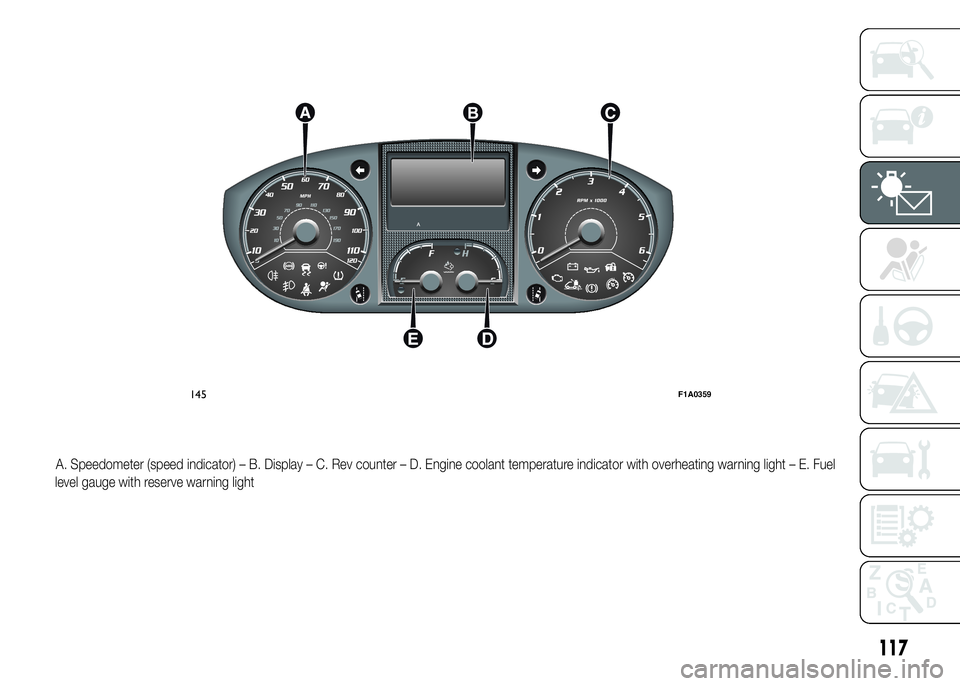
A. Speedometer (speed indicator) – B. Display – C. Rev counter – D. Engine coolant temperature indicator with overheating warning light – E. Fuel
level gauge with reserve warning light
145F1A0359
117
Page 145 of 367
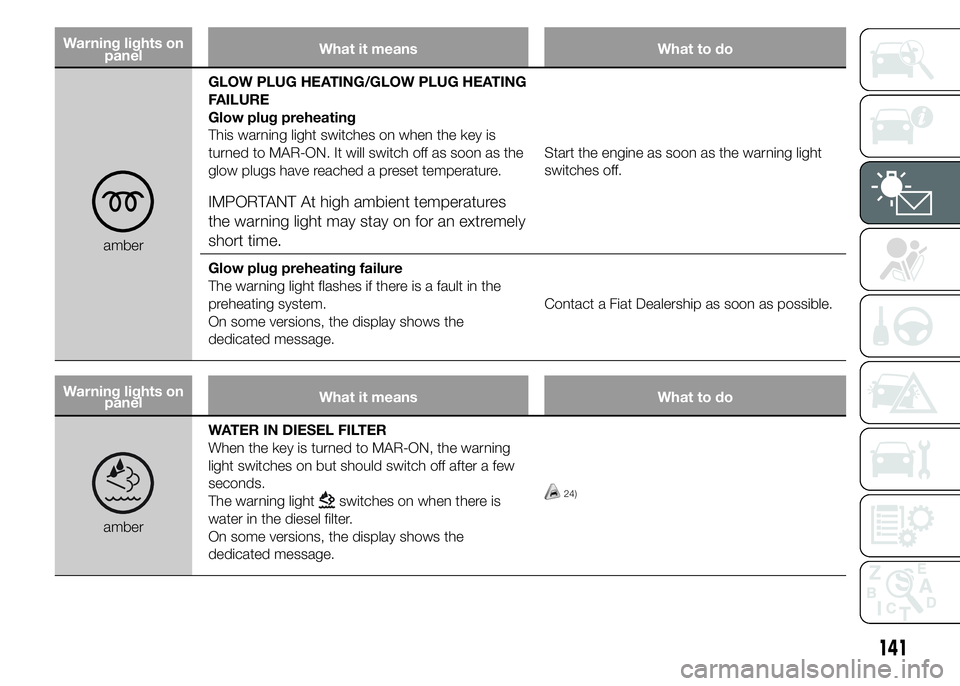
Warning lights on
panelWhat it means What to do
amberGLOW PLUG HEATING/GLOW PLUG HEATING
FAILURE
Glow plug preheating
This warning light switches on when the key is
turned to MAR-ON. It will switch off as soon as the
glow plugs have reached a preset temperature.
IMPORTANT At high ambient temperatures
the warning light may stay on for an extremely
short time.
Start the engine as soon as the warning light
switches off.
Glow plug preheating failure
The warning light flashes if there is a fault in the
preheating system.
On some versions, the display shows the
dedicated message.Contact a Fiat Dealership as soon as possible.
Warning lights on
panelWhat it means What to do
amberWATER IN DIESEL FILTER
When the key is turned to MAR-ON, the warning
light switches on but should switch off after a few
seconds.
The warning light
switches on when there is
water in the diesel filter.
On some versions, the display shows the
dedicated message.24)
141
Page 163 of 367
❒prevent the retractors from getting
wet: their correct operation is only
guaranteed if water does not get
inside;
❒replace the seat belt when it shows
wear or cuts.
WARNING
102) The pretensioner may be used
only once. After it is triggered,
have it replaced at a Fiat
Dealership.
103) The belt must not be twisted.
The upper part must pass over
the shoulder and cross the chest
diagonally. The lower part must
adhere to the pelvis (as shown in
fig. 156) rather than the abdomen
of the passenger. Never use
devices (clips, clamps, etc.) that
hold the seat belt away from your
body.104) For maximum protection, keep
the backrest upright, lean back
into it and make sure the seat belt
fits closely across your chest
and pelvis. Always fasten the seat
belts on both the front and the
rear seats! Travelling without
wearing seat belts will increase
the risk of serious injury and even
death in the event of an accident.
105) Removing or otherwise
tampering with seat belt and
pretensioner components is
strictly prohibited. Any operations
on these components must be
performed by qualified and
authorised technicians. Always go
to a Fiat Dealership.
106) If the belt has been subjected
to a high level of stress, for
example after an accident, it must
be completely replaced together
with the attachments, attachment
fixing screws and the
pretensioner. In fact, even if the
belt has no visible defects, it could
have lost its resilience.
107) Each seat belt must be used by
only one person. Never travel with
a child sitting on the passenger's
lap and a single belt to protect
them both fig. 157. In general, do
not place any objects between the
person and the belt.
IMPORTANT
26) Operations which lead to
impacts, vibrations or localised
heating (over 100°C for a
maximum of six hours) in the area
around the pretensioners may
damage or accidentally deploy
them. Contact a Fiat Dealership
should intervention be necessary
on these components.
159
Page 184 of 367
STARTING THE
ENGINE
The vehicle is fitted with an
electronic engine lock device: if the
engine fails to start, see the
paragraph “The Fiat CODE system”
in section “Know your vehicle”.
27) 28)
129)
PROCEDURE
Proceed as follows:
❒engage the handbrake;
❒put the gear lever into neutral;
❒turn the ignition key to MAR-ON: the
warning lights
andon the
instrument panel will turn on;
❒wait for the warning lights
and
to switch off. The hotter the
engine is, the quicker this will
happen;
❒fully press the clutch pedal without
touching the accelerator;
❒turn the ignition key to AVV as soon
as warning light
switches off.
Waiting too long will waste the
heating work carried out by the glow
plugs.
Release the key as soon as the
engine starts.
If the engine does not start at the
first attempt, return the ignition key
to STOP before repeating the
starting procedure.
If, when the ignition key is at
MAR-ON the
warning light
remains lit, turn the key to STOP
and then back to MAR-ON; if
the warning light remains lit, try with
the other keys provided with the
car.
IMPORTANT Go to a Fiat
Dealership immediately if warning
light
stays on constantly on the
instrument panel.
IMPORTANT Never leave the
ignition key in MAR-ON position
when the engine is stopped.
29)
WARMING UP THE
ENGINE JUST AFTER
IT HAS STARTED
Proceed as follows:
❒drive off slowly, letting the engine turn
at medium revs. Do not accelerate
abruptly;❒do not demand full performance at
first. Wait until the engine coolant
temperature gauge starts moving.
30) 31)
STOPPING THE
ENGINE
Turn the ignition key to STOP while
the engine is idling.
32) 33)
IMPORTANT
27) It is advisable not to demand
maximum performance from
your vehicle (e.g. excessive
acceleration, long distances at
high speeds, excessively intense
braking, etc.) during the initial
period of use.
28) When the engine is off, do not
leave the ignition key turned to
MAR-ON to prevent unnecessary
electrical consumption from
draining the battery.
180
STARTING AND DRIVING
Page 185 of 367
29) If thewarning light flashes
for about 60 seconds after
starting or during prolonged
cranking, this indicates a fault in
the glow plug preheating system.
Use the vehicle normally if the
engine starts, but contact a Fiat
Dealership as soon as possible.
30) Remember that the brake servo
and power steering are not
operational until the engine has
been started, so you need to apply
much more force than usual to
the brake pedal and steering
wheel.
31) Never start the engine by
pushing, towing or driving
downhill. This could cause fuel to
flow into the catalytic converter
and damage it beyond repair.
32) A quick burst on the accelerator
before turning off the engine
serves absolutely no practical
purpose; it wastes fuel and is
especially damaging to
turbocharged engines.
33) In some cases, when the engine
switches off, the fan could
activate for max. 120 seconds.
WARNING
129) It is dangerous to run the
engine in enclosed areas. The
engine takes in oxygen and
releases carbon dioxide, carbon
monoxide and other toxic gases.
PARKING
Proceed as follows:
❒stop the engine and engage the
handbrake;
❒engage a gear (on a slope, engage
first gear if the car is facing uphill or
reverse if it is facing downhill) and
leave the wheels steered.
If the vehicle is parked on a steep
slope, it is advisable to block the
wheels with a wedge or stone.
Do not leave the key in the ignition
as this drains the battery. Always
remove the key when you leave the
car.
130)
HANDBRAKE
The handbrake lever is located to
the left of the driver's seat fig. 171.
Pull the lever upwards to engage
the handbrake and ensure that the
vehicle does not move.
IMPORTANT Make sure that the
handbrake is engaged in such
a way as to ensure the stationing of
the vehicle, especially in the case
of steep slopes and full load.
181