Warning control FIAT DUCATO 2016 3.G User Guide
[x] Cancel search | Manufacturer: FIAT, Model Year: 2016, Model line: DUCATO, Model: FIAT DUCATO 2016 3.GPages: 296, PDF Size: 15.08 MB
Page 29 of 296
Activation
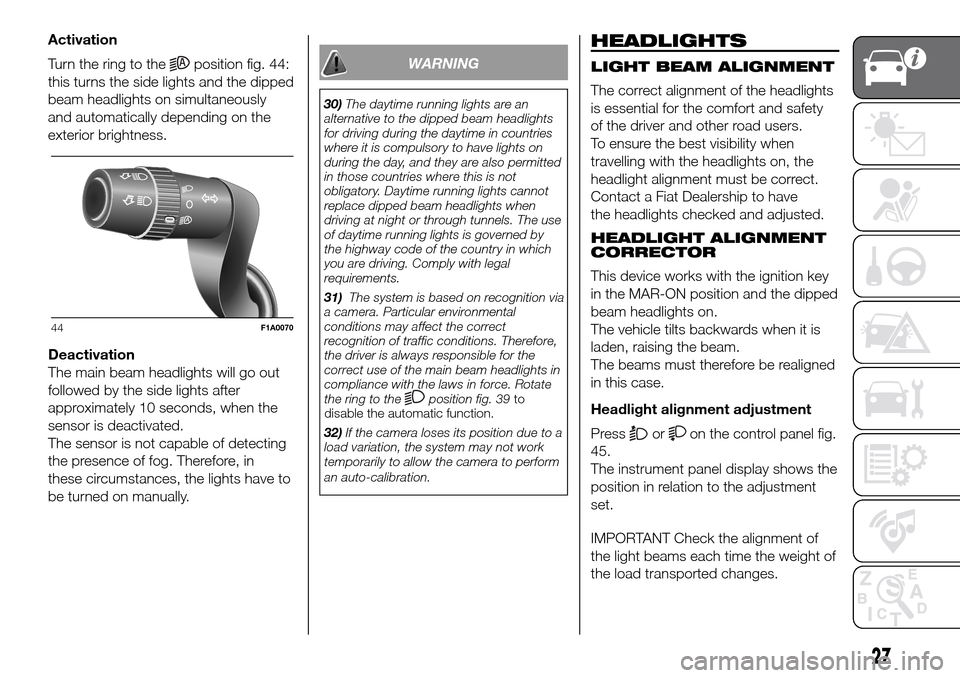
Turn the ring to the
position fig. 44:
this turns the side lights and the dipped
beam headlights on simultaneously
and automatically depending on the
exterior brightness.
Deactivation
The main beam headlights will go out
followed by the side lights after
approximately 10 seconds, when the
sensor is deactivated.
The sensor is not capable of detecting
the presence of fog. Therefore, in
these circumstances, the lights have to
be turned on manually.WARNING
30)The daytime running lights are an
alternative to the dipped beam headlights
for driving during the daytime in countries
where it is compulsory to have lights on
during the day, and they are also permitted
in those countries where this is not
obligatory. Daytime running lights cannot
replace dipped beam headlights when
driving at night or through tunnels. The use
of daytime running lights is governed by
the highway code of the country in which
you are driving. Comply with legal
requirements.
31)The system is based on recognition via
a camera. Particular environmental
conditions may affect the correct
recognition of traffic conditions. Therefore,
the driver is always responsible for the
correct use of the main beam headlights in
compliance with the laws in force. Rotate
the ring to the
position fig. 39to
disable the automatic function.
32)If the camera loses its position due to a
load variation, the system may not work
temporarily to allow the camera to perform
an auto-calibration.
HEADLIGHTS
LIGHT BEAM ALIGNMENT
The correct alignment of the headlights
is essential for the comfort and safety
of the driver and other road users.
To ensure the best visibility when
travelling with the headlights on, the
headlight alignment must be correct.
Contact a Fiat Dealership to have
the headlights checked and adjusted.
HEADLIGHT ALIGNMENT
CORRECTOR
This device works with the ignition key
in the MAR-ON position and the dipped
beam headlights on.
The vehicle tilts backwards when it is
laden, raising the beam.
The beams must therefore be realigned
in this case.
Headlight alignment adjustment
Press
oron the control panel fig.
45.
The instrument panel display shows the
position in relation to the adjustment
set.
IMPORTANT Check the alignment of
the light beams each time the weight of
the load transported changes.
44F1A0070
27
Page 31 of 296
CONTROLS
HAZARD LIGHTS
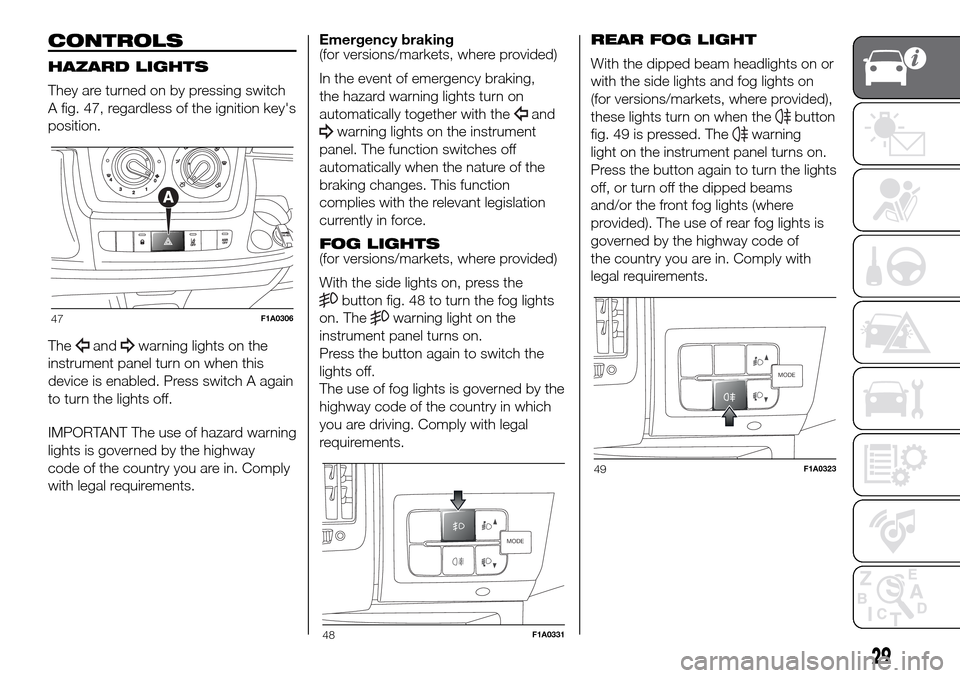
They are turned on by pressing switch
A fig. 47, regardless of the ignition key's
position.
The
andwarning lights on the
instrument panel turn on when this
device is enabled. Press switch A again
to turn the lights off.
IMPORTANT The use of hazard warning
lights is governed by the highway
code of the country you are in. Comply
with legal requirements.Emergency braking
(for versions/markets, where provided)
In the event of emergency braking,
the hazard warning lights turn on
automatically together with the
and
warning lights on the instrument
panel. The function switches off
automatically when the nature of the
braking changes. This function
complies with the relevant legislation
currently in force.
FOG LIGHTS
(for versions/markets, where provided)
With the side lights on, press the
button fig. 48 to turn the fog lights
on. The
warning light on the
instrument panel turns on.
Press the button again to switch the
lights off.
The use of fog lights is governed by the
highway code of the country in which
you are driving. Comply with legal
requirements.REAR FOG LIGHT
With the dipped beam headlights on or
with the side lights and fog lights on
(for versions/markets, where provided),
these lights turn on when the
button
fig. 49 is pressed. The
warning
light on the instrument panel turns on.
Press the button again to turn the lights
off, or turn off the dipped beams
and/or the front fog lights (where
provided). The use of rear fog lights is
governed by the highway code of
the country you are in. Comply with
legal requirements.
47F1A0306
MODE
48F1A0331
MODE
49F1A0323
29
Page 35 of 296
IMPORTANT Keep the glass in the
sensor area clean.
Activation fig. 56
Move the right lever down by one click
(position B).
The activation of the sensor is signalled
by a "stroke" to show that the
command has been acquired.
Turn the control F to increase the rain
sensor sensitivity.
The increasing of the rain sensor
sensitivity is signalled by a "stroke" to
show that the command has been
acquired.
If the windscreen washer is used with
the rain sensor activated, the normal
washing cycle is performed, after which
the rain sensor resumes its normal
automatic operation.
Deactivation fig. 56
Move the lever from position B or turn
the ignition key to OFF. The next time
the vehicle is started (ignition key in ON
position), the sensor is not reactivated
even if the lever is still in position B.
To activate the sensor, move the lever
to position A or C and then back to
position B or turn the ring nut for
adjusting the sensitivity. Rain sensor
activation will be indicated by at least
one wiper “stroke” even if the
windscreen is dry.The rain sensor is capable of
recognising the difference between day
and night and making the necessary
adjustments automatically.
33)
HEADLIGHT WASHERS
(for versions/markets, where provided)
The headlight washers are “retractable”,
i.e.: they are located inside the front
bumper and they are activated when
(with dipped beams on) the windscreen
washer is operated.
IMPORTANT Check the correct
condition and cleanliness of nozzles at
regular intervals.
WARNING
33)Streaks of water may cause
unnecessary blade movements.
WARNING
4)Never use the windscreen wiper to
remove layers of snow or ice from
the windscreen. In such conditions, the
windscreen wiper may be subjected to
excessive stress and the motor cut-out
switch, which prevents operation for a few
seconds, may intervene. If operation is
not restored, contact a Fiat Dealership.
33
Page 39 of 296
During fully automatic system
operation, you can change the set
temperature, air distribution and fan
speed at any time by using the relevant
buttons or knobs: the system will
automatically change its settings to
adjust to the new requirements. During
fully automatic operation (FULL AUTO),
the word FULL will disappear if the air
distribution and/or flow rate and/or
engagement of the compressor and/or
recirculation settings are changed. In
this way, the functions will switch from
automatic to manual control until the
AUTO button is pressed again. With
one or more functions turned on
manually, the adjustment of the intake
air temperature continues to be
managed automatically, except with the
compressor switched off: if this is the
case, the temperature of the air sent
into the passenger compartment
cannot be lower than that of the
outside air.
WARNING
2)The air conditioning system uses R134a
or R1234yf refrigerant compatible with
the regulations in force in the countries
where the vehicle is sold. When charging,
only use the gas indicated on the
dedicated plate in the engine compartment
. The use of other coolants affects the
efficiency and condition of the system. The
lubricant used for the compressor is also
strictly linked to the type of cooling gas,
please refer to a Fiat Dealership.
ADDITIONAL
HEATER
(for versions/markets, where provided)
On some versions, an additional heater
is also present beneath the driver's
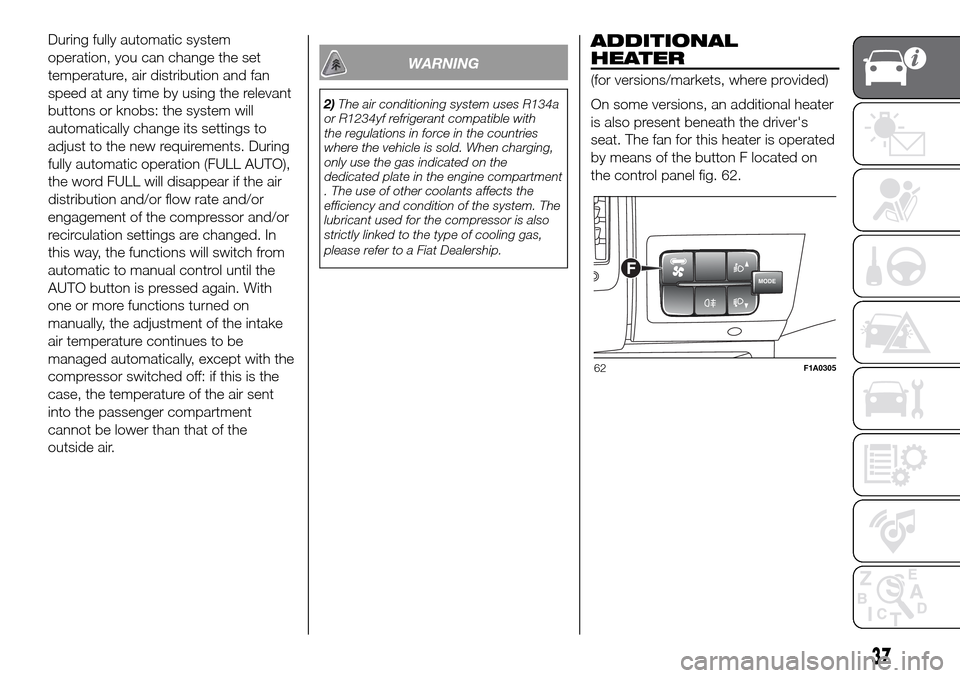
seat. The fan for this heater is operated
by means of the button F located on
the control panel fig. 62.
MODEF
62F1A0305
37
Page 40 of 296
INDEPENDENT
ADDITIONAL
HEATER
(for versions/markets, where provided)
The vehicle is available, on request,
with two different independent heaters:
one fully automatic, the other which
can be programmed.
AUTOMATIC VERSION
The additional heater is turned on in
automatic mode when the engine
is started and the required outside
temperature and coolant conditions are
present. Deactivation is always
automatic.
34)
IMPORTANT During periods with low
outdoor temperatures when the device
cuts in, check that the fuel level is
always higher than the reserve level.
Otherwise the device could lock and
require the assistance of a Fiat
Dealership.PROGRAMMABLE
VERSION
The additional heater operates
completely independently of engine
operation and allows the following:
heating the passenger compartment
with the engine off
defrosting the windows;
heat the engine coolant and then the
engine itself prior to starting.
The system consists of:
a diesel burner for heating the water
with an exhaust silencer for the
combustion gases;
a metering pump connected to the
reservoir pipes for supplying the burner;
a heat exchanger connected to the
engine cooling system pipes;
a control unit connected to the
passenger compartment heating/
ventilation system to allow automatic
operation;
an electronic control unit for
controlling and adjusting the built-in
burner;
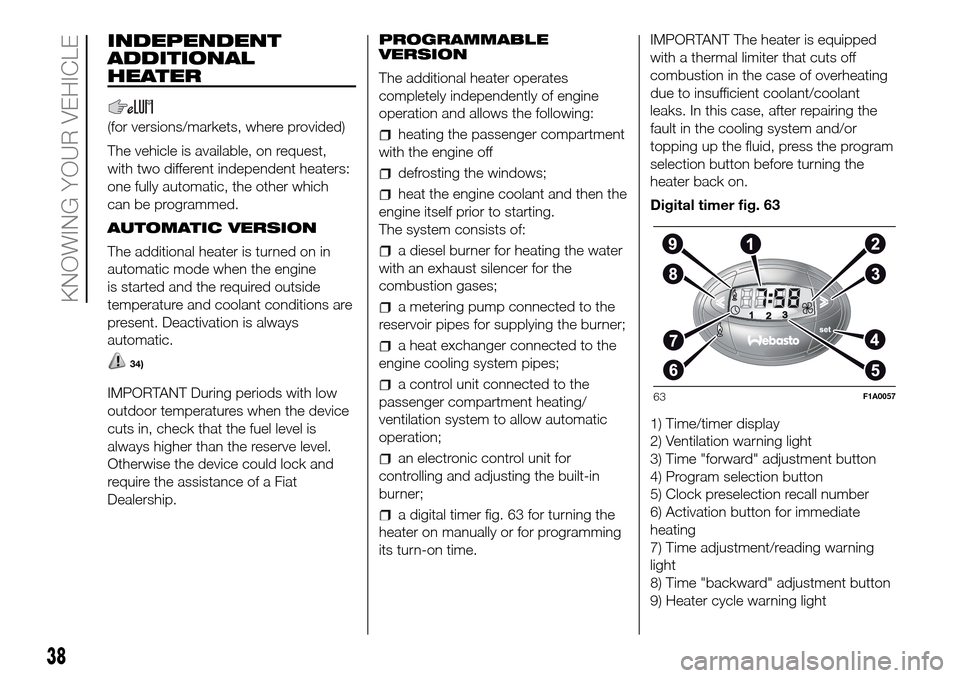
a digital timer fig. 63 for turning the
heater on manually or for programming
its turn-on time.IMPORTANT The heater is equipped
with a thermal limiter that cuts off
combustion in the case of overheating
due to insufficient coolant/coolant
leaks. In this case, after repairing the
fault in the cooling system and/or
topping up the fluid, press the program
selection button before turning the
heater back on.
Digital timer fig. 63
1) Time/timer display
2) Ventilation warning light
3) Time "forward" adjustment button
4) Program selection button
5) Clock preselection recall number
6) Activation button for immediate
heating
7) Time adjustment/reading warning
light
8) Time "backward" adjustment button
9) Heater cycle warning light
63F1A0057
38
KNOWING YOUR VEHICLE
Page 42 of 296
In both cases, the heating warning light,
the display lighting and the passenger
compartment heater fan go off and
burning stops.
The fluid circulation pump continues to
work for around two minutes to
dissipate as much heat as possible; the
heater can be turned back on during
this stage.
IMPORTANT The parking heater goes
off when battery voltage is low to allow
the vehicle to be started.
IMPORTANT Before turning on the
device, ensure that the fuel level is
above the reserve. Otherwise the
device could lock and require
the assistance of a Fiat Dealership.
Always turn off the heater when
refuelling and near service stations to
avoid the risk of explosion or fire
hazards.
Do not park the vehicle on
inflammable material such as paper,
grass or dry leaves: fire hazard!
The temperature near the heater
should not exceed 120°C (e.g. during
oven painting in a body shop). The
electronic control unit components may
be damaged at higher temperatures.
Whilst the heater is operating with
the engine switched off, it absorbs
energy from the battery; the engine
should therefore be left running for
a while to make sure that the battery is
properly recharged.
To check the coolant level, follow the
instructions in the "Vehicle
maintenance" chapter, "Engine coolant
system fluid" paragraph. The water in
the heating circuit must contain a
minimum percentage of 10% antifreeze.
For maintenance and repairs,
consult only a Fiat Dealership and use
only original parts.
MAINTENANCE
Have the additional heater checked
regularly at a Fiat Dealership (and
always at the start of every winter). This
will guarantee safe and economic
operation of the heater as well as a long
duration.
ADDITIONAL REAR
HEATING (Panorama and
Combinato)
(for versions/markets, where provided)
The Panorama and Combi versions
are equipped with a main heating
system plus an additional system
(available on request) with controls in
the roof panel trim above the second
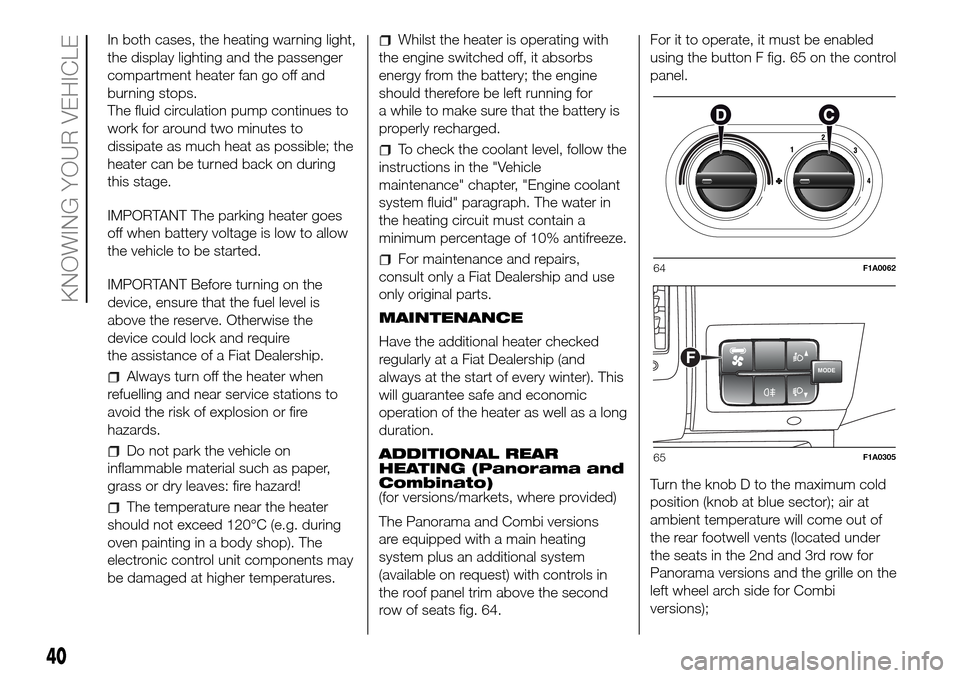
row of seats fig. 64.For it to operate, it must be enabled
using the button F fig. 65 on the control
panel.
Turn the knob D to the maximum cold
position (knob at blue sector); air at
ambient temperature will come out of
the rear footwell vents (located under
the seats in the 2nd and 3rd row for
Panorama versions and the grille on the
left wheel arch side for Combi
versions);64F1A0062
MODEF
65F1A0305
40
KNOWING YOUR VEHICLE
Page 43 of 296
Turn the knob D to the maximum
heating position (knob at red
sector);warm air will emerge (with the
engine warmed up), from the rear
footwell outlets (located under the seats
in the 2nd and 3rd row for Panorama
versions and the grille on the left wheel
arch side for Combi versions).
ADDITIONAL REAR
CLIMATE CONTROL
(Panorama and Combi)
(for versions/markets, where provided)
The Panorama and Combi versions
are equipped with a main heating/air
conditioning system plus an additional
system (available on request) with
controls in the roof panel trim above the
second row of seats fig. 64. Button F
fig. 65 on the control panel must be
enabled for operation; the air
conditioning only works if the main air
conditioner is on.
When the knob D is placed in the
fully cold position (control in blue sector)
cold air comes out the vents in the
ceiling.
Turn the knob D to the maximum
heating position (knob at red
sector);warm air will emerge (with the
engine warmed up), from the rear
footwell outlets (located under the seats
in the 2nd and 3rd row for Panorama
versions and the grille on the left wheel
arch side for Combi versions).
If the selector knob D is placed in
the intermediate positions, the air
will be distributed between the vents in
the ceiling and the rear footwell vents,
varying the temperature.
IMPORTANT If the compressor on the
main air conditioner control is turned on
(operation of button E), even if the
additional air conditioner fan is in
position 0, the 1st speed will
automatically be activated to prevent
ice formation, with possible damage to
the component.
WARNING
34)The heater burns fuel in the same way
as the engine, though to a lesser extent. To
prevent poisoning and asphyxiation, the
supplementary heater must never be
turned on, not even for short periods, in
closed environments such as a garage or
workshops without extraction fans for
the exhaust gases.
ELECTRIC WINDOWS
ELECTRIC
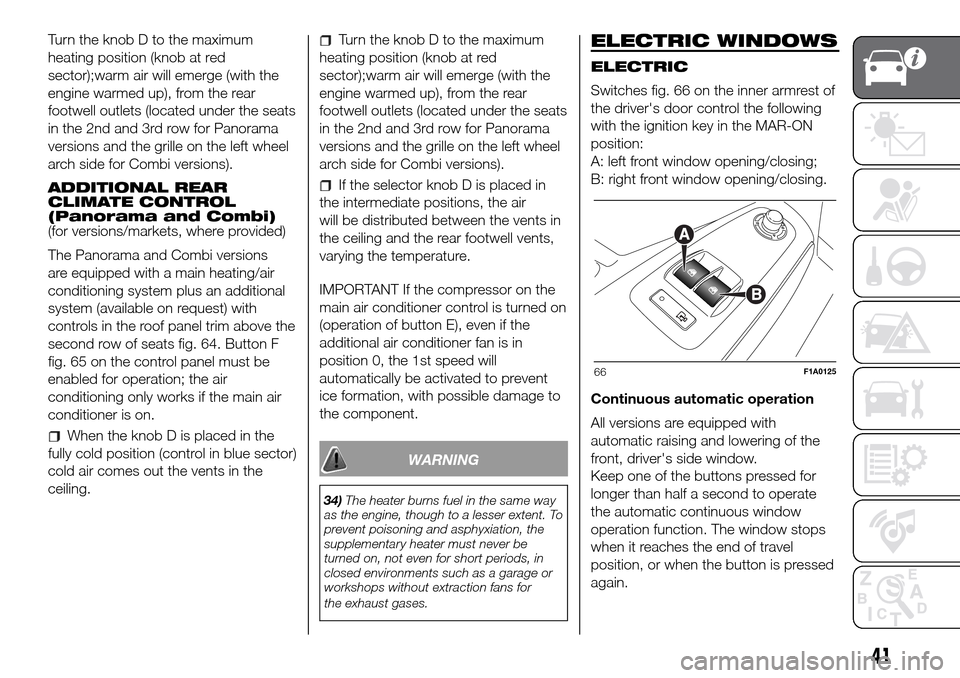
Switches fig. 66 on the inner armrest of
the driver's door control the following
with the ignition key in the MAR-ON
position:
A: left front window opening/closing;
B: right front window opening/closing.
Continuous automatic operation
All versions are equipped with
automatic raising and lowering of the
front, driver's side window.
Keep one of the buttons pressed for
longer than half a second to operate
the automatic continuous window
operation function. The window stops
when it reaches the end of travel
position, or when the button is pressed
again.
66F1A0125
41
Page 49 of 296
KNOWING THE INSTRUMENT PANEL
This section of the booklet gives you all
the information you need to
understand, interpret and use the
instrument panel correctly.EOBD SYSTEM............................... 49
CONTROL PANEL AND
ON-BOARD INSTRUMENTS ........... 50
DISPLAY ........................................ 52
TRIP COMPUTER ........................... 54
WARNING LIGHTS AND
MESSAGES .................................... 56
- LOW BRAKE FLUID/HANDBRAKE
APPLIED ............................................ 56
- EBD FAILURE .................................. 57
- AIR BAG FAILURE ............................ 57
- SEAT BELTS REMINDER .................. 57
- ENGINE COOLANT TEMPERATURE
TOO HIGH .......................................... 58
- LOW BATTERY CHARGE ................. 59
- LOW ENGINE OIL PRESSURE ......... 60
-ENGINE OIL DETERIORATED ........... 60
-INCOMPLETE DOOR/LOAD
COMPARTMENT CLOSURE ............... 61
-POWER STEERING FAILURE ............ 61
- SELF-LEVELLING SUSPENSION
FAILURE ............................................. 61
- EOBD/INJECTION SYSTEM
FAILURE ............................................. 63
-UREA INJECTION SYSTEM FAILURE
............................................................ 64
-ABS FAILURE .................................... 64
- FUEL RESERVE ............................... 64
-GLOW PLUG PREHEATING / GLOW
PLUG PREHEATING FAILURE ............ 65
-LOW DIESEL EMISSIONS ADDITIVE
(UREA) LEVEL WARNING ................... 65
-VEHICLE PROTECTION SYSTEM
FAILURE - FIAT CODE ........................ 66
-REAR FOG LIGHTS ........................... 66
- GENERAL FAILURE WARNING ........ 67-DPF (PARTICULATE FILTER)
CLEANING UNDERWAY ..................... 68
- BRAKE PAD WEAR .......................... 68
-DRIVING ADVISOR ........................... 69
- TPMS ............................................... 70
-DIPPED BEAM HEADLIGHTS ........... 71
-FOLLOW ME HOME ......................... 71
- LEFT DIRECTION INDICATOR .......... 71
- RIGHT DIRECTION INDICATOR ....... 71
- FOG LIGHTS .................................... 72
- CRUISE CONTROL .......................... 72
- SPEED LIMITER ............................... 72
- AUTOMATIC MAIN BEAM
HEADLIGHTS ..................................... 72
- MAIN BEAM HEADLIGHTS .............. 72
-"UP" FUNCTION ............................... 73
-EXTERIOR LIGHTS FAILURE ............. 74
-LOW ENGINE OIL PRESSURE
WARNING LIGHT FAILURE ................. 74
-BRAKE LIGHTS FAILURE .................. 74
-MAIN BEAM AUTOMATISM FAULT ... 74
-POSSIBLE ICE ON ROAD ................. 75
-SPEED LIMIT EXCEEDED ................. 75
-SCHEDULED SERVICING ................. 75
-FUEL CUT-OFF DEVICE INERTIA
SWITCH TRIPPED .............................. 76
-COMFORT-MATIC SYSTEM FAILURE
INDICATION ........................................ 76
-PARKING SENSOR FAILURE ............ 76
-DRIVING ADVISOR SYSTEM
FAILURE ............................................. 76
-TRAFFIC SIGN RECOGNITION
FAILURE ............................................. 76
-LIMITED RANGE ............................... 76
-START&STOP SYSTEM
ACTIVATION/DEACTIVATION .............. 77
-START&STOP FAILURE .................... 77
47
Page 51 of 296
EOBD SYSTEM
The EOBD system (European On Board
Diagnosis) allows continuous diagnosis
of emission-related components on
the vehicle to be made.
It also alerts the driver, by turning on
the
warning light in the instrument
panel (together with relevant message
in the multifunction display, for
versions/markets where provided) when
these components are no longer in
peak condition (see “Warning lights and
messages” paragraph).
The aim of the system is to:
monitor system efficiency;
indicate an increase in emissions
due to vehicle malfunction;
indicate the need to replace
components which have deteriorated.
The system also has a connector
that can be interfaced with appropriate
equipment, which makes it possible
to read the error codes stored in the
control unit together with a series
of specific parameters for engine
operation and diagnosis. This check
can also be carried out by traffic control
authorities.IMPORTANT After eliminating the
failure, to check the system completely,
Fiat Dealerships run a bench test and,
if necessary, road tests which may
also call for a long journey.
49
Page 52 of 296
CONTROL PANEL AND ON-BOARD INSTRUMENTS
.
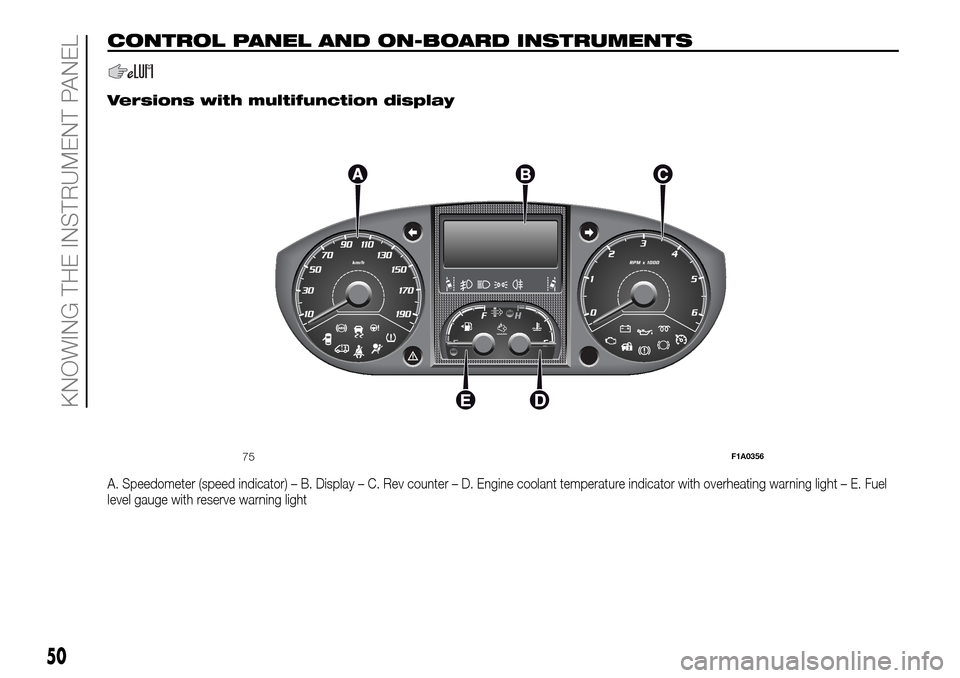
Versions with multifunction display
A. Speedometer (speed indicator) – B. Display – C. Rev counter – D. Engine coolant temperature indicator with overheating warning light – E. Fuel
level gauge with reserve warning light
75F1A0356
50
KNOWING THE INSTRUMENT PANEL