Windscreen FIAT DUCATO 2016 3.G User Guide
[x] Cancel search | Manufacturer: FIAT, Model Year: 2016, Model line: DUCATO, Model: FIAT DUCATO 2016 3.GPages: 296, PDF Size: 15.08 MB
Page 127 of 296
WARNING
124)If the camera loses its position due to
a load variation, the system may not work
temporarily to allow the camera to perform
an auto-calibration.
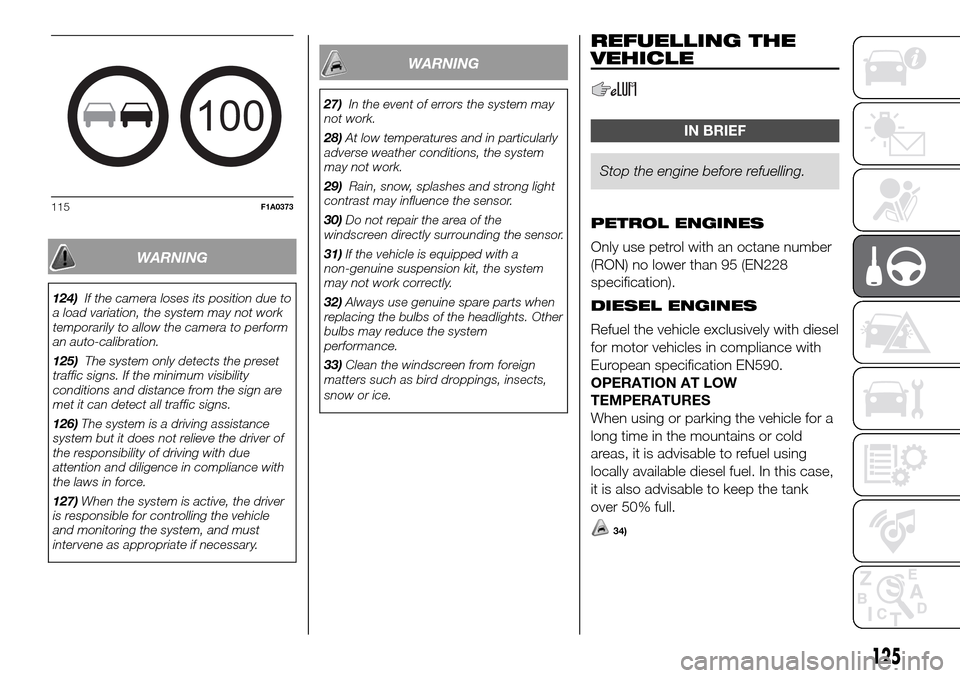
125)The system only detects the preset
traffic signs. If the minimum visibility
conditions and distance from the sign are
met it can detect all traffic signs.
126)The system is a driving assistance
system but it does not relieve the driver of
the responsibility of driving with due
attention and diligence in compliance with
the laws in force.
127)When the system is active, the driver
is responsible for controlling the vehicle
and monitoring the system, and must
intervene as appropriate if necessary.
WARNING
27)In the event of errors the system may
not work.
28)At low temperatures and in particularly
adverse weather conditions, the system
may not work.
29)Rain, snow, splashes and strong light
contrast may influence the sensor.
30)Do not repair the area of the
windscreen directly surrounding the sensor.
31)If the vehicle is equipped with a
non-genuine suspension kit, the system
may not work correctly.
32)Always use genuine spare parts when
replacing the bulbs of the headlights. Other
bulbs may reduce the system
performance.
33)Clean the windscreen from foreign
matters such as bird droppings, insects,
snow or ice.
REFUELLING THE
VEHICLE
IN BRIEF
Stop the engine before refuelling.
PETROL ENGINES
Only use petrol with an octane number
(RON) no lower than 95 (EN228
specification).
DIESEL ENGINES
Refuel the vehicle exclusively with diesel
for motor vehicles in compliance with
European specification EN590.
OPERATION AT LOW
TEMPERATURES
When using or parking the vehicle for a
long time in the mountains or cold
areas, it is advisable to refuel using
locally available diesel fuel. In this case,
it is also advisable to keep the tank
over 50% full.
34)
100
115F1A0373
125
Page 143 of 296
PROLONGED
VEHICLE INACTIVITY
If the vehicle needs to be off the road
for longer than one month, the following
precautions must be taken:
park the vehicle indoors in a dry
and, if possible, well-ventilated place;
engage a gear;
check that the handbrake is not
engaged;
disconnect the negative battery
terminal; if the vehicle is equipped with
a battery disconnection function
(disconnector), see the description of
the procedure in the "Controls"
paragraph in the "Dashboard and
controls" section;
clean and protect the painted parts
using protective wax;
clean and protect the shiny metal
parts using special compounds
available commercially;
sprinkle talcum powder on the
windscreen and rear window wiper
rubber blades and lift them off the
glass;
slightly open the windows;
cover the vehicle with a piece of
fabric or perforated plastic sheet. Do
not use compact plastic tarpaulins,
which prevent humidity from
evaporating from the surface of the
vehicle;
inflate tyres to +0.5 bar above the
standard specified pressure and check
it at intervals;
do not drain the engine cooling
system.
IMPORTANT If the vehicle is equipped
with an alarm system, switch off the
vehicle alarm with the remote control.
IMPORTANT After turning the ignition
key to STOP and having closed the
driver side door, wait at least one
minute before disconnecting the
electrical supply from the battery. When
reconnecting the electrical supply to
the battery, make sure that the ignition
key is in the STOP position and the
driver side door is closed.
141
Page 157 of 296
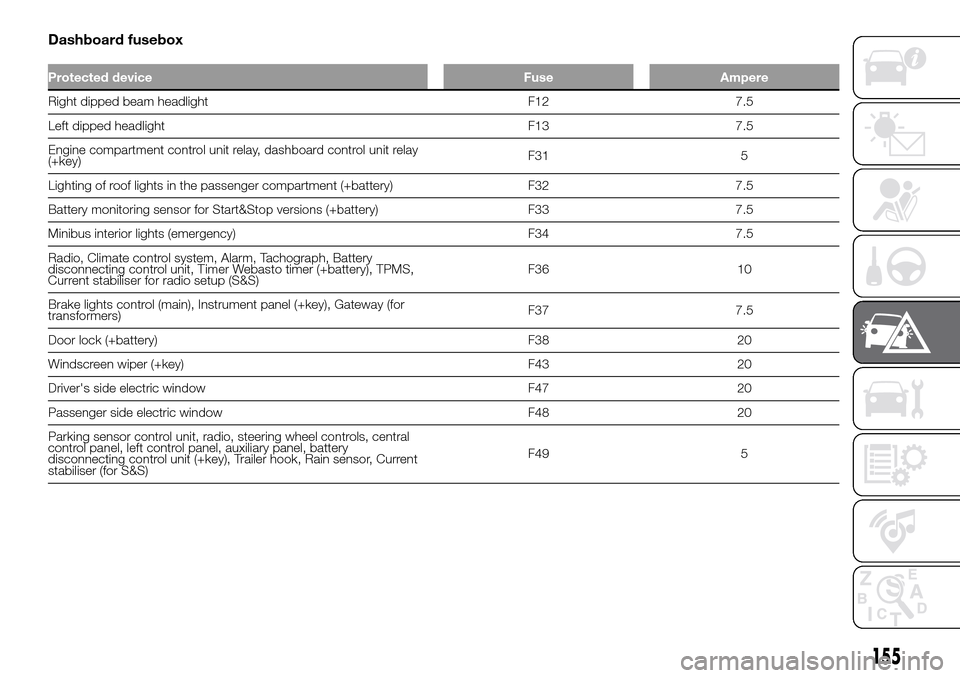
Dashboard fusebox
Protected device Fuse Ampere
Right dipped beam headlight F12 7.5
Left dipped headlight F13 7.5
Engine compartment control unit relay, dashboard control unit relay
(+key)F31 5
Lighting of roof lights in the passenger compartment (+battery) F32 7.5
Battery monitoring sensor for Start&Stop versions (+battery) F33 7.5
Minibus interior lights (emergency) F34 7.5
Radio, Climate control system, Alarm, Tachograph, Battery
disconnecting control unit, Timer Webasto timer (+battery), TPMS,
Current stabiliser for radio setup (S&S)F36 10
Brake lights control (main), Instrument panel (+key), Gateway (for
transformers)F37 7.5
Door lock (+battery) F38 20
Windscreen wiper (+key) F43 20
Driver's side electric window F47 20
Passenger side electric window F48 20
Parking sensor control unit, radio, steering wheel controls, central
control panel, left control panel, auxiliary panel, battery
disconnecting control unit (+key), Trailer hook, Rain sensor, Current
stabiliser (for S&S)F49 5
155
Page 159 of 296
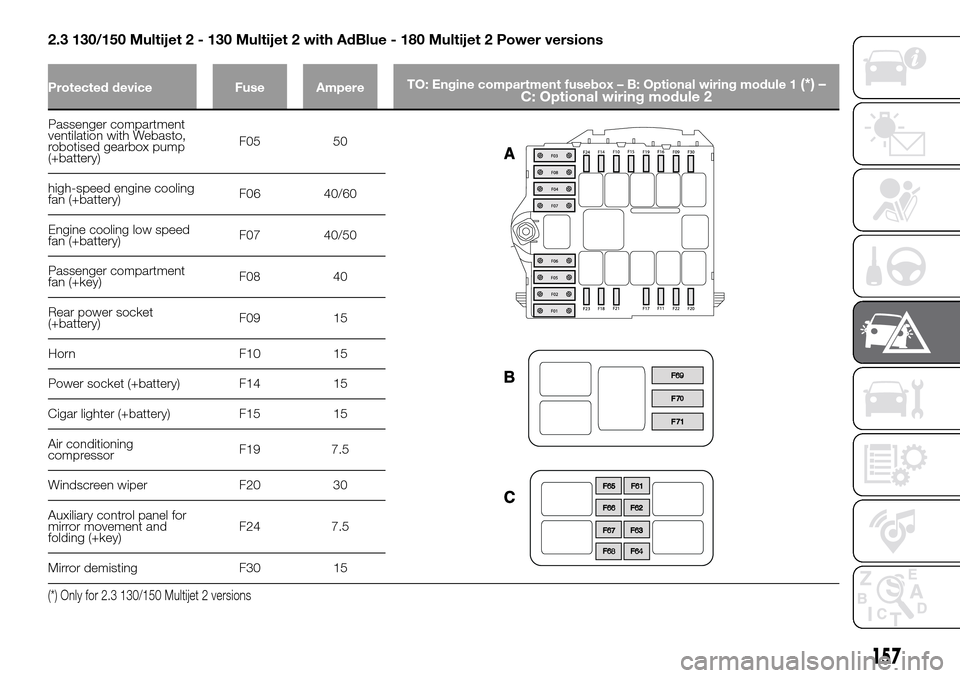
2.3 130/150 Multijet 2 - 130 Multijet 2 with AdBlue - 180 Multijet 2 Power versions
Protected device Fuse AmpereTO: Engine compartment fusebox – B: Optional wiring module 1(*) –
C: Optional wiring module 2
Passenger compartment
ventilation with Webasto,
robotised gearbox pump
(+battery)F05 50
high-speed engine cooling
fan (+battery)F06 40/60
Engine cooling low speed
fan (+battery)F07 40/50
Passenger compartment
fan (+key)F08 40
Rear power socket
(+battery)F09 15
Horn F10 15
Power socket (+battery) F14 15
Cigar lighter (+battery) F15 15
Air conditioning
compressorF19 7.5
Windscreen wiper F20 30
Auxiliary control panel for
mirror movement and
folding (+key)F24 7.5
Mirror demisting F30 15
(*) Only for 2.3 130/150 Multijet 2 versions
157
Page 161 of 296
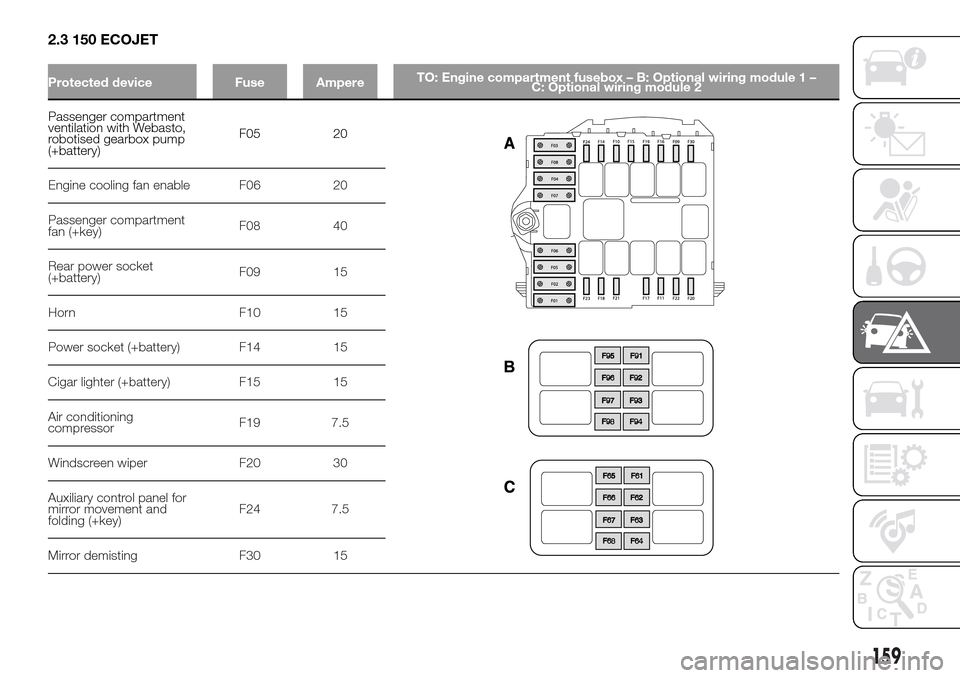
2.3 150 ECOJET
Protected device Fuse AmpereTO: Engine compartment fusebox – B: Optional wiring module 1 –
C: Optional wiring module 2
Passenger compartment
ventilation with Webasto,
robotised gearbox pump
(+battery)F05 20
Engine cooling fan enable F06 20
Passenger compartment
fan (+key)F08 40
Rear power socket
(+battery)F09 15
Horn F10 15
Power socket (+battery) F14 15
Cigar lighter (+battery) F15 15
Air conditioning
compressorF19 7.5
Windscreen wiper F20 30
Auxiliary control panel for
mirror movement and
folding (+key)F24 7.5
Mirror demisting F30 15
159
Page 163 of 296
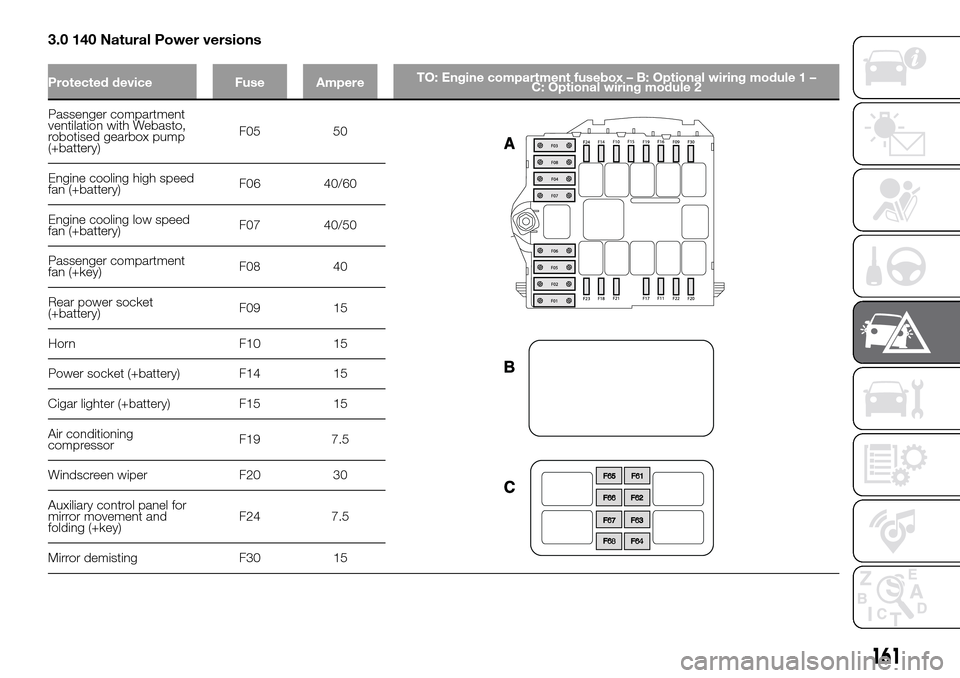
3.0 140 Natural Power versions
Protected device Fuse AmpereTO: Engine compartment fusebox – B: Optional wiring module 1 –
C: Optional wiring module 2
Passenger compartment
ventilation with Webasto,
robotised gearbox pump
(+battery)F05 50
Engine cooling high speed
fan (+battery)F06 40/60
Engine cooling low speed
fan (+battery)F07 40/50
Passenger compartment
fan (+key)F08 40
Rear power socket
(+battery)F09 15
Horn F10 15
Power socket (+battery) F14 15
Cigar lighter (+battery) F15 15
Air conditioning
compressorF19 7.5
Windscreen wiper F20 30
Auxiliary control panel for
mirror movement and
folding (+key)F24 7.5
Mirror demisting F30 15
161
Page 184 of 296
SERVICING AND CARE
Correct maintenance permits the
performance of the car to be
maintained over time, as well as limited
running costs and safeguarding the
efficiency of the safety systems.
This chapter explains how.SCHEDULED SERVICING ...............183
PERIODIC CHECKS ........................183
DEMANDING VEHICLE USE ...........184
SCHEDULED SERVICING PLAN .....185
CHECKING LEVELS........................192
AIR CLEANER/POLLEN FILTER ......199
BATTERY ........................................199
WINDSCREEN WIPER ....................201
LIFTING THE VEHICLE....................202
WHEELS AND TYRES.....................203
SNOW TYRES ................................204
SNOW CHAINS...............................204
BODYWORK ...................................205
INTERIOR .......................................206
RUBBER HOSES ............................207
182
SERVICING AND CARE
Page 185 of 296
SCHEDULED
SERVICING
Correct servicing is crucial for
guaranteeing a long life for the vehicle
under the best conditions.
This is why Fiat has planned a series of
checks and maintenance operations
every 48,000 km depending on the
engine version.
It is, however, important to remember
that scheduled servicing does not
completely cover all the requirements of
the car: even in the initial period before
48,000 km, and then subsequently
between one service and another,
ordinary care is always required such as
routine checks involving topping up
fluid level, checking tyre pressures etc.
IMPORTANT Scheduled Servicing
interventions are set out by the
Manufacturer. Failure to have them
carried out may invalidate the warranty.
Scheduled Servicing can be carried
out by any Fiat Dealership, at
pre-established times.
If during each operation, in addition to
the ones scheduled, the need arises for
further replacements or repairs, these
may only be carried out with the
express agreement of the Customer.IMPORTANT It is advisable to inform a
Fiat Dealership of any small operating
irregularities without waiting for the next
service.
If your vehicle is used frequently for
towing, the interval between service
coupons must be reduced.
The customer can have servicing done
outside the authorised Fiat Dealership
without losing the warranty in force. The
warranty depends on carrying out the
scheduled servicing constantly, as
described in this Owner Handbook. The
customer can choose to have the
above mentioned servicing, and any
other repairs covered by the warranty,
carried out by any workshop (within
or outside the Fiat Dealership), as long
as it has suitable means and follows the
instructions described in this Owner
Handbook.
PERIODIC CHECKS
Before long journeys, check and, if
necessary, restore:
engine coolant level;
brake fluid level;
control and recovery of additive level
for AdBlue Diesel emissions (UREA)
(for versions/markets, where provided);
windscreen washer fluid level;
tyre inflation pressure and condition;
operation of lighting system
(headlamps, direction indicators, hazard
warning lights, etc.);
operation of screen washer/wiper
system and positioning/wear of
windscreen/rear window wiper blades.
To ensure that the vehicle is always
efficient and well maintained, it is
advisable to make sure that you carry
out the above operations regularly
(approximately every 1000 km and
every 3000 km for checking and
topping up engine oil is advisable).
183
Page 187 of 296
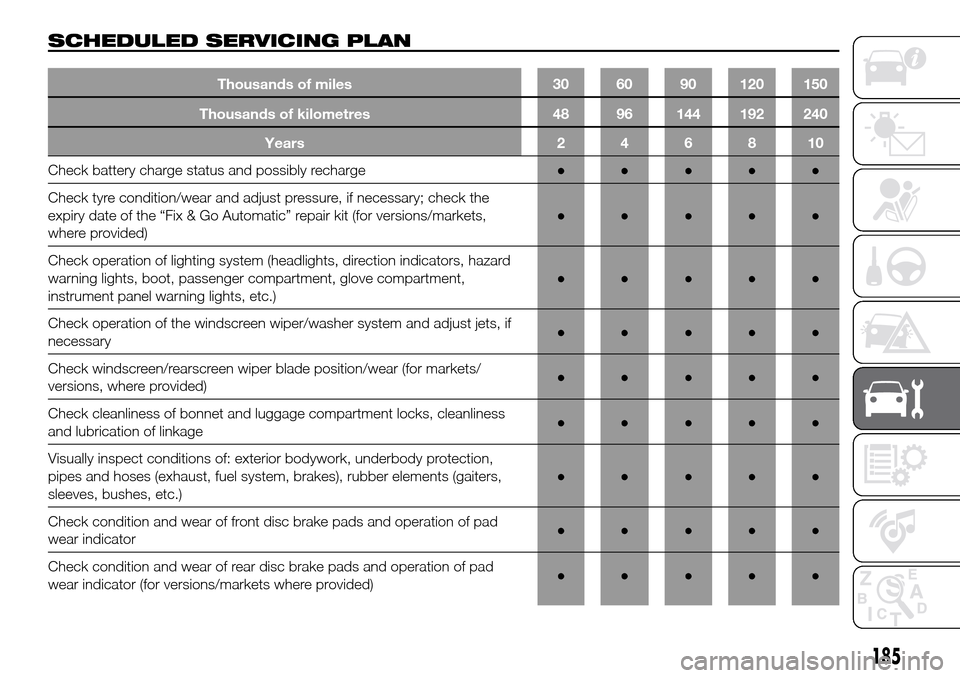
SCHEDULED SERVICING PLAN
Thousands of kilometres 48 96 144 192 240
Years 2 4 6 8 10
Check battery charge status and possibly recharge●●●●●
Check tyre condition/wear and adjust pressure, if necessary; check the
expiry date of the “Fix & Go Automatic” repair kit (for versions/markets,
where provided)●●●●●
Check operation of lighting system (headlights, direction indicators, hazard
warning lights, boot, passenger compartment, glove compartment,
instrument panel warning lights, etc.)●●●●●
Check operation of the windscreen wiper/washer system and adjust jets, if
necessary●●●●●
Check windscreen/rearscreen wiper blade position/wear (for markets/
versions, where provided)●●●●●
Check cleanliness of bonnet and luggage compartment locks, cleanliness
and lubrication of linkage●●●●●
Visually inspect conditions of: exterior bodywork, underbody protection,
pipes and hoses (exhaust, fuel system, brakes), rubber elements (gaiters,
sleeves, bushes, etc.)●●●●●
Check condition and wear of front disc brake pads and operation of pad
wear indicator●●●●●
Check condition and wear of rear disc brake pads and operation of pad
wear indicator (for versions/markets where provided)●●●●●
185
Thousands of miles 30 60 90 120 150
Page 191 of 296
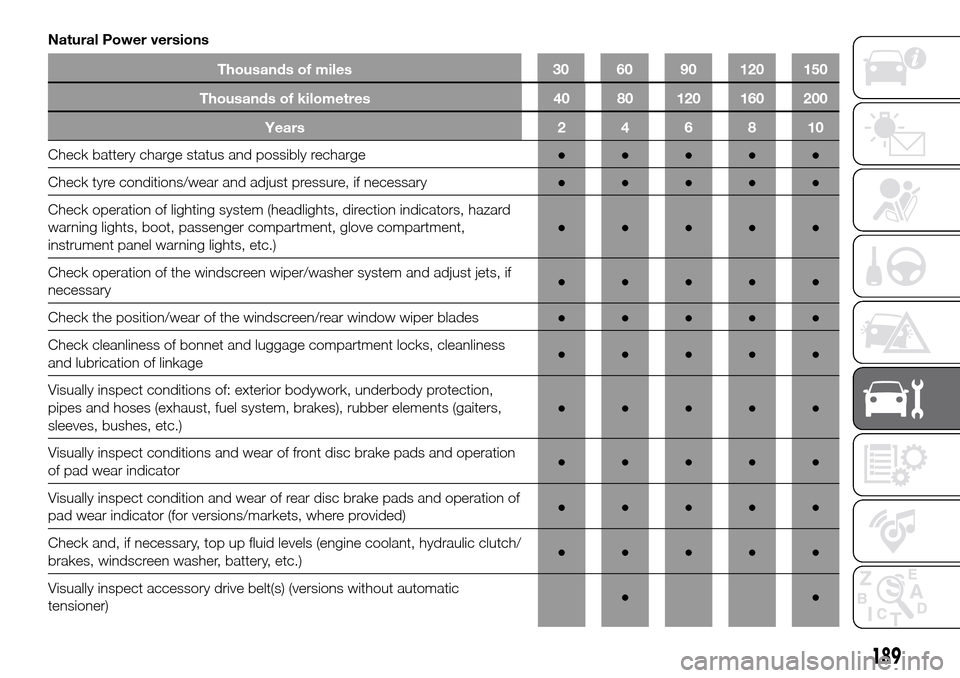
Natural Power versions
Thousands of kilometres 40 80 120 160 200
Years246810
Check battery charge status and possibly recharge●●●●●
Check tyre conditions/wear and adjust pressure, if necessary●●●●●
Check operation of lighting system (headlights, direction indicators, hazard
warning lights, boot, passenger compartment, glove compartment,
instrument panel warning lights, etc.)●●●●●
Check operation of the windscreen wiper/washer system and adjust jets, if
necessary●●●●●
Check the position/wear of the windscreen/rear window wiper blades●●●●●
Check cleanliness of bonnet and luggage compartment locks, cleanliness
and lubrication of linkage●●●●●
Visually inspect conditions of: exterior bodywork, underbody protection,
pipes and hoses (exhaust, fuel system, brakes), rubber elements (gaiters,
sleeves, bushes, etc.)●●●●●
Visually inspect conditions and wear of front disc brake pads and operation
of pad wear indicator●●●●●
Visually inspect condition and wear of rear disc brake pads and operation of
pad wear indicator (for versions/markets, where provided)●●●●●
Check and, if necessary, top up fluid levels (engine coolant, hydraulic clutch/
brakes, windscreen washer, battery, etc.)●●●●●
Visually inspect accessory drive belt(s) (versions without automatic
tensioner)●●
189
Thousands of miles 30 60 90 120 150