belt FIAT DUCATO 2016 3.G User Guide
[x] Cancel search | Manufacturer: FIAT, Model Year: 2016, Model line: DUCATO, Model: FIAT DUCATO 2016 3.GPages: 296, PDF Size: 15.08 MB
Page 102 of 296
Below is a summary of
the main safety rules to
be followed when
carrying children
The recommended position for
installing child restraint systems is on
the rear seat, as it is the most protected
area in the event of an impact.
Keep children in rearward-facing
child restraint systems for as long
as possible, ideally until they are 3–4
years old.
If the passenger front airbag is
deactivated, always check the
corresponding LED on the button
on
the instrument panel to make sure
that it has actually been deactivated.
Carefully follow the instructions that
come with the child seat, which the
manufacturer must supply. Keep the
instructions in the vehicle along with the
other papers and this handbook. Do
not use second-hand child seats
without instructions.
Always check that the seat belt is
well fastened by pulling on it.
Only one child is to be strapped into
each restraint system; never carry two
children using one child restraint
system.
Always check that seat belts do not
rest on the child’s neck.
While travelling, do not let the child
sit incorrectly or unfasten the belts.
Never carry children on your lap,
even newborns. No one can hold
a child in the case of an accident.
Never allow a child to put the belt's
diagonal section under an arm or
behind their back.
If the vehicle has been involved in a
road accident, replace the child
restraint system with a new one. In
addition, and depending on the type of
child restraint system installed, replace
the Isofix anchorages or the seat belt
with which the child restraint system
was connected.
The rear headrest can be removed if
needed to install a child restraint
system. The headrest must always be
fitted in the vehicle if the seat is used by
an adult passenger or a child sitting in
a restraint system without backrest.
WARNING
87)Do not place a rearward facing cradle
seat on the front seat if the passenger side
airbag is enabled. Deployment of the
airbag in an accident could cause fatal
injuries to the child regardless of the
severity of the impact. It is advisable to
always carry children in a child restraint
system on the rear seat, which is the most
protected position in the event of a
collision. If you need to carry a child on the
front passenger seat in a rearward facing
cradle seat, the passenger side airbags
(front and side bags for chest/pelvis
protection, for versions/markets, where
provided) must be deactivated using
the setup menu. It is important to check
the dedicated LED on button
on the
instrument panel to make sure that they
are actually deactivated. Move the
passenger's seat as far back as possible
to avoid contact between the child seat
and the dashboard.
88)On the sun visor there is a label with
suitable symbols reminding the user that it
is compulsory to deactivate the airbag if
a rearward facing child restraint system is
fitted. Always comply with the instructions
on the passenger side sun visor (see the
"Supplementary Restraint System (SRS)
- Airbag" paragraph).
89)Do not move the front or rear seat if a
child is seated on it or on the dedicated
child restraint system.
100
SAFETY
Page 103 of 296
90)Incorrect fitting of the child restraint
system may result in an inefficient
protection system. In the event of an
accident the child restraint system may
become loose and the child may be
injured, even fatally. When fitting a restraint
system for newborns or children, strictly
comply with the instructions provided
by the Manufacturer.
91)When the child restraint system is not
used, secure it with the seat belt or with
the ISOFIX anchorages, or remove it from
the vehicle. Do not leave it unsecured
inside the passenger compartment. In this
way, in the case of sudden braking or an
accident, it will not cause injuries to the
occupants.
92)Always make sure that the diagonal
section of the seat belt does not pass
under the arms or behind the back of the
child. In the event of an accident the seat
belt will not be able to secure the child,
with the risk of injury, including fatal injury.
Therefore the child must always wear
the seat belt correctly.
93)The figures are only examples for fitting
purposes. Fit the child restraint system
according to the instructions, which must
be included.
94)Car seats for weight groups 0 and 1
feature an anchor in front of the vehicle
safety belts as well as its own belts to
restrain the child. Due to their weight, they
may be dangerous if incorrectly mounted
(e.g. if fastened to the vehicle seat belts
placing a cushion in between). Follow the
assembly instructions carefully.SETUP FOR
“UNIVERSAL
ISOFIX” CHILD
RESTRAINT SYSTEM
The vehicle is set up for fitting an Isofix
child restraint system.
The ISOFIX system lets you install the
ISOFIX child restraining system quickly,
simply and safely, without using the
car seat belts, but by connecting the
child restrain system directly to the car
seat with three anchors in the vehicle.
Traditional child restraint systems can
be fitted alongside ISOFIX child restraint
systems on different seats in the same
vehicle.
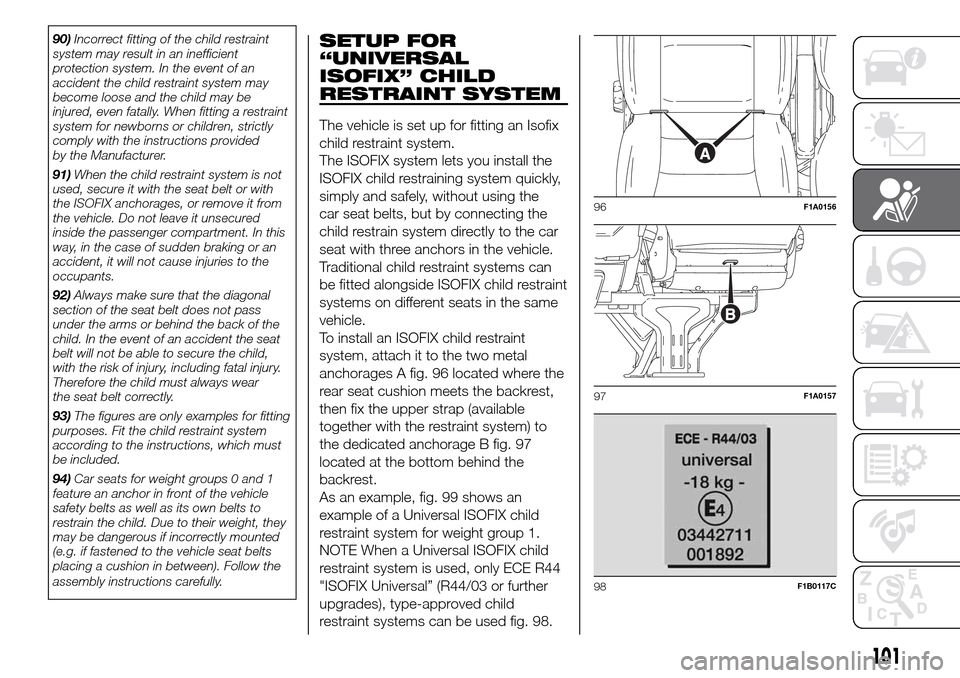
To install an ISOFIX child restraint
system, attach it to the two metal
anchorages A fig. 96 located where the
rear seat cushion meets the backrest,
then fix the upper strap (available
together with the restraint system) to
the dedicated anchorage B fig. 97
located at the bottom behind the
backrest.
As an example, fig. 99 shows an
example of a Universal ISOFIX child
restraint system for weight group 1.
NOTE When a Universal ISOFIX child
restraint system is used, only ECE R44
"ISOFIX Universal” (R44/03 or further
upgrades), type-approved child
restraint systems can be used fig. 98.
96F1A0156
97F1A0157
98F1B0117C
101
Page 106 of 296
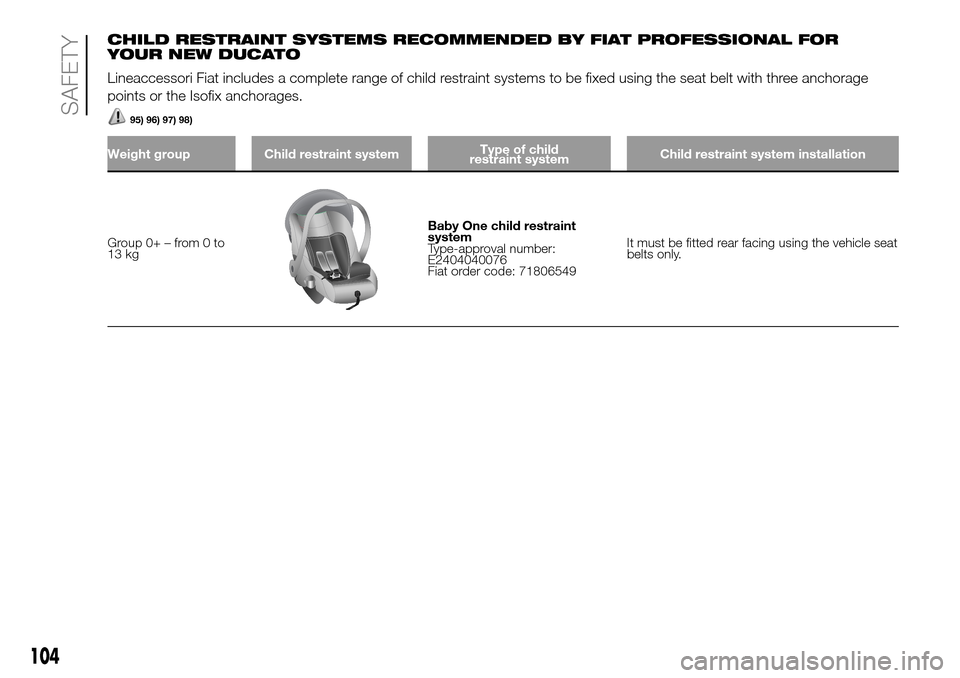
CHILD RESTRAINT SYSTEMS RECOMMENDED BY FIAT PROFESSIONAL FOR
YOUR NEW DUCATO
Lineaccessori Fiat includes a complete range of child restraint systems to be fixed using the seat belt with three anchorage
points or the Isofix anchorages.
95) 96) 97) 98)
Weight group Child restraint systemType of child
restraint systemChild restraint system installation
Group 0+ – from 0 to
13 kg
Baby One child restraint
system
Type-approval number:
E2404040076
Fiat order code: 71806549It must be fitted rear facing using the vehicle seat
belts only.
104
SAFETY
Page 107 of 296
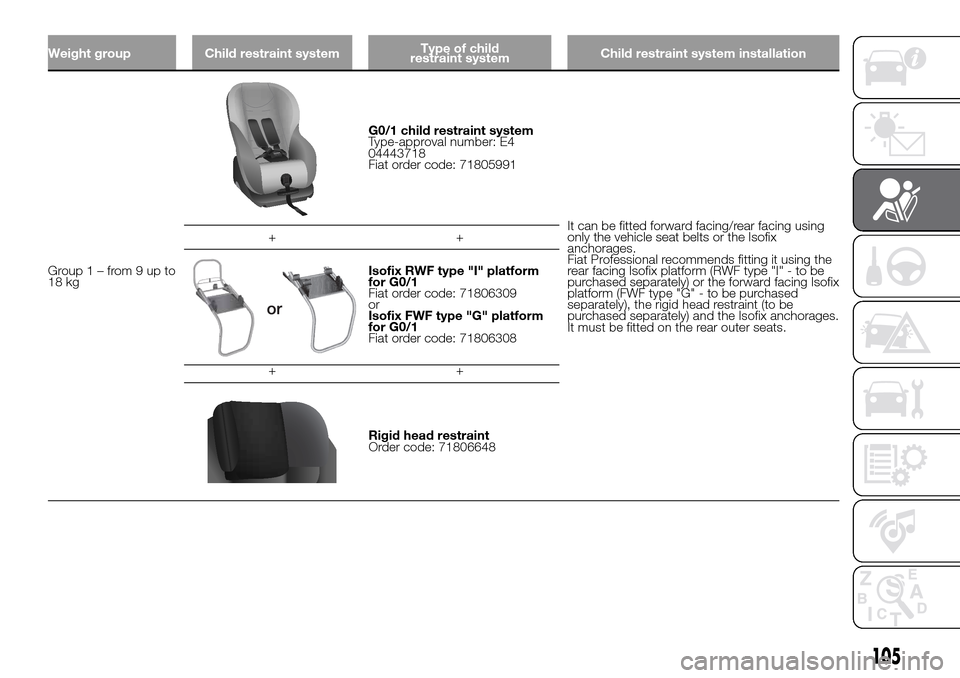
Weight group Child restraint systemType of child
restraint systemChild restraint system installation
Group1–from9upto
18 kg
G0/1 child restraint system
Type-approval number: E4
04443718
Fiat order code: 71805991
It can be fitted forward facing/rear facing using
only the vehicle seat belts or the Isofix
anchorages.
Fiat Professional recommends fitting it using the
rear facing Isofix platform (RWF type "I" - to be
purchased separately) or the forward facing Isofix
platform (FWF type "G" - to be purchased
separately), the rigid head restraint (to be
purchased separately) and the Isofix anchorages.
It must be fitted on the rear outer seats. ++
Isofix RWF type "I" platform
for G0/1
Fiat order code: 71806309
or
Isofix FWF type "G" platform
for G0/1
Fiat order code: 71806308
++
Rigid head restraint
Order code: 71806648
105
Page 108 of 296
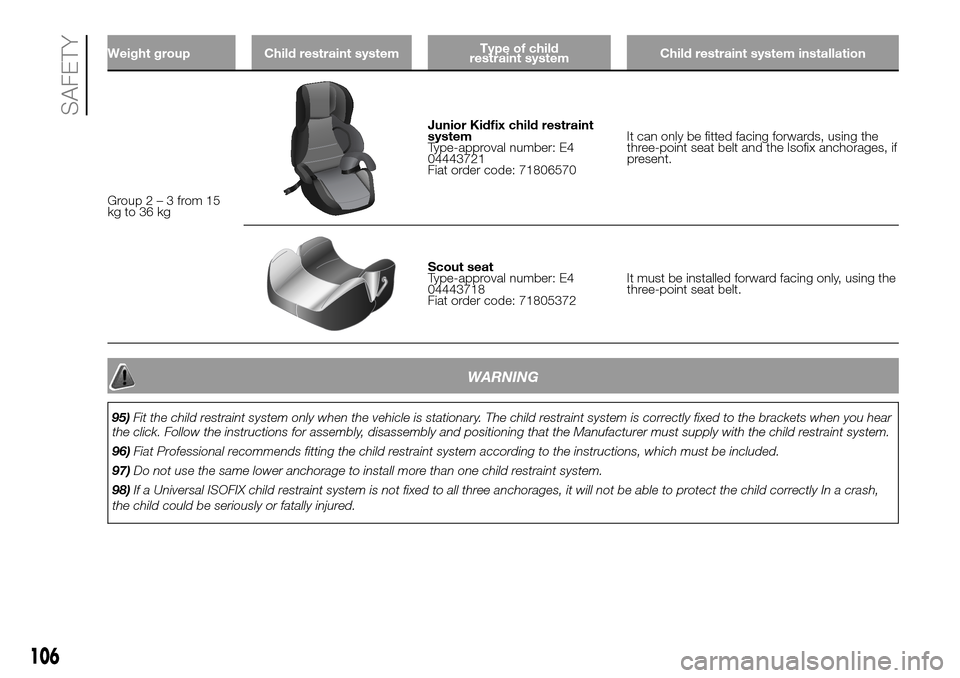
Weight group Child restraint systemType of child
restraint systemChild restraint system installation
Group2–3from15
kg to 36 kg
Junior Kidfix child restraint
system
Type-approval number: E4
04443721
Fiat order code: 71806570It can only be fitted facing forwards, using the
three-point seat belt and the Isofix anchorages, if
present.
Scout seat
Type-approval number: E4
04443718
Fiat order code: 71805372It must be installed forward facing only, using the
three-point seat belt.
WARNING
95)Fit the child restraint system only when the vehicle is stationary. The child restraint system is correctly fixed to the brackets when you hear
the click. Follow the instructions for assembly, disassembly and positioning that the Manufacturer must supply with the child restraint system.
96)Fiat Professional recommends fitting the child restraint system according to the instructions, which must be included.
97)Do not use the same lower anchorage to install more than one child restraint system.
98)If a Universal ISOFIX child restraint system is not fixed to all three anchorages, it will not be able to protect the child correctly In a crash,
the child could be seriously or fatally injured.
106
SAFETY
Page 109 of 296
SUPPLEMENTARY
RESTRAINT SYSTEM
(SRS) - AIRBAG
The vehicle may be equipped with:
driver front airbag;
passenger front airbag;
front side bags to protect the pelvis
and chest of the driver and passenger;
window bags to protect the heads
of the front seat occupants.
The airbag locations on the vehicle are
marked by the word "AIRBAG" in the
middle of the steering wheel, on the
dashboard, on the side lining or on
a label placed next to the airbag
deployment area.
FRONT AIRBAGS
The front airbags protect the front seat
occupants in the event of a medium-
high severity frontal impact, by placing
the bag between the occupant and
the steering wheel or dashboard.
Therefore, non-activation in other types
of collisions (side collisions, rear shunts,
roll-overs, etc.) is not a system
malfunction.
An electronic control unit will make the
bag inflate in the event of a frontal
impact.The bag will inflate instantaneously
placing itself between the front
occupants body and the structures
which could cause injury. It will deflate
immediately afterwards.
Front airbags are not a replacement of
but complementary to the seat belts,
which you are recommended to always
wear, as specified by law in Europe
and most non-European countries.
In the event of an impact, someone not
wearing a seat belt could move forward
and come into contact with a bag
which is still opening. The protection
offered by the bag is compromised
in these circumstances.
Front airbags may not activate in the
following situations:
frontal impacts against highly
deformable objects not involving the
front surface of the vehicle (e.g. wing
collision against guard rail, etc.);
when the vehicle is wedged under
other vehicles or protective barriers
(e.g. under a lorry or a guardrail); Failure
to deploy in the conditions described
above is due to the fact that the airbags
may not provide any additional
protection compared with seat belts, so
their activation would be inappropriate.
In these cases, non-deployment does
not indicate a system malfunction.
99)
The driver's and passenger's front
airbags have been designed and
calibrated to protect front seat
occupants wearing seat belts. At their
maximum inflation, their volume fills
most of the space between the steering
wheel and the driver and between the
dashboard and the passenger.
The airbags are not deployed in the
event of minor frontal impacts (for
which the restraining action of the seat
belts is sufficient). Seat belts must
always be worn. In the event of a frontal
collision, they ensure the correct
positioning of the occupant.
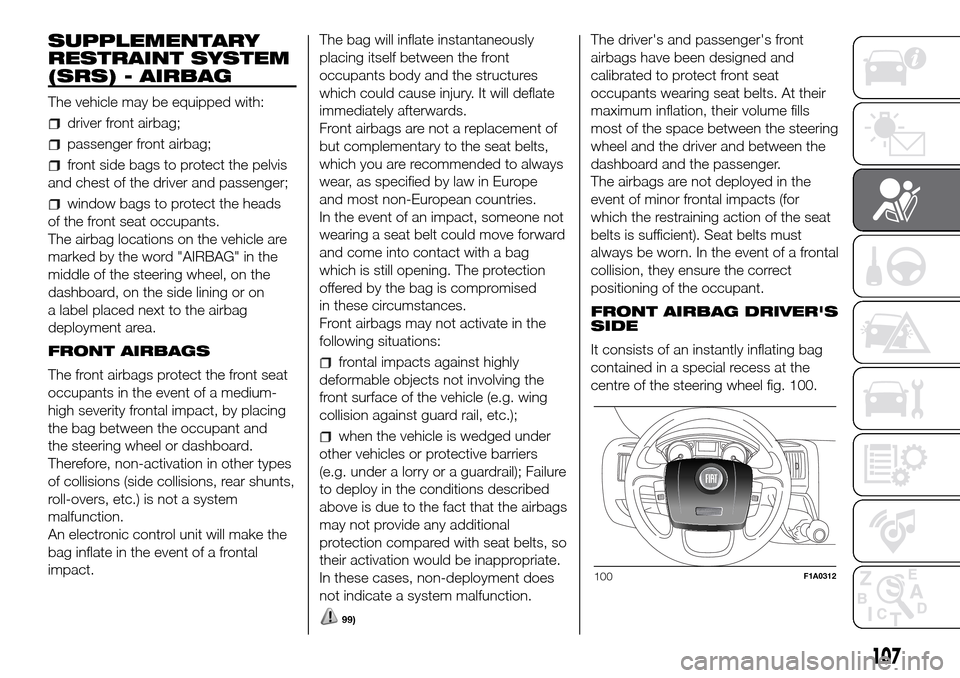
FRONT AIRBAG DRIVER'S
SIDE
It consists of an instantly inflating bag
contained in a special recess at the
centre of the steering wheel fig. 100.
100F1A0312
107
Page 113 of 296
SIDE BAGS
101) 102) 103) 104) 105) 106) 107) 108) 109) 110)
111) 112) 113) 114)
To help increase occupant protection in
the event of a side impact, for
versions/markets where provided, the
car is equipped with front side bags
and window bags.
Side bags (for versions/markets where
provided) protect occupants from
side impacts of medium-high severity,
by placing the bag between the
occupant and the internal parts of the
side structure of the vehicle. Non-
activation of side bags in other types of
collisions (front collisions, rear shunts,
roll-overs, etc.) is not a system
malfunction.
An electronic control unit causes the
bags to inflate in the event of a side-on
collision. The bags inflate
instantaneously, placing themselves
between the occupant's body and the
structures which could cause injury.
They deflate immediately afterwards.
Side bags (for versions/markets where
provided) are not a replacement of
but complementary to the belts, which
you are recommended to always wear,
as specified by law in Europe and
most non-European countries.FRONT SIDE BAGS FOR
CHEST PROTECTION
(for versions/markets, where provided)
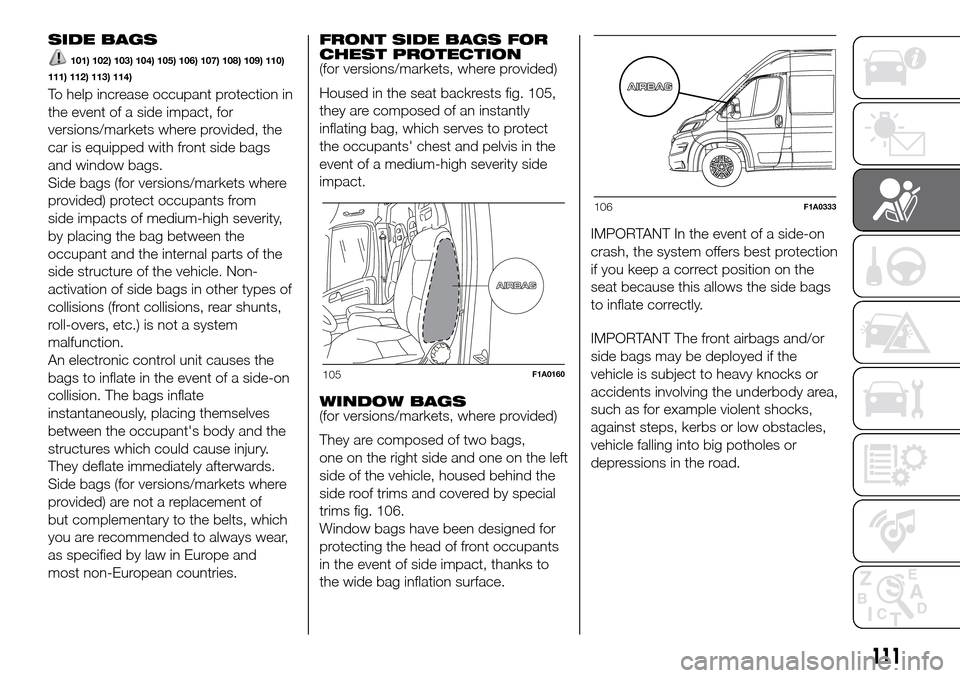
Housed in the seat backrests fig. 105,
they are composed of an instantly
inflating bag, which serves to protect
the occupants' chest and pelvis in the
event of a medium-high severity side
impact.
WINDOW BAGS
(for versions/markets, where provided)
They are composed of two bags,
one on the right side and one on the left
side of the vehicle, housed behind the
side roof trims and covered by special
trims fig. 106.
Window bags have been designed for
protecting the head of front occupants
in the event of side impact, thanks to
the wide bag inflation surface.IMPORTANT In the event of a side-on
crash, the system offers best protection
if you keep a correct position on the
seat because this allows the side bags
to inflate correctly.
IMPORTANT The front airbags and/or
side bags may be deployed if the
vehicle is subject to heavy knocks or
accidents involving the underbody area,
such as for example violent shocks,
against steps, kerbs or low obstacles,
vehicle falling into big potholes or
depressions in the road.
105F1A0160
106F1A0333
111
Page 115 of 296
107)Airbags may be deployed if another
vehicle crashes into yours if the key is
inserted and on, even if the engine is not
running and your vehicle is standing.
Therefore, even if the car is stationary,
when an active front passenger airbag is
fitted, DO NOT install rear facing child
restraint systems on the front passenger
seat. Deployment of the airbag following an
impact could cause fatal injuries to the
child. Therefore, always deactivate the
passenger side airbag when a rearward
facing child restraint system is installed on
the front passenger seat. The front
passenger seat must also be positioned
back as far as possible in order to prevent
the child restraint system from coming
into contact with the dashboard.
Immediately reactivate the passenger
airbag as soon as the child restraint system
has been removed. Also remember that, if
the key is turned to STOP, none of the
safety devices (airbags or pretensioners)
will be deployed in the event of collision.
Non-deployment in such cases does
not indicate a system malfunction.
108)Have the airbag system checked by a
Fiat Dealership if the car was stolen, if
theft was attempted, or if the car was
subjected to vandalism or flooding.
109)By turning the ignition key to MAR
position, the LED on the
button located
on the dashboard lights up (the time it
stays lit up can vary depending on the
market), to check that the button LED is
working correctly.
110)Do not wash the seats with water or
pressurised steam (wash by hand or at
automatic seat washing stations).111)The front airbag is designed to be
deployed for impacts of a greater intensity
than for the pretensioners. For impacts
whose intensity falls between the two
levels, normally, only the pretensioners will
be activated.
112)Do not affix rigid objects to the
garment hooks or support handles.
113)The airbag does not replace seat
belts but increases their efficiency.
Furthermore, since front airbags are not
deployed in low-speed frontal impacts,
side impacts, rear shunts or roll-overs, the
passengers are protected only by the
seat belts which must therefore be
fastened at all times.
114)In some versions, in the event of a
LED
OFFfailure (located on the
dashboard trim), thewarning light on
the instrument panel turns on and the
passenger side bags are deactivated. In
some versions, in the event of a LED
ONfailure (located on the dashboard
trim), thelight on the console turns on.
113
Page 117 of 296
STARTING THE
ENGINE
The vehicle is fitted with an electronic
engine lock device: if the engine fails to
start, see the paragraph “The Fiat
CODE system” in section “Know your
vehicle”.
Before starting the vehicle, adjust the
seat, the interior rear view mirrors,
the door mirrors and fasten the seat
belts correctly. Never press the
accelerator pedal for starting the
engine.
115)
14) 15)
PROCEDURE FOR
VERSIONS WITH MANUAL
TRANSMISSION
Proceed as follows:
engage the handbrake;
put the gear lever into neutral;
turn the ignition key to theMAR
position: the warning lights
and
on the instrument panel will turn on;
wait for the warning lightsand
to turn off, which will happen faster
the warmer the engine is;
fully depress the clutch pedal
without touching the accelerator;
turn the ignition key to the AVV
position as soon as the warning light
turns off. Waiting too long will waste
the heating work carried out by the
plugs.
Release the key as soon as the engine
starts.
PROCEDURE FOR
VERSIONS WITH
COMFORT MATIC
TRANSMISSION
The system allows the engine to be
started both with a gear engaged and
with the gearbox in neutral (N);
however, the brake pedal must be
pressed first with a gear engaged.
It is advisable to place the gear lever in
neutral (N) before starting the engine.
16)
PROCEDURE FOR
NATURAL POWER
VERSIONS
(For versions/markets, where provided)
The various engine cranking methods
are described below:
METHANE tank not on reserve –
petrol tank not empty:
the engine is always started in methane
mode;
METHANE tank empty – petrol tank
not empty:the engine is forced to start on petrol
and it will not switch to methane until
the methane tank has been filled. At the
same time, the reserve warning light
will turn on and the "REFUELLING
REQUIRED" message will be shown on
the instrument panel display;
METHANE tank not on reserve –
petrol tank empty:
the engine is always started in methane
mode.
17) 18) 19) 20) 21)
WARNING
115)It is dangerous to run the engine in
enclosed areas. The engine takes in
oxygen and releases carbon dioxide,
carbon monoxide and other toxic gases.
WARNING
14)It is advisable not to demand maximum
performance from your vehicle (e.g.
excessive acceleration, long distances at
high speeds, excessive intense braking,
etc.) during the initial period of use.
15)When the engine is switched off never
leave the key turned to MAR-ON to prevent
useless current absorption from draining
the battery.
115
Page 186 of 296
DEMANDING
VEHICLE USE
If the vehicle is mostly used in one of
the following conditions:
towing a trailer or caravan;
dusty roads;
short, repeated journeys (less than
7-8 km) at sub-zero outside
temperatures;
engine often idling or driving long
distances at low speeds or long periods
of inactivity;
the following checks must be carried
out more often than indicated in the
Scheduled Servicing Plan:
check front disc brake pad
conditions and wear;
check cleanliness of bonnet and
boot locks, cleanliness and lubrication
of linkage;
visually inspect conditions of:
engine, gearbox, transmission, pipes
and hoses (exhaust - fuel system -
brakes) and rubber elements (boots -
sleeves - bushes - etc.);
check battery charge and battery
fluid level (electrolyte);
visually inspect condition of the
accessory drive belts;
check and, if necessary, change
engine oil and replace oil filter;
Restore additive level for AdBlue
Diesel emissions (UREA) (for versions /
markets where applicable), at the
ignition of the lamp or the message on
the instrument panel;
check and, if necessary, replace
pollen filter.
184
SERVICING AND CARE