urea FIAT DUCATO 2016 3.G User Guide
[x] Cancel search | Manufacturer: FIAT, Model Year: 2016, Model line: DUCATO, Model: FIAT DUCATO 2016 3.GPages: 296, PDF Size: 15.08 MB
Page 131 of 296
any container or part that comes in
contact with the UREA must be compatible
with it (plastic or stainless steel). Materials
such as copper, brass, aluminium, iron
or stainless steel is not as susceptible to
corrosion by UREA are to be avoided;
if UREA is spilled from a container,
completely clean the area.
METHANE ENGINES
(NATURAL POWER)
METHANE GAS FILLER
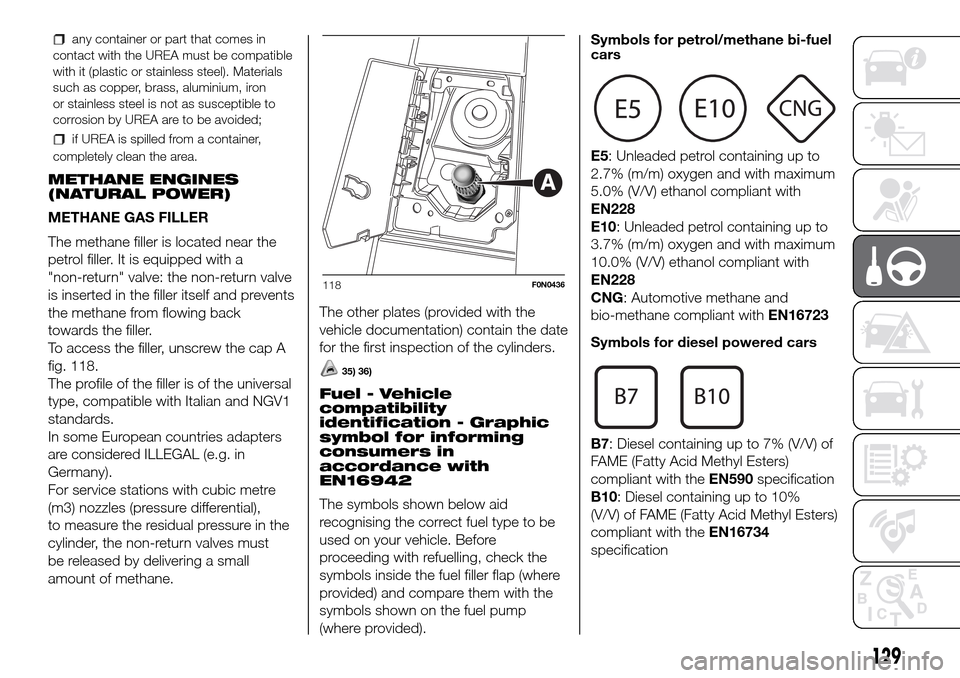
The methane filler is located near the
petrol filler. It is equipped with a
"non-return" valve: the non-return valve
is inserted in the filler itself and prevents
the methane from flowing back
towards the filler.
To access the filler, unscrew the cap A
fig. 118.
The profile of the filler is of the universal
type, compatible with Italian and NGV1
standards.
In some European countries adapters
are considered ILLEGAL (e.g. in
Germany).
For service stations with cubic metre
(m3) nozzles (pressure differential),
to measure the residual pressure in the
cylinder, the non-return valves must
be released by delivering a small
amount of methane.The other plates (provided with the
vehicle documentation) contain the date
for the first inspection of the cylinders.
35) 36)
Fuel - Vehicle
compatibility
identification - Graphic
symbol for informing
consumers in
accordance with
EN16942
The symbols shown below aid
recognising the correct fuel type to be
used on your vehicle. Before
proceeding with refuelling, check the
symbols inside the fuel filler flap (where
provided) and compare them with the
symbols shown on the fuel pump
(where provided).Symbols for petrol/methane bi-fuel
cars
E5: Unleaded petrol containing up to
2.7% (m/m) oxygen and with maximum
5.0% (V/V) ethanol compliant with
EN228
E10: Unleaded petrol containing up to
3.7% (m/m) oxygen and with maximum
10.0% (V/V) ethanol compliant with
EN228
CNG: Automotive methane and
bio-methane compliant withEN16723
Symbols for diesel powered cars
B7: Diesel containing up to 7% (V/V) of
FAME (Fatty Acid Methyl Esters)
compliant with theEN590specification
B10: Diesel containing up to 10%
(V/V) of FAME (Fatty Acid Methyl Esters)
compliant with theEN16734
specification
118F0N0436
129
Page 132 of 296
WARNING
128)Do not approach naked flames or lit
cigarettes to the fuel tank filler: fire risk.
Keep your face away from the fuel filler to
prevent breathing in harmful vapours.
129)To avoid fuel spillage and the
exceeding of the maximum level, avoid
topping up after filling the tank.
130)Any fuel pumping in portable
containers located on a floor can cause a
fire. Danger of burns. Always put the fuel
container on the ground during filling. Avoid
using contaminated fuel: a fuel
contaminated with water or earth can
cause serious damage to the motor supply.
Proper maintenance of the fuel filter, of
the engine and the fuel tank is essential.
131)If AdBlue overheats for a prolonged
period inside the tank to over 50 ° C (for
example due to direct solar irradiation),
AdBlue can decompose ammonia vapours.
Ammonia vapours have a pungent odour
when the cap of the AdBlue tank is
unscrewed, therefore be careful not to
inhale any ammonia vapours in the tank
outlet. In this concentration, however, the
ammonia vapors are not harmful or
dangerous to health.
132)Do not open the fuel system at high
pressure with the engine running. The
operation of the engine creates a high fuel
pressure. A jet of high-pressure fuel can
cause serious injury or death.
WARNING
34)Only refuel with automotive diesel
complying with the European specification
EN 590. The use of other products or
mixtures may damage the engine beyond
repair and consequently invalidate the
warranty, due to the damage caused. If
you accidentally introduce other types of
fuel into the tank, do not start the engine.
Empty the tank. If the engine has been run
for even an extremely limited amount of
time, you must not only drain the fuel tank,
but the rest of the supply circuit as well.
35)Methane refuelling stations are not
authorised to refill the cylinders when the
inspection date has expired. The check
valve prevents the methane from flowing
back to the fuel filler.
36)If the vehicle has been registered in a
country other than Italy, the certification
data, identification and inspection
procedures for the methane cylinders
should conform to the legislation in that
country. In any case, it should be
remembered that the life of the cylinders is
20 years from the production date as set
out in ECE Regulation no. 110.
ADDITIVE FOR
DIESEL EMISSIONS
ADBLUE (UREA)
The vehicle is equipped with a Selective
Catalytic Reduction system to meet
the strict Diesel emissions standards
required by the Agency for
Environmental Protection.
The purpose of the system of Selective
Catalytic Reduction is to reduce the
nitrogen oxides levels emitted by
engines; these elements are harmful to
our health and to the environment
even at minimum levels. A small
amount of additive for Diesel emissions
AdBlue (UREA) is injected upstream
of the catalyst exhaust outlet where,
when it turns into gas, converts
nitrogen oxides, that create smog, in
simple nitrogen and water vapour, two
natural components of air we breathe.
You can use your vehicle with the
peace of mind of knowing that you are
contributing to a cleaner and healthy
environment for future generations.
System description
The vehicle is equipped with an UREA
fuel injection system and a Selective
Catalytic Reduction catalyst to meet the
emission standards.
130
STARTING AND DRIVING
Page 133 of 296
These two systems ensure compliance
with the diesel emissions requirements;
at the same it maintains fuel saving
levels, driveability, torque and power.
For the system messages and warnings
refer to the "Warning lights and
messages" paragraph in the "Knowing
the instrument panel" section.
Notes
When you stop the vehicle you
could hear a distinct click coming from
under the vehicle due to the UREA
injection system, this is normal.
The UREA injection system pump
continues to operate for a short period
of time after the engine is switched
off, to purge the circuit. This is normal,
and you can still hear its noise from
under the vehicle.
VERSION WITH
METHANE SYSTEM
(Natural Power)
37) 38)
INTRODUCTION
The "Natural Power" version of the Fiat
Ducato features two fuel system, one
primary natural gas (methane) system
and one emergency petrol system.
METHANE CYLINDERS
The vehicle is equipped with five
cylinders (total capacity of about 218
litres) located under the vehicle floor
and protected by two special shields.
The cylinders are the tank that contains
the methane in its compressed
gaseous state (nominal pressure of 200
bar at 15°C). The methane, stored in
the cylinders at high pressure, flows
through a dedicated pipe to reach the
pressure regulator/reduction unit which
supplies the 4 methane injectors at
low pressure (about 6 bar).
IMPORTANT If gas is smelled, switch
from methane operation to petrol
operation and immediately go to a Fiat
Dealership to have the vehicle checked
and possible system faults excluded.FUEL SWITCHING
LOGICS
Management of switching between the
two different fuel supplies is fully
automatic, and carried out by the
engine control unit.
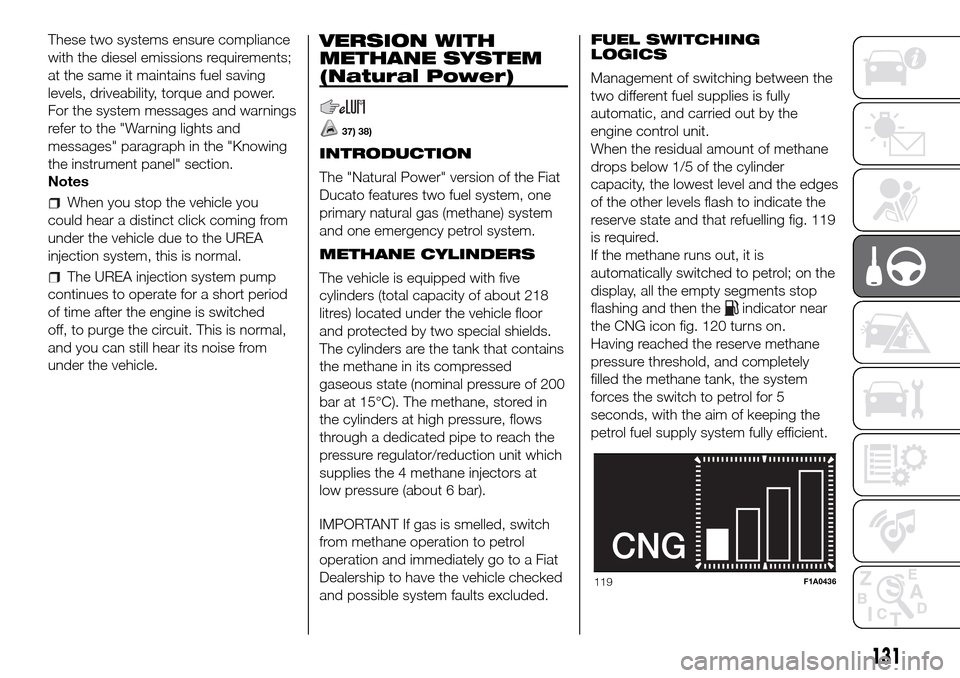
When the residual amount of methane
drops below 1/5 of the cylinder
capacity, the lowest level and the edges
of the other levels flash to indicate the
reserve state and that refuelling fig. 119
is required.
If the methane runs out, it is
automatically switched to petrol; on the
display, all the empty segments stop
flashing and then the
indicator near
the CNG icon fig. 120 turns on.
Having reached the reserve methane
pressure threshold, and completely
filled the methane tank, the system
forces the switch to petrol for 5
seconds, with the aim of keeping the
petrol fuel supply system fully efficient.
119F1A0436
131
Page 185 of 296
SCHEDULED
SERVICING
Correct servicing is crucial for
guaranteeing a long life for the vehicle
under the best conditions.
This is why Fiat has planned a series of
checks and maintenance operations
every 48,000 km depending on the
engine version.
It is, however, important to remember
that scheduled servicing does not
completely cover all the requirements of
the car: even in the initial period before
48,000 km, and then subsequently
between one service and another,
ordinary care is always required such as
routine checks involving topping up
fluid level, checking tyre pressures etc.
IMPORTANT Scheduled Servicing
interventions are set out by the
Manufacturer. Failure to have them
carried out may invalidate the warranty.
Scheduled Servicing can be carried
out by any Fiat Dealership, at
pre-established times.
If during each operation, in addition to
the ones scheduled, the need arises for
further replacements or repairs, these
may only be carried out with the
express agreement of the Customer.IMPORTANT It is advisable to inform a
Fiat Dealership of any small operating
irregularities without waiting for the next
service.
If your vehicle is used frequently for
towing, the interval between service
coupons must be reduced.
The customer can have servicing done
outside the authorised Fiat Dealership
without losing the warranty in force. The
warranty depends on carrying out the
scheduled servicing constantly, as
described in this Owner Handbook. The
customer can choose to have the
above mentioned servicing, and any
other repairs covered by the warranty,
carried out by any workshop (within
or outside the Fiat Dealership), as long
as it has suitable means and follows the
instructions described in this Owner
Handbook.
PERIODIC CHECKS
Before long journeys, check and, if
necessary, restore:
engine coolant level;
brake fluid level;
control and recovery of additive level
for AdBlue Diesel emissions (UREA)
(for versions/markets, where provided);
windscreen washer fluid level;
tyre inflation pressure and condition;
operation of lighting system
(headlamps, direction indicators, hazard
warning lights, etc.);
operation of screen washer/wiper
system and positioning/wear of
windscreen/rear window wiper blades.
To ensure that the vehicle is always
efficient and well maintained, it is
advisable to make sure that you carry
out the above operations regularly
(approximately every 1000 km and
every 3000 km for checking and
topping up engine oil is advisable).
183
Page 186 of 296
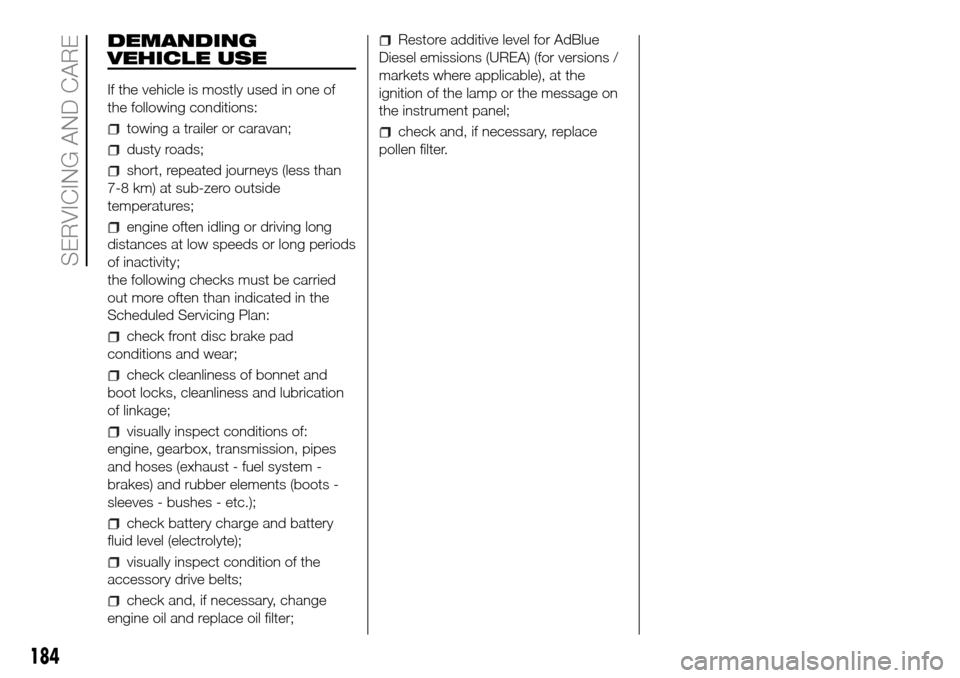
DEMANDING
VEHICLE USE
If the vehicle is mostly used in one of
the following conditions:
towing a trailer or caravan;
dusty roads;
short, repeated journeys (less than
7-8 km) at sub-zero outside
temperatures;
engine often idling or driving long
distances at low speeds or long periods
of inactivity;
the following checks must be carried
out more often than indicated in the
Scheduled Servicing Plan:
check front disc brake pad
conditions and wear;
check cleanliness of bonnet and
boot locks, cleanliness and lubrication
of linkage;
visually inspect conditions of:
engine, gearbox, transmission, pipes
and hoses (exhaust - fuel system -
brakes) and rubber elements (boots -
sleeves - bushes - etc.);
check battery charge and battery
fluid level (electrolyte);
visually inspect condition of the
accessory drive belts;
check and, if necessary, change
engine oil and replace oil filter;
Restore additive level for AdBlue
Diesel emissions (UREA) (for versions /
markets where applicable), at the
ignition of the lamp or the message on
the instrument panel;
check and, if necessary, replace
pollen filter.
184
SERVICING AND CARE
Page 188 of 296
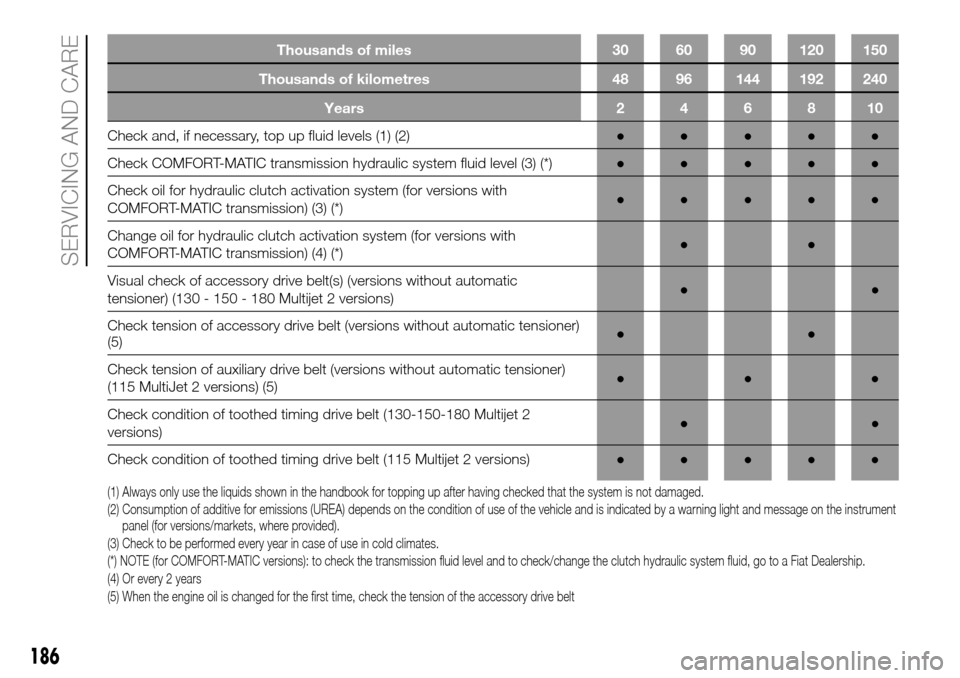
Thousands of kilometres 48 96 144 192 240
Years 2 4 6 8 10
Check and, if necessary, top up fluid levels (1) (2)●●●●●
Check COMFORT-MATIC transmission hydraulic system fluid level (3) (*)●●●●●
Check oil for hydraulic clutch activation system (for versions with
COMFORT-MATIC transmission) (3) (*)●●●●●
Change oil for hydraulic clutch activation system (for versions with
COMFORT-MATIC transmission) (4) (*)●●
Visual check of accessory drive belt(s) (versions without automatic
tensioner) (130 - 150 - 180 Multijet 2 versions)●●
Check tension of accessory drive belt (versions without automatic tensioner)
(5)●●
Check tension of auxiliary drive belt (versions without automatic tensioner)
(115 MultiJet 2 versions) (5)●●●
Check condition of toothed timing drive belt (130-150-180 Multijet 2
versions)●●
Check condition of toothed timing drive belt (115 Multijet 2 versions)●●●●●
(1) Always only use the liquids shown in the handbook for topping up after having checked that the system is not damaged.
(2) Consumption of additive for emissions (UREA) depends on the condition of use of the vehicle and is indicated by a warning light and message on the instrument
panel (for versions/markets, where provided).
(3) Check to be performed every year in case of use in cold climates.
(*) NOTE (for COMFORT-MATIC versions): to check the transmission fluid level and to check/change the clutch hydraulic system fluid, go to a Fiat Dealership.
(4) Or every 2 years
(5) When the engine oil is changed for the first time, check the tension of the accessory drive belt
186
SERVICING AND CARE
Thousands of miles 30 60 90 120 150
Page 239 of 296
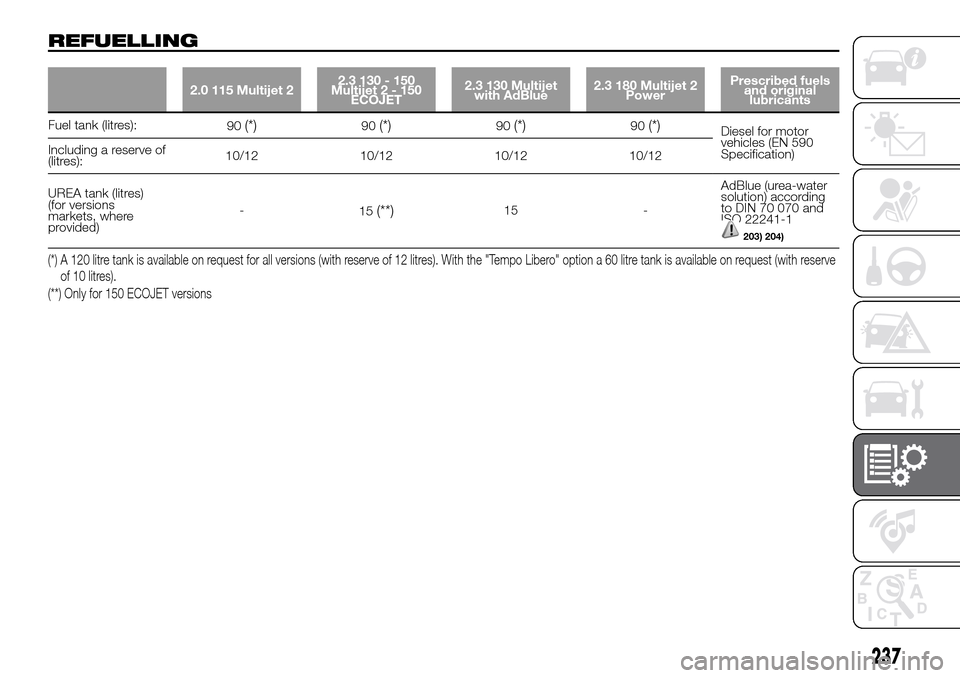
REFUELLING
2.0 115 Multijet 22.3 130 - 150
Multijet2-150
ECOJET2.3 130 Multijet
with AdBlue2.3 180 Multijet 2
PowerPrescribed fuels
and original
lubricants
Fuel tank (litres):
90(*)90(*)90(*)90(*)Diesel for motor
vehicles (EN 590
Specification) Including a reserve of
(litres):10/12 10/12 10/12 10/12
UREA tank (litres)
(for versions
markets, where
provided)-
15
(**)15 -AdBlue (urea-water
solution) according
to DIN 70 070 and
ISO 22241-1
203) 204)
(*) A 120 litre tank is available on request for all versions (with reserve of 12 litres). With the "Tempo Libero" option a 60 litre tank is available on request (with reserve
of 10 litres).
(**) Only for 150 ECOJET versions
237
Page 243 of 296
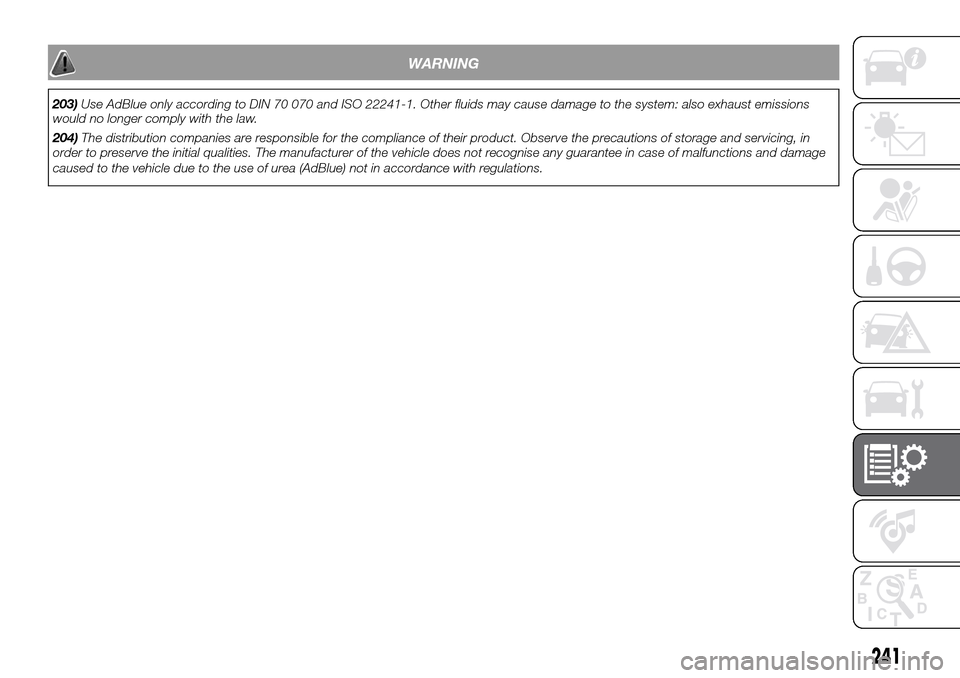
WARNING
203)Use AdBlue only according to DIN 70 070 and ISO 22241-1. Other fluids may cause damage to the system: also exhaust emissions
would no longer comply with the law.
204)The distribution companies are responsible for the compliance of their product. Observe the precautions of storage and servicing, in
order to preserve the initial qualities. The manufacturer of the vehicle does not recognise any guarantee in case of malfunctions and damage
caused to the vehicle due to the use of urea (AdBlue) not in accordance with regulations.
241
Page 246 of 296
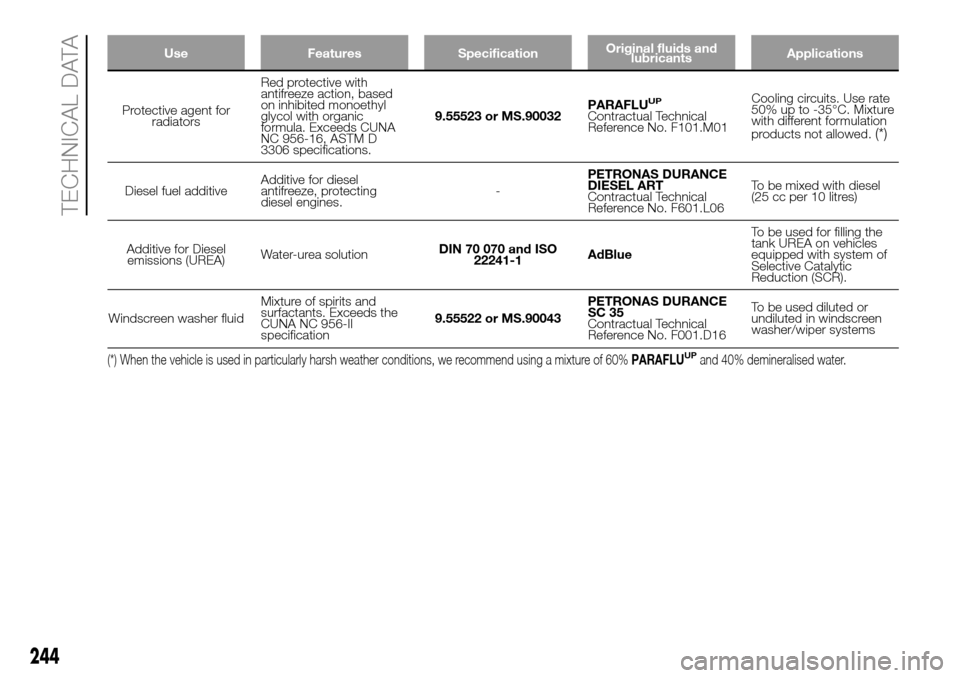
Use Features SpecificationOriginal fluids and
lubricantsApplications
Protective agent for
radiatorsRed protective with
antifreeze action, based
on inhibited monoethyl
glycol with organic
formula. Exceeds CUNA
NC 956-16, ASTM D
3306 specifications.9.55523 or MS.90032PARAFLUUP
Contractual Technical
Reference No. F101.M01Cooling circuits. Use rate
50% up to -35°C. Mixture
with different formulation
products not allowed.
(*)
Diesel fuel additiveAdditive for diesel
antifreeze, protecting
diesel engines.-PETRONAS DURANCE
DIESEL ART
Contractual Technical
Reference No. F601.L06To be mixed with diesel
(25 cc per 10 litres)
Additive for Diesel
emissions (UREA)Water-urea solutionDIN 70 070 and ISO
22241-1AdBlueTo be used for filling the
tank UREA on vehicles
equipped with system of
Selective Catalytic
Reduction (SCR).
Windscreen washer fluidMixture of spirits and
surfactants. Exceeds the
CUNA NC 956-II
specification9.55522 or MS.90043PETRONAS DURANCE
SC 35
Contractual Technical
Reference No. F001.D16To be used diluted or
undiluted in windscreen
washer/wiper systems
(*) When the vehicle is used in particularly harsh weather conditions, we recommend using a mixture of 60%PARAFLUUPand 40% demineralised water.
244
TECHNICAL DATA
Page 291 of 296
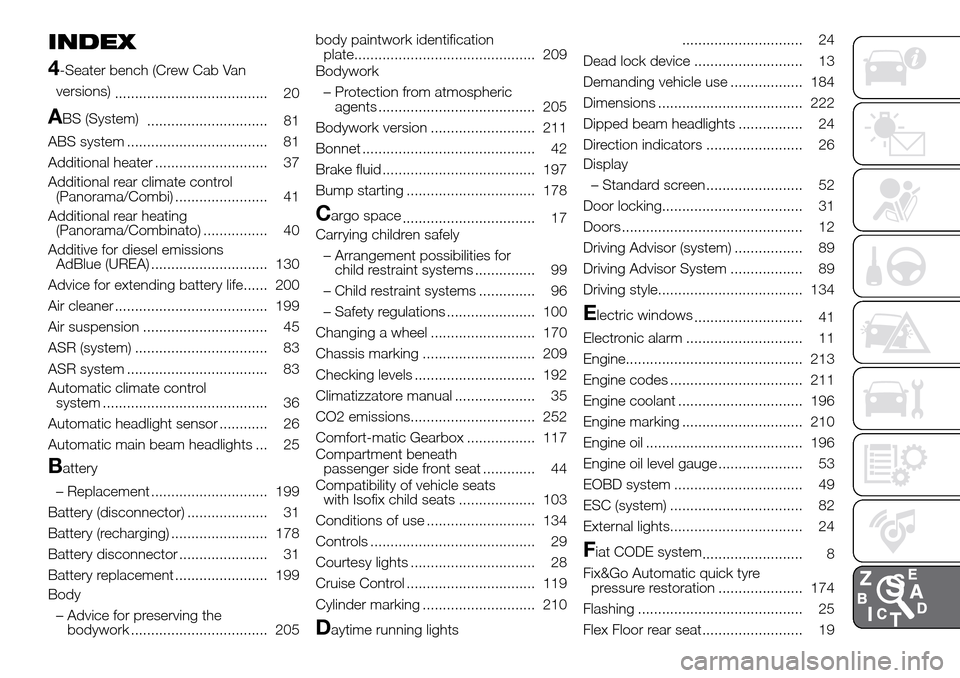
INDEX
4
-Seater bench (Crew Cab Van
versions)
...................................... 20
ABS (System)
.............................. 81
ABS system ................................... 81
Additional heater ............................ 37
Additional rear climate control
(Panorama/Combi) ....................... 41
Additional rear heating
(Panorama/Combinato) ................ 40
Additive for diesel emissions
AdBlue (UREA) ............................. 130
Advice for extending battery life...... 200
Air cleaner ...................................... 199
Air suspension ............................... 45
ASR (system) ................................. 83
ASR system ................................... 83
Automatic climate control
system ......................................... 36
Automatic headlight sensor ............ 26
Automatic main beam headlights ... 25
Battery
– Replacement ............................. 199
Battery (disconnector) .................... 31
Battery (recharging) ........................ 178
Battery disconnector ...................... 31
Battery replacement ....................... 199
Body
– Advice for preserving the
bodywork .................................. 205body paintwork identification
plate............................................. 209
Bodywork
– Protection from atmospheric
agents ....................................... 205
Bodywork version .......................... 211
Bonnet ........................................... 42
Brake fluid ...................................... 197
Bump starting ................................ 178
Cargo space
................................. 17
Carrying children safely
– Arrangement possibilities for
child restraint systems ............... 99
– Child restraint systems .............. 96
– Safety regulations ...................... 100
Changing a wheel .......................... 170
Chassis marking ............................ 209
Checking levels .............................. 192
Climatizzatore manual .................... 35
CO2 emissions............................... 252
Comfort-matic Gearbox ................. 117
Compartment beneath
passenger side front seat ............. 44
Compatibility of vehicle seats
with Isofix child seats ................... 103
Conditions of use ........................... 134
Controls ......................................... 29
Courtesy lights ............................... 28
Cruise Control ................................ 119
Cylinder marking ............................ 210
Daytime running lights.............................. 24
Dead lock device ........................... 13
Demanding vehicle use .................. 184
Dimensions .................................... 222
Dipped beam headlights ................ 24
Direction indicators ........................ 26
Display
– Standard screen ........................ 52
Door locking................................... 31
Doors ............................................. 12
Driving Advisor (system) ................. 89
Driving Advisor System .................. 89
Driving style.................................... 134
Electric windows
........................... 41
Electronic alarm ............................. 11
Engine............................................ 213
Engine codes ................................. 211
Engine coolant ............................... 196
Engine marking .............................. 210
Engine oil ....................................... 196
Engine oil level gauge ..................... 53
EOBD system ................................ 49
ESC (system) ................................. 82
External lights................................. 24
Fiat CODE system
......................... 8
Fix&Go Automatic quick tyre
pressure restoration ..................... 174
Flashing ......................................... 25
Flex Floor rear seat......................... 19