battery FIAT DUCATO 2016 Owner handbook (in English)
[x] Cancel search | Manufacturer: FIAT, Model Year: 2016, Model line: DUCATO, Model: FIAT DUCATO 2016Pages: 387, PDF Size: 20.76 MB
Page 236 of 387
BATTERY
RECHARGING
IMPORTANT The battery recharging
procedure is given as information only.
You are advised to contact a Fiat
Dealership to have this operation
carried out.
IMPORTANT After turning the ignition
key to STOP and having closed the
driver side door, wait at least one
minute before disconnecting the
electrical supply from the battery. When
reconnecting the electrical supply to
the battery, make sure that the ignition
key is in the STOP position and the
driver side door is closed.
Charging should be slow at a low
ampere rating for approximately 24
hours. Charging for a longer time may
damage the battery.
174) 175)
IN THE ABSENCE OF
START&STOP SYSTEM
To recharge, proceed as follows:
❒disconnect the negative battery
terminal;
❒connect the charger cables to the
battery terminals, observing the
polarity;
❒turn on the charger;
❒when it is recharged, turn the charger
off before disconnecting it from the
battery;
❒reconnect the negative battery
terminal.
WITH START&STOP
SYSTEM
To recharge, proceed as follows:
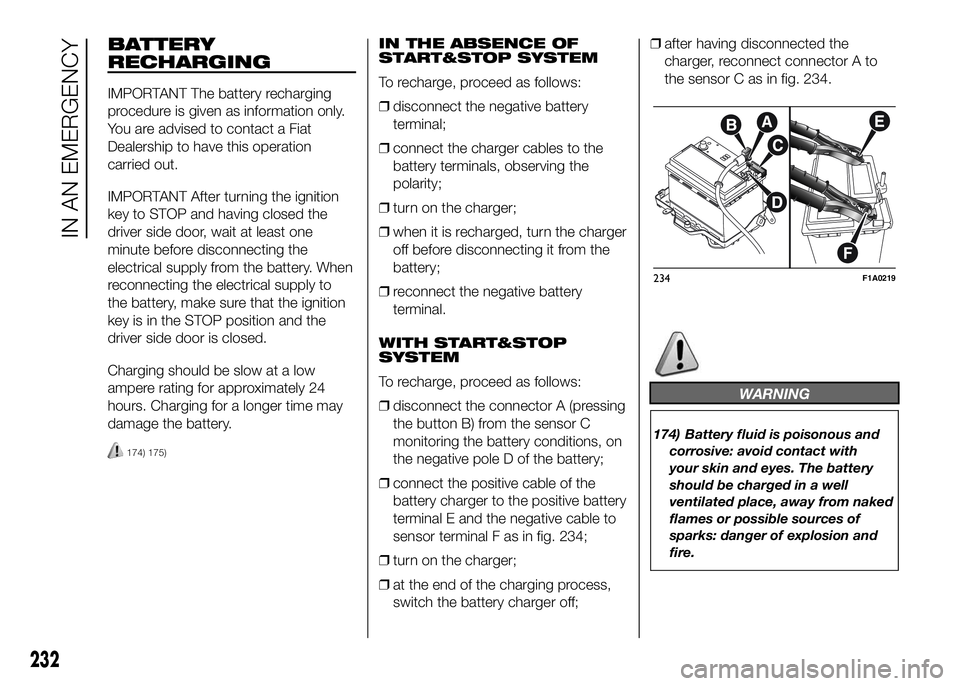
❒disconnect the connector A (pressing
the button B) from the sensor C
monitoring the battery conditions, on
the negative pole D of the battery;
❒connect the positive cable of the
battery charger to the positive battery
terminal E and the negative cable to
sensor terminal F as in fig. 234;
❒turn on the charger;
❒at the end of the charging process,
switch the battery charger off;❒after having disconnected the
charger, reconnect connector A to
the sensor C as in fig. 234.
WARNING
174) Battery fluid is poisonous and
corrosive: avoid contact with
your skin and eyes. The battery
should be charged in a well
ventilated place, away from naked
flames or possible sources of
sparks: danger of explosion and
fire.
234F1A0219
232
IN AN EMERGENCY
Page 237 of 387
175) Do not attempt to charge a
frozen battery: it must be thawed
first, otherwise it may explode.
If freezing has occurred, the
battery should be checked by
skilled personnel to make sure
that the internal elements are not
damaged and that the body is
not cracked, with the risk of
leaking poisonous and corrosive
acid.LIFTING THE
VEHICLE
If the vehicle needs to be lifted, go to a
Fiat Dealership which is equipped
with the arm hoist or workshop lift.
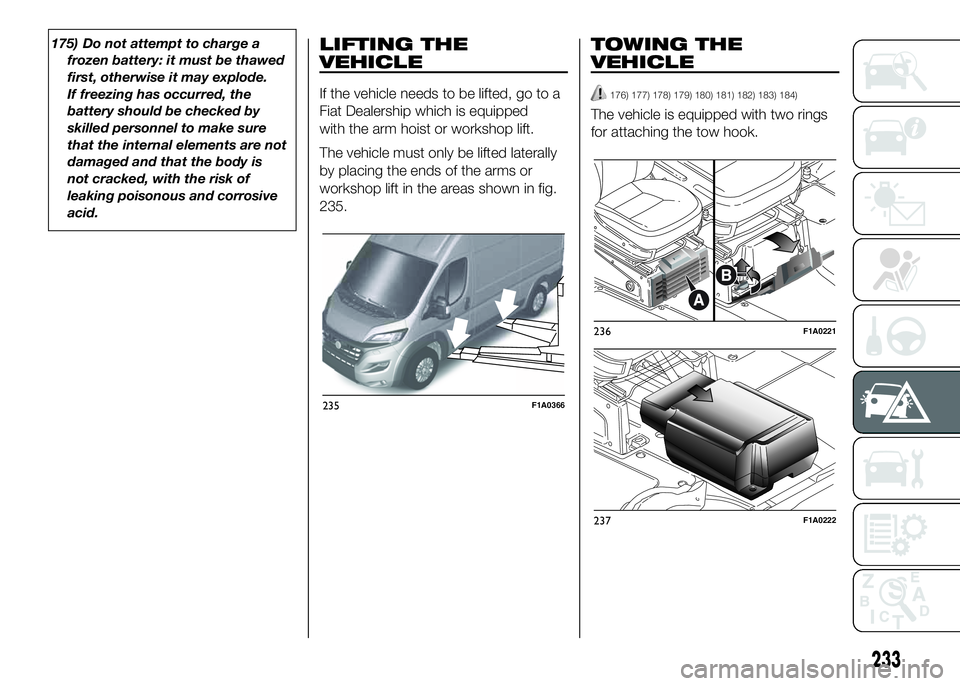
The vehicle must only be lifted laterally
by placing the ends of the arms or
workshop lift in the areas shown in fig.
235.
TOWING THE
VEHICLE
176) 177) 178) 179) 180) 181) 182) 183) 184)
The vehicle is equipped with two rings
for attaching the tow hook.
235F1A0366
236F1A0221
237F1A0222
233
Page 241 of 387
SERVICING AND MAINTENANCE
Correct maintenance permits the
performance of the car to be
maintained over time, as well as limited
running costs and safeguarding the
efficiency of the safety systems.
This chapter explains how.SCHEDULED SERVICING ...............238
SCHEDULED SERVICING PLAN .....239
PERIODIC CHECKS ........................242
DEMANDING VEHICLE USE ...........242
CHECKING LEVELS........................243
AIR CLEANER/POLLEN FILTER ......250
BATTERY ........................................251
WHEELS AND TYRES.....................254
RUBBER HOSES ............................255
WINDSCREEN WIPER ....................255
BODYWORK ...................................257
INTERIORS .....................................259
237
Page 243 of 387
SCHEDULED SERVICING PLAN
Thousands of miles 30 60 90 120 150
Thousands of kilometres 48 96 144 192 240
Years246810
Check battery charge status and recharge if necessary●●●●●
Checktyre conditions/wear and adjust pressure, if required●●●●●
Check operation of lighting system (headlights, direction indicators, hazard
warning lights, luggage compartment, passenger compartment, glove
compartment, instrument panel warning lights, etc.)●●●●●
Check operation of windscreen wiper/washer system and adjust jets, if
necessary●●●●●
Check the position/wear of the windscreen/rear window wiper blades●●●●●
Check cleanliness of bonnet and luggage compartment locks, as well as
cleanliness and lubrication of linkages●●●●●
Visually inspect condition of: exterior bodywork, underbody protection,
pipes and hoses (exhaust, fuel system, brakes), rubber elements (boots,
sleeves, bushes, etc.)●●●●●
Check condition and wear of front disc brake pads and operation of pad
wear indicator●●●●●
Check condition and wear of rear disc brake pads and operation of pad
wear indicator (for versions/markets where provided)●●●●●
239
Page 244 of 387
Thousands of miles 30 60 90 120 150
Thousands of kilometres 48 96 144 192 240
Years246810
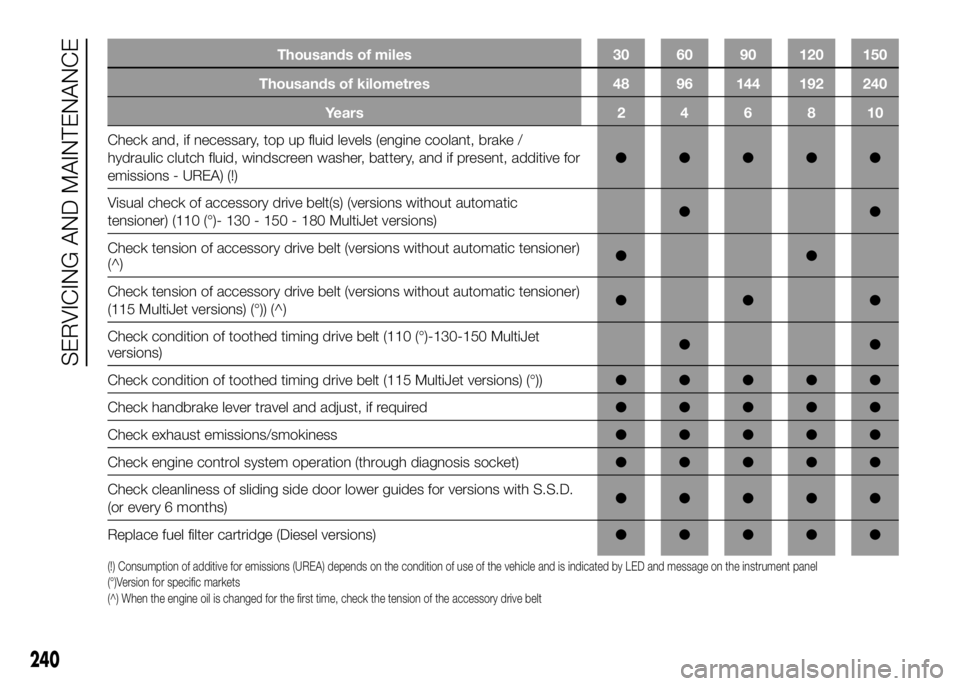
Check and, if necessary, top up fluid levels (engine coolant, brake /
hydraulicclutch fluid, windscreen washer, battery, and if present, additive for
emissions - UREA) (!)●●●●●
Visual check of accessory drive belt(s) (versions without automatic
tensioner) (110 (°)- 130 - 150 - 180 MultiJet versions)●●
Check tension of accessory drive belt (versions without automatic tensioner)
(^)●●
Check tension of accessory drive belt (versions without automatic tensioner)
(115 MultiJet versions) (°)) (^)●●●
Check condition of toothed timing drive belt (110 (°)-130-150 MultiJet
versions)●●
Check condition of toothed timing drive belt (115 MultiJet versions) (°))●●●●●
Check handbrake lever travel and adjust, if required●●●●●
Check exhaust emissions/smokiness●●●●●
Check engine control system operation (through diagnosis socket)●●●●●
Check cleanliness of sliding side door lower guides for versions with S.S.D.
(or every 6 months)●●●●●
Replace fuel filter cartridge (Diesel versions)●●●●●
(!) Consumption of additive for emissions (UREA) depends on the condition of use of the vehicle and is indicated by LED and message on the instrument panel
(°)Version for specific markets
(^) When the engine oil is changed for the first time, check the tension of the accessory drive belt
240
SERVICING AND MAINTENANCE
Page 246 of 387
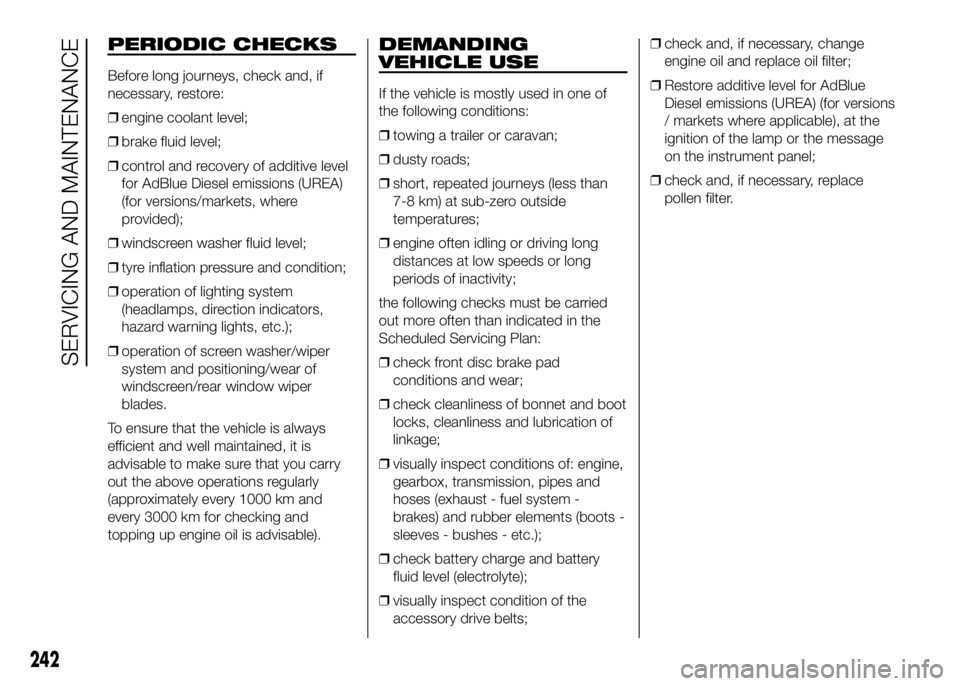
PERIODIC CHECKS
Before long journeys, check and, if
necessary, restore:
❒engine coolant level;
❒brake fluid level;
❒control and recovery of additive level
for AdBlue Diesel emissions (UREA)
(for versions/markets, where
provided);
❒windscreen washer fluid level;
❒tyre inflation pressure and condition;
❒operation of lighting system
(headlamps, direction indicators,
hazard warning lights, etc.);
❒operation of screen washer/wiper
system and positioning/wear of
windscreen/rear window wiper
blades.
To ensure that the vehicle is always
efficient and well maintained, it is
advisable to make sure that you carry
out the above operations regularly
(approximately every 1000 km and
every 3000 km for checking and
topping up engine oil is advisable).
DEMANDING
VEHICLE USE
If the vehicle is mostly used in one of
the following conditions:
❒towing a trailer or caravan;
❒dusty roads;
❒short, repeated journeys (less than
7-8 km) at sub-zero outside
temperatures;
❒engine often idling or driving long
distances at low speeds or long
periods of inactivity;
the following checks must be carried
out more often than indicated in the
Scheduled Servicing Plan:
❒check front disc brake pad
conditions and wear;
❒check cleanliness of bonnet and boot
locks, cleanliness and lubrication of
linkage;
❒visually inspect conditions of: engine,
gearbox, transmission, pipes and
hoses (exhaust - fuel system -
brakes) and rubber elements (boots -
sleeves - bushes - etc.);
❒check battery charge and battery
fluid level (electrolyte);
❒visually inspect condition of the
accessory drive belts;❒check and, if necessary, change
engine oil and replace oil filter;
❒Restore additive level for AdBlue
Diesel emissions (UREA) (for versions
/ markets where applicable), at the
ignition of the lamp or the message
on the instrument panel;
❒check and, if necessary, replace
pollen filter.
242
SERVICING AND MAINTENANCE
Page 255 of 387
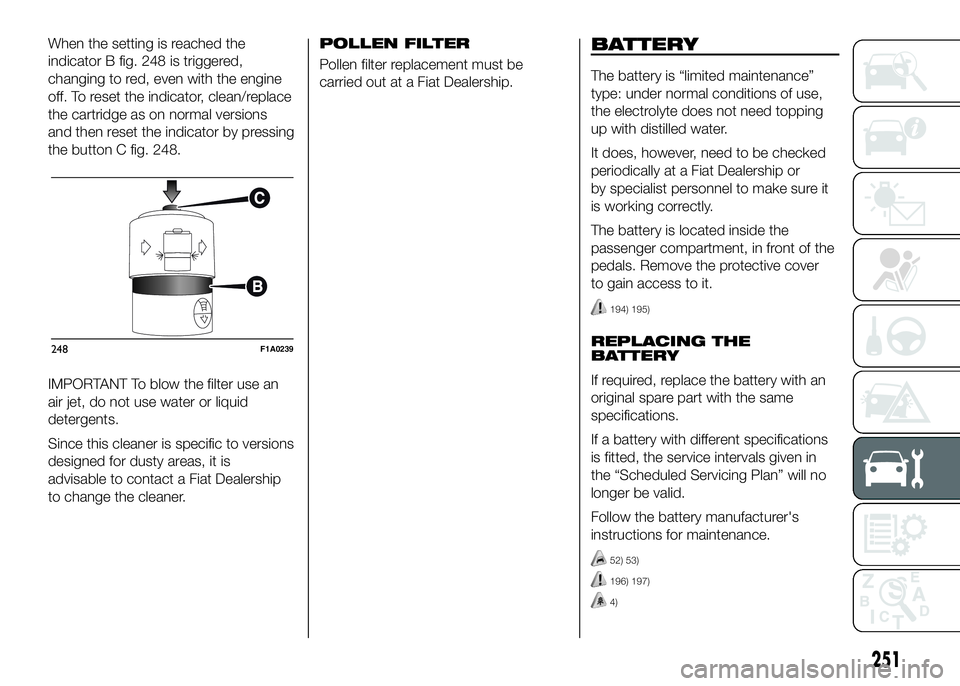
When the setting is reached the
indicator B fig. 248 is triggered,
changing to red, even with the engine
off. To reset the indicator, clean/replace
the cartridge as on normal versions
and then reset the indicator by pressing
the button C fig. 248.
IMPORTANT To blow the filter use an
air jet, do not use water or liquid
detergents.
Since this cleaner is specific to versions
designed for dusty areas, it is
advisable to contact a Fiat Dealership
to change the cleaner.POLLEN FILTER
Pollen filter replacement must be
carried out at a Fiat Dealership.BATTERY
The battery is “limited maintenance”
type: under normal conditions of use,
the electrolyte does not need topping
up with distilled water.
It does, however, need to be checked
periodically at a Fiat Dealership or
by specialist personnel to make sure it
is working correctly.
The battery is located inside the
passenger compartment, in front of the
pedals. Remove the protective cover
to gain access to it.
194) 195)
REPLACING THE
BATTERY
If required, replace the battery with an
original spare part with the same
specifications.
If a battery with different specifications
is fitted, the service intervals given in
the “Scheduled Servicing Plan” will no
longer be valid.
Follow the battery manufacturer's
instructions for maintenance.
52) 53)
196) 197)
4)
248F1A0239
251
Page 256 of 387
USEFUL ADVICE FOR
EXTENDING THE LIFE OF
YOUR BATTERY
To avoid draining your battery and
make it last longer, observe the
following instructions:
❒when you park the vehicle, ensure
that the doors, tailgate and bonnet
are closed properly, to prevent any
roof lights from remaining on inside
the passenger's compartment;
❒switch off all roof lights inside the
vehicle: the vehicle is however
equipped with a system which
switches all internal lights off
automatically;
❒do not keep accessories (e.g. sound
system, hazard lights, etc.) switched
on for a long time when the engine
is not running;
❒before carrying out any operation on
the electrical system, disconnect the
negative battery cable through the
suitable terminal;
❒Completely tighten the battery
terminals.IMPORTANT After turning the ignition
key to STOP and having closed the
driver side door, wait at least one
minute before disconnecting the
electrical supply from the battery. When
reconnecting the electrical supply to
the battery, make sure that the ignition
key is in the STOP position and the
driver side door is closed.
IMPORTANT If the charge level remains
under 50% for a long time, the battery
is damaged by sulphation, reducing
its capacity and efficiency at start-up.
The battery is also more prone to the
risk of freezing (at temperatures as high
as -10°C).
Refer to the paragraph "Car inactivity"
in "Starting and driving" if the car is
left parked for a long time.If, after buying the vehicle, you want to
install electrical accessories which
require permanent electric supply
(alarm, etc.) or accessories that in any
case burden the electrical supply,
contact a Fiat Dealership, whose
qualified personnel, in addition
to suggesting the most suitable devices
from Lineaccessori Fiat, will evaluate
the overall electrical consumption,
checking whether the vehicle’s electrical
system is capable of withstanding the
load required, or whether it should
be integrated with a more powerful
battery.
Since some of these devices continue
to consume electricity even when
the engine is off, they gradually run
down the battery.
IMPORTANT If a tachograph is fitted, if
the vehicle is parked for a long period
of 5 days, it is advisable to disconnect
the negative battery terminal to
maintain its charge.
If the vehicle is equipped with a battery
disconnection function (disconnector),
see the description of the procedure
in the "Controls" paragraph in the
"Dashboard and controls" section.
252
SERVICING AND MAINTENANCE
Page 257 of 387
WARNING
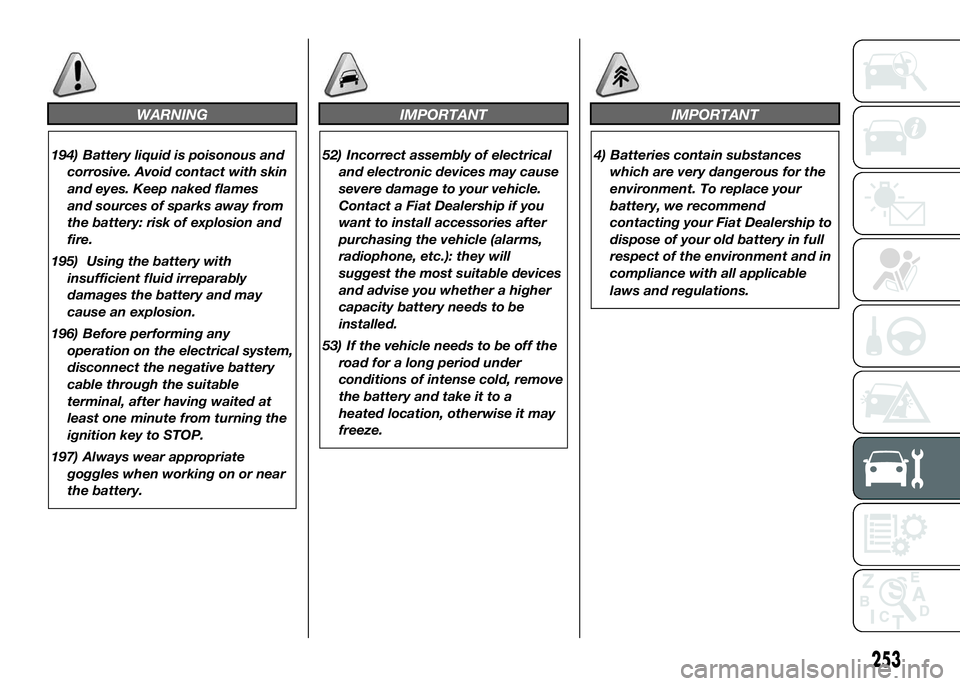
194) Battery liquid is poisonous and
corrosive. Avoid contact with skin
and eyes. Keep naked flames
and sources of sparks away from
the battery: risk of explosion and
fire.
195) Using the battery with
insufficient fluid irreparably
damages the battery and may
cause an explosion.
196) Before performing any
operation on the electrical system,
disconnect the negative battery
cable through the suitable
terminal, after having waited at
least one minute from turning the
ignition key to STOP.
197) Always wear appropriate
goggles when working on or near
the battery.
IMPORTANT
52) Incorrect assembly of electrical
and electronic devices may cause
severe damage to your vehicle.
Contact a Fiat Dealership if you
want to install accessories after
purchasing the vehicle (alarms,
radiophone, etc.): they will
suggest the most suitable devices
and advise you whether a higher
capacity battery needs to be
installed.
53) If the vehicle needs to be off the
road for a long period under
conditions of intense cold, remove
the battery and take it to a
heated location, otherwise it may
freeze.
IMPORTANT
4) Batteries contain substances
which are very dangerous for the
environment. To replace your
battery, we recommend
contacting your Fiat Dealership to
dispose of your old battery in full
respect of the environment and in
compliance with all applicable
laws and regulations.
253
Page 366 of 387
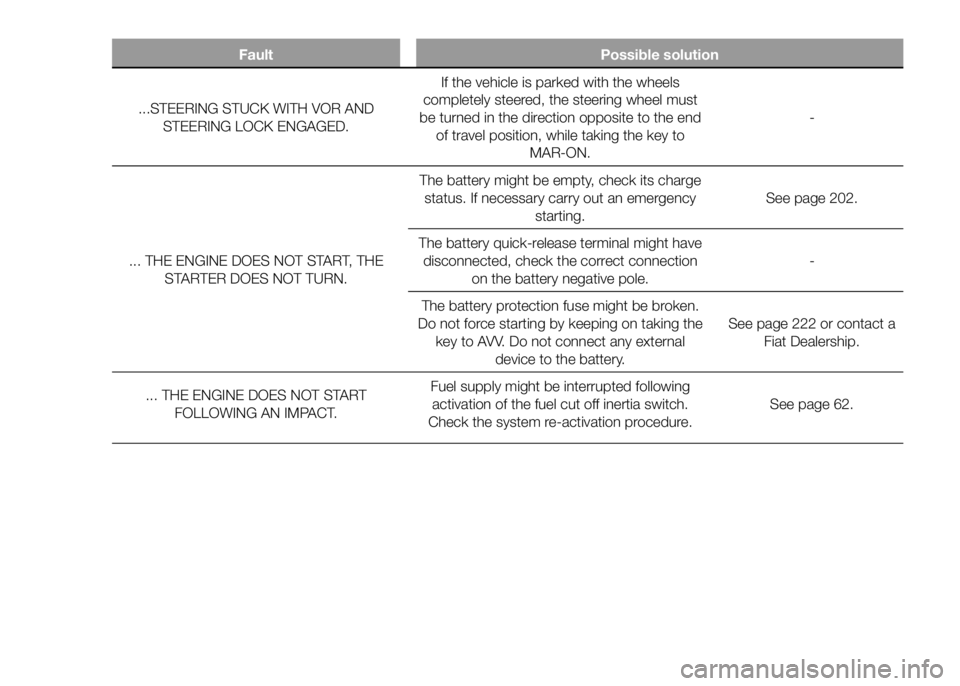
Fault Possible solution
...STEERING STUCK WITH VOR AND
STEERING
LOCK ENGAGED.If the vehicle is parked with the wheels
completely steered, the steering wheel must
be turned in the direction opposite to the end
of travel position, while taking the key to
MAR-ON.-
... THE ENGINE DOES NOT START, THE
STARTER DOES NOT TURN.The battery might be empty, check its charge
status. If necessary carry out an emergency
starting.See page 202.
The battery quick-release terminal might have
disconnected, check the correct connection
on the battery negative pole.-
The battery protection fuse might be broken.
Do not force starting by keeping on taking the
key to AVV. Do not connect any external
device to the battery.See page 222 or contact a
Fiat Dealership.
... THE ENGINE DOES NOT START
FOLLOWING AN IMPACT.Fuel supply might be interrupted following
activation of the fuel cut off inertia switch.
Check the system re-activation procedure.See page 62.