front seats FIAT DUCATO 2018 Owner handbook (in English)
[x] Cancel search | Manufacturer: FIAT, Model Year: 2018, Model line: DUCATO, Model: FIAT DUCATO 2018Pages: 304, PDF Size: 14.93 MB
Page 19 of 304
WARNING
2)The footboard presence may reduce the
ramp approach angles; it is therefore
recommended, in case of a very steep
ramp, to be very careful in order not to
damage the footboard.
SEATS
17)
3)
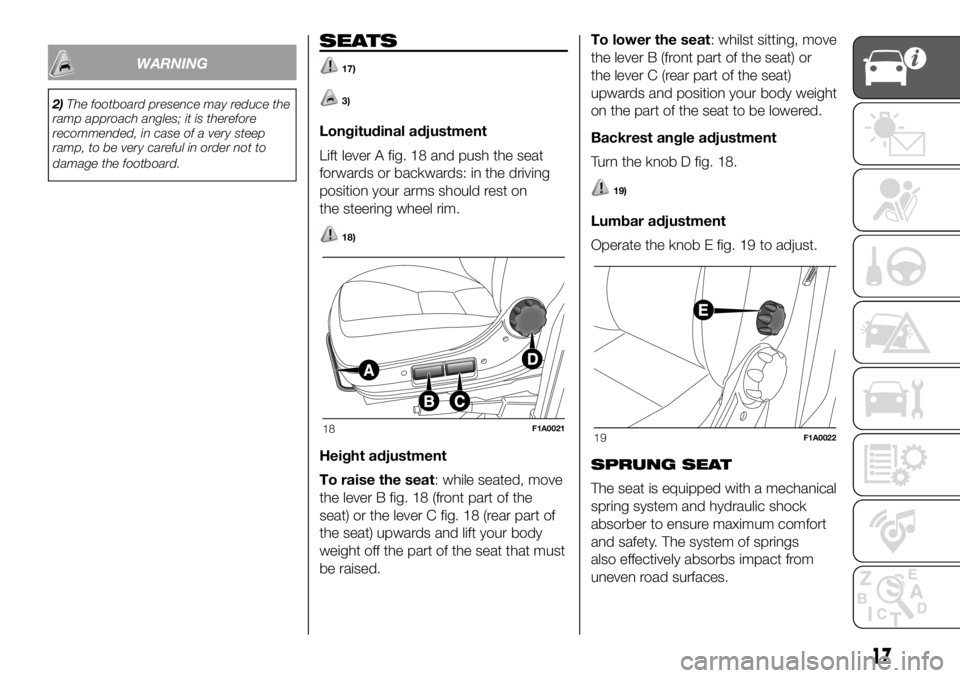
Longitudinal adjustment
Lift lever A fig. 18 and push the seat
forwards or backwards: in the driving
position your arms should rest on
the steering wheel rim.
18)
Height adjustment
To raise the seat: while seated, move
the lever B fig. 18 (front part of the
seat) or the lever C fig. 18 (rear part of
the seat) upwards and lift your body
weight off the part of the seat that must
be raised.To lower the seat: whilst sitting, move
the lever B (front part of the seat) or
the lever C (rear part of the seat)
upwards and position your body weight
on the part of the seat to be lowered.
Backrest angle adjustment
Turn the knob D fig. 18.
19)
Lumbar adjustment
Operate the knob E fig. 19 to adjust.
SPRUNG SEAT
The seat is equipped with a mechanical
spring system and hydraulic shock
absorber to ensure maximum comfort
and safety. The system of springs
also effectively absorbs impact from
uneven road surfaces.
18F1A002119F1A0022
17
Page 21 of 304
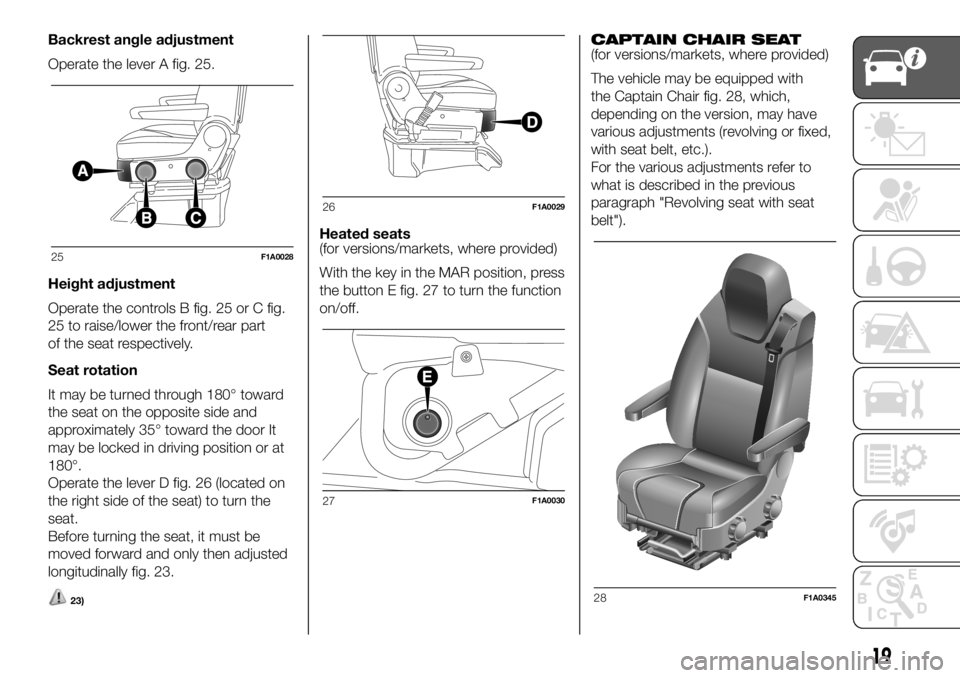
Backrest angle adjustment
Operate the lever A fig. 25.
Height adjustment
Operate the controls B fig. 25 or C fig.
25 to raise/lower the front/rear part
of the seat respectively.
Seat rotation
It may be turned through 180° toward
the seat on the opposite side and
approximately 35° toward the door It
may be locked in driving position or at
180°.
Operate the lever D fig. 26 (located on
the right side of the seat) to turn the
seat.
Before turning the seat, it must be
moved forward and only then adjusted
longitudinally fig. 23.
23)
Heated seats
(for versions/markets, where provided)
With the key in the MAR position, press
the button E fig. 27 to turn the function
on/off.CAPTAIN CHAIR SEAT
(for versions/markets, where provided)
The vehicle may be equipped with
the Captain Chair fig. 28, which,
depending on the version, may have
various adjustments (revolving or fixed,
with seat belt, etc.).
For the various adjustments refer to
what is described in the previous
paragraph "Revolving seat with seat
belt").
25F1A0028
26F1A0029
27F1A0030
28F1A0345
19
Page 39 of 304
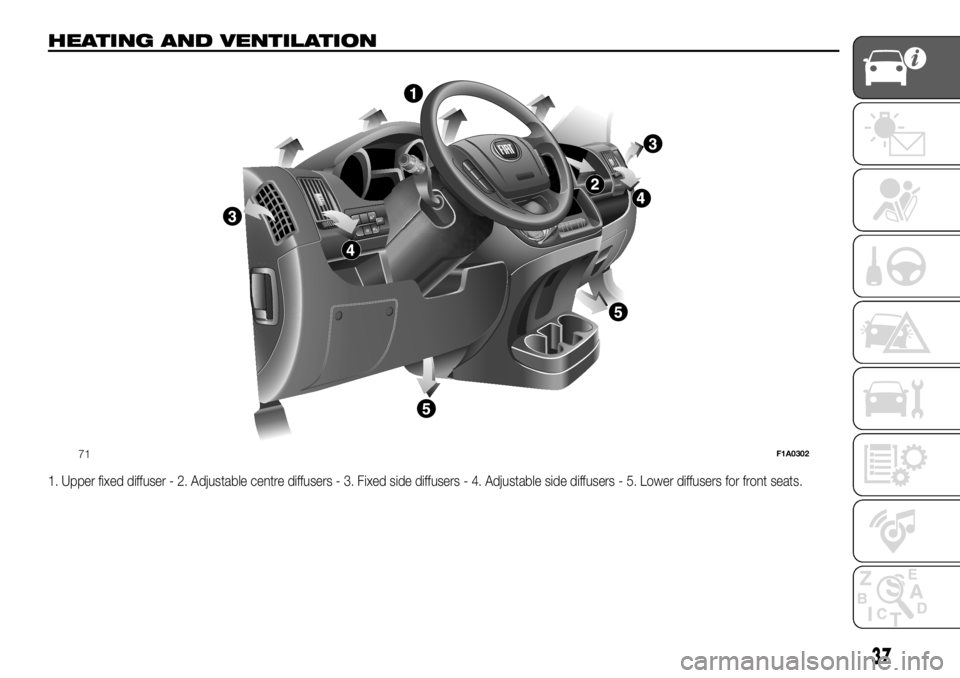
HEATING AND VENTILATION.
1. Upper fixed diffuser - 2. Adjustable centre diffusers - 3. Fixed side diffusers - 4. Adjustable side diffusers - 5. Lower diffusers for front seats.
MODE
71F1A0302
37
Page 46 of 304
Turn the knob D to the maximum
heating position (knob at red
sector);warm air will emerge (with the
engine warmed up), from the rear
footwell outlets (located under the seats
in the 2nd and 3rd row for Panorama
versions and the grille on the left wheel
arch side for Combi versions).
ADDITIONAL REAR
CLIMATE CONTROL
(Panorama and Combi)
(for versions/markets, where provided)
The Panorama and Combi versions
are equipped with a main heating/air
conditioning system plus an additional
system (available on request) with
controls in the roof panel trim above the
second row of seats fig. 77. Button F
fig. 78 on the control panel must be
enabled for operation; the air
conditioning only works if the main
climate control system is on.
When the knob D is placed in the
fully cold position (control in blue sector)
cold air comes out the vents in the
ceiling.
Turn the knob D to the maximum
heating position (knob at red
sector);warm air will emerge (with the
engine warmed up), from the rear
footwell outlets (located under the seats
in the 2nd and 3rd row for Panorama
versions and the grille on the left wheel
arch side for Combi versions).
If the selector knob D is placed in
the intermediate positions, the air
will be distributed between the vents in
the ceiling and the rear footwell vents,
varying the temperature.
IMPORTANT If the compressor on the
main climate control system control
is turned on (operation of button E),
even if the additional climate control
system fan is in position 0, the 1st
speed will automatically be activated to
prevent ice formation, with possible
damage to the component.
WARNING
35)The heater burns fuel in the same way
as the engine, though to a lesser extent. To
prevent poisoning and asphyxiation, the
supplementary heater must never be
turned on, not even for short periods, in
closed environments such as a garage or
workshops without extraction fans for
the exhaust gases.
ELECTRIC WINDOWS
ELECTRIC
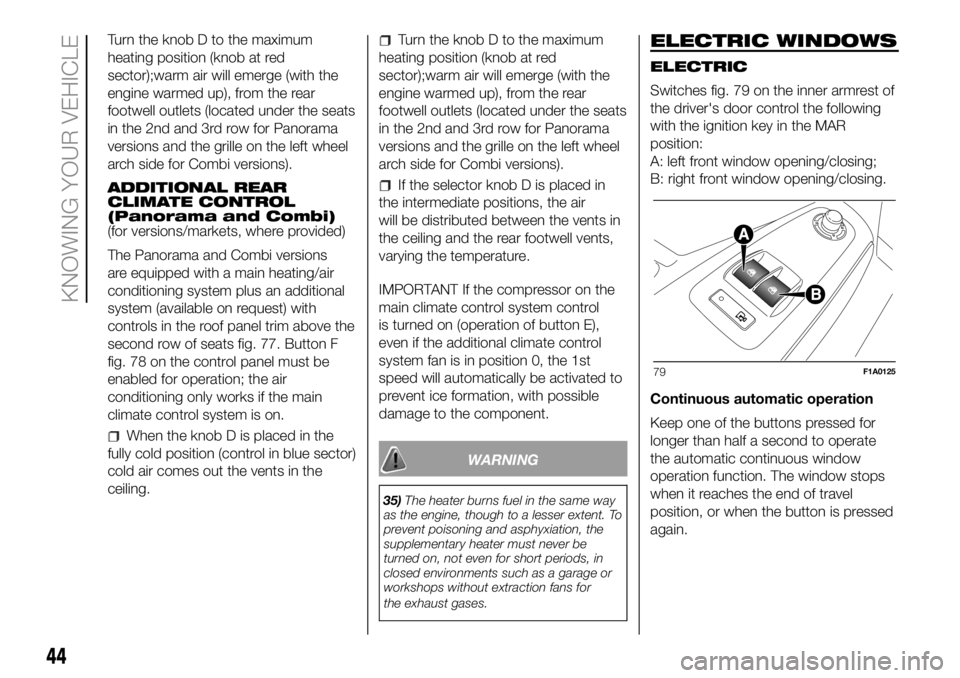
Switches fig. 79 on the inner armrest of
the driver's door control the following
with the ignition key in the MAR
position:
A: left front window opening/closing;
B: right front window opening/closing.
Continuous automatic operation
Keep one of the buttons pressed for
longer than half a second to operate
the automatic continuous window
operation function. The window stops
when it reaches the end of travel
position, or when the button is pressed
again.
79F1A0125
44
KNOWING YOUR VEHICLE
Page 99 of 304
SEAT BELTS
IN BRIEF
All the seats in the vehicle are
equipped with seatbelts with three
anchoring points and a retractor. The
reel mechanism operates locking
the belt in the event of sharp braking
or strong deceleration due to an
impact. This allows the belt strap to
slide freely and to adapt to the body
of the occupant. In the event of an
accident, the belt will lock to reduce
the risk of impact inside the
passenger compartment or of being
projected outside the vehicle. The
driver is responsible for respecting,
and ensuring that all the other
occupants of the vehicle also
respect, the local laws in force in
relation to the use of the seat belts.
Always fasten the seat belts before
setting off.
USING THE SEAT BELTS
The belt should be worn keeping the
torso straight and rested against the
backrest.
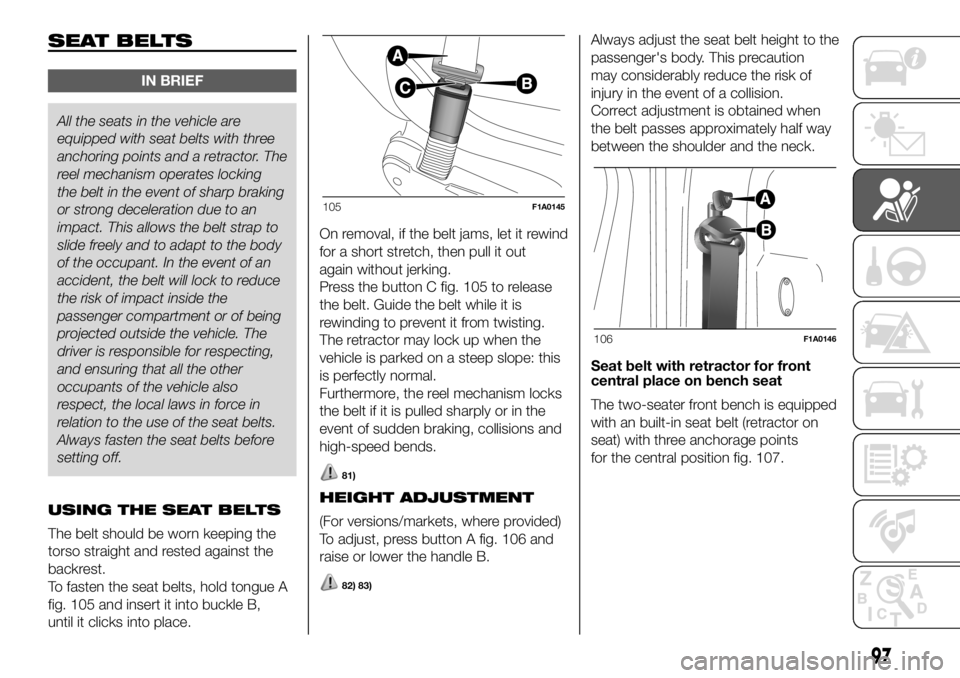
To fasten the seat belts, hold tongue A
fig. 105 and insert it into buckle B,
until it clicks into place.On removal, if the belt jams, let it rewind
for a short stretch, then pull it out
again without jerking.
Press the button C fig. 105 to release
the belt. Guide the belt while it is
rewinding to prevent it from twisting.
The retractor may lock up when the
vehicle is parked on a steep slope: this
is perfectly normal.
Furthermore, the reel mechanism locks
the belt if it is pulled sharply or in the
event of sudden braking, collisions and
high-speed bends.
81)
HEIGHT ADJUSTMENT
(For versions/markets, where provided)
To adjust, press button A fig. 106 and
raise or lower the handle B.
82) 83)
Always adjust the seat belt height to the
passenger's body. This precaution
may considerably reduce the risk of
injury in the event of a collision.
Correct adjustment is obtained when
the belt passes approximately half way
between the shoulder and the neck.
Seat belt with retractor for front
central place on bench seat
The two-seater front bench is equipped
with an built-in seat belt (retractor on
seat) with three anchorage points
for the central position fig. 107.
105F1A0145
106F1A0146
97
Page 102 of 304
SEAT BELTS
MAINTENANCE
For keeping the seat belts in efficient
conditions, carefully observe the
following warnings:
always use the seat belt well
stretched and never twisted; make sure
that it is free to run without
obstructions;
check seat belt operation as follows:
attach the seat belt and pull it hard;
replace the belt after an accident of
a certain severity even if it does not
appear to be damaged. Always replace
the belt if the pretensioners were
deployed;
prevent the retractors from getting
wet: their correct operation is only
guaranteed if water does not get inside;
replace the seat belt when it shows
wear or cuts.
WARNING
84)The pretensioner may be used only
once. After it is triggered, have it replaced
at a Fiat Dealership.
85)For maximum safety, keep the backrest
upright, lean back into it and make sure
the seat belt fits closely across your chest
and pelvis. Always fasten the seat belts
on both the front and the rear seats!
Travelling without wearing seat belts will
increase the risk of serious injury and even
death in the event of an accident.
86)Removing or tampering with seat belt
and pretensioner components is strictly
prohibited. Any intervention on these
components must be performed by
qualified and authorised technicians.
Always go to a Fiat Dealership.
87)If the belt has been sharply pulled, for
example as the result of an accident,
the seat belt, together with the anchoring
devices, the anchoring device fixing screws
and the pretensioner must be completely
replaced. Even if the belt does not present
any exterior signs of wear or damage, it
may have lost its restraining properties.
WARNING
13)Operations which lead to impacts,
vibrations or localised heating (over 100°C
for a maximum of six hours) in the area
around the pretensioners may damage or
deploy them. Contact a Fiat Dealership
should intervention be necessary on these
components.
100
SAFETY
Page 105 of 304
PASSENGER SEAT COMPLIANCE FOR USING UNIVERSAL CHILD SEATS
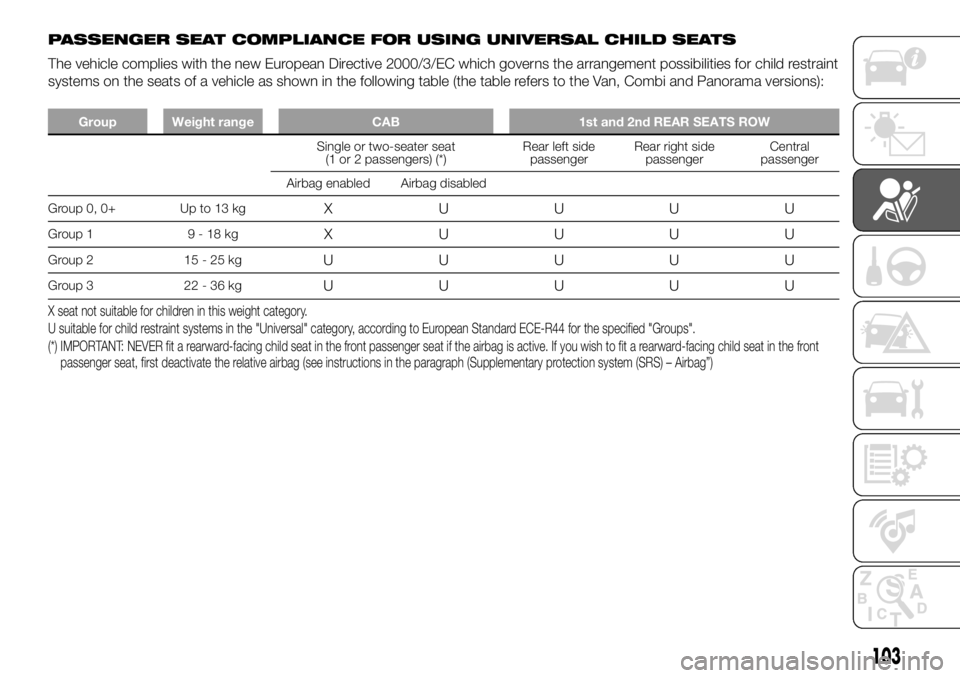
The vehicle complies with the new European Directive 2000/3/EC which governs the arrangement possibilities for child restraint
systems on the seats of a vehicle as shown in the following table (the table refers to the Van, Combi and Panorama versions):
Group Weight range CAB 1st and 2nd REAR SEATS ROW
Single or two-seater seat
(1 or 2 passengers) (*)Rear left side
passengerRear right side
passengerCentral
passenger
Airbag enabled Airbag disabled
Group 0, 0+ Up to 13 kg
X UUUU
Group 1 9 - 18 kgX UUUU
Group 2 15 - 25 kgUUUUU
Group 3 22 - 36 kgUUUUU
X seat not suitable for children in this weight category.
U suitable for child restraint systems in the "Universal" category, according to European Standard ECE-R44 for the specified "Groups".
(*) IMPORTANT: NEVER fit a rearward-facing child seat in the front passenger seat if the airbag is active. If you wish to fit a rearward-facing child seat in the front
passenger seat, first deactivate the relative airbag (see instructions in the paragraph (Supplementary protection system (SRS) – Airbag”)
103
Page 106 of 304
Below is a summary of
the main safety rules to
be followed when
carrying children
The recommended position for
installing child restraint systems is on
the rear seat, as it is the most protected
area in the event of an impact.
Keep children in rearward-facing
child restraint systems for as long
as possible, ideally until they are 3–4
years old.
If the passenger front airbag is
deactivated, always check the
corresponding LED on the button
on
the instrument panel to make sure
that it has actually been deactivated.
Carefully follow the instructions that
come with the child seat, which the
manufacturer must supply. Keep the
instructions in the vehicle along with the
other papers and this handbook. Do
not use second-hand child seats
without instructions.
Always check that the seat belt is
well fastened by pulling on it.
Only one child is to be strapped into
each restraint system; never carry two
children using one child restraint
system.
Always check that seat belts do not
rest on the child’s neck.
While travelling, do not let the child
sit incorrectly or unfasten the belts.
Never carry children on your lap,
even newborns. No-one can hold
a child in the case of a crash.
Never allow a child to put the belt's
diagonal section under an arm or
behind their back.
If the vehicle has been involved in a
road accident, replace the child
restraint system with a new one. In
addition, and depending on the type of
child restraint system installed, replace
the Isofix anchorages or the seat belt
with which the child restraint system
was connected.
The rear headrest can be removed if
needed to install a child restraint
system. The headrest must always be
fitted in the vehicle if the seat is used by
an adult passenger or a child sitting in
a restraint system without backrest.
WARNING
88)Do not place a rearward facing cradle
seat on the front seat if the passenger side
airbag is enabled. Deployment of the
airbag in an accident could cause fatal
injuries to the child regardless of the
severity of the impact. It is advisable to
always carry children in a child restraint
system on the rear seat, which is the most
protected position in the event of a
collision. If you need to carry a child on the
front passenger seat in a rearward facing
cradle restraint system, the passenger side
airbags (front and side bags for chest/
pelvis protection, for versions/markets,
where provided) must be deactivated using
the setup menu. It is important to check
the dedicated LED on button
on the
dashboard to make sure that they are
actually deactivated. Move the
passenger's seat as far back as possible
to avoid contact between the child seat
and the dashboard.
89)On the sun visor there is a label with
suitable symbols reminding the user that it
is compulsory to deactivate the airbag if
a rearward facing child restraint system is
fitted. Always comply with the instructions
on the passenger side sun visor (see the
"Supplementary Restraint System (SRS)
- Airbag" paragraph).
90)Do not move the front or rear seat if a
child is seated on it or on the dedicated
child restraint system.
104
SAFETY
Page 107 of 304
91)Incorrect fitting of the child restraint
system may result in an inefficient
protection system. In the event of an
accident the child restraint system may
become loose and the child may be
injured, even fatally. When fitting a restraint
system for newborns or children, strictly
comply with the instructions provided
by the Manufacturer.
92)When the child restraint system is not
used, secure it with the seat belt or with
the ISOFIX anchorages, or remove it from
the vehicle. Do not leave it unsecured
inside the passenger compartment. This
way, in the case of sudden braking or
an accident, it will not cause injuries to the
occupants.
93)Always make sure that the diagonal
section of the seat belt does not pass
under the arms or behind the back of the
child. In the event of an accident the seat
belt will not be able to secure the child,
with the risk of injury, including fatal injury.
Therefore the child must always wear
the seat belt correctly.
94)The figures are only examples for fitting
purposes. Fit the child restraint system
according to the instructions, which must
be included.
95)Car seats for weight groups 0 and 1
feature an anchor in front of the vehicle
safety belts as well as its own belts to
restrain the child. Due to their weight, they
may be dangerous if incorrectly mounted
(e.g. if fastened to the vehicle seat belts
placing a cushion in between). Follow the
assembly instructions carefully.SETUP FOR
“UNIVERSAL
ISOFIX” CHILD
RESTRAINT SYSTEM
The vehicle is set up for fitting an Isofix
child restraint system.
The ISOFIX system lets you install the
ISOFIX child restraining system quickly,
simply and safely, without using the
car seat belts, but by connecting the
child restrain system directly to the car
seat with three anchors in the vehicle.
Traditional child restraint systems can
be fitted alongside ISOFIX child restraint
systems on different seats in the same
vehicle.
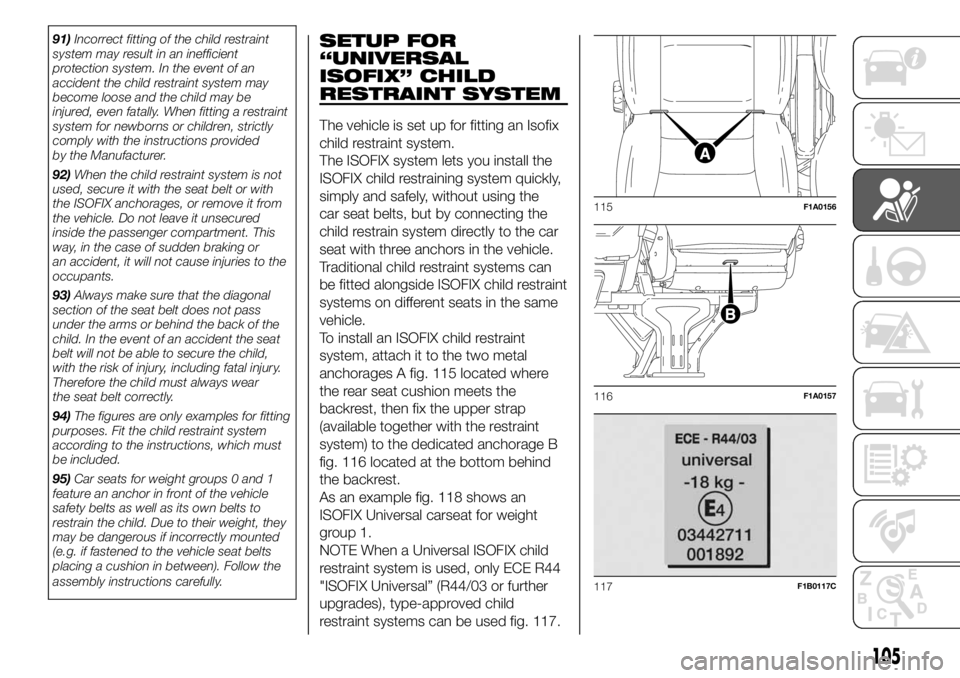
To install an ISOFIX child restraint
system, attach it to the two metal
anchorages A fig. 115 located where
the rear seat cushion meets the
backrest, then fix the upper strap
(available together with the restraint
system) to the dedicated anchorage B
fig. 116 located at the bottom behind
the backrest.
As an example fig. 118 shows an
ISOFIX Universal carseat for weight
group 1.
NOTE When a Universal ISOFIX child
restraint system is used, only ECE R44
"ISOFIX Universal” (R44/03 or further
upgrades), type-approved child
restraint systems can be used fig. 117.
115F1A0156
116F1A0157
117F1B0117C
105
Page 118 of 304
IMPORTANT A small amount of dust
will be released when the airbags
are deployed. The dust is not harmful
and does not indicate the beginning of
a fire. Furthermore, the surface of the
deployed bag and the interior of the
vehicle may be covered in a dusty
residue: this may irritate your skin and
eyes. Wash with mild soap and water in
the event of exposure.
IMPORTANT Should an accident occur
in which any of the safety devices are
activated, take the vehicle to a Fiat
Dealership to have the activated
devices replaced and to have the whole
system checked.
Every control, repair and replacement
operation concerning the airbags must
be carried out only at Fiat Dealerships.
If you are having the vehicle scrapped,
have the system deactivated at a Fiat
Dealership first. If the vehicle changes
ownership, the new owner must be
informed of how to use the airbags and
the above warnings and also be given
this "Owner Handbook".
IMPORTANT Pretensioners, front
airbags and front side bags are
deployed differently according to the
type of collision. Failure to activate one
or more of the devices does not
indicate a system malfunction.
WARNING
100)Do not apply stickers or other objects
to the steering wheel, the dashboard in
the passenger side airbag area and the
seats. Never put objects (e.g. mobile
phones) on the passenger side of the
dashboard since they could interfere with
correct inflation of the passenger airbag
and also cause serious injury to the
passengers.
101)When there is an active passenger
airbag, DO NOT install rearward facing
child restraint systems on the front seat.
Deployment of the airbag in an accident
could cause fatal injuries to the child
regardless of the severity of the impact.
Therefore, always deactivate the passenger
side airbag when a rearward facing child
restraint system is installed on the front
passenger seat. The front passenger seat
must also be positioned back as far as
possible in order to prevent the child
restraint system from coming into contact
with the dashboard. Immediately reactivate
the passenger airbag as soon as the child
restraint system has been removed.
102)Never rest head, arms and elbows on
the doors, on the windows and in the
side air bag head protection area (Window
Bag) to prevent possible injuries during
inflation phase.
103)Never lean your head, arms or elbows
out of the window.104)If when turning the key to MAR the
warning light
does not turn on or if
it stays on when travelling (together with
the message on the multifunction display,
for versions/markets where provided), there
could be a fault in the safety systems; in
this event, airbags or pretensioners may
not trigger in the case of impact or, in
a lower number of cases, they could be
triggered accidentally. Contact a Fiat
Dealership immediately to have the system
checked.
105)Do not cover the backrest of the front
or rear seats with covers which are not
suitable for use with side bags.
106)Do not travel carrying objects in your
lap, in front of your chest or between
your lips (pipe, pencils, etc.): they could
cause severe injury if the airbag is
deployed.
107)Always drive keeping your hands on
the steering wheel rim so the airbag can
inflate freely if necessary. Do not drive with
your body bent forward. Keep your back
straight against the backrest.
116
SAFETY