disc FIAT DUCATO 244 2005 3.G User Guide
[x] Cancel search | Manufacturer: FIAT, Model Year: 2005, Model line: DUCATO 244, Model: FIAT DUCATO 244 2005 3.GPages: 258, PDF Size: 4.05 MB
Page 164 of 258
163VEHICLE MAINTENANCE
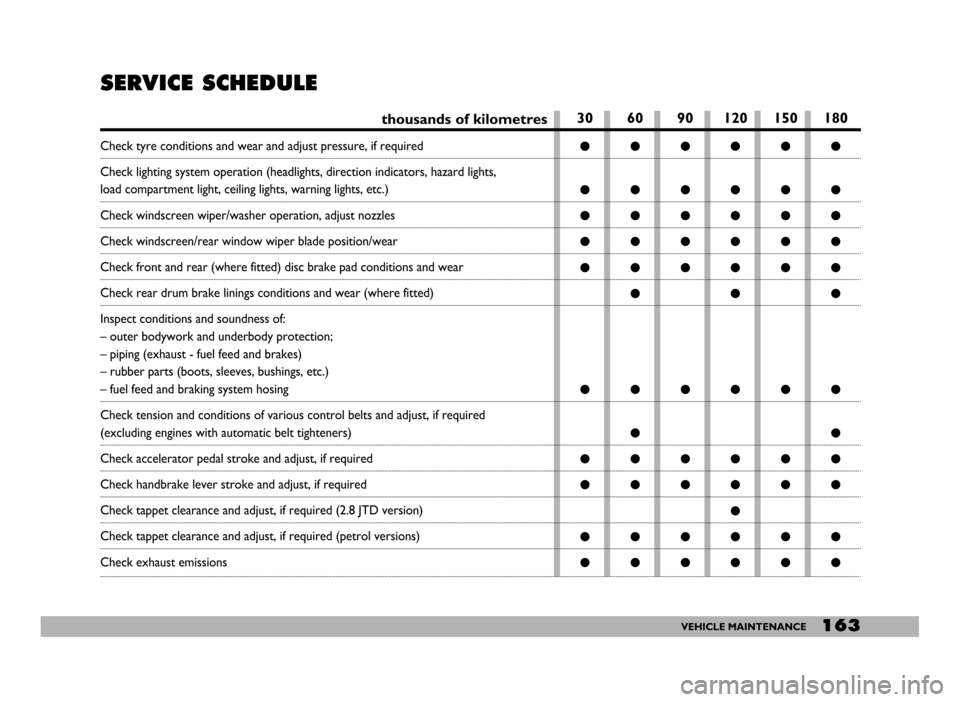
SERVICE SCHEDULE
thousands of kilometres
Check tyre conditions and wear and adjust pressure, if required
Check lighting system operation (headlights, direction indicators, hazard lights,
load compartment light, ceiling lights, warning lights, etc.)
Check windscreen wiper/washer operation, adjust nozzles
Check windscreen/rear window wiper blade position/wear
Check front and rear (where fitted) disc brake pad conditions and wear
Check rear drum brake linings conditions and wear (where fitted)
Inspect conditions and soundness of:
– outer bodywork and underbody protection;
– piping (exhaust - fuel feed and brakes)
– rubber parts (boots, sleeves, bushings, etc.)
– fuel feed and braking system hosing
Check tension and conditions of various control belts and adjust, if required
(excluding engines with automatic belt tighteners)
Check accelerator pedal stroke and adjust, if required
Check handbrake lever stroke and adjust, if required
Check tappet clearance and adjust, if required (2.8 JTD version)
Check tappet clearance and adjust, if required (petrol versions)
Check exhaust emissions
30 60 90 120 150 180
●●●●●●
●●●●●●
●●●●●●
●●●●●●
●●●●●●
●●●
●●●●●●
●●
●●●●●●
●●●●●●
●
●●●●●●
●●●●●●
Page 177 of 258
176VEHICLE MAINTENANCE
Furthermore, remember that high in-
take electric devices (such as baby bot-
tle warmers, vacuum cleaners, cellular
phones, mini-fridges, etc.) powered
when the engine is offcan deploy
the battery.
IMPORTANTWhen installing ad-
ditional systems on the vehicle, bear
in mind that improper branches on
connections of the vehicle wiring are
dangerous, particularly if safety devices
are involved.
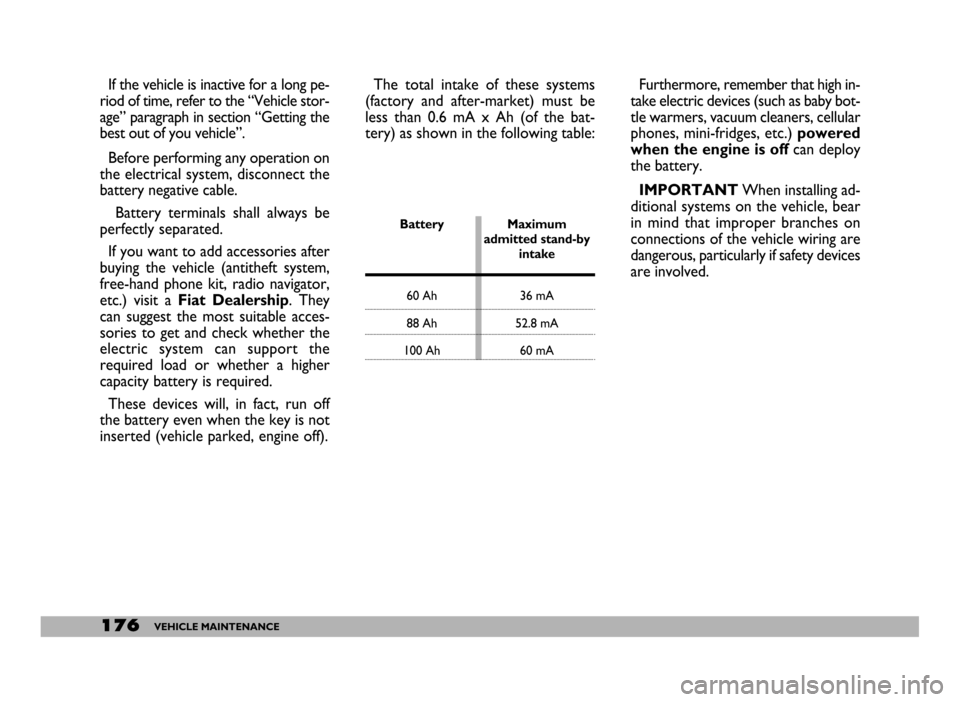
Battery
60 Ah
88 Ah
100 Ah
The total intake of these systems
(factory and after-market) must be
less than 0.6 mA x Ah (of the bat-
tery) as shown in the following table:
Maximum
admitted stand-by
intake
36 mA
52.8 mA
60 mA
If the vehicle is inactive for a long pe-
riod of time, refer to the “Vehicle stor-
age” paragraph in section “Getting the
best out of you vehicle”.
Before performing any operation on
the electrical system, disconnect the
battery negative cable.
Battery terminals shall always be
perfectly separated.
If you want to add accessories after
buying the vehicle (antitheft system,
free-hand phone kit, radio navigator,
etc.) visit a Fiat Dealership. They
can suggest the most suitable acces-
sories to get and check whether the
electric system can support the
required load or whether a higher
capacity battery is required.
These devices will, in fact, run off
the battery even when the key is not
inserted (vehicle parked, engine off).
Page 178 of 258
177VEHICLE MAINTENANCE
ELECTRONIC
CONTROL UNIT
When the vehicle is being used nor-
mally, special measures are not nec-
essary.
The following instructions must be
followed very carefully however, if
you work on the electrical system or
in cases where emergency starting is
necessary:
– never disconnect the battery from
the electric system while the engine is
running;
– disconnect the battery from the
electric system if you are recharging it;
– never perform emergency starting
with a battery charger. Always use an
auxiliary battery;
– be particularly careful when con-
necting the battery to the electric sys-
tem. Make sure that the polarity is
correct and that the connection is ef-
ficient;
– do not connect or disconnect the
terminals of the electronic units while
the ignition key is at MAR;
– do not check polarity through
sparking;– disconnect the electronic control
units if you are electrically welding the
vehicle body. Remove the units if tem-
peratures exceed 80 °C (special op-
erations on the bodywork, etc.).
IMPORTANTIf the sound system
or vehicle alarm systems are not in-
stalled correctly, they can interfere
with the working of the electronic
control units.
Modifications or repairs to
the electrical system car-
ried out incorrectly and without
bearing the features of the system
in mind can cause malfunctions
with the risk of fire.
WARNING
SPEED LIMITER
On certain version, the injection con-
trol unit is set to limit the vehicle
speed at a max. preset limit.
Speed limits are the following:
– for Minibus versions (M2 homolo-
gation category): 100 km/h;
– for good Transport versions (ve-
hicle dead weight: > 3.5 t) (N2 ho-
mologation category): 90 km/h;
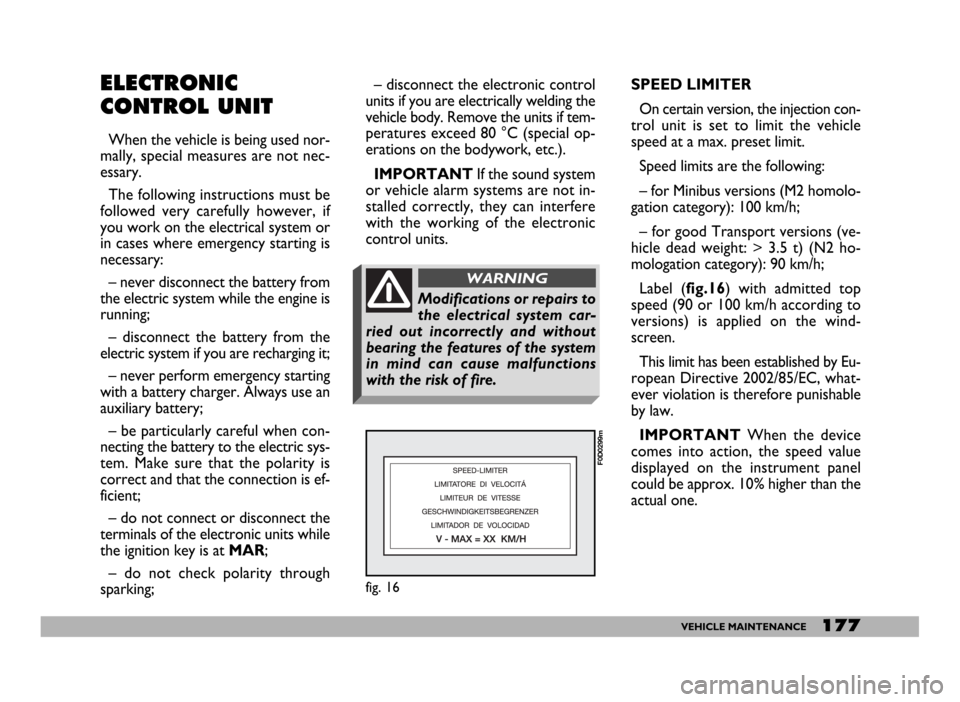
Label (fig.16) with admitted top
speed (90 or 100 km/h according to
versions) is applied on the wind-
screen.
This limit has been established by Eu-
ropean Directive 2002/85/EC, what-
ever violation is therefore punishable
by law.
IMPORTANTWhen the device
comes into action, the speed value
displayed on the instrument panel
could be approx. 10% higher than the
actual one.
fig. 16
F0D0299m
Page 217 of 258
216TECHNICAL SPECIFICATIONS
BRAKES
SERVICE AND EMERGENCY
BRAKES
Front: disc, floating caliper with two
operating cylinders for each wheel and
pad wear warning light.
Rear: self-centring shoes and micro-
metric mechanism for clearance take-
up.
Certain versions are fitted with rear
disc brakes with Drum in hat device
(i.e. drum on disc to block the vehicle
when parked with handbrake en-
gaged).
Cross-over hydraulic circuit control.
Four sensors ABS system with EBD.
Automatic recovery of the friction
gasket wear; versions with rear disc
brake excluded (Drum in hat ver-
sions).
Lacking ABS system brakeforce dis-
tributor acting on rear brake hydraulic
circuit according to rear axle load.HANDBRAKE
Controlled by a lever, it works me-
chanically on the rear brake shoes.
For versions with rear disc brakes,
the handbrake works on the Drum in
hat device shoes.
IMPORTANTPull the handbrake
lever only when the vehicle is at a
standstill, or when the vehicle is run-
ning, but however only in case of a
failure of the hydraulic system.
Should the handbrake be exception-
ally used when the vehicle is running,
it is suggested to keep a moderate
traction to avoid causing the rear axle
block, entailing vehicle side skidding.
TRANSMISSION
CLUTCH
Hydraulically controlled without
travel-free pedal.
MECHANICAL GEARBOX
AND DIFFERENTIAL
Five forward gears and reverse with
synchromesh for front gear engage-
ment.
Cyclical gear reduction and differen-
tial assembly incorporated in the gear-
box.
Drive transmission to the front
wheels by means of drive shafts con-
nected to the differential assembly and
the wheels with CV joints.
Water, ice or salt on road
surfaces can deposit on
brake discs, reducing braking effi-
ciency on the first braking.
WARNING