wheel FIAT DUCATO 244 2005 3.G User Guide
[x] Cancel search | Manufacturer: FIAT, Model Year: 2005, Model line: DUCATO 244, Model: FIAT DUCATO 244 2005 3.GPages: 258, PDF Size: 4.05 MB
Page 68 of 258
67GETTING TO KNOW YOUR VEHICLE
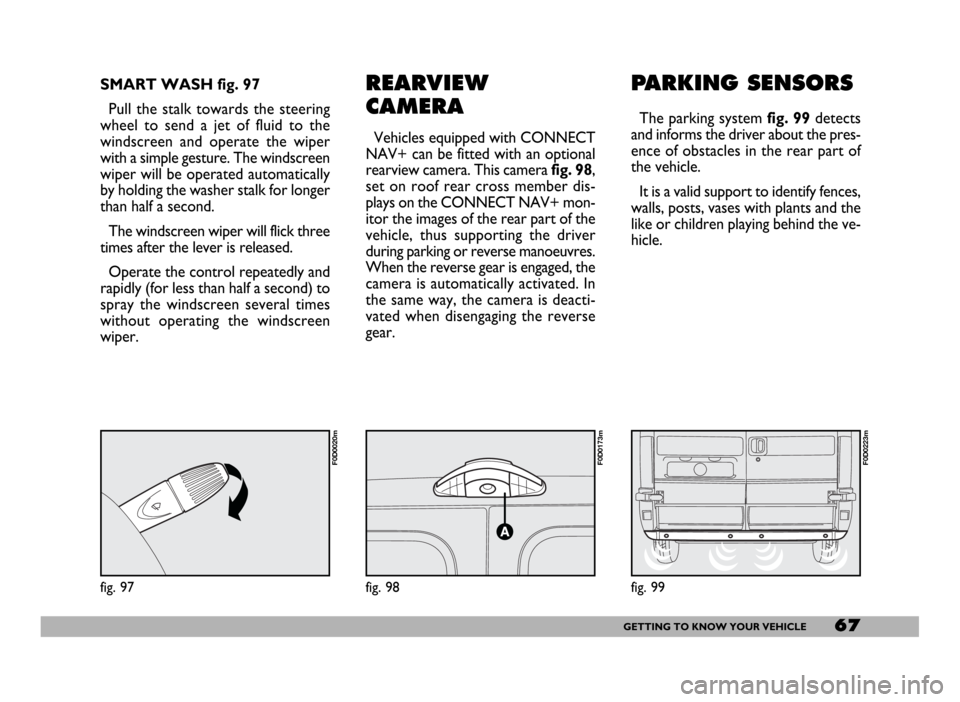
REARVIEW
CAMERA
Vehicles equipped with CONNECT
NAV+ can be fitted with an optional
rearview camera. This camerafig. 98,
set on roof rear cross member dis-
plays on the CONNECT NAV+ mon-
itor the images of the rear part of the
vehicle, thus supporting the driver
during parking or reverse manoeuvres.
When the reverse gear is engaged, the
camera is automatically activated. In
the same way, the camera is deacti-
vated when disengaging the reverse
gear.
PARKING SENSORS
The parking system fig. 99detects
and informs the driver about the pres-
ence of obstacles in the rear part of
the vehicle.
It is a valid support to identify fences,
walls, posts, vases with plants and the
like or children playing behind the ve-
hicle.
fig. 98
F0D0173m
SMART WASH fig. 97
Pull the stalk towards the steering
wheel to send a jet of fluid to the
windscreen and operate the wiper
with a simple gesture. The windscreen
wiper will be operated automatically
by holding the washer stalk for longer
than half a second.
The windscreen wiper will flick three
times after the lever is released.
Operate the control repeatedly and
rapidly (for less than half a second) to
spray the windscreen several times
without operating the windscreen
wiper.
fig. 97
F0D0020m
fig. 99
F0D0223m
Page 70 of 258
69GETTING TO KNOW YOUR VEHICLE
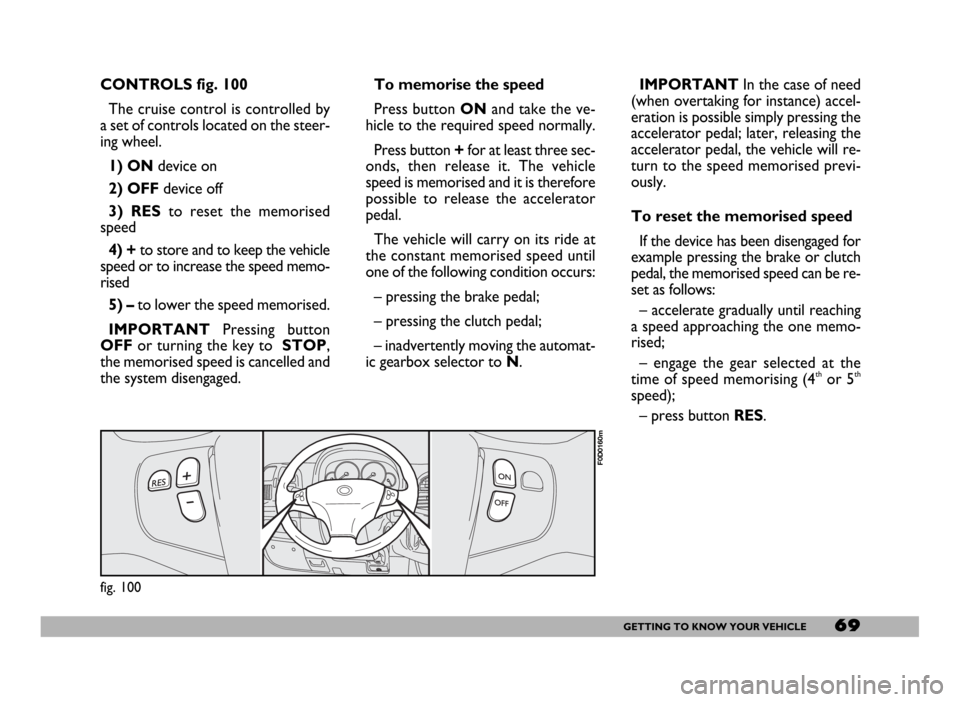
CONTROLS fig. 100
The cruise control is controlled by
a set of controls located on the steer-
ing wheel.
1) ONdevice on
2) OFFdevice off
3) RESto reset the memorised
speed
4) +to store and to keep the vehicle
speed or to increase the speed memo-
rised
5) – to lower the speed memorised.
IMPORTANTPressing button
OFFor turning the key to STOP,
the memorised speed is cancelled and
the system disengaged.IMPORTANTIn the case of need
(when overtaking for instance) accel-
eration is possible simply pressing the
accelerator pedal; later, releasing the
accelerator pedal, the vehicle will re-
turn to the speed memorised previ-
ously.
To reset the memorised speed
If the device has been disengaged for
example pressing the brake or clutch
pedal, the memorised speed can be re-
set as follows:
– accelerate gradually until reaching
a speed approaching the one memo-
rised;
– engage the gear selected at the
time of speed memorising (4
thor 5th
speed);
– press button RES. To memorise the speed
Press button ONand take the ve-
hicle to the required speed normally.
Press button +for at least three sec-
onds, then release it. The vehicle
speed is memorised and it is therefore
possible to release the accelerator
pedal.
The vehicle will carry on its ride at
the constant memorised speed until
one of the following condition occurs:
– pressing the brake pedal;
– pressing the clutch pedal;
– inadvertently moving the automat-
ic gearbox selector to N.
fig. 100
F0D0160m
Page 89 of 258
88GETTING TO KNOW YOUR VEHICLE
If you have never driven a vehicle
with ABS before, you should practice
using the system on slippery terrain,
obviously with the necessary safety
precautions and keeping to the High-
way Code of the country you are in.
It is also a good idea to read the fol-
lowing information carefully.
The advantage in using the ABS sys-
tem is that it continues to give you
maximum manoeuvrability even when
braking hard in conditions of poor grip
by preventing the wheels locking.
You should, however, not expect the
braking distance to always decrease:
for example surfaces with gravel or
fresh snow on a slippery road will in
fact increase the braking distance.
To exploit the ABS system to the full
in the event of necessity, you should
take heed of the following advice:ABS
The vehicle is fitted with an ABS
braking system (optional), which pre-
vents the wheels from locking when
braking, makes the most of road grip
and gives the best control when emer-
gency braking under difficult road con-
ditions.
The driver can tell the ABS system
has come into play when he feels the
brake pedal pulsating slightly and the
system gets noiser.
This should not be interpreted as a
fault in the brakes; on the contrary it
is a sign that the ABS system is work-
ing: it tells the driver that the vehicle
is travelling at the limit of its road grip
and that he should alter his speed to
fit the type of road surface.
The ABS system is an addition to the
basic braking system. If there is a mal-
function, the system turns off auto-
matically and only the ordinary brakes
continue to work.
If a failure occurs, and consequently
the anti-lock function is not effective,
the braking system will continue to
work as usual.
If the ABS system cuts in it
is a sign that the grip be-
tween the tyre and the road surface
has reached the limit: you must
slow down to match the speed to
the road grip available.
WARNING
If there is a fault, the warn-
ing light >will light up on
the dashboard. At this point, reduce
speed and go to a Fiat Dealership
to have your vehicle checked and
put right immediately.
WARNING
The ABS exploits the tyre-
road grip available to the
full, but it cannot improve it; you
should therefore take every care
when driving on slippery surfaces,
and not take unnecessary risks.
WARNING
Page 90 of 258
89GETTING TO KNOW YOUR VEHICLE
Warning light >alone,
with the engine running,
normally indicates a fault in the
ABS system only. In this case, the
braking system is still efficient,
though without the anti-locking de-
vice. Under these conditions, per-
formance of the EBD system may
be reduced. In this case too, you are
advised to go immediately to the
nearest Fiat Dealership, driving in
such a way to avoid sharp braking
to have the system checked over.
WARNING
If the xbrake fluid low
warning light comes on,
stop the vehicle immediately and
contact the nearest Fiat Dealership.
Fluid leaks from the hydraulic sys-
tem, in fact, can compromise brake
system operation, both traditional
systems and systems with ABS.
WARNING
Braking while cornering always re-
quires extreme care even when using
ABS.
The most important advice to follow
is this:
If you follow these tips you will be
able to brake better in any situation.
IMPORTANTVehicles fitted with
ABS shall only be fitted with wheel rims,
tyres and brake pads of the make and
model approved by the vehicle manu-
facturer.The system is completed with an elec-
tronic brakeforce distributor called
EBD which improves braking system
performance by means of the ABSsys-
tem control unit and sensors.
When the ABS cuts in, and
you feel the brake pedal
pulsating, do not remove your foot,
but keep it pressed. In doing so you
will stop in the shortest amount of
space possible under the current
road conditions.
WARNING
The vehicle is fitted with an
electronic brakeforce dis-
tributor (EBD). The >and x
warning lights come on at the same
time when the engine is running to
indicate that there is an EBD sys-
tem failure. In this case violent
braking may be accompanied by
early rear wheel locking with the
possibility of skidding. Drive ex-
tremely carefully to the nearest Fi-
at Dealership to have the system
checked.
WARNING
Page 91 of 258
90GETTING TO KNOW YOUR VEHICLE
FRONT AND SIDE
AIRBAGS
FRONT AIRBAGS
Description and operation
The front airbag (driver’s and passen-
ger’s) is a safety device which comes in-
to action in the event of a head-on col-
lision.
It consists of a cushion that inflates
instantaneously contained in a special
recess:
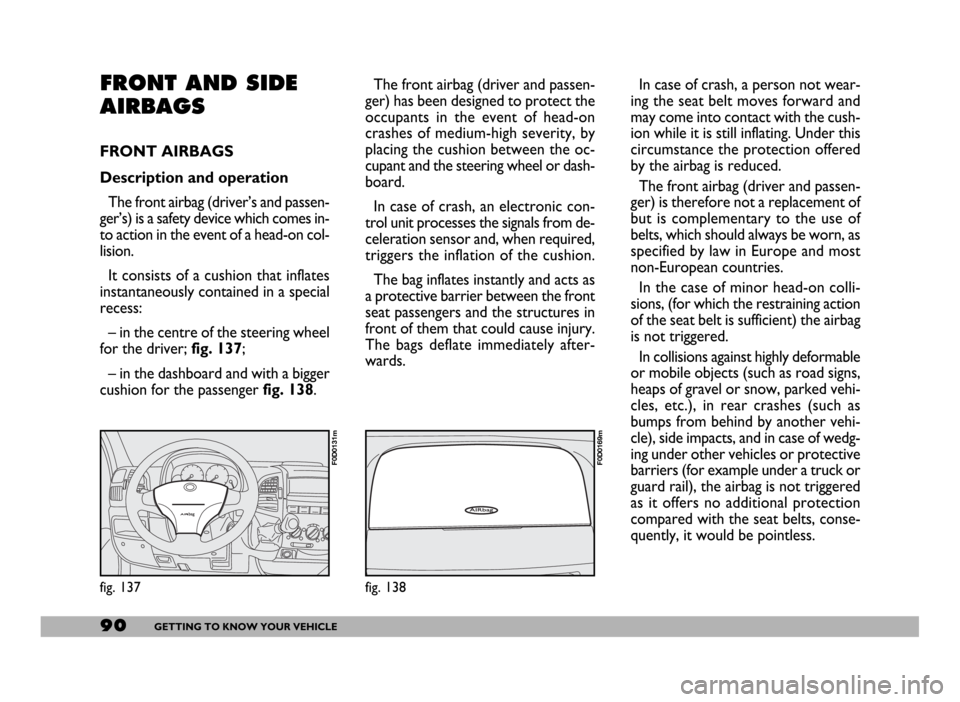
– in the centre of the steering wheel
for the driver; fig. 137;
– in the dashboard and with a bigger
cushion for the passenger fig. 138.The front airbag (driver and passen-
ger) has been designed to protect the
occupants in the event of head-on
crashes of medium-high severity, by
placing the cushion between the oc-
cupant and the steering wheel or dash-
board.
In case of crash, an electronic con-
trol unit processes the signals from de-
celeration sensor and, when required,
triggers the inflation of the cushion.
The bag inflates instantly and acts as
a protective barrier between the front
seat passengers and the structures in
front of them that could cause injury.
The bags deflate immediately after-
wards.
fig. 137
F0D0131m
fig. 138
F0D0169m
In case of crash, a person not wear-
ing the seat belt moves forward and
may come into contact with the cush-
ion while it is still inflating. Under this
circumstance the protection offered
by the airbag is reduced.
The front airbag (driver and passen-
ger) is therefore not a replacement of
but is complementary to the use of
belts, which should always be worn, as
specified by law in Europe and most
non-European countries.
In the case of minor head-on colli-
sions, (for which the restraining action
of the seat belt is sufficient) the airbag
is not triggered.
In collisions against highly deformable
or mobile objects (such as road signs,
heaps of gravel or snow, parked vehi-
cles, etc.), in rear crashes (such as
bumps from behind by another vehi-
cle), side impacts, and in case of wedg-
ing under other vehicles or protective
barriers (for example under a truck or
guard rail), the airbag is not triggered
as it offers no additional protection
compared with the seat belts, conse-
quently, it would be pointless.
Page 95 of 258
94GETTING TO KNOW YOUR VEHICLE
If the vehicle changes owner-
ship, the new owner must be in-
formed of the method of use of
airbags and the above warnings
and also be given this Owner
Handbook.
The triggering of pretensioners
and front and side airbags is de-
cided in a differentiated manner
by the electronic control unit, de-
pending on the type of crash. The
failure to deploy one or more of
them does not mean that the sys-
tem is not working properly.
If the ¬warning light does
not turn on when turning
the ignition key to MAR or if it stays
on when travelling, this could indi-
cate a failure in safety retaining sys-
tems; under this condition air bags
or pretensioners could not trigger
in the event of collision or, in a re-
stricted number of cases, they could
trigger accidentally. Stop the car
and contact Fiat Dealership to have
the system checked immediately.
WARNING
If the vehicle has been
stolen or an attempt to
steal it has been made, if it has
been subjected to vandals or floods,
have the airbag system checked by
Fiat Dealership.
WARNING
Do not apply stickers or
other objects to the steer-
ing wheel or to the airbag console
on the passenger’s side. Never trav-
el with objects on your lap, in front
of your chest or with a pipe, pencil,
etc. between your lips; injury may
result in the event of the airbag be-
ing triggered.
WARNING
Always keep your hands on
the steering wheel rim
when driving, so that if the airbag
is triggered, it can inflate without
meeting any obstacles which could
cause serious harm to you. Do not
drive with the body bent forwards,
keep the seat back rest in the erect
position and lean your back well
against it.
WARNING
When the passenger’s front
airbag is active (passenger
front airbag deactivation switch at
ON), the
Fwarning light will
come on for approx. 4 seconds and
flash for other four seconds when
the ignition key is turned to MAR to
remind the driver that the passen-
ger’s front and side airbags (where
provided) will be fired in the event
of a crash. The warning light should
go off immediately afterwards.
WARNING
Page 97 of 258
96GETTING TO KNOW YOUR VEHICLE
The action of the ASR is particularly
helpful in the following circumstances:
– slipping of the inner wheel due to
the effect of dynamic load changes or
excessive acceleration.
– too much power transmitted to
the wheels also in relation to the con-
ditions of the road surface.
– acceleration on slippery, snowy or
frozen surfaces.
– in the case of loss of grip on a wet
surface (aquaplaning). Furthermore, the system is equipped
with a connector for interfacing with
specific tools used to read the error
codes stored in the control unit mem-
ory along with a set of diagnostic and
engine specific parameters.ASR SYSTEM
(Antislip Regulation)
The ASR system controls the vehicle
drive and cuts in automatically every
time one or both driving wheels slip.
In slipping conditions, two different
control systems are activated:
– if the slipping involves both the dri-
ving wheels, the ASR function inter-
venes reducing the power transmitted
by the engine;
– if slipping involves only one driving
wheel, the ASR system cuts in auto-
matically braking the wheel that is slip-
ping.
IMPORTANTAfter eliminating the
problem, your Fiat Dealershipwill
run a bench test to fully check the sys-
tem. In some cases, a long road test
may be required.Contact a Fiat Dealer-
ship as soon as possible if
the Uwarning light ei-
ther does not come on when the
key is turned to MAR or comes
on, with fixed or flashing light,
when travelling. Warning light U
operation can be checked by
means of special equipment by
traffic agents. Always comply
with the road traffic regulations
in force in the Country where you
are travelling.
The performance of the
system, in terms of active
safety should not induce the driver
to take pointless and unnecessary
risks. The style of driving must in
any case always be adapted to the
conditions of the road surface, vis-
ibility and traffic. Road safety is al-
ways the driver’s responsibility.
WARNING
Page 98 of 258
97GETTING TO KNOW YOUR VEHICLE
SWITCHING THE ASR
SYSTEM ON AND OFF
The ASR function switches on auto-
matically each time the engine is
started.
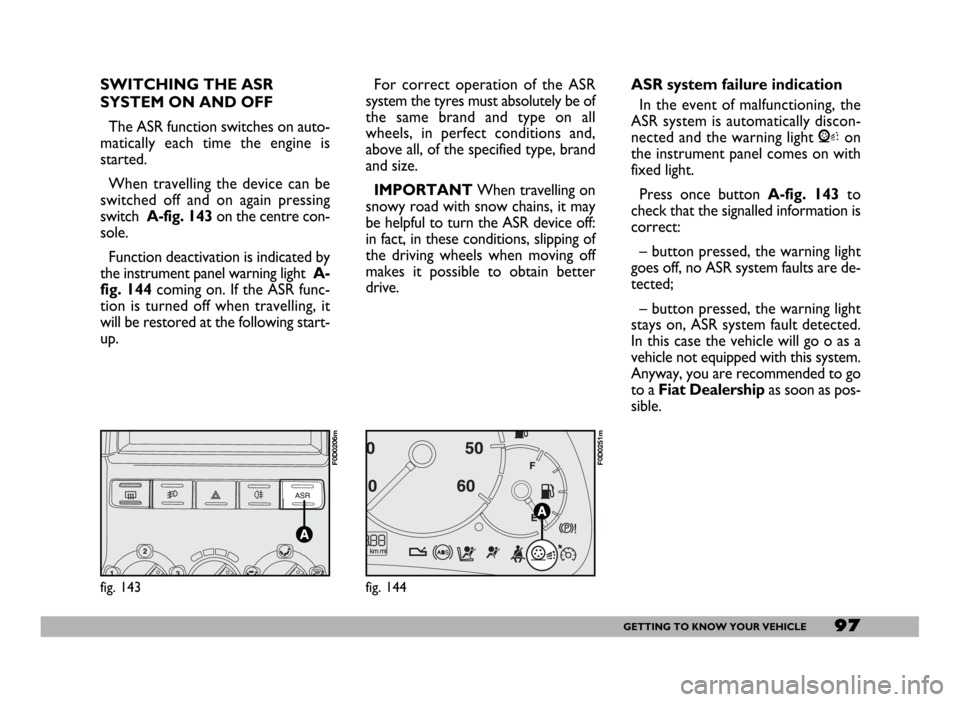
When travelling the device can be
switched off and on again pressing
switch A-fig. 143 on the centre con-
sole.
Function deactivation is indicated by
the instrument panel warning light A-
fig. 144coming on. If the ASR func-
tion is turned off when travelling, it
will be restored at the following start-
up.For correct operation of the ASR
system the tyres must absolutely be of
the same brand and type on all
wheels, in perfect conditions and,
above all, of the specified type, brand
and size.
IMPORTANTWhen travelling on
snowy road with snow chains, it may
be helpful to turn the ASR device off:
in fact, in these conditions, slipping of
the driving wheels when moving off
makes it possible to obtain better
drive.
fig. 143
F0D0206m
ASR system failure indication
In the event of malfunctioning, the
ASR system is automatically discon-
nected and the warning light Von
the instrument panel comes on with
fixed light.
Press once button A-fig. 143to
check that the signalled information is
correct:
– button pressed, the warning light
goes off, no ASR system faults are de-
tected;
– button pressed, the warning light
stays on, ASR system fault detected.
In this case the vehicle will go o as a
vehicle not equipped with this system.
Anyway, you are recommended to go
to a Fiat Dealershipas soon as pos-
sible.
fig. 144
F0D0251m
Page 102 of 258
101GETTING TO KNOW YOUR VEHICLE
RADIO
TRANSMITTERS AND
CELLULAR
TELEPHONES
Cellular telephones and other radio
transceiver equipment (e.g. HAM ra-
dio system) must not be used inside
the vehicle unless a separate aerial is
mounted on the outside of the vehicle.
IMPORTANTThe use of cellular
telephones, HAM transmitters or oth-
er similar devices inside the passenger
compartment (without external aeri-
al) produces RF electromagnetic fields
which, amplified by the resonance ef-
fects inside the passenger compart-
ment may cause vehicle electrical sys-
tem to malfunction.
Moreover, the transmission and re-
ceiving quality deteriorates due to the
screening effect of the vehicle body. Have the cellular phone and the con-
nections to the system installed by a
Fiat Dealership.
The hands-free tele-
phone you purchase will
need to be compatible
with your cellular telephone.
Have the cellular tele-
phone and the connec-
tions to the system in-
stalled by a Fiat Dealership only.
This will ensure the best results
and prevent problems which
could impair vehicle safety.
ROOF RACK/
SKI RACK
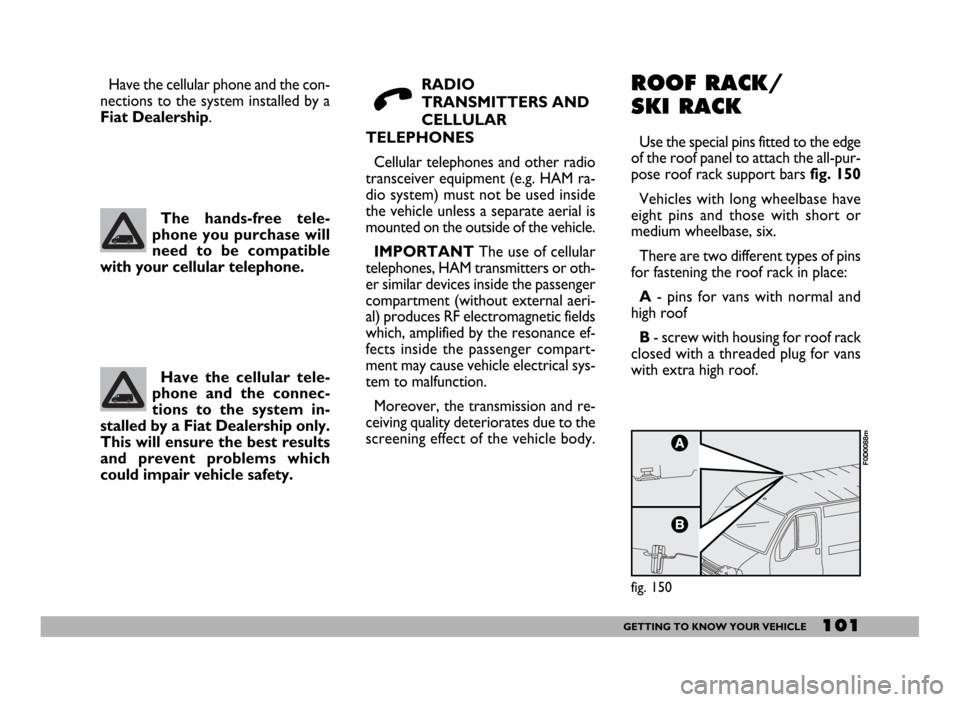
Use the special pins fitted to the edge
of the roof panel to attach the all-pur-
pose roof rack support bars fig. 150
Vehicles with long wheelbase have
eight pins and those with short or
medium wheelbase, six.
There are two different types of pins
for fastening the roof rack in place:
A- pins for vans with normal and
high roof
B- screw with housing for roof rack
closed with a threaded plug for vans
with extra high roof.
fig. 150
F0D0088m
Page 108 of 258
107GETTING THE BEST OUT OF YOUR VEHICLE
If you still cannot start the engine,
get in touch with a Fiat Dealership.
IMPORTANT When the outside
temperature is low, it is important to
note that the use of a more fluid oil
will facilitate starting the cold engine.
Therefore, in winter, follow the advice
in chapter “Technical specifications”,
paragraph “Fluids and lubricants”.
IMPORTANTNever leave the igni-
tion key at MARwhen the engine is off.
Minibus and School Bus versions:
press the ignition enable button lo-
cated to the left of the steering col-
umn as shown in the specific supple-
ment to this handbook.HOW TO WARM UP
THE ENGINE AFTER IT
HAS JUST STARTED
(petrol and diesel versions)
– Begin to move forward slowly let-
ting the engine turn at medium revs.
Do not accelerate abruptly.
– Do not push the engine to its lim-
it for the first few kilometres. You are
recommended to wait until the
coolant temperature indicator starts
to move.
EMERGENCY START-UP
If the Fiat CODE system fails to
recognise that code transmitted by the
ignition key (warning light Yon the
instrument panel lit) the emergency
start-up can be performed by using the
CODE card code.
See the “In an emergency” section.Catalysed vehicles must
not be bump started
(pushed, towed or coast-
ed downhill) as this could cause
fuel to flow into the catalytic ex-
haust system and damage it be-
yond repair.
Remember that until the
engine has started the
brake booster and power steering
systems will not work and a greater
effort will therefore be required to
depress the brake pedal or turn the
steering wheel.
WARNING