ABS FIAT DUCATO 244 2005 3.G Owner's Manual
[x] Cancel search | Manufacturer: FIAT, Model Year: 2005, Model line: DUCATO 244, Model: FIAT DUCATO 244 2005 3.GPages: 258, PDF Size: 4.05 MB
Page 125 of 258

124GETTING THE BEST OUT OF YOUR VEHICLE
To get the most out of ABS:
– During emergency stops or when
grip conditions are poor, you will feel
a slight pulsation on the brake pedal.
This is the sign that the ABS is work-
ing. Do not release the brake pedal but
continue to press so as not to inter-
rupt the braking action;
– ABS enables you to brake and steer
at the same time. If you meet an un-
expected obstacle you can therefore
steer around it;
– the ABS prevents the wheels from
locking but it does not increase actu-
al grip conditions between tyre and
road. Therefore, even if your vehicle
is fitted with ABS, keep a safe distance
from the vehicle in front of you and
keep your speed down when driving
into bends.
ABS serves to increase your control
over the vehicle, not to enable you to
go faster.Some suggestions which may help
you to keep the running costs of the
vehicle down and lower the amount
of toxic emissions released into the at-
mosphere are given below.
GENERAL
CONSIDERATIONS
Vehicle maintenance
Carry out the checks and adjust-
ments/regulations specified in the
“Service Schedule”.
Tyres
Check tyre inflation pressure regu-
larly. Tyres should be checked at least
once every four weeks: if the pressure
is too low, fuel consumption increas-
es as the resistance to the rolling
movement of the tyre is greater.Unnecessary loads
Do not travel with too much load.
The weight of the vehicle (specially in
urban traffic) and its trim greatly ef-
fects consumption and stability.
Roof rack/ski rack
Remove the roof or ski racks from
the vehicle as soon as they are no
longer needed. These accessories re-
duce the aerodynamic penetration of
the vehicle and will increase con-
sumption. When transporting partic-
ularly large objects, use a trailer,
where possible.CONTAINING RUNNING COSTS
Page 130 of 258
129GETTING THE BEST OUT OF YOUR VEHICLE
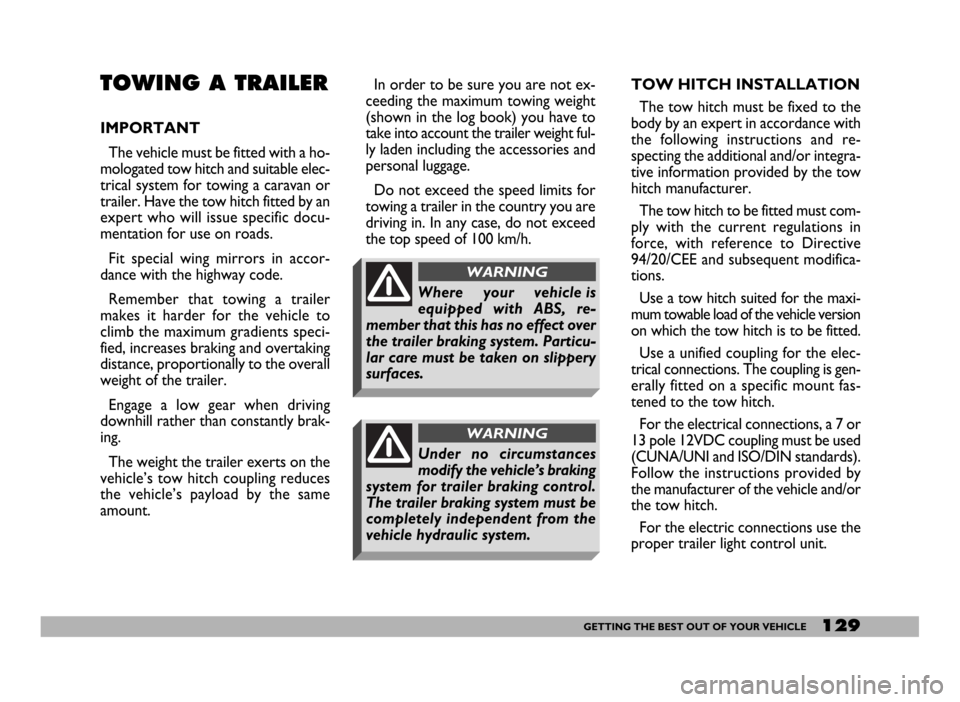
TOWING A TRAILER
IMPORTANT
The vehicle must be fitted with a ho-
mologated tow hitch and suitable elec-
trical system for towing a caravan or
trailer. Have the tow hitch fitted by an
expert who will issue specific docu-
mentation for use on roads.
Fit special wing mirrors in accor-
dance with the highway code.
Remember that towing a trailer
makes it harder for the vehicle to
climb the maximum gradients speci-
fied, increases braking and overtaking
distance, proportionally to the overall
weight of the trailer.
Engage a low gear when driving
downhill rather than constantly brak-
ing.
The weight the trailer exerts on the
vehicle’s tow hitch coupling reduces
the vehicle’s payload by the same
amount.In order to be sure you are not ex-
ceeding the maximum towing weight
(shown in the log book) you have to
take into account the trailer weight ful-
ly laden including the accessories and
personal luggage.
Do not exceed the speed limits for
towing a trailer in the country you are
driving in. In any case, do not exceed
the top speed of 100 km/h.TOW HITCH INSTALLATION
The tow hitch must be fixed to the
body by an expert in accordance with
the following instructions and re-
specting the additional and/or integra-
tive information provided by the tow
hitch manufacturer.
The tow hitch to be fitted must com-
ply with the current regulations in
force, with reference to Directive
94/20/CEE and subsequent modifica-
tions.
Use a tow hitch suited for the maxi-
mum towable load of the vehicle version
on which the tow hitch is to be fitted.
Use a unified coupling for the elec-
trical connections. The coupling is gen-
erally fitted on a specific mount fas-
tened to the tow hitch.
For the electrical connections, a 7 or
13 pole 12VDC coupling must be used
(CUNA/UNI and ISO/DIN standards).
Follow the instructions provided by
the manufacturer of the vehicle and/or
the tow hitch.
For the electric connections use the
proper trailer light control unit.
Under no circumstances
modify the vehicle’s braking
system for trailer braking control.
The trailer braking system must be
completely independent from the
vehicle hydraulic system.
WARNING
Where your vehicle is
equipped with ABS, re-
member that this has no effect over
the trailer braking system. Particu-
lar care must be taken on slippery
surfaces.
WARNING
Page 156 of 258
155IN AN EMERGENCY
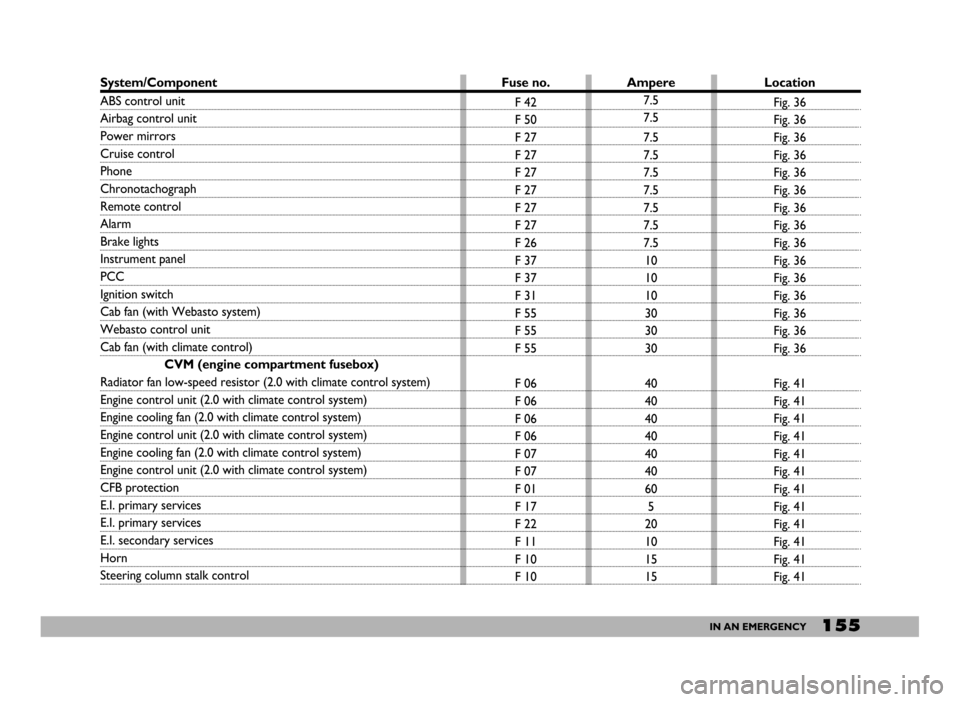
System/Component
ABS control unit
Airbag control unit
Power mirrors
Cruise control
Phone
Chronotachograph
Remote control
Alarm
Brake lights
Instrument panel
PCC
Ignition switch
Cab fan (with Webasto system)
Webasto control unit
Cab fan (with climate control)
CVM (engine compartment fusebox)
Radiator fan low-speed resistor (2.0 with climate control system)
Engine control unit (2.0 with climate control system)
Engine cooling fan (2.0 with climate control system)
Engine control unit (2.0 with climate control system)
Engine cooling fan (2.0 with climate control system)
Engine control unit (2.0 with climate control system)
CFB protection
E.I. primary services
E.I. primary services
E.I. secondary services
Horn
Steering column stalk controlFuse no.
F 42
F 50
F 27
F 27
F 27
F 27
F 27
F 27
F 26
F 37
F 37
F 31
F 55
F 55
F 55
F 06
F 06
F 06
F 06
F 07
F 07
F 01
F 17
F 22
F 11
F 10
F 10Ampere
7.5
7.5
7.5
7.5
7.5
7.5
7.5
7.5
7.5
10
10
10
30
30
30
40
40
40
40
40
40
60
5
20
10
15
15Location
Fig. 36
Fig. 36
Fig. 36
Fig. 36
Fig. 36
Fig. 36
Fig. 36
Fig. 36
Fig. 36
Fig. 36
Fig. 36
Fig. 36
Fig. 36
Fig. 36
Fig. 36
Fig. 41
Fig. 41
Fig. 41
Fig. 41
Fig. 41
Fig. 41
Fig. 41
Fig. 41
Fig. 41
Fig. 41
Fig. 41
Fig. 41
Page 157 of 258
156IN AN EMERGENCY
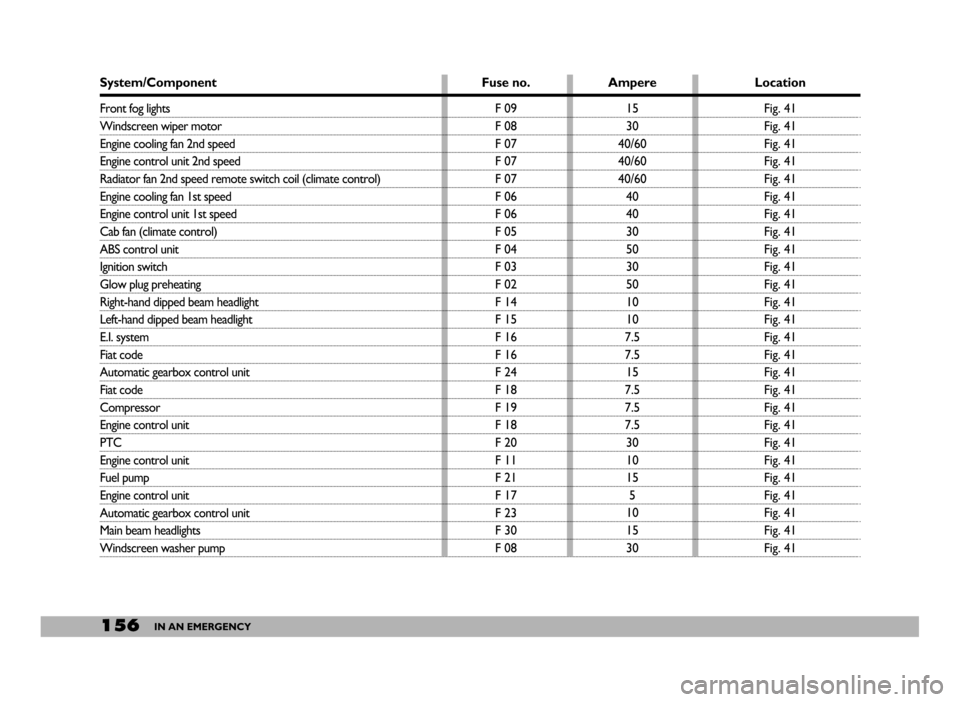
System/Component
Front fog lights
Windscreen wiper motor
Engine cooling fan 2nd speed
Engine control unit 2nd speed
Radiator fan 2nd speed remote switch coil (climate control)
Engine cooling fan 1st speed
Engine control unit 1st speed
Cab fan (climate control)
ABS control unit
Ignition switch
Glow plug preheating
Right-hand dipped beam headlight
Left-hand dipped beam headlight
E.I. system
Fiat code
Automatic gearbox control unit
Fiat code
Compressor
Engine control unit
PTC
Engine control unit
Fuel pump
Engine control unit
Automatic gearbox control unit
Main beam headlights
Windscreen washer pumpFuse no.
F 09
F 08
F 07
F 07
F 07
F 06
F 06
F 05
F 04
F 03
F 02
F 14
F 15
F 16
F 16
F 24
F 18
F 19
F 18
F 20
F 11
F 21
F 17
F 23
F 30
F 08Ampere
15
30
40/60
40/60
40/60
40
40
30
50
30
50
10
10
7.5
7.5
15
7.5
7.5
7.5
30
10
15
5
10
15
30Location
Fig. 41
Fig. 41
Fig. 41
Fig. 41
Fig. 41
Fig. 41
Fig. 41
Fig. 41
Fig. 41
Fig. 41
Fig. 41
Fig. 41
Fig. 41
Fig. 41
Fig. 41
Fig. 41
Fig. 41
Fig. 41
Fig. 41
Fig. 41
Fig. 41
Fig. 41
Fig. 41
Fig. 41
Fig. 41
Fig. 41
Page 167 of 258
166VEHICLE MAINTENANCE
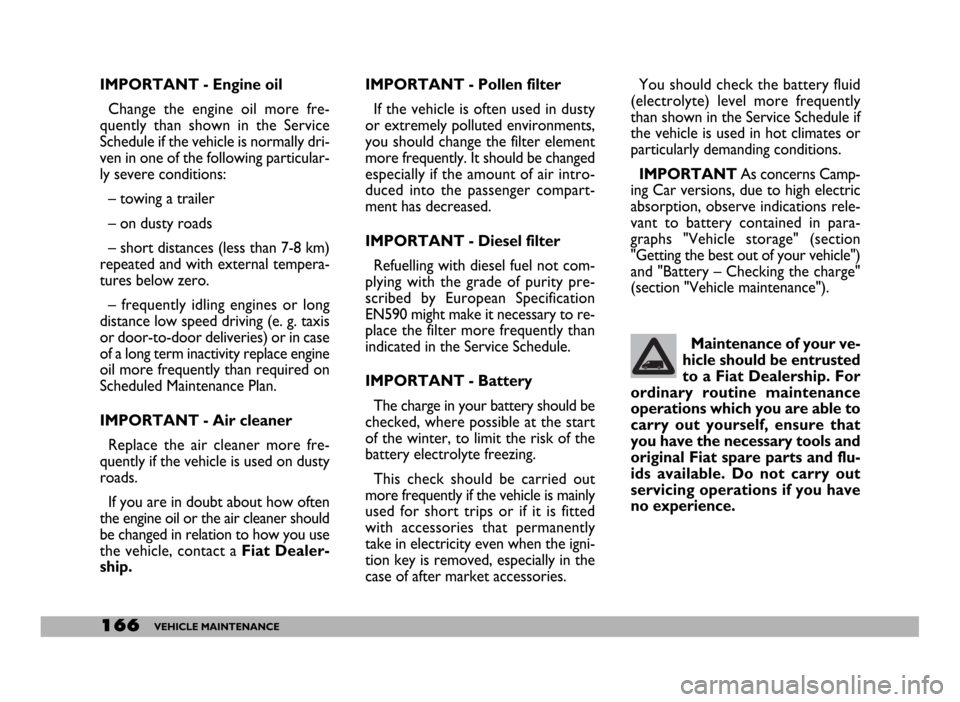
IMPORTANT - Pollen filter
If the vehicle is often used in dusty
or extremely polluted environments,
you should change the filter element
more frequently. It should be changed
especially if the amount of air intro-
duced into the passenger compart-
ment has decreased.
IMPORTANT - Diesel filter
Refuelling with diesel fuel not com-
plying with the grade of purity pre-
scribed by European Specification
EN590 might make it necessary to re-
place the filter more frequently than
indicated in the Service Schedule.
IMPORTANT - Battery
The charge in your battery should be
checked, where possible at the start
of the winter, to limit the risk of the
battery electrolyte freezing.
This check should be carried out
more frequently if the vehicle is mainly
used for short trips or if it is fitted
with accessories that permanently
take in electricity even when the igni-
tion key is removed, especially in the
case of after market accessories.You should check the battery fluid
(electrolyte) level more frequently
than shown in the Service Schedule if
the vehicle is used in hot climates or
particularly demanding conditions.
IMPORTANTAs concerns Camp-
ing Car versions, due to high electric
absorption, observe indications rele-
vant to battery contained in para-
graphs "Vehicle storage" (section
"Getting the best out of your vehicle")
and "Battery – Checking the charge"
(section "Vehicle maintenance").
Maintenance of your ve-
hicle should be entrusted
to a Fiat Dealership. For
ordinary routine maintenance
operations which you are able to
carry out yourself, ensure that
you have the necessary tools and
original Fiat spare parts and flu-
ids available. Do not carry out
servicing operations if you have
no experience.IMPORTANT - Engine oil
Change the engine oil more fre-
quently than shown in the Service
Schedule if the vehicle is normally dri-
ven in one of the following particular-
ly severe conditions:
– towing a trailer
– on dusty roads
– short distances (less than 7-8 km)
repeated and with external tempera-
tures below zero.
– frequently idling engines or long
distance low speed driving (e. g. taxis
or door-to-door deliveries) or in case
of a long term inactivity replace engine
oil more frequently than required on
Scheduled Maintenance Plan.
IMPORTANT - Air cleaner
Replace the air cleaner more fre-
quently if the vehicle is used on dusty
roads.
If you are in doubt about how often
the engine oil or the air cleaner should
be changed in relation to how you use
the vehicle, contact a Fiat Dealer-
ship.
Page 173 of 258
172VEHICLE MAINTENANCE
BRAKE FLUID
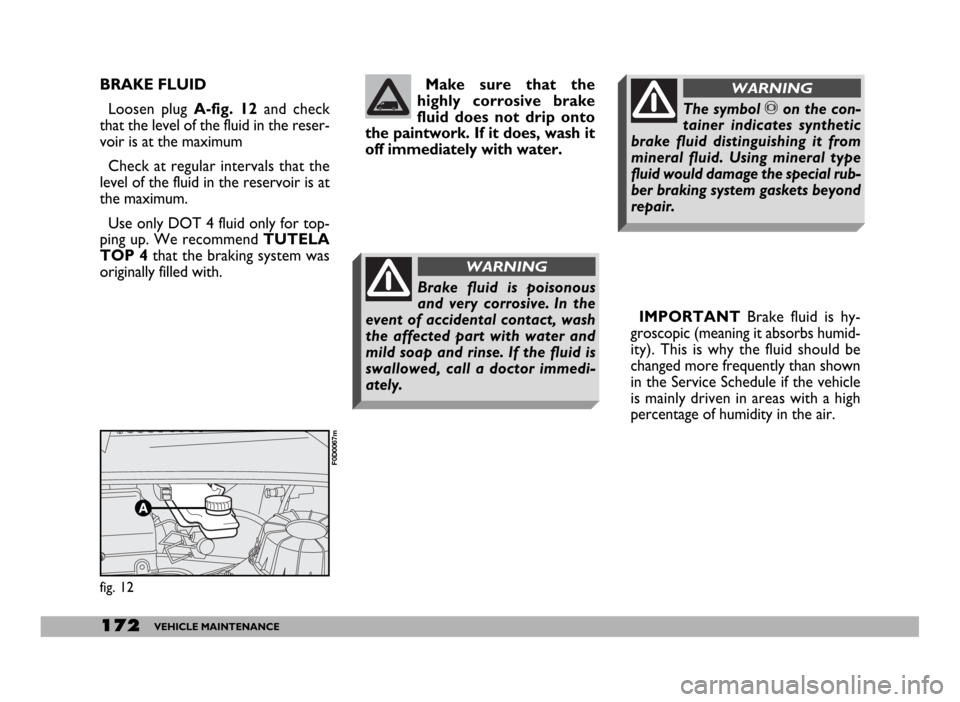
Loosen plug A-fig. 12and check
that the level of the fluid in the reser-
voir is at the maximum
Check at regular intervals that the
level of the fluid in the reservoir is at
the maximum.
Use only DOT 4 fluid only for top-
ping up. We recommend TUTELA
TOP 4that the braking system was
originally filled with.
IMPORTANTBrake fluid is hy-
groscopic (meaning it absorbs humid-
ity). This is why the fluid should be
changed more frequently than shown
in the Service Schedule if the vehicle
is mainly driven in areas with a high
percentage of humidity in the air. Make sure that the
highly corrosive brake
fluid does not drip onto
the paintwork. If it does, wash it
off immediately with water.
fig. 12
F0D0067m
The symbol πon the con-
tainer indicates synthetic
brake fluid distinguishing it from
mineral fluid. Using mineral type
fluid would damage the special rub-
ber braking system gaskets beyond
repair.
WARNING
Brake fluid is poisonous
and very corrosive. In the
event of accidental contact, wash
the affected part with water and
mild soap and rinse. If the fluid is
swallowed, call a doctor immedi-
ately.
WARNING
Page 180 of 258
179VEHICLE MAINTENANCE
Tyres age even if they are not used
very much. Cracking of the tread rub-
ber and the side walls are a sign of this
ageing. In any case, if the tyres have
been fitted for more than six years
they should be examined by an expert
who can judge whether they are still
fit for use. Remember to check the
spare tyre particularly carefully too.
If a replacement is necessary, always
use new tyres and avoid using ones
the origin of which you are not cer-
tain about.
The Ducato uses tubeless tyres. Un-
der no circumstances use an inner
tube with these tyres.
If you replace a tyre it is a good idea
to change the inflation valve, too.To ensure the front and rear tyres all
wear evenly, you are advised to change
the tyres over every 10 - 15 thousand
kilometres keeping them on the same
side of the vehicle so as not to reverse
the direction of rotation.RUBBER TUBING
Follow the Service Schedule carefully
in the case of braking and fuel supply
system rubber tubing.
Ozone, high temperatures and long
absence of fluid in the system can in
fact cause the hardening and cracking
of the pipes with possible loss of fluid.
A careful check is therefore essential.
Do not change the tyres
over in criss-cross fashion
by moving a tyre from the left-hand
side of the vehicle to the right and
vice versa.
WARNING
Never submit alloy rims to
repainting treatments re-
quiring to use temperatures ex-
ceeding 150°C since the mechani-
cal properties of the wheels could
be impaired.
WARNING
Page 217 of 258
216TECHNICAL SPECIFICATIONS
BRAKES
SERVICE AND EMERGENCY
BRAKES
Front: disc, floating caliper with two
operating cylinders for each wheel and
pad wear warning light.
Rear: self-centring shoes and micro-
metric mechanism for clearance take-
up.
Certain versions are fitted with rear
disc brakes with Drum in hat device
(i.e. drum on disc to block the vehicle
when parked with handbrake en-
gaged).
Cross-over hydraulic circuit control.
Four sensors ABS system with EBD.
Automatic recovery of the friction
gasket wear; versions with rear disc
brake excluded (Drum in hat ver-
sions).
Lacking ABS system brakeforce dis-
tributor acting on rear brake hydraulic
circuit according to rear axle load.HANDBRAKE
Controlled by a lever, it works me-
chanically on the rear brake shoes.
For versions with rear disc brakes,
the handbrake works on the Drum in
hat device shoes.
IMPORTANTPull the handbrake
lever only when the vehicle is at a
standstill, or when the vehicle is run-
ning, but however only in case of a
failure of the hydraulic system.
Should the handbrake be exception-
ally used when the vehicle is running,
it is suggested to keep a moderate
traction to avoid causing the rear axle
block, entailing vehicle side skidding.
TRANSMISSION
CLUTCH
Hydraulically controlled without
travel-free pedal.
MECHANICAL GEARBOX
AND DIFFERENTIAL
Five forward gears and reverse with
synchromesh for front gear engage-
ment.
Cyclical gear reduction and differen-
tial assembly incorporated in the gear-
box.
Drive transmission to the front
wheels by means of drive shafts con-
nected to the differential assembly and
the wheels with CV joints.
Water, ice or salt on road
surfaces can deposit on
brake discs, reducing braking effi-
ciency on the first braking.
WARNING
Page 218 of 258

217TECHNICAL SPECIFICATIONS
ELECTRONIC AUTOMATIC
GEARBOX
(2.8 JTD versions only)
Automatic gearbox with four speeds
plus reverse with self-adapting control
(i.e. capable of adapting to the driver’s
driving style), which transmits power
continuously and with very fast elec-
tro-hydraulic gear engagement times.SUSPENSIONS
FRONT
Independent wheel, McPherson sus-
pension.
Telescopic dampers with flexible an-
chorage to the body and dust guards
on buffers.
Coil springs offset with shock ab-
sorbers and knock-guard buffers.
Lower wishbone with twin taper
rubber bushing on chassis and ball
head on wheel stud.REAR
Rigid tubular axle type.
Lengthways single blade (two-blades
as optional) leaf spring.
Vertical shock absorbers anchored
above on the body (on the inside of
the wheelhouse) and down on the
axle flange.
Knock-guard buffer fixed to the side
member.
Coupling for brake load proportion-
ing.
Page 219 of 258
218TECHNICAL SPECIFICATIONS
WHEELS
RIMS AND TYRES
Printed steel rims with ventilated
disk.
Tubeless tyres with radial carcass.
The homologated tyres are listed in
the log book.
IMPORTANT In the event of dis-
crepancies between the information
provided in this Owner Handbook and
the Log Book, consider the specifica-
tions shown in the Log Book only.
To ensure safety of the vehicle in
movement, it must be fitted with tyres
of the same make and type on all
wheels.
IMPORTANT Do not use inner
tubes with tubeless tyres.SPARE WHEEL
Printed steel rim.
Tubeless tyre (same as those fitted).
SNOW CHAINS
Only use low profile chains, see
“Snow chains”.
WHEEL GEOMETRY
Front wheel toe-in measured from
rim to rim: – 2 ± 1 mm.
The values refer to the vehicle in run-
ning order.
STEERING
Energy-absorbing jointed steering
column and wheel.
Height adjustable steering wheel.
Permanently lubricated rack and pin-
ion.
Hydraulic power steering.
Minimum turning circle:
– short wheelbase ................ 11 m
– medium wheelbase ............ 12.1 m
– long wheelbase .................. 13,7 m
Number of steering wheel turns lock
to lock ......................................... 3.52
Do not hold the power as-
sisted steering wheel with
the engine running for longer than
15 seconds. It will make a noise and
you could damage the system.
WARNING