condition FIAT DUCATO 244 2005 3.G Owner's Manual
[x] Cancel search | Manufacturer: FIAT, Model Year: 2005, Model line: DUCATO 244, Model: FIAT DUCATO 244 2005 3.GPages: 258, PDF Size: 4.05 MB
Page 120 of 258

119GETTING THE BEST OUT OF YOUR VEHICLE
Manual sequential programme
This function enables manual se-
quential use of the gearbox merely
moving the selector lever to the left.
Each time the lever is pressed only
one gear is shifted: more than one shift
cannot be obtained.
To avoid overevving or excessively
low engine rpm, the control unit in-
hibits requests for gearshifting that
would cause such situations.
Winter driving programme
This programme is engaged by press-
ing button WINTERnear the
gearshift lever,
in case of driving wheel skidding and
it changes to specific gears.
Starting is possible only in 2
ndgear.
On snowy roads use however snow
chains and/or tyres.
The WINTERfunction shall always
be off on slopes.Engine warming up programme
This programme allows the engine to
reach normal operating temperature
in the shortest time possible (de-
pending on the outside temperature)
highering the gearshifting points, in re-
lation to engine temperature.
The programme engages automati-
cally after starting, if the engine tem-
perature is below 30 °C and it remains
active up to 34 °C.
Excessive gearbox oil
temperature programme
This is activated when the gearbox
oil temperature reaches 120 °C and it
remains active down to 117 °C.
To facilitate oil cooling, this pro-
gramme inhibits gearshifting, either up
or down. It is however possible to use
the manual programme.
SAFE DRIVING
In designing Ducato, Fiat has made
every effort to come up with a vehicle
able to provide driver and passengers
with top-class levels of safety. Never-
theless it is always the behaviour of the
person at the wheel that determines
road safety.
In the following pages you will find
some simple tips to help you travel in
safety under different conditions. You
will no doubt be familiar with many of
them already but it will be useful to
read them all carefully.
Page 121 of 258
120GETTING THE BEST OUT OF YOUR VEHICLE
BEFORE GETTING BEHIND
THE WHEEL
– Make sure all light, including the
headlights, are working properly;
– adjust the position of seats and dri-
ving and door mirrors properly for the
best driving position;
– make sure that nothing (mats, etc.)
gets in the way of the pedals when
they are pushed down;
– make sure that any child restraint
systems (child seats, cradles, etc.) are
properly fixed;
– place any objects in the load com-
partment in such a way that they can-
not be thrown forwards in the event
of an accident;
– light eating will help keep your re-
flexes prompt. Above all, do not have
anything alcoholic to drink.
Remember to periodically check:
– tyre pressure,
– engine oil level,
– engine coolant level and cooling
system conditions,– brake fluid level,
– windscreen washer fluid level.
WHEN TRAVELLING
– The first rule of safe driving is pru-
dence;
– prudence also means putting your-
self into a position where you can pre-
dict wrong or imprudent behaviour
from other drivers;
– stick closely to the rules of the
road in the particular country where
the vehicle is being driven and, above
all, do not exceed speed limits;
– ensure that, besides yourself, all the
other passengers in the vehicle have
their seat belts fastened, that children
are sitting in the appropriate child
seats and any animals in the vehicle are
placed in suitable compartment;
– you should be physically fit and
mentally alert before setting out on
long journeys.
Always fasten both front
and back seat belts
(Panorama, Minibus, Combi and
Crew Cab versions). Travelling with
the seat belts unfastened increas-
es the risk of injury or death if you
are in a collision.
WARNING
Driving while drunk or un-
der the influence of drugs
or certain medicines is dangerous
for both you and other road users.
WARNING
Page 123 of 258

122GETTING THE BEST OUT OF YOUR VEHICLE
as soon as you see vehicles coming in
the other direction and pass them with
the headlights dipped;
– keep all lights clean;
– be careful of animals crossing the
road when driving in the country. Slow
down to avoid the risk of running
them over.
DRIVING IN THE RAIN
Rain and wet road surfaces spell dan-
ger. All manoeuvres are more difficult
on a wet road because the grip of the
wheels on the tarmac is greatly re-
duced. This is why braking distances
are much longer and road-holding is
lower.
Here is some advice for driving in the
rain:
– reduce speed and maintain a
greater safety distance from the vehi-
cles in front;
– If it is raining particularly heavily,
visibility is also reduced. In these cas-
es, switch on the dipped headlights
even if it is still daylight so you can be
seen more easily;– Do not drive through puddles at
speed and hold on tightly to the wheel
if you do: a puddle taken at high speed
might cause you to lose control of the
vehicle (aquaplaning);
– Position the ventilation controls for
demisting (see section “Getting to
know your vehicle”), to prevent visi-
bility from worsening;
– Routinely check the conditions of
the windscreen wiper blades.
DRIVING IN FOG
– If the fog is thick, do not start out
on a journey unless you absolutely
have to.
If driving in mist, blanket fog or when
there is the danger of fog patches:
– keep your speed down;
– turn on the dipped headlights, rear
fog lights and front fog lights, if fitted,
even during the day. Do not drive with
your headlights at main beam.IMPORTANT On stretches of
road with good visibility, switch off
your rear foglights; the brightness of
these lights could annoy the people
travelling in the vehicles behind.
– Remember that fog also means the
taramac is wet and therefore ma-
noeuvres of all kinds are more difficult
and stopping distances are longer;
– keep a good distance from the ve-
hicles in front of you;
– as far as possible, avoid spurts of
speed or sudden deceleration;
– do not overtake other vehicles if
possible;
Page 124 of 258

123GETTING THE BEST OUT OF YOUR VEHICLE
– if you are forced to stop your ve-
hicle (breakdown, limited visibility,
etc.) try to stop off the road. Turn on
the hazard lights and, if possible, the
dipped beam headlights. Rhythmically
sound the horn if you release anoth-
er vehicle is coming.
DRIVING IN THE
MOUNTAINS
– Check fluid levels (oil, brake fluid,
coolant) and tyre wear before driving
in the mountains;
– when driving downhill use the en-
gine braking effect by engaging a low
gear so as not to overheat the brakes;
– under no circumstances should you
drive downhill with the engine off or
with the gear in neutral, let alone with
the ignition key out;
– drive at moderate speed and avoid
“cutting” corners;
– remember that overtaking while
going uphill is slower and therefore re-
quires more free road. If you are be-
ing overtaken while driving uphill,
make it easier for the other vehicle
to pass.DRIVING ON SNOW
AND ICE
Here are some tips for driving in
these conditions:
– keep your speed down;
– use chains if the roads are covered
with snow;
– do not park the vehicle with the
engine running for long periods of
time: snow could divert exhaust fumes
into the passenger compartment;
– mainly use the braking effect of the
engine and under all circumstances
avoid braking sharply;
– when braking a vehicle not fitted
with ABS, reduce the possibility of the
wheels locking by varying the pressure
you exert on the brake pedal;
– do not accelerate suddenly and
avoid swerving;– in the winter, even apparently dry
roads may have icy patches. Be care-
ful therefore when driving over
stretches that do not get much expo-
sure to the sun or are lined with trees
or rocks where ice might not have
melted;
– keep a good distance from the ve-
hicles in front.
DRIVING WITH ABS
– ABS is a braking system that es-
sentially offers two advantages:
1) It prevents wheel lock and con-
sequent skidding in emergency stops,
particularly when the road does not
offer much grip.
2) it makes it possible to brake and
steer at the same time and direct the
vehicle where you want while braking.
Page 125 of 258

124GETTING THE BEST OUT OF YOUR VEHICLE
To get the most out of ABS:
– During emergency stops or when
grip conditions are poor, you will feel
a slight pulsation on the brake pedal.
This is the sign that the ABS is work-
ing. Do not release the brake pedal but
continue to press so as not to inter-
rupt the braking action;
– ABS enables you to brake and steer
at the same time. If you meet an un-
expected obstacle you can therefore
steer around it;
– the ABS prevents the wheels from
locking but it does not increase actu-
al grip conditions between tyre and
road. Therefore, even if your vehicle
is fitted with ABS, keep a safe distance
from the vehicle in front of you and
keep your speed down when driving
into bends.
ABS serves to increase your control
over the vehicle, not to enable you to
go faster.Some suggestions which may help
you to keep the running costs of the
vehicle down and lower the amount
of toxic emissions released into the at-
mosphere are given below.
GENERAL
CONSIDERATIONS
Vehicle maintenance
Carry out the checks and adjust-
ments/regulations specified in the
“Service Schedule”.
Tyres
Check tyre inflation pressure regu-
larly. Tyres should be checked at least
once every four weeks: if the pressure
is too low, fuel consumption increas-
es as the resistance to the rolling
movement of the tyre is greater.Unnecessary loads
Do not travel with too much load.
The weight of the vehicle (specially in
urban traffic) and its trim greatly ef-
fects consumption and stability.
Roof rack/ski rack
Remove the roof or ski racks from
the vehicle as soon as they are no
longer needed. These accessories re-
duce the aerodynamic penetration of
the vehicle and will increase con-
sumption. When transporting partic-
ularly large objects, use a trailer,
where possible.CONTAINING RUNNING COSTS
Page 127 of 258
126GETTING THE BEST OUT OF YOUR VEHICLE
CONDITIONS OF USE
Cold starting
Frequent cold starting will not enable
the engine to reach optimal running
temperature. It follows, therefore,
that consumption will be higher (from
+15 to +30% in towns) as will the
production of toxic emissions.
Traffic and road conditions
Heavy traffic and higher consumption
are synonymous: for example, when
driving slowly with frequent use of low-
er gears or in towns where there are
numerous traffic lights.
Winding roads, mountain roads and
bumpy roads also have a negative effect
on consumption.
Enforced halts
During prolonged stops (traffic lights,
level crossings, etc.) the engine should
be switched off.LOAD
RECOMMENDATIONS
The version of the Ducato you are
driving has been designed and ap-
proved on the basis of several set
maximum weights (see the tables
“Weights” in section “Technical spec-
ifications”):
– kerb weight
– payload
– total weight
– total weight on the front axle
– total weight on the rear axle
– towable weight
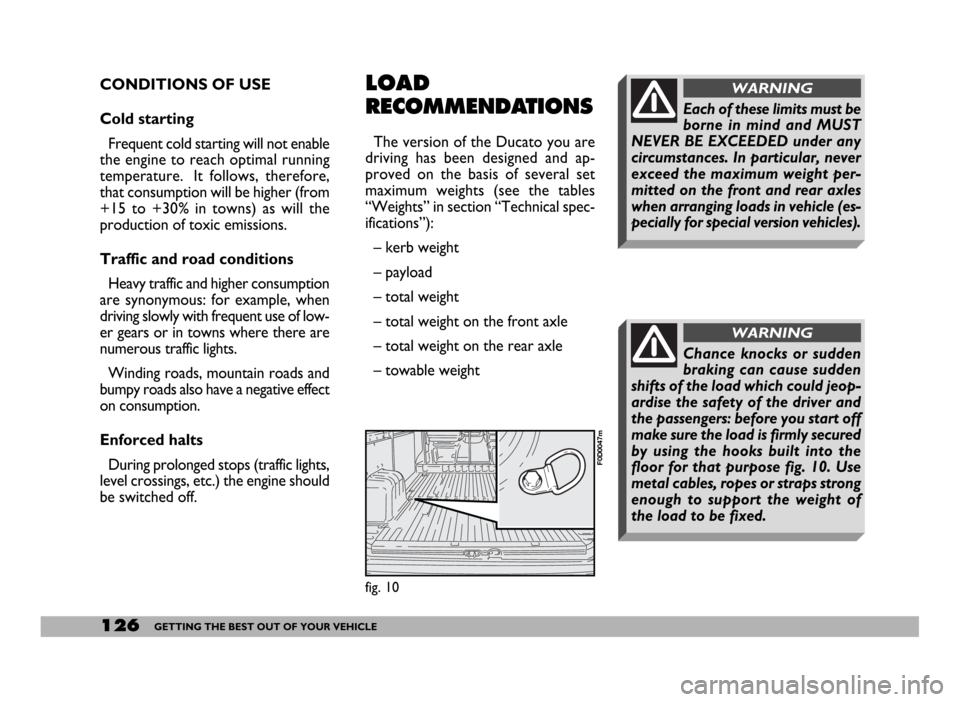
fig. 10
F0D0047m
Each of these limits must be
borne in mind and MUST
NEVER BE EXCEEDED under any
circumstances. In particular, never
exceed the maximum weight per-
mitted on the front and rear axles
when arranging loads in vehicle (es-
pecially for special version vehicles).
WARNING
Chance knocks or sudden
braking can cause sudden
shifts of the load which could jeop-
ardise the safety of the driver and
the passengers: before you start off
make sure the load is firmly secured
by using the hooks built into the
floor for that purpose fig. 10. Use
metal cables, ropes or straps strong
enough to support the weight of
the load to be fixed.
WARNING
Page 133 of 258
132GETTING THE BEST OUT OF YOUR VEHICLE
SNOW TYRES
Use snow tyres specified in the
“Snow tyres” table in section “Tech-
nical Specifications”.
Fiat Dealershipwill be happy to
provide advice concerning the most
suitable type of tyre for the customer’s
requirements.
For the type of tyre to be used, in-
flation pressures and the specifications
of snow tyres, follow the instructions
given at paragraph “Wheels” in section
“Technical Specifications”.The winter features of these tyres
are reduced considerably when the
tread depth is below 4 mm. In this
case, they should be replaced.
Due to the snow tyre features, un-
der normal conditions of use or on
long motorway journeys, the perfor-
mance of these tyres is lower than that
of normal tyres.
It is therefore necessary to limit their
use to the purposes for which they are
certified.
IMPORTANT When snow tyres
are used with a max. speed index be-
low the one that can be reached by
the vehicle (increased by 5%), place a
notice in the passenger compartment,
plainly in the driver’s view which states
the max. permissible speed of the
snow tyres (as per EC Directive).All four tyres should be the same
(brand and track) to ensure greater
safety when driving and braking and
better driveability.
Remember that it is inappropriate to
change the direction of rotation of
tyres.
The max. speed for snow
tyres with “Q” marking is
160 km/h. The Road Traffic Code
speed limits must however be al-
ways strictly observed.
WARNING
Page 163 of 258
162VEHICLE MAINTENANCE
V V
E E
H H
I I
C C
L L
E E
M M
A A
I I
N N
T T
E E
N N
A A
N N
C C
E E
SCHEDULED
SERVICING
Correct maintenance of the vehicle
is essential for ensuring it stays in tip-
top condition for a long time to come.
This is why Fiat has programmed a
number of service checks and opera-
tions carried out every 30,000 kilo-
metres.
It is however important to remem-
ber that "Scheduled Servicing" is not
all your vehicle requires. Regular
checks - also in the initial period be-
fore the 30,000 kilometre coupon and
later between coupons - ordinary care
is required, such as checking fluid lev-
els and topping up, checking tyre in-
flation pressure, checking cleanness of
bonnet and boot locks, cleaning and
lubricating levers, etc...If it is seen that further replacements
or repairs are necessary in addition to
the work being carried out, these will
only be done after the customer has
given his/her consent.
IMPORTANTYou are recom-
mended to get in touch with a Fiat
Dealershipimmediately if any small
running problems crop up without
waiting for the next coupon.
If the vehicle is fre-
quently used to tow trail-
ers, carry out the sched-
uled service operations more fre-
quently than shown.
IMPORTANTThe Manufacturer
requires the Service Schedule coupon
related checks to be carried out. Fail-
ure to do so could result in the war-
ranty being cancelled for those defects
that can be attributed to such failure.
Scheduled Servicing is performed at
all Fiat Dealershipsand there is a set
time scale for such operations.
Page 164 of 258
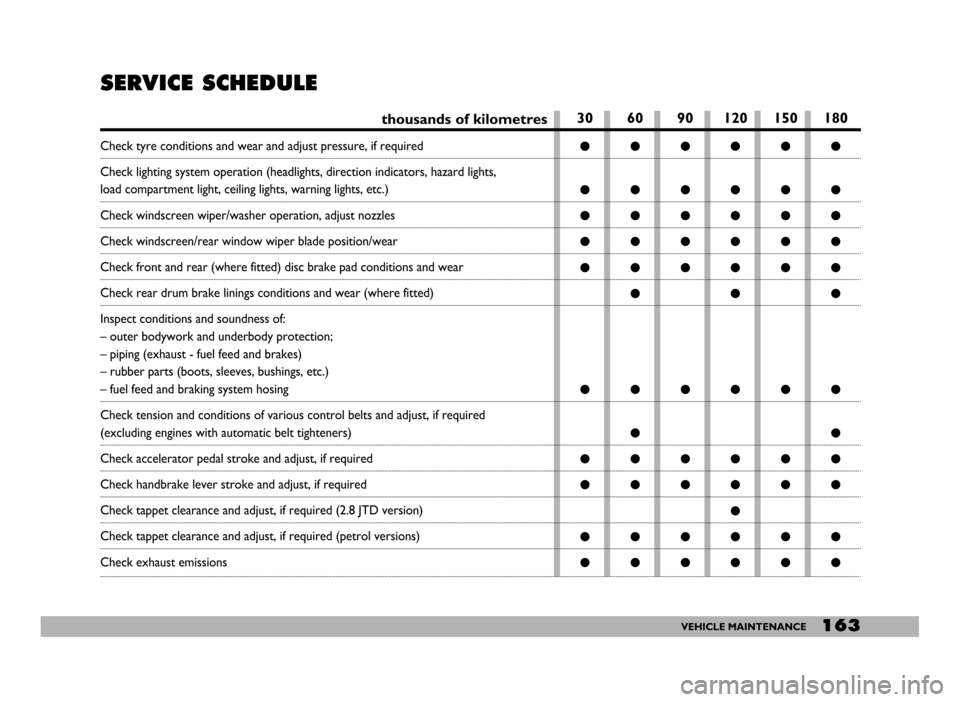
163VEHICLE MAINTENANCE
SERVICE SCHEDULE
thousands of kilometres
Check tyre conditions and wear and adjust pressure, if required
Check lighting system operation (headlights, direction indicators, hazard lights,
load compartment light, ceiling lights, warning lights, etc.)
Check windscreen wiper/washer operation, adjust nozzles
Check windscreen/rear window wiper blade position/wear
Check front and rear (where fitted) disc brake pad conditions and wear
Check rear drum brake linings conditions and wear (where fitted)
Inspect conditions and soundness of:
– outer bodywork and underbody protection;
– piping (exhaust - fuel feed and brakes)
– rubber parts (boots, sleeves, bushings, etc.)
– fuel feed and braking system hosing
Check tension and conditions of various control belts and adjust, if required
(excluding engines with automatic belt tighteners)
Check accelerator pedal stroke and adjust, if required
Check handbrake lever stroke and adjust, if required
Check tappet clearance and adjust, if required (2.8 JTD version)
Check tappet clearance and adjust, if required (petrol versions)
Check exhaust emissions
30 60 90 120 150 180
●●●●●●
●●●●●●
●●●●●●
●●●●●●
●●●●●●
●●●
●●●●●●
●●
●●●●●●
●●●●●●
●
●●●●●●
●●●●●●
Page 165 of 258
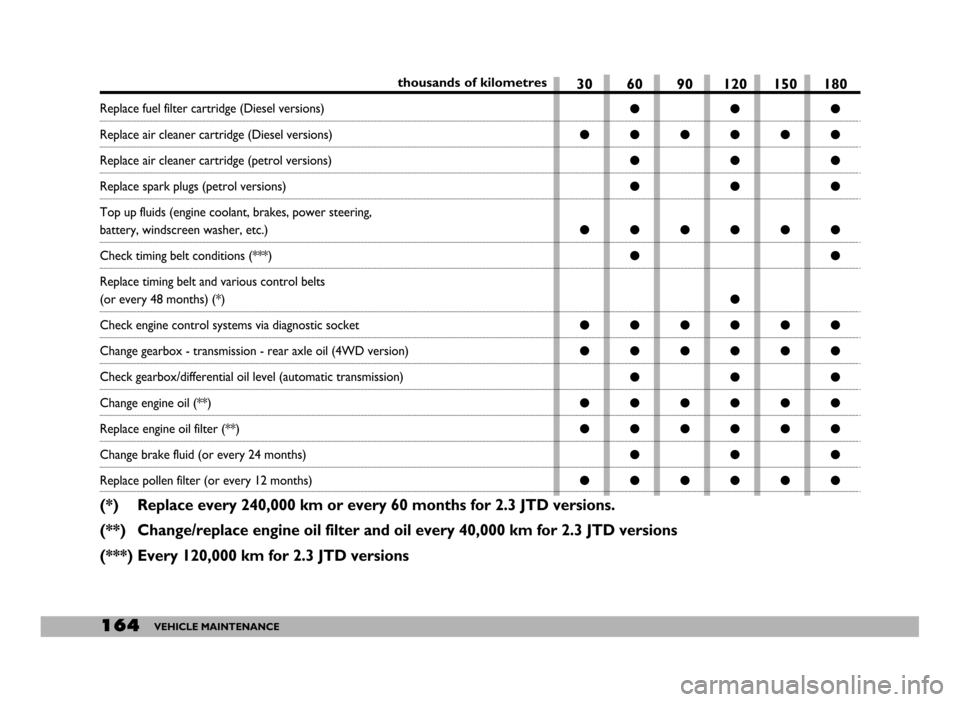
164VEHICLE MAINTENANCE
thousands of kilometres
Replace fuel filter cartridge (Diesel versions)
Replace air cleaner cartridge (Diesel versions)
Replace air cleaner cartridge (petrol versions)
Replace spark plugs (petrol versions)
Top up fluids (engine coolant, brakes, power steering,
battery, windscreen washer, etc.)
Check timing belt conditions (***)
Replace timing belt and various control belts
(or every 48 months) (*)
Check engine control systems via diagnostic socket
Change gearbox - transmission - rear axle oil (4WD version)
Check gearbox/differential oil level (automatic transmission)
Change engine oil (**)
Replace engine oil filter (**)
Change brake fluid (or every 24 months)
Replace pollen filter (or every 12 months)
(*) Replace every 240,000 km or every 60 months for 2.3 JTD versions.
(**) Change/replace engine oil filter and oil every 40,000 km for 2.3 JTD versions
(***) Every 120,000 km for 2.3 JTD versions
30 60 90 120 150 180
●●●
●●●●●●
●●●
●●●
●●●●●●
●●
●
●●●●●●
●●●●●●
●●●
●●●●●●
●●●●●●
●●●
●●●●●●