Engine FIAT DUCATO 244 2005 3.G Workshop Manual
[x] Cancel search | Manufacturer: FIAT, Model Year: 2005, Model line: DUCATO 244, Model: FIAT DUCATO 244 2005 3.GPages: 258, PDF Size: 4.05 MB
Page 129 of 258
128GETTING THE BEST OUT OF YOUR VEHICLE
LOOKING AFTER EMISSION
CONTROL DEVICES
The correct use of pollution control
devices not only ensures respect for
the environment but also has an effect
on the vehicle’s performance.
Keeping these devices in good con-
ditions is therefore a fundamental rule
for driving that is easy on your pock-
et and on the environment too.
The first step to take is to follow the
Service Schedule to the letter.
If your vehicle has a petrol engine
with catalytic converter use only un-
leaded petrol.
if you have trouble starting, do not
keep turning the ignition key for long
periods. Be especially careful to avoid
bump starting the vehicle by pushing,
towing or rolling downhill: these are
all manoeuvres that can damage the
catalyst.
Use an auxiliary battery for start-ups
only.If the engine begins to “loose its
smoothness” when travelling, contin-
ue your journey but reduce the de-
mands you are making on the engine
and have the vehicle seen to at a Fi-
at Dealershipas soon as you can.
When the instrument panel fuel re-
serve warning light comes on, fill up as
soon as possible. A low fuel level may
cause an uneven supply of fuel to the
engine with inevitable increase in the
temperature of the exhaust gas and se-
rious damage to the catalytic con-
verter.
Never run the engine with one or
more spark plugs disconnected, even
for testing purposes.
Do not warm up the engine by let-
ting it idle for a while before moving
off unless the outside temperature is
very low and, even in this case, only
do so for less than thirty seconds.
Do not install heat shields and do not
remove those already fitted to the cat-
alytic converter and exhaust pipe.
Do not allow anything to
be sprayed onto the cat-
alytic converter, lambda sensor and
exhaust pipe.
WARNING
Ignoring the above rules
may lead to fire.
WARNING
When functioning normal-
ly the catalytic converter
reaches high temperatures. For this
reason do not park the vehicle over
inflammable material (grass, dry
leaves, pine needles, etc.): fire haz-
ard.
WARNING
Page 135 of 258
134GETTING THE BEST OUT OF YOUR VEHICLE
VEHICLE STORAGE
The following precautions should be
taken if the vehicle will not be used for
several months:
– park the vehicle in covered, dry and
if possible well-ventilated premises;
– engage a gear;
– remove the cables from the battery
(first remove the cable to the negative
terminal) and check the battery
charge. If the vehicle is to be stored
for long periods the charge of the bat-
tery should be checked every month
and recharged if it falls below 12.5 V;– make sure the handbrake is not en-
gaged;
– clean and protect the painted parts
using protective wax;
– clean and protect the shiny metal
parts using special compounds readi-
ly available;
– sprinkle talcum powder on the rub-
ber windscreen and rear window
wiper blades and lift them off the glass;
– slightly open the windows;
– cover the vehicle with a cloth or
perforated plastic sheet. Do not use
sheets of non-perforated plastic as
they do not allow moisture on the ve-
hicle body to evaporate;– inflate the tyres to 0.5 bar above
the normal specified pressure and
check it at intervals;
– do not drain the engine cooling sys-
tem.
IMPORTANTWhere relevant,
switch off the electronic vehicle alarm
with the remote control and deacti-
vate the system by turning the emer-
gency key to OFF (see “Electronic
alarm” in section “Getting to know
your vehicle”).
Page 136 of 258
135IN AN EMERGENCY
I I
N N
A A
N N
E E
M M
E E
R R
G G
E E
N N
C C
Y Y
EMERGENCY
START-UP
DIESEL VERSIONS
Emergency start-ups cannot be per-
formed on versions with a diesel en-
gine; contact aFiat Dealership.
PETROL VERSIONS
If the Fiat CODE cannot deactivate
the engine immobiliser, the Yand
Uwarning lights stay on and the en-
gine will not start. Follow the emer-
gency start-up procedure to start the
engine.
Read the whole procedure care-
fully before trying to carry it out.
If you make a mistake, you must turn
the ignition key back to STOPand re-
peat the whole operation from the be-
ginning (step 1).1) Read the 5-figure electronic code
given on the CODE card.
2) Turn the ignition key to MAR.
3)Press and hold down the accel-
erator pedal. Warning light
Uwill
come on for about 8 seconds, and
then go out. At this point release the
accelerator pedal and get ready to
count the flashes of the warning light
U.
4) Count the number of flashes that
corresponds to the first figure of the
code on the CODE card, then press
the accelerator pedal and keep it there
until the warning light
Ucomes on
for four seconds and then goes out;
release the accelerator pedal.
5) Warning light
Uwill start flash-
ing again: after it has flashed the num-
ber of times that corresponds to the
second figure on the CODE card,
press the accelerator pedal and keep
it pressed.
6) Do the same for the remaining fig-
ures on the CODE card.7) Once the final figure has been en-
tered, keep the accelerator pedal
pressed. Warning light
Uwill light up
for four seconds and then go out; re-
lease the accelerator pedal.
8)Warning light
Uwill flash rapid-
ly for about 4 seconds to indicate that
the operation has been completed
correctly.
9) Start the engine by turning the ig-
nition key from MARto AVV.
If, however, the warning light
U
stays on, turn the ignition key to
STOPan repeat the procedure from
step 1).
IMPORTANT After an emergency
start-up, you should contact a Fiat
Dealership otherwise you will have
to repeat the procedure described
each time you want to start the en-
gine.
Page 137 of 258
136IN AN EMERGENCY
JUMP STARTING
If the battery is flat, you can use an-
other battery to start the engine. Its
capacity must be the same or slightly
greater than the flat battery.
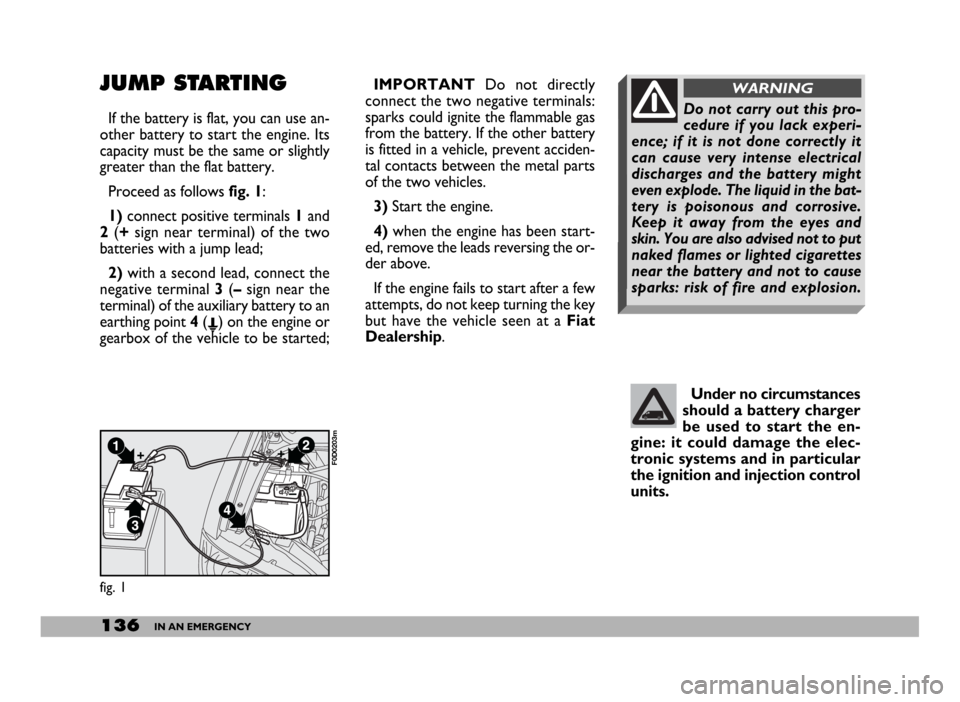
Proceed as follows fig. 1:
1) connect positive terminals1and
2 (+sign near terminal) of the two
batteries with a jump lead;
2) with a second lead, connect the
negative terminal 3(– sign near the
terminal) of the auxiliary battery to an
earthing point 4(E) on the engine or
gearbox of the vehicle to be started;IMPORTANTDo not directly
connect the two negative terminals:
sparks could ignite the flammable gas
from the battery. If the other battery
is fitted in a vehicle, prevent acciden-
tal contacts between the metal parts
of the two vehicles.
3) Start the engine.
4)when the engine has been start-
ed, remove the leads reversing the or-
der above.
If the engine fails to start after a few
attempts, do not keep turning the key
but have the vehicle seen at a Fiat
Dealership.
fig. 1
F0D0203m
Under no circumstances
should a battery charger
be used to start the en-
gine: it could damage the elec-
tronic systems and in particular
the ignition and injection control
units.
Do not carry out this pro-
cedure if you lack experi-
ence; if it is not done correctly it
can cause very intense electrical
discharges and the battery might
even explode. The liquid in the bat-
tery is poisonous and corrosive.
Keep it away from the eyes and
skin. You are also advised not to put
naked flames or lighted cigarettes
near the battery and not to cause
sparks: risk of fire and explosion.
WARNING
Page 138 of 258
137IN AN EMERGENCY
BUMP STARTING IF A TYRE IS
PUNCTURED
General instructions
Observe the instruc-
tions on this and the fol-
lowing pages to use the
jack and spare wheel correctly.Catalysed vehicles must
not be bump started
(pushed, towed or
coasted downhill) as this could
cause fuel to flow into the cat-
alytic exhaust system and dam-
age it beyond repair.
Never start the engine
when the vehicle is jacked
up.
WARNING
Remember that until the
engine has started the
brake booster and power steering
systems will not work and a greater
effort will therefore be required to
depress the brake pedal or turn the
steering wheel.
WARNING
If you are towing a trailer,
remove the trailer before
jacking up the vehicle.
WARNING
The jack should only be
used to changed a wheel on
the vehicle for which it was de-
signed. It should not be put to oth-
er uses or employed to raise other
models. Under no circumstances
should it be used when carrying out
repairs under the vehicle. An incor-
rectly positioned jack may cause
the vehicle to fall. Do not use the
jack to lift loads exceeding that in-
dicated on the label attached to the
to the jack itself.
WARNING
Page 139 of 258
138IN AN EMERGENCY
1. STOP THE VEHICLE
– Stop the vehicle in a position that
is not dangerous for oncoming traffic
where you can change the wheel safe-
ly. The ground should be flat and ad-
equately firm. If you have to change
the wheel at night, choose a lit area if
possible.
– Turn the engine off and pull up the
handbrake.
– Engage first or reverse gear.
– Alert other drivers that the vehicle
is stationary in compliance with local
regulations: hazard warning lights,
warning triangle, etc.
Any passengers should get out and
wait as far away as possible from the
danger of traffic.
If the road is sloping or bumpy, place
wedges or other suitable material to
prevent the vehicle from moving, un-
der the wheels.2. TAKE OUT THE TOOLS,
JACK AND SPARE WHEEL
The tools are in the cab near the
seats.
Please note:
– the jack weights 4.2 kg;
– the jack requires no adjustments;
– the jack cannot be repaired. If it
breaks it must be replaced with a new
jack;
– no other tool, apart from the ex-
tension and the ratchet wrench shown
in this chapter can be fitted to the jack.
The spare wheel is located under the
rear part of the load bed.
Do not lubricate the bolt
threads before fitting
them back: they could come
loose.
WARNING
Check tyre pressure and
spare wheel pressure regu-
larly. Refer to section “Technical
Specifications”.
WARNING
Page 153 of 258
152IN AN EMERGENCY
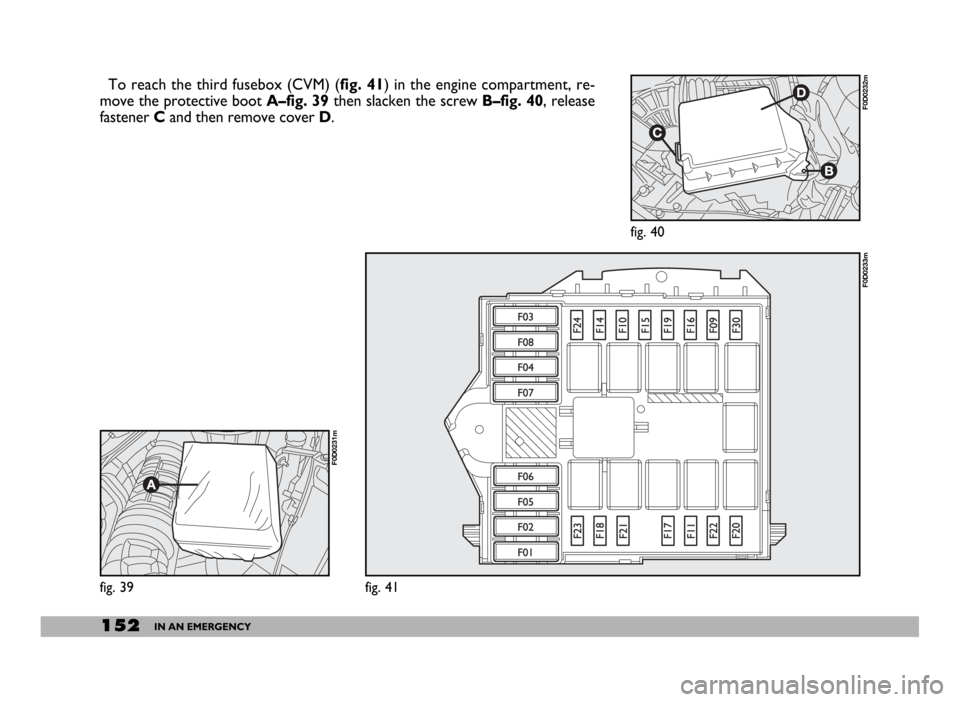
To reach the third fusebox (CVM) (fig. 41) in the engine compartment, re-
move the protective boot A–fig. 39then slacken the screw B–fig. 40, release
fastener Cand then remove cover D.
fig. 39
F0D0231m
fig. 40
F0D0232m
fig. 41
F0D0233m
Page 156 of 258
155IN AN EMERGENCY
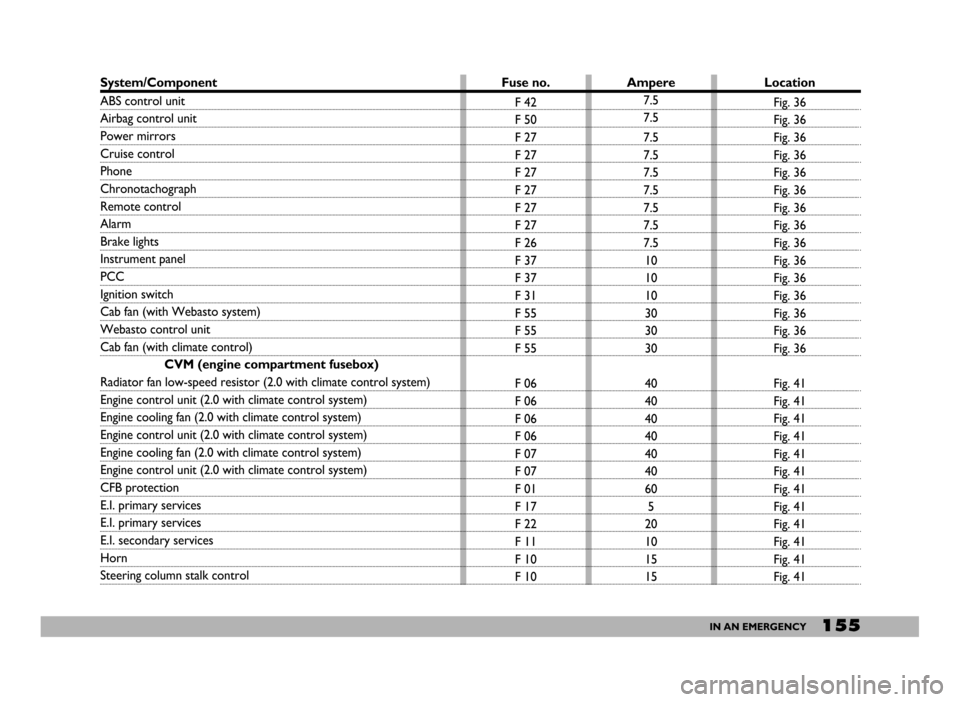
System/Component
ABS control unit
Airbag control unit
Power mirrors
Cruise control
Phone
Chronotachograph
Remote control
Alarm
Brake lights
Instrument panel
PCC
Ignition switch
Cab fan (with Webasto system)
Webasto control unit
Cab fan (with climate control)
CVM (engine compartment fusebox)
Radiator fan low-speed resistor (2.0 with climate control system)
Engine control unit (2.0 with climate control system)
Engine cooling fan (2.0 with climate control system)
Engine control unit (2.0 with climate control system)
Engine cooling fan (2.0 with climate control system)
Engine control unit (2.0 with climate control system)
CFB protection
E.I. primary services
E.I. primary services
E.I. secondary services
Horn
Steering column stalk controlFuse no.
F 42
F 50
F 27
F 27
F 27
F 27
F 27
F 27
F 26
F 37
F 37
F 31
F 55
F 55
F 55
F 06
F 06
F 06
F 06
F 07
F 07
F 01
F 17
F 22
F 11
F 10
F 10Ampere
7.5
7.5
7.5
7.5
7.5
7.5
7.5
7.5
7.5
10
10
10
30
30
30
40
40
40
40
40
40
60
5
20
10
15
15Location
Fig. 36
Fig. 36
Fig. 36
Fig. 36
Fig. 36
Fig. 36
Fig. 36
Fig. 36
Fig. 36
Fig. 36
Fig. 36
Fig. 36
Fig. 36
Fig. 36
Fig. 36
Fig. 41
Fig. 41
Fig. 41
Fig. 41
Fig. 41
Fig. 41
Fig. 41
Fig. 41
Fig. 41
Fig. 41
Fig. 41
Fig. 41
Page 157 of 258
156IN AN EMERGENCY
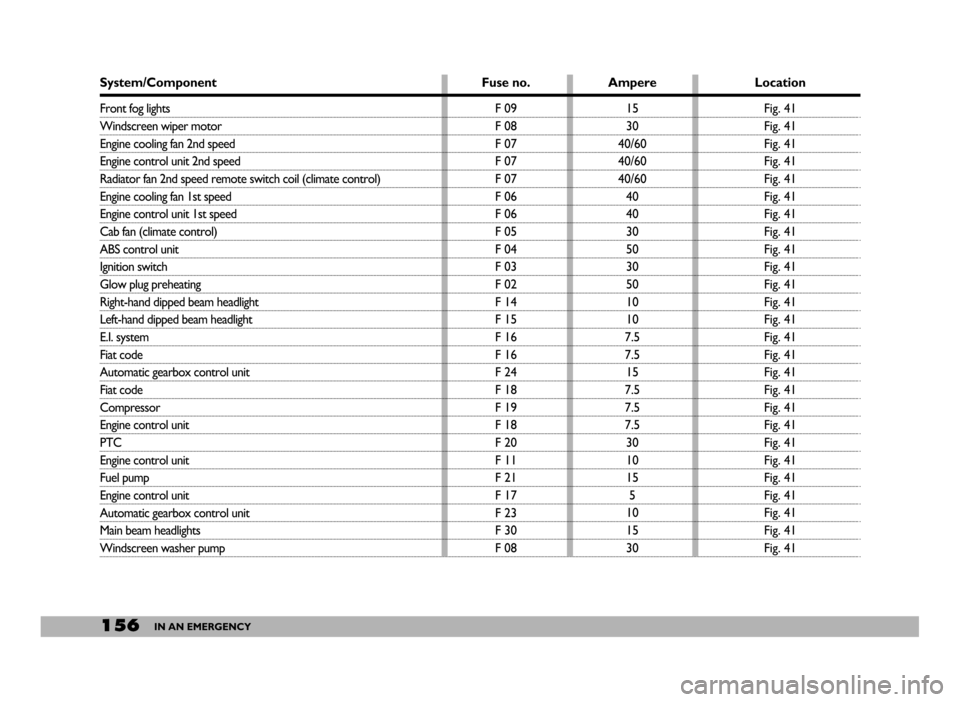
System/Component
Front fog lights
Windscreen wiper motor
Engine cooling fan 2nd speed
Engine control unit 2nd speed
Radiator fan 2nd speed remote switch coil (climate control)
Engine cooling fan 1st speed
Engine control unit 1st speed
Cab fan (climate control)
ABS control unit
Ignition switch
Glow plug preheating
Right-hand dipped beam headlight
Left-hand dipped beam headlight
E.I. system
Fiat code
Automatic gearbox control unit
Fiat code
Compressor
Engine control unit
PTC
Engine control unit
Fuel pump
Engine control unit
Automatic gearbox control unit
Main beam headlights
Windscreen washer pumpFuse no.
F 09
F 08
F 07
F 07
F 07
F 06
F 06
F 05
F 04
F 03
F 02
F 14
F 15
F 16
F 16
F 24
F 18
F 19
F 18
F 20
F 11
F 21
F 17
F 23
F 30
F 08Ampere
15
30
40/60
40/60
40/60
40
40
30
50
30
50
10
10
7.5
7.5
15
7.5
7.5
7.5
30
10
15
5
10
15
30Location
Fig. 41
Fig. 41
Fig. 41
Fig. 41
Fig. 41
Fig. 41
Fig. 41
Fig. 41
Fig. 41
Fig. 41
Fig. 41
Fig. 41
Fig. 41
Fig. 41
Fig. 41
Fig. 41
Fig. 41
Fig. 41
Fig. 41
Fig. 41
Fig. 41
Fig. 41
Fig. 41
Fig. 41
Fig. 41
Fig. 41
Page 159 of 258
158IN AN EMERGENCY
JACKING
THE VEHICLE
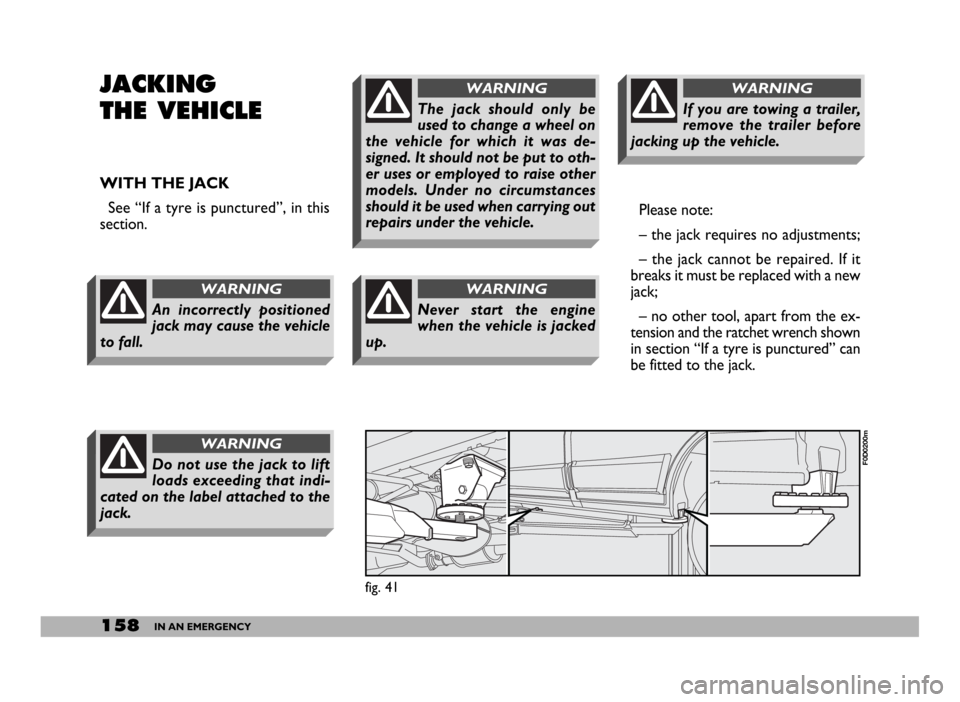
WITH THE JACK
See “If a tyre is punctured”, in this
section.Please note:
– the jack requires no adjustments;
– the jack cannot be repaired. If it
breaks it must be replaced with a new
jack;
– no other tool, apart from the ex-
tension and the ratchet wrench shown
in section “If a tyre is punctured” can
be fitted to the jack.
fig. 41
F0D0200mDo not use the jack to lift
loads exceeding that indi-
cated on the label attached to the
jack.
WARNING
The jack should only be
used to change a wheel on
the vehicle for which it was de-
signed. It should not be put to oth-
er uses or employed to raise other
models. Under no circumstances
should it be used when carrying out
repairs under the vehicle.
WARNING
Never start the engine
when the vehicle is jacked
up.
WARNING
An incorrectly positioned
jack may cause the vehicle
to fall.
WARNING
If you are towing a trailer,
remove the trailer before
jacking up the vehicle.
WARNING