lights FIAT DUCATO BASE CAMPER 2015 Owner handbook (in English)
[x] Cancel search | Manufacturer: FIAT, Model Year: 2015, Model line: DUCATO BASE CAMPER, Model: FIAT DUCATO BASE CAMPER 2015Pages: 367, PDF Size: 19.73 MB
Page 90 of 367
HILL DESCENT
CONTROL (HDC)
SYSTEM
It is an integral part of the ESC and
is aimed at keeping the vehicle at
a constant speed during a descent,
operating autonomously on the
brakes in various ways at the same
time. In this way the vehicle stability
and completely safe driving are
guaranteed, above all in poor grip
conditions and/or steep descents.
To activate the system reach a
speed slower than 25 km/h and
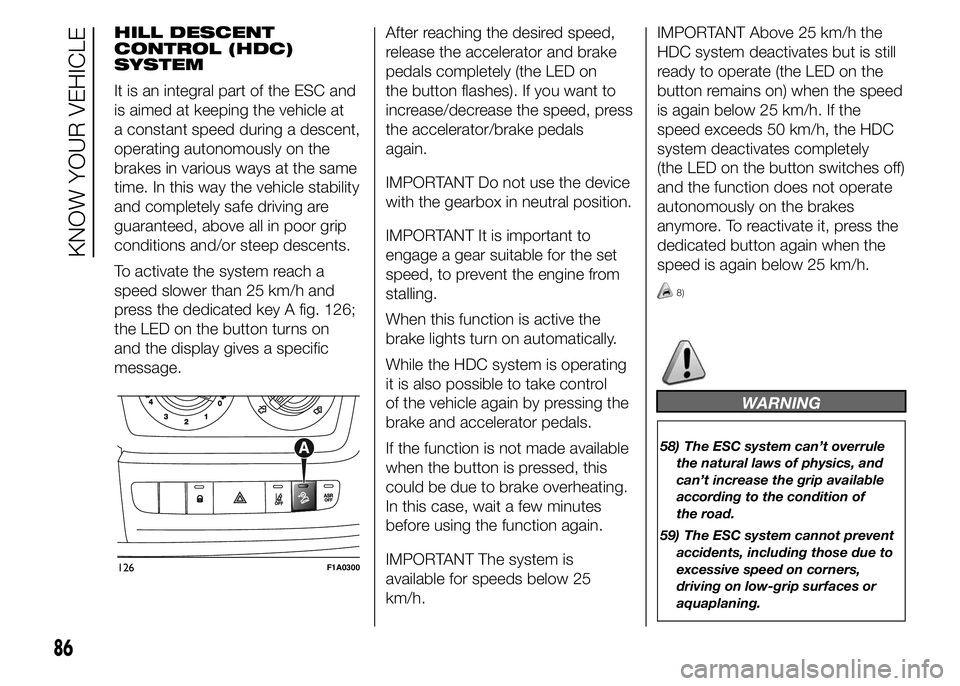
press the dedicated key A fig. 126;
the LED on the button turns on
and the display gives a specific
message.After reaching the desired speed,
release the accelerator and brake
pedals completely (the LED on
the button flashes). If you want to
increase/decrease the speed, press
the accelerator/brake pedals
again.
IMPORTANT Do not use the device
with the gearbox in neutral position.
IMPORTANT It is important to
engage a gear suitable for the set
speed, to prevent the engine from
stalling.
When this function is active the
brake lights turn on automatically.
While the HDC system is operating
it is also possible to take control
of the vehicle again by pressing the
brake and accelerator pedals.
If the function is not made available
when the button is pressed, this
could be due to brake overheating.
In this case, wait a few minutes
before using the function again.
IMPORTANT The system is
available for speeds below 25
km/h.IMPORTANT Above 25 km/h the
HDC system deactivates but is still
ready to operate (the LED on the
button remains on) when the speed
is again below 25 km/h. If the
speed exceeds 50 km/h, the HDC
system deactivates completely
(the LED on the button switches off)
and the function does not operate
autonomously on the brakes
anymore. To reactivate it, press the
dedicated button again when the
speed is again below 25 km/h.
8)
WARNING
58) The ESC system can’t overrule
the natural laws of physics, and
can’t increase the grip available
according to the condition of
the road.
59) The ESC system cannot prevent
accidents, including those due to
excessive speed on corners,
driving on low-grip surfaces or
aquaplaning.
126F1A0300
86
KNOW YOUR VEHICLE
Page 96 of 367
DRIVING ADVISOR
(lane crossing warning)
(for versions/markets, where
provided)
82) 79) 80)
The Driving Advisor is a warning
system that notifies the driver
if he/she crosses the lane because
he/she has been distracted.
A video sensor, fitted on the
windscreen near the interior rear
view mirror, detects the lane
demarcation lines and the position
of the car in relation to them.
IMPORTANT On cars with Driving
Advisor, it is advisable to contact
a Fiat Dealership should the
windscreen need to be replaced. If
the repair is carried out at a
specialist window replacement
centre, it is still necessary to go to a
Fiat Dealership to have the camera
calibrated.OPERATION
The system is always active when
the vehicle is started. It can be
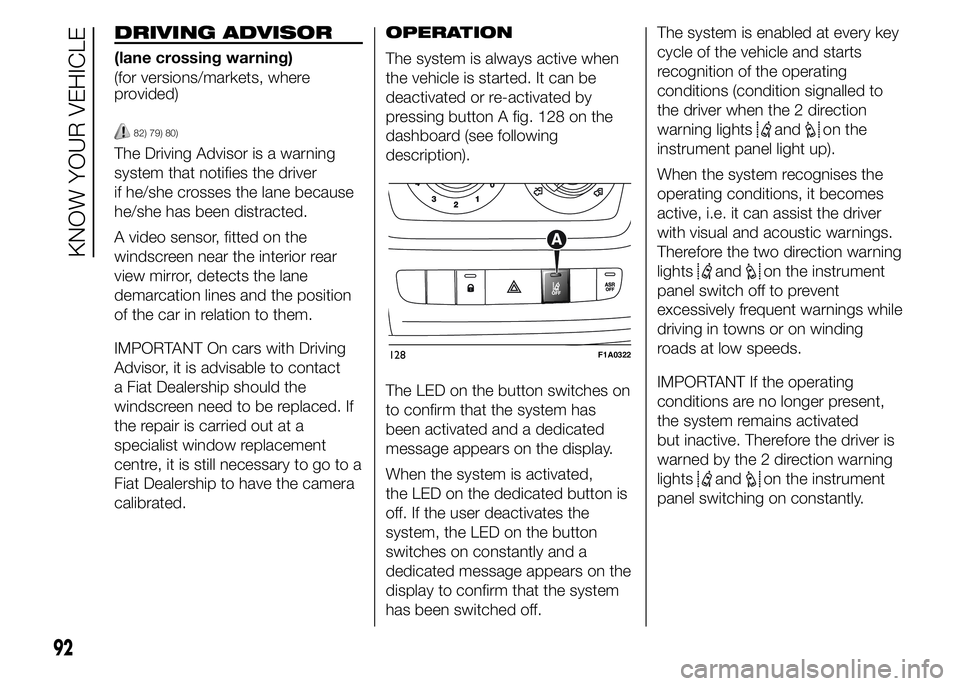
deactivated or re-activated by
pressing button A fig. 128 on the
dashboard (see following
description).
The LED on the button switches on
to confirm that the system has
been activated and a dedicated
message appears on the display.
When the system is activated,
the LED on the dedicated button is
off. If the user deactivates the
system, the LED on the button
switches on constantly and a
dedicated message appears on the
display to confirm that the system
has been switched off.The system is enabled at every key
cycle of the vehicle and starts
recognition of the operating
conditions (condition signalled to
the driver when the 2 direction
warning lights
andon the
instrument panel light up).
When the system recognises the
operating conditions, it becomes
active, i.e. it can assist the driver
with visual and acoustic warnings.
Therefore the two direction warning
lights
andon the instrument
panel switch off to prevent
excessively frequent warnings while
driving in towns or on winding
roads at low speeds.
IMPORTANT If the operating
conditions are no longer present,
the system remains activated
but inactive. Therefore the driver is
warned by the 2 direction warning
lights
andon the instrument
panel switching on constantly.
128F1A0322
92
KNOW YOUR VEHICLE
Page 99 of 367
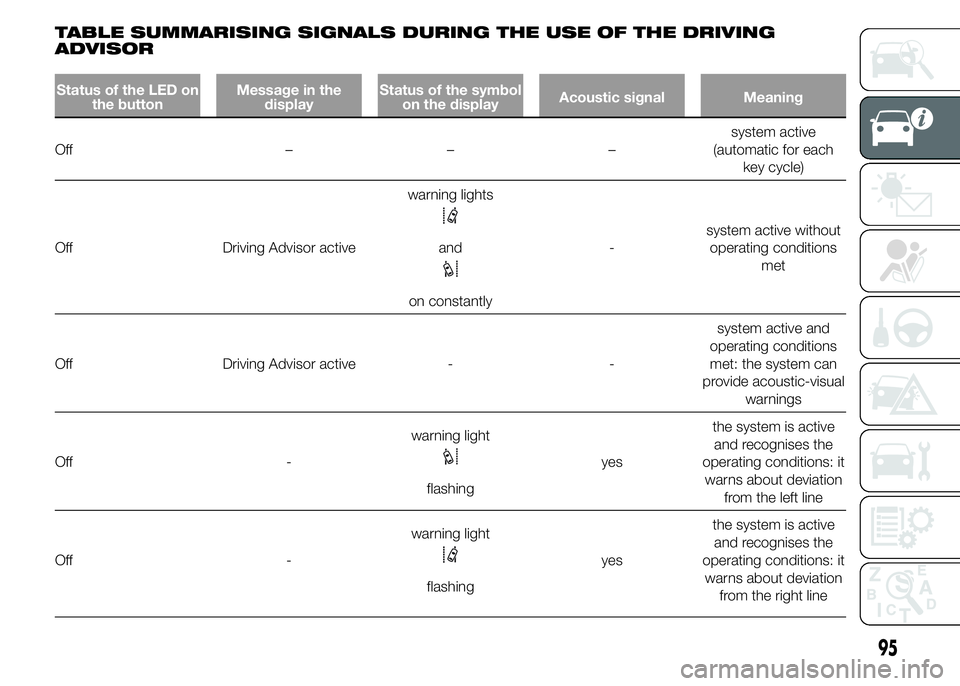
TABLE SUMMARISING SIGNALS DURING THE USE OF THE DRIVING
ADVISOR
Status of the LED on
the buttonMessage in the
displayStatus of the symbol
on the displayAcoustic signal Meaning
Off – – –system active
(automatic for each
key cycle)
Off Driving Advisor activewarning lights
and
on constantly-system active without
operating conditions
met
Off Driving Advisor active - -system active and
operating conditions
met: the system can
provide acoustic-visual
warnings
Off -warning light
flashingyesthe system is active
and recognises the
operating conditions: it
warns about deviation
from the left line
Off -warning light
flashingyesthe system is active
and recognises the
operating conditions: it
warns about deviation
from the right line
95
Page 104 of 367
WARNING
82) If the camera loses its position
due to a load variation, the system
may not work temporarily to allow
the camera to perform an
autocalibration.
83) The system only detects the
preset traffic signs. If the
minimum visibility conditions and
distance from the sign are met
it can detect all traffic signs.
84) The system is a driving
assistance system but it does not
relieve the driver of the
responsibility of driving with due
attention and diligence in
compliance with the laws in force.
85) When the system is active, the
driver is responsible for
controlling the vehicle and
monitoring the system, and must
intervene as appropriate if
necessary.
IMPORTANT
10) If the sensor is blocked, the
system may not work.
11) In the case of low temperatures
or harsh weather conditions, the
system may not work.
12) Rain, snow, splashes and strong
light contrast may influence the
sensor.
13) Do not repair the area of the
windscreen directly surrounding
the sensor.
14) If the vehicle is equipped with a
non-genuine suspension kit, the
system may not work correctly.
15) Always use genuine spare parts
when replacing the bulbs of the
headlights. Other bulbs may
reduce the system performance.
16) Clean the windscreen from
foreign matters such as bird
droppings, insects, snow or ice.
EOBD SYSTEM
The EOBD system (European On
Board Diagnosis) allows continuous
diagnosis of emission-related
components on the vehicle to be
made.
It also alerts the driver, by turning
on the
warning light in the
instrument panel (together with
relevant message in the
multifunction display, for versions/
markets where provided) when
these components are no longer in
peak condition (see “Warning
lights and messages” paragraph).
The aim of the system is to:
❒monitor system efficiency;
❒indicate an increase in emissions due
to vehicle malfunction;
❒indicate the need to replace
components which have
deteriorated.
100
KNOW YOUR VEHICLE
Page 115 of 367
PROTECTING THE
ENVIRONMENT
The following devices are used for
reducing diesel fuel engine
emissions:
❒oxidising catalytic converter;
❒exhaust gas recirculation system
(EGR);
❒particulate filter (DPF) (for versions/
markets, where provided).
93)
DIESEL PARTICULATE
FILTER (DPF)
The Diesel Particulate Filter is a
mechanical filter, integral to the
exhaust system, that physically
traps carbon particles present in
the exhaust gases of diesel
engines.
The diesel particulate filter has been
adopted to eliminate almost all
particulates in compliance with
current / future legal regulations.During normal use of the vehicle,
the Powertrain Control Module
records a set of data (travel time,
type of route, temperatures
reached etc.) and calculates how
much particulate has been trapped
by the filter.
Since this filter physically traps
particulate, it should be
regenerated (cleaned) at regular
intervals by burning carbon
particles.
The regeneration procedure is
controlled automatically by the
Powertrain Control Module
according to the filter conditions
and vehicle usage conditions.
During regeneration, the following
may occur: a limited increase in the
engine speed, activation of the
fan, a limited increase in fumes and
high temperatures at the exhaust.
These are not faults; they do not
impair vehicle performance or
damage the environment. If the
dedicated message is displayed,
refer to paragraph "Warning lights
and messages".
WARNING
93) The diesel particulate filter (DPF)
reaches high temperatures during
normal operation. Do not park
the vehicle on flammable material
(grass, dry leaves, pine needles
etc.): fire hazard.
111
Page 117 of 367
KNOWING THE INSTRUMENT PANEL
This section of the booklet gives
you all the information you need to
understand, interpret and use
the instrument panel correctly.CONTROL PANEL AND
INSTRUMENTS ...............................114
DISPLAY ........................................120
TRIP COMPUTER ...........................129
WARNING LIGHTS AND
MESSAGES ....................................132
- LOW BRAKE FLUID/HANDBRAKE
ENGAGED .......................................... 132
- EBD FAILURE .................................. 133
- AIRBAG FAILURE ............................. 133
- SEAT BELTS NOT FASTENED .......... 134
- ENGINE COOLANT TEMPERATURE
TOO HIGH .......................................... 135
- LOW BATTERY CHARGE ................. 135
- LOW ENGINE OIL PRESSURE ......... 136
-ENGINE OIL DETERIORATED ........... 136
-INCOMPLETE DOOR/LOAD
COMPARTMENT CLOSURE ............... 137
- POWER STEERING FAILURE ........... 137
-SELF-LEVELLING SUSPENSION
FAILURE ............................................. 137
- INJECTION/EOBD SYSTEM
FAILURE ............................................. 139
- ABS FAILURE ................................... 140
-FUEL RESERVE ................................ 140
- GLOW PLUG HEATING/GLOW
PLUG HEATING FAILURE ................... 141
- WATER IN DIESEL FILTER ................ 141
-VEHICLE PROTECTION SYSTEM
FAILURE - FIAT CODE ........................ 142
- REAR FOG LIGHTS .......................... 142
-GENERIC FAILURE INDICATION ....... 142
-DPF (PARTICULATE FILTER)
CLEANING UNDERWAY ..................... 144
-WORN BRAKE PADS ........................ 145
-DRIVING ADVISOR ........................... 146
- TPMS ............................................... 147
- DIPPED HEADLIGHTS ..................... 148- FOLLOW ME HOME ........................ 148
- LEFT-HAND DIRECTION INDICATOR
............................................................ 148
- RIGHT-HAND DIRECTION
INDICATOR ........................................ 149
-FOG LIGHTS ..................................... 149
- CRUISE CONTROL .......................... 149
-SPEED LIMITER ................................ 149
- AUTOMATIC MAIN BEAM
HEADLIGHTS ..................................... 150
- MAIN BEAM HEADLIGHTS .............. 150
-EXTERIOR LIGHTS FAULT ................ 151
-BRAKE LIGHT FAILURE .................... 151
-MAIN BEAM AUTOMATISM FAULT ... 152
-POSSIBLE ICE ON ROAD ................. 152
-SPEED LIMIT EXCEEDED ................. 152
-SCHEDULED SERVICING ................. 152
-DRIVING ADVISOR SYSTEM
FAILURE ............................................. 153
-TRAFFIC SIGN RECOGNITION
FAILURE ............................................. 153
-LIMITED RANGE ............................... 153
-START&STOP SYSTEM
ACTIVATION/DEACTIVATION .............. 154
-START&STOP FAILURE .................... 154
113
Page 123 of 367
ENGINE OIL LEVEL
GAUGE
(for versions/markets, where
provided)
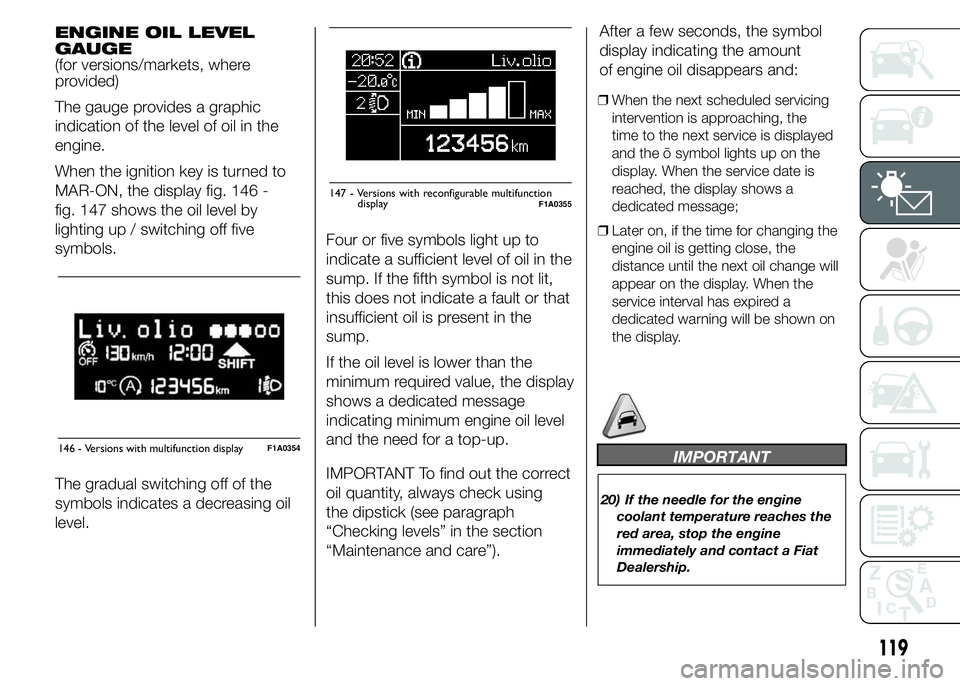
The gauge provides a graphic
indication of the level of oil in the
engine.
When the ignition key is turned to
MAR-ON, the display fig. 146 -
fig. 147 shows the oil level by
lighting up / switching off five
symbols.
The gradual switching off of the
symbols indicates a decreasing oil
level.Four or five symbols light up to
indicate a sufficient level of oil in the
sump. If the fifth symbol is not lit,
this does not indicate a fault or that
insufficient oil is present in the
sump.
If the oil level is lower than the
minimum required value, the display
shows a dedicated message
indicating minimum engine oil level
and the need for a top-up.
IMPORTANT To find out the correct
oil quantity, always check using
the dipstick (see paragraph
“Checking levels” in the section
“Maintenance and care”).After a few seconds, the symbol
display indicating the amount
of engine oil disappears and:
❒When the next scheduled servicing
intervention is approaching, the
time to the next service is displayed
and the õ symbol lights up on the
display. When the service date is
reached, the display shows a
dedicated message;
❒Later on, if the time for changing the
engine oil is getting close, the
distance until the next oil change will
appear on the display. When the
service interval has expired a
dedicated warning will be shown on
the display.
IMPORTANT
20) If the needle for the engine
coolant temperature reaches the
red area, stop the engine
immediately and contact a Fiat
Dealership.
146 - Versions with multifunction displayF1A0354
Liv.olio
MAX MIN
147 - Versions with reconfigurable multifunctionF1A0355
119
display
Page 124 of 367
DISPLAY
(for versions/markets, where
provided)
The vehicle may be equipped with
a multifunction display or with a
reconfigurable multifunction display,
able to display information that is
useful and necessary when driving.
MULTIFUNCTION
DISPLAY "STANDARD"
SCREEN
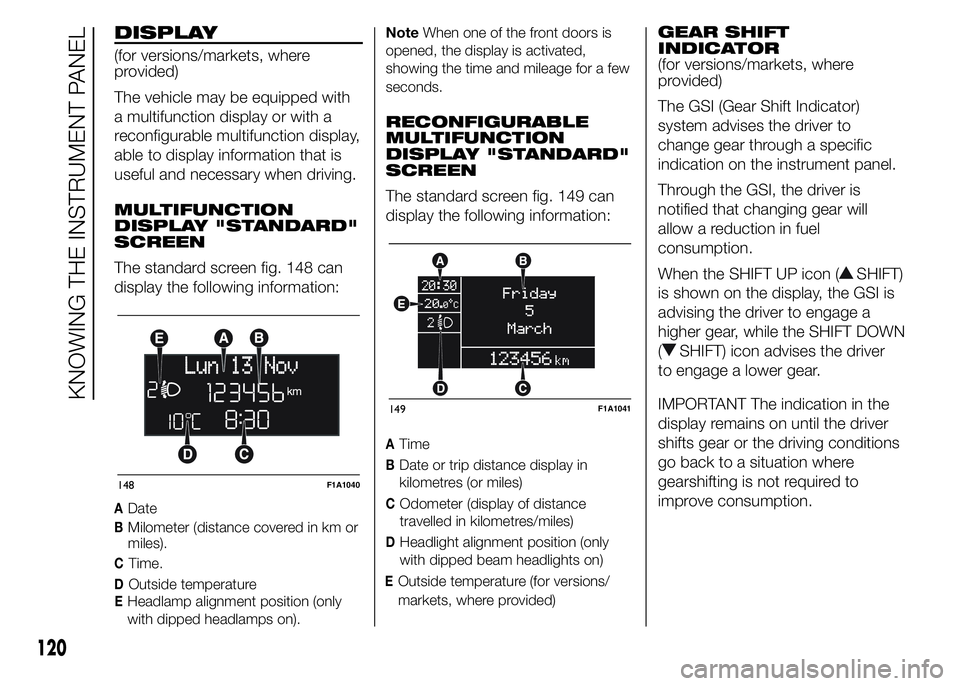
The standard screen fig. 148 can
display the following information:
ADate
BMilometer (distance covered in km or
miles).
CTime.
DOutside temperature
EHeadlamp alignment position (only
with dipped headlamps on).NoteWhen one of the front doors is
opened, the display is activated,
showing the time and mileage for a few
seconds.
RECONFIGURABLE
MULTIFUNCTION
DISPLAY "STANDARD"
SCREEN
The standard screen fig. 149 can
display the following information:
ATime
BDate or trip distance display in
kilometres (or miles)
COdometer (display of distance
travelled in kilometres/miles)
DHeadlight alignment position (only
with dipped beam headlights on)
EOutside temperature (for versions/
markets, where provided)
GEAR SHIFT
INDICATOR
(for versions/markets, where
provided)
The GSI (Gear Shift Indicator)
system advises the driver to
change gear through a specific
indication on the instrument panel.
Through the GSI, the driver is
notified that changing gear will
allow a reduction in fuel
consumption.
When the SHIFT UP icon (
SHIFT)
is shown on the display, the GSI is
advising the driver to engage a
higher gear, while the SHIFT DOWN
(
SHIFT) icon advises the driver
to engage a lower gear.
IMPORTANT The indication in the
display remains on until the driver
shifts gear or the driving conditions
go back to a situation where
gearshifting is not required to
improve consumption.
148F1A1040
149F1A1041
120
KNOWING THE INSTRUMENT PANEL
Page 125 of 367
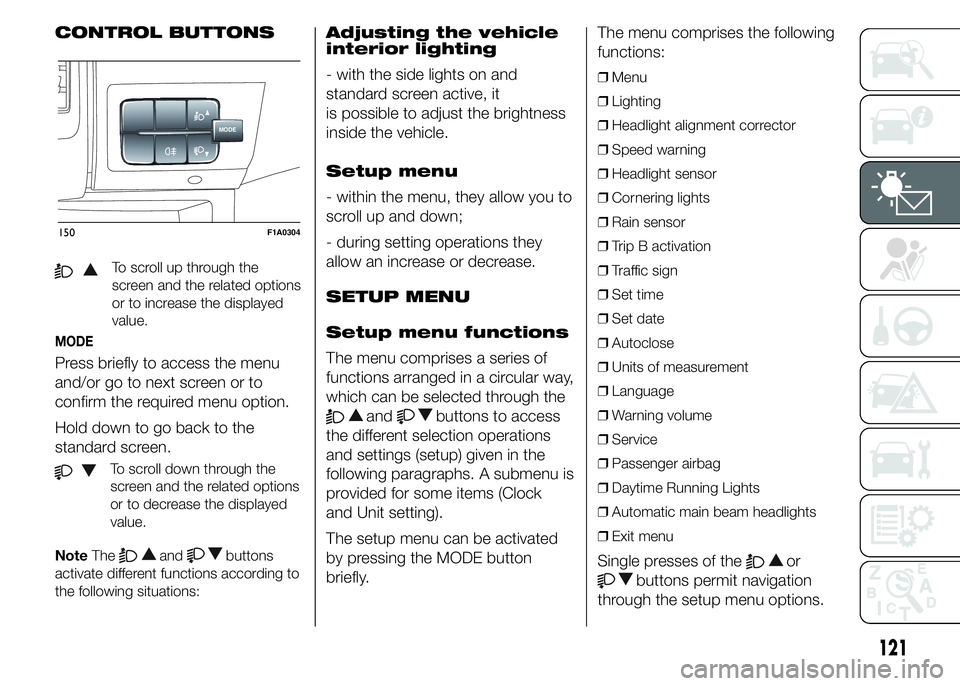
CONTROL BUTTONS
To scroll up through the
screen and the related options
or to increase the displayed
value.
MODE
Press briefly to access the menu
and/or go to next screen or to
confirm the required menu option.
Hold down to go back to the
standard screen.
To scroll down through the
screen and the related options
or to decrease the displayed
value.
NoteThe
andbuttons
activate different functions according to
the following situations:
Adjusting the vehicle
interior lighting
- with the side lights on and
standard screen active, it
is possible to adjust the brightness
inside the vehicle.
Setup menu
- within the menu, they allow you to
scroll up and down;
- during setting operations they
allow an increase or decrease.
SETUP MENU
Setup menu functions
The menu comprises a series of
functions arranged in a circular way,
which can be selected through the
andbuttons to access
the different selection operations
and settings (setup) given in the
following paragraphs. A submenu is
provided for some items (Clock
and Unit setting).
The setup menu can be activated
by pressing the MODE button
briefly.The menu comprises the following
functions:
❒Menu
❒Lighting
❒Headlight alignment corrector
❒Speed warning
❒Headlight sensor
❒Cornering lights
❒Rain sensor
❒Trip B activation
❒Traffic sign
❒Set time
❒Set date
❒Autoclose
❒Units of measurement
❒Language
❒Warning volume
❒Service
❒Passenger airbag
❒Daytime Running Lights
❒Automatic main beam headlights
❒Exit menu
Single presses of theor
buttons permit navigation
through the setup menu options.
MODE
150F1A0304
121
Page 127 of 367
Lighting
(Passenger compartment light
adjustment)
(only with side lights on)
This function is used to set the
brightness of the instrument panel,
uconnect™system controls (for
versions/markets where provided)
and automatic climate control
system controls (for versions/
markets where provided) to
8 levels.
Proceed as follows to adjust the
light intensity:
❒briefly press the MODE button. The
level set previously flashes on the
display;
❒press button
orto set
the required brightness level;
❒briefly press the MODE button to
return to the menu screen or hold the
button down to return to the
standard screen without storing.
NoteOn versions with reconfigurable
multifunction display adjustment can be
made both with lights off ("daytime"
mode brightness level) and with lights
on ("nighttime" mode brightness level).
Headlight alignment
(Headlight alignment
corrector position
adjustment)
(for versions/markets, where
provided)
This function permits the
adjustment (to 4 levels) of the
headlight alignment corrector
position.
To carry out the adjustment,
proceed as follows:
❒briefly press the MODE button. The
level set previously flashes on the
display;
❒press button
orto adjust
the position;
❒briefly press the MODE button to
return to the menu screen or hold the
button down to return to the
standard screen without storing.
Speed limit (Speed
Beep)
This function makes it possible to
set the vehicle speed limit (km/h or
mph). When this limit is exceeded
the driver is immediately alerted
(see “Warning lights and messages”
section).To set the desired speed limit,
proceed as follows:
- briefly press the MODE button:
the display will show the wording
(Speed Beep);
press button
orto select
speed limit activation (On) or
deactivation (Off);
- if the function has been activated
(On), press the
orbutton
to select the desired speed limit
and then press MODE to confirm.
NoteSetting is possible between
30 and 200 km/h, or 20 and 125 mph,
according to the previously set unit.
See the "Setting the unit of
measurement (Measurement unit)"
paragraph described below. The setting
will increase/decrease by 5 units each
time button
/is pressed.
Hold down the
/button to
automatically increase/decrease the
setting rapidly. Complete the
adjustment with single presses of the
button when you approach the desired
value.
- press the MODE button briefly to
return to the menu screen or hold
the button down to return to the
standard screen without storing.
123