seats FIAT FIORINO 2016 Owner handbook (in English)
[x] Cancel search | Manufacturer: FIAT, Model Year: 2016, Model line: FIORINO, Model: FIAT FIORINO 2016Pages: 210, PDF Size: 4.9 MB
Page 91 of 210
90
STARTING
AND DRIVING
WARNING
LIGHTS AND
MESSAGES
IN AN
EMERGENCY
MAINTENANCE
AND CARE
TECHNICAL
SPECIFICATIONS
INDEX
DASHBOARDAND CONTROLS
SAFETY
SEVERE DANGER: Do not
arrange child seats facing
backwards on the front seat
if the passenger’s airbag is on.
Deployment of the airbag in
the event of a shock could cause fa-
tal injuries to the baby. It is advisable
to carry children on the rear seat,
which is the most protected position
in the event of an accident. Child
seats must not be fitted on the front
seat of vehicles provided with a pas-
senger’s airbag, whose deployment in
an accident could cause fatal injuries
to the baby regardless of how severe
the shock causing airbag deployment
is. If necessary, children can sit on the
front seat in vehicles where the pas-
senger’s airbag can be disabled. Ver-
ify that the airbag is actually deacti-
vated, observing the warning light
“on the dashboard (see “Front airbag
- passenger’s side” in paragraph
“Front airbags”). Move the passen-
ger’s seat as far back as possible to
avoid contact between the child seat
and the dashboard.
WARNING
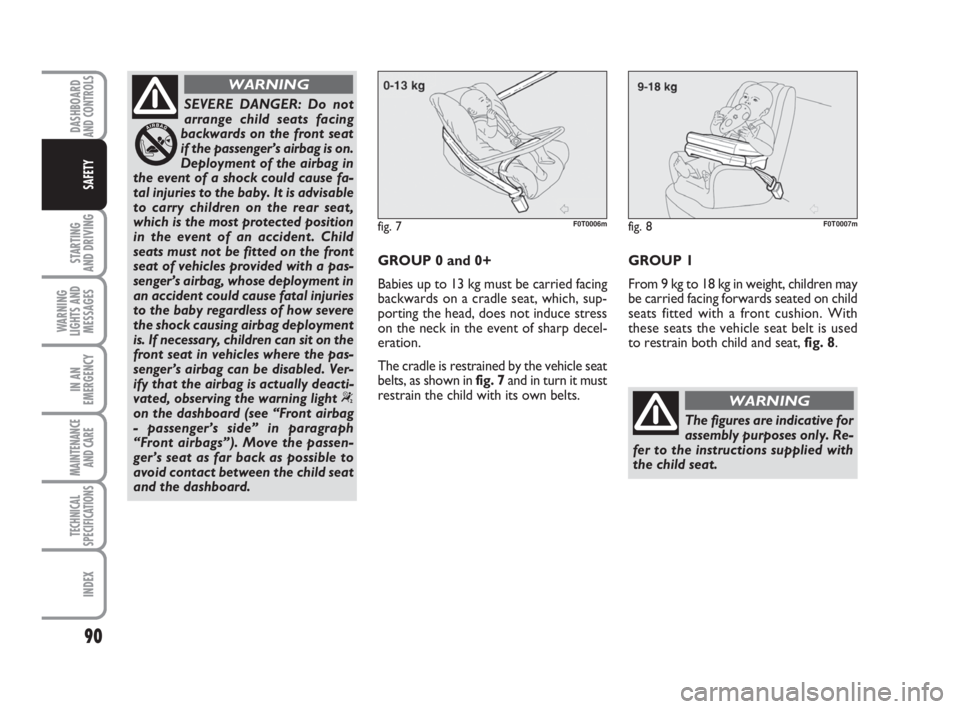
GROUP 0 and 0+
Babies up to 13 kg must be carried facing
backwards on a cradle seat, which, sup-
porting the head, does not induce stress
on the neck in the event of sharp decel-
eration.
The cradle is restrained by the vehicle seat
belts, as shown in fig. 7and in turn it must
restrain the child with its own belts.GROUP 1
From 9 kg to 18 kg in weight, children may
be carried facing forwards seated on child
seats fitted with a front cushion. With
these seats the vehicle seat belt is used
to restrain both child and seat, fig. 8.
fig. 7F0T0006mfig. 8F0T0007m
The figures are indicative for
assembly purposes only. Re-
fer to the instructions supplied with
the child seat.
WARNING
083-100 Fiorino GB 1ed:083-100 Fiorino GB 1ed 30-11-2009 15:53 Pagina 90
Page 93 of 210
92
STARTING
AND DRIVING
WARNING
LIGHTS AND
MESSAGES
IN AN
EMERGENCY
MAINTENANCE
AND CARE
TECHNICAL
SPECIFICATIONS
INDEX
DASHBOARDAND CONTROLS
SAFETY
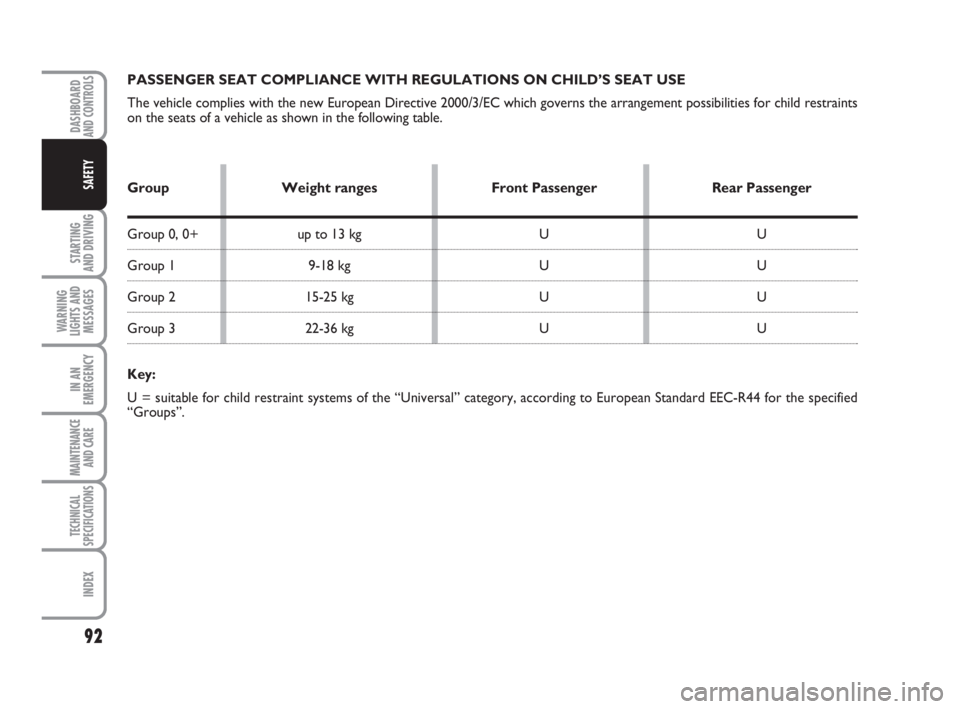
PASSENGER SEAT COMPLIANCE WITH REGULATIONS ON CHILD’S SEAT USE
The vehicle complies with the new European Directive 2000/3/EC which governs the arrangement possibilities for child restraints
on the seats of a vehicle as shown in the following table.
Group Weight ranges Front Passenger Rear Passenger
Group 0, 0+ up to 13 kg U U
Group 1 9-18 kg U U
Group 2 15-25 kg U U
Group 3 22-36 kg U U
Key:
U = suitable for child restraint systems of the “Universal” category, according to European Standard EEC-R44 for the specified
“Groups”.
083-100 Fiorino GB 1ed:083-100 Fiorino GB 1ed 30-11-2009 15:53 Pagina 92
Page 94 of 210
93
STARTING
AND DRIVING
WARNING
LIGHTS AND
MESSAGES
IN AN
EMERGENCY
MAINTENANCE
AND CARE
TECHNICAL
SPECIFICATIONS
INDEX
DASHBOARDAND CONTROLS
SAFETY
Below is a summary of the safety
rules to be followed for carrying chil-
dren.
❒Install the child seats on the rear seat,
which is the most protected position in
the event of an accident.
❒If the passenger’s airbag is deactivated,
always check the warning light
“on the
instrument panel to make sure that it
has actually been deactivated.
❒Carefully follow the instructions sup-
plied with the child restraint system
which are mandatory by law. Keep the
instructions in the vehicle along with
the other papers and this handbook. Do
not use child seats without instructions.❒Always check the seat belt is well fas-
tened by pulling the belt.
❒Only one child is to be strapped to each
retaining system.
❒Always check the seat belts do not fit
around the child’s throat.
❒While travelling, do not let the child sit
incorrectly or release the belts.
❒Never carry children on your lap, even
newborns. No-one can hold a child in
the event of an accident.
❒In the event of an accident, replace the
child’s seat with a new one.
Do not arrange child seats on
the front seat in vehicles fit-
ted with a passenger’s airbag. Chil-
dren must never travel on the front
seat.
WARNING
ISOFIX CHILD
RESTRAINT
ASSEMBLY SETUP
(for versions/markets, where provided)
Provision has been made on the vehicle
for mounting a Universal Isofix child re-
straint system, a new European standard-
ised system for carrying children safely.
Isofix systems can be mounted simultane-
ously with a traditional restraint system.
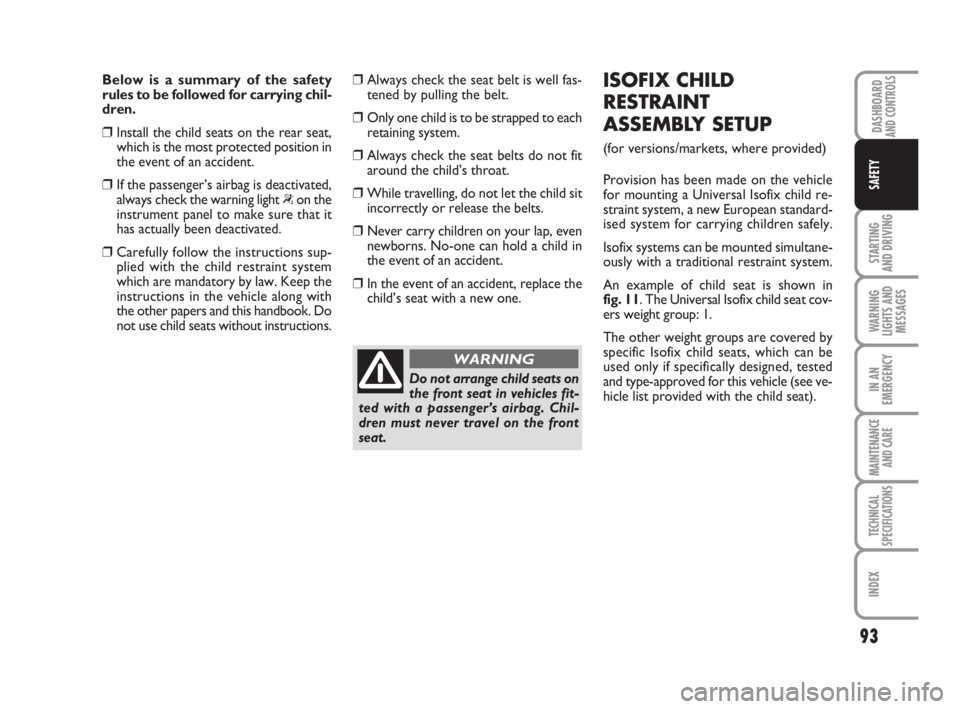
An example of child seat is shown in
fig. 11. The Universal Isofix child seat cov-
ers weight group: 1.
The other weight groups are covered by
specific Isofix child seats, which can be
used only if specifically designed, tested
and type-approved for this vehicle (see ve-
hicle list provided with the child seat).
083-100 Fiorino GB 1ed:083-100 Fiorino GB 1ed 30-11-2009 15:53 Pagina 93
Page 95 of 210
94
STARTING
AND DRIVING
WARNING
LIGHTS AND
MESSAGES
IN AN
EMERGENCY
MAINTENANCE
AND CARE
TECHNICAL
SPECIFICATIONS
INDEX
DASHBOARDAND CONTROLS
SAFETY
fig. 12F0T0145m
fig. 11F0T0010m
Fit the child seat when the
vehicle is stationary. The
child seat is correctly anchored to the
brackets when you hear the click. Fol-
low the instructions for assembly, dis-
assembly and positioning that the
manufacturer must supply with the
child seat.
WARNINGRemember that only Universal Isofix child
seats bearing the type-approval text “ECE
R44/03 Universal Isofix” can be used.
Universal Isofix “Duo Plus” child seat is
available from Lineaccessori Fiat.
For any further details regarding installa-
tion/use, refer to the “Instructions Man-
ual” that must be provided by the Manu-
facturer of the child restraint system.
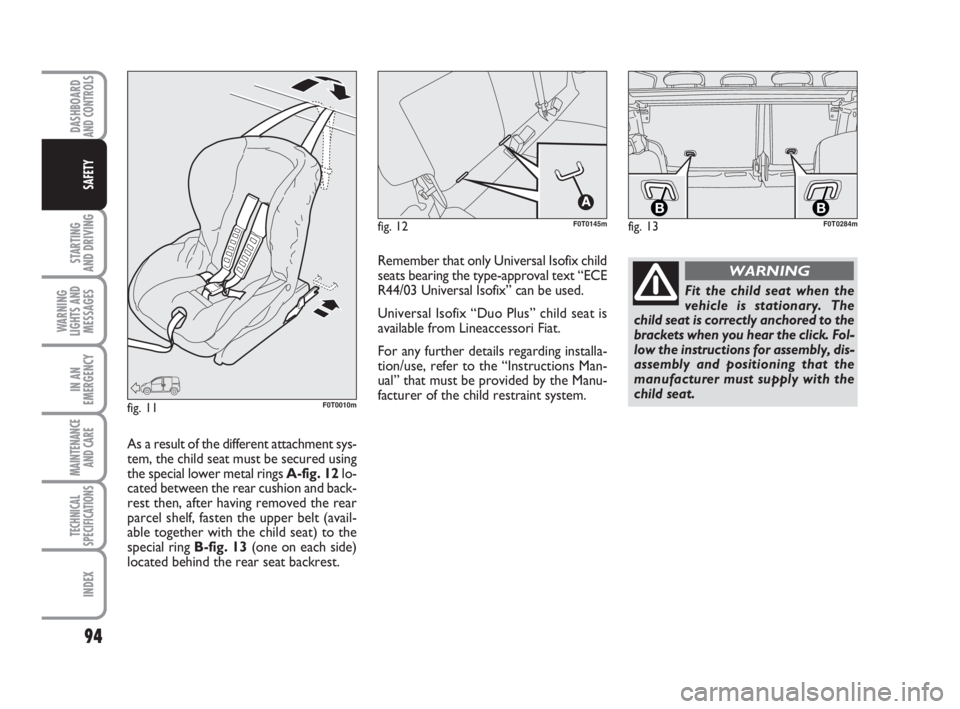
As a result of the different attachment sys-
tem, the child seat must be secured using
the special lower metal rings A-fig. 12lo-
cated between the rear cushion and back-
rest then, after having removed the rear
parcel shelf, fasten the upper belt (avail-
able together with the child seat) to the
special ring B-fig. 13(one on each side)
located behind the rear seat backrest.
fig. 13
BBF0T0284m
083-100 Fiorino GB 1ed:083-100 Fiorino GB 1ed 30-11-2009 15:53 Pagina 94
Page 96 of 210
95
STARTING
AND DRIVING
WARNING
LIGHTS AND
MESSAGES
IN AN
EMERGENCY
MAINTENANCE
AND CARE
TECHNICAL
SPECIFICATIONS
INDEX
DASHBOARDAND CONTROLS
SAFETY
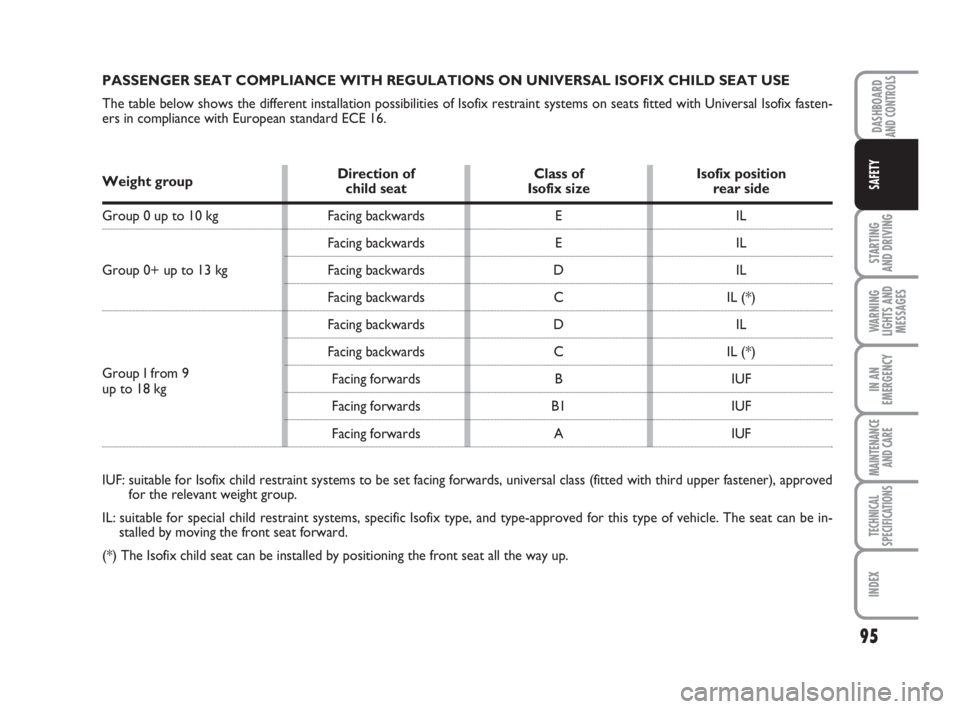
PASSENGER SEAT COMPLIANCE WITH REGULATIONS ON UNIVERSAL ISOFIX CHILD SEAT USE
The table below shows the different installation possibilities of Isofix restraint systems on seats fitted with Universal Isofix fasten-
ers in compliance with European standard ECE 16.
Weight groupDirection of Class of Isofix position
child seat Isofix size rear side
Group 0 up to 10 kg
Group 0+ up to 13 kg
Group I from 9
up to 18 kg
IUF: suitable for Isofix child restraint systems to be set facing forwards, universal class (fitted with third upper fastener), approved
for the relevant weight group.
IL: suitable for special child restraint systems, specific Isofix type, and type-approved for this type of vehicle. The seat can be in-
stalled by moving the front seat forward.
(*) The Isofix child seat can be installed by positioning the front seat all the way up.E
E
D
C
D
C
B
B1
AIL
IL
IL
IL (*)
IL
IL (*)
IUF
IUF
IUF Facing backwards
Facing backwards
Facing backwards
Facing backwards
Facing backwards
Facing backwards
Facing forwards
Facing forwards
Facing forwards
083-100 Fiorino GB 1ed:083-100 Fiorino GB 1ed 30-11-2009 15:53 Pagina 95
Page 97 of 210
96
STARTING
AND DRIVING
WARNING
LIGHTS AND
MESSAGES
IN AN
EMERGENCY
MAINTENANCE
AND CARE
TECHNICAL
SPECIFICATIONS
INDEX
DASHBOARDAND CONTROLS
SAFETY
FRONT AIRBAGS
The vehicle is provided with front airbags
for the driver and the passenger (for ver-
sions/markets, where provided).
FRONT AIRBAGS
The front airbags on both the driver’s and
passenger’s side (for versions/markets,
where provided) have been designed to
protect the occupants in the event of
head-on crashes of medium-high severity,
by placing the bag between the occupant
and the steering wheel or dashboard.
Non-deployment of the airbags in other
types of collisions (side collisions, rear
shunts, roll-overs, etc.) does not neces-
sarily indicate a system malfunction.
An electronic control unit causes the bag
to inflate in the event of a front crash.
The bag will inflate instantaneously placing
itself between the front occupant’s body
and the structures which could cause in-
jury. It will deflate immediately afterwards.
Driver and passenger front airbags (for
versions/markets, where provided) are
not a replacement of, but complementary
to, the seat belts, which you are recom-
mended to always wear as specified by law
in Europe and most non-European coun-
tries.In the event of a collision, a person not
wearing the seat belt may be thrown for-
ward and come into contact with the bag
before it has fully opened. The protection
offered by the bag is reduced in such a
case.
Front airbags may not be activated in the
following situations:
❒in front collisions against highly de-
formable objects which do not affect
the front surface of the vehicle (e.g.
bumper collision against guard rail, etc.);
❒vehicle penetration under other vehi-
cles or protective barriers (e.g. trucks
or guard rails);
they could not provide any additional pro-
tection compared with seat belts, so their
deployment would be improper. In these
cases non-deployment of the airbag does
not necessarily indicate a system malfunc-
tion.Do not apply stickers or oth-
er objects on the steering
wheel, on the dashboard (in passen-
ger side airbag area) and on the seats.
Do not place objects (e.g. cell phones)
on the passenger’s side dashboard be-
cause these could interfere with cor-
rect deployment of the passenger’s
airbag and cause severe injury to ve-
hicle occupants.
WARNING
The front airbags on the driver’s and pas-
senger’s sides are designed and calibrated
to protect the front seat passengers who
wear safety belts.
The volume of the front airbags at max.
inflation fills most of the space between
the steering wheel and the driver and be-
tween the dashboard and the passenger.
The airbags are not deployed in the event
of front collisions of low severity (for
which the withholding action of the seat
belts is sufficient). Safety belts must always
be worn. In the event of a front crash they
ensure the correct positioning of the oc-
cupant.
083-100 Fiorino GB 1ed:083-100 Fiorino GB 1ed 30-11-2009 15:53 Pagina 96
Page 98 of 210
97
STARTING
AND DRIVING
WARNING
LIGHTS AND
MESSAGES
IN AN
EMERGENCY
MAINTENANCE
AND CARE
TECHNICAL
SPECIFICATIONS
INDEX
DASHBOARDAND CONTROLS
SAFETY
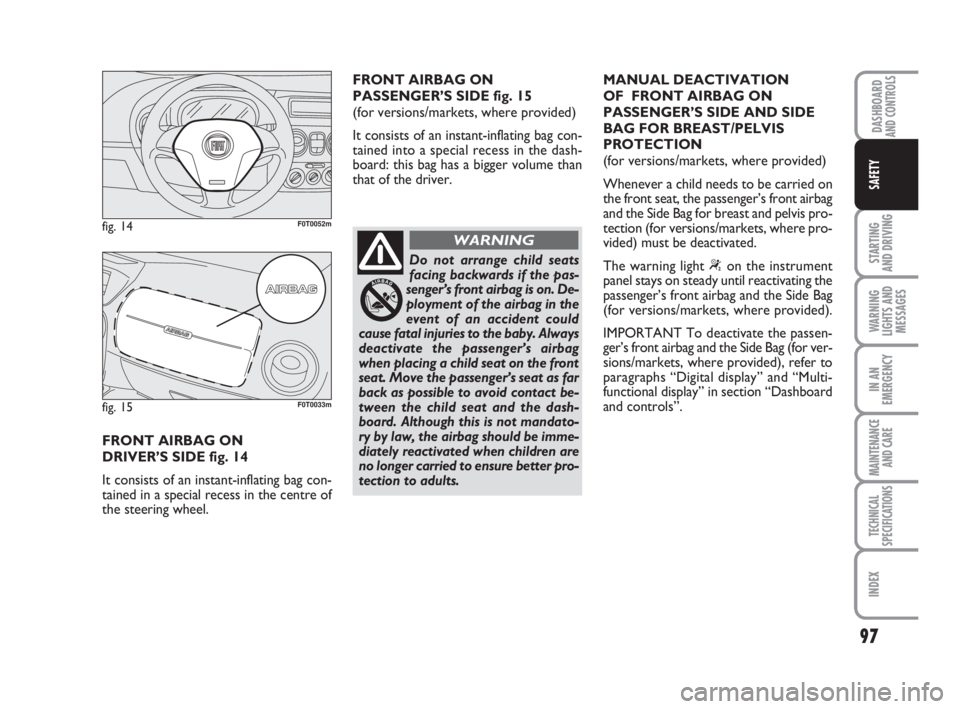
FRONT AIRBAG ON
DRIVER’S SIDE fig. 14
It consists of an instant-inflating bag con-
tained in a special recess in the centre of
the steering wheel.
fig. 14F0T0052m
fig. 15F0T0033m
FRONT AIRBAG ON
PASSENGER’S SIDE fig. 15
(for versions/markets, where provided)
It consists of an instant-inflating bag con-
tained into a special recess in the dash-
board: this bag has a bigger volume than
that of the driver.
Do not arrange child seats
facing backwards if the pas-
senger’s front airbag is on. De-
ployment of the airbag in the
event of an accident could
cause fatal injuries to the baby. Always
deactivate the passenger’s airbag
when placing a child seat on the front
seat. Move the passenger’s seat as far
back as possible to avoid contact be-
tween the child seat and the dash-
board. Although this is not mandato-
ry by law, the airbag should be imme-
diately reactivated when children are
no longer carried to ensure better pro-
tection to adults.
WARNING
MANUAL DEACTIVATION
OF FRONT AIRBAG ON
PASSENGER’S SIDE AND SIDE
BAG FOR BREAST/PELVIS
PROTECTION
(for versions/markets, where provided)
Whenever a child needs to be carried on
the front seat, the passenger’s front airbag
and the Side Bag for breast and pelvis pro-
tection (for versions/markets, where pro-
vided) must be deactivated.
The warning light
“on the instrument
panel stays on steady until reactivating the
passenger’s front airbag and the Side Bag
(for versions/markets, where provided).
IMPORTANT To deactivate the passen-
ger’s front airbag and the Side Bag (for ver-
sions/markets, where provided), refer to
paragraphs “Digital display” and “Multi-
functional display” in section “Dashboard
and controls”.
083-100 Fiorino GB 1ed:083-100 Fiorino GB 1ed 30-11-2009 15:53 Pagina 97
Page 99 of 210
98
STARTING
AND DRIVING
WARNING
LIGHTS AND
MESSAGES
IN AN
EMERGENCY
MAINTENANCE
AND CARE
TECHNICAL
SPECIFICATIONS
INDEX
DASHBOARDAND CONTROLS
SAFETY
SIDE BAGS
(for versions/markets, where provided)
Some versions have front side bags on
both the driver’s and passenger’s sides.
Side bags protect vehicle occupants from
side crashes of medium-high severity, by
placing the bag between the occupant and
the internal parts of the side structure of
the vehicle.
Non-deployment of side bags in other
types of collisions (front collisions, rear
shunts, roll-overs, etc...) does not neces-
sarily indicate a system malfunction.
An electronic control unit causes the bags
to inflate in the event of a frontal crash.
The bags inflate instantaneously placing
themselves between the front occupant’s
body and the structures which could cause
injury. They deflate immediately after-
wards.
Side bags are not a replacement of, but
complementary to, the seat belts, which
you are always recommended to wear, as
specified by law in Europe and in most
non-European countries.
For this reason, the seat belt must be
worn at all times. During side collisions
the seat belts hold the occupant in the
correct position and prevent ejection
from the vehicle during very violent colli-
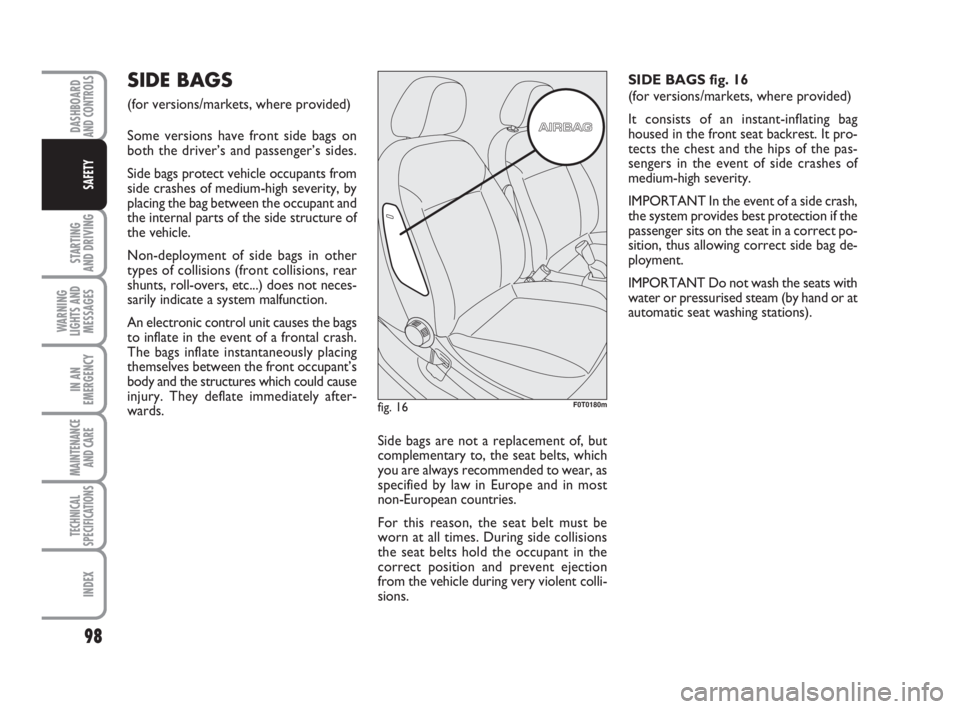
sions.SIDE BAGS fig. 16
(for versions/markets, where provided)
It consists of an instant-inflating bag
housed in the front seat backrest. It pro-
tects the chest and the hips of the pas-
sengers in the event of side crashes of
medium-high severity.
IMPORTANT In the event of a side crash,
the system provides best protection if the
passenger sits on the seat in a correct po-
sition, thus allowing correct side bag de-
ployment.
IMPORTANT Do not wash the seats with
water or pressurised steam (by hand or at
automatic seat washing stations).
fig. 16F0T0180m
083-100 Fiorino GB 1ed:083-100 Fiorino GB 1ed 30-11-2009 15:53 Pagina 98
Page 105 of 210
104
SAFETY
WARNING
LIGHTS AND
MESSAGES
IN AN
EMERGENCY
MAINTENANCE
AND CARE
TECHNICAL
SPECIFICATIONS
INDEX
DASHBOARDAND CONTROLS
STARTING
AND DRIVING
HANDBRAKE
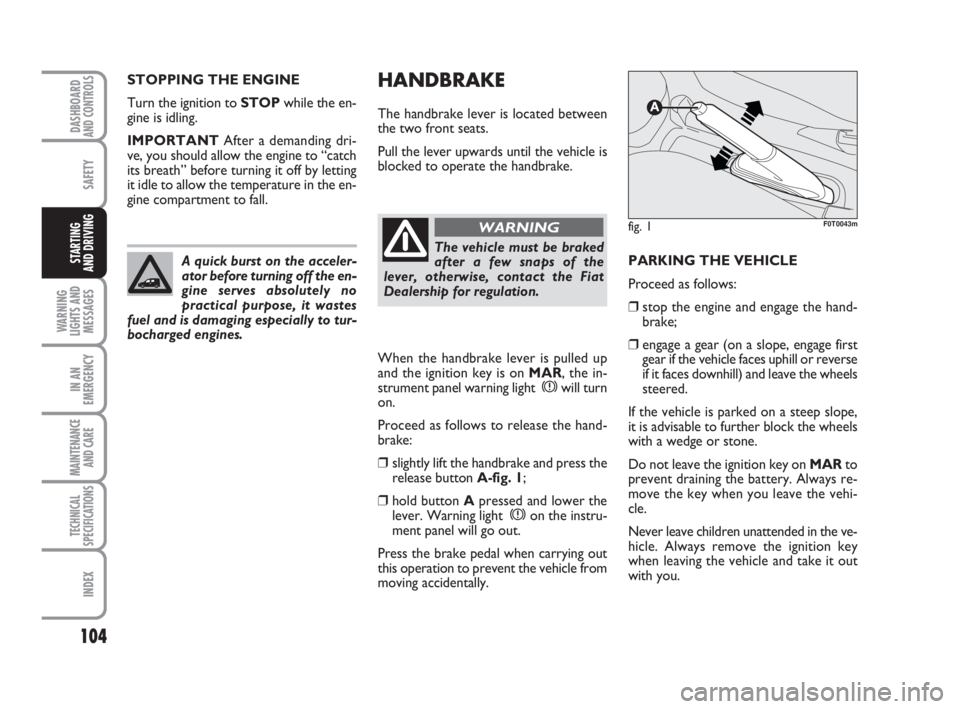
The handbrake lever is located between
the two front seats.
Pull the lever upwards until the vehicle is
blocked to operate the handbrake.
When the handbrake lever is pulled up
and the ignition key is on MAR, the in-
strument panel warning light xwill turn
on.
Proceed as follows to release the hand-
brake:
❒slightly lift the handbrake and press the
release button A-fig. 1;
❒hold button Apressed and lower the
lever. Warning light xon the instru-
ment panel will go out.
Press the brake pedal when carrying out
this operation to prevent the vehicle from
moving accidentally.PARKING THE VEHICLE
Proceed as follows:
❒stop the engine and engage the hand-
brake;
❒engage a gear (on a slope, engage first
gear if the vehicle faces uphill or reverse
if it faces downhill) and leave the wheels
steered.
If the vehicle is parked on a steep slope,
it is advisable to further block the wheels
with a wedge or stone.
Do not leave the ignition key on MARto
prevent draining the battery. Always re-
move the key when you leave the vehi-
cle.
Never leave children unattended in the ve-
hicle. Always remove the ignition key
when leaving the vehicle and take it out
with you. STOPPING THE ENGINE
Turn the ignition to STOPwhile the en-
gine is idling.
IMPORTANTAfter a demanding dri-
ve, you should allow the engine to “catch
its breath” before turning it off by letting
it idle to allow the temperature in the en-
gine compartment to fall.
A quick burst on the acceler-
ator before turning off the en-
gine serves absolutely no
practical purpose, it wastes
fuel and is damaging especially to tur-
bocharged engines.
fig. 1F0T0043m
The vehicle must be braked
after a few snaps of the
lever, otherwise, contact the Fiat
Dealership for regulation.
WARNING
101-110 Fiorino GB 1ed:101-110 Fiorino GB 1ed 30-11-2009 16:14 Pagina 104
Page 148 of 210
147
SAFETY
MAINTENANCE
AND CARE
TECHNICAL
SPECIFICATIONS
INDEX
DASHBOARDAND CONTROLS
STARTING
AND DRIVING
WARNING
LIGHTS AND
MESSAGES
IN AN
EMERGENCY
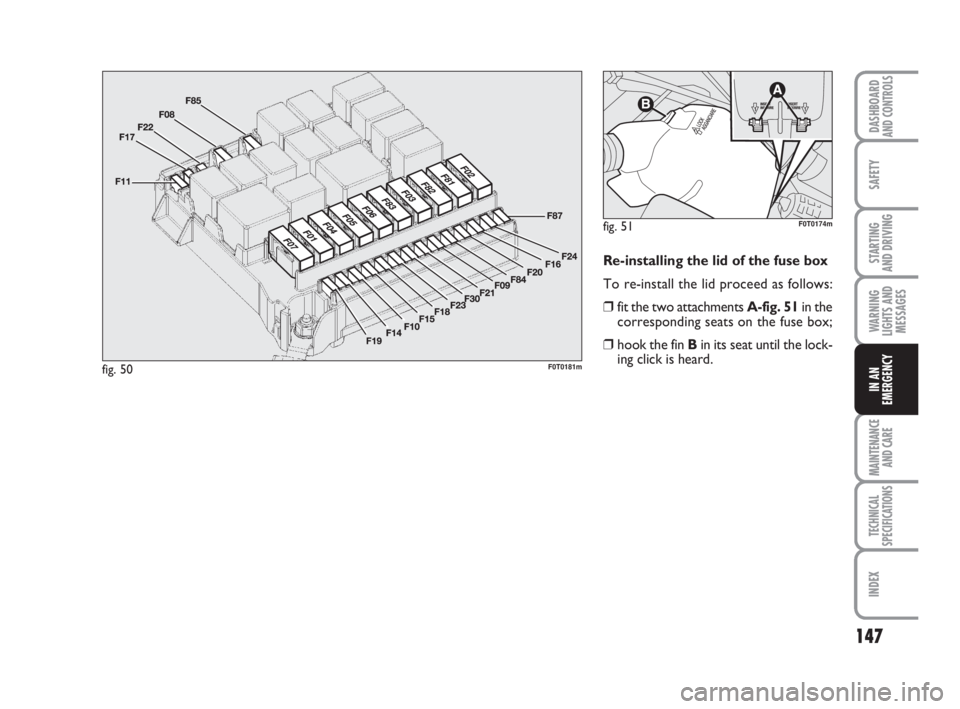
Re-installing the lid of the fuse box
To re-install the lid proceed as follows:
❒fit the two attachments A-fig. 51in the
corresponding seats on the fuse box;
❒hook the fin Bin its seat until the lock-
ing click is heard.
fig. 50F0T0181m
fig. 51F0T0174m
123-154 Fiorino GB 1ed:123-154 Fiorino GB 1ed 3-12-2009 15:33 Pagina 147