brakes FIAT FIORINO 2018 Owner handbook (in English)
[x] Cancel search | Manufacturer: FIAT, Model Year: 2018, Model line: FIORINO, Model: FIAT FIORINO 2018Pages: 196, PDF Size: 4.99 MB
Page 3 of 196
Dear Customer,
We would like to congratulate and thank you for choosing a Fiat Fiorino.
We have written this handbook to help you get to know all the features of your vehicle and use it in the best possible way.
Here you will find information, advice and important warnings regarding vehicle use and how to achieve the best performance from the
technical features of your Fiat Fiorino.
You are advised to read it right through before taking to the road for the first time, to become familiar with the controls and above all
with those concerning brakes, steering and transmission; at the same time, you can understand the vehicle behaviour on different road
surfaces.
This document also provides a description of special features and tips, as well as essential information for the safe driving, care and
servicing of your Fiat Fiorino over time.
After reading it, you are advised to keep the handbook inside the vehicle, for an easy reference and for making sure it remains on
board the vehicle should it be sold.
In the attached Warranty Booklet you will also find a description of the Services that Fiat offers to its customers, the Warranty
Certificate, the detail of the terms and conditions for maintaining its validity and the range of additional services available to Fiat
Customers.
We are sure that these will help you to get in touch with and appreciate your new vehicle and the service provided by the people at
Fiat.
Enjoy reading. Happy motoring!
WARNING
This Owner Handbook describes all Fiat Fiorino versions. As a consequence, you should only consider the information
related to the trim level, engine and version that you have purchased. All data contained in this publication are purely
indicative. FCA Italy S.p.A. can modify the specifications of the vehicle model described in this publication at any time, for
technical or marketing purposes. For further information, contact a Fiat Dealership.
Page 70 of 196
ESC (Electronic
Stability Control)
SYSTEM
(for versions/markets, where provided)
This is an electronic system that
controls vehicle stability in the event of
tyre grip loss, helping to maintain
directional control. The system
is capable of recognising potentially
dangerous situations in terms of vehicle
stability and intervenes automatically
on the brakes in a differentiated manner
for the four wheels in order to provide
a stabilizing torque.
The ESC system switches on
automatically when the engine is
started and cannot be switched off.
The ESC system also includes the
following systems:
Hill Holder
ASR
MSR
HBA
SYSTEM INTERVENTION
This is signalled by the flashing of the
warning light in the instrument panel,
to inform the driver that the vehicle is
in critical stability and grip conditions.
Switching the system on
The ESC system is automatically
activated when the vehicle is started
and cannot be deactivated.Fault warnings
In the event of a failure, the ESC will be
automatically switched off and the
warning light
will come on constantly
in the instrument panel along with a
message in the multifunction display
(for versions/markets where provided)
(see “Warning lights and messages”
section in the "Knowing the instrument
panel" chapter). Contact a Fiat
Dealership as soon as possible.
44) 45) 46)
HILL HOLDER SYSTEM
(for versions/markets, where provided)
It is an integral part of the ESC system
and facilitates starting on an incline.
It is automatically activated in the
following conditions:
uphill: vehicle stationary on a road
with a gradient higher than 5%, engine
running, brake pedal pressed and
gearbox in neutral or gear other than
reverse;
downhill: vehicle stationary on a road
with a gradient higher than 5%, engine
running, brake pedal pressed and
reverse gear engaged.
When setting off, the ESC system
control unit maintains the braking
pressure on the wheels until the torque
necessary for starting is reached, or
in any case for a maximum of 2seconds, allowing your right foot to be
moved easily from the brake pedal to
the accelerator. When the 2 seconds
have elapsed, without starting, the
system is automatically deactivated,
gradually releasing the braking
pressure. During this release stage, the
typical brake disengagement noise
indicating that the vehicle is going to
move imminently will be heard.
Fault warnings
System failure is indicated by
instrument panel warning light
with
digital display and warning light
on
the instrument panel with multifunction
display (for versions/markets, where
provided) (see section “Warning lights
and messages” in the "Knowing the
instrument panel" chapter).
IMPORTANT The Hill Holder system is
not a parking brake, therefore do not
leave the vehicle without activating the
handbrake, switching off the engine
and engaging first gear.
47)
ASR SYSTEM (Antislip
Regulation)
(for versions/markets, where provided)
This is a traction control system that
cuts in automatically every time one or
both drive wheels slip.
68
SAFETY
Page 101 of 196
SPEED BLOCK
(for 1.3 MultiJet versions with manual
transmission)
The vehicle is equipped with a speed
limitation function that can be set on
the user's request to one of four default
values. 90, 100, 110, 130 km/h.
To activate/deactivate this function,
contact a Fiat Dealership.
Following the operation, a sticker fig.
110 will be applied to the windscreen
showing the top speed setting.
IMPORTANT The speedometer could
indicate a higher maximum speed than
the effective one, set by the Dealership,
in accordance with the regulations in
force.
PARKING SENSORS
(for versions/markets, where provided)
99)
31)
These are located in the rear bumper
fig. 111 and their function is to inform
the driver, through an intermittent
beeping noise, about the presence of
obstacles behind the vehicle.
ACTIVATION/
DEACTIVATION
The sensors are automatically activated
when reverse gear is engaged.
The buzzer becomes more frequent as
the obstacle behind the vehicle gets
closer to the bumper.OPERATION WITH A
TRAILER
The operation of the sensors is
automatically deactivated when the
plug for the electric cable for the trailer
is inserted in the vehicle tow hook
socket.
The sensors are automatically
reactivated when the trailer's cable plug
is removed.
IMPORTANT If you wish to leave the
tow hook fitted without towing a trailer,
it is advisable to contact a Fiat
Dealership for the relevant system
update operations because the tow
hook could be detected as an obstacle
by the central sensors.
IMPORTANT NOTES
During parking manoeuvres, pay the
utmost attention to any obstacles that
could be located above or below the
sensors.
Sometimes, objects located very
near the rear of the vehicle are not
detected and could therefore damage
the vehicle or be damaged themselves.
The signals sent out by the sensors
can be altered by dirt, snow or ice
deposited on the sensors or by
ultrasound systems (e.g. truck
pneumatic brakes or pneumatic drills)
near the vehicle.110F0T0330
111F0T0155
99
Page 102 of 196
The parking sensors work properly
with the swing doors closed. If they are
open, they can cause the system to
send false signals: always close the rear
doors.
Also, do not apply stickers to the
sensors.
The following conditions may influence
the performance of the parking
assistance system:
Reduced sensor sensitivity and a
reduction in the parking assistance
system performance could be due to
the presence on the surface of the
sensor of: ice, snow, mud, thick paint.
The sensor may detect a non-
existent obstacle (echo noise) due to
mechanical noises, for example when
washing the vehicle, in case of rain,
strong wind, hail.
The warnings sent by the sensor
can also be altered by the presence of
ultrasonic systems (e.g. pneumatic
brakes of trucks or pneumatic drills)
near the car.
Detection of obstacles in the upper
part of the vehicle (particularly in the
case of vans or chassis cabs) may not
be guaranteed because the system
detects obstacles that could strike the
lower part of the vehicle.
WARNING
99)Parking manoeuvres, however, are
always the driver’s responsibility. While
carrying out these manoeuvres, always
make sure that no people (especially
children) or animals are in the area
concerned. Parking sensors are designed
to assist drivers; however, you must always
concentrate fully during potentially
dangerous manoeuvres, even if carried out
at low speeds.
WARNING
31)The sensor must be free of mud, dirt,
snow or ice in order for the system to
work. Be careful not to scratch or damage
the sensors while cleaning them. Avoid
using dry, rough or hard cloths. The
sensors should be washed using clean
water with the addition of car shampoo if
necessary. When using special washing
equipment such as high pressure jets
or steam cleaning, clean the sensors very
quickly keeping the jet more than 10 cm
away.
START&STOP
SYSTEM
(for versions/markets, where provided)
101) 102) 103) 104)
IN BRIEF
The Start&Stop device automatically
stops the engine each time the
vehicle is stationary and all the
conditions for automatic switch-off
have been met, and starts it again
when the driver wants to move off.
This improves the efficiency of the
vehicle by reducing fuel consumption,
the emission of harmful gases and
noise pollution.
OPERATING MODE
Stopping the engine
Versions with manual transmission
With the vehicle stationary, the engine
stops with the gearbox in neutral and
the clutch pedal released.
100
STARTING AND DRIVING
Page 128 of 196
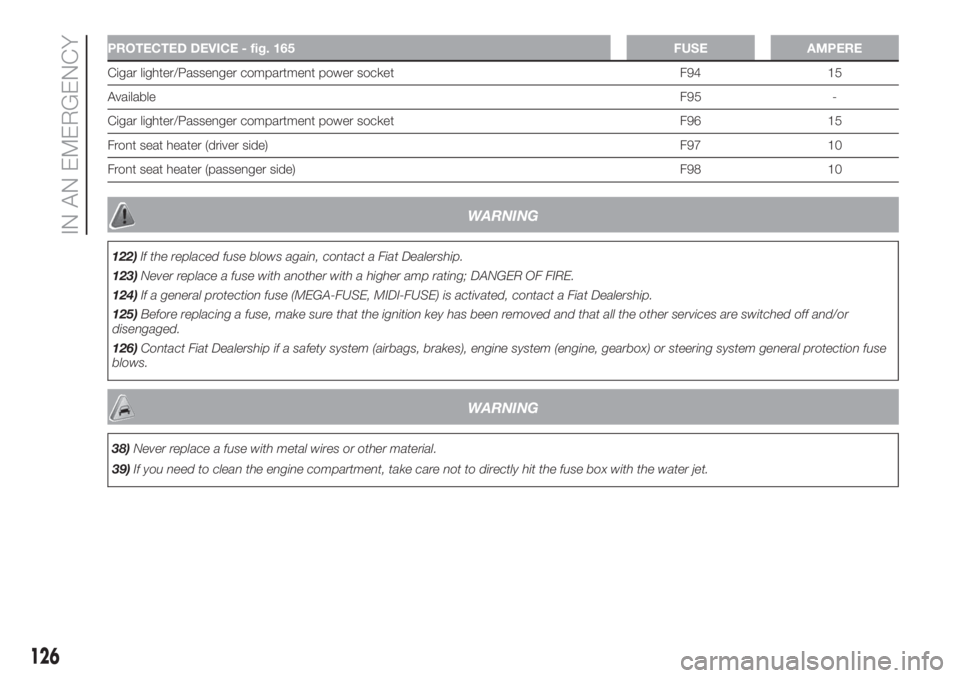
PROTECTED DEVICE - fig. 165 FUSE AMPERE
Cigar lighter/Passenger compartment power socket F94 15
AvailableF95 -
Cigar lighter/Passenger compartment power socket F96 15
Front seat heater (driver side) F97 10
Front seat heater (passenger side) F98 10
WARNING
122)If the replaced fuse blows again, contact a Fiat Dealership.
123)Never replace a fuse with another with a higher amp rating; DANGER OF FIRE.
124)If a general protection fuse (MEGA-FUSE, MIDI-FUSE) is activated, contact a Fiat Dealership.
125)Before replacing a fuse, make sure that the ignition key has been removed and that all the other services are switched off and/or
disengaged.
126)Contact Fiat Dealership if a safety system (airbags, brakes), engine system (engine, gearbox) or steering system general protection fuse
blows.
WARNING
38)Never replace a fuse with metal wires or other material.
39)If you need to clean the engine compartment, take care not to directly hit the fuse box with the water jet.
126
IN AN EMERGENCY
Page 134 of 196
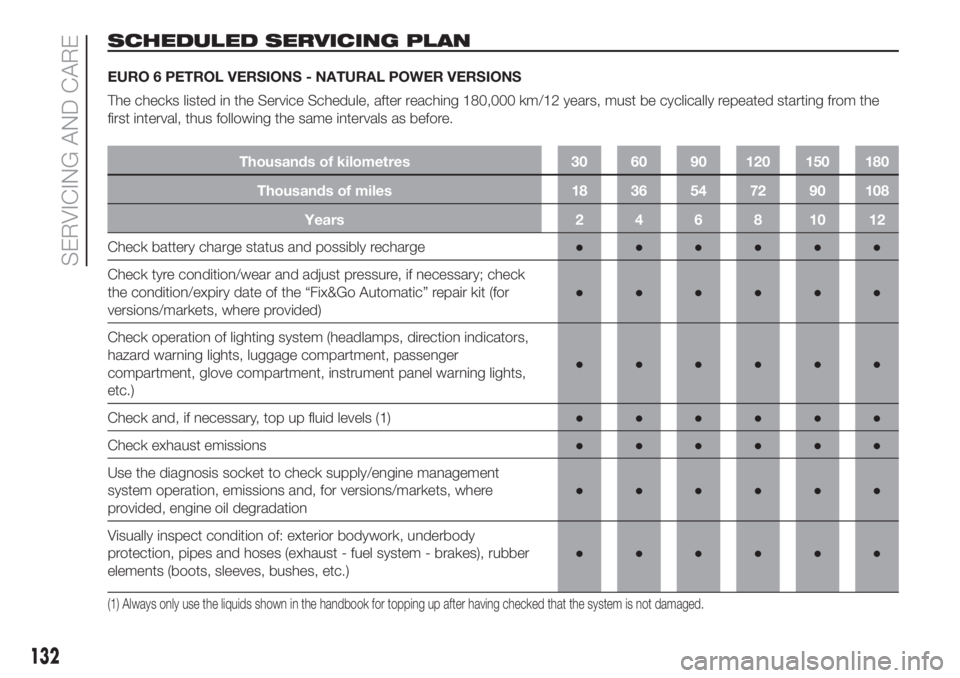
SCHEDULED SERVICING PLAN
EURO 6 PETROL VERSIONS - NATURAL POWER VERSIONS
The checks listed in the Service Schedule, after reaching 180,000 km/12 years, must be cyclically repeated starting from the
first interval, thus following the same intervals as before.
Thousands of kilometres 30 60 90 120 150 180
Thousands of miles 18 36 54 72 90 108
Years 2 4 6 8 10 12
Check battery charge status and possibly recharge●●●●●●
Check tyre condition/wear and adjust pressure, if necessary; check
the condition/expiry date of the “Fix&Go Automatic” repair kit (for
versions/markets, where provided)●●●●●●
Check operation of lighting system (headlamps, direction indicators,
hazard warning lights, luggage compartment, passenger
compartment, glove compartment, instrument panel warning lights,
etc.)●●●●●●
Check and, if necessary, top up fluid levels (1)●●●●●●
Check exhaust emissions●●●●●●
Use the diagnosis socket to check supply/engine management
system operation, emissions and, for versions/markets, where
provided, engine oil degradation●●●●●●
Visually inspect condition of: exterior bodywork, underbody
protection, pipes and hoses (exhaust - fuel system - brakes), rubber
elements (boots, sleeves, bushes, etc.)●●●●●●
(1) Always only use the liquids shown in the handbook for topping up after having checked that the system is not damaged.
132
SERVICING AND CARE
Page 138 of 196
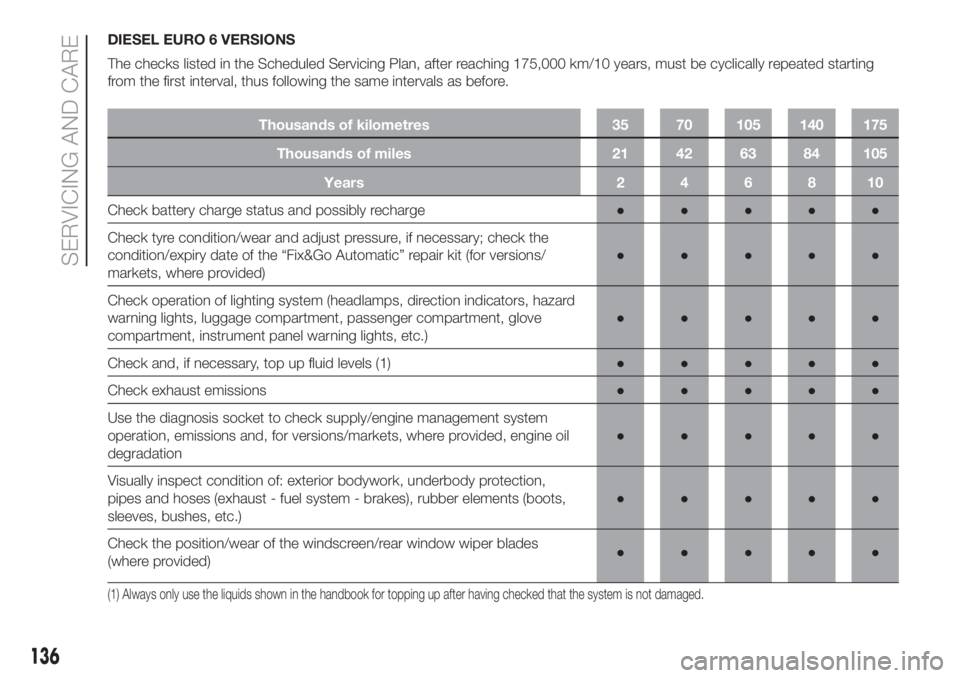
DIESEL EURO 6 VERSIONS
The checks listed in the Scheduled Servicing Plan, after reaching 175,000 km/10 years, must be cyclically repeated starting
from the first interval, thus following the same intervals as before.
Thousands of kilometres 35 70 105 140 175
Thousands of miles 21 42 63 84 105
Years 2 4 6 8 10
Check battery charge status and possibly recharge●●●●●
Check tyre condition/wear and adjust pressure, if necessary; check the
condition/expiry date of the “Fix&Go Automatic” repair kit (for versions/
markets, where provided)●●●●●
Check operation of lighting system (headlamps, direction indicators, hazard
warning lights, luggage compartment, passenger compartment, glove
compartment, instrument panel warning lights, etc.)●●●●●
Check and, if necessary, top up fluid levels (1)●●●●●
Check exhaust emissions●●●●●
Use the diagnosis socket to check supply/engine management system
operation, emissions and, for versions/markets, where provided, engine oil
degradation●●●●●
Visually inspect condition of: exterior bodywork, underbody protection,
pipes and hoses (exhaust - fuel system - brakes), rubber elements (boots,
sleeves, bushes, etc.)●●●●●
Check the position/wear of the windscreen/rear window wiper blades
(where provided)●●●●●
(1) Always only use the liquids shown in the handbook for topping up after having checked that the system is not damaged.
136
SERVICING AND CARE
Page 141 of 196
PERIODIC CHECKS
Every 1,000 km or before long
journeys, check and, if necessary, top
up:
engine coolant level;
brake fluid level;
windscreen washer fluid level;
tyre inflation pressure and condition;
operation of lighting system
(headlights, direction indicators, hazard
warning lights, etc.);
operation of windscreen washer/
wiper system and positioning/wear of
rear window wiper blades.
To ensure that the vehicle is always
efficient and well maintained, it is
advisable to make sure that you carry
out the above operations regularly
(approximately every 1000 km and
every 3000 km for checking and
topping up engine oil is advisable).
DEMANDING
VEHICLE USE
If the vehicle is mostly used in one of
the following conditions:
towing a trailer or caravan;
dusty roads;
short, repeated journeys (less than
7-8 km) at sub-zero temperatures;
engine often idling or driving long
distances at low speeds or long periods
of inactivity;
the following checks must be carried
out more often than indicated in the
Scheduled Servicing Plan:
check front disc brake pad condition
and wear;
check cleanliness of bonnet and
luggage compartment locks,
cleanliness and lubrication of linkage;
visually inspect the conditions of:
engine, gearbox, transmission, pipes
and hoses (exhaust/fuel supply/brakes),
rubber parts (boots/sleeves/bushes,
etc.);
check battery charge and battery
fluid level (electrolyte);
visually inspect conditions of the
accessory drive belts;
check and, if necessary, change
engine oil and replace oil filter;
check and, if necessary, replace
pollen filter;
check and, if necessary, replace air
cleaner.
139
Page 167 of 196
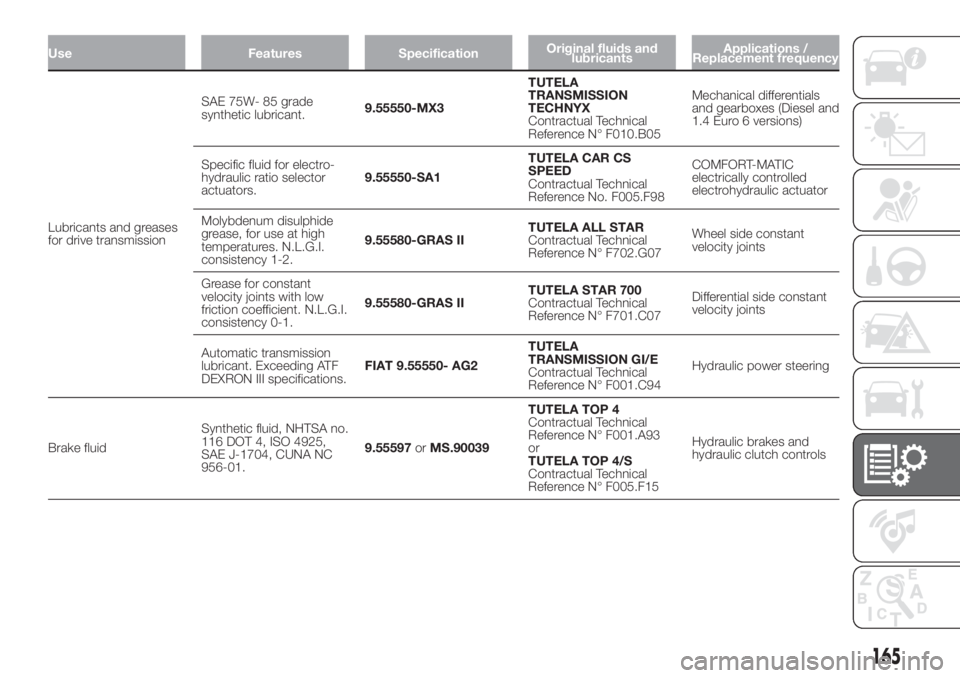
Use Features SpecificationOriginal fluids and
lubricantsApplications /
Replacement frequency
Lubricants and greases
for drive transmissionSAE 75W- 85 grade
synthetic lubricant.9.55550-MX3TUTELA
TRANSMISSION
TECHNYX
Contractual Technical
Reference N° F010.B05Mechanical differentials
and gearboxes (Diesel and
1.4 Euro 6 versions)
Specific fluid for electro-
hydraulic ratio selector
actuators.9.55550-SA1TUTELA CAR CS
SPEED
Contractual Technical
Reference No. F005.F98COMFORT-MATIC
electrically controlled
electrohydraulic actuator
Molybdenum disulphide
grease, for use at high
temperatures. N.L.G.I.
consistency 1-2.9.55580-GRAS IITUTELA ALL STAR
Contractual Technical
Reference N° F702.G07Wheel side constant
velocity joints
Grease for constant
velocity joints with low
friction coefficient. N.L.G.I.
consistency 0-1.9.55580-GRAS IITUTELA STAR 700
Contractual Technical
Reference N° F701.C07Differential side constant
velocity joints
Automatic transmission
lubricant. Exceeding ATF
DEXRON III specifications.FIAT 9.55550- AG2TUTELA
TRANSMISSION GI/E
Contractual Technical
Reference N° F001.C94Hydraulic power steering
Brake fluidSynthetic fluid, NHTSA no.
116 DOT 4, ISO 4925,
SAE J-1704, CUNA NC
956-01.9.55597orMS.90039TUTELA TOP 4
Contractual Technical
Reference N° F001.A93
or
TUTELA TOP 4/S
Contractual Technical
Reference N° F005.F15Hydraulic brakes and
hydraulic clutch controls
165