fuel pressure FIAT FIORINO 2018 Owner handbook (in English)
[x] Cancel search | Manufacturer: FIAT, Model Year: 2018, Model line: FIORINO, Model: FIAT FIORINO 2018Pages: 196, PDF Size: 4.99 MB
Page 11 of 196
KEYS
1)
1)
MECHANICAL KEY
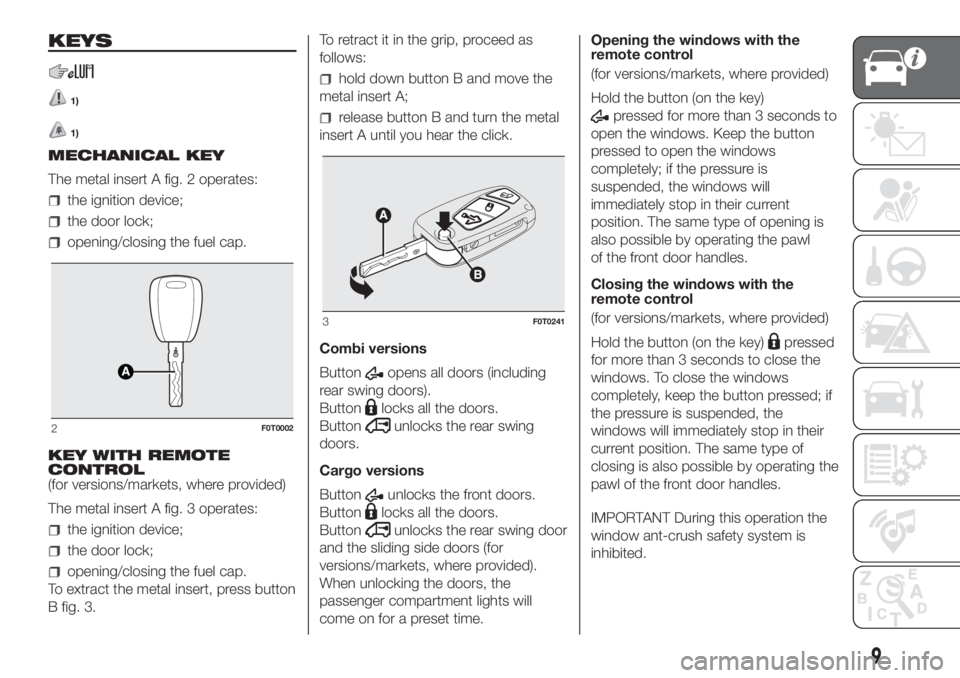
The metal insert A fig. 2 operates:
the ignition device;
the door lock;
opening/closing the fuel cap.
KEY WITH REMOTE
CONTROL
(for versions/markets, where provided)
The metal insert A fig. 3 operates:
the ignition device;
the door lock;
opening/closing the fuel cap.
To extract the metal insert, press button
B fig. 3.To retract it in the grip, proceed as
follows:
hold down button B and move the
metal insert A;
release button B and turn the metal
insert A until you hear the click.
Combi versions
Button
opens all doors (including
rear swing doors).
Button
locks all the doors.
Button
unlocks the rear swing
doors.
Cargo versions
Button
unlocks the front doors.
Button
locks all the doors.
Button
unlocks the rear swing door
and the sliding side doors (for
versions/markets, where provided).
When unlocking the doors, the
passenger compartment lights will
come on for a preset time.Opening the windows with the
remote control
(for versions/markets, where provided)
Hold the button (on the key)
pressed for more than 3 seconds to
open the windows. Keep the button
pressed to open the windows
completely; if the pressure is
suspended, the windows will
immediately stop in their current
position. The same type of opening is
also possible by operating the pawl
of the front door handles.
Closing the windows with the
remote control
(for versions/markets, where provided)
Hold the button (on the key)
pressed
for more than 3 seconds to close the
windows. To close the windows
completely, keep the button pressed; if
the pressure is suspended, the
windows will immediately stop in their
current position. The same type of
closing is also possible by operating the
pawl of the front door handles.
IMPORTANT During this operation the
window ant-crush safety system is
inhibited.
2F0T0002
3F0T0241
9
Page 35 of 196
take the cushion back to horizontal
position and check that it is secured
correctly;
tip back the backrest and check that
it is secured correctly.
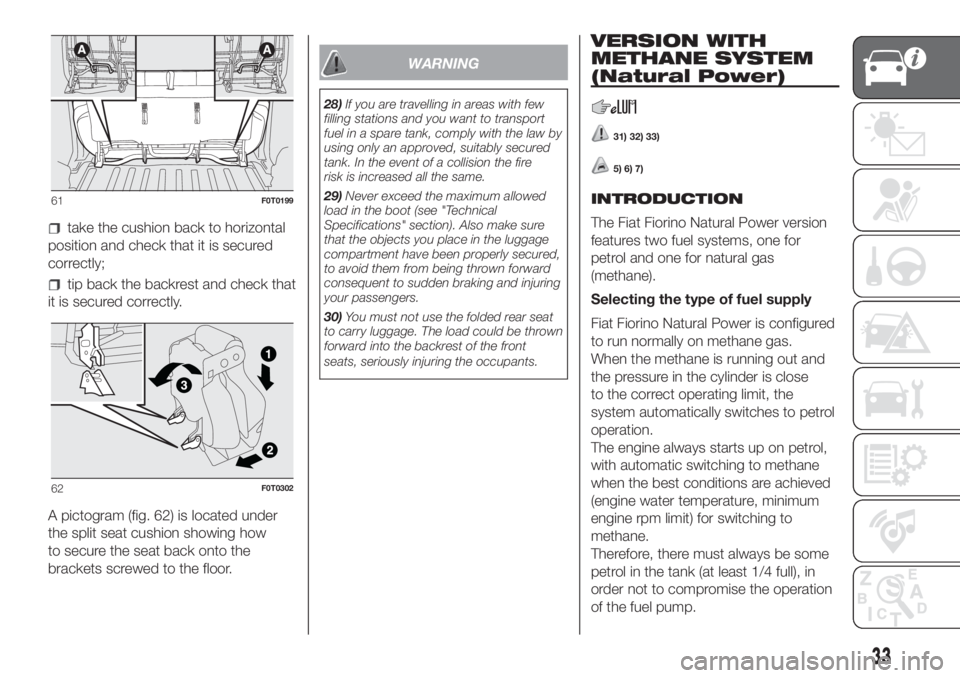
A pictogram (fig. 62) is located under
the split seat cushion showing how
to secure the seat back onto the
brackets screwed to the floor.
WARNING
28)If you are travelling in areas with few
filling stations and you want to transport
fuel in a spare tank, comply with the law by
using only an approved, suitably secured
tank. In the event of a collision the fire
risk is increased all the same.
29)Never exceed the maximum allowed
load in the boot (see "Technical
Specifications" section). Also make sure
that the objects you place in the luggage
compartment have been properly secured,
to avoid them from being thrown forward
consequent to sudden braking and injuring
your passengers.
30)You must not use the folded rear seat
to carry luggage. The load could be thrown
forward into the backrest of the front
seats, seriously injuring the occupants.
VERSION WITH
METHANE SYSTEM
(Natural Power)
31) 32) 33)
5) 6) 7)
INTRODUCTION
The Fiat Fiorino Natural Power version
features two fuel systems, one for
petrol and one for natural gas
(methane).
Selecting the type of fuel supply
Fiat Fiorino Natural Power is configured
to run normally on methane gas.
When the methane is running out and
the pressure in the cylinder is close
to the correct operating limit, the
system automatically switches to petrol
operation.
The engine always starts up on petrol,
with automatic switching to methane
when the best conditions are achieved
(engine water temperature, minimum
engine rpm limit) for switching to
methane.
Therefore, there must always be some
petrol in the tank (at least 1/4 full), in
order not to compromise the operation
of the fuel pump.61F0T0199
62F0T0302
33
Page 36 of 196
For this reason there must always
be petrol in the tank.
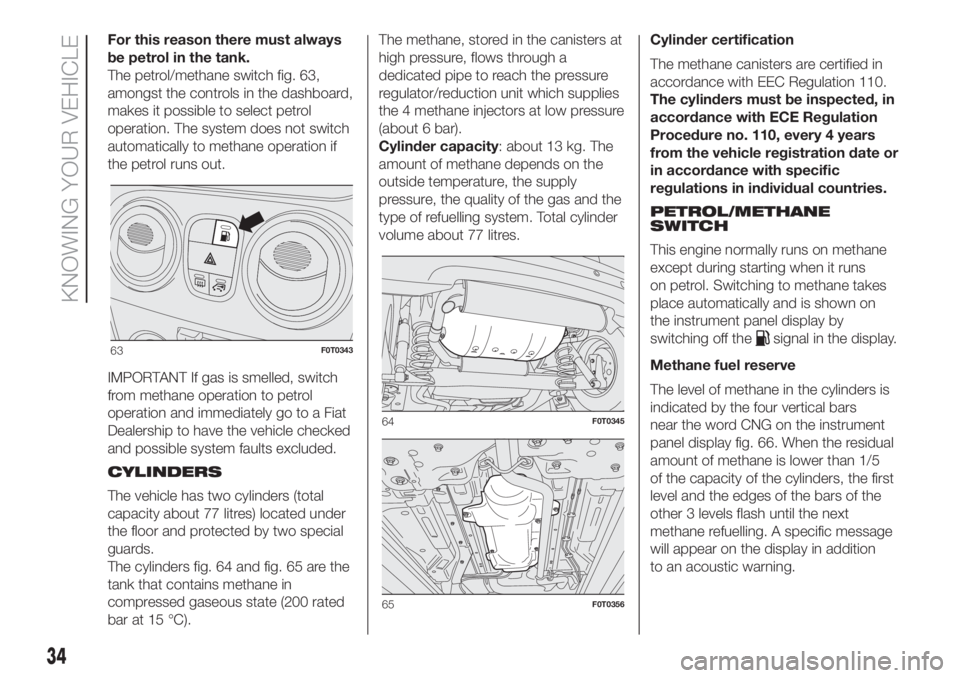
The petrol/methane switch fig. 63,
amongst the controls in the dashboard,
makes it possible to select petrol
operation. The system does not switch
automatically to methane operation if
the petrol runs out.
IMPORTANT If gas is smelled, switch
from methane operation to petrol
operation and immediately go to a Fiat
Dealership to have the vehicle checked
and possible system faults excluded.
CYLINDERS
The vehicle has two cylinders (total
capacity about 77 litres) located under
the floor and protected by two special
guards.
The cylinders fig. 64 and fig. 65 are the
tank that contains methane in
compressed gaseous state (200 rated
bar at 15 °C).The methane, stored in the canisters at
high pressure, flows through a
dedicated pipe to reach the pressure
regulator/reduction unit which supplies
the 4 methane injectors at low pressure
(about 6 bar).
Cylinder capacity: about 13 kg. The
amount of methane depends on the
outside temperature, the supply
pressure, the quality of the gas and the
type of refuelling system. Total cylinder
volume about 77 litres.Cylinder certification
The methane canisters are certified in
accordance with EEC Regulation 110.
The cylinders must be inspected, in
accordance with ECE Regulation
Procedure no. 110, every 4 years
from the vehicle registration date or
in accordance with specific
regulations in individual countries.
PETROL/METHANE
SWITCH
This engine normally runs on methane
except during starting when it runs
on petrol. Switching to methane takes
place automatically and is shown on
the instrument panel display by
switching off the
signal in the display.
Methane fuel reserve
The level of methane in the cylinders is
indicated by the four vertical bars
near the word CNG on the instrument
panel display fig. 66. When the residual
amount of methane is lower than 1/5
of the capacity of the cylinders, the first
level and the edges of the bars of the
other 3 levels flash until the next
methane refuelling. A specific message
will appear on the display in addition
to an acoustic warning.63F0T0343
64F0T0345
65F0T0356
34
KNOWING YOUR VEHICLE
Page 37 of 196
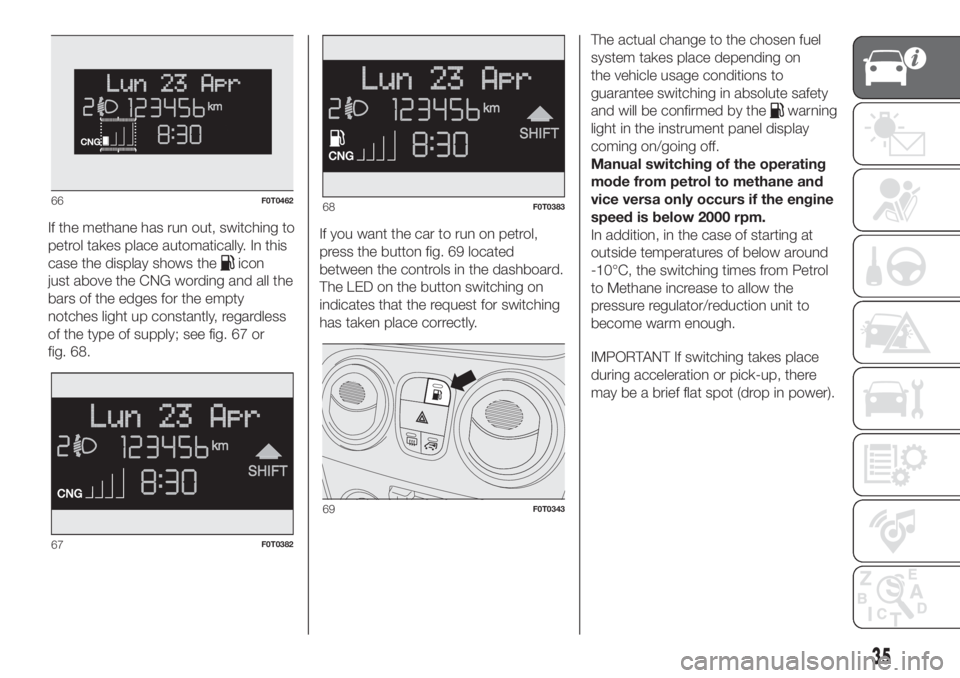
If the methane has run out, switching to
petrol takes place automatically. In this
case the display shows the
icon
just above the CNG wording and all the
bars of the edges for the empty
notches light up constantly, regardless
of the type of supply; see fig. 67 or
fig. 68.If you want the car to run on petrol,
press the button fig. 69 located
between the controls in the dashboard.
The LED on the button switching on
indicates that the request for switching
has taken place correctly.The actual change to the chosen fuel
system takes place depending on
the vehicle usage conditions to
guarantee switching in absolute safety
and will be confirmed by the
warning
light in the instrument panel display
coming on/going off.
Manual switching of the operating
mode from petrol to methane and
vice versa only occurs if the engine
speed is below 2000 rpm.
In addition, in the case of starting at
outside temperatures of below around
-10°C, the switching times from Petrol
to Methane increase to allow the
pressure regulator/reduction unit to
become warm enough.
IMPORTANT If switching takes place
during acceleration or pick-up, there
may be a brief flat spot (drop in power).
66F0T0462
67F0T0382
68F0T0383
69F0T0343
35
Page 38 of 196
WARNING
31)The Fiat Fiorino Natural Power is
equipped with a high pressure methane
fuel supply system, designed to operate at
a rated pressure of 200 bar. It is dangerous
to stretch the system with higher
pressures. To prevent damage to the
methane system parts when towing or
lifting the vehicle, follow the instructions in
the main handbook in the chapter: "Towing
the vehicle". If there is a problem with the
methane system, only contact a Fiat
Dealership. Do not alter the methane
system configuration or components. They
are designed exclusively for the Fiat
Fiorino Natural Power. The use of other
components or materials could cause
malfunctions and prejudice safety.
32)When oven painting, the cylinders must
be removed from the vehicle and refitted
by a Fiat Dealership. Although the methane
system has numerous safety features, it is
advisable to close the manual tap on the
cylinders every time the vehicle is not
in use for a long period, transported on
other vehicles or moved in an emergency
as a result of a breakdown or accident.
33)If gas is smelt, switch from methane
operation to petrol operation and
immediately go to a Fiat Dealerships to
have the vehicle checked and possible
system faults supply excluded.
WARNING
5)Regardless of the last fuel system used,
at the following engine starting, after the
initial petrol stage, the system will
automatically switch to methane.
6)At the time of the switching request
there will be a metallic noise from the
valves which are pressurising the circuit
(more obvious with the ignition key in
the MAR-ON position). For the switching
logic described above, a delay between the
valve ticking and the switching off of the
instrument panel indication is completely
normal.
7)Do not switch between the two
operating modes whilst starting the engine.
36
KNOWING YOUR VEHICLE
Page 39 of 196
KNOWING THE INSTRUMENT PANEL
This section of the handbook gives you
all the information you need to
understand, interpret and use the
instrument panel correctly.INSTRUMENT PANEL ..................... 38
DIGITAL DISPLAY............................ 42
MULTIFUNCTION DISPLAY ............. 43
TRIP COMPUTER ........................... 44
WARNING LIGHTS AND
MESSAGES .................................... 46
-LOW BRAKE FLUID/HANDBRAKE
ENGAGED........................................... 46
-EBD FAILURE .................................... 47
-AIR BAG FAILURE .............................. 47
-SEAT BELTS REMINDER.................... 48
-GEARBOX FAILURE ........................... 48
-ENGINE COOLANT TEMPERATURE
TOO HIGH........................................... 49
-LOW BATTERY CHARGE ................... 49
-INSUFFICIENT ENGINE OIL
PRESSURE/ENGINE OIL
DETERIORATED .................................. 50
-LOW ENGINE OIL LEVEL ................... 51
-DOOR OPEN ..................................... 51
-POWER STEERING FAILURE ............. 51
-INJECTION SYSTEM FAULT (Multijet
versions) - EOBD ENGINE CONTROL
SYSTEM FAULT (petrol versions) ......... 52
-ABS FAILURE..................................... 53
-FUEL RESERVE ................................. 54
-PLUG PREHEATING (Multijet
versions) - PLUG PREHEATING FAULT
(Multijet versions) ................................. 54
-WATER IN DIESEL FILTER (Multijet
versions) .............................................. 55
-VEHICLE PROTECTION SYSTEM
FAULT - FIAT CODE - ALARM FAULT
(for versions/markets, where provided
- amber) - BREAK-IN ATTEMPT .......... 56
-GENERAL FAILURE INDICATION ....... 57-DPF (PARTICULATE FILTER)
CLEANING UNDERWAY ...................... 59
-HILL HOLDER FAILURE ..................... 59
-iTPMS ................................................ 60
-BRAKE PAD WEAR ............................ 60
-PARKING SENSOR FAILURE ............. 60
-START&STOP SYSTEM FAILURE....... 60
-ASR SYSTEM DEACTIVATED ............. 61
-TRACTION PLUS SYSTEM
ACTIVATION ........................................ 61
-REAR FOG LIGHTS............................ 61
-SIDE LIGHTS - FOLLOW ME HOME .. 62
-LEFT-HAND DIRECTION INDICATOR
(blinking) .............................................. 62
-RIGHT-HAND DIRECTION
INDICATOR (blinking) ........................... 63
-FRONT FOG LIGHTS ......................... 63
-CRUISE CONTROL ............................ 63
-MAIN BEAM HEADLIGHTS ................ 63
-GEAR SHIFT INDICATION .................. 64
-CNG SYSTEM FAILURE ..................... 64
37
Page 62 of 196
What it means What to do
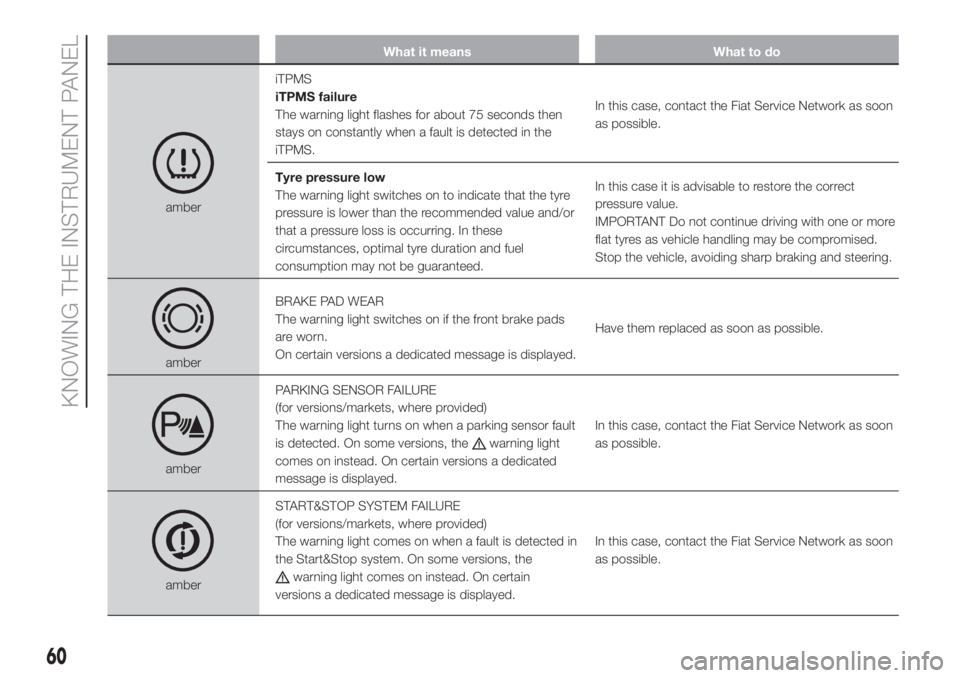
amberiTPMS
iTPMS failure
The warning light flashes for about 75 seconds then
stays on constantly when a fault is detected in the
iTPMS.In this case, contact the Fiat Service Network as soon
as possible.
Tyre pressure low
The warning light switches on to indicate that the tyre
pressure is lower than the recommended value and/or
that a pressure loss is occurring. In these
circumstances, optimal tyre duration and fuel
consumption may not be guaranteed.In this case it is advisable to restore the correct
pressure value.
IMPORTANT Do not continue driving with one or more
flat tyres as vehicle handling may be compromised.
Stop the vehicle, avoiding sharp braking and steering.
amberBRAKE PAD WEAR
The warning light switches on if the front brake pads
are worn.
On certain versions a dedicated message is displayed.Have them replaced as soon as possible.
amberPARKING SENSOR FAILURE
(for versions/markets, where provided)
The warning light turns on when a parking sensor fault
is detected. On some versions, the
warning light
comes on instead. On certain versions a dedicated
message is displayed.In this case, contact the Fiat Service Network as soon
as possible.
amberSTART&STOP SYSTEM FAILURE
(for versions/markets, where provided)
The warning light comes on when a fault is detected in
the Start&Stop system. On some versions, thewarning light comes on instead. On certain
versions a dedicated message is displayed.In this case, contact the Fiat Service Network as soon
as possible.
60
KNOWING THE INSTRUMENT PANEL
Page 102 of 196
The parking sensors work properly
with the swing doors closed. If they are
open, they can cause the system to
send false signals: always close the rear
doors.
Also, do not apply stickers to the
sensors.
The following conditions may influence
the performance of the parking
assistance system:
Reduced sensor sensitivity and a
reduction in the parking assistance
system performance could be due to
the presence on the surface of the
sensor of: ice, snow, mud, thick paint.
The sensor may detect a non-
existent obstacle (echo noise) due to
mechanical noises, for example when
washing the vehicle, in case of rain,
strong wind, hail.
The warnings sent by the sensor
can also be altered by the presence of
ultrasonic systems (e.g. pneumatic
brakes of trucks or pneumatic drills)
near the car.
Detection of obstacles in the upper
part of the vehicle (particularly in the
case of vans or chassis cabs) may not
be guaranteed because the system
detects obstacles that could strike the
lower part of the vehicle.
WARNING
99)Parking manoeuvres, however, are
always the driver’s responsibility. While
carrying out these manoeuvres, always
make sure that no people (especially
children) or animals are in the area
concerned. Parking sensors are designed
to assist drivers; however, you must always
concentrate fully during potentially
dangerous manoeuvres, even if carried out
at low speeds.
WARNING
31)The sensor must be free of mud, dirt,
snow or ice in order for the system to
work. Be careful not to scratch or damage
the sensors while cleaning them. Avoid
using dry, rough or hard cloths. The
sensors should be washed using clean
water with the addition of car shampoo if
necessary. When using special washing
equipment such as high pressure jets
or steam cleaning, clean the sensors very
quickly keeping the jet more than 10 cm
away.
START&STOP
SYSTEM
(for versions/markets, where provided)
101) 102) 103) 104)
IN BRIEF
The Start&Stop device automatically
stops the engine each time the
vehicle is stationary and all the
conditions for automatic switch-off
have been met, and starts it again
when the driver wants to move off.
This improves the efficiency of the
vehicle by reducing fuel consumption,
the emission of harmful gases and
noise pollution.
OPERATING MODE
Stopping the engine
Versions with manual transmission
With the vehicle stationary, the engine
stops with the gearbox in neutral and
the clutch pedal released.
100
STARTING AND DRIVING
Page 105 of 196
Operation at low temperatures
In order to avoid these problems,
different types of diesel are distributed
according to the season: summer type,
winter type and arctic type (cold/
mountain areas). If refuelling with diesel
whose specifications are not suitable
for the usage temperature, it is
advisable to mix PETRONAS
DURANCE DIESEL ART additive in the
proportions shown on the container
with the fuel. Pour the additive into the
tank before the fuel.
When using or parking the vehicle for a
long time in the mountains or cold
areas, it is advisable to refuel using
locally available diesel fuel.
In this case, it is also advisable to keep
the tank over 50% full.
REFUELLING CAPACITY
To ensure that you fill the tank
completely, top up twice after the first
click of the fuel supply gun. Further
top-ups could cause faults in the fuel
feeding system.
FUEL TANK CAP
Opening
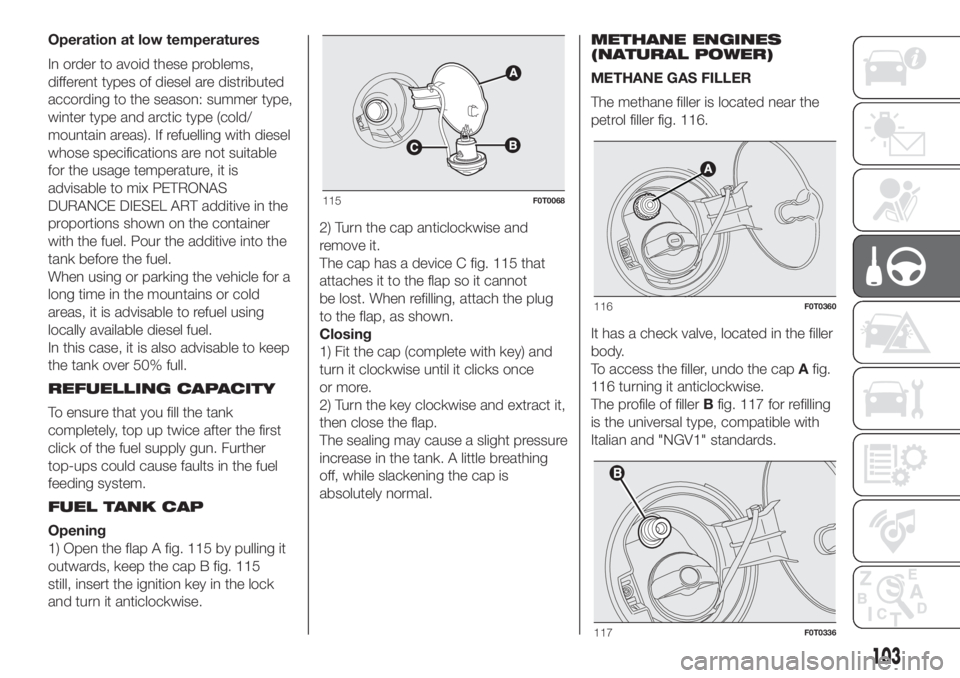
1) Open the flap A fig. 115 by pulling it
outwards, keep the cap B fig. 115
still, insert the ignition key in the lock
and turn it anticlockwise.2) Turn the cap anticlockwise and
remove it.
The cap has a device C fig. 115 that
attaches it to the flap so it cannot
be lost. When refilling, attach the plug
to the flap, as shown.
Closing
1) Fit the cap (complete with key) and
turn it clockwise until it clicks once
or more.
2) Turn the key clockwise and extract it,
then close the flap.
The sealing may cause a slight pressure
increase in the tank. A little breathing
off, while slackening the cap is
absolutely normal.METHANE ENGINES
(NATURAL POWER)
METHANE GAS FILLER
The methane filler is located near the
petrol filler fig. 116.
It has a check valve, located in the filler
body.
To access the filler, undo the capAfig.
116 turning it anticlockwise.
The profile of fillerBfig. 117 for refilling
is the universal type, compatible with
Italian and "NGV1" standards.
115F0T0068
116F0T0360
117F0T0336
103
Page 106 of 196
In some European countries adapters
are considered ILLEGAL (e.g. in
Germany).
For service stations with cubic metre
(m
3) nozzles (pressure differential)
the check valves must be released by
delivering a small amount of methane to
measure the residual pressure in the
cylinder.
The plates (provided with the vehicle
documentation) contain the date for the
first inspection of the cylinders.
34)
Fuels - identification of
vehicle compatibility.
Graphic symbol for
consumer information in
accordance with
EN16942
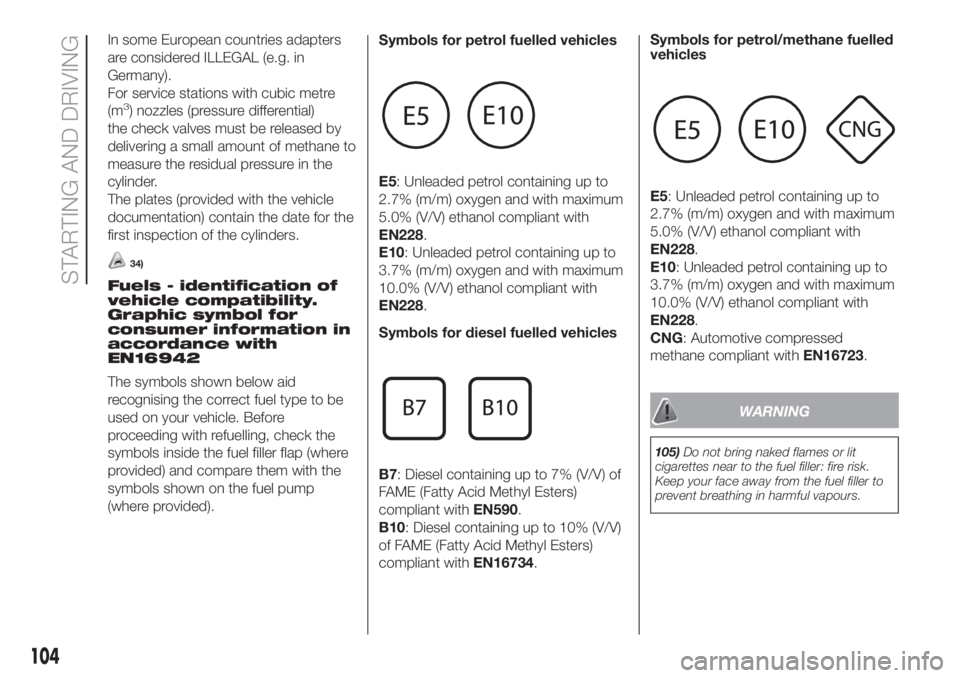
The symbols shown below aid
recognising the correct fuel type to be
used on your vehicle. Before
proceeding with refuelling, check the
symbols inside the fuel filler flap (where
provided) and compare them with the
symbols shown on the fuel pump
(where provided).Symbols for petrol fuelled vehicles
E5: Unleaded petrol containing up to
2.7% (m/m) oxygen and with maximum
5.0% (V/V) ethanol compliant with
EN228.
E10: Unleaded petrol containing up to
3.7% (m/m) oxygen and with maximum
10.0% (V/V) ethanol compliant with
EN228.
Symbols for diesel fuelled vehicles
B7: Diesel containing up to 7% (V/V) of
FAME (Fatty Acid Methyl Esters)
compliant withEN590.
B10: Diesel containing up to 10% (V/V)
of FAME (Fatty Acid Methyl Esters)
compliant withEN16734.Symbols for petrol/methane fuelled
vehicles
E5: Unleaded petrol containing up to
2.7% (m/m) oxygen and with maximum
5.0% (V/V) ethanol compliant with
EN228.
E10: Unleaded petrol containing up to
3.7% (m/m) oxygen and with maximum
10.0% (V/V) ethanol compliant with
EN228.
CNG: Automotive compressed
methane compliant withEN16723.
WARNING
105)Do not bring naked flames or lit
cigarettes near to the fuel filler: fire risk.
Keep your face away from the fuel filler to
prevent breathing in harmful vapours.
104
STARTING AND DRIVING