oil level FIAT FIORINO 2018 Owner handbook (in English)
[x] Cancel search | Manufacturer: FIAT, Model Year: 2018, Model line: FIORINO, Model: FIAT FIORINO 2018Pages: 196, PDF Size: 4.99 MB
Page 39 of 196
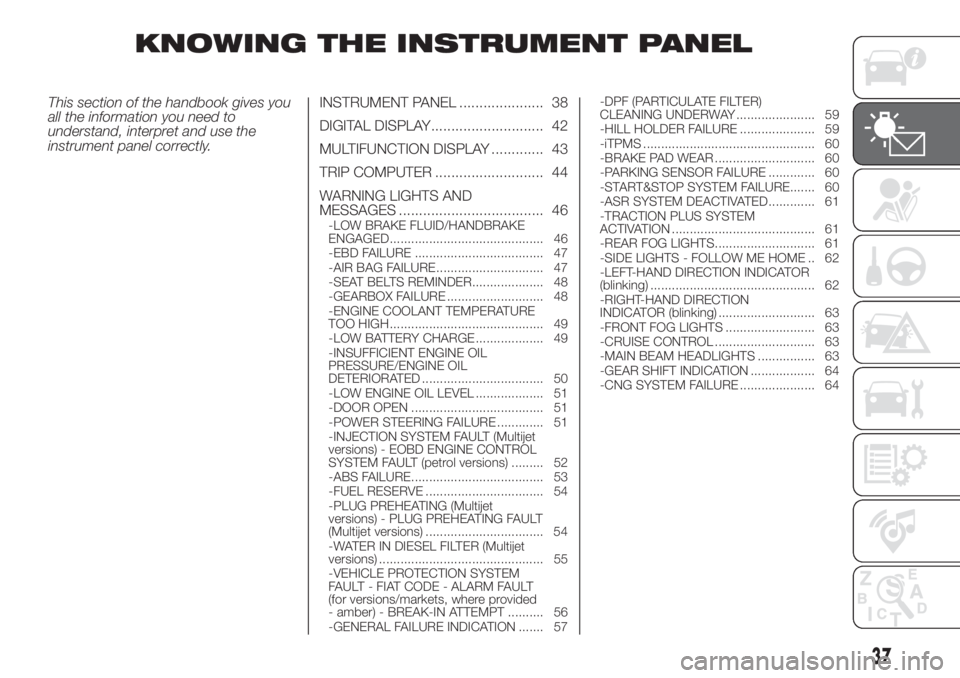
KNOWING THE INSTRUMENT PANEL
This section of the handbook gives you
all the information you need to
understand, interpret and use the
instrument panel correctly.INSTRUMENT PANEL ..................... 38
DIGITAL DISPLAY............................ 42
MULTIFUNCTION DISPLAY ............. 43
TRIP COMPUTER ........................... 44
WARNING LIGHTS AND
MESSAGES .................................... 46
-LOW BRAKE FLUID/HANDBRAKE
ENGAGED........................................... 46
-EBD FAILURE .................................... 47
-AIR BAG FAILURE .............................. 47
-SEAT BELTS REMINDER.................... 48
-GEARBOX FAILURE ........................... 48
-ENGINE COOLANT TEMPERATURE
TOO HIGH........................................... 49
-LOW BATTERY CHARGE ................... 49
-INSUFFICIENT ENGINE OIL
PRESSURE/ENGINE OIL
DETERIORATED .................................. 50
-LOW ENGINE OIL LEVEL ................... 51
-DOOR OPEN ..................................... 51
-POWER STEERING FAILURE ............. 51
-INJECTION SYSTEM FAULT (Multijet
versions) - EOBD ENGINE CONTROL
SYSTEM FAULT (petrol versions) ......... 52
-ABS FAILURE..................................... 53
-FUEL RESERVE ................................. 54
-PLUG PREHEATING (Multijet
versions) - PLUG PREHEATING FAULT
(Multijet versions) ................................. 54
-WATER IN DIESEL FILTER (Multijet
versions) .............................................. 55
-VEHICLE PROTECTION SYSTEM
FAULT - FIAT CODE - ALARM FAULT
(for versions/markets, where provided
- amber) - BREAK-IN ATTEMPT .......... 56
-GENERAL FAILURE INDICATION ....... 57-DPF (PARTICULATE FILTER)
CLEANING UNDERWAY ...................... 59
-HILL HOLDER FAILURE ..................... 59
-iTPMS ................................................ 60
-BRAKE PAD WEAR ............................ 60
-PARKING SENSOR FAILURE ............. 60
-START&STOP SYSTEM FAILURE....... 60
-ASR SYSTEM DEACTIVATED ............. 61
-TRACTION PLUS SYSTEM
ACTIVATION ........................................ 61
-REAR FOG LIGHTS............................ 61
-SIDE LIGHTS - FOLLOW ME HOME .. 62
-LEFT-HAND DIRECTION INDICATOR
(blinking) .............................................. 62
-RIGHT-HAND DIRECTION
INDICATOR (blinking) ........................... 63
-FRONT FOG LIGHTS ......................... 63
-CRUISE CONTROL ............................ 63
-MAIN BEAM HEADLIGHTS ................ 63
-GEAR SHIFT INDICATION .................. 64
-CNG SYSTEM FAILURE ..................... 64
37
Page 53 of 196
What it means What to do
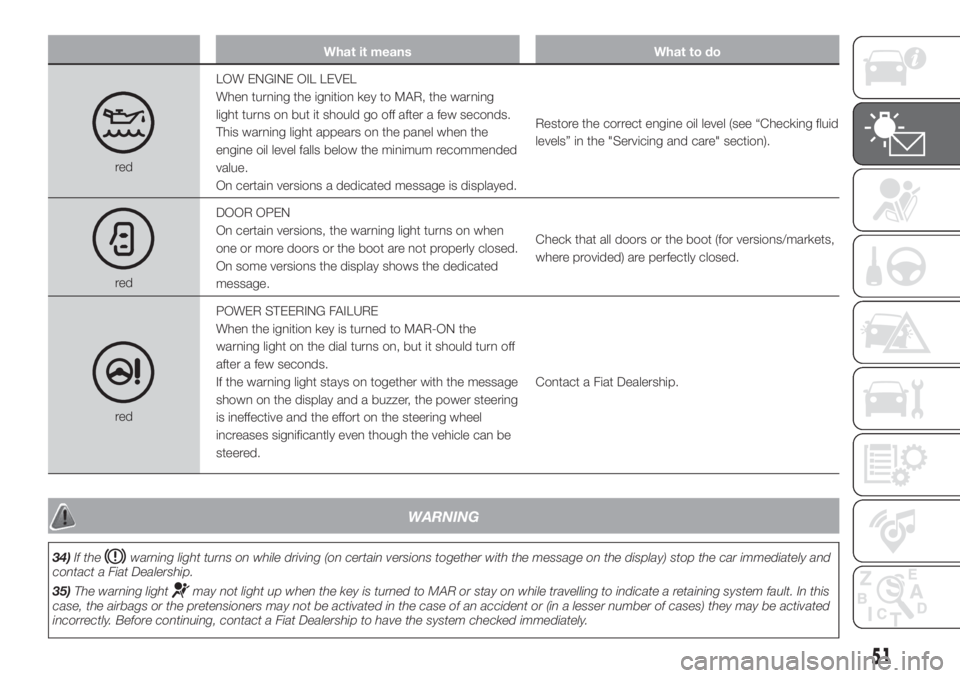
redLOW ENGINE OIL LEVEL
When turning the ignition key to MAR, the warning
light turns on but it should go off after a few seconds.
This warning light appears on the panel when the
engine oil level falls below the minimum recommended
value.
On certain versions a dedicated message is displayed.Restore the correct engine oil level (see “Checking fluid
levels” in the "Servicing and care" section).
redDOOR OPEN
On certain versions, the warning light turns on when
one or more doors or the boot are not properly closed.
On some versions the display shows the dedicated
message.Check that all doors or the boot (for versions/markets,
where provided) are perfectly closed.
redPOWER STEERING FAILURE
When the ignition key is turned to MAR-ON the
warning light on the dial turns on, but it should turn off
after a few seconds.
If the warning light stays on together with the message
shown on the display and a buzzer, the power steering
is ineffective and the effort on the steering wheel
increases significantly even though the vehicle can be
steered.Contact a Fiat Dealership.
WARNING
34)If thewarning light turns on while driving (on certain versions together with the message on the display) stop the car immediately and
contact a Fiat Dealership.
35)The warning light
may not light up when the key is turned to MAR or stay on while travelling to indicate a retaining system fault. In this
case, the airbags or the pretensioners may not be activated in the case of an accident or (in a lesser number of cases) they may be activated
incorrectly. Before continuing, contact a Fiat Dealership to have the system checked immediately.
51
Page 54 of 196
36)A failure of thewarning light is indicated by thewarning light flashing or, depending on the version, by theicon turning on
continuously on the display. In this case, thewarning light may not indicate a possible problem with the airbag restraint system. Before
continuing, contact a Fiat Dealership to have the system checked immediately.
37)If the
warning light switches on when travelling (on certain versions together with the message on the display), stop the engine
immediately and contact a Fiat Dealership.
WARNING
9)If the warning light switches on, the degraded engine oil must be changed as soon as possible, and never more than 500 km from the first
time that the warning light switches on. Failure to observe the above may result in severe damage to the engine and invalidate the warranty.
The activation of this warning light is not related to the amount of oil in the engine. Therefore, never top up with oil when the warning light
starts flashing.
Amber warning lights
What it means What to do
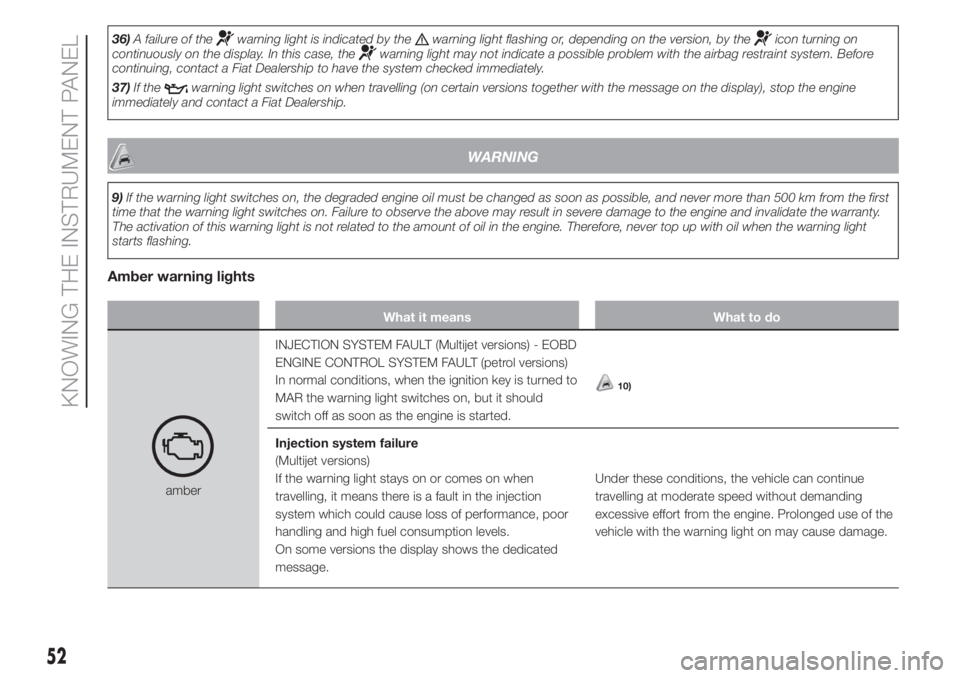
amberINJECTION SYSTEM FAULT (Multijet versions) - EOBD
ENGINE CONTROL SYSTEM FAULT (petrol versions)
In normal conditions, when the ignition key is turned to
MAR the warning light switches on, but it should
switch off as soon as the engine is started.
10)
Injection system failure
(Multijet versions)
If the warning light stays on or comes on when
travelling, it means there is a fault in the injection
system which could cause loss of performance, poor
handling and high fuel consumption levels.
On some versions the display shows the dedicated
message.Under these conditions, the vehicle can continue
travelling at moderate speed without demanding
excessive effort from the engine. Prolonged use of the
vehicle with the warning light on may cause damage.
52
KNOWING THE INSTRUMENT PANEL
Page 134 of 196
SCHEDULED SERVICING PLAN
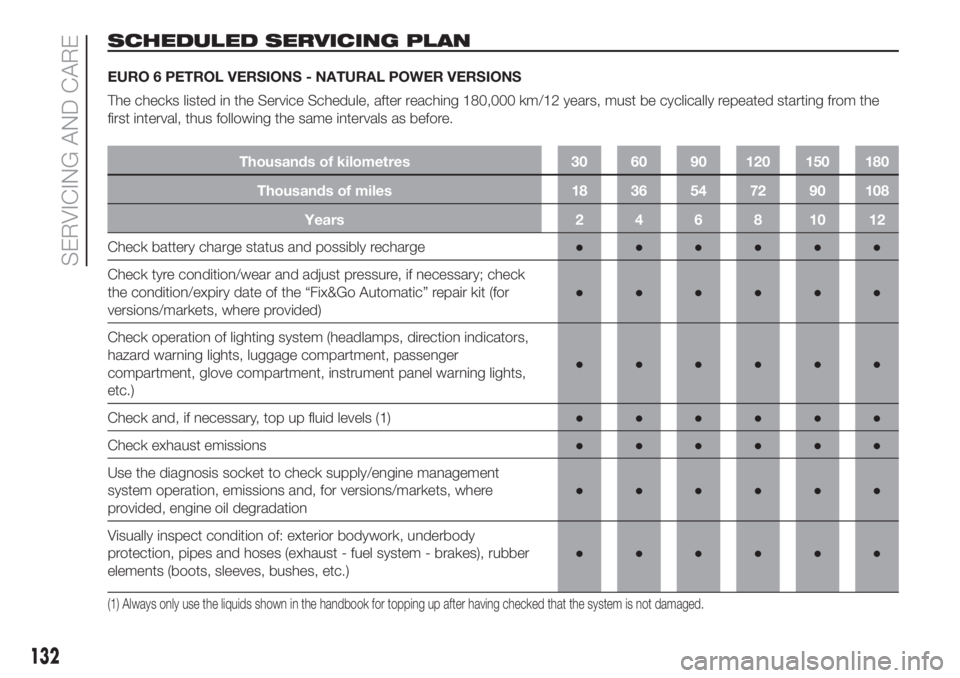
EURO 6 PETROL VERSIONS - NATURAL POWER VERSIONS
The checks listed in the Service Schedule, after reaching 180,000 km/12 years, must be cyclically repeated starting from the
first interval, thus following the same intervals as before.
Thousands of kilometres 30 60 90 120 150 180
Thousands of miles 18 36 54 72 90 108
Years 2 4 6 8 10 12
Check battery charge status and possibly recharge●●●●●●
Check tyre condition/wear and adjust pressure, if necessary; check
the condition/expiry date of the “Fix&Go Automatic” repair kit (for
versions/markets, where provided)●●●●●●
Check operation of lighting system (headlamps, direction indicators,
hazard warning lights, luggage compartment, passenger
compartment, glove compartment, instrument panel warning lights,
etc.)●●●●●●
Check and, if necessary, top up fluid levels (1)●●●●●●
Check exhaust emissions●●●●●●
Use the diagnosis socket to check supply/engine management
system operation, emissions and, for versions/markets, where
provided, engine oil degradation●●●●●●
Visually inspect condition of: exterior bodywork, underbody
protection, pipes and hoses (exhaust - fuel system - brakes), rubber
elements (boots, sleeves, bushes, etc.)●●●●●●
(1) Always only use the liquids shown in the handbook for topping up after having checked that the system is not damaged.
132
SERVICING AND CARE
Page 138 of 196
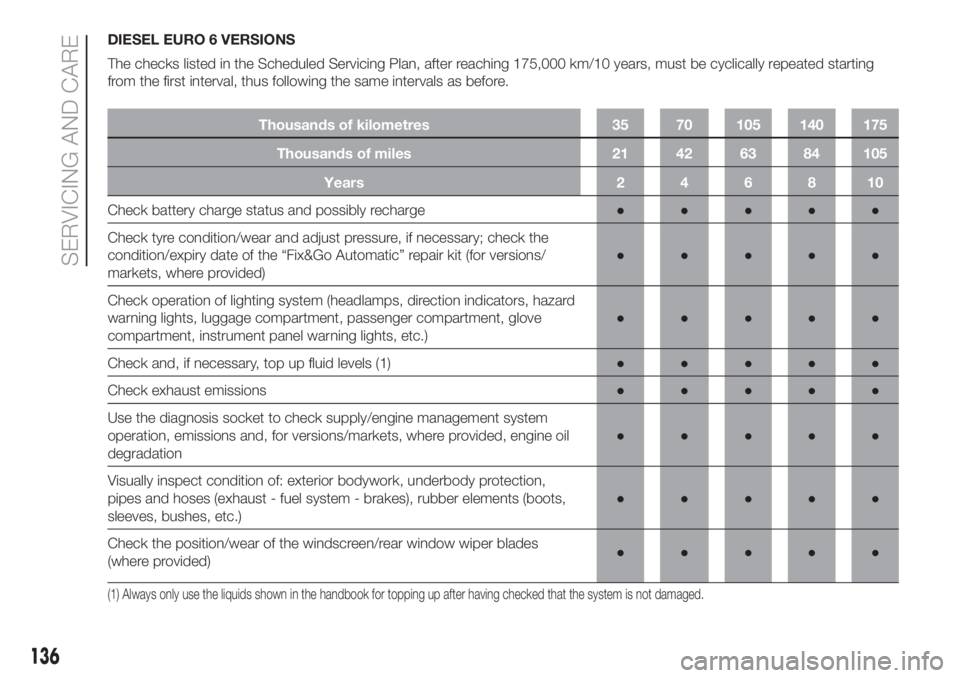
DIESEL EURO 6 VERSIONS
The checks listed in the Scheduled Servicing Plan, after reaching 175,000 km/10 years, must be cyclically repeated starting
from the first interval, thus following the same intervals as before.
Thousands of kilometres 35 70 105 140 175
Thousands of miles 21 42 63 84 105
Years 2 4 6 8 10
Check battery charge status and possibly recharge●●●●●
Check tyre condition/wear and adjust pressure, if necessary; check the
condition/expiry date of the “Fix&Go Automatic” repair kit (for versions/
markets, where provided)●●●●●
Check operation of lighting system (headlamps, direction indicators, hazard
warning lights, luggage compartment, passenger compartment, glove
compartment, instrument panel warning lights, etc.)●●●●●
Check and, if necessary, top up fluid levels (1)●●●●●
Check exhaust emissions●●●●●
Use the diagnosis socket to check supply/engine management system
operation, emissions and, for versions/markets, where provided, engine oil
degradation●●●●●
Visually inspect condition of: exterior bodywork, underbody protection,
pipes and hoses (exhaust - fuel system - brakes), rubber elements (boots,
sleeves, bushes, etc.)●●●●●
Check the position/wear of the windscreen/rear window wiper blades
(where provided)●●●●●
(1) Always only use the liquids shown in the handbook for topping up after having checked that the system is not damaged.
136
SERVICING AND CARE
Page 139 of 196
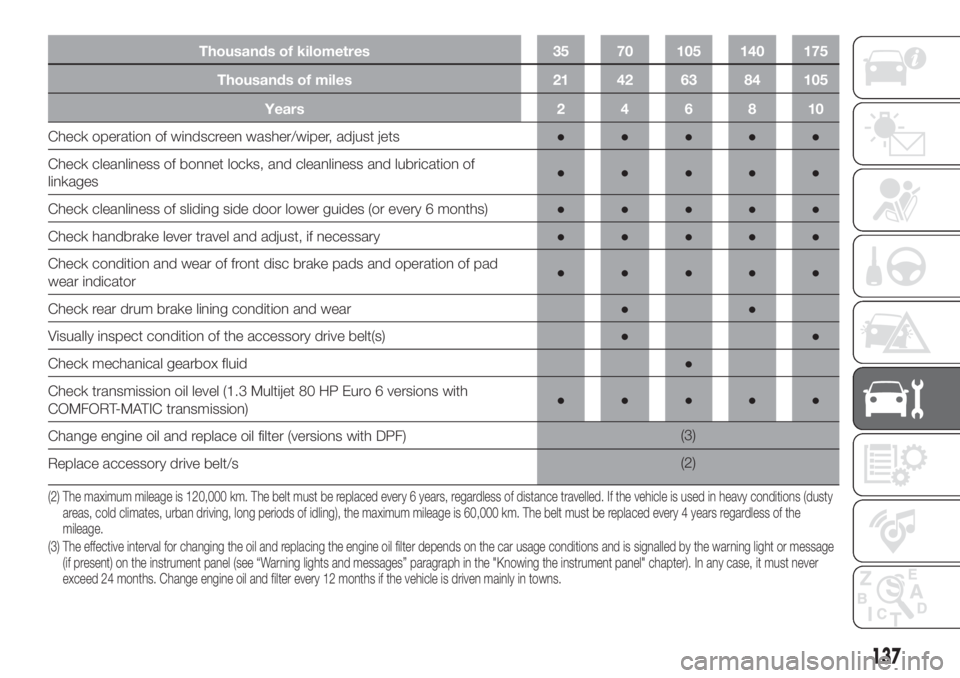
Thousands of kilometres 35 70 105 140 175
Thousands of miles 21 42 63 84 105
Years 2 4 6 8 10
Check operation of windscreen washer/wiper, adjust jets●●●●●
Check cleanliness of bonnet locks, and cleanliness and lubrication of
linkages●●●●●
Check cleanliness of sliding side door lower guides (or every 6 months)●●●●●
Check handbrake lever travel and adjust, if necessary●●●●●
Check condition and wear of front disc brake pads and operation of pad
wear indicator●●●●●
Check rear drum brake lining condition and wear●●
Visually inspect condition of the accessory drive belt(s)●●
Check mechanical gearbox fluid●
Check transmission oil level (1.3 Multijet 80 HP Euro 6 versions with
COMFORT-MATIC transmission)●●●●●
Change engine oil and replace oil filter (versions with DPF)(3)
Replace accessory drive belt/s(2)
(2) The maximum mileage is 120,000 km. The belt must be replaced every 6 years, regardless of distance travelled. If the vehicle is used in heavy conditions (dusty
areas, cold climates, urban driving, long periods of idling), the maximum mileage is 60,000 km. The belt must be replaced every 4 years regardless of the
mileage.
(3) The effective interval for changing the oil and replacing the engine oil filter depends on the car usage conditions and is signalled by the warning light or message
(if present) on the instrument panel (see “Warning lights and messages” paragraph in the "Knowing the instrument panel" chapter). In any case, it mustnever
exceed 24 months. Change engine oil and filter every 12 months if the vehicle is driven mainly in towns.
137
Page 141 of 196
PERIODIC CHECKS
Every 1,000 km or before long
journeys, check and, if necessary, top
up:
engine coolant level;
brake fluid level;
windscreen washer fluid level;
tyre inflation pressure and condition;
operation of lighting system
(headlights, direction indicators, hazard
warning lights, etc.);
operation of windscreen washer/
wiper system and positioning/wear of
rear window wiper blades.
To ensure that the vehicle is always
efficient and well maintained, it is
advisable to make sure that you carry
out the above operations regularly
(approximately every 1000 km and
every 3000 km for checking and
topping up engine oil is advisable).
DEMANDING
VEHICLE USE
If the vehicle is mostly used in one of
the following conditions:
towing a trailer or caravan;
dusty roads;
short, repeated journeys (less than
7-8 km) at sub-zero temperatures;
engine often idling or driving long
distances at low speeds or long periods
of inactivity;
the following checks must be carried
out more often than indicated in the
Scheduled Servicing Plan:
check front disc brake pad condition
and wear;
check cleanliness of bonnet and
luggage compartment locks,
cleanliness and lubrication of linkage;
visually inspect the conditions of:
engine, gearbox, transmission, pipes
and hoses (exhaust/fuel supply/brakes),
rubber parts (boots/sleeves/bushes,
etc.);
check battery charge and battery
fluid level (electrolyte);
visually inspect conditions of the
accessory drive belts;
check and, if necessary, change
engine oil and replace oil filter;
check and, if necessary, replace
pollen filter;
check and, if necessary, replace air
cleaner.
139
Page 142 of 196
CHECKING LEVELS
133)
43).
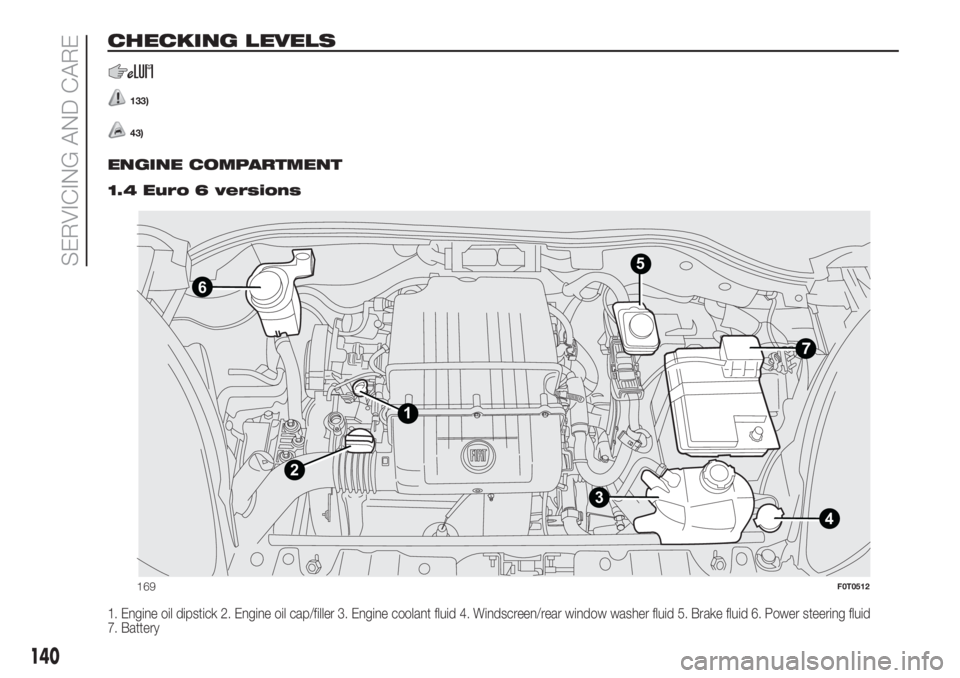
ENGINE COMPARTMENT.
1.4 Euro 6 versions
1. Engine oil dipstick 2. Engine oil cap/filler 3. Engine coolant fluid 4. Windscreen/rear window washer fluid 5. Brake fluid 6. Power steering fluid
7. Battery
4
6
1
2
35
169F0T0512
140
SERVICING AND CARE
Page 145 of 196
ENGINE OIL
Engine oil level check
Check the oil level a few minutes (about
5) after the engine has stopped, with
the vehicle parked on level ground.
Take out the dipstick 1, clean it and
then reinsert it fully; take it out and
check that the level is between the MIN
and MAX marks on the dipstick. The
interval between MIN and MAX marks
corresponds to about 1 litre of oil.
Topping up the engine oil
If the oil level is close to or below the
MIN mark, add oil via the filler 2 until it
reaches the MAX mark.
The oil level must never exceed the
MAX. mark.
IMPORTANT If the engine oil level after
the check is over the MAX level, go
to a Fiat Dealership to have the correct
level restored.
IMPORTANT After adding or changing
the oil, let the engine turn over for a few
seconds and wait a few minutes after
turning it off before you check the level.
Engine oil consumption
The maximum engine oil consumption
is usually 400 grams every 1000 km.
When the vehicle is new, the engine
needs to be run in, therefore the engine
oil consumption can only be considered
stabilised after the first 5,000–6,000
km.IMPORTANT The oil consumption
depends on driving style and the
conditions under which the vehicle is
used.
IMPORTANT Always top up using
engine oil of the same specifications as
that already in the engine.
134)
44)
ENGINE COOLANT
The coolant level should be checked
when the engine is cold and should be
between the MIN and MAX lines on
the vessel.
If the level is low, pour a 50% mixture of
demineralised water and PETRONAS
LUBRICANTS PARAFLU
UPinto the
vessel through cap 3.
The mixture of 50% PARAFLU
UPand
50% distilled water protects against
freezing down to temperatures of
-35°C. For particularly harsh climate
conditions, we recommended using a
mixture of 60% PARAFLU
UPand 40%
distilled water.
135)
45)
WINDSCREEN/REAR
WINDOW WASHING FLUID
To add fluid, lift the cap 4 and pour in a
mixture of water and PETRONAS
DURANCE SC 35 fluid, in the following
proportions:
30% PETRONAS DURANCE SC 35
and 70% water in summer;
50% PETRONAS DURANCE SC 35
and 50% water in winter.
At temperatures below -20°C, use
undiluted PETRONAS DURANCE SC
35 fluid.
Check fluid level through the reservoir.
136) 137)
BRAKE FLUID
Unscrew the cap 5 and check that the
fluid in the reservoir is at the maximum
level.
The fluid level in the reservoir must not
exceed the MAX mark.
Use the brake fluid shown in the "Fluids
and lubricants" table (see "Technical
Specifications"). When opening the cap
A, make sure that no dirt gets into the
reservoir.
For topping-up, always use a funnel
with integrated filter with mesh equal to
or lower than 0.12 mm.
143
Page 146 of 196
IMPORTANT Brake fluid absorbs
moisture. For this reason, if the vehicle
is mainly used in areas with a high
degree of atmospheric humidity, the
fluid should be replaced at more
frequent intervals than specified in the
“Scheduled Servicing Plan”.
138) 139)
46)
POWER STEERING FLUID
Unscrew the cap 6 and check that the
fluid in the reservoir is between the
MIN and MAX marks on the reservoir.
The level may exceed the MAX mark
when the oil is hot. If topping up is
required, make sure the oil you use has
the same specifications as that already
in the system.
140)
3)
COMFORT-MATIC
TRANSMISSION
HYDRAULIC SYSTEM
FLUID
To check the transmission oil level and
to check/change the clutch hydraulic
system fluid, go to a Fiat Dealership.
4)
BATTERY
The battery does not require the
electrolyte to be topped up with distilled
water. A periodic check carried out at
a Fiat Dealership is, however, necessary
to check efficiency.
IMPORTANT If the charge level remains
under 50% for a long time, the battery
is damaged by sulphation, reducing
its capacity and efficiency at start-up.
141) 142)
Replacing the battery
If required, replace the battery with an
original spare part with the same
specifications.
If a battery with different specifications
is fitted, the service intervals given in
the “Scheduled Servicing Plan” will no
longer be valid.
Follow the battery manufacturer's
instructions for maintenance.
143)
47) 48)
5)
WARNING
133)Never smoke while working in the
engine compartment: inflammable gases
and vapours may be present, constituting
a fire risk.
134)Be very careful working in the engine
compartment when the engine is hot:
you may get burned. Remember that the
fan may start up if the engine is hot: this
could injure you. Scarves, ties and other
loose clothing might be pulled by moving
parts.
135)Do not remove the reservoir cap
when the engine is very hot as there is a
risk of scalding. The cooling system is
pressurised. If the cap needs replacing, do
so with another original or the effectiveness
of the system may be compromised.
136)Do not travel if the windscreen washer
reservoir is empty: using the windscreen
washer is essential for improving visibility.
137)Some commercial windscreen washer
additives are flammable. The engine
compartment contains hot parts which
could start a fire if they come into contact.
138)Brake fluid is poisonous and highly
corrosive. In the event of accidental
contact, immediately wash the affected
parts with water and mild soap. Then rinse
thoroughly. Call a doctor immediately if
swallowed.
139)The symbol
, on the brake fluid
container indicates if a brake fluid is
synthetic or mineralbased. Use of mineral
type fluids will damage the special rubber
seals of the braking system beyond repair.
144
SERVICING AND CARE