parking brake FIAT FIORINO 2018 Owner handbook (in English)
[x] Cancel search | Manufacturer: FIAT, Model Year: 2018, Model line: FIORINO, Model: FIAT FIORINO 2018Pages: 196, PDF Size: 4.99 MB
Page 4 of 196
READ THIS CAREFULLY
REFUELLINGPetrol engines: only refuel with unleaded petrol with an octane rating (RON) of no less than 95 conforming to the European specification EN
228.
Diesel engines: only use diesel fuel for motor vehicles conforming to the European specification EN 590. The use of other products or
mixtures may damage the engine beyond repair and consequently invalidate the warranty, due to the damage caused.
Refuelling with methane: refuel only with methane for motor vehicles. The use of other products or mixtures may damage the engine
beyond repair and consequently invalidate the warranty, due to the damage caused.
For further details on the use of the correct fuel see the "Refuelling the vehicle" paragraph in the "Starting and driving" chapter.
STARTING THE ENGINE
Versions with manual transmission (petrol engines): make sure that the handbrake is engaged; put the gear lever in neutral; fully
depress the clutch pedal without pressing the accelerator, then turn the ignition key to AVV and release it as soon as the engine has started.
Versions with manual transmission (Diesel engines): Turn the ignition key to MAR and wait for the warning light
to go out. Turn
the ignition key to AVV and release as soon as the engine starts.
Versions with Comfort-matic transmission: make sure that the handbrake is engaged and that the gear lever is in P (Park) or N (Neutral).
Then depress the brake pedal, turn the ignition key to AVV and release it as soon as the engine starts.
PARKING ON FLAMMABLE MATERIAL
The catalytic converter develops high temperatures during operation. Do not park on grass, dry leaves, pine needles or other flammable
material: fire hazard.
RESPECTING THE ENVIRONMENT
The vehicle is fitted with a system that allows continuous diagnosis of the emission-related components in order to help protect the
environment.
ELECTRICAL ACCESSORIES
If, after buying the vehicle, you decide to add electrical accessories (with the risk of gradually draining the battery), visit a Fiat Dealership. They
can calculate the overall electrical requirement and check that the vehicle's electrical system can support the required load.
SCHEDULED SERVICING
Correct maintenance enables the vehicle to perfectly maintain performance and safety characteristics, its environmental friendliness and low
running costs over time.
THE OWNER HANDBOOK CONTAINS
... important information, advice and warnings for correct use, driving safety and maintenance of your vehicle over time. Special attention
must be paid to the symbols(safety of persons)(environmental protection)(vehicle integrity).
Page 39 of 196
KNOWING THE INSTRUMENT PANEL
This section of the handbook gives you
all the information you need to
understand, interpret and use the
instrument panel correctly.INSTRUMENT PANEL ..................... 38
DIGITAL DISPLAY............................ 42
MULTIFUNCTION DISPLAY ............. 43
TRIP COMPUTER ........................... 44
WARNING LIGHTS AND
MESSAGES .................................... 46
-LOW BRAKE FLUID/HANDBRAKE
ENGAGED........................................... 46
-EBD FAILURE .................................... 47
-AIR BAG FAILURE .............................. 47
-SEAT BELTS REMINDER.................... 48
-GEARBOX FAILURE ........................... 48
-ENGINE COOLANT TEMPERATURE
TOO HIGH........................................... 49
-LOW BATTERY CHARGE ................... 49
-INSUFFICIENT ENGINE OIL
PRESSURE/ENGINE OIL
DETERIORATED .................................. 50
-LOW ENGINE OIL LEVEL ................... 51
-DOOR OPEN ..................................... 51
-POWER STEERING FAILURE ............. 51
-INJECTION SYSTEM FAULT (Multijet
versions) - EOBD ENGINE CONTROL
SYSTEM FAULT (petrol versions) ......... 52
-ABS FAILURE..................................... 53
-FUEL RESERVE ................................. 54
-PLUG PREHEATING (Multijet
versions) - PLUG PREHEATING FAULT
(Multijet versions) ................................. 54
-WATER IN DIESEL FILTER (Multijet
versions) .............................................. 55
-VEHICLE PROTECTION SYSTEM
FAULT - FIAT CODE - ALARM FAULT
(for versions/markets, where provided
- amber) - BREAK-IN ATTEMPT .......... 56
-GENERAL FAILURE INDICATION ....... 57-DPF (PARTICULATE FILTER)
CLEANING UNDERWAY ...................... 59
-HILL HOLDER FAILURE ..................... 59
-iTPMS ................................................ 60
-BRAKE PAD WEAR ............................ 60
-PARKING SENSOR FAILURE ............. 60
-START&STOP SYSTEM FAILURE....... 60
-ASR SYSTEM DEACTIVATED ............. 61
-TRACTION PLUS SYSTEM
ACTIVATION ........................................ 61
-REAR FOG LIGHTS............................ 61
-SIDE LIGHTS - FOLLOW ME HOME .. 62
-LEFT-HAND DIRECTION INDICATOR
(blinking) .............................................. 62
-RIGHT-HAND DIRECTION
INDICATOR (blinking) ........................... 63
-FRONT FOG LIGHTS ......................... 63
-CRUISE CONTROL ............................ 63
-MAIN BEAM HEADLIGHTS ................ 63
-GEAR SHIFT INDICATION .................. 64
-CNG SYSTEM FAILURE ..................... 64
37
Page 62 of 196
What it means What to do
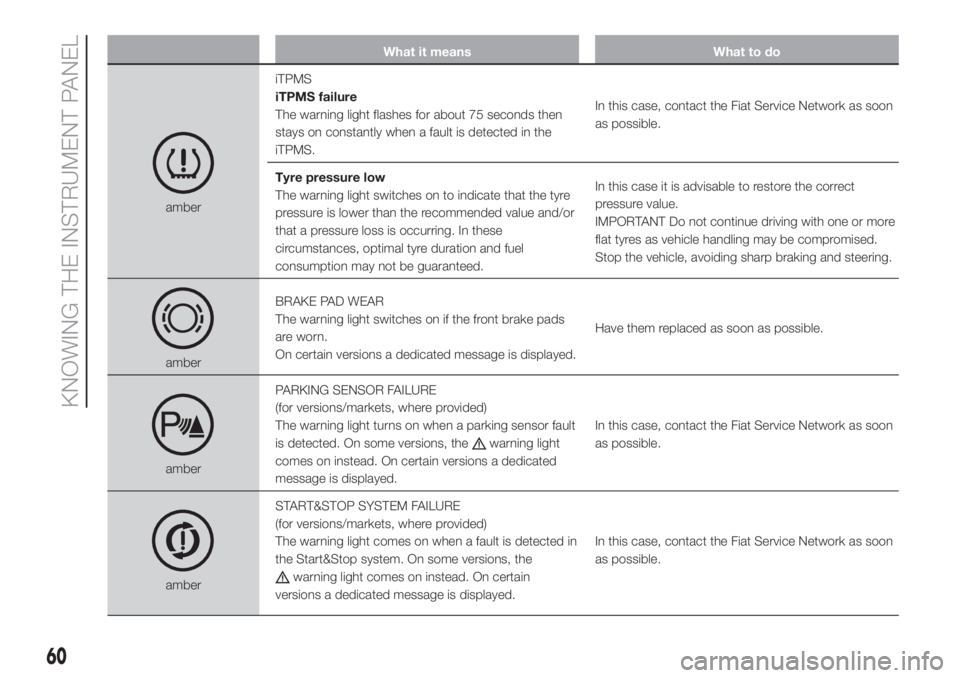
amberiTPMS
iTPMS failure
The warning light flashes for about 75 seconds then
stays on constantly when a fault is detected in the
iTPMS.In this case, contact the Fiat Service Network as soon
as possible.
Tyre pressure low
The warning light switches on to indicate that the tyre
pressure is lower than the recommended value and/or
that a pressure loss is occurring. In these
circumstances, optimal tyre duration and fuel
consumption may not be guaranteed.In this case it is advisable to restore the correct
pressure value.
IMPORTANT Do not continue driving with one or more
flat tyres as vehicle handling may be compromised.
Stop the vehicle, avoiding sharp braking and steering.
amberBRAKE PAD WEAR
The warning light switches on if the front brake pads
are worn.
On certain versions a dedicated message is displayed.Have them replaced as soon as possible.
amberPARKING SENSOR FAILURE
(for versions/markets, where provided)
The warning light turns on when a parking sensor fault
is detected. On some versions, the
warning light
comes on instead. On certain versions a dedicated
message is displayed.In this case, contact the Fiat Service Network as soon
as possible.
amberSTART&STOP SYSTEM FAILURE
(for versions/markets, where provided)
The warning light comes on when a fault is detected in
the Start&Stop system. On some versions, thewarning light comes on instead. On certain
versions a dedicated message is displayed.In this case, contact the Fiat Service Network as soon
as possible.
60
KNOWING THE INSTRUMENT PANEL
Page 70 of 196
ESC (Electronic
Stability Control)
SYSTEM
(for versions/markets, where provided)
This is an electronic system that
controls vehicle stability in the event of
tyre grip loss, helping to maintain
directional control. The system
is capable of recognising potentially
dangerous situations in terms of vehicle
stability and intervenes automatically
on the brakes in a differentiated manner
for the four wheels in order to provide
a stabilizing torque.
The ESC system switches on
automatically when the engine is
started and cannot be switched off.
The ESC system also includes the
following systems:
Hill Holder
ASR
MSR
HBA
SYSTEM INTERVENTION
This is signalled by the flashing of the
warning light in the instrument panel,
to inform the driver that the vehicle is
in critical stability and grip conditions.
Switching the system on
The ESC system is automatically
activated when the vehicle is started
and cannot be deactivated.Fault warnings
In the event of a failure, the ESC will be
automatically switched off and the
warning light
will come on constantly
in the instrument panel along with a
message in the multifunction display
(for versions/markets where provided)
(see “Warning lights and messages”
section in the "Knowing the instrument
panel" chapter). Contact a Fiat
Dealership as soon as possible.
44) 45) 46)
HILL HOLDER SYSTEM
(for versions/markets, where provided)
It is an integral part of the ESC system
and facilitates starting on an incline.
It is automatically activated in the
following conditions:
uphill: vehicle stationary on a road
with a gradient higher than 5%, engine
running, brake pedal pressed and
gearbox in neutral or gear other than
reverse;
downhill: vehicle stationary on a road
with a gradient higher than 5%, engine
running, brake pedal pressed and
reverse gear engaged.
When setting off, the ESC system
control unit maintains the braking
pressure on the wheels until the torque
necessary for starting is reached, or
in any case for a maximum of 2seconds, allowing your right foot to be
moved easily from the brake pedal to
the accelerator. When the 2 seconds
have elapsed, without starting, the
system is automatically deactivated,
gradually releasing the braking
pressure. During this release stage, the
typical brake disengagement noise
indicating that the vehicle is going to
move imminently will be heard.
Fault warnings
System failure is indicated by
instrument panel warning light
with
digital display and warning light
on
the instrument panel with multifunction
display (for versions/markets, where
provided) (see section “Warning lights
and messages” in the "Knowing the
instrument panel" chapter).
IMPORTANT The Hill Holder system is
not a parking brake, therefore do not
leave the vehicle without activating the
handbrake, switching off the engine
and engaging first gear.
47)
ASR SYSTEM (Antislip
Regulation)
(for versions/markets, where provided)
This is a traction control system that
cuts in automatically every time one or
both drive wheels slip.
68
SAFETY
Page 93 of 196
STARTING AND DRIVING
Let’s get to the core of the vehicle:
seeing how you can exploit all of its
potential to the full.
We’ll look at how to drive it safely in any
situation, so that it can be a welcome
companion, with our comfort and
our wallets in mind.STARTING THE ENGINE ................. 92
HANDBRAKE .................................. 93
WHEN PARKED .............................. 94
USING THE MANUAL
TRANSMISSION ............................. 95
“COMFORT-MATIC”
TRANSMISSION ............................. 96
CRUISE CONTROL (CONSTANT
SPEED REGULATOR) ..................... 97
SPEED BLOCK ............................... 99
PARKING SENSORS....................... 99
START&STOP SYSTEM ..................100
REFUELLING THE VEHICLE ...........102
TOWING TRAILERS ........................105
91
Page 96 of 196
WARNING
92)Never leave children unattended in the
vehicle. Always remove the ignition key
when leaving the vehicle and take it out
with you.
93)The vehicle should be secured after
several clicks of the lever. If it is not,
contact a Fiat Dealership to have it
adjusted.
94)In the case of parking manoeuvres on
roads on a gradient, the front wheels
must be steered towards the pavement
(when parking downhill), or in the opposite
direction if the vehicle is parked uphill. If
the vehicle is parked on a steep slope, it is
advisable to block the wheels with a wedge
or stone.
WHEN PARKED
95)
Proceed as follows when parking and
leaving the vehicle:
engage a gear (1stgear if facing
uphill or reverse if facing downhill) and
leave the wheels turned;
stop the engine and engage the
handbrake;
always remove the ignition key.
If the vehicle is parked on a steep
slope, it is advisable to block the
wheels with a wedge or stone.
Do not leave the key in the MAR
position to prevent the battery from
running down.
Versions with COMFORT-MATIC
transmission
To park safely, keeping a foot on the
brake pedal, the 1
stor reverse (R) gear
must be engaged and, in case of
parking uphills/downhills, the
handbrake must be engaged.
IMPORTANT NEVER leave the vehicle
with the transmission in neutral (N)
or, on versions equipped with automatic
(Comfort matic) transmission, before
putting the shift lever in thePposition.IMPORTANT NOTES
With the vehicle stationary and a
gear engaged, always keep the brake
pedal pressed until you decide to
set off, then release the brake and
accelerate gently;
during prolonged stops with the
engine running, it is advisable to keep
the gearbox in neutral (N);
In order to safeguard the efficiency
of the clutch, do not use the
accelerator to keep the vehicle
stationary (e.g. when stopped on an
incline);
the clutch could overheat and be
damaged; use the brake pedal and only
operate the accelerator pedal when
you decide to set off;
only use second gear when you
need greater control for starting
manoeuvres on surfaces with poor grip;
if, with reverse gear (R) engaged,
you have to engage first gear or vice
versa, only do this when the vehicle is
completely stationary and with the
brake pedal pressed;
94
STARTING AND DRIVING
Page 101 of 196
SPEED BLOCK
(for 1.3 MultiJet versions with manual
transmission)
The vehicle is equipped with a speed
limitation function that can be set on
the user's request to one of four default
values. 90, 100, 110, 130 km/h.
To activate/deactivate this function,
contact a Fiat Dealership.
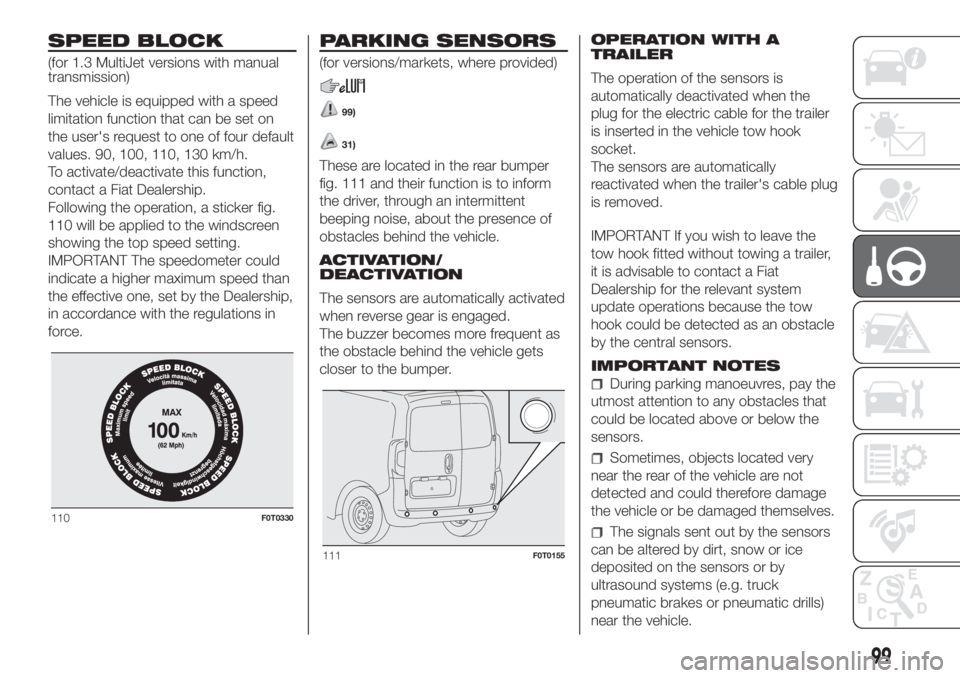
Following the operation, a sticker fig.
110 will be applied to the windscreen
showing the top speed setting.
IMPORTANT The speedometer could
indicate a higher maximum speed than
the effective one, set by the Dealership,
in accordance with the regulations in
force.
PARKING SENSORS
(for versions/markets, where provided)
99)
31)
These are located in the rear bumper
fig. 111 and their function is to inform
the driver, through an intermittent
beeping noise, about the presence of
obstacles behind the vehicle.
ACTIVATION/
DEACTIVATION
The sensors are automatically activated
when reverse gear is engaged.
The buzzer becomes more frequent as
the obstacle behind the vehicle gets
closer to the bumper.OPERATION WITH A
TRAILER
The operation of the sensors is
automatically deactivated when the
plug for the electric cable for the trailer
is inserted in the vehicle tow hook
socket.
The sensors are automatically
reactivated when the trailer's cable plug
is removed.
IMPORTANT If you wish to leave the
tow hook fitted without towing a trailer,
it is advisable to contact a Fiat
Dealership for the relevant system
update operations because the tow
hook could be detected as an obstacle
by the central sensors.
IMPORTANT NOTES
During parking manoeuvres, pay the
utmost attention to any obstacles that
could be located above or below the
sensors.
Sometimes, objects located very
near the rear of the vehicle are not
detected and could therefore damage
the vehicle or be damaged themselves.
The signals sent out by the sensors
can be altered by dirt, snow or ice
deposited on the sensors or by
ultrasound systems (e.g. truck
pneumatic brakes or pneumatic drills)
near the vehicle.110F0T0330
111F0T0155
99
Page 102 of 196
The parking sensors work properly
with the swing doors closed. If they are
open, they can cause the system to
send false signals: always close the rear
doors.
Also, do not apply stickers to the
sensors.
The following conditions may influence
the performance of the parking
assistance system:
Reduced sensor sensitivity and a
reduction in the parking assistance
system performance could be due to
the presence on the surface of the
sensor of: ice, snow, mud, thick paint.
The sensor may detect a non-
existent obstacle (echo noise) due to
mechanical noises, for example when
washing the vehicle, in case of rain,
strong wind, hail.
The warnings sent by the sensor
can also be altered by the presence of
ultrasonic systems (e.g. pneumatic
brakes of trucks or pneumatic drills)
near the car.
Detection of obstacles in the upper
part of the vehicle (particularly in the
case of vans or chassis cabs) may not
be guaranteed because the system
detects obstacles that could strike the
lower part of the vehicle.
WARNING
99)Parking manoeuvres, however, are
always the driver’s responsibility. While
carrying out these manoeuvres, always
make sure that no people (especially
children) or animals are in the area
concerned. Parking sensors are designed
to assist drivers; however, you must always
concentrate fully during potentially
dangerous manoeuvres, even if carried out
at low speeds.
WARNING
31)The sensor must be free of mud, dirt,
snow or ice in order for the system to
work. Be careful not to scratch or damage
the sensors while cleaning them. Avoid
using dry, rough or hard cloths. The
sensors should be washed using clean
water with the addition of car shampoo if
necessary. When using special washing
equipment such as high pressure jets
or steam cleaning, clean the sensors very
quickly keeping the jet more than 10 cm
away.
START&STOP
SYSTEM
(for versions/markets, where provided)
101) 102) 103) 104)
IN BRIEF
The Start&Stop device automatically
stops the engine each time the
vehicle is stationary and all the
conditions for automatic switch-off
have been met, and starts it again
when the driver wants to move off.
This improves the efficiency of the
vehicle by reducing fuel consumption,
the emission of harmful gases and
noise pollution.
OPERATING MODE
Stopping the engine
Versions with manual transmission
With the vehicle stationary, the engine
stops with the gearbox in neutral and
the clutch pedal released.
100
STARTING AND DRIVING
Page 113 of 196
FIX&GO
AUTOMATIC KIT
115) 116)
37)
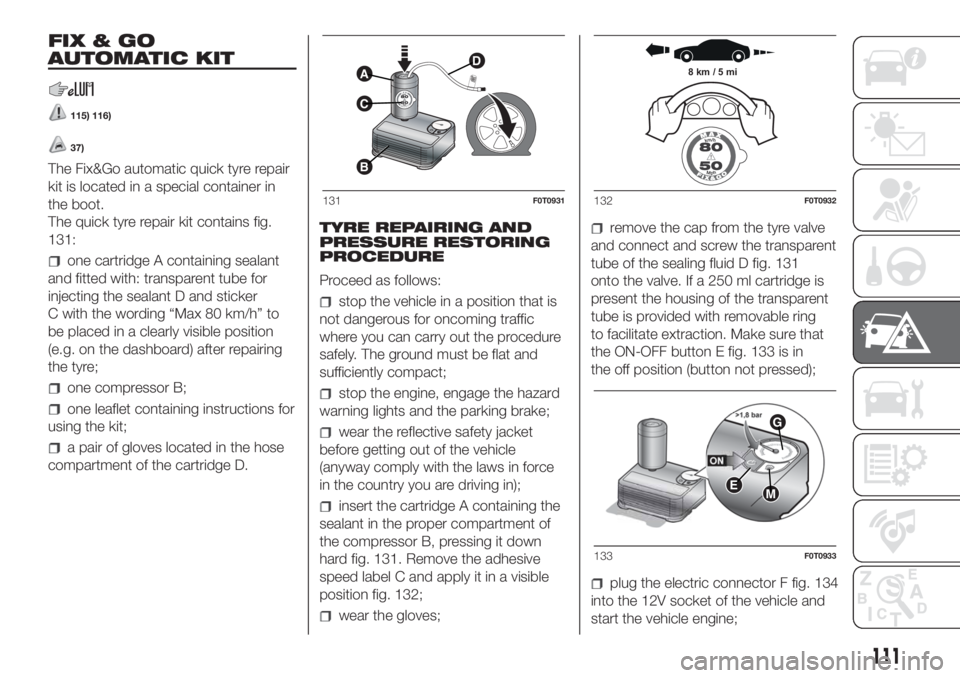
The Fix&Go automatic quick tyre repair
kit is located in a special container in
the boot.
The quick tyre repair kit contains fig.
131:
one cartridge A containing sealant
and fitted with: transparent tube for
injecting the sealant D and sticker
C with the wording “Max 80 km/h” to
be placed in a clearly visible position
(e.g. on the dashboard) after repairing
the tyre;
one compressor B;
one leaflet containing instructions for
using the kit;
a pair of gloves located in the hose
compartment of the cartridge D.TYRE REPAIRING AND
PRESSURE RESTORING
PROCEDURE
Proceed as follows:
stop the vehicle in a position that is
not dangerous for oncoming traffic
where you can carry out the procedure
safely. The ground must be flat and
sufficiently compact;
stop the engine, engage the hazard
warning lights and the parking brake;
wear the reflective safety jacket
before getting out of the vehicle
(anyway comply with the laws in force
in the country you are driving in);
insert the cartridge A containing the
sealant in the proper compartment of
the compressor B, pressing it down
hard fig. 131. Remove the adhesive
speed label C and apply it in a visible
position fig. 132;
wear the gloves;
remove the cap from the tyre valve
and connect and screw the transparent
tube of the sealing fluid D fig. 131
onto the valve. If a 250 ml cartridge is
present the housing of the transparent
tube is provided with removable ring
to facilitate extraction. Make sure that
the ON-OFF button E fig. 133 is in
the off position (button not pressed);
plug the electric connector F fig. 134
into the 12V socket of the vehicle and
start the vehicle engine;
A
C
B
D
131F0T0931
8 km / 5 mi
132F0T0932
EM
G
133F0T0933
111
Page 127 of 196
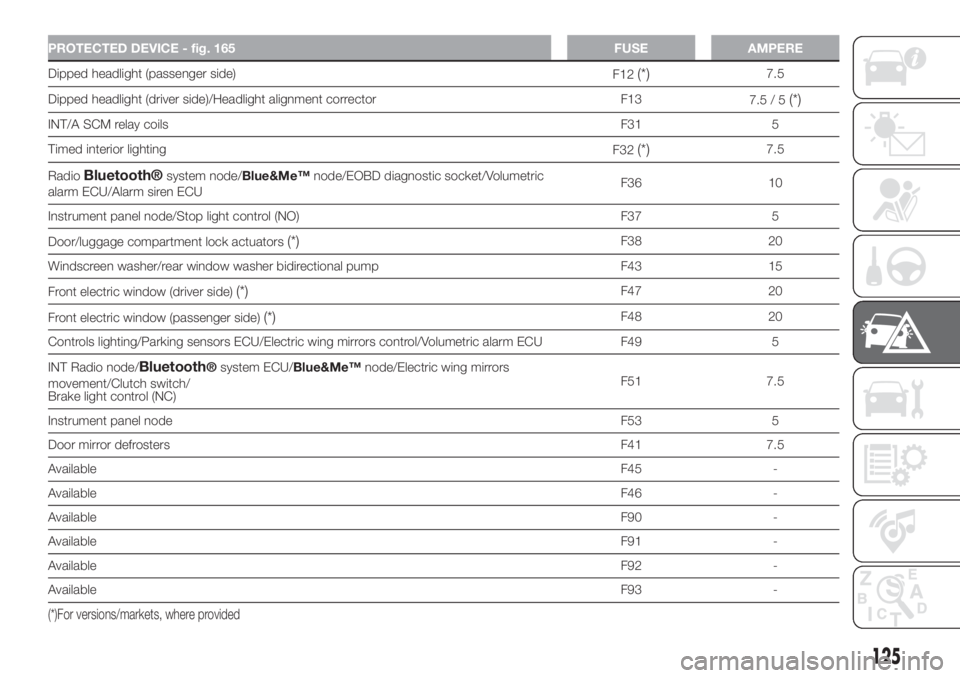
PROTECTED DEVICE - fig. 165 FUSE AMPERE
Dipped headlight (passenger side)
F12(*)7.5
Dipped headlight (driver side)/Headlight alignment corrector F13
7.5 / 5
(*)
INT/A SCM relay coilsF31 5
Timed interior lighting
F32
(*)7.5
Radio
Bluetooth®system node/Blue&Me™node/EOBD diagnostic socket/Volumetric
alarm ECU/Alarm siren ECUF36 10
Instrument panel node/Stop light control (NO) F37 5
Door/luggage compartment lock actuators
(*)F38 20
Windscreen washer/rear window washer bidirectional pump F43 15
Front electric window (driver side)
(*)F47 20
Front electric window (passenger side)
(*)F48 20
Controls lighting/Parking sensors ECU/Electric wing mirrors control/Volumetric alarm ECU F49 5
INT Radio node/
Bluetooth®system ECU/Blue&Me™node/Electric wing mirrors
movement/Clutch switch/
Brake light control (NC)F51 7.5
Instrument panel nodeF53 5
Door mirror defrostersF41 7.5
AvailableF45 -
AvailableF46 -
AvailableF90 -
AvailableF91 -
AvailableF92 -
AvailableF93 -
(*)For versions/markets, where provided
125