brake fluid FIAT FREEMONT 2013 Owner handbook (in English)
[x] Cancel search | Manufacturer: FIAT, Model Year: 2013, Model line: FREEMONT, Model: FIAT FREEMONT 2013Pages: 352, PDF Size: 5.22 MB
Page 293 of 352
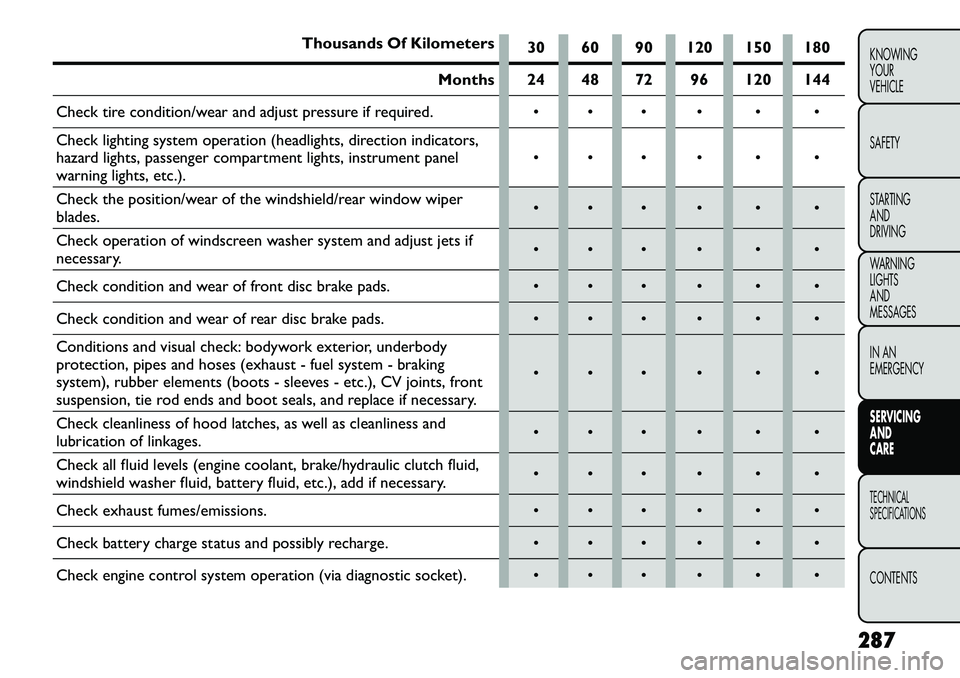
Thousands Of Kilometers30 60 90 120 150 180
Months 24 48 72 96 120 144
Check tire condition/wear and adjust pressure if required.
Check lighting system operation (headlights, direction indicators,
hazard lights, passenger compartment lights, instrument panel
warning lights, etc.).
Check the position/wear of the windshield/rear window wiper
blades.
Check operation of windscreen washer system and adjust jets if
necessary.
Check condition and wear of front disc brake pads.
Check condition and wear of rear disc brake pads.
Conditions and visual check: bodywork exterior, underbody
protection, pipes and hoses (exhaust - fuel system - braking
system), rubber elements (boots - sleeves - etc.), CV joints, front
suspension, tie rod ends and boot seals, and replace if necessary.
Check cleanliness of hood latches, as well as cleanliness and
lubrication of linkages.
Check all fluid levels (engine coolant, brake/hydraulic clutch fluid,
windshield washer fluid, battery fluid, etc.), add if necessary.
Check exhaust fumes/emissions.
Check battery charge status and possibly recharge.
Check engine control system operation (via diagnostic socket).
287
KNOWING
YOUR
VEHICLE
SAFETY
STARTING
AND
DRIVING
WARNING
LIGHTS
AND
MESSAGES
IN AN
EMERGENCY
SERVICING
AND
CARETECHNICAL
SPECIFICATIONSCONTENTS
Page 294 of 352
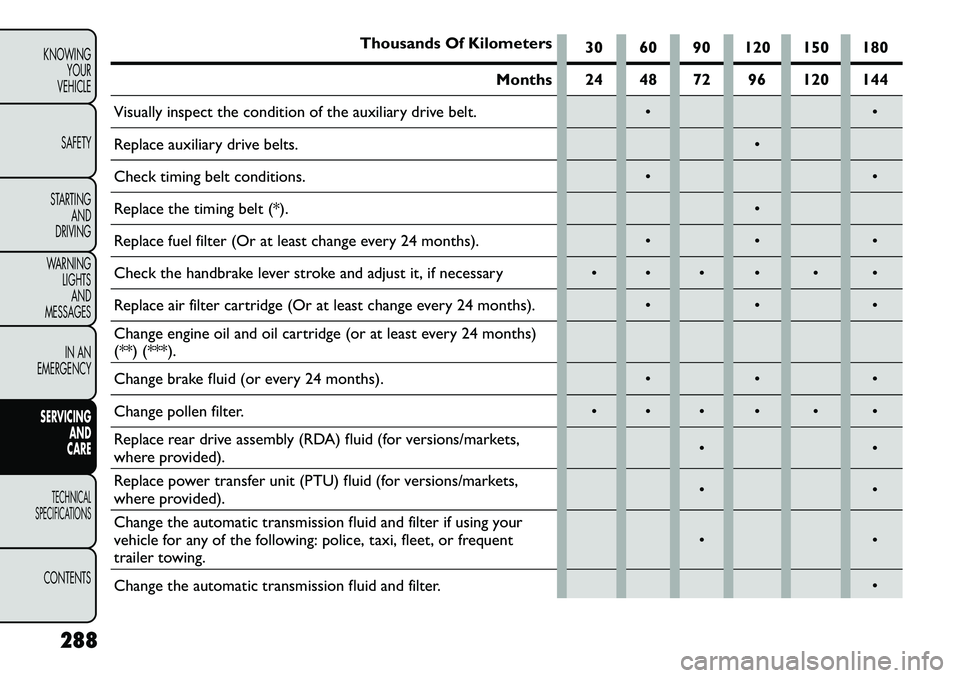
Thousands Of Kilometers30 60 90 120 150 180
Months 24 48 72 96 120 144
Visually inspect the condition of the auxiliary drive belt.
Replace auxiliary drive belts.
Check timing belt conditions.
Replace the timing belt (*).
Replace fuel filter (Or at least change every 24 months).
Check the handbrake lever stroke and adjust it, if necessary
Replace air filter cartridge (Or at least change every 24 months).
Change engine oil and oil cartridge (or at least every 24 months)
(**) (***).
Change brake fluid (or every 24 months).
Change pollen filter.
Replace rear drive assembly (RDA) fluid (for versions/markets,
where provided).
Replace power transfer unit (PTU) fluid (for versions/markets,
where provided).
Change the automatic transmission fluid and filter if using your
vehicle for any of the following: police, taxi, fleet, or frequent
trailer towing.
Change the automatic transmission fluid and filter.
288
KNOWING YOUR
VEHICLE
SAFETY
STARTING AND
DRIVING
WARNING LIGHTSAND
MESSAGES
IN AN
EMERGENCY
SERVICING AND
C
ARETECHNICAL
SPECIFICATIONSCONTENTS
Page 295 of 352
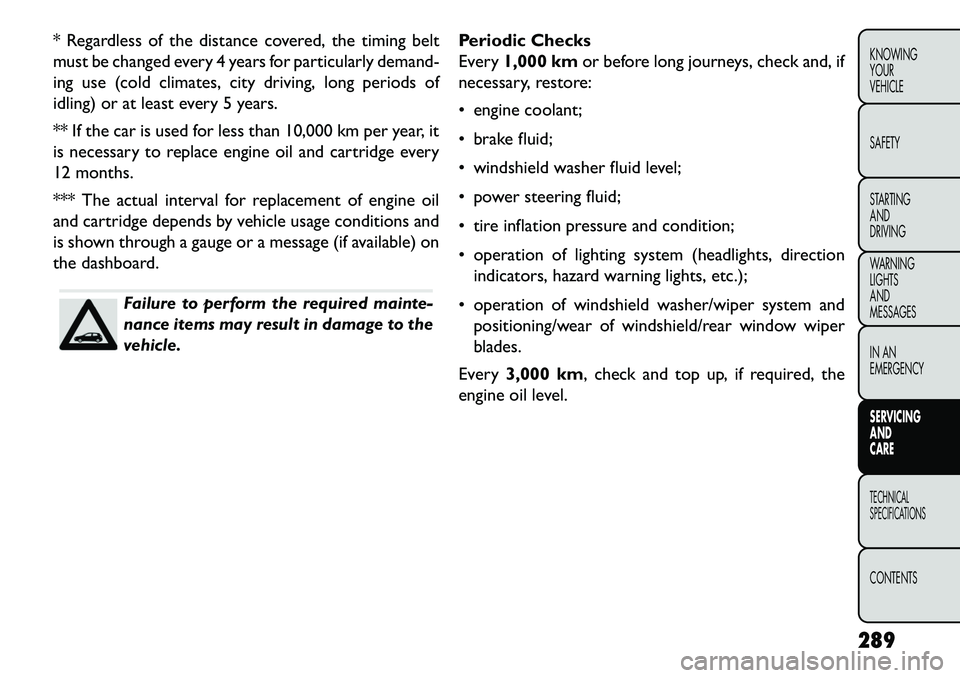
* Regardless of the distance covered, the timing belt
must be changed every 4 years for particularly demand-
ing use (cold climates, city driving, long periods of
idling) or at least every 5 years.
** If the car is used for less than 10,000 km per year, it
is necessary to replace engine oil and cartridge every
12 months.
*** The actual interval for replacement of engine oil
and cartridge depends by vehicle usage conditions and
is shown through a gauge or a message (if available) on
the dashboard.
Failure to perform the required mainte-
nance items may result in damage to the
vehicle.Periodic Checks
Every
1,000 km or before long journeys, check and, if
necessary, restore:
engine coolant;
brake fluid;
windshield washer fluid level;
power steering fluid;
tire inflation pressure and condition;
operation of lighting system (headlights, direction indicators, hazard warning lights, etc.);
operation of windshield washer/wiper system and positioning/wear of windshield/rear window wiper
blades.
Every 3,000 km, check and top up, if required, the
engine oil level.
289
KNOWING
YOUR
VEHICLE
SAFETY
STARTING
AND
DRIVING
WARNING
LIGHTS
AND
MESSAGES
IN AN
EMERGENCY
SERVICING
AND
CARETECHNICAL
SPECIFICATIONSCONTENTS
Page 296 of 352
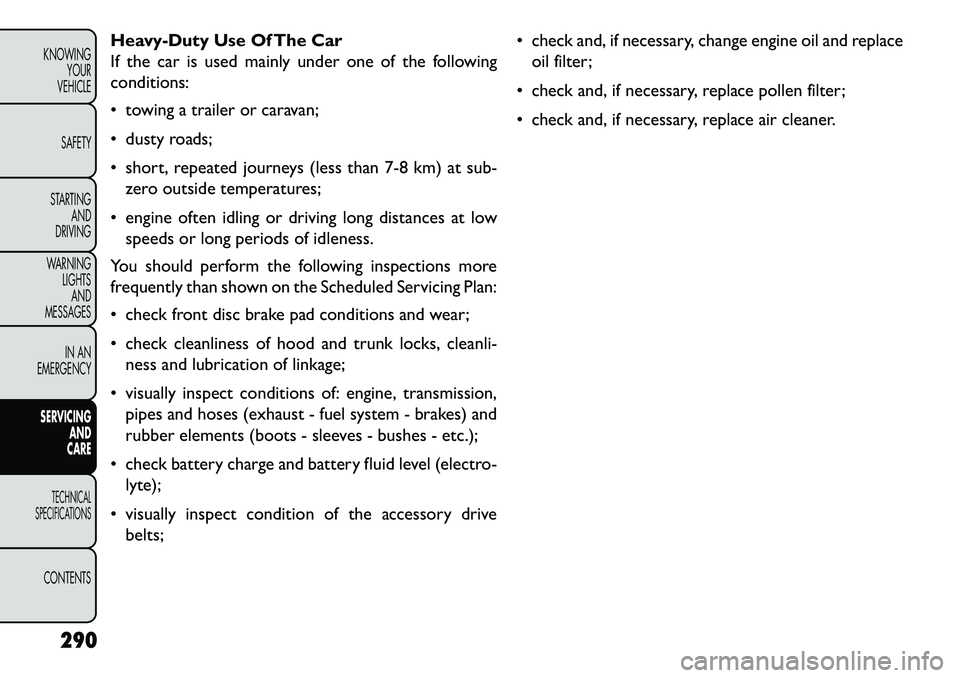
Heavy-Duty Use Of The Car
If the car is used mainly under one of the following
conditions:
towing a trailer or caravan;
dusty roads;
short, repeated journeys (less than 7-8 km) at sub-zero outside temperatures;
engine often idling or driving long distances at low speeds or long periods of idleness.
You should perform the following inspections more
frequently than shown on the Scheduled Servicing Plan:
check front disc brake pad conditions and wear;
check cleanliness of hood and trunk locks, cleanli- ness and lubrication of linkage;
visually inspect conditions of: engine, transmission, pipes and hoses (exhaust - fuel system - brakes) and
rubber elements (boots - sleeves - bushes - etc.);
check battery charge and battery fluid level (electro- lyte);
visually inspect condition of the accessory drive belts; check and, if necessary, change engine oil and replace
oil filter;
check and, if necessary, replace pollen filter;
check and, if necessary, replace air cleaner.
290
KNOWING YOUR
VEHICLE
SAFETY
STARTING AND
DRIVING
WARNING LIGHTSAND
MESSAGES
IN AN
EMERGENCY
SERVICING AND
C
ARETECHNICAL
SPECIFICATIONSCONTENTS
Page 297 of 352
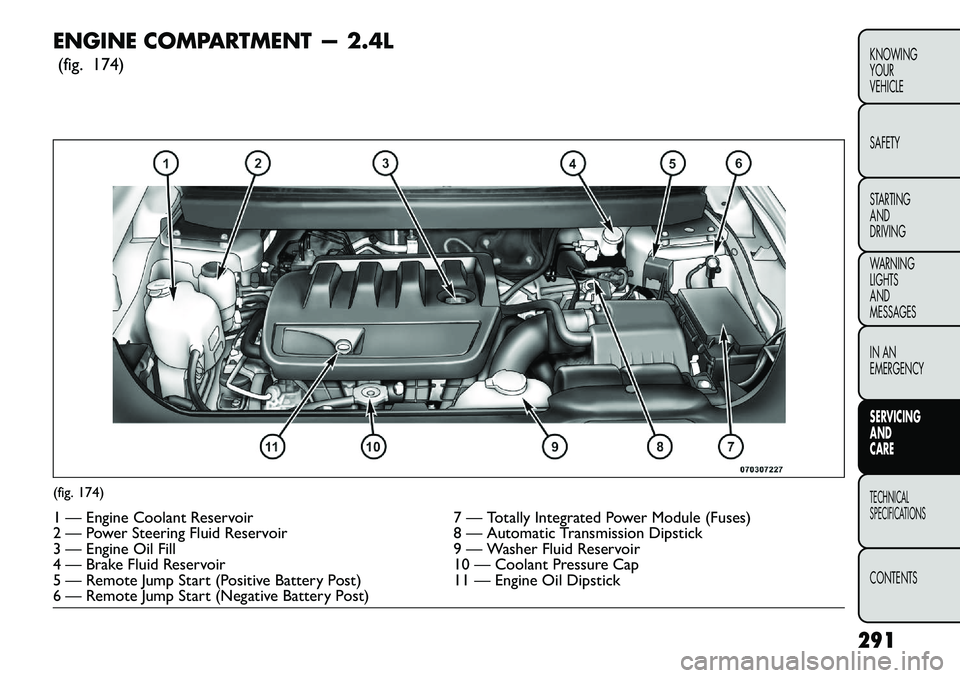
ENGINE COMPARTMENT — 2.4L(fig. 174)(fig. 174)1 — Engine Coolant Reservoir 7 — Totally Integrated Power Module (Fuses)
2 — Power Steering Fluid Reservoir 8 — Automatic Transmission Dipstick
3 — Engine Oil Fill 9 — Washer Fluid Reservoir
4 — Brake Fluid Reservoir 10 — Coolant Pressure Cap
5 — Remote Jump Start (Positive Battery Post) 11 — Engine Oil Dipstick
6 — Remote Jump Start (Negative Battery Post)
291
KNOWING
YOUR
VEHICLE
SAFETY
STARTING
AND
DRIVING
WARNING
LIGHTS
AND
MESSAGES
IN AN
EMERGENCY
SERVICING
AND
CARETECHNICAL
SPECIFICATIONSCONTENTS
Page 298 of 352

ENGINE COMPARTMENT — 3.6L(fig. 175)(fig. 175)1 — Engine Coolant Reservoir 5 — Air Cleaner Filter
2 — Power Steering Fluid Reservoir 6 — Washer Fluid Reservoir
3 — Brake Fluid Reservoir 7 — Engine Oil Dipstick
4 — Totally Integrated Power Module (Fuses) 8 — Engine Oil Fill
292
KNOWING YOUR
VEHICLE
SAFETY
STARTING AND
DRIVING
WARNING LIGHTSAND
MESSAGES
IN AN
EMERGENCY
SERVICING AND
C
ARETECHNICAL
SPECIFICATIONSCONTENTS
Page 299 of 352

ENGINE COMPARTMENT — 2.0L
DIESEL(fig. 176)(fig. 176)1 — Engine Coolant Reservoir 5 — Brake Fluid Reservoir
2 — Power Steering Fluid Reservoir 6 — Totally Integrated Power Module (Fuses)
3 — Engine Oil Fill 7 — Air Cleaner Filter
4 — Engine Oil Dipstick 8 — Washer Fluid Reservoir
293
KNOWING
YOUR
VEHICLE
SAFETY
STARTING
AND
DRIVING
WARNING
LIGHTS
AND
MESSAGES
IN AN
EMERGENCY
SERVICING
AND
CARETECHNICAL
SPECIFICATIONSCONTENTS
Page 313 of 352
Do not overfill the coolant recovery bottle.
Check coolant freeze point in the radiator and in thecoolant recovery bottle. If antifreeze needs to be
added, contents of coolant recovery bottle must also
be protected against freezing.
If frequent coolant additions are required, or if the level in the coolant recovery bottle does not drop
when the engine cools, the cooling system should be
pressure tested for leaks.
Make sure that the radiator and coolant recovery bottle overflow hoses are not kinked or obstructed.
Keep the front of the radiator clean. If your vehicle is equipped with air conditioning, keep the front of the
condenser clean.
Do not change the thermostat for Summer or Win- ter operation. If replacement is ever necessary, install
ONLY the correct type thermostat. Other designs
may result in unsatisfactory coolant performance,
poor gas mileage, and increased emissions.
BRAKE SYSTEM
In order to assure brake system performance, all brake
system components should be inspected periodically.
Refer to the “Maintenance Schedule” for the proper
maintenance intervals.
WARNING!
Riding the brakes can lead to brake fail-
ure
and possibly an accident . Driving
with your foot resting or riding on the brake
pedal can result in abnormally high brake tem-
peratures, excessive lining wear, and possible
brake damage.You would not have your full brak-
ing capacity in an emergency.Car maintenance should be done at a
FIAT Dealership. For routine and minor
maintenance operations you wish to
carry out yourself, we do recommend you have
the proper equipment , genuine FIAT spare parts
and the necessary fluids; do not however carry out
these operations if you have no experience.
Master Cylinder – Brake Fluid Level Check
Check the fluid level in the master cylinder immediately
if the “Brake Warning Light” indicates system failure.
Check the fluid level in the master cylinder when
performing underhood services.
Clean the top of the master cylinder area before
removing the cap. If necessary, add fluid to bring the
fluid level up to the requirements described on the
brake fluid reservoir.
307
KNOWING
YOUR
VEHICLE
SAFETY
STARTING
AND
DRIVING
WARNING
LIGHTS
AND
MESSAGES
IN AN
EMERGENCY
SERVICING
AND
CARETECHNICAL
SPECIFICATIONSCONTENTS
Page 314 of 352
Overfilling of fluid is not recommended because it may
cause leaking in the system.
Fluid level can be expected to fall as the brake pads
wear. Brake fluid level should be checked when pads are
replaced. However, low fluid level may be caused by a
leak and a checkup may be needed.
Use only manufacturer's recommended brake fluid.
Refer to “Fluids, Lubricants, and Genuine Parts” in
“Technical Specifications” for further information.
WARNING!
Us
e only manufacturer's recom-
mended brake fluid. Refer to “Fluids, Lu-
bricants, and Genuine Parts” in “Technical Speci-
fications” for further information. Using the
wrong type of brake fluid can severely damage
your brake system and/or impair its perfor-
mance. The proper type of brake fluid for your
vehicle is also identified on the original factory
installed hydraulic master cylinder reservoir.
(Continued)(Continued)
To avoid contamination from foreign matter or
moisture, use only new brake fluid or fluid that
has been in a tightly closed container. Keep the
master cylinder reservoir cap secured at all
times. Brake fluid in a open container absorbs
moisture from the air resulting in a lower boiling
point . This may cause it to boil unexpectedly
during hard or prolonged braking, resulting in
sudden brake failure. This could result in a acci-
dent .
Overfilling the brake fluid reservoir can result
in spilling brake fluid on hot engine parts, causing
the brake fluid to catch fire. Brake fluid can also
damage painted and vinyl surfaces, care should
be taken to avoid its contact with these surfaces.
Do not allow petroleum based fluid to con-
taminate the brake fluid. Brake seal components
could be damaged, causing partial or complete
brake failure.This could result in an accident .
AUTOMATIC TRANSMISSION (for
versions/markets, where provided)
Selection Of Lubricant
It is important to use the proper transmission fluid to
ensure optimum transmission performance and life.
Use only the manufacturer’s recommended transmis-
sion fluid. Refer to “Fluids, Lubricants, and Genuine
308
KNOWING YOUR
VEHICLE
SAFETY
STARTING AND
DRIVING
WARNING LIGHTSAND
MESSAGES
IN AN
EMERGENCY
SERVICING AND
C
ARETECHNICAL
SPECIFICATIONSCONTENTS
Page 335 of 352

*** Lubricants with ACEA C2 performance as a minimum may be used for Diesel engines in an emergency, where
no original products are available. In such event, the engine may not provide optimal performance. We
recommend having the lubricant replaced as soon as possible. Using products with specifications lower than
ILSAC GF-5 for gasoline engines or lower than ACEA C2 for Diesel engines may cause engine damage not
covered by warranty.
CHASSISComponentFluids and Lubricants Specs (Genuine Parts)
Automatic Transmission (for
versions/markets, where provided) Totally synthetic lubricant that meets FIAT Classification 9.55550-AV4 (TU-
TELA TRANSMISSION FORCE4, Contractual Technical Reference N°
F108.F11)
Manual Transmission (for versions/
markets, where provided) Grade SAE 75W synthetic lubricant that meets FIAT Classification 9.55550-
MZ6 (TUTELA TRANSMISSION GEARFORCE Contractual Technical Refer-
ence N° F002.F10)
Brake/Clutch Master Cylinder Synthetic fluid that meets FIAT Classification 9.55597, FMVSS n° 116, DOT 4,
ISO 4925, SAE J-1704 (TUTELA TOP 4, Contractual Technical Reference N°
F001.A93)
Power Steering Reservoir Totally synthetic lubricant that meets FIAT Classification 9.55550-AV4 (TU-
TELA TRANSMISSION FORCE4, Contractual Technical Reference N°
F108.F11)
Windshield/Rear Window Washer
Fluid Mixture of alcohol, water and surfactants that meets FIAT Classification
9.55522, CUNA NC 956-11 (TUTELA PROFESSIONAL SC35, Contractual
Technical Reference N° F201.D02)
329
KNOWING
YOUR
VEHICLE
SAFETY
STARTING
AND
DRIVING
WARNING
LIGHTS
AND
MESSAGES
IN AN
EMERGENCY
SERVICING
AND
CARETECHNICAL
SPECIFICATIONSCONTENTS