emergency towing FIAT FREEMONT 2013 Owner handbook (in English)
[x] Cancel search | Manufacturer: FIAT, Model Year: 2013, Model line: FREEMONT, Model: FIAT FREEMONT 2013Pages: 352, PDF Size: 5.22 MB
Page 236 of 352
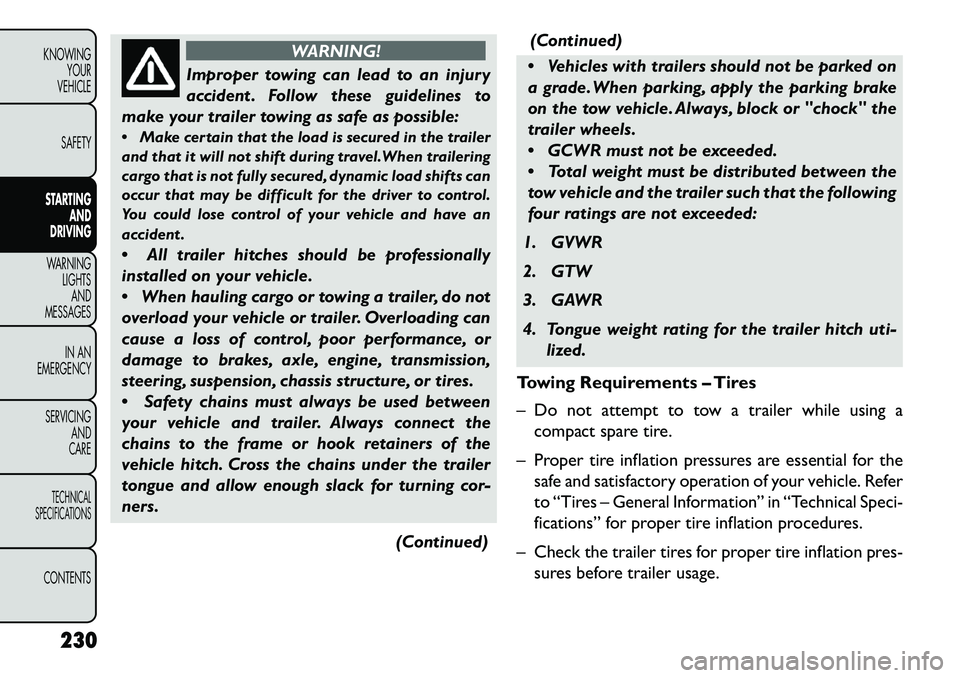
WARNING!
Improper towing can lead to an injury
ac
cident . Follow these guidelines to
make your trailer towing as safe as possible:
Make certain that the load is secured in the trailer
and that it will not shift during travel.When trailering
cargo that is not fully secured, dynamic load shifts can
occur that may be difficult for the driver to control.
You could lose control of your vehicle and have an
accident .
All trailer hitches should be professionally
installed on your vehicle.
When hauling cargo or towing a trailer, do not
overload your vehicle or trailer. Overloading can
cause a loss of control, poor performance, or
damage to brakes, axle, engine, transmission,
steering, suspension, chassis structure, or tires.
Safety chains must always be used between
your vehicle and trailer. Always connect the
chains to the frame or hook retainers of the
vehicle hitch. Cross the chains under the trailer
tongue and allow enough slack for turning cor-
ners.
(Continued)(Continued)
Vehicles with trailers should not be parked on
a grade. When parking, apply the parking brake
on the tow vehicle. Always, block or "chock" the
trailer wheels.
GCWR must not be exceeded.
Total weight must be distributed between the
tow vehicle and the trailer such that the following
four ratings are not exceeded:
1. GVWR
2. GTW
3. GAWR
4. Tongue weight rating for the trailer hitch uti- lized.
Towing Requirements – Tires
– Do not attempt to tow a trailer while using a compact spare tire.
– Proper tire inflation pressures are essential for the safe and satisfactory operation of your vehicle. Refer
to “Tires – General Information” in “Technical Speci-
fications” for proper tire inflation procedures.
– Check the trailer tires for proper tire inflation pres- sures before trailer usage.
230
KNOWING YOUR
VEHICLE
SAFETY
STARTING AND
DRIVING
WARNING LIGHTSAND
MESSA
GES
IN AN
EMERGENCY
SERVICING AND
CARETECHNICAL
SPECIFICATIONSCONTENTS
Page 237 of 352
– Check for signs of tire wear or visible tire damagebefore towing a trailer. Refer to “Tires – General
Information” in “Technical Specifications” for the
proper tire inspection procedures.
– When replacing tires, refer to “Tires – General Information” in “Technical Specifications” for proper
tire replacement procedures. Replacing tires with a
higher load carrying capacity will not increase the
vehicle's GVWR and GAWR limits.
Towing Requirements – Trailer Brakes
– Do notinterconnect the hydraulic brake system or
vacuum system of your vehicle with that of the
trailer. This could cause inadequate braking and pos-
sible personal injury.
– When towing a trailer equipped with a hydraulic surge actuated brake system, an electronic brake
controller is not required.
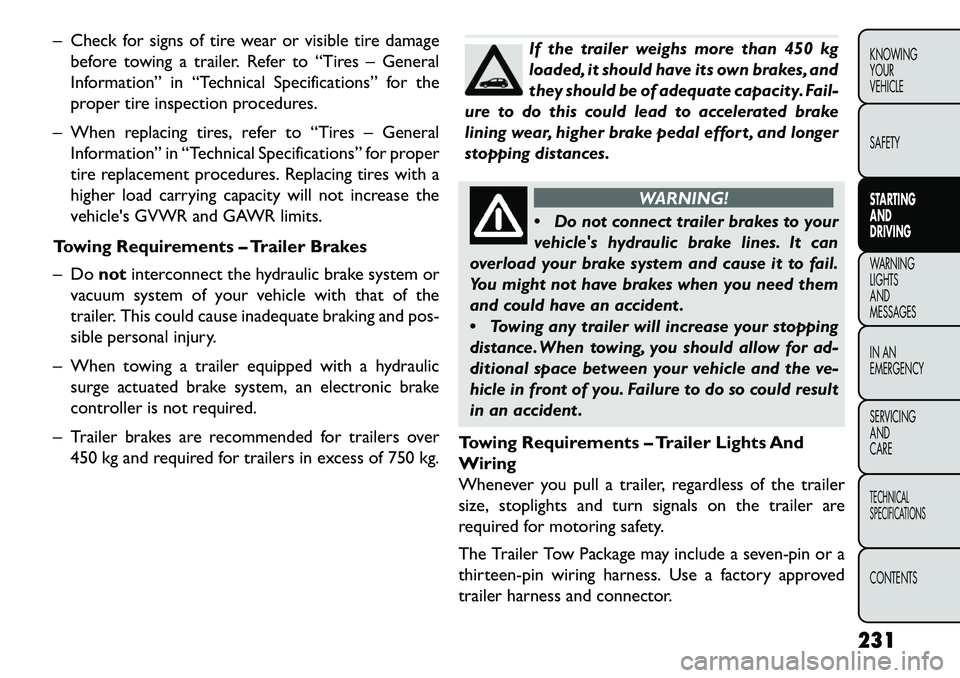
– Trailer brakes are recommended for trailers over 450 kg and required for trailers in excess of 750 kg.
If the trailer weighs more than 450 kg
loaded, it should have its own brakes, and
they should be of adequate capacity. Fail-
ure to do this could lead to accelerated brake
lining wear, higher brake pedal effort , and longer
stopping distances.
WARNING!
Do
not connect trailer brakes to your
vehicle's hydraulic brake lines. It can
overload your brake system and cause it to fail.
You might not have brakes when you need them
and could have an accident .
Towing any trailer will increase your stopping
distance. When towing, you should allow for ad-
ditional space between your vehicle and the ve-
hicle in front of you. Failure to do so could result
in an accident .
Towing Requirements – Trailer Lights And
Wiring
Whenever you pull a trailer, regardless of the trailer
size, stoplights and turn signals on the trailer are
required for motoring safety.
The Trailer Tow Package may include a seven-pin or a
thirteen-pin wiring harness. Use a factory approved
trailer harness and connector.
231
KNOWING
YOUR
VEHICLE
SAFETY
STARTING
AND
DRIVING
WARNING
LIGHTS
AND
MESSA
GES
IN AN
EMERGENCY
SERVICING
AND
CARETECHNICAL
SPECIFICATIONSCONTENTS
Page 240 of 352
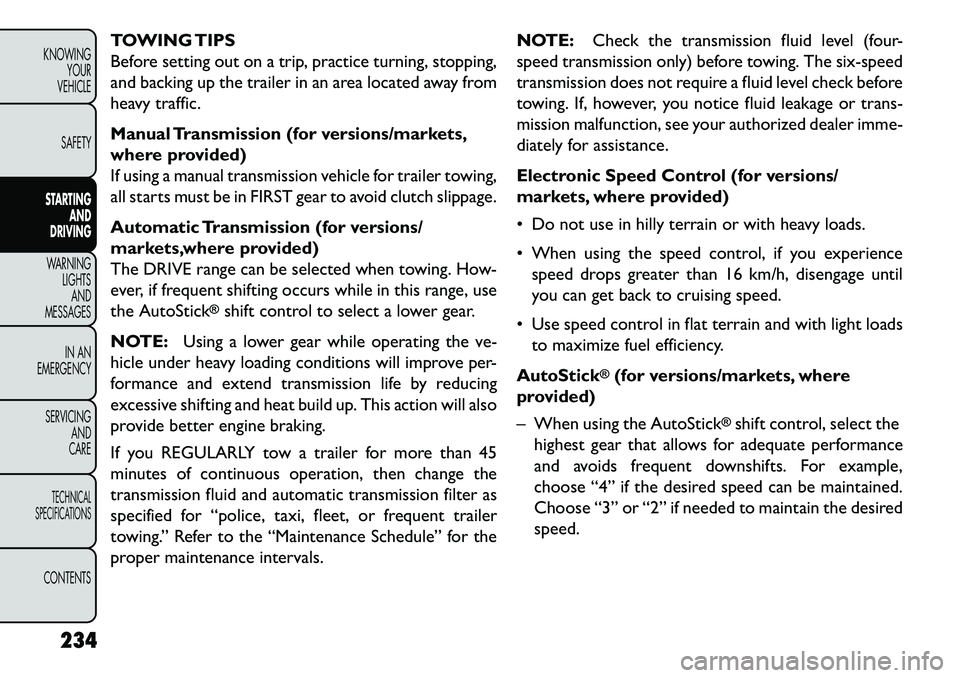
TOWING TIPS
Before setting out on a trip, practice turning, stopping,
and backing up the trailer in an area located away from
heavy traffic.
Manual Transmission (for versions/markets,
where provided)
If using a manual transmission vehicle for trailer towing,
all starts must be in FIRST gear to avoid clutch slippage.
Automatic Transmission (for versions/
markets,where provided)
The DRIVE range can be selected when towing. How-
ever, if frequent shifting occurs while in this range, use
the AutoStick
®shift control to select a lower gear.
NOTE: Using a lower gear while operating the ve-
hicle under heavy loading conditions will improve per-
formance and extend transmission life by reducing
excessive shifting and heat build up. This action will also
provide better engine braking.
If you REGULARLY tow a trailer for more than 45
minutes of continuous operation, then change the
transmission fluid and automatic transmission filter as
specified for “police, taxi, fleet, or frequent trailer
towing.” Refer to the “Maintenance Schedule” for the
proper maintenance intervals. NOTE:
Check the transmission fluid level (four-
speed transmission only) before towing. The six-speed
transmission does not require a fluid level check before
towing. If, however, you notice fluid leakage or trans-
mission malfunction, see your authorized dealer imme-
diately for assistance.
Electronic Speed Control (for versions/
markets, where provided)
Do not use in hilly terrain or with heavy loads.
When using the speed control, if you experience speed drops greater than 16 km/h, disengage until
you can get back to cruising speed.
Use speed control in flat terrain and with light loads to maximize fuel efficiency.
AutoStick
®(for versions/markets, where
provided)
– When using the AutoStick
®shift control, select the
highest gear that allows for adequate performance
and avoids frequent downshifts. For example,
choose “4” if the desired speed can be maintained.
Choose “3” or “2” if needed to maintain the desired
speed.
234
KNOWING YOUR
VEHICLE
SAFETY
STARTING AND
DRIVING
WARNING LIGHTSAND
MESSA
GES
IN AN
EMERGENCY
SERVICING AND
CARETECHNICAL
SPECIFICATIONSCONTENTS
Page 242 of 352
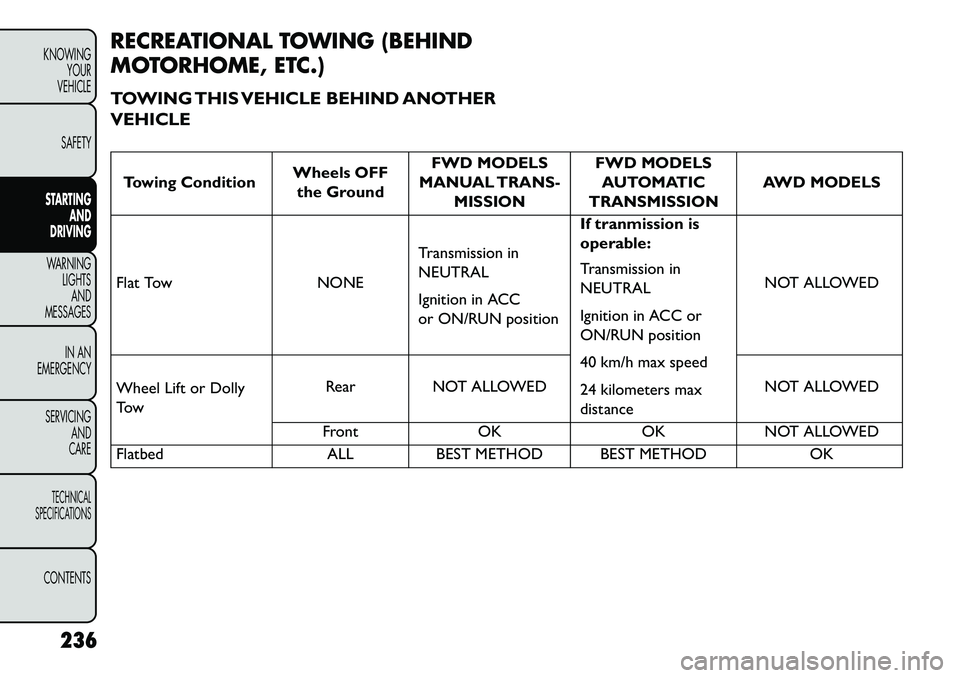
RECREATIONAL TOWING (BEHIND
MOTORHOME, ETC.)
TOWING THIS VEHICLE BEHIND ANOTHER
VEHICLETowing ConditionWheels OFF
the Ground FWD MODELS
MANUAL TRANS- MISSION FWD MODELS
AUTOMATIC
TRANSMISSION AWD MODELS
Flat Tow NONETransmission in
NEUTRAL
Ignition in ACC
or ON/RUN position If tranmission is
operable:
Transmission in
NEUTRAL
Ignition in ACC or
ON/RUN position
40 km/h max speed
24 kilometers max
distance NOT ALLOWED
Wheel Lift or Dolly
Tow Rear NOT ALLOWED
NOT ALLOWED
Front OK OKNOT ALLOWED
Flatbed ALLBEST METHOD BEST METHOD OK
236
KNOWING YOUR
VEHICLE
SAFETY
STARTING AND
DRIVING
WARNING LIGHTSAND
MESSA
GES
IN AN
EMERGENCY
SERVICING AND
CARETECHNICAL
SPECIFICATIONSCONTENTS
Page 243 of 352
All-Wheel Drive (AWD) Models
Recreational towing (with all four wheels on the
ground, or using a towing dolly) isNOT ALLOWED.
The only acceptable method for towing this vehicle
(behind another vehicle) is on a vehicle trailer with all
four wheels OFF the ground.
Front-Wheel Drive (FWD) Models - Manual
Transmission
Front-wheel drive vehicles with manual transmis-
sions may be flat towed (with all four wheels on the
ground) at any legal highway speed, for any distance, if
the manual transmission is in NEUTRAL and the
ignition is in the ACC or ON/RUN position.
These vehicles may also be towed using a tow dolly
(with the front wheels OFF the ground), or on a flatbed
or vehicle trailer (with all four wheels OFF the ground). Front-Wheel Drive (FWD) Models - Automatic
Transmission
DO NOT flat tow any vehicle equipped
with an automatic transmission. Damage
to the drivetrain will result . If these ve-
hicles require towing, make sure all drive wheels
are OFF the ground.
NOTE: This vehicle may be towed on a flatbed or
vehicle trailer provided all four wheels are OFF the
ground.
This vehicle may also be towed using a tow dolly (with
the front wheels OFF the ground).Towing this vehicle in violation of the
above requirements can cause severe
transmission damage. Damage from im-
proper towing is not covered under the New Ve-
hicle Limited Warranty.
237
KNOWING
YOUR
VEHICLE
SAFETY
STARTING
AND
DRIVING
WARNING
LIGHTS
AND
MESSAGES
IN AN
EMERGENCY
SERVICING
AND
CARETECHNICAL
SPECIFICATIONSCONTENTS
Page 284 of 352
TOW EYE
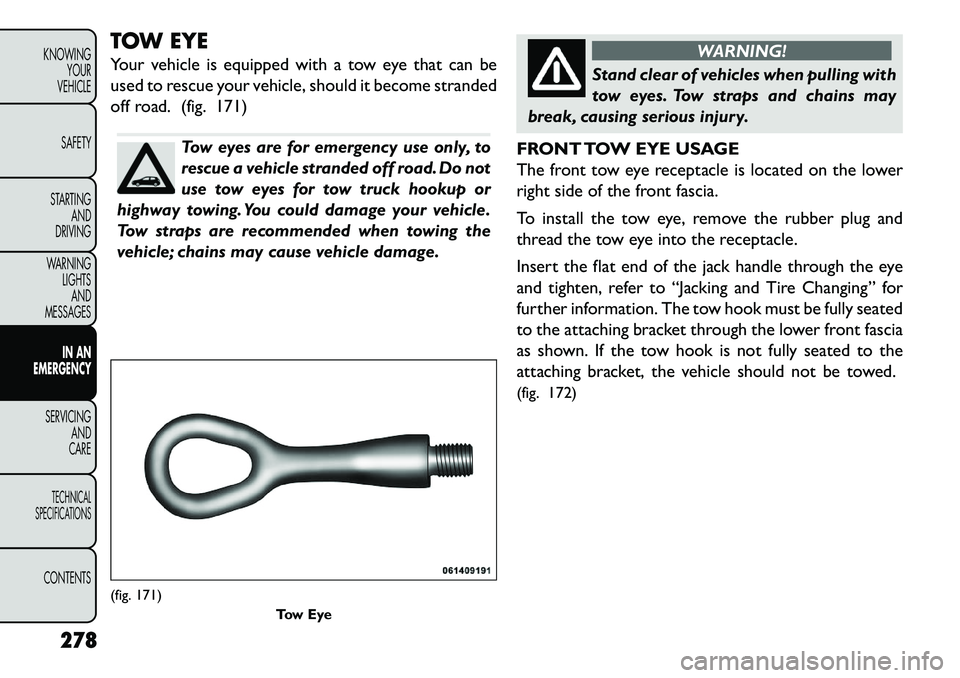
Your vehicle is equipped with a tow eye that can be
used to rescue your vehicle, should it become stranded
off road. (fig. 171)
Tow eyes are for emergency use only, to
rescue a vehicle stranded off road. Do not
use tow eyes for tow truck hookup or
highway towing. You could damage your vehicle.
Tow straps are recommended when towing the
vehicle; chains may cause vehicle damage.
WARNING!
Stand clear of vehicles when pulling with
t
ow eyes. Tow straps and chains may
break, causing serious injury.
FRONT TOW EYE USAGE
The front tow eye receptacle is located on the lower
right side of the front fascia.
To install the tow eye, remove the rubber plug and
thread the tow eye into the receptacle.
Insert the flat end of the jack handle through the eye
and tighten, refer to “Jacking and Tire Changing” for
further information. The tow hook must be fully seated
to the attaching bracket through the lower front fascia
as shown. If the tow hook is not fully seated to the
attaching bracket, the vehicle should not be towed.
(fig. 172)
(fig. 171) Tow Eye
278
KNOWING YOUR
VEHICLE
SAFETY
STARTING AND
DRIVING
WARNING LIGHTSAND
MESSAGES
IN AN
EMERGENC
Y
SERVICING AND
C
ARETECHNICAL
SPECIFICATIONSCONTENTS
Page 287 of 352
Do not use sling type equipment when
towing. Damage to the fascia will occur.
When securing the vehicle to a flatbed
truck, do not attach to front or rear suspension
components. Damage to your vehicle may result
from improper towing.
Do not push or tow this vehicle with another
vehicle as damage to the bumper fascia and trans-
mission may result .
If the vehicle being towed requires steering, the
ignition switch must be in the ON/RUN position,
not in the OFF or ACC position.
WITHOUT THE KEY FOB
Special care must be taken when the vehicle is towed
with the ignition in the OFF position. Flatbed towing is
the preferred towing method. However, if a flatbed
towing vehicle is not available, wheel lift towing equip-
ment may be used. Rear towing (with the front wheels
on the ground) is not allowed, as transmission damage
will occur. If rear towing is the only alternative, the
front wheels must be placed on a towing dolly. Proper
towing equipment is necessary to prevent damage to
the vehicle. All-Wheel Drive (AWD) Models
The manufacturer requires towing with all four wheels
OFF
the ground. Acceptable methods are to tow the
vehicle on a flatbed, or with one end of vehicle raised
and the opposite end on a towing dolly.
Failure to follow these towing methods
can cause severe damage to the trans-
mission and/or transfer case. Such dam-
age is not covered by the New Vehicle Limited
Warranty.
281
KNOWING
YOUR
VEHICLE
SAFETY
STARTING
AND
DRIVING
WARNING
LIGHTS
AND
MESSAGES
IN AN
EMERGENCY
SERVICING
AND
C ARETECHNICAL
SPECIFICATIONSCONTENTS
Page 292 of 352
Periodic Checks
Every1,000 km or before long journeys, check and, if
necessary, restore:
engine coolant;
brake fluid;
windshield washer fluid level;
power steering fluid;
tire inflation pressure and condition;
operation of lighting system (headlights, direction indicators, hazard warning lights, etc.);
operation of windshield washer/wiper system and positioning/wear of windshield/rear window wiper
blades.
Every 3,000 km, check and top up, if required, the
engine oil level.
Heavy-Duty Use Of The Car
If the car is used mainly under one of the following
conditions:
towing a trailer or caravan;
dusty roads;
short, repeated journeys (less than 7-8 km) at sub- zero outside temperatures; engine often idling or driving long distances at low
speeds or long periods of idleness.
You should perform the following inspections more
frequently than shown on the Scheduled Servicing Plan:
check front disc brake pad conditions and wear;
check cleanliness of hood and trunk locks, cleanli- ness and lubrication of linkage;
visually inspect conditions of: engine, transmission, pipes and hoses (exhaust - fuel system - brakes) and
rubber elements (boots - sleeves - bushes - etc.);
check battery charge and battery fluid level (electro- lyte);
visually inspect condition of the accessory drive belts;
check and, if necessary, change engine oil and replace oil filter;
check and, if necessary, replace pollen filter;
check and, if necessary, replace air cleaner.
MAINTENANCE SCHEDULE — DIESEL
ENGINE
Required Maintenance Intervals
Refer to the Maintenance Schedules on the following
pages for the required maintenance intervals.
286
KNOWING YOUR
VEHICLE
SAFETY
STARTING AND
DRIVING
WARNING LIGHTSAND
MESSAGES
IN AN
EMERGENCY
SERVICING AND
C
ARETECHNICAL
SPECIFICATIONSCONTENTS
Page 294 of 352
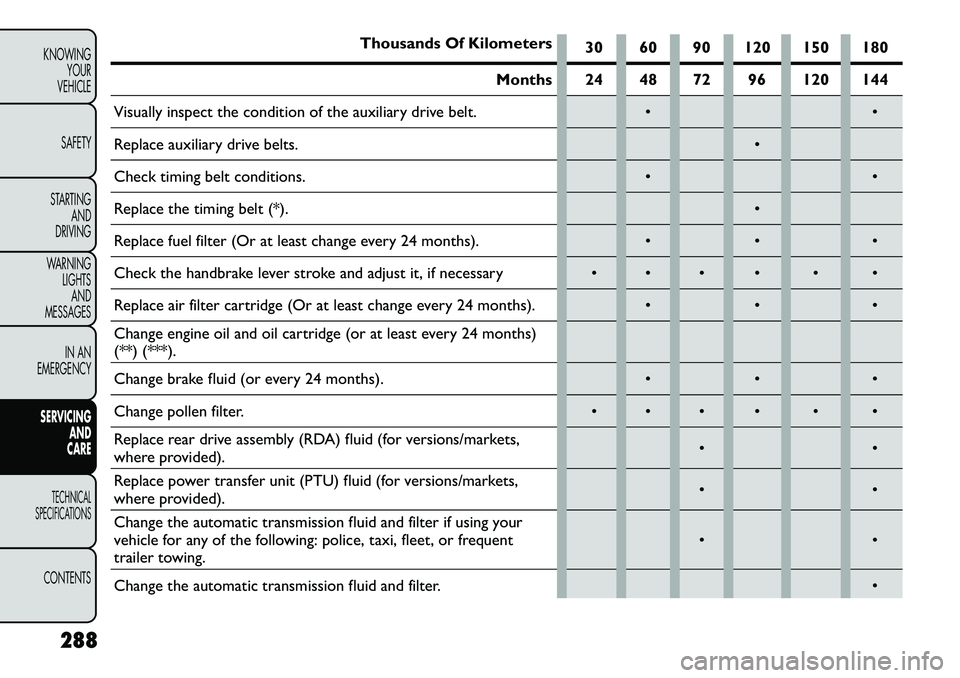
Thousands Of Kilometers30 60 90 120 150 180
Months 24 48 72 96 120 144
Visually inspect the condition of the auxiliary drive belt.
Replace auxiliary drive belts.
Check timing belt conditions.
Replace the timing belt (*).
Replace fuel filter (Or at least change every 24 months).
Check the handbrake lever stroke and adjust it, if necessary
Replace air filter cartridge (Or at least change every 24 months).
Change engine oil and oil cartridge (or at least every 24 months)
(**) (***).
Change brake fluid (or every 24 months).
Change pollen filter.
Replace rear drive assembly (RDA) fluid (for versions/markets,
where provided).
Replace power transfer unit (PTU) fluid (for versions/markets,
where provided).
Change the automatic transmission fluid and filter if using your
vehicle for any of the following: police, taxi, fleet, or frequent
trailer towing.
Change the automatic transmission fluid and filter.
288
KNOWING YOUR
VEHICLE
SAFETY
STARTING AND
DRIVING
WARNING LIGHTSAND
MESSAGES
IN AN
EMERGENCY
SERVICING AND
C
ARETECHNICAL
SPECIFICATIONSCONTENTS
Page 296 of 352
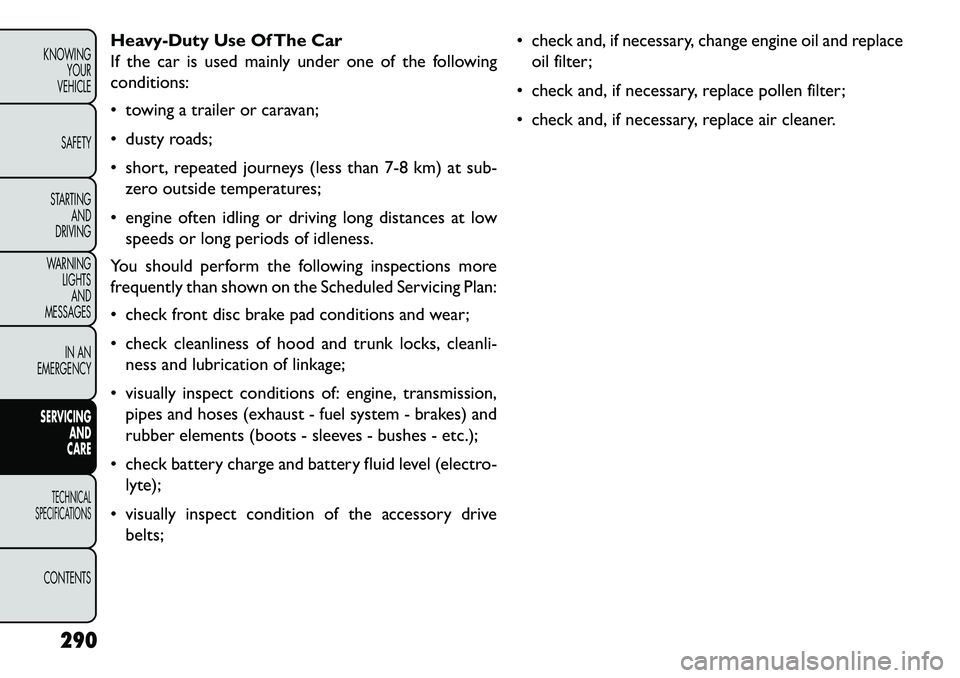
Heavy-Duty Use Of The Car
If the car is used mainly under one of the following
conditions:
towing a trailer or caravan;
dusty roads;
short, repeated journeys (less than 7-8 km) at sub-zero outside temperatures;
engine often idling or driving long distances at low speeds or long periods of idleness.
You should perform the following inspections more
frequently than shown on the Scheduled Servicing Plan:
check front disc brake pad conditions and wear;
check cleanliness of hood and trunk locks, cleanli- ness and lubrication of linkage;
visually inspect conditions of: engine, transmission, pipes and hoses (exhaust - fuel system - brakes) and
rubber elements (boots - sleeves - bushes - etc.);
check battery charge and battery fluid level (electro- lyte);
visually inspect condition of the accessory drive belts; check and, if necessary, change engine oil and replace
oil filter;
check and, if necessary, replace pollen filter;
check and, if necessary, replace air cleaner.
290
KNOWING YOUR
VEHICLE
SAFETY
STARTING AND
DRIVING
WARNING LIGHTSAND
MESSAGES
IN AN
EMERGENCY
SERVICING AND
C
ARETECHNICAL
SPECIFICATIONSCONTENTS