sensor FIAT FREEMONT 2013 Owner handbook (in English)
[x] Cancel search | Manufacturer: FIAT, Model Year: 2013, Model line: FREEMONT, Model: FIAT FREEMONT 2013Pages: 352, PDF Size: 5.22 MB
Page 141 of 352

pressure values. Upon the next ignition switch cycle,
the TPMS will no longer chime or turn on the Tire
Pressure Monitoring Telltale Light, or display the text
message in the EVIC. However, the graphic will still
display “- -.“
To reactivate the TPMS, first, replace all four wheel and
tire assemblies (road tires) with those equipped with
TPM Sensors. Then, drive the vehicle for up to 20
minutes above 25 km/h. The TPMS will chime, the Tire
Pressure Monitoring Telltale Light will flash on and off
for 75 seconds, the EVIC will display a “CHECK TPM
SYSTEM” text message, and the graphic will display tire
pressure values to show that the TPMS is receiving
sensor data.GENERAL INFORMATION
Transmitter and receivers operate on a carrier fre-
quency of 433.92 MHz as required by EEC regulations.
These devices must be certified to conform to specific
regulations in each individual country. Two sets of
regulations are involved: ETS (European Telecommuni-
cation Standard) 300–220, which most countries use,
and German BZT federal regulation 225Z125, which is
based on ETC 300–220 but has additional unique re-
quirements. Other defined requirements are noted in
ANNEX VI of COMMISSION DIRECTIVE 95/56/EC.
Operation is subject to the following two conditions:
This device may not cause harmful interference.
This device must accept any interference received,
including interference that may cause undesired op-
eration.
135
KNOWING
YOUR
VEHICLE
SAFETY
STARTING
AND
DRIVING
WARNING
LIGHTS
AND
MESSAGES
IN AN
EMERGENCY
SERVICING
AND
CARETECHNICAL
SPECIFICATIONSCONTENTS
Page 142 of 352
PARKSENSE® REAR PARK ASSIST
(for versions/markets, where
provided)
The ParkSense
®
Rear Park Assist system provides
visual and audible indications of the distance between
the rear fascia and a detected obstacle when backing
up, e.g. during a parking maneuver. Refer to
“ParkSense
®
System Usage Precautions” for limita-
tions of this system and recommendations.
ParkSense
®will retain the last system state (enabled
or disabled) from the last ignition cycle when the
ignition is changed to the ON/RUN position.
ParkSense®can be active only when the shift lever is in
REVERSE. If ParkSense
®is enabled at this shift lever
position, the system will remain active until the vehicle
speed is increased to approximately 11 km/h or above.
The system will become active again if the vehicle
speed is decreased to speeds less than approximately
9 km/h.
PARKSENSE
®SENSORS
The four ParkSense
®
sensors, located in the rear
fascia/bumper, monitor the area behind the vehicle that
is within the sensors’ field of view. The sensors can
detect obstacles from approximately 30 cm up to 200
cm from the rear fascia/bumper in the horizontal direc- tion, depending on the location, type and orientation
of the obstacle.
PARKSENSE
®WARNING DISPLAY
The ParkSense®Warning screen will only be displayed
if Sound and Display is selected from the Uconnect
Touch™ System. Refer to “Uconnect Touch™ Set-
tings” for further information.
The ParkSense®Warning screen is located within the
Electronic Vehicle Information Center (EVIC). It pro-
vides visual warnings to indicate the distance between
the rear fascia/bumper and the detected obstacle. Re-
fer to “Electronic Vehicle Information Center (EVIC)/
Settings” for further information.
PARKSENSE®DISPLAY
When the vehicle is in REVERSE, the warning display
will turn ON indicating the system status. (fig. 101)
(fig. 102)
The system will indicate a detected obstacle by show-
ing three solid arcs and will produce a one-half second
tone. As the vehicle moves closer to the object, the
EVIC display will show fewer arcs and the sound tone
will change from slow, to fast, to continuous. (fig. 103)
(fig. 104) (fig. 105)
136
KNOWING YOUR
VEHICLE
SAFETY
S
TARTING AND
DRIVING
WARNING LIGHTSAND
MESSAGES
IN AN
EMERGENCY
SERVICING AND
CARETECHNICAL
SPECIFICATIONSCONTENTS
Page 145 of 352
SERVICE THE PARKSENSE
®REAR PARK
ASSIST SYSTEM
When the ParkSense
®
Rear Park Assist system is
malfunctioning, the Electronic Vehicle Information
Center (EVIC) will actuate a single chime, once per
ignition cycle, and it will display the “CLEAN PARK
ASSIST”, “SERVICE PARK ASSIST” or “SERVICE PARK
ASSIST SYSTEM” message. Refer to “Electronic Vehicle
Information Center (EVIC)” for further information.
When the shift lever is moved to REVERSE and the
system has detected a fault condition, the EVIC will
display the “CLEAN PARK ASSIST”, “SERVICE PARK
ASSIST” or “SERVICE PARK ASSIST SYSTEM” mes-
sage for as long as the vehicle is in REVERSE. Under this
condition, ParkSense
®will not operate.
If “CLEAN PARK ASSIST” appears in the Electronic
Vehicle Information Center (EVIC) make sure the
outer surface and the underside of the rear fascia/
bumper is clean and clear of snow, ice, mud, dirt or
other obstruction and then cycle the ignition. If the
message continues to appear see an authorized dealer.
If “SERVICE PARK ASSIST SYSTEM” or “SERVICE
PARK ASSIST SYSTEM” appears in the EVIC, see your
authorized dealer.
CLEANING THE PARKSENSE
®SYSTEM
Clean the ParkSense
®
sensors with water, car wash
soap and a soft cloth. Do not use rough or hard cloths. Do not scratch or poke the sensors. Otherwise, you
could damage the sensors.
PARKSENSE
®SYSTEM USAGE
PRECAUTIONS
NOTE:
Ensure that the rear bumper is free of snow, ice,
mud, dirt and debris to keep the ParkSense
®system
operating properly.
Jackhammers, large trucks, and other vibrations could affect the performance of ParkSense®.
When you turn ParkSense
®off, the EVIC will display
“PARK ASSIST SYSTEM OFF.” Furthermore, once
you turn ParkSense
®off, it remains off until you turn
it on again, even if you cycle the ignition key.
When you move the shift lever to the REVERSE position and ParkSense®is turned off, the EVIC will
display the “PARK ASSIST SYSTEM OFF” message
for as long as the vehicle is in REVERSE.
Clean the ParkSense
®sensors regularly, taking care
not to scratch or damage them. The sensors must
not be covered with ice, snow, slush, mud, dirt or
debris. Failure to do so can result in the system not
working properly. The ParkSense
®system might not
detect an obstacle behind the fascia/bumper, or it
139
KNOWING
YOUR
VEHICLE
SAFETY
STARTING
AND
DRIVING
WARNING
LIGHTS
AND
MESSAGES
IN AN
EMERGENCY
SERVICING
AND
CARETECHNICAL
SPECIFICATIONSCONTENTS
Page 146 of 352
could provide a false indication that an obstacle is
behind the fascia/bumper.
Objects such as bicycle carriers, trailer hitches, etc., must not be placed within 30 cm from the rear
fascia/bumper while driving the vehicle. Failure to do
so can result in the system misinterpreting a close
object as a sensor problem, causing the “SERVICE
PARK ASSIST” message to be displayed in the EVIC.
ParkSense
®is only a parking aid and it
is unable to recognize every obstacle,
including small obstacles. Parking curbs
might be temporarily detected or not detected at
all. Obstacles located above or below the sensors
will not be detected when they are in close prox-
imity.
The vehicle must be driven slowly when using
ParkSense
®
in order to be able to stop in time
when an obstacle is detected. It is recommended
that the driver looks over his/her shoulder when
using ParkSense
®.
WARNING!
Dr
ivers must be careful when backing
up even when using the Rear Park Assist
system. Always check carefully behind your ve-
hicle, look behind you, and be sure to check for
pedestrians, animals, other vehicles, obstruc-
tions, and blind spots before backing up.You are
responsible for safety and must continue to pay
attention to your surroundings. Failure to do so
can result in serious injury or death.
Before using the Rear Park Assist system, it is
strongly recommended that the ball mount and
hitch ball assembly is disconnected from the ve-
hicle when the vehicle is not used for towing.
Failure to do so can result in injury or damage to
vehicles or obstacles because the hitch ball will
be much closer to the obstacle than the rear
fascia when the loudspeaker sounds the continu-
ous tone. Also, the sensors could detect the ball
mount and hitch ball assembly, depending on its
size and shape, giving a false indication that an
obstacle is behind the vehicle.
140
KNOWING YOUR
VEHICLE
SAFETY
S
TARTING AND
DRIVING
WARNING LIGHTSAND
MESSAGES
IN AN
EMERGENCY
SERVICING AND
CARETECHNICAL
SPECIFICATIONSCONTENTS
Page 180 of 352
ACTIVE HOOD SYSTEM (for versions/
markets, where provided)
The Active Hood system is intended to enhance pe-
destrian protection by elevating the vehicle’s hood
upon an impact with a pedestrian or other object. The
system is automatically activated when the vehicle is
moving within a specified vehicle speed range. In order
to detect a range of pedestrians, other objects that are
impacted may result in an Active Hood deployment.
Deployment Sensors And Controls
The Electronic Pedestrian Protection Module (EPPM)
determines if deployment of the actuators in a frontal
impact is required. Based on the impact sensors signals,
the EPPM determines when to deploy the actuators.
The impact sensors are located within the front bum-
per area.
The EPPM monitors the readiness of the electronic
parts of the Active Hood system whenever the ignition
switch is in the START or ON/RUN position. If the key
is in the LOCK position, in the ACC position, or not in
the ignition, the Active Hood system is not on and the
Active Hood will not deploy.
The EPPM contains a backup power supply system that
may deploy the actuators even if the battery loses
power or it becomes disconnected prior to deploy-
ment.Service Active Hood System
If the EPPM has deployed the Active Hood, or if it
detects a malfunction in any part of the system, it turns
on the Air Bag Warning Light and it will display the
“SERVICE ACTIVE HOOD” message in the Electronic
Vehicle Information Center (EVIC), for versions/
markets, where provided. A single chime will sound if
the Air Bag Warning Light comes on again after initial
startup. It also includes diagnostics that will illuminate
the Air Bag Warning Light if a malfunction is noted that
could affect the Active Hood system. The diagnostics
also record the nature of the malfunction. If the Air Bag
Warning Light is illuminated, or if “SERVICE ACTIVE
HOOD” appears in the EVIC, see your authorized
dealer.
In the event of an Active Hood deployment, the vehicle
should be serviced by an authorized dealer. The hood
hinges must be serviced and the actuator assemblies
replaced to restore system functionality.
Following an Active Hood deployment, the hood posi-
tion can be temporarily reset by pushing down at the
rear edge over the hood hinges as the internal pressure
of each actuator is relieved. The temporary hood reset
position is intended to improve forward driving visibil-
ity over the hood until the vehicle can be serviced. The
temporary hood reset position will leave the hood
174
KNOWING YOUR
VEHICLE
SAFETY
STARTING AND
DRIVING
W
ARNING LIGHTS AND
MESSAGES
IN AN
EMERGENCY
SERVICING AND
CARETECHNICAL
SPECIFICATIONSCONTENTS
Page 194 of 352
This vehicle may be equipped with a driver and/or front
passenger seat belt buckle switch that detects whether
the driver or front passenger seat belt is fastened. The
seat belt buckle switch may adjust the inflation rate of
the Advanced Front Air Bags.
This vehicle is equipped with Supplemental Side Air Bag
Inflatable Curtains (SABIC) to protect the driver, front,
and rear passengers sitting next to a window. The
SABIC air bags are located above the side windows and
their covers are also labeled: SRS AIRBAG.
This vehicle is equipped with Supplemental Seat-
Mounted Side Air Bags (SAB). The SABs are marked
with an air bag label sewn into the outboard side of the
front seats.
NOTE:
Air Bag covers may not be obvious in the interiortrim, but they will open during air bag deployment.
After any accident, the vehicle should be taken to an authorized dealer immediately.
Air Bag System Components
Your vehicle may be equipped with the following air bag
system components:
Occupant Restraint Controller (ORC)
Air Bag Warning Light
Steering Wheel and Column Instrument Panel
Knee Impact Bolster
Driver Advanced Front Air Bag
Passenger Advanced Front Air Bag
Supplemental Seat-Mounted Side Air Bags (SAB)
Supplemental Side Air Bag Inflatable Curtains
(SABIC)
Front and Side Impact Sensors
Front Seat Belt Pretensioners
Seat Belt Buckle Switch
ADVANCED FRONT AIR BAG FEATURES
The Advanced Front Air Bag system has multistage
driver and front passenger air bags. This system pro-
vides output appropriate to the severity and type of
collision as determined by the Occupant Restraint
Controller (ORC), which may receive information
from the front impact sensors.
The first stage inflator is triggered immediately during
an impact that requires air bag deployment. This low
output is used in less severe collisions. A higher energy
output is used for more severe collisions.
188
KNOWING YOUR
VEHICLE
SAFETY
STARTING AND
DRIVING
W
ARNING LIGHTS AND
MESSAGES
IN AN
EMERGENCY
SERVICING AND
CARETECHNICAL
SPECIFICATIONSCONTENTS
Page 196 of 352
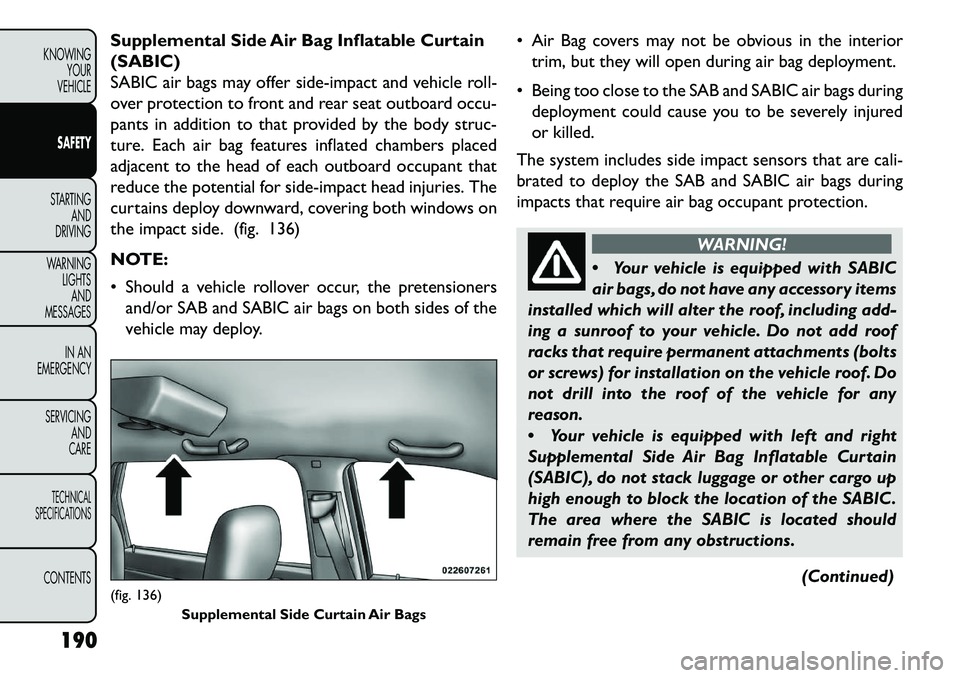
Supplemental Side Air Bag Inflatable Curtain
(SABIC)
SABIC air bags may offer side-impact and vehicle roll-
over protection to front and rear seat outboard occu-
pants in addition to that provided by the body struc-
ture. Each air bag features inflated chambers placed
adjacent to the head of each outboard occupant that
reduce the potential for side-impact head injuries. The
curtains deploy downward, covering both windows on
the impact side. (fig. 136)
NOTE:
Should a vehicle rollover occur, the pretensionersand/or SAB and SABIC air bags on both sides of the
vehicle may deploy. Air Bag covers may not be obvious in the interior
trim, but they will open during air bag deployment.
Being too close to the SAB and SABIC air bags during deployment could cause you to be severely injured
or killed.
The system includes side impact sensors that are cali-
brated to deploy the SAB and SABIC air bags during
impacts that require air bag occupant protection.
WARNING!
Y
our vehicle is equipped with SABIC
air bags, do not have any accessory items
installed which will alter the roof, including add-
ing a sunroof to your vehicle. Do not add roof
racks that require permanent attachments (bolts
or screws) for installation on the vehicle roof. Do
not drill into the roof of the vehicle for any
reason.
Your vehicle is equipped with left and right
Supplemental Side Air Bag Inflatable Curtain
(SABIC), do not stack luggage or other cargo up
high enough to block the location of the SABIC.
The area where the SABIC is located should
remain free from any obstructions.
(Continued)
(fig. 136)Supplemental Side Curtain Air Bags
190
KNOWING YOUR
VEHICLE
SAFETY
STARTING AND
DRIVING
W
ARNING LIGHTS AND
MESSAGES
IN AN
EMERGENCY
SERVICING AND
CARETECHNICAL
SPECIFICATIONSCONTENTS
Page 198 of 352
If the air bag system in this vehicle needs to be modified
to accommodate a disabled person, contact the Cus-
tomer Center. Phone numbers are provided under "If
You Need Assistance".
WARNING!
R
elying on the air bags alone could
lead to more severe injuries in a collision.
The air bags work with your seat belt to restrain
you properly. In some collisions, the air bags
won't deploy at all. Always wear your seat belts
even though you have air bags.
Being too close to the steering wheel or instru-
ment panel during Advanced Front Air Bag de-
ployment could cause serious injury, including
death. Air Bags need room to inflate. Sit back,
comfortably extending your arms to reach the
steering wheel or instrument panel.
Side air bags also need room to inflate. Do not
lean against the door or window. Sit upright in
the center of the seat .
Air Bag Deployment Sensors And Controls
Occupant Restraint Controller (ORC)
The ORC is part of a regulated safety system required
for this vehicle. The ORC determines if deployment of the front and/or
side air bags in a frontal or side collision is required.
Based on the impact sensor's signals, a central elec-
tronic ORC deploys the Advanced Front Air Bags,
SABIC air bags, Supplemental Seat-Mounted Side Air
Bags, Supplemental Driver Side Knee Air Bag, and front
seat belt pretensioners, as required, depending on
several factors, including the severity and type of im-
pact.
The Advanced Front Air Bags and Supplemental Driver
Side Knee Air Bag are designed to provide additional
protection by supplementing the seat belts in certain
frontal collisions depending on several factors, includ-
ing the severity and type of collision. Advanced Front
Air Bags are not expected to reduce the risk of injury in
rear, side, or rollover collisions.
The Advanced Front Air Bags and Supplemental Driver
Side Knee Air Bag will not deploy in all frontal colli-
sions, including some that may produce substantial
vehicle damage — for example, some pole collisions,
truck underrides, and angle offset collisions. On the
other hand, depending on the type and location of
impact, Advanced Front Air Bags may deploy in crashes
with little vehicle front-end damage but that produce a
severe initial deceleration.
192
KNOWING YOUR
VEHICLE
SAFETY
STARTING AND
DRIVING
W
ARNING LIGHTS AND
MESSAGES
IN AN
EMERGENCY
SERVICING AND
CARETECHNICAL
SPECIFICATIONSCONTENTS
Page 199 of 352
The side air bags will not deploy in all side collisions.
Side air bag deployment will depend on the severity and
type of collision.
Because air bag sensors measure vehicle deceleration
over time, vehicle speed and damage by themselves are
not good indicators of whether or not an air bag should
have deployed.
Seat belts are necessary for your protection in all
collisions, and also are needed to help keep you in
position, away from an inflating air bag.
The ORC monitors the readiness of the electronic
parts of the air bag system whenever the ignition is in
the ON/RUN position. If the ignition is in the OFF
position, or in the ACC position, the air bag system is
not on and the air bags will not inflate.
The ORC contains a backup power supply system that
may deploy the air bags even if the battery loses power
or it becomes disconnected prior to deployment.Also, the ORC turns on the Air Bag Warning
Light in the instrument panel for approxi-
mately four to eight seconds for a self-check
when the ignition is first turned on. After the self-
check, the Air Bag Warning Light will turn off. If the
ORC detects a malfunction in any part of the system, it
turns on the Air Bag Warning Light, either momentarily or continuously. A single chime will sound if the light
comes on again after initial startup.
It also includes diagnostics that will illuminate the
instrument cluster Air Bag Warning Light if a malfunc-
tion is noted that could affect the air bag system. The
diagnostics also record the nature of the malfunction.
WARNING!
Ignoring the Air Bag Warning Light in
y
our instrument panel could mean you
won't have the air bags to protect you in a
collision. If the light does not come on as a bulb
check when the ignition is first turned on, stays
on after you start the vehicle, or if it comes on as
you drive, have an authorized dealer service the
air bag system immediately.
Driver And Passenger Advanced Front Air Bag
Inflator Units
The Driver and Passenger Advanced Front Air Bag
Inflator Units are located in the center of the steering
wheel and on the right side of the instrument panel.
When the ORC detects a collision requiring the Ad-
vanced Front Air Bags, it signals the inflator units. A
large quantity of non-toxic gas is generated to inflate
the Advanced Front Air Bags. Different air bag inflation
rates are possible, based on several factors, including
the collision type and severity. The steering wheel hub
193KNOWING
YOUR
VEHICLE
SAFETY
STARTING
AND
DRIVING
W
ARNING
LIGHTS
AND
MESSAGES
IN AN
EMERGENCY
SERVICING
AND
CARETECHNICAL
SPECIFICATIONSCONTENTS
Page 200 of 352
trim cover and the upper right side of the instrument
panel separate and fold out of the way as the air bags
inflate to their full size. The air bags fully inflate in about
50 to 70 milliseconds. This is about half of the time it
takes to blink your eyes. The air bags then quickly
deflate while helping to restrain the driver and front
passenger.
The Advanced Front Air Bag gas is vented through the
vent holes in the sides of the air bag. In this way, the air
bags do not interfere with your control of the vehicle.
Supplemental Seat-Mounted Side Air Bag
(SAB) Inflator Units
The Supplemental Seat-Mounted Side Air Bags (SAB)
are designed to activate only in certain side collisions.
The ORC determines if a side collision requires the
side air bags to inflate, based on the severity and type of
collision.
Based on the severity and type of collision, the side air
bag inflator on the crash side of the vehicle may be
triggered, releasing a quantity of non-toxic gas. The
inflating SAB exits through the seat seam into the space
between the occupant and the door. The SAB fully
inflate in about 10 milliseconds. The side air bag moves
at a very high speed and with such a high force that it
could injure you if you are not seated properly, or ifitems are positioned in the area where the side air bag
inflates. This especially applies to children.
Supplemental Side Air Bag Inflatable Curtain
(SABIC) Inflator Units
During collisions where the impact is confined to a
particular area of the side of the vehicle, the ORC may
deploy the SABIC air bags, depending on the severity
and type of collision. In these events, the ORC will
deploy the SABIC only on the impact side of the
vehicle.
A quantity of non-toxic gas is generated to inflate the
side curtain air bag. The inflating side curtain air bag
pushes the outside edge of the headliner out of the way
and covers the window. The air bag inflates in about 30
milliseconds (about one-quarter of the time that it
takes to blink your eyes) with enough force to injure
you if you are not belted and seated properly, or if
items are positioned in the area where the side curtain
air bag inflates. This especially applies to children. The
side curtain air bag is only about 9 cm thick when it is
inflated.
Because air bag sensors estimate deceleration over
time, vehicle speed and damage are not good indicators
of whether or not an air bag should have deployed.
194
KNOWING YOUR
VEHICLE
SAFETY
STARTING AND
DRIVING
W
ARNING LIGHTS AND
MESSAGES
IN AN
EMERGENCY
SERVICING AND
CARETECHNICAL
SPECIFICATIONSCONTENTS