transmission FIAT FREEMONT 2013 Owner handbook (in English)
[x] Cancel search | Manufacturer: FIAT, Model Year: 2013, Model line: FREEMONT, Model: FIAT FREEMONT 2013Pages: 352, PDF Size: 5.22 MB
Page 291 of 352
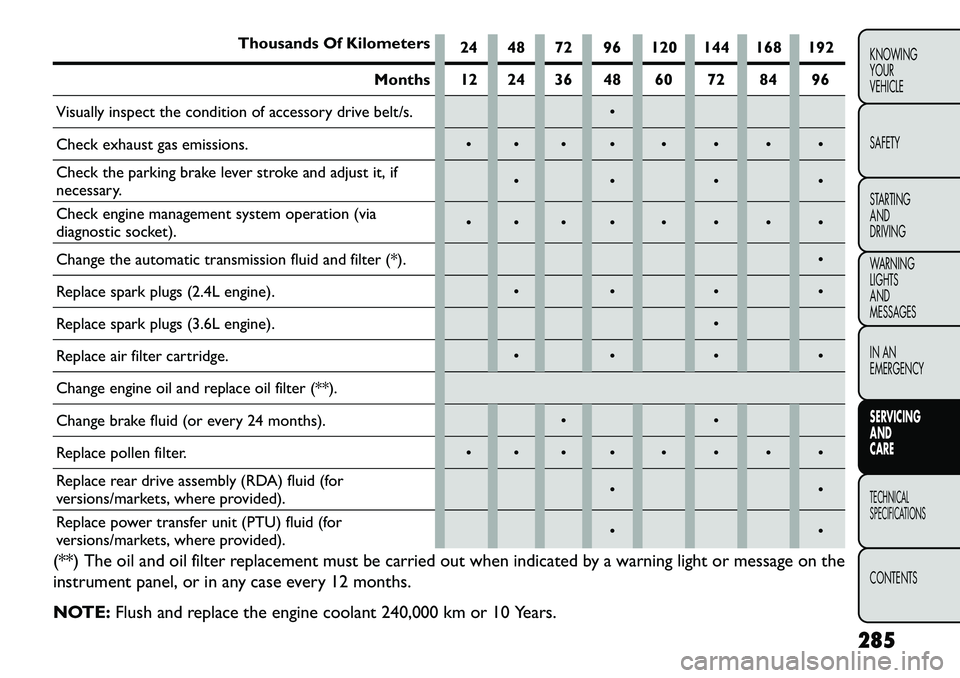
Thousands Of Kilometers24 48 72 96 120 144 168 192
Months 12 24 36 48 60 72 84 96
Visually inspect the condition of accessory drive belt/s.
Check exhaust gas emissions.
Check the parking brake lever stroke and adjust it, if
necessary.
Check engine management system operation (via
diagnostic socket).
Change the automatic transmission fluid and filter (*).
Replace spark plugs (2.4L engine).
Replace spark plugs (3.6L engine).
Replace air filter cartridge.
Change engine oil and replace oil filter (**).
Change brake fluid (or every 24 months).
Replace pollen filter.
Replace rear drive assembly (RDA) fluid (for
versions/markets, where provided).
Replace power transfer unit (PTU) fluid (for
versions/markets, where provided).
(**) The oil and oil filter replacement must be carried out when indicated by a warning light or message on the
instrument panel, or in any case every 12 months.
NOTE: Flush and replace the engine coolant 240,000 km or 10 Years.
285
KNOWING
YOUR
VEHICLE
SAFETY
STARTING
AND
DRIVING
WARNING
LIGHTS
AND
MESSAGES
IN AN
EMERGENCY
SERVICING
AND
C
ARETECHNICAL
SPECIFICATIONSCONTENTS
Page 292 of 352
Periodic Checks
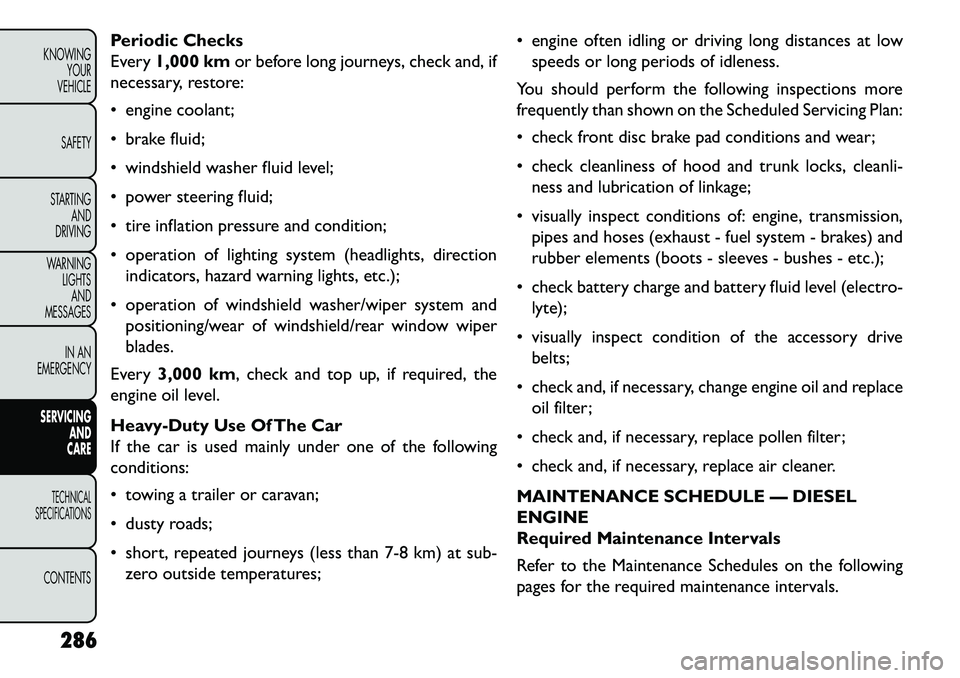
Every1,000 km or before long journeys, check and, if
necessary, restore:
engine coolant;
brake fluid;
windshield washer fluid level;
power steering fluid;
tire inflation pressure and condition;
operation of lighting system (headlights, direction indicators, hazard warning lights, etc.);
operation of windshield washer/wiper system and positioning/wear of windshield/rear window wiper
blades.
Every 3,000 km, check and top up, if required, the
engine oil level.
Heavy-Duty Use Of The Car
If the car is used mainly under one of the following
conditions:
towing a trailer or caravan;
dusty roads;
short, repeated journeys (less than 7-8 km) at sub- zero outside temperatures; engine often idling or driving long distances at low
speeds or long periods of idleness.
You should perform the following inspections more
frequently than shown on the Scheduled Servicing Plan:
check front disc brake pad conditions and wear;
check cleanliness of hood and trunk locks, cleanli- ness and lubrication of linkage;
visually inspect conditions of: engine, transmission, pipes and hoses (exhaust - fuel system - brakes) and
rubber elements (boots - sleeves - bushes - etc.);
check battery charge and battery fluid level (electro- lyte);
visually inspect condition of the accessory drive belts;
check and, if necessary, change engine oil and replace oil filter;
check and, if necessary, replace pollen filter;
check and, if necessary, replace air cleaner.
MAINTENANCE SCHEDULE — DIESEL
ENGINE
Required Maintenance Intervals
Refer to the Maintenance Schedules on the following
pages for the required maintenance intervals.
286
KNOWING YOUR
VEHICLE
SAFETY
STARTING AND
DRIVING
WARNING LIGHTSAND
MESSAGES
IN AN
EMERGENCY
SERVICING AND
C
ARETECHNICAL
SPECIFICATIONSCONTENTS
Page 294 of 352
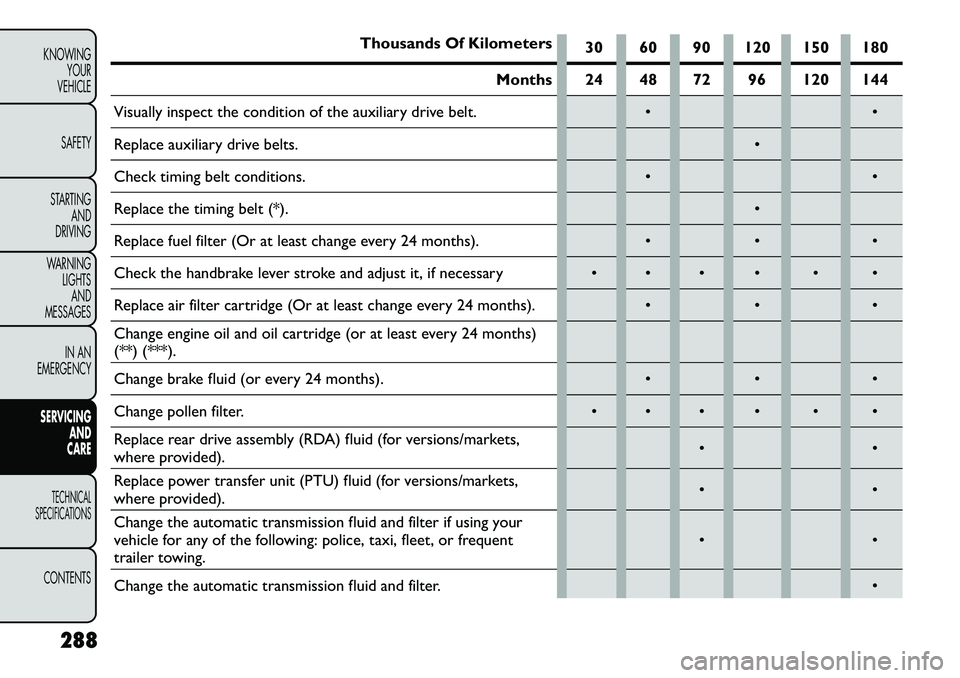
Thousands Of Kilometers30 60 90 120 150 180
Months 24 48 72 96 120 144
Visually inspect the condition of the auxiliary drive belt.
Replace auxiliary drive belts.
Check timing belt conditions.
Replace the timing belt (*).
Replace fuel filter (Or at least change every 24 months).
Check the handbrake lever stroke and adjust it, if necessary
Replace air filter cartridge (Or at least change every 24 months).
Change engine oil and oil cartridge (or at least every 24 months)
(**) (***).
Change brake fluid (or every 24 months).
Change pollen filter.
Replace rear drive assembly (RDA) fluid (for versions/markets,
where provided).
Replace power transfer unit (PTU) fluid (for versions/markets,
where provided).
Change the automatic transmission fluid and filter if using your
vehicle for any of the following: police, taxi, fleet, or frequent
trailer towing.
Change the automatic transmission fluid and filter.
288
KNOWING YOUR
VEHICLE
SAFETY
STARTING AND
DRIVING
WARNING LIGHTSAND
MESSAGES
IN AN
EMERGENCY
SERVICING AND
C
ARETECHNICAL
SPECIFICATIONSCONTENTS
Page 296 of 352
Heavy-Duty Use Of The Car
If the car is used mainly under one of the following
conditions:
towing a trailer or caravan;
dusty roads;
short, repeated journeys (less than 7-8 km) at sub-zero outside temperatures;
engine often idling or driving long distances at low speeds or long periods of idleness.
You should perform the following inspections more
frequently than shown on the Scheduled Servicing Plan:
check front disc brake pad conditions and wear;
check cleanliness of hood and trunk locks, cleanli- ness and lubrication of linkage;
visually inspect conditions of: engine, transmission, pipes and hoses (exhaust - fuel system - brakes) and
rubber elements (boots - sleeves - bushes - etc.);
check battery charge and battery fluid level (electro- lyte);
visually inspect condition of the accessory drive belts; check and, if necessary, change engine oil and replace
oil filter;
check and, if necessary, replace pollen filter;
check and, if necessary, replace air cleaner.
290
KNOWING YOUR
VEHICLE
SAFETY
STARTING AND
DRIVING
WARNING LIGHTSAND
MESSAGES
IN AN
EMERGENCY
SERVICING AND
C
ARETECHNICAL
SPECIFICATIONSCONTENTS
Page 297 of 352
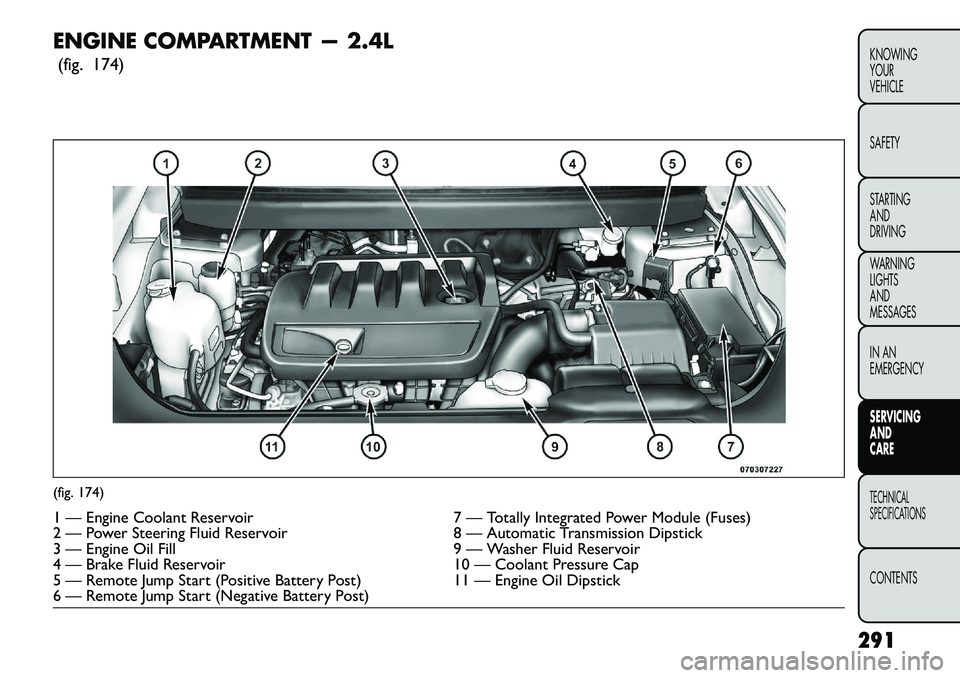
ENGINE COMPARTMENT — 2.4L(fig. 174)(fig. 174)1 — Engine Coolant Reservoir 7 — Totally Integrated Power Module (Fuses)
2 — Power Steering Fluid Reservoir 8 — Automatic Transmission Dipstick
3 — Engine Oil Fill 9 — Washer Fluid Reservoir
4 — Brake Fluid Reservoir 10 — Coolant Pressure Cap
5 — Remote Jump Start (Positive Battery Post) 11 — Engine Oil Dipstick
6 — Remote Jump Start (Negative Battery Post)
291
KNOWING
YOUR
VEHICLE
SAFETY
STARTING
AND
DRIVING
WARNING
LIGHTS
AND
MESSAGES
IN AN
EMERGENCY
SERVICING
AND
CARETECHNICAL
SPECIFICATIONSCONTENTS
Page 300 of 352
MAINTENANCE PROCEDURES
The pages that follow contain therequiredmainte-
nance services determined by the engineers who de-
signed your vehicle.
Besides those maintenance items specified in the fixed
maintenance schedule, there are other components
which may require servicing or replacement in the
future.
Failure to properly maintain your ve-
hicle or perform repairs and service when
necessary could result in more costly re-
pairs, damage to other components or negatively
impact vehicle performance. Immediately have
potential malfunctions examined by an autho-
rized dealership or qualified repair center.
Car maintenance should be done at a FIAT
Dealership. For routine and minor maintenance
operations you wish to carry out yourself, we do
recommend you have the proper equipment ,
genuine FIAT parts and the necessary fluids; do
not however carry out these operations if you
have no experience.
(Continued)(Continued)
Your vehicle has been built with improved fluids
that protect the performance and durability of
your vehicle and also allow extended mainte-
nance intervals. Do not use chemical flushes in
these components as the chemicals can damage
your engine, transmission, power steering or air
conditioning. Such damage is not covered by the
New Vehicle Limited Warranty. If a flush is needed
because of component malfunction, use only the
specified fluid for the flushing procedure.
ENGINE OIL
Checking Oil Level – Gasoline Engine
To assure proper engine lubrication, the engine oil
must be maintained at the correct level. Check the oil
level at regular intervals, such as every fuel stop.
The best time to check the engine oil level is about five
minutes after a fully warmed engine is shut off. Do not
check oil level before starting the engine after it has sat
overnight. Checking engine oil level when the engine is
cold will give you an incorrect reading.
Checking the oil while the vehicle is on level ground
and only when the engine is hot, will improve the
accuracy of the oil level readings. Maintain the oil level
between the range markings on the dipstick. Either the
range markings consist of a crosshatch zone marked
294
KNOWING YOUR
VEHICLE
SAFETY
STARTING AND
DRIVING
WARNING LIGHTSAND
MESSAGES
IN AN
EMERGENCY
SERVICING AND
C
ARETECHNICAL
SPECIFICATIONSCONTENTS
Page 309 of 352
WARNING!
Exhaust gases can injure or kill. They
c
ontain carbon monoxide (CO), which is
colorless and odorless. Breathing it can make you
unconscious and can eventually poison you. To
avoid breathing CO, refer to “Safety Tips/Exhaust
Gas” in “Safety” for further information.
NOTE: Intentional tampering with emissions control
systems can result in civil penalties being assessed
against you.
WARNING!
A hot exhaust system can start a fire if
y
ou park over materials that can burn.
Such materials might be grass or leaves coming
into contact with your exhaust system. Do not
park or operate your vehicle in areas where your
exhaust system can contact anything that can
burn.
In unusual situations involving grossly malfunctioning
engine operation, a scorching odor may indicate severe
and abnormal catalyst overheating. If this occurs, safely
bring the vehicle to a complete stop, shut the engine
OFF, and allow the vehicle to cool. Thereafter, obtain
service, including a tune-up to manufacturer’s specifi-
cations immediately. To minimize the possibility of catalyst damage:
Do not shut OFF the engine or interrupt the ignition
when the transmission is in gear and the vehicle is in
motion.
Do not try to start the engine by pushing or towing the vehicle.
Do not idle the engine with any ignition coil connec- tors disconnected for prolonged periods.
COOLING SYSTEM
WARNING!
Wh
en working near the radiator cool-
ing fan, disconnect the fan motor lead or
turn the ignition switch to the LOCK position.The
fan is temperature controlled and can start at
any time the ignition switch is in the ON position.
You or others can be badly burned by hot
engine coolant (antifreeze) or steam from your
radiator. If you see or hear steam coming from
under the hood, do not open the hood until the
radiator has had time to cool. Never try to open a
cooling system pressure cap when the radiator is
hot .
303
KNOWING
YOUR
VEHICLE
SAFETY
STARTING
AND
DRIVING
WARNING
LIGHTS
AND
MESSAGES
IN AN
EMERGENCY
SERVICING
AND
CARETECHNICAL
SPECIFICATIONSCONTENTS
Page 314 of 352
Overfilling of fluid is not recommended because it may
cause leaking in the system.
Fluid level can be expected to fall as the brake pads
wear. Brake fluid level should be checked when pads are
replaced. However, low fluid level may be caused by a
leak and a checkup may be needed.
Use only manufacturer's recommended brake fluid.
Refer to “Fluids, Lubricants, and Genuine Parts” in
“Technical Specifications” for further information.
WARNING!
Us
e only manufacturer's recom-
mended brake fluid. Refer to “Fluids, Lu-
bricants, and Genuine Parts” in “Technical Speci-
fications” for further information. Using the
wrong type of brake fluid can severely damage
your brake system and/or impair its perfor-
mance. The proper type of brake fluid for your
vehicle is also identified on the original factory
installed hydraulic master cylinder reservoir.
(Continued)(Continued)
To avoid contamination from foreign matter or
moisture, use only new brake fluid or fluid that
has been in a tightly closed container. Keep the
master cylinder reservoir cap secured at all
times. Brake fluid in a open container absorbs
moisture from the air resulting in a lower boiling
point . This may cause it to boil unexpectedly
during hard or prolonged braking, resulting in
sudden brake failure. This could result in a acci-
dent .
Overfilling the brake fluid reservoir can result
in spilling brake fluid on hot engine parts, causing
the brake fluid to catch fire. Brake fluid can also
damage painted and vinyl surfaces, care should
be taken to avoid its contact with these surfaces.
Do not allow petroleum based fluid to con-
taminate the brake fluid. Brake seal components
could be damaged, causing partial or complete
brake failure.This could result in an accident .
AUTOMATIC TRANSMISSION (for
versions/markets, where provided)
Selection Of Lubricant
It is important to use the proper transmission fluid to
ensure optimum transmission performance and life.
Use only the manufacturer’s recommended transmis-
sion fluid. Refer to “Fluids, Lubricants, and Genuine
308
KNOWING YOUR
VEHICLE
SAFETY
STARTING AND
DRIVING
WARNING LIGHTSAND
MESSAGES
IN AN
EMERGENCY
SERVICING AND
C
ARETECHNICAL
SPECIFICATIONSCONTENTS
Page 315 of 352
Parts” in “Technical Specifications” for further informa-
tion. It is important to maintain the transmission fluid
at the correct level using the recommended fluid. No
chemical flushes should be used in any transmission;
only the approved lubricant should be used.
Special Additives
The manufacturer strongly recommends against using
any special additives in the transmission. Automatic
Transmission Fluid (ATF) is an engineered product and
its performance may be impaired by supplemental ad-
ditives. Therefore, do not add any fluid additives to the
transmission. The only exception to this policy is the
use of special dyes for diagnosing fluid leaks. Avoid
using transmission sealers as they may adversely affect
seals.
Do not use chemical flushes in your
transmission as the chemicals can dam-
age your transmission components. Such
damage is not covered by the New Vehicle Limited
Warranty.
Fluid Level Check – Six-Speed Automatic
The fluid level is preset at the factory and does not
require adjustment under normal operating conditions.
Routine fluid level checks are not required, therefore
the transmission has no dipstick. Your authorized
dealer can check your transmission fluid level using a special service dipstick. If you notice fluid leakage or
transmission malfunction, visit your authorized dealer
immediately to have the transmission fluid level
checked. Operating the vehicle with an improper fluid
level can cause severe transmission damage.
Car maintenance should be done at a
FIAT Dealership. For routine and minor
maintenance operations you wish to
carry out yourself, we do recommend you have
the proper equipment , genuine FIAT spare parts
and the necessary fluids; do not however carry out
these operations if you have no experience.
Fluid And Filter Changes
Refer to the “Maintenance Schedule” for the proper
maintenance intervals.
In addition, change the fluid and filter if the transmis-
sion is disassembled for any reason.
MANUAL TRANSMISSION (for versions/
markets, where provided)
Fluid Level Check
Visually inspect manual transmission for leakage at each
oil change. Add fluid, if necessary, to maintain the
proper fluid level.
309
KNOWING
YOUR
VEHICLE
SAFETY
STARTING
AND
DRIVING
WARNING
LIGHTS
AND
MESSAGES
IN AN
EMERGENCY
SERVICING
AND
CARETECHNICAL
SPECIFICATIONSCONTENTS
Page 316 of 352
Check the fluid level by removing the fill plug. The fluid
level should be between the bottom of the fill hole and
a point not more that 4.7 mm below the bottom of the
hole.
Lubricant Selection
Use only manufacturers recommended transmission
fluid. Do not add any materials (other than leak detec-
tion dyes). Refer to “Fluids, Lubricants, and Genuine
Parts” in “Technical Specifications” for further informa-
tion.
Frequency Of Fluid Change
Change the manual transmission fluid at the intervals
shown in the “Maintenance Schedule” in this manual.
REAR DRIVE ASSEMBLY (RDA) – AWD
MODELS ONLY
Lubricant Selection
Use only the manufacturer's recommended fluid. Refer
to “Fluids, Lubricants, and Genuine Parts” in “Technical
Specifications” for further information.
Fluid Level Check
Visually inspect the unit at each oil change for leakage.
If leakage is detected, check the fluid level by removing
the fill plug. The fluid level should be maintained be-
tween the bottom of the fill hole to 4 mm below the fill
hole.Add fluid, if necessary, to maintain the proper level.
Frequency Of Fluid Change
Refer to the “Maintenance Schedule” for the proper
maintenance intervals.
POWER TRANSFER UNIT (PTU) – AWD
MODELS ONLY
Lubricant Selection
Use only the manufacturer's recommended fluid. Refer
to “Fluids, Lubricants, and Genuine Parts” in “Technical
Specifications” for further information.
Fluid Level Check
Visually inspect the unit at each oil change for leakage.
If leakage is detected, Check the fluid level by removing
the fill plug. The fluid level should be maintained be-
tween the bottom of the fill hole to 4 mm below the fill
hole.
Add fluid, if necessary, to maintain the proper level.
Frequency Of Fluid Change
Refer to the “Maintenance Schedule” for the proper
maintenance intervals.
310
KNOWING YOUR
VEHICLE
SAFETY
STARTING AND
DRIVING
WARNING LIGHTSAND
MESSAGES
IN AN
EMERGENCY
SERVICING AND
C
ARETECHNICAL
SPECIFICATIONSCONTENTS