engine oil FIAT FREEMONT 2014 1.G Owner's Manual
[x] Cancel search | Manufacturer: FIAT, Model Year: 2014, Model line: FREEMONT, Model: FIAT FREEMONT 2014 1.GPages: 388, PDF Size: 4.13 MB
Page 330 of 388
ENGINE OIL
Checking Oil Level – Gasoline Engine
To assure proper engine lubrication, the engine oil
must be maintained at the correct level. Check the oil
level at regular intervals, such as every fuel stop.
The best time to check the engine oil level is about five
minutes after a fully warmed engine is shut off. Do not
check oil level before starting the engine after it has sat
overnight. Checking engine oil level when the engine is
cold will give you an incorrect reading.
Checking the oil while the vehicle is on level ground
and only when the engine is hot, will improve the
accuracy of the oil level readings. Maintain the oil level
between the range markings on the dipstick. Either the
range markings consist of a crosshatch zone marked
SAFE or a crosshatch zone marked with MIN at the low
end of the range and MAX at the high end of the range.
Adding 1 Quart or 1 Liter of oil when the reading is at
the low end of the range marking will raise the oil level
to the high end of the range marking.Do not overfill the engine. Overfilling the
engine will cause oil aeration, which can
lead to loss of oil pressure and an in-
crease in oil temperature.This could damage your
engine.Also, be sure the oil fill cap is replaced and
tightened after adding oil.
Checking Oil Level – Diesel Engine
To assure proper engine lubrication, the engine oil
must be maintained at the correct level. Check the oil
level at regular intervals, such as every fuel stop.
The best time to check the engine oil level is about five
minutes after a fully warmed engine is shut off or
before starting the engine after it has sat overnight.
Checking the oil while the vehicle is on level ground will
improve the accuracy of the oil level readings. Maintain
the oil level between the MIN and MAX markings on
the dipstick. Adding 1 Quart or 1 Liter of oil when the
reading is at the MIN mark will result in a MAX reading
on these engines.
324
KNOWING YOUR
VEHICLE
SAFETY
STARTING AND
DRIVING
WARNING LIGHTSAND
MESSAGES
IN AN
EMERGENCY
SERVICING AND CARE
TECHNICAL
SPECIFICATIONS
CONTENTS
Page 331 of 388
Car maintenance should be done at a
FIAT Dealership. For routine and minor
maintenance operations you wish to
carry out yourself, we do recommend you have
the proper equipment , genuine FIAT spare parts
and the necessary fluids; do not however carry out
these operations if you have no experience.
Change Engine Oil – Gasoline Engine
Refer to the “Maintenance Schedule” for the proper
maintenance intervals.
Change Engine Oil – Diesel Engine
Refer to the “Maintenance Schedule” for the proper
maintenance intervals.
Engine Oil Viscosity – 2.4L And 3.6L Gasoline
Engine
SAE Grade 5W-20 SELENIA K POWER fully synthetic
engine oil that meets FIAT Qualification 9.55535-CR1
API SN, ILSAC GF-5 or equivalent.
The engine oil filler cap also shows the recommended
engine oil viscosity for your vehicle. For information on
engine oil filler cap location, refer to “Engine Compart-
ment” in “Servicing And Care” for further information. NOTE:
SAE Grade 5W-30 SELENIA K POWER fully
synthetic engine oil that meets FIAT Qualification
9.55535-CR1 API SN, ILSAC GF-5 may be used when
SAE 5W-20 engine oil meeting Fiat 9.55535-CR1 is not
available.
Engine Oil Viscosity – 2.0L Diesel Engine
SAE Grade 5W-30 SELENIA WR P.E. fully synthetic
engine oil that meets FIAT Qualification 9.55535–S1,
ACEA C2 or equivalent.
The engine oil filler cap also shows the recommended
engine oil viscosity for your engine. For information on
engine oil filler cap location, refer to “Engine Compart-
ment” in “Servicing and Care” for further information.
Change Engine Oil – Diesel Engine
Refer to the “Maintenance Schedule” for the proper
maintenance intervals.
Materials Added To Engine Oil
Do not add any supplemental materials, other than leak
detection dyes, to the engine oil. Engine oil is an
engineered product and its performance may be im-
paired by supplemental additives.
325
KNOWING
YOUR
VEHICLE
SAFETY
STARTING
AND
DRIVING
WARNING
LIGHTS
AND
MESSAGES
IN AN
EMERGENCY
SERVICING
AND CARE
TECHNICAL
SPECIFICATIONS
CONTENTS
Page 332 of 388
Disposing Of Used Engine Oil And Oil Filters
Care should be taken in disposing of used engine oil and
oil filters from your vehicle. Used oil and oil filters,
indiscriminately discarded, can present a problem to
the environment. Contact your authorized dealer, ser-
vice station or governmental agency for advice on how
and where used oil and oil filters can be safely discarded
in your area.
ENGINE AIR CLEANER FILTER
Refer to the “Maintenance Schedule” for the proper
maintenance intervals.
WARNING!
The air induction system (air cleaner,
hoses, et
c .) can provide a measure of
protection in the case of engine backfire. Do not
remove the air induction system (air cleaner,
hoses, etc .) unless such removal is necessary for
repair or maintenance. Make sure that no one is
near the engine compartment before starting the
vehicle with the air induction system (air cleaner,
hoses, etc .) removed. Failure to do so can result in
serious personal injury. Engine Air Cleaner Filter Selection
The quality of replacement engine air cleaner filters
varies considerably. Only high quality filters should be
used to assure most efficient service.
MAINTENANCE-FREE BATTERY
You will never have to add water, and periodic mainte-
nance is not required.
NOTE:
The battery is stored in a compartment that is
located behind the left front fender and is accessible
through the wheel well. The wheel and tire assemble
do not need to be removed to access the compart-
ment. Remote battery terminals are located in the
engine compartment for jump-starting.
To access the battery, turn the steering wheel fully to
the right and remove the access panel from the inner
fender shield.
WARNING!
• Battery fluid is a corrosive acid solu-
ti on
and can burn or even blind you. Do
not allow battery fluid to contact your eyes, skin,
or clothing. Do not lean over a battery when
attaching clamps. If acid splashes in eyes or on
skin, flush the area immediately with large
amounts of water.
(Continued)
326
KNOWINGYOUR
VEHICLE
SAFETY
STARTING AND
DRIVING
WARNING LIGHTSAND
MESSAGES
IN AN
EMERGENCY
SERVICING AND CARE
TECHNICAL
SPECIFICATIONS
CONTENTS
Page 336 of 388
Car maintenance should be done at a
FIAT Dealership. For routine and minor
maintenance operations you wish to
carry out yourself, we do recommend you have
the proper equipment , genuine FIAT spare parts
and the necessary fluids; do not however carry out
these operations if you have no experience.
WIPER BLADES
Clean the rubber edges of the wiper blades and the
windshield and rear window periodically with a sponge
or soft cloth and a mild nonabrasive cleaner. This will
remove accumulations of salt, waxes, or road film, and
help reduce streaking and smearing.
Operation of the wipers on dry glass for long periods
may cause deterioration of the wiper blades. Always
use washer fluid when using the wipers to remove salt
or dirt from a dry windshield or rear window.
Avoid using the wiper blades to remove frost or ice
from the windshield or rear window. Make sure that
they are not frozen to the glass before turning them on
to avoid damaging the blade. Keep the blade rubber out
of contact with petroleum products such as engine oil,
gasoline, etc. NOTE:
Life expectancy of wiper blades varies depend-
ing on geographical area and frequency of use. Poor
performance of blades may be present with chattering,
marks, water lines or wet spots. If any of these condi-
tions are present, clean the wiper blades or replace as
necessary.
Rear Wiper Removal/Installation
1. Lift the pivot cap on the rear wiper arm upward, this will allow the rear wiper blade to be raised off of the
liftgate glass. (fig. 196)
NOTE: The rear wiper arm cannot be raised fully
upward unless the pivot cap is raised first.
(fig. 196)
1 — Wiper Arm
2 — Pivot Cap
330
KNOWING YOUR
VEHICLE
SAFETY
STARTING AND
DRIVING
WARNING LIGHTSAND
MESSAGES
IN AN
EMERGENCY
SERVICING AND CARE
TECHNICAL
SPECIFICATIONS
CONTENTS
Page 338 of 388
Car maintenance should be done at a
FIAT Dealership. For routine and minor
maintenance operations you wish to
carry out yourself, we do recommend you have
the proper equipment , genuine FIAT spare parts
and the necessary fluids; do not however carry out
these operations if you have no experience.
INTERVENTION REGENERATION
STRATEGY – 2.0L DIESEL ENGINE
This vehicle is equipped with a state-of-the-art engine
and exhaust system containing a diesel particulate
filter. The engine and exhaust after-treatment system
work together to meet the Emission standards. The
system manages engine combustion to allow the ex-
haust system’s catalyst to trap and burn Particulate
Matter (PM) pollutants with no input or interaction on
your part.
Refer to “Electronic Vehicle Information Center
(EVIC)” in “Knowing Your Vehicle” for further informa-
tion. EXHAUST SYSTEM
The best protection against carbon monoxide entry
into the vehicle body is a properly maintained engine
exhaust system.
Whenever a change is noticed in the sound of the
exhaust system, when exhaust fumes can be detected
inside the vehicle, or when the underside or rear of the
vehicle is damaged, have a competent technician in-
spect the complete exhaust system and adjacent body
areas for broken, damaged, deteriorated, or misposi-
tioned parts. Open seams or loose connections could
permit exhaust fumes to seep into the passenger com-
partment. In addition, inspect the exhaust system each
time the vehicle is raised for lubrication or oil change.
Replace as required.
WARNING!
Exhaust gases can injure or kill. They
contain car
bon monoxide (CO), which is
colorless and odorless. Breathing it can make you
unconscious and can eventually poison you. To
avoid breathing CO, refer to “Safety Tips/Exhaust
Gas” in “Safety” for further information.
NOTE: Intentional tampering with emissions control
systems can result in civil penalties being assessed
against you.
332
KNOWING YOUR
VEHICLE
SAFETY
STARTING AND
DRIVING
WARNING LIGHTSAND
MESSAGES
IN AN
EMERGENCY
SERVICING AND CARE
TECHNICAL
SPECIFICATIONS
CONTENTS
Page 339 of 388
WARNING!
A hot exhaust system can start a fire if
you par k
over materials that can burn.
Such materials might be grass or leaves coming
into contact with your exhaust system. Do not
park or operate your vehicle in areas where your
exhaust system can contact anything that can
burn.
In unusual situations involving grossly malfunctioning
engine operation, a scorching odor may indicate severe
and abnormal catalyst overheating. If this occurs, safely
bring the vehicle to a complete stop, shut the engine
OFF, and allow the vehicle to cool. Thereafter, obtain
service, including a tune-up to manufacturer’s specifi-
cations immediately.
To minimize the possibility of catalyst damage:
• Do not shut OFF the engine or interrupt the ignition when the transmission is in gear and the vehicle is in
motion.
• Do not try to start the engine by pushing or towing the vehicle.
• Do not idle the engine with any ignition coil connec- tors disconnected for prolonged periods. COOLING SYSTEMWARNING!
•
When working near the radiator cool-
ing fan, disconnect the fan motor lead or
turn the ignition switch to the LOCK position.
The fan is temperature controlled and can start at
any time the ignition switch is in the ON position.
• You or others can be badly burned by hot
engine coolant (antifreeze) or steam from your
radiator. If you see or hear steam coming from
under the hood, do not open the hood until the
radiator has had time to cool. Never tr y to open a
cooling system pressure cap when the radiator is
hot .
Car maintenance should be done at a
FIAT Dealership. For routine and minor
maintenance operations you wish to
carry out yourself, we do recommend you have
the proper equipment , genuine FIAT spare parts
and the necessary fluids; do not however carry out
these operations if you have no experience.
333
KNOWING
YOUR
VEHICLE
SAFETY
STARTING
AND
DRIVING
WARNING
LIGHTS
AND
MESSAGES
IN AN
EMERGENCY
SERVICING
AND CARE
TECHNICAL
SPECIFICATIONS
CONTENTS
Page 367 of 388
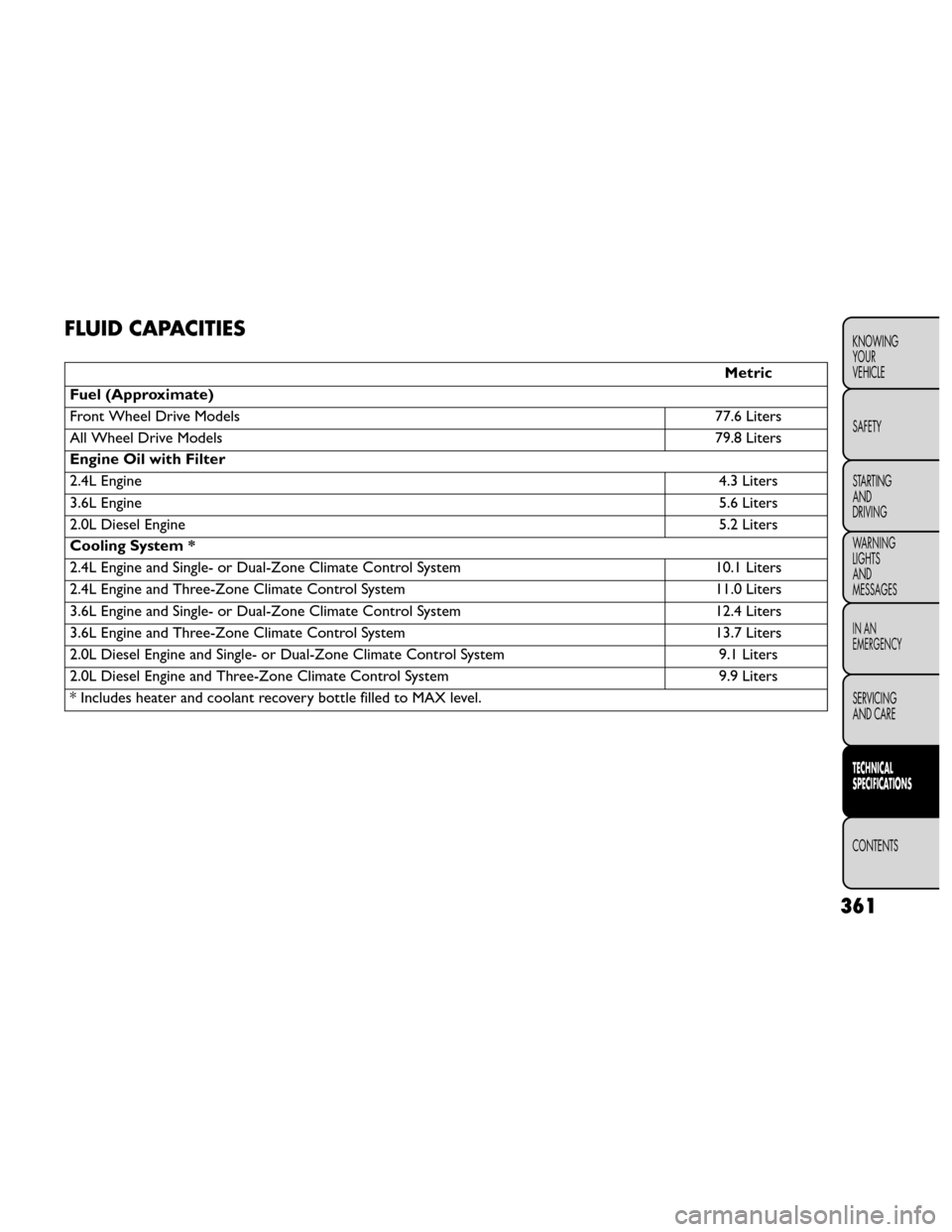
FLUID CAPACITIES
Metric
Fuel (Approximate)
Front Wheel Drive Models 77.6 Liters
All Wheel Drive Models 79.8 Liters
Engine Oil with Filter
2.4L Engine 4.3 Liters
3.6L Engine 5.6 Liters
2.0L Diesel Engine 5.2 Liters
Cooling System *
2.4L Engine and Single- or Dual-Zone Climate Control System 10.1 Liters
2.4L Engine and Three-Zone Climate Control System 11.0 Liters
3.6L Engine and Single- or Dual-Zone Climate Control System 12.4 Liters
3.6L Engine and Three-Zone Climate Control System 13.7 Liters
2.0L Diesel Engine and Single- or Dual-Zone Climate Control System 9.1 Liters
2.0L Diesel Engine and Three-Zone Climate Control System 9.9 Liters
* Includes heater and coolant recovery bottle filled to MAX level.
361
KNOWING
YOUR
VEHICLE
SAFETY
STARTING
AND
DRIVING
WARNING
LIGHTS
AND
MESSAGES
IN AN
EMERGENCY
SERVICING
AND CARE
TECHNICAL
SPECIFICATIONS
CONTENTS
Page 368 of 388
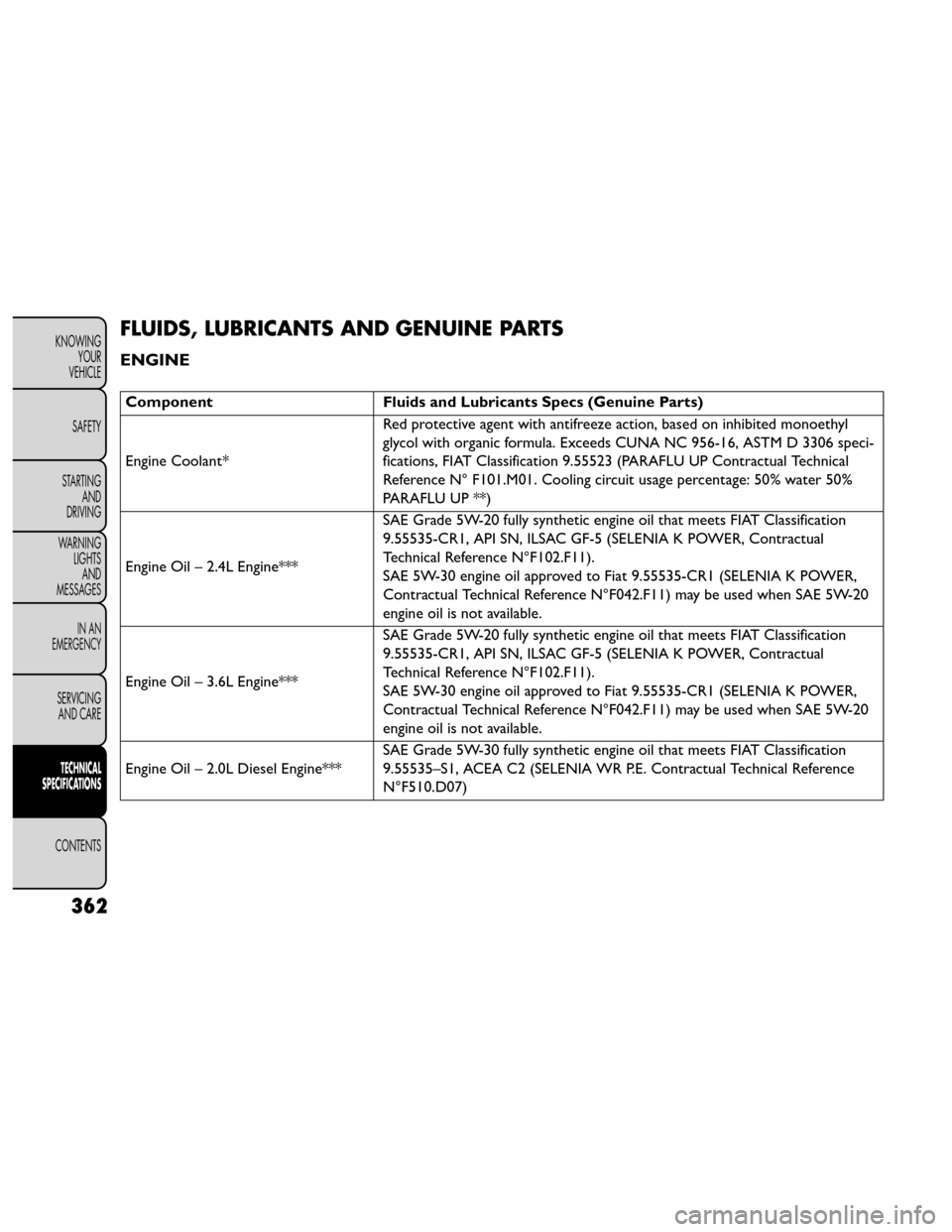
FLUIDS, LUBRICANTS AND GENUINE PARTS
ENGINE
ComponentFluids and Lubricants Specs (Genuine Parts)
Engine Coolant* Red protective agent with antifreeze action, based on inhibited monoethyl
glycol with organic formula. Exceeds CUNA NC 956-16, ASTM D 3306 speci-
fications, FIAT Classification 9.55523 (PARAFLU UP Contractual Technical
Reference N° F101.M01. Cooling circuit usage percentage: 50% water 50%
PARAFLU UP **)
Engine Oil – 2.4L Engine*** SAE Grade 5W-20 fully synthetic engine oil that meets FIAT Classification
9.55535-CR1, API SN, ILSAC GF-5 (SELENIA K POWER, Contractual
Technical Reference N°F102.F11).
SAE 5W-30 engine oil approved to Fiat 9.55535-CR1 (SELENIA K POWER,
Contractual Technical Reference N°F042.F11) may be used when SAE 5W-20
engine oil is not available.
Engine Oil – 3.6L Engine*** SAE Grade 5W-20 fully synthetic engine oil that meets FIAT Classification
9.55535-CR1, API SN, ILSAC GF-5 (SELENIA K POWER, Contractual
Technical Reference N°F102.F11).
SAE 5W-30 engine oil approved to Fiat 9.55535-CR1 (SELENIA K POWER,
Contractual Technical Reference N°F042.F11) may be used when SAE 5W-20
engine oil is not available.
Engine Oil – 2.0L Diesel Engine*** SAE Grade 5W-30 fully synthetic engine oil that meets FIAT Classification
9.55535–S1, ACEA C2 (SELENIA WR P.E. Contractual Technical Reference
N°F510.D07)
362
KNOWING
YOUR
VEHICLE
SAFETY
STARTING AND
DRIVING
WARNING LIGHTSAND
MESSAGES
IN AN
EMERGENCY
SERVICING AND CARE
TECHNICAL
SPECIFICATIONS
CONTENTS
Page 374 of 388
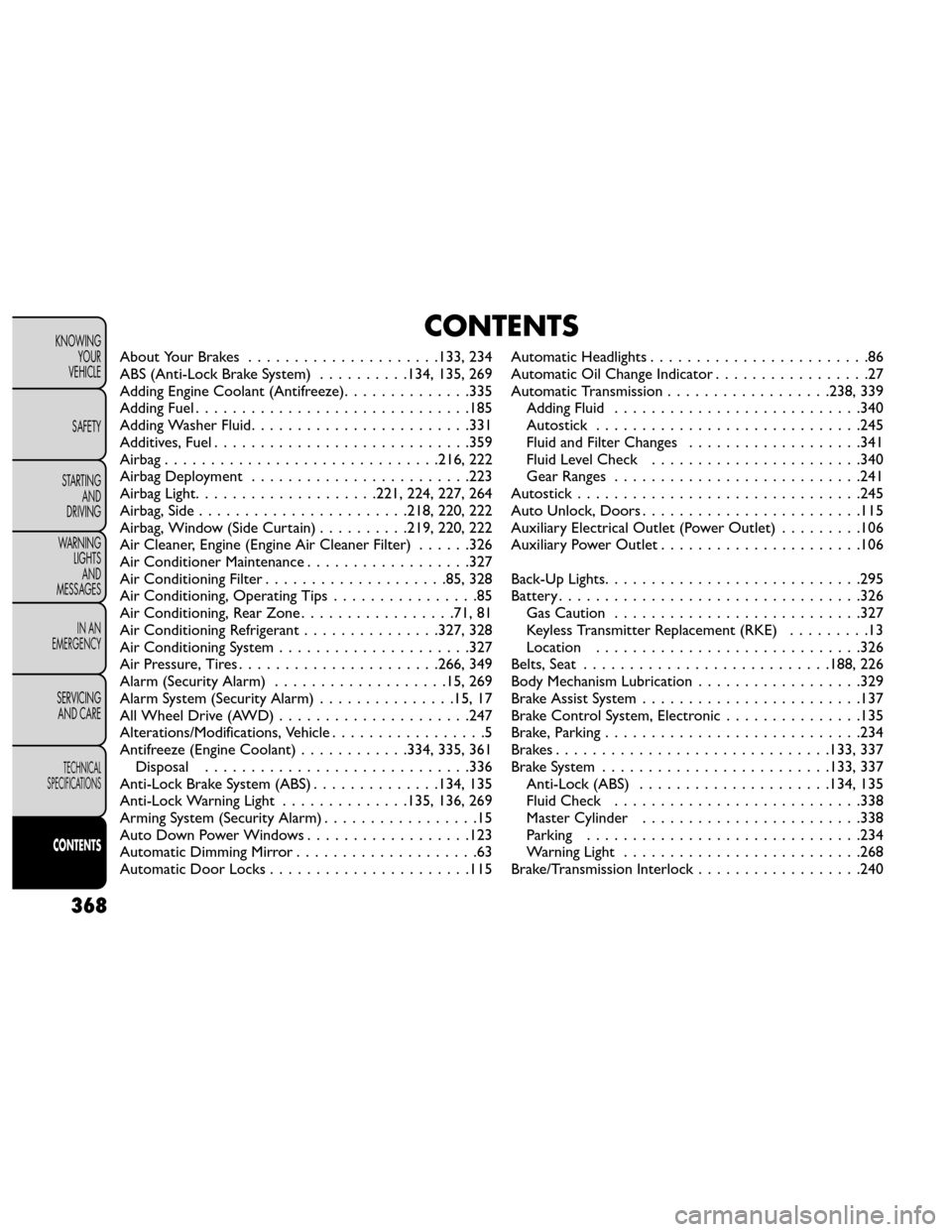
CONTENTS
About Your Brakes..................... 133, 234
ABS (Anti-Lock Brake System) ..........134, 135, 269
Adding Engine Coolant (Antifreeze) ..............335
Adding Fuel ..............................185
Adding Washer Fluid ........................331
Additives, Fuel ............................359
Airbag .............................. 216, 222
Airbag Deployment ........................223
Airbag Light ....................221, 224, 227, 264
Airbag, Side ....................... 218, 220, 222
Airbag, Window (Side Curtain) ..........219, 220, 222
Air Cleaner, Engine (Engine Air Cleaner Filter) ......326
Air Conditioner Maintenance ..................327
Air Conditioning Filter ....................85, 328
Air Conditioning, Operating Tips ................85
Air Conditioning, Rear Zone .................71,81
Air Conditioning Refrigerant ...............327, 328
Air Conditioning System .....................327
Air Pressure, Tires ......................266, 349
Alarm (Security Alarm) ...................15, 269
Alarm System (Security Alarm) ...............15, 17
All Wheel Drive (AWD) .....................247
Alterations/Modifications, Vehicle .................5
Antifreeze (Engine Coolant) ............334, 335, 361
Disposal .............................336
Anti-Lock Brake System (ABS) ..............134, 135
Anti-Lock Warning Light ..............135, 136, 269
Arming System (Security Alarm) .................15
Auto Down Power Windows ..................123
Automatic Dimming Mirror ....................63
Automatic Door Locks ......................115 Automatic Headlights
........................86
Automatic Oil Change Indicator .................27
Automatic Transmission .................. 238, 339
Adding Fluid ...........................340
Autostick .............................245
Fluid and Filter Changes ...................341
Fluid Level Check .......................340
Gear Ranges ...........................241
Autostick ..............................
.245
Auto Unlock, Doors ........................115
Auxiliary Electrical Outlet (Power Outlet) .........106
Auxiliary Power Outlet ......................106
Back-Up Lights ............................295
Battery .................................326
Gas Caution ...........................327
Keyless Transmitter Replacement (RKE) .........13
Location .............................326
Belts, Seat ........................... 188, 226
Body Mechanism Lubrication ..................329
Brake Assist System ........................137
Brake Control System, Electronic ...............135
Brake, Parking ............................234
Brakes ..............................133, 337
Brake System ......................... 133, 337
Anti-Lock (ABS) .....................134, 135
Fluid Check ...........................338
Master Cylinder ........................338
Parking ..............................234
Warning Light ..........................268
Brake/Transmission Interlock ..................240
368
KNOWING
YOUR
VEHICLE
SAFETY
STARTING AND
DRIVING
WARNING LIGHTSAND
MESSAGES
IN AN
EMERGENCY
SERVICING AND CARE
TECHNICAL
SPECIFICATIONS
CONTENTS
Page 375 of 388
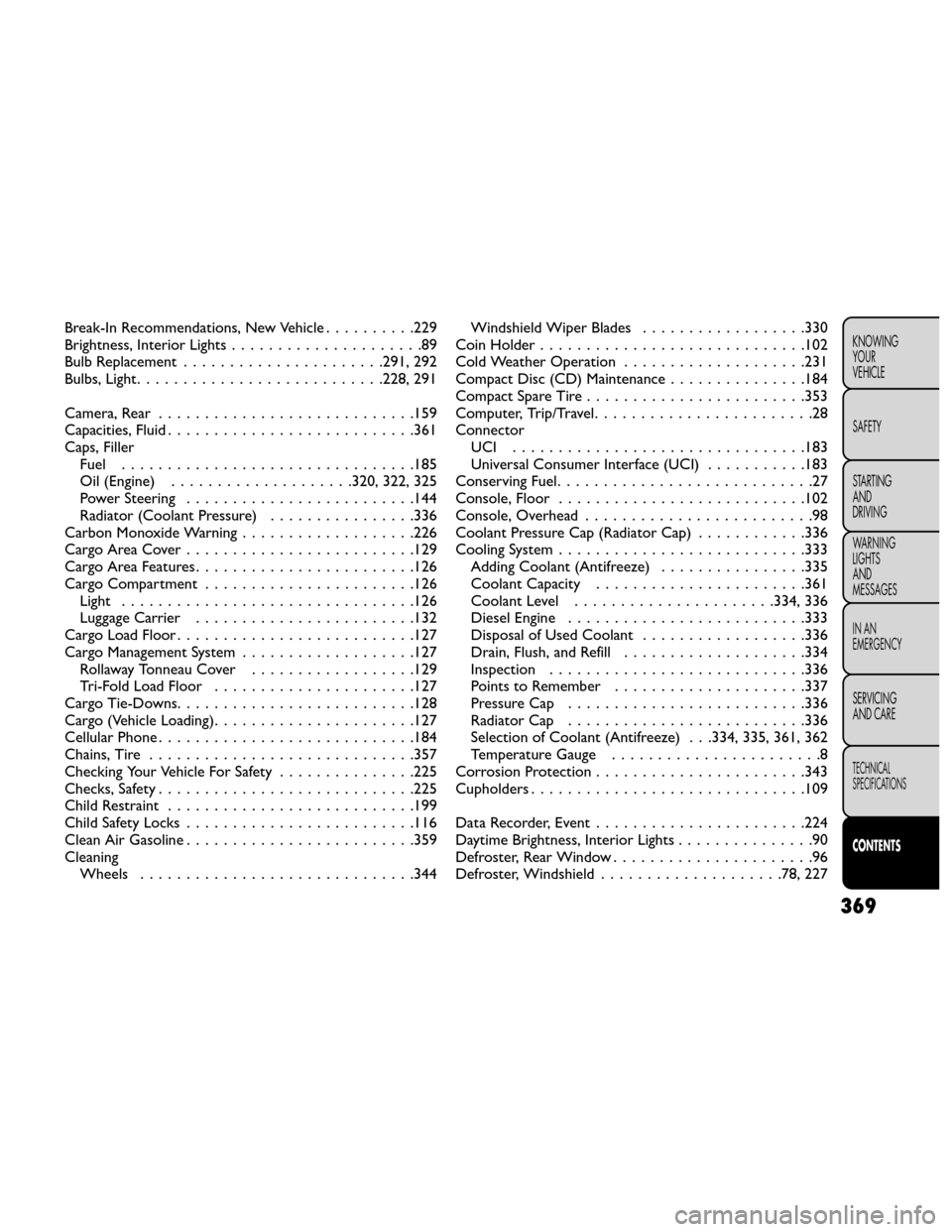
Break-In Recommendations, New Vehicle..........229
Brightness, Interior Lights .....................89
Bulb Replacement ...................... 291, 292
Bulbs, Light ...........................228, 291
Camera, Rear ............................159
Capacities, Fluid ...........................361
Caps, Filler Fuel ................................185
Oil (Engine) ....................320, 322, 325
Power Steering .........................144
Radiator (Coolant Pressure) ................336
Carbon Monoxide Warning ...................226
CargoAreaCover.........................129
Cargo Area Features ........................126
CargoCompartment .......................126 Light ................................126
Luggage Carrier ........................132
Cargo Load Floor ..........................127
Cargo Management System ...................127
Rollaway Tonneau Cover ..................129
Tri-Fold Load Floor ......................127
Cargo Tie-Downs ..........................128
Cargo (Vehicle Loading) ......................127
Cellular Phone ............................184
Chains, Tire .............................357
Checking Your Vehicle For Safety ...............225
Checks, Safety ............................225
Child Restraint ...........................199
Child Safety Locks .........................116
Clean Air Gasoline .........................359
Cleaning Wheels ..............................344 Windshield Wiper Blades
..................330
Coin Holder .............................102
Cold Weather Operation ....................231
Compact Disc (CD) Maintenance ...............184
Compact Spare Tire ........................353
Computer, Trip/Travel ........................28
Connector UCI ............................... .183
Universal Consumer Int
erface (UCI) ...........183
Conserving Fuel ............................27
Console, Floor ...........................102
Console, Overhead .........................98
Coolant Pressure Cap (Radiator Cap) ............336
Cooling System ...........................333
Adding Coolant (Antifreeze) ................335
Coolant Capacity .......................361
Coolant Level ......................334, 336
Diesel Engine ..........................333
Disposal of Used Coolant ..................336
Drain, Flush, and Refill ....................334
Inspection ............................336
Points to Remember .....................337
Pressure Cap ..........................336
Radiator Cap ..........................336
Selection of Coolant (Antifreeze) . . .334, 335, 361, 362
Temperature Gauge .......................8
Corrosion Protection .......................343
Cupholders ..............................109
Data Recorder, Event .......................224
Daytime Brightness, Interior Lights ...............90
Defroster, Rear Window ......................96
Defroster, Windshield ....................78, 227
369
KNOWING
YOUR
VEHICLE
SAFETY
STARTING
AND
DRIVING
WARNING
LIGHTS
AND
MESSAGES
IN AN
EMERGENCY
SERVICING
AND CARE
TECHNICAL
SPECIFICATIONS
CONTENTS