trailer FIAT FREEMONT 2014 1.G Owner's Manual
[x] Cancel search | Manufacturer: FIAT, Model Year: 2014, Model line: FREEMONT, Model: FIAT FREEMONT 2014 1.GPages: 388, PDF Size: 4.13 MB
Page 268 of 388
Failure to follow these towing methods
can cause severe engine and/or transmis-
sion damage. Damage from improper
towing is not covered under the New Vehicle Lim-
ited Warranty.
Front-Wheel Drive (FWD) Models - Automatic
Transmission
DO NOT flat tow any vehicle equipped
with an automatic transmission. Damage
to the drivetrain will result . If these ve-
hicles require towing, make sure all drive wheels
are OFF the ground. NOTE:
This vehicle may be towed on a flatbed or
vehicle trailer provided all four wheels are OFF the
ground.
This vehicle may also be towed using a tow dolly (with
the front wheels OFF the ground).
Towing this vehicle in violation of the
above requirements can cause severe
transmission damage. Damage from
improper towing is not covered under the New
Vehicle Limited Warranty.
262
KNOWING YOUR
VEHICLE
SAFETY
STARTING AND
DRIVING
WARNING LIGHTSAND
MESSAGES
IN AN
EMERGENCY
SERVICING AND CARE
TECHNICAL
SPECIFICATIONS
CONTENTS
Page 305 of 388
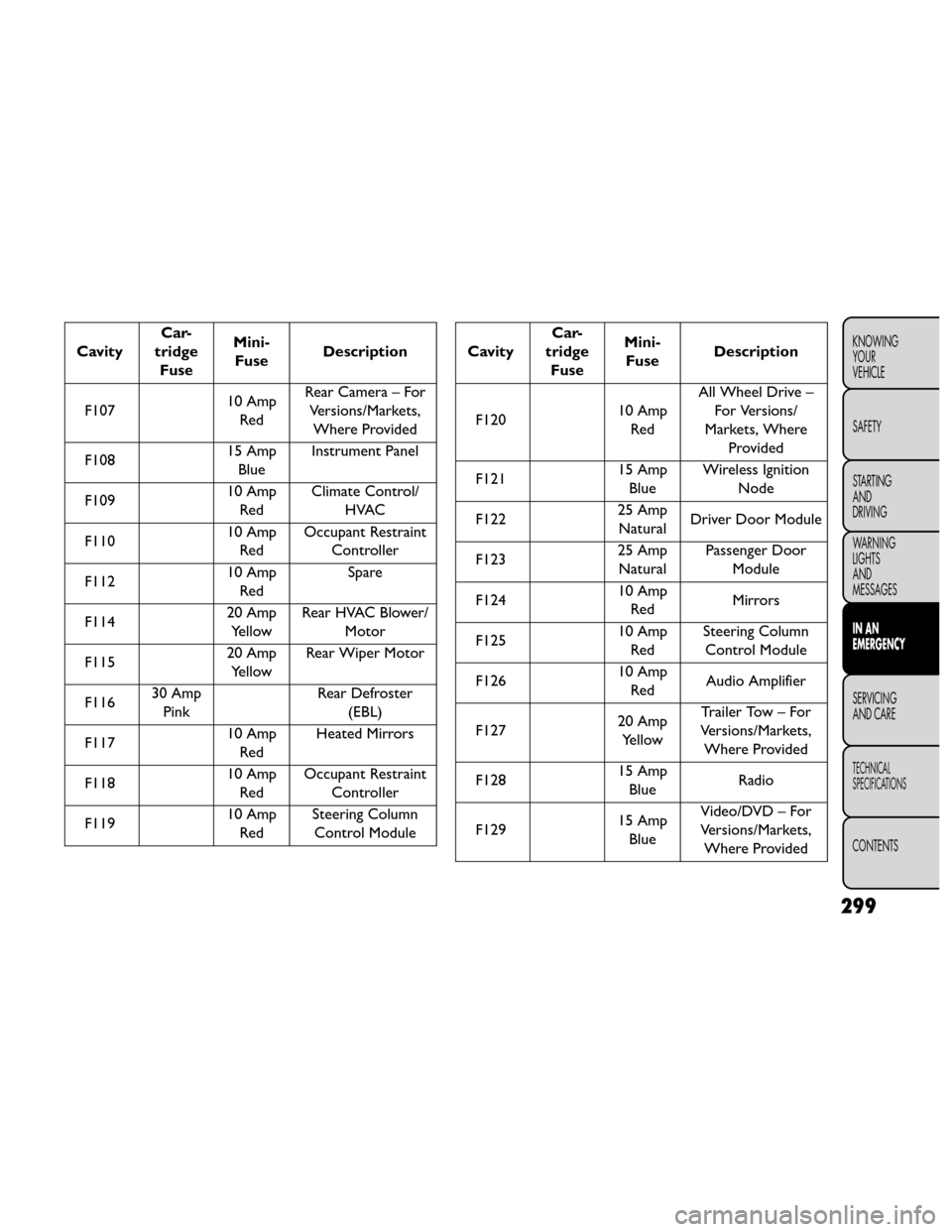
CavityCar-
tridge Fuse Mini-
Fuse Description
F107 10 Amp
Red Rear Camera – For
Versions/Markets,Where Provided
F108 15 Amp
Blue Instrument Panel
F109 10 Amp
Red Climate Control/
HVAC
F110 10 Amp
Red Occupant Restraint
Controller
F112 10 Amp
Red Spare
F114 20 Amp
Yellow Rear HVAC Blower/
Motor
F115 20 Amp
Yellow Rear Wiper Motor
F116 30 Amp
Pink Rear Defroster
(EBL)
F117 10 Amp
Red Heated Mirrors
F118 10 Amp
Red Occupant Restraint
Controller
F119 10 Amp
Red Steering Column
Control ModuleCavity Car-
tridge Fuse Mini-
Fuse Description
F120 10 Amp
Red All Wheel Drive –
For Versions/
Markets, Where Provided
F121 15 Amp
Blue Wireless Ignition
Node
F122 25 Amp
Natural Driver Door Module
F123 25 Amp
Natural Passenger Door
Module
F124 10 Amp
Red Mirrors
F125 10 Amp
Red Steering Column
Control Module
F126 10 Amp
Red Audio Amplifier
F127 20 Amp
Yellow Trailer Tow – For
Versions/Markets, Where Provided
F128 15 Amp
Blue Radio
F129 15 Amp
Blue Video/DVD – For
Versions/Markets, Where Provided
299
KNOWING
YOUR
VEHICLE
SAFETY
STARTING
AND
DRIVING
WARNING
LIGHTS
AND
MESSAGES
IN AN
EMERGENCY
SERVICING
AND CARE
TECHNICAL
SPECIFICATIONS
CONTENTS
Page 319 of 388
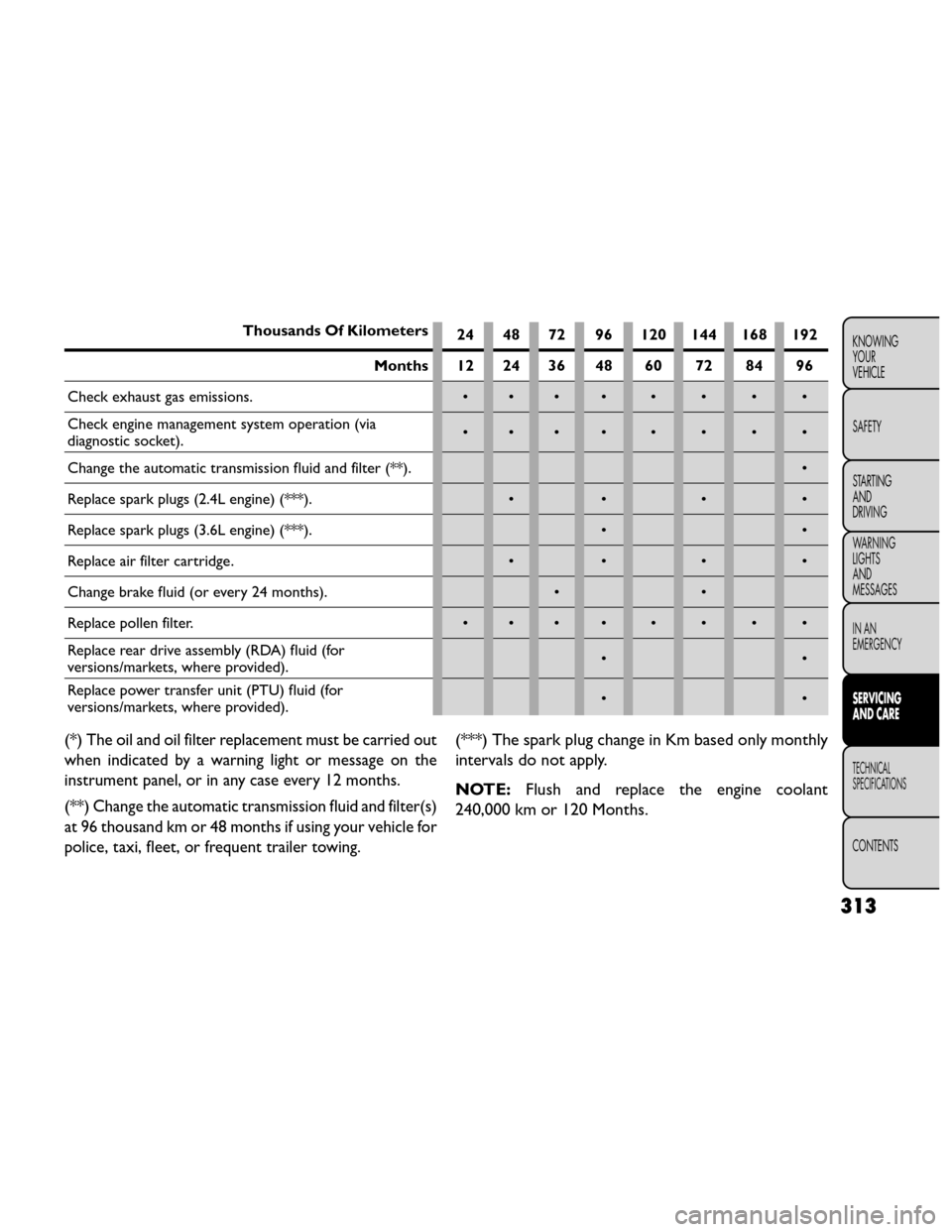
Thousands Of Kilometers24 48 72 96 120 144 168 192
Months 12 24 36 48 60 72 84 96
Check exhaust gas emissions. • • • •••••
Check engine management system operation (via
diagnostic socket). ••••••••
Change the automatic transmission fluid and filter (**). •
Replace spark plugs (2.4L engine) (***). •• • •
Replace spark plugs (3.6L engine) (***). ••
Replace air filter cartridge. •• • •
Change brake fluid (or every 24 months). ••
Replace pollen filter. • • • •••••
Replace rear drive assembly (RDA) fluid (for
versions/markets, where provided). ••
Replace power transfer unit (PTU) fluid (for
versions/markets, where provided). ••
(*)The oil and oil filter replacement must be carried out
when indicated by a warning light or message on the
instrument panel, or in any case every 12 months.
(**)Change the automatic transmission fluid and filter(s)
at 96 thousand km or 48 months if using your vehicle for
police, taxi, fleet, or frequent trailer towing.
(***) The spark plug change in Km based only monthly
intervals do not apply.
NOTE: Flush and replace the engine coolant
240,000 km or 120 Months.
313
KNOWING
YOUR
VEHICLE
SAFETY
STARTING
AND
DRIVING
WARNING
LIGHTS
AND
MESSAGES
IN AN
EMERGENCY
SERVICING
AND CARE
TECHNICAL
SPECIFICATIONS
CONTENTS
Page 320 of 388
Periodic Checks
Every1,000 km or before long journeys, check and, if
necessary, restore:
• engine coolant;
• brake fluid;
• power steering fluid;
• windshield washer fluid level;
• power steering fluid;
• tire inflation pressure and condition;
• operation of lighting system (headlights, direction indicators, hazard warning lights, etc.);
• operation of windshield washer/wiper system and positioning/wear of windshield/rear window wiper
blades.
Every 3,000 km, check and top up, if required, the
engine oil level and automatic transmission fluid level
(four-speed automatic only). Heavy-Duty Use Of The Car
If the car is used mainly under one of the following
conditions:
• towing a trailer or caravan;
• dusty roads;
• short, repeated journeys (less than 7-8 km) at sub-
zero outside temperatures;
• engine often idling or driving long distances at low speeds or long periods of idleness.
You should perform the following inspections more
frequently than shown on the Scheduled Servicing Plan:
• check front disc brake pad conditions and wear;
• check cleanliness of hood and trunk locks, cleanli- ness and lubrication of linkage;
• visually inspect conditions of: engine, transmission, pipes and hoses (exhaust - fuel system - brakes) and
rubber elements (boots - sleeves - bushes - etc.);
• check battery charge and battery fluid level (electro- lyte);
•
visually inspect condition of the accessory drive belts;
• check and, if necessary, change engine oil and replace oil filter;
• check and, if necessary, replace pollen filter;
• check and, if necessary, replace air cleaner.
314
KNOWING YOUR
VEHICLE
SAFETY
STARTING AND
DRIVING
WARNING LIGHTSAND
MESSAGES
IN AN
EMERGENCY
SERVICING AND CARE
TECHNICAL
SPECIFICATIONS
CONTENTS
Page 324 of 388
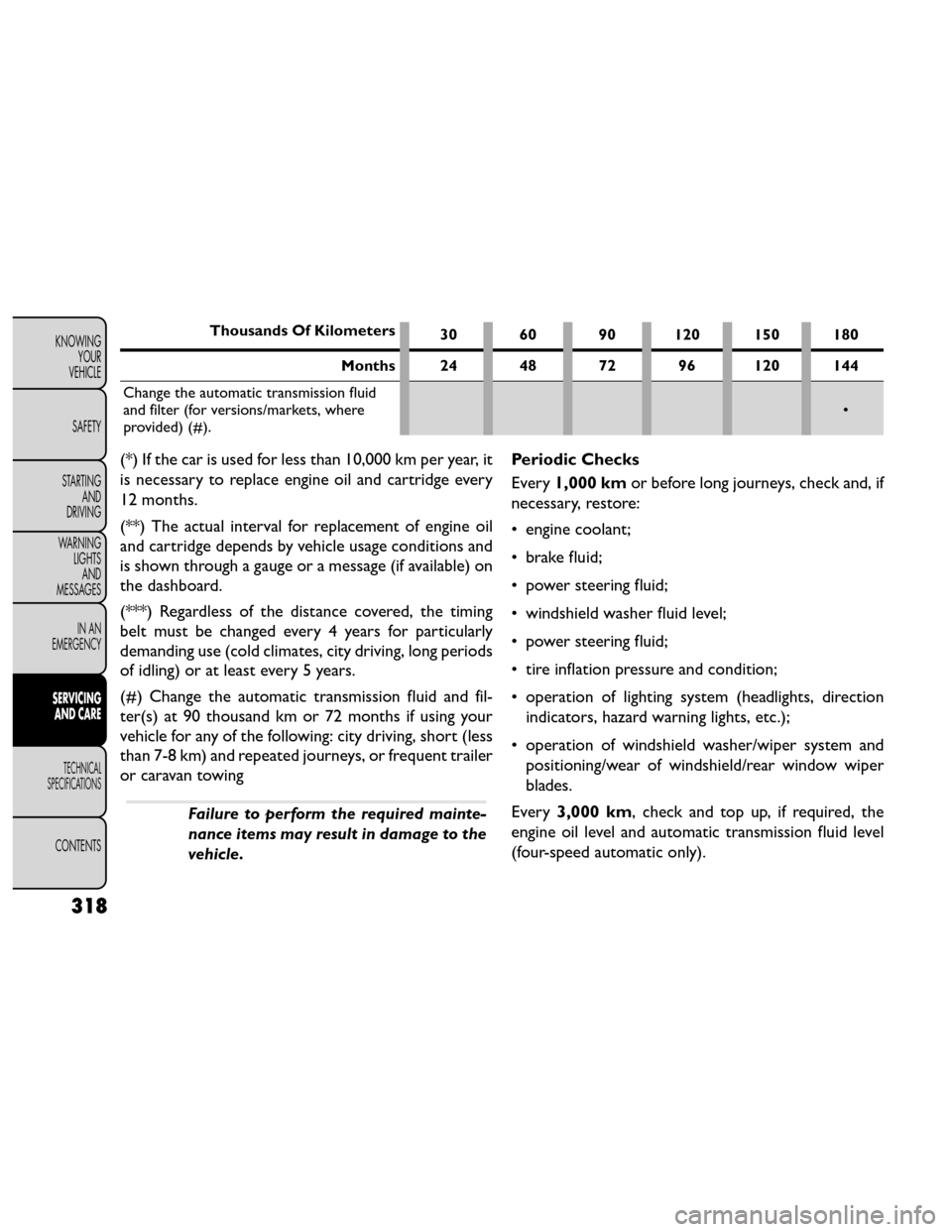
Thousands Of Kilometers30 60 90 120 150 180
Months 24 48 72 96 120 144
Change the automatic transmission fluid
and filter (for versions/markets, where
provided) (#). •
(*) If the car is used for less than 10,000 km per year, it
is necessary to replace engine oil and cartridge every
12 months.
(**) The actual interval for replacement of engine oil
and cartridge depends by vehicle usage conditions and
is shown through a gauge or a message (if available) on
the dashboard.
(***) Regardless of the distance covered, the timing
belt must be changed every 4 years for particularly
demanding use (cold climates, city driving, long periods
of idling) or at least every 5 years.
(#) Change the automatic transmission fluid and fil-
ter(s) at 90 thousand km or 72 months if using your
vehicle for any of the following: city driving, short (less
than 7-8 km) and repeated journeys, or frequent trailer
or caravan towing
Failure to perform the required mainte-
nance items may result in damage to the
vehicle.Periodic Checks
Every
1,000 km or before long journeys, check and, if
necessary, restore:
• engine coolant;
• brake fluid;
• power steering fluid;
• windshield washer fluid level;
• power steering fluid;
• tire inflation pressure and condition;
• operation of lighting system (headlights, direction indicators, hazard warning lights, etc.);
• operation of windshield washer/wiper system and positioning/wear of windshield/rear window wiper
blades.
Every 3,000 km, check and top up, if required, the
engine oil level and automatic transmission fluid level
(four-speed automatic only).
318
KNOWING YOUR
VEHICLE
SAFETY
STARTING AND
DRIVING
WARNING LIGHTSAND
MESSAGES
IN AN
EMERGENCY
SERVICING AND CARE
TECHNICAL
SPECIFICATIONS
CONTENTS
Page 325 of 388
Heavy-Duty Use Of The Car
If the car is used mainly under one of the following
conditions:
• towing a trailer or caravan;
• dusty roads;
• short, repeated journeys (less than 7-8 km) at sub-zero outside temperatures;
• engine often idling or driving long distances at low speeds or long periods of idleness.
You should perform the following inspections more
frequently than shown on the Scheduled Servicing Plan:
• check front disc brake pad conditions and wear;
• check cleanliness of hood and trunk locks, cleanli- ness and lubrication of linkage; • visually inspect conditions of: engine, transmission,
pipes and hoses (exhaust - fuel system - brakes) and
rubber elements (boots - sleeves - bushes - etc.);
• check battery charge and battery fluid level (electro- lyte);
• visually inspect condition of the accessory drive belts;
• check and, if necessary, change engine oil and replace oil filter;
• check and, if necessary, replace pollen filter;
• check and, if necessary, replace air cleaner.
319
KNOWING
YOUR
VEHICLE
SAFETY
STARTING
AND
DRIVING
WARNING
LIGHTS
AND
MESSAGES
IN AN
EMERGENCY
SERVICING
AND CARE
TECHNICAL
SPECIFICATIONS
CONTENTS
Page 358 of 388
Snow Tires
Some areas of the country require the use of snow
tires during the winter. Snow tires can be identified by
a mountain/snowflake symbol on the tire sidewall.
If you need snow tires, select tires equivalent in size
and type to the original equipment tires. Use snow tires
only in sets of four; failure to do so may adversely affect
the safety and handling of your vehicle.
Snow tires generally have lower speed ratings than
what was originally equipped with your vehicle and
should not be operated at sustained speeds over
120 km/h. For speeds above 120 km/h refer to original
equipment or an authorized tire dealer for recom-
mended safe operating speeds, loading and cold tire
inflation pressures.
While studded tires improve performance on ice, skid
and traction capability on wet or dry surfaces may be
poorer than that of non-studded tires. Some states
prohibit studded tires; therefore, local laws should be
checked before using these tire types.Run Flat Tires (for versions/markets, where
provided)
Run Flat tires allow you the capability to drive 80 km at
80 km/h after a rapid loss of inflation pressure. This
rapid loss of inflation is referred to as the Run Flat
mode. A Run Flat mode occurs when the tire inflation
pressure is of/or below 96 kPa. Once a Run Flat tire
reaches the run flat mode it has limited driving capa-
bilities and needs to be replaced immediately. A Run
Flat tire is not repairable.
It is not recommended driving a vehicle loaded at full
capacity or to tow a trailer while a tire is in the run flat
mode.
See the tire pressure monitoring section for more
information.
Spare Tires (for versions/markets, where
provided)
NOTE:
For vehicles equipped with TIREFIT instead of
a spare tire, please refer to “TIREFIT KIT” in “In an
emergency” for further information.
Because of the reduced ground clear-
ance, do not take your vehicle through an
automatic car wash with a compact , full
size or limited-use temporary spare installed.
Damage to the vehicle may result .
352
KNOWING YOUR
VEHICLE
SAFETY
STARTING AND
DRIVING
WARNING LIGHTSAND
MESSAGES
IN AN
EMERGENCY
SERVICING AND CARE
TECHNICAL
SPECIFICATIONS
CONTENTS
Page 383 of 388
Tilt Column............................60
Wheel, Heated ..........................61
Wheel Lock ............................19
Wheel, Tilt ............................60
Steering Wheel Audio Controls ................161
Steering Wheel Mounted Sound System Controls . . . .161
Storage .................................347
Storage, Vehicle ............................84
Stuck, Freeing ............................304
Sunglasses Storage ..........................99
SunRoof................................111
Sunroof Maintenance .......................113
Sun Visor Extension .........................65
Supplemental Restraint System - Airbag ...........216
Sway Control, Trailer .......................142
System, Navigation (Uconnect® gps) .............160
Tachometer ...............................7
Taillights ................................295
Telescoping Steering Column ...................60
Temperature Gauge, Engine Coolant ...............8
Tie Down Hooks, Cargo .....................128
Tilt Steering Column ........................60
Time Delay, Headlight ........................87
TIREFIT ................................284
Tires...............................228, 349 Aging (Life of Tires) ......................355
Air Pressure ...........................349
Chains ...............................357
Compact Spare .........................353
General Information .....................349
High Speed ............................350
Inflation Pressures .......................349 LifeofTires ...........................355
Pressure Monitor System (TPMS)
.............145
Radial ...............................351
Replacement ..........................356
Rotation .............................347
Safety ...............................349
SnowTires ............................352
Spare Tire ............................275
Spinning ..............................354
Trailer Towing .........................255
Tread Wear Indicators ....................355
Tongue W eight/T
railer Weight .................253
ToOpenHood ...........................131
Towing.................................250 Disabled Vehicle ........................308
Guide ...............................253
Recreational ...........................261
Weight ..............................253
TowingEyes .............................306
Traction ............................. 247, 248
Traction Control ..........................137
Trailer Sway Control (TSC) ...................142
Trailer Towing ............................250
Cooling System Tips .....................260
Hitches ..............................260
Minimum Requirements ...................254
Tips ................................259
Trailer and Tongue Weight .................253
Wiring ..............................256
Trailer Towing Guide .......................253
Trailer Weight ............................253
Transaxle Manual ..............................342
377
KNOWING
YOUR
VEHICLE
SAFETY
STARTING
AND
DRIVING
WARNING
LIGHTS
AND
MESSAGES
IN AN
EMERGENCY
SERVICING
AND CARE
TECHNICAL
SPECIFICATIONS
CONTENTS