tow FIAT FREEMONT 2014 1.G Workshop Manual
[x] Cancel search | Manufacturer: FIAT, Model Year: 2014, Model line: FREEMONT, Model: FIAT FREEMONT 2014 1.GPages: 388, PDF Size: 4.13 MB
Page 292 of 388
avoid injecting sealant into them. The TIREFIT Seal-
ant is only intended to seal punctures less than 6 mm
diameter in the tread of your vehicle.
• Do not lift or carry the TIREFIT kit by the hoses.
WARNING!
• Do not attempt to seal a tire on the
side of
the vehicle close to traffic . Pull
far enough off the road to avoid the danger of
being hit when using the TIREFIT kit .
• Do not use TIREFIT or drive the vehicle under
the following circumstances:
–If the puncture in the tire tread is approxi-
mately6mmorlarger.
– If the tire has any sidewall damage.
– If the tire has any damage from driving with
extremely low tire pressure.
– If the tire has any damage from driving on a
flat tire.
– If the wheel has any damage.
– If you are unsure of the condition of the tire or
the wheel.
• Keep TIREFIT away from open flame or heat
source.
(Continued)(Continued)
• A loose TIREFIT kit thrown forward in a colli-
sion or hard stop could endanger the occupants
of the vehicle. Always stow the TIREFIT kit in the
place provided. Failure to follow these warnings
can result in injuries that are serious or fatal to
you, your passengers, and others around you.
• Take care not to allow the contents of TIREFIT
to come in contact with hair, eyes, or clothing.
TIREFIT is harmful if inhaled, swallowed, or ab-
sorbed through the skin: It causes skin, eye, and
respiratory irritation. Flush immediately with
plenty of water if there is any contact with eyes
or skin. Change clothing as soon as possible, if
there is any contact with clothing.
• TIREFIT Sealant solution contains latex. In case
of allergic reaction or rash, consult a physician
immediately. Keep TIREFIT out of reach of chil-
dren. If swallowed, rinse mouth immediately with
plenty of water and drink plenty of water. Do not
induce vomiting! Consult a physician immedi-
ately.
• Use the gloves provided in the Accessor y Stor-
age Compartment (located on the bottom of the
air pump) when operating the TIREFIT kit .
286
KNOWING YOUR
VEHICLE
SAFETY
STARTING AND
DRIVING
WARNING LIGHTSAND
MESSAGES
IN AN
EMERGENCY
SERVICING AND CARE
TECHNICAL
SPECIFICATIONS
CONTENTS
Page 303 of 388
4. Rotate the applicable bulb's electrical connector¼ turn counterclockwise and remove it from the
housing.
5. Remove the bulb from the connector socket and install the replacement bulb.
6. Install the bulb and connector assembly into the housing and rotate the connector ¼ turn clockwise
to lock it in place.
7. Reinstall the taillamp housing and fasteners.
LICENSE PLATE LAMP
1. Push the small locking tab sticking out of the end of the lens toward the side of the vehicle and hold it in
that position.
2. Insert a small flat-blade tool between the end of the lens with the locking tab and the surrounding hous-
ing and then pivot the tool to separate the lens from
the housing. 3. Hold the lens with one hand and rotate the bulb's
electrical connector ¼ turn counterclockwise with
the other hand and then separate the bulb and
connector assembly from the lens.
4. Remove the bulb from the connector socket and install the replacement bulb.
5. Install the bulb and connector assembly into the lens and rotate the connector ¼ turn clockwise to
lock it in place.
6. Insert the end of the lens without the locking tab into the housing on the liftgate and then push the
opposite end of the lens into the housing, making
sure it locks in the housing.
297
KNOWING
YOUR
VEHICLE
SAFETY
STARTING
AND
DRIVING
WARNING
LIGHTS
AND
MESSAGES
IN AN
EMERGENCY
SERVICING
AND CARE
TECHNICAL
SPECIFICATIONS
CONTENTS
Page 305 of 388
CavityCar-
tridge Fuse Mini-
Fuse Description
F107 10 Amp
Red Rear Camera – For
Versions/Markets,Where Provided
F108 15 Amp
Blue Instrument Panel
F109 10 Amp
Red Climate Control/
HVAC
F110 10 Amp
Red Occupant Restraint
Controller
F112 10 Amp
Red Spare
F114 20 Amp
Yellow Rear HVAC Blower/
Motor
F115 20 Amp
Yellow Rear Wiper Motor
F116 30 Amp
Pink Rear Defroster
(EBL)
F117 10 Amp
Red Heated Mirrors
F118 10 Amp
Red Occupant Restraint
Controller
F119 10 Amp
Red Steering Column
Control ModuleCavity Car-
tridge Fuse Mini-
Fuse Description
F120 10 Amp
Red All Wheel Drive –
For Versions/
Markets, Where Provided
F121 15 Amp
Blue Wireless Ignition
Node
F122 25 Amp
Natural Driver Door Module
F123 25 Amp
Natural Passenger Door
Module
F124 10 Amp
Red Mirrors
F125 10 Amp
Red Steering Column
Control Module
F126 10 Amp
Red Audio Amplifier
F127 20 Amp
Yellow Trailer Tow – For
Versions/Markets, Where Provided
F128 15 Amp
Blue Radio
F129 15 Amp
Blue Video/DVD – For
Versions/Markets, Where Provided
299
KNOWING
YOUR
VEHICLE
SAFETY
STARTING
AND
DRIVING
WARNING
LIGHTS
AND
MESSAGES
IN AN
EMERGENCY
SERVICING
AND CARE
TECHNICAL
SPECIFICATIONS
CONTENTS
Page 312 of 388
TOW EYE
Your vehicle is equipped with a tow eye that can be
used to tow a disabled vehicle.
(fig. 188)
Tow eyes are for emergency use only, to
rescue a vehicle stranded off road. Do not
use tow eyes for tow truck hookup or
highway towing. You could damage your vehicle.
Tow straps are recommended when towing the
vehicle; chains may cause vehicle damage.
WARNING!
Stand clear of vehicles when pulling with
tow e y
es. Tow straps and chains may
break, causing serious injury.
(fig. 188)
To w E y e
306
KNOWINGYOUR
VEHICLE
SAFETY
STARTING AND
DRIVING
WARNING LIGHTSAND
MESSAGES
IN AN
EMERGENCY
SERVICING AND CARE
TECHNICAL
SPECIFICATIONS
CONTENTS
Page 313 of 388
FRONT TOW EYE USAGE
The front tow eye receptacle is located on the lower
right side of the front fascia.
To install the tow eye, remove the rubber plug and
thread the tow eye into the receptacle.
Insert the flat end of the jack handle through the eye
and tighten, refer to “Jacking and Tire Changing” for
further information. The tow hook must be fully seated
to the attaching bracket through the lower front fascia
as shown. If the tow hook is not fully seated to the
attaching bracket, the vehicle should not be towed.
(fig. 189)
REAR TOW EYE USAGE
The rear tow eye receptacle is located behind a door,
located on the left rear bumper fascia.
To install the tow eye, open the door using the vehicle
key or a small screwdriver, and thread the tow eye into
the receptacle.
Insert the flat end of the jack handle through the eye
and tighten, refer to “Jacking and Tire Changing” for
further information. The tow hook must be fully seated
to the attaching bracket through the lower rear fascia
as shown. If the tow hook is not fully seated to the
attaching bracket, the vehicle should not be towed.
(fig. 190)
(fig. 189)Front Tow Eye Installed(fig. 190) Rear Tow Eye Installed
307
KNOWING
YOUR
VEHICLE
SAFETY
STARTING
AND
DRIVING
WARNING
LIGHTS
AND
MESSAGES
IN AN
EMERGENCY
SERVICING
AND CARE
TECHNICAL
SPECIFICATIONS
CONTENTS
Page 314 of 388
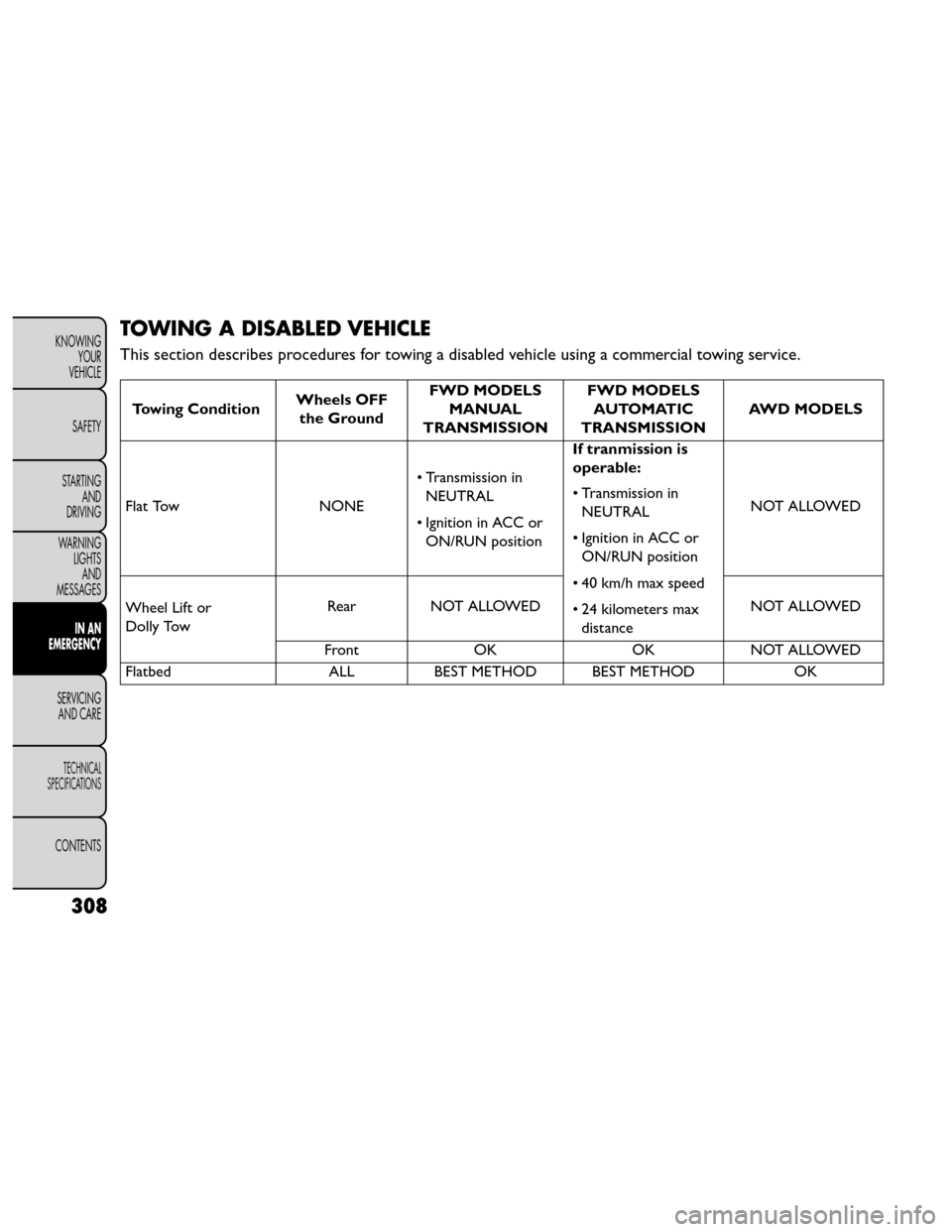
TOWING A DISABLED VEHICLE
This section describes procedures for towing a disabled vehicle using a commercial towing service.
Towing ConditionWheels OFF
the Ground FWD MODELS
MANUAL
TRANSMISSION FWD MODELS
AUTOMATIC
TRANSMISSION AWD MODELS
Flat Tow NONE • Transmission in
NEUTRAL
• Ignition in ACC or ON/RUN position If tranmission is
operable:
• Transmission in
NEUTRAL
• Ignition in ACC or ON/RUN position
• 40 km/h max speed
• 24 kilometers max distance NOT ALLOWED
Wheel Lift or
Dolly Tow Rear NOT ALLOWED
NOT ALLOWED
Front OK OKNOT ALLOWED
Flatbed ALLBEST METHOD BEST METHOD OK
308
KNOWING
YOUR
VEHICLE
SAFETY
STARTING AND
DRIVING
WARNING LIGHTSAND
MESSAGES
IN AN
EMERGENCY
SERVICING AND CARE
TECHNICAL
SPECIFICATIONS
CONTENTS
Page 315 of 388
Proper towing or lifting equipment is required to pre-
vent damage to your vehicle. Use only tow bars and
other equipment designed for this purpose, following
equipment manufacturer’s instructions. Use of safety
chains is mandatory. Attach a tow bar or other towing
device to main structural members of the vehicle, not
to bumpers or associated brackets. State and local laws
regarding vehicles under tow must be observed.
If you must use the accessories (wipers, defrosters,
etc.) while being towed, the ignition must be in the
ON/RUN position, not the ACC position.
If the vehicle's battery is discharged, refer to "Shift Lever
Override" in this section for instructions on shifting the
automatic transmission out of PARK for towing.
•Do not use sling type equipment when
towing. Damage to the fascia will occur.
• When securing the vehicle to a flatbed
truck, do not attach to front or rear suspension
components. Damage to your vehicle may result
from improper towing.
• Do not push or tow this vehicle with another
vehicle as damage to the bumper fascia and trans-
mission may result .
• If the vehicle being towed requires steering, the
ignitionswitchmustbeintheACCorON/RUN
position, not in the LOCK/OFF position. WITHOUT THE KEY FOB
Special care must be taken when the vehicle is towed
with the ignition in the OFF position. Flatbed towing is
the preferred towing method. However, if a flatbed
towing vehicle is not available, wheel lift towing equip-
ment may be used. Rear towing (with the front wheels
on the ground) is not allowed, as transmission damage
will occur. If rear towing is the only alternative, the
front wheels must be placed on a towing dolly. Proper
towing equipment is necessary to prevent damage to
the vehicle.
ALL-WHEEL DRIVE (AWD) MODELS
The manufacturer requires towing with all four wheels
OFF
the ground. Acceptable methods are to tow the
vehicle on a flatbed, or with one end of vehicle raised
and the opposite end on a towing dolly.
Towing this vehicle in violation of the
above requirements can cause severe
transmission and/or power transfer unit
damage. Damage from improper towing is not cov-
ered under the New Vehicle Limited Warranty.
309
KNOWING
YOUR
VEHICLE
SAFETY
STARTING
AND
DRIVING
WARNING
LIGHTS
AND
MESSAGES
IN AN
EMERGENCY
SERVICING
AND CARE
TECHNICAL
SPECIFICATIONS
CONTENTS
Page 316 of 388
FRONT WHEEL DRIVE (FWD) MODELS —
MANUAL TRANSMISSION
The manufacturer recommends towing your vehicle
with all four wheels OFF the ground using a flatbed.
Your vehicle may also be towed in the forward direc-
tion, with all four wheels on the ground, the transmis-
sion in NEUTRAL, and the ignition in the ACC or
ON/RUN position. If the transmission is not operative,
the vehicle must be towed with the front wheels OFF
the ground (using a flatbed truck, towing dolly, or
wheel lift equipment with the front wheels raised).
Towing this vehicle in violation of the
above requirements can cause severe
engine and/or transmission damage.
Damage from improper towing is not covered
under the New Vehicle Limited Warranty. FRONT WHEEL DRIVE (FWD) MODELS —
AUTOMATIC TRANSMISSION
The manufacturer recommends towing your vehicle
with all four wheels OFF the ground using a flatbed.
If flatbed equipment is not available, and the transmission
is operable, the vehicle may be flat towed (with all four
wheels on the ground) under the following conditions:
• The transmission must be in NEUTRAL.
• The towing distance must not exceed 24 km .
• The towing speed must not exceed 40 km/h.
If the transmission is not operable, or the ve-
hicle must be towed faster than 40 km/h or
farther than 24 km, it must be towed with the
front wheels OFF the ground (using a flatbed
truck, towing dolly, or wheel lift equipment with
the front wheels raised).
Towing this vehicle in violation of the
above requirements can cause severe
transmission damage. Damage from
improper towing is not covered under the New
Vehicle Limited Warranty.
310
KNOWING YOUR
VEHICLE
SAFETY
STARTING AND
DRIVING
WARNING LIGHTSAND
MESSAGES
IN AN
EMERGENCY
SERVICING AND CARE
TECHNICAL
SPECIFICATIONS
CONTENTS
Page 319 of 388
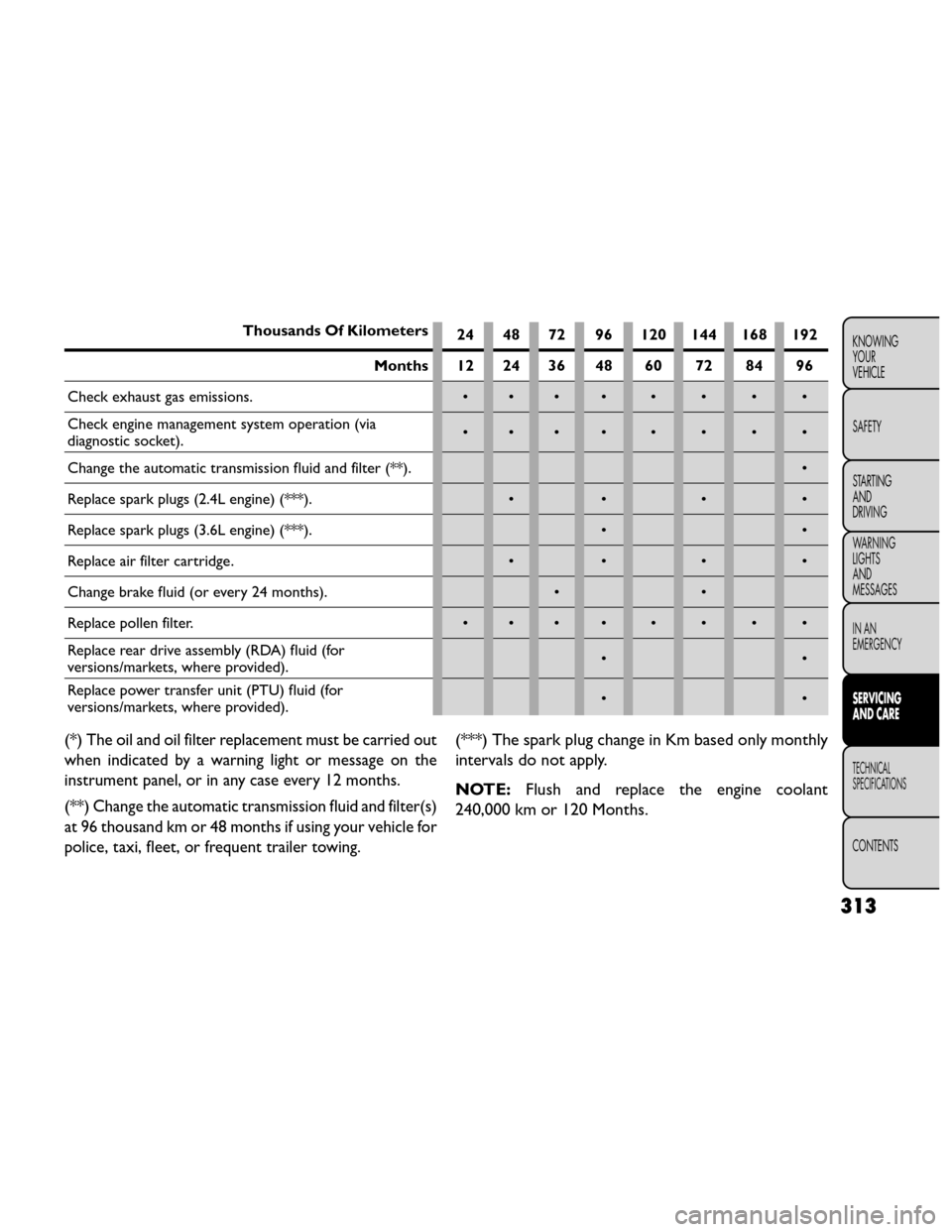
Thousands Of Kilometers24 48 72 96 120 144 168 192
Months 12 24 36 48 60 72 84 96
Check exhaust gas emissions. • • • •••••
Check engine management system operation (via
diagnostic socket). ••••••••
Change the automatic transmission fluid and filter (**). •
Replace spark plugs (2.4L engine) (***). •• • •
Replace spark plugs (3.6L engine) (***). ••
Replace air filter cartridge. •• • •
Change brake fluid (or every 24 months). ••
Replace pollen filter. • • • •••••
Replace rear drive assembly (RDA) fluid (for
versions/markets, where provided). ••
Replace power transfer unit (PTU) fluid (for
versions/markets, where provided). ••
(*)The oil and oil filter replacement must be carried out
when indicated by a warning light or message on the
instrument panel, or in any case every 12 months.
(**)Change the automatic transmission fluid and filter(s)
at 96 thousand km or 48 months if using your vehicle for
police, taxi, fleet, or frequent trailer towing.
(***) The spark plug change in Km based only monthly
intervals do not apply.
NOTE: Flush and replace the engine coolant
240,000 km or 120 Months.
313
KNOWING
YOUR
VEHICLE
SAFETY
STARTING
AND
DRIVING
WARNING
LIGHTS
AND
MESSAGES
IN AN
EMERGENCY
SERVICING
AND CARE
TECHNICAL
SPECIFICATIONS
CONTENTS
Page 320 of 388
Periodic Checks
Every1,000 km or before long journeys, check and, if
necessary, restore:
• engine coolant;
• brake fluid;
• power steering fluid;
• windshield washer fluid level;
• power steering fluid;
• tire inflation pressure and condition;
• operation of lighting system (headlights, direction indicators, hazard warning lights, etc.);
• operation of windshield washer/wiper system and positioning/wear of windshield/rear window wiper
blades.
Every 3,000 km, check and top up, if required, the
engine oil level and automatic transmission fluid level
(four-speed automatic only). Heavy-Duty Use Of The Car
If the car is used mainly under one of the following
conditions:
• towing a trailer or caravan;
• dusty roads;
• short, repeated journeys (less than 7-8 km) at sub-
zero outside temperatures;
• engine often idling or driving long distances at low speeds or long periods of idleness.
You should perform the following inspections more
frequently than shown on the Scheduled Servicing Plan:
• check front disc brake pad conditions and wear;
• check cleanliness of hood and trunk locks, cleanli- ness and lubrication of linkage;
• visually inspect conditions of: engine, transmission, pipes and hoses (exhaust - fuel system - brakes) and
rubber elements (boots - sleeves - bushes - etc.);
• check battery charge and battery fluid level (electro- lyte);
•
visually inspect condition of the accessory drive belts;
• check and, if necessary, change engine oil and replace oil filter;
• check and, if necessary, replace pollen filter;
• check and, if necessary, replace air cleaner.
314
KNOWING YOUR
VEHICLE
SAFETY
STARTING AND
DRIVING
WARNING LIGHTSAND
MESSAGES
IN AN
EMERGENCY
SERVICING AND CARE
TECHNICAL
SPECIFICATIONS
CONTENTS