wiper fluid FIAT FREEMONT 2014 1.G Owners Manual
[x] Cancel search | Manufacturer: FIAT, Model Year: 2014, Model line: FREEMONT, Model: FIAT FREEMONT 2014 1.GPages: 388, PDF Size: 4.13 MB
Page 99 of 388
•Turn the windshield wipers OFF when
driving through an automatic car wash.
Damage to the windshield wipers may
result if the wiper control is left in any position
other than OFF.
• In cold weather, always turn OFF the wiper
switch and allow the wipers to return to the park
position before turning OFF the engine. If the
wiper switch is left ON and the wipers freeze to
the windshield, damage to the wiper motor may
occur when the vehicle is restarted.
• Always remove any buildup of snow that pre-
vents the windshield wiper blades from returning
to the “park” position. If the windshield wiper
control is turned OFF, and the blades cannot
return to the “park” position, damage to the wiper
motor may occur.
WINDSHIELD WASHERS
To use the windshield washer, push the washer knob,
located on the end of the multifunction lever, inward to
the second detent.
If you activate the washer while the wiper control is in
the delay range, the wipers will operate in low-speed
for two or three wipe cycles after releasing the lever
and then resume the intermittent interval previously
selected. If you activate the washer while the wiper control is in
the OFF position, the wipers will operate for two or
three wipe cycles and then turn OFF.
WARNING!
Sudden loss of visibility through the
windshield c
ould lead to a collision. You
might not see other vehicles or other obstacles.
To avoid sudden icing of the windshield during
freezing weather, warm the windshield with the
defroster before and during windshield washer
use.
MIST FEATURE
Push the washer knob, located on the end of the
multifunction lever, inward to the first detent to acti-
vate a single wipe cycle to clear the windshield of road
mist or spray from a passing vehicle. The wipers will
continue to operate until you release the lever.
NOTE: The mist feature does not activate the washer
pump; therefore, no washer fluid will be sprayed on the
windshield. The wash function must be used in order to
spray the windshield with washer fluid.
93
KNOWING
YOUR
VEHICLE
SAFETY
STARTING
AND
DRIVING
W
ARNING
LIGHTS
AND
MESSAGES
IN AN
EMERGENCY
SERVICING
AND CARE
TECHNICAL
SPECIFICATIONS
CONTENTS
Page 100 of 388
HEADLIGHT WASHERS
(for versions/markets, where
provided)
The Headlight Washers are recessed into the top of
the fascia, centrally located below each headlight.
The windshield wiper/washer control lever operates
the headlight washers when the ignition switch is in the
ON position and the headlights are ON. The lever is
located on the left side of the steering column.
To use the headlight washers, push the washer knob,
located on the end of the multifunction lever, inward to
the second detent to activate the windshield washers
and release it. When this is done, the two stationary
washer nozzles at each headlight spray one timed
high-pressure spray of washer fluid onto each headlight
lens. In addition, the windshield washers will spray the
windshield and the windshield wipers will cycle.
NOTE:After turning the ignition switch and head-
lights ON, the headlight washers will operate on the
first spray of the windshield washer and then every
eleventh spray after that.
REAR WINDOW FEATURES
REAR WINDOW WIPER/WASHER
The rear window wiper/washer control is located on
the right side of the steering column.
(fig. 69)
Rotate the switch upward to the first detent
position for rear wiper operation.
NOTE: The rear wiper operates in an intermittent
mode only.
(fig. 69)
Rear Wiper/Washer
94
KNOWINGYOUR
VEHICLE
SAFETY
STARTING AND
DRIVING
W
ARNING LIGHTS AND
MESSAGES
IN AN
EMERGENCY
SERVICING AND CARE
TECHNICAL
SPECIFICATIONS
CONTENTS
Page 318 of 388
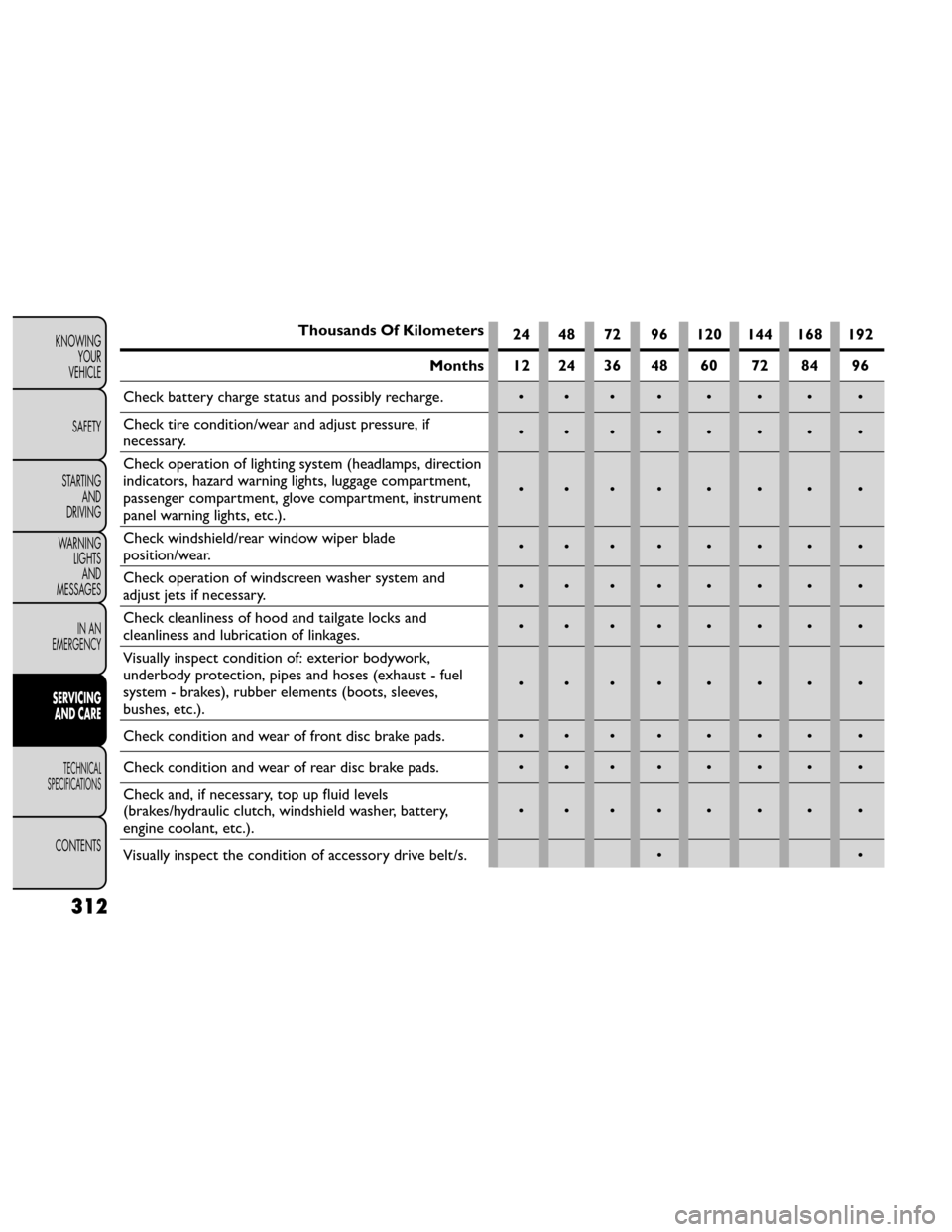
Thousands Of Kilometers24 48 72 96 120 144 168 192
Months 12 24 36 48 60 72 84 96
Check battery charge status and possibly recharge. • • • • ••••
Check tire condition/wear and adjust pressure, if
necessary. ••••••••
Check operation of lighting system (headlamps, direction
indicators, hazard warning lights, luggage compartment,
passenger compartment, glove compartment, instrument
panel warning lights, etc.). ••••••••
Check windshield/rear window wiper blade
position/wear. ••••••••
Check operation of windscreen washer system and
adjust jets if necessary. ••••••••
Check cleanliness of hood and tailgate locks and
cleanliness and lubrication of linkages. ••••••••
Visually inspect condition of: exterior bodywork,
underbody protection, pipes and hoses (exhaust - fuel
system - brakes), rubber elements (boots, sleeves,
bushes, etc.). ••••••••
Check condition and wear of front disc brake pads. • • • • ••••
Check condition and wear of rear disc brake pads. • • • •••••
Check and, if necessary, top up fluid levels
(brakes/hydraulic clutch, windshield washer, battery,
engine coolant, etc.). ••••••••
Visually inspect the condition of accessory drive belt/s. ••
312
KNOWING
YOUR
VEHICLE
SAFETY
STARTING AND
DRIVING
WARNING LIGHTSAND
MESSAGES
IN AN
EMERGENCY
SERVICING AND CARE
TECHNICAL
SPECIFICATIONS
CONTENTS
Page 320 of 388
Periodic Checks
Every1,000 km or before long journeys, check and, if
necessary, restore:
• engine coolant;
• brake fluid;
• power steering fluid;
• windshield washer fluid level;
• power steering fluid;
• tire inflation pressure and condition;
• operation of lighting system (headlights, direction indicators, hazard warning lights, etc.);
• operation of windshield washer/wiper system and positioning/wear of windshield/rear window wiper
blades.
Every 3,000 km, check and top up, if required, the
engine oil level and automatic transmission fluid level
(four-speed automatic only). Heavy-Duty Use Of The Car
If the car is used mainly under one of the following
conditions:
• towing a trailer or caravan;
• dusty roads;
• short, repeated journeys (less than 7-8 km) at sub-
zero outside temperatures;
• engine often idling or driving long distances at low speeds or long periods of idleness.
You should perform the following inspections more
frequently than shown on the Scheduled Servicing Plan:
• check front disc brake pad conditions and wear;
• check cleanliness of hood and trunk locks, cleanli- ness and lubrication of linkage;
• visually inspect conditions of: engine, transmission, pipes and hoses (exhaust - fuel system - brakes) and
rubber elements (boots - sleeves - bushes - etc.);
• check battery charge and battery fluid level (electro- lyte);
•
visually inspect condition of the accessory drive belts;
• check and, if necessary, change engine oil and replace oil filter;
• check and, if necessary, replace pollen filter;
• check and, if necessary, replace air cleaner.
314
KNOWING YOUR
VEHICLE
SAFETY
STARTING AND
DRIVING
WARNING LIGHTSAND
MESSAGES
IN AN
EMERGENCY
SERVICING AND CARE
TECHNICAL
SPECIFICATIONS
CONTENTS
Page 322 of 388
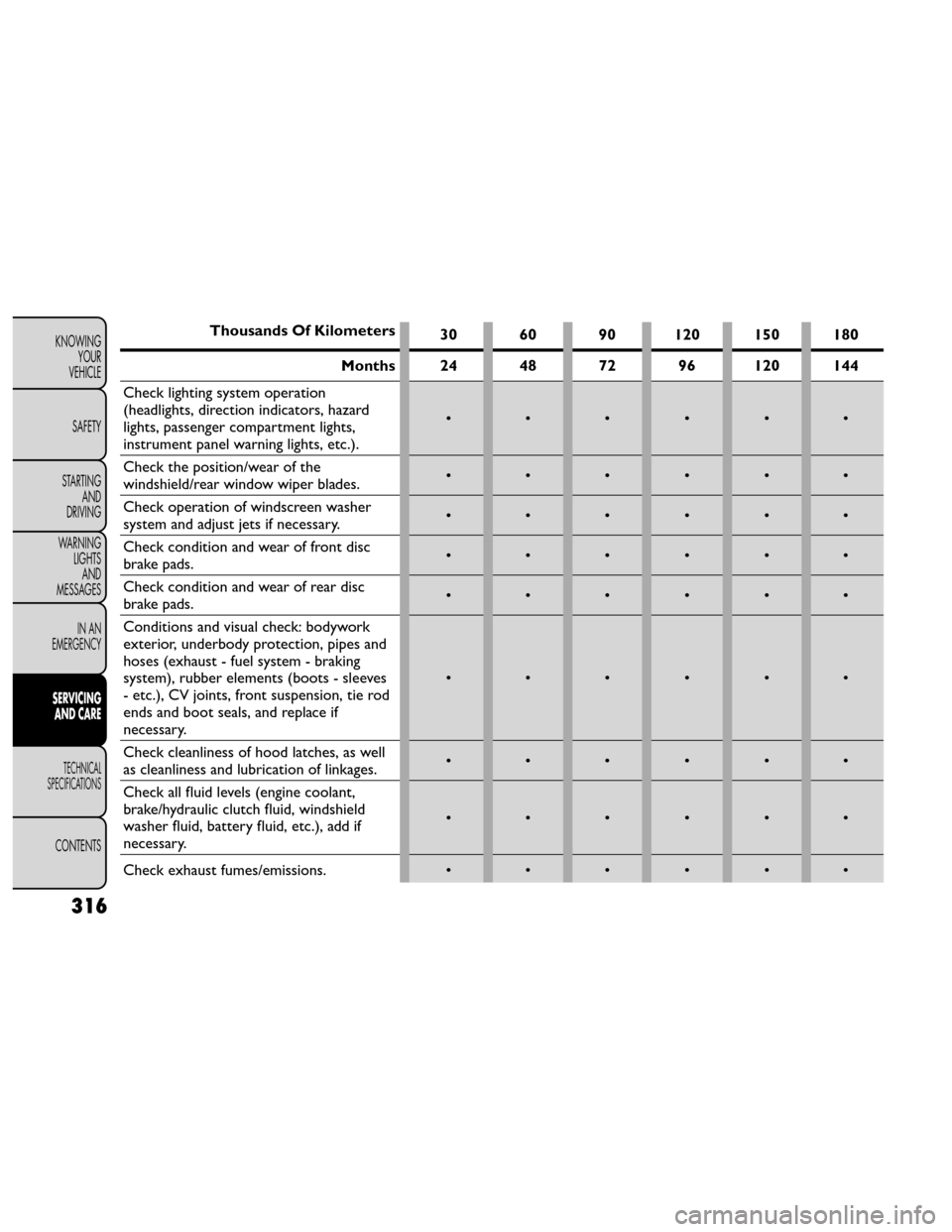
Thousands Of Kilometers30 60 90 120 150 180
Months 24 48 72 96 120 144
Check lighting system operation
(headlights, direction indicators, hazard
lights, passenger compartment lights,
instrument panel warning lights, etc.). ••••••
Check the position/wear of the
windshield/rear window wiper blades. ••••••
Check operation of windscreen washer
system and adjust jets if necessary. ••••••
Check condition and wear of front disc
brake pads. ••••••
Check condition and wear of rear disc
brake pads. ••••••
Conditions and visual check: bodywork
exterior, underbody protection, pipes and
hoses (exhaust - fuel system - braking
system), rubber elements (boots - sleeves
- etc.), CV joints, front suspension, tie rod
ends and boot seals, and replace if
necessary. ••••••
Check cleanliness of hood latches, as well
as cleanliness and lubrication of linkages. ••••••
Check all fluid levels (engine coolant,
brake/hydraulic clutch fluid, windshield
washer fluid, battery fluid, etc.), add if
necessary. ••••••
Check exhaust fumes/emissions. • • • • • •
316
KNOWING
YOUR
VEHICLE
SAFETY
STARTING AND
DRIVING
WARNING LIGHTSAND
MESSAGES
IN AN
EMERGENCY
SERVICING AND CARE
TECHNICAL
SPECIFICATIONS
CONTENTS
Page 324 of 388
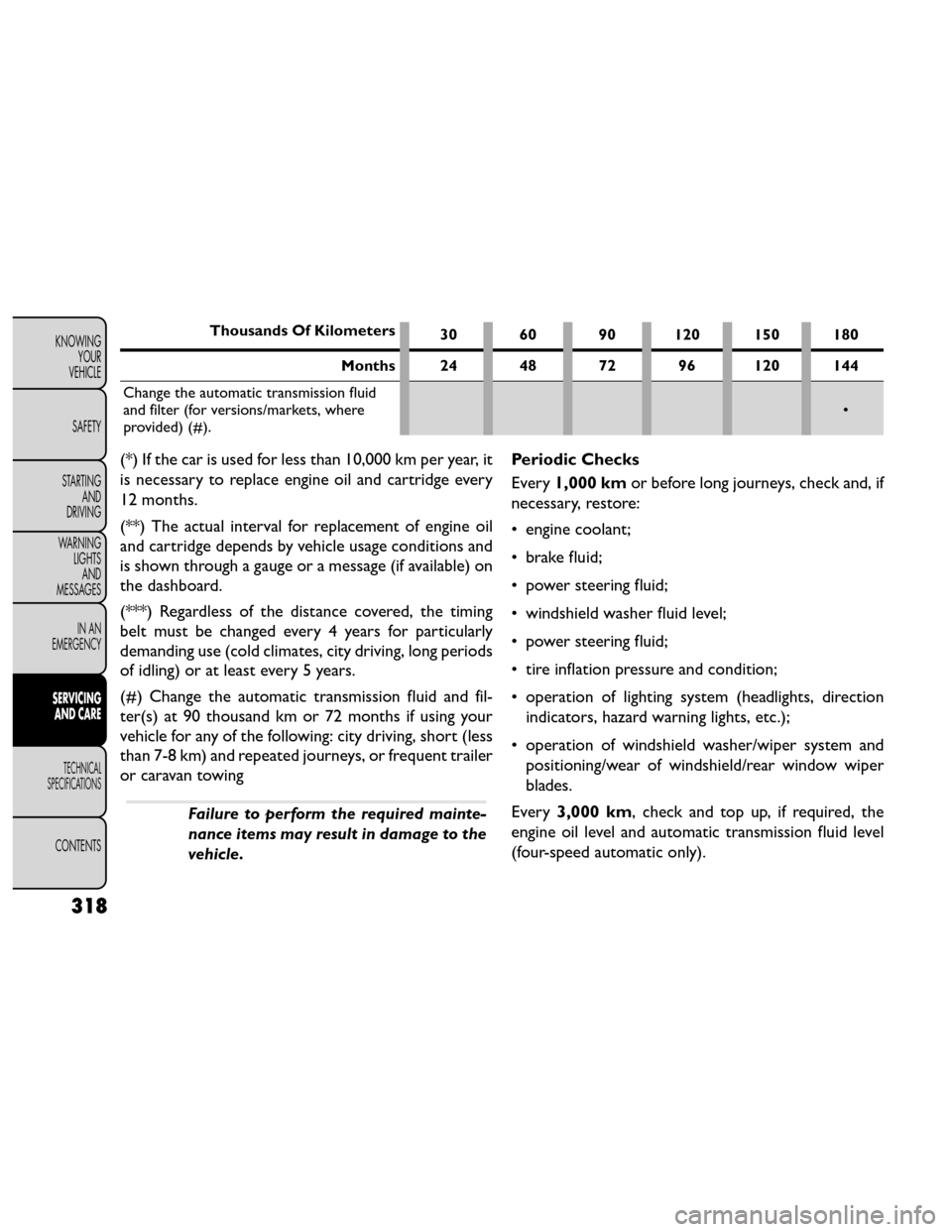
Thousands Of Kilometers30 60 90 120 150 180
Months 24 48 72 96 120 144
Change the automatic transmission fluid
and filter (for versions/markets, where
provided) (#). •
(*) If the car is used for less than 10,000 km per year, it
is necessary to replace engine oil and cartridge every
12 months.
(**) The actual interval for replacement of engine oil
and cartridge depends by vehicle usage conditions and
is shown through a gauge or a message (if available) on
the dashboard.
(***) Regardless of the distance covered, the timing
belt must be changed every 4 years for particularly
demanding use (cold climates, city driving, long periods
of idling) or at least every 5 years.
(#) Change the automatic transmission fluid and fil-
ter(s) at 90 thousand km or 72 months if using your
vehicle for any of the following: city driving, short (less
than 7-8 km) and repeated journeys, or frequent trailer
or caravan towing
Failure to perform the required mainte-
nance items may result in damage to the
vehicle.Periodic Checks
Every
1,000 km or before long journeys, check and, if
necessary, restore:
• engine coolant;
• brake fluid;
• power steering fluid;
• windshield washer fluid level;
• power steering fluid;
• tire inflation pressure and condition;
• operation of lighting system (headlights, direction indicators, hazard warning lights, etc.);
• operation of windshield washer/wiper system and positioning/wear of windshield/rear window wiper
blades.
Every 3,000 km, check and top up, if required, the
engine oil level and automatic transmission fluid level
(four-speed automatic only).
318
KNOWING YOUR
VEHICLE
SAFETY
STARTING AND
DRIVING
WARNING LIGHTSAND
MESSAGES
IN AN
EMERGENCY
SERVICING AND CARE
TECHNICAL
SPECIFICATIONS
CONTENTS
Page 336 of 388
Car maintenance should be done at a
FIAT Dealership. For routine and minor
maintenance operations you wish to
carry out yourself, we do recommend you have
the proper equipment , genuine FIAT spare parts
and the necessary fluids; do not however carry out
these operations if you have no experience.
WIPER BLADES
Clean the rubber edges of the wiper blades and the
windshield and rear window periodically with a sponge
or soft cloth and a mild nonabrasive cleaner. This will
remove accumulations of salt, waxes, or road film, and
help reduce streaking and smearing.
Operation of the wipers on dry glass for long periods
may cause deterioration of the wiper blades. Always
use washer fluid when using the wipers to remove salt
or dirt from a dry windshield or rear window.
Avoid using the wiper blades to remove frost or ice
from the windshield or rear window. Make sure that
they are not frozen to the glass before turning them on
to avoid damaging the blade. Keep the blade rubber out
of contact with petroleum products such as engine oil,
gasoline, etc. NOTE:
Life expectancy of wiper blades varies depend-
ing on geographical area and frequency of use. Poor
performance of blades may be present with chattering,
marks, water lines or wet spots. If any of these condi-
tions are present, clean the wiper blades or replace as
necessary.
Rear Wiper Removal/Installation
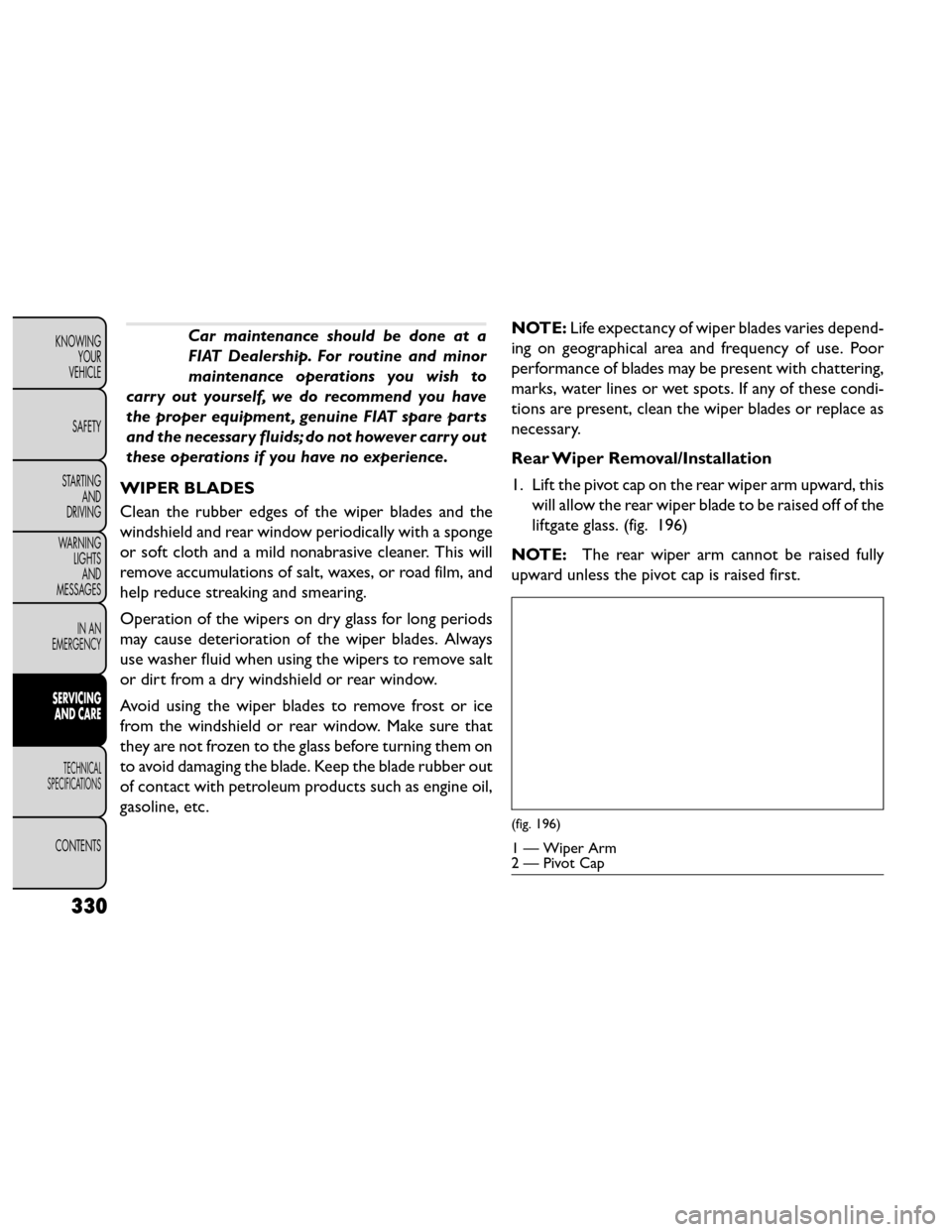
1. Lift the pivot cap on the rear wiper arm upward, this will allow the rear wiper blade to be raised off of the
liftgate glass. (fig. 196)
NOTE: The rear wiper arm cannot be raised fully
upward unless the pivot cap is raised first.
(fig. 196)
1 — Wiper Arm
2 — Pivot Cap
330
KNOWING YOUR
VEHICLE
SAFETY
STARTING AND
DRIVING
WARNING LIGHTSAND
MESSAGES
IN AN
EMERGENCY
SERVICING AND CARE
TECHNICAL
SPECIFICATIONS
CONTENTS
Page 337 of 388
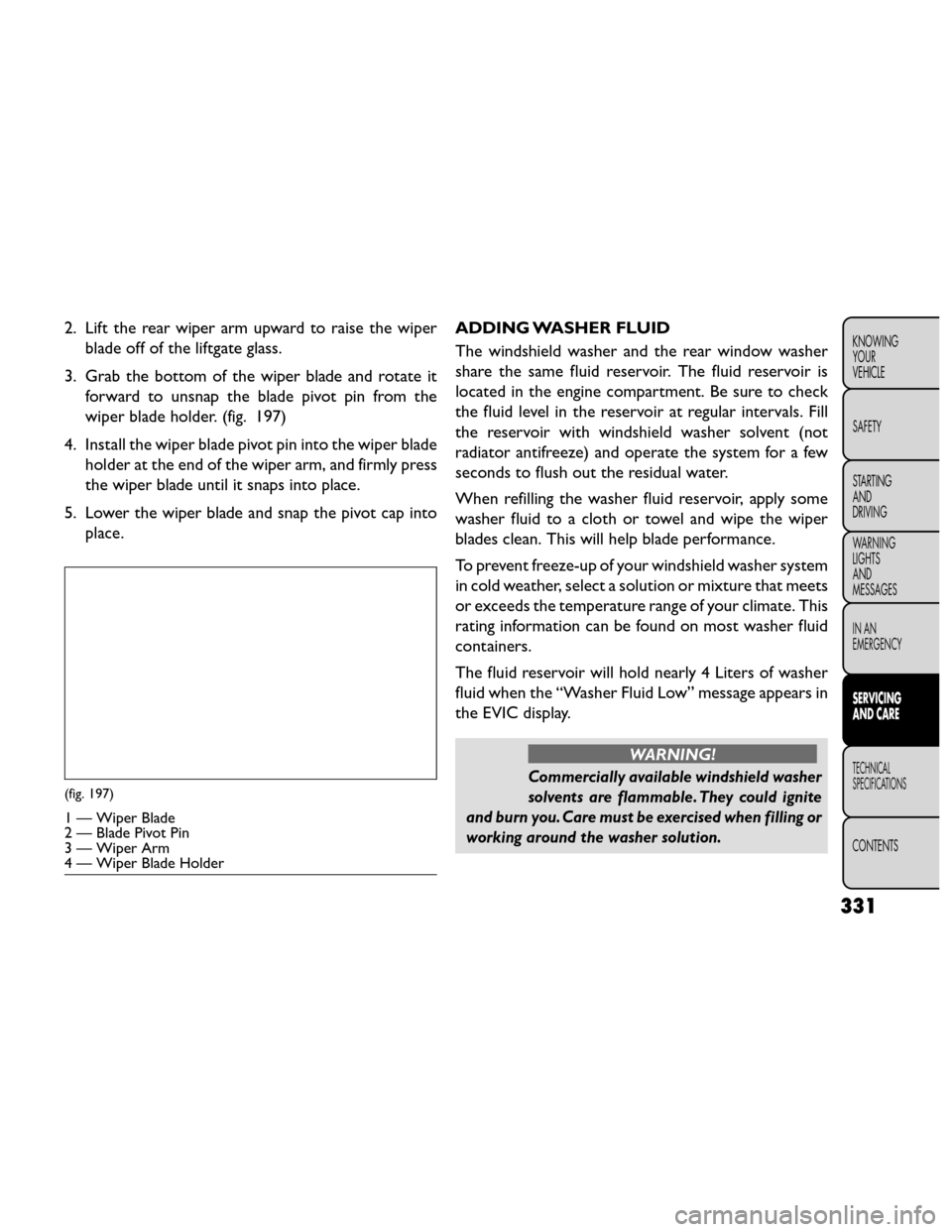
2. Lift the rear wiper arm upward to raise the wiperblade off of the liftgate glass.
3. Grab the bottom of the wiper blade and rotate it forward to unsnap the blade pivot pin from the
wiper blade holder. (fig. 197)
4. Install the wiper blade pivot pin into the wiper blade holder at the end of the wiper arm, and firmly press
the wiper blade until it snaps into place.
5. Lower the wiper blade and snap the pivot cap into place. ADDING WASHER FLUID
The windshield washer and the rear window washer
share the same fluid reservoir. The fluid reservoir is
located in the engine compartment. Be sure to check
the fluid level in the reservoir at regular intervals. Fill
the reservoir with windshield washer solvent (not
radiator antifreeze) and operate the system for a few
seconds to flush out the residual water.
When refilling the washer fluid reservoir, apply some
washer fluid to a cloth or towel and wipe the wiper
blades clean. This will help blade performance.
To prevent freeze-up of your windshield washer system
in cold weather, select a solution or mixture that meets
or exceeds the temperature range of your climate. This
rating information can be found on most washer fluid
containers.
The fluid reservoir will hold nearly 4 Liters of washer
fluid when the “Washer Fluid Low” message appears in
the EVIC display.
WARNING!
Commercially available windshield washer
solvents are flammable. They could ignite
and burn you. Care must be exercised when filling or
working around the washer solution.
(fig. 197)
1 — Wiper Blade
2 — Blade Pivot Pin
3 — Wiper Arm
4 — Wiper Blade Holder
331
KNOWING
YOUR
VEHICLE
SAFETY
STARTING
AND
DRIVING
WARNING
LIGHTS
AND
MESSAGES
IN AN
EMERGENCY
SERVICING
AND CARE
TECHNICAL
SPECIFICATIONS
CONTENTS
Page 375 of 388
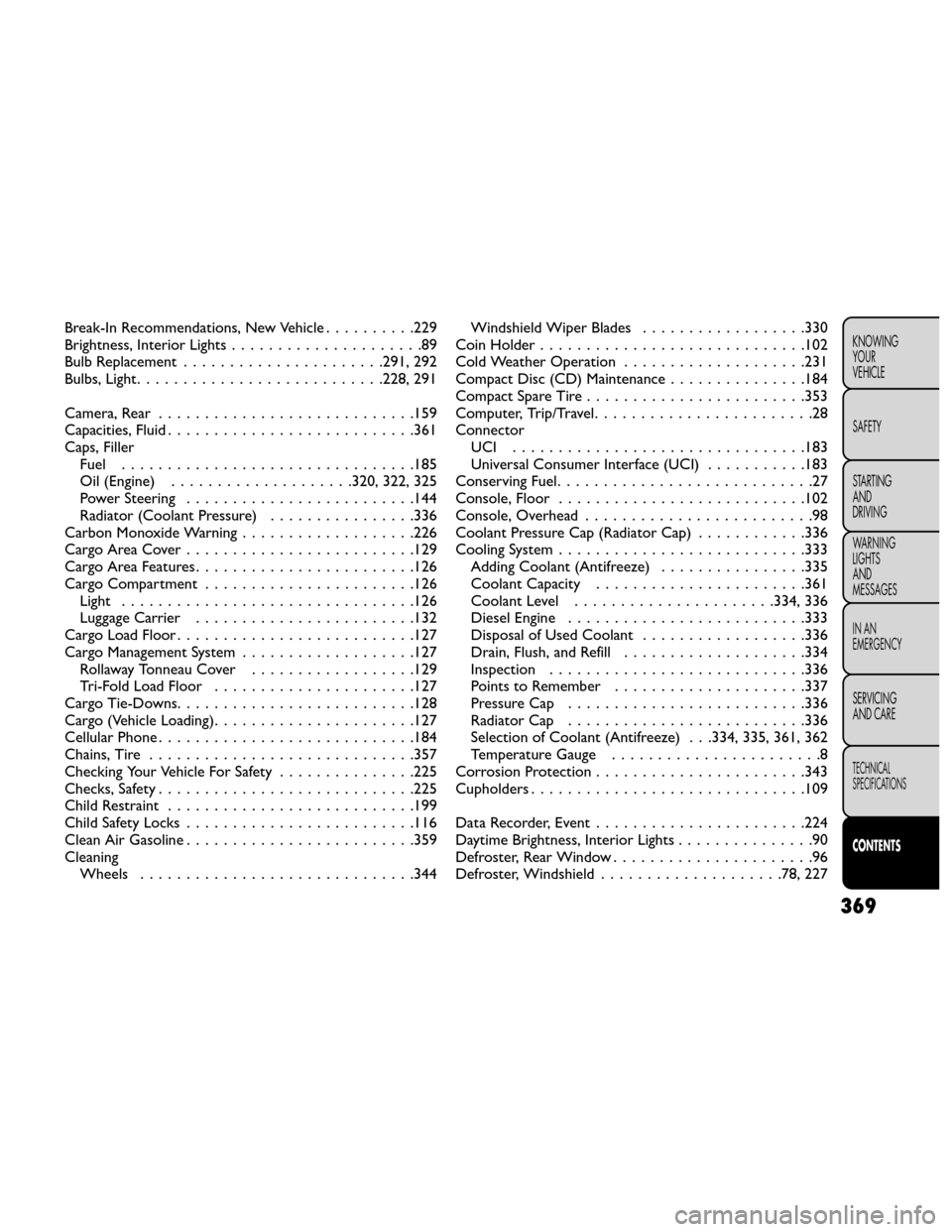
Break-In Recommendations, New Vehicle..........229
Brightness, Interior Lights .....................89
Bulb Replacement ...................... 291, 292
Bulbs, Light ...........................228, 291
Camera, Rear ............................159
Capacities, Fluid ...........................361
Caps, Filler Fuel ................................185
Oil (Engine) ....................320, 322, 325
Power Steering .........................144
Radiator (Coolant Pressure) ................336
Carbon Monoxide Warning ...................226
CargoAreaCover.........................129
Cargo Area Features ........................126
CargoCompartment .......................126 Light ................................126
Luggage Carrier ........................132
Cargo Load Floor ..........................127
Cargo Management System ...................127
Rollaway Tonneau Cover ..................129
Tri-Fold Load Floor ......................127
Cargo Tie-Downs ..........................128
Cargo (Vehicle Loading) ......................127
Cellular Phone ............................184
Chains, Tire .............................357
Checking Your Vehicle For Safety ...............225
Checks, Safety ............................225
Child Restraint ...........................199
Child Safety Locks .........................116
Clean Air Gasoline .........................359
Cleaning Wheels ..............................344 Windshield Wiper Blades
..................330
Coin Holder .............................102
Cold Weather Operation ....................231
Compact Disc (CD) Maintenance ...............184
Compact Spare Tire ........................353
Computer, Trip/Travel ........................28
Connector UCI ............................... .183
Universal Consumer Int
erface (UCI) ...........183
Conserving Fuel ............................27
Console, Floor ...........................102
Console, Overhead .........................98
Coolant Pressure Cap (Radiator Cap) ............336
Cooling System ...........................333
Adding Coolant (Antifreeze) ................335
Coolant Capacity .......................361
Coolant Level ......................334, 336
Diesel Engine ..........................333
Disposal of Used Coolant ..................336
Drain, Flush, and Refill ....................334
Inspection ............................336
Points to Remember .....................337
Pressure Cap ..........................336
Radiator Cap ..........................336
Selection of Coolant (Antifreeze) . . .334, 335, 361, 362
Temperature Gauge .......................8
Corrosion Protection .......................343
Cupholders ..............................109
Data Recorder, Event .......................224
Daytime Brightness, Interior Lights ...............90
Defroster, Rear Window ......................96
Defroster, Windshield ....................78, 227
369
KNOWING
YOUR
VEHICLE
SAFETY
STARTING
AND
DRIVING
WARNING
LIGHTS
AND
MESSAGES
IN AN
EMERGENCY
SERVICING
AND CARE
TECHNICAL
SPECIFICATIONS
CONTENTS
Page 379 of 388
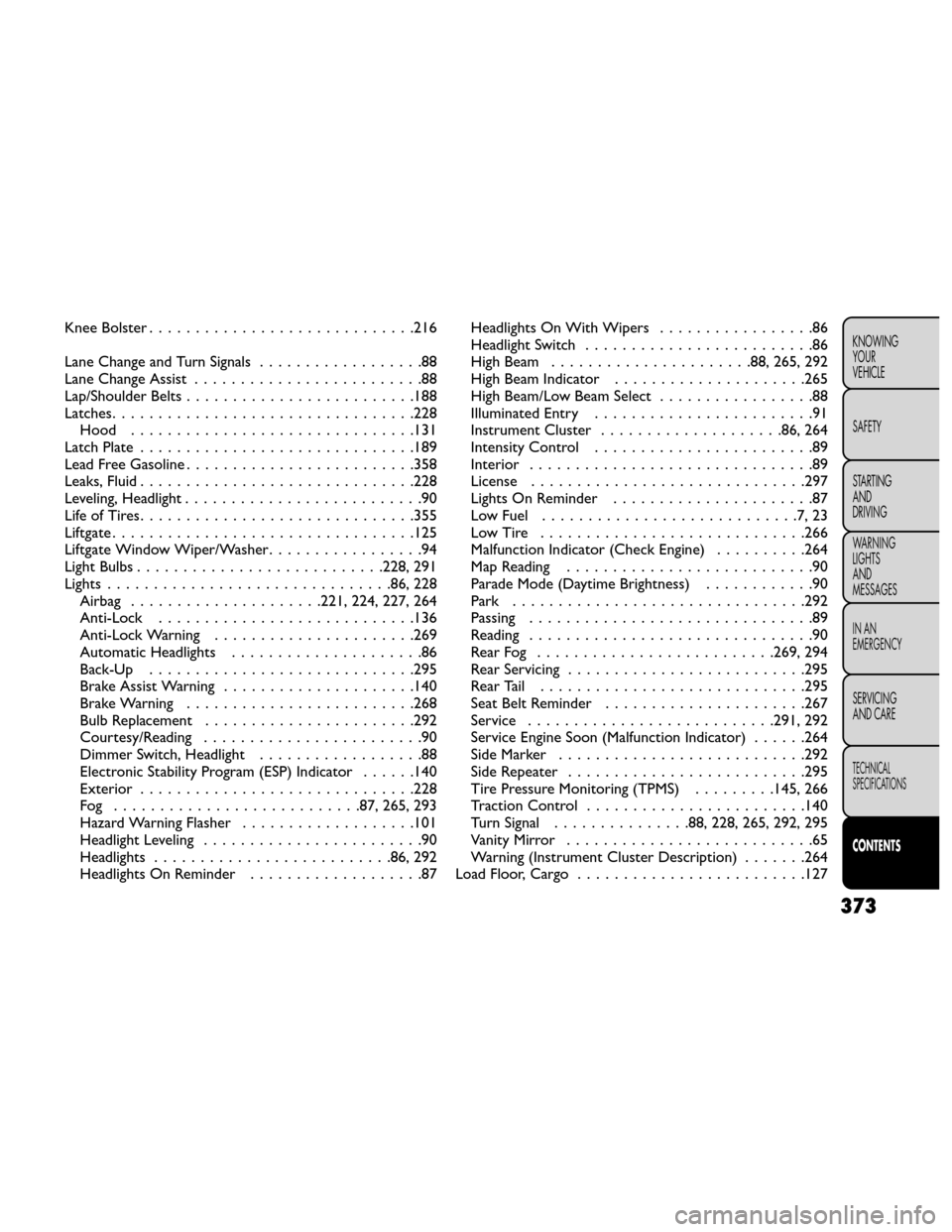
Knee Bolster.............................216
Lane Change and Turn Signals ..................88
Lane Change Assist .........................88
Lap/Shoulder Belts .........................188
Latches .................................228
Hood ...............................131
Latch Plate ..............................189
Lead Free Gasoline .........................358
Leaks, Fluid ..............................228
Leveling, Headlight ..........................90
LifeofTires..............................355
Liftgate.................................125
Liftgate Window Wiper/Washer .................94
Light Bulbs ...........................228, 291
Lights ...............................86, 228
Airbag .....................221, 224, 227, 264
Anti-Lock ............................136
Anti-Lock Warning ......................269
Automatic Headlights .....................86
Back-Up .............................295
Brake Assist Warning .....................140
Brake Warning .........................268
Bulb Replacement .......................292
Courtesy/Reading ........................90
Dimmer Switch, Headlight ..................88
Electronic Stability Program (ESP) Indicator ......140
Exterior ..............................228
Fog ...........................87, 265, 293
Hazard Warning Flasher ...................101
Headlight Leveling ........................90
Headlights ..........................86, 292
Headlights On Reminder ...................87 Headlights On With Wipers
.................86
Headlight Switch .........................86
High Beam ......................88, 265, 292
High Beam Indicator .....................265
High Beam/Low Beam Select .................88
Illuminated Entry ........................91
Instrument Cluster ....................86, 264
Intensity Control ........................89
Interior ...............................89
License ..............................297
Lights On Reminder ......................
87
Low Fuel ............................7,23
LowTire .............................266
Malfunction Indicator (Check Engine) ..........264
Map Reading ...........................90
Parade Mode (Daytime Brightness) ............90
Park ................................292
Passing ...............................89
Reading ...............................90
RearFog ..........................269, 294
Rear Servicing ..........................295
RearTail .............................295
Seat Belt Reminder ......................267
Service ...........................291, 292
Service Engine Soon (Malfunction Indicator) ......264
Side Marker ...........................292
Side Repeater ..........................295
Tire Pressure Monitoring (TPMS) .........145, 266
Traction Control ........................140
Turn Signal ...............88, 228, 265, 292, 295
Vanity Mirror ...........................65
Warning (Instrument Cluster Description) .......264
Load Floor, Cargo .........................127
373
KNOWING
YOUR
VEHICLE
SAFETY
STARTING
AND
DRIVING
WARNING
LIGHTS
AND
MESSAGES
IN AN
EMERGENCY
SERVICING
AND CARE
TECHNICAL
SPECIFICATIONS
CONTENTS