engine coolant FIAT FREEMONT 2015 1.G User Guide
[x] Cancel search | Manufacturer: FIAT, Model Year: 2015, Model line: FREEMONT, Model: FIAT FREEMONT 2015 1.GPages: 412, PDF Size: 3.37 MB
Page 339 of 412
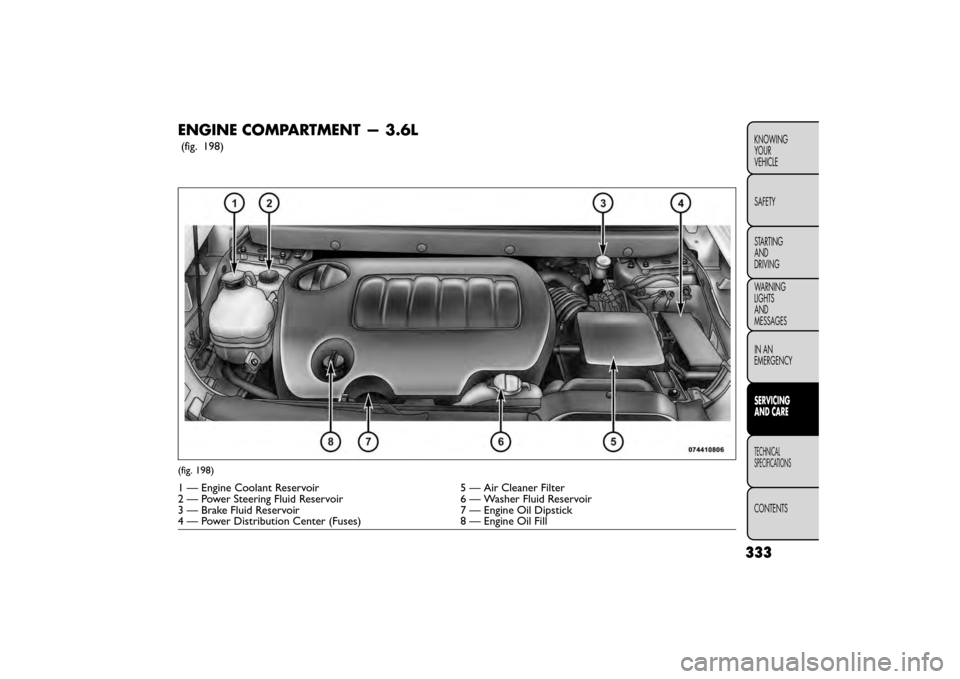
ENGINE COMPARTMENT — 3.6L
(fig. 198)
(fig. 198)
1 — Engine Coolant Reservoir5 — Air Cleaner Filter
2 — Power Steering Fluid Reservoir 6 — Washer Fluid Reservoir
3 — Brake Fluid Reservoir 7 — Engine Oil Dipstick
4 — Power Distribution Center (Fuses) 8 — Engine Oil Fill
333
KNOWING
YOUR
VEHICLE
SAFETY
STARTING
AND
DRIVING
WARNING
LIGHTS
AND
MESSAGES
IN AN
EMERGENCY
SERVICING
AND CARE
TECHNICAL
SPECIFICATIONS
CONTENTS
Page 340 of 412
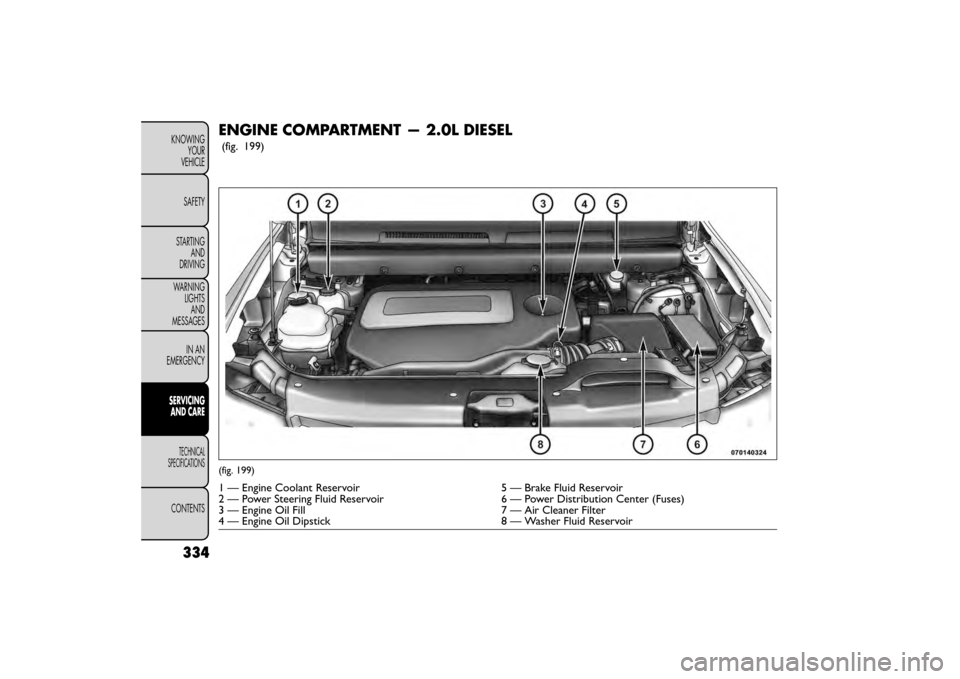
ENGINE COMPARTMENT — 2.0L DIESEL
(fig. 199)
(fig. 199)
1 — Engine Coolant Reservoir5 — Brake Fluid Reservoir
2 — Power Steering Fluid Reservoir 6 — Power Distribution Center (Fuses)
3 — Engine Oil Fill 7 — Air Cleaner Filter
4 — Engine Oil Dipstick 8 — Washer Fluid Reservoir
334
KNOWING
YOUR
VEHICLE
SAFETY
STARTING AND
DRIVING
WARNING LIGHTSAND
MESSAGES
IN AN
EMERGENCY
SERVICINGAND C ARE
TECHNICAL
SPECIFICATIONS
CONTENTS
Page 351 of 412
NOTE:Intentional tampering with emissions control
systems can result in civil penalties being assessed
against you.
WARNING!
A hot exhaust system can start a fire if you
park over materials that can burn. Such
materials might be grass or leaves coming into
contact with your exhaust system. Do not park or
operate your vehicle in areas where your exhaust
system can contact anything that can burn.
In unusual situations involving grossly malfunctioning
engine operation, a scorching odor may indicate severe
and abnormal catalyst overheating. If this occurs, safely
bring the vehicle to a complete stop, shut the engine
OFF, and allow the vehicle to cool. Thereafter, obtain
service, including a tune-up to manufacturer’s specifi-
cations immediately.
To minimize the possibility of catalyst damage:
• Do not shut OFF the engine or interrupt the ignition when the transmission is in gear and the vehicle is in
motion.
• Do not try to start the engine by pushing or towing the vehicle.
• Do not idle the engine with any ignition coil connec- tors disconnected for prolonged periods. COOLING SYSTEM
WARNING!
• When working near the radiator cool-
in g
fan, disconnect the fan motor lead or
turn the ignition switch to the LOCK position.The
fan is temperature controlled and can start at
any time the ignition switch is in the ON position.
• You or others can be badly burned by hot
engine coolant (antifreeze) or steam from your
radiator. If you see or hear steam coming from
under the hood, do not open the hood until the
radiator has had time to cool. Never tr y to open a
cooling system pressure cap when the radiator is
hot .
Car maintenance should be done at a
FIAT Dealership. For routine and minor
maintenance operations you wish to
carry out yourself, we do recommend you have
the proper equipment , genuine FIAT spare parts
and the necessary fluids; do not however carry out
these operations if you have no experience.
345
KNOWING
YOUR
VEHICLE
SAFETY
STARTING
AND
DRIVING
WARNING
LIGHTS
AND
MESSAGES
IN AN
EMERGENCY
SERVICING
AND C ARE
TECHNICAL
SPECIFICATIONS
CONTENTS
Page 352 of 412
Coolant Checks
Check engine coolant (antifreeze) protection every 1
year (before the onset of freezing weather, where
applicable). If coolant is dirty or rusty in appearance,
the system should be drained, flushed, and refilled with
fresh coolant. Check the front of the A/C condenser
for any accumulation of bugs, leaves, etc. If dirty, clean
by gently spraying water from a garden hose vertically
down the face of the condenser.
Check the coolant recovery bottle tubing for brittle
rubber, cracking, tears, cuts, and tightness of the con-
nection at the bottle and radiator. Inspect the entire
system for leaks.
Cooling System — Drain, Flush, And Refill
Refer to the “Maintenance Schedule” for the proper
maintenance intervals.
If the solution is dirty or contains a considerable
amount of sediment, clean and flush with a reliable
cooling system cleaner. Follow with a thorough rinsing
to remove all deposits and chemicals. Properly dispose
of the old engine coolant (antifreeze) solution.Selection Of Coolant — Gasoline Engine
Use only the manufacturer's recommended coolant.
Refer to “Fluids, Lubricants, and Genuine Parts” in
“Technical Specifications” for further information.
•
Mixing of engine coolant (antifreeze)
other than specified engine coolant (an-
tifreeze), may result in engine damage
and may decrease corrosion protection. If a non-
specified engine coolant (antifreeze) is intro-
duced into the cooling system in an emergency, it
should be replaced with the specified engine cool-
ant (antifreeze) as soon as possible.
• Do not use plain water alone or alcohol-based
engine coolant (antifreeze) products. Do not use
additional rust inhibitors or antirust products, as
they may not be compatible with the radiator
engine coolant (antifreeze) and may plug the
radiator.
• This vehicle has not been designed for use with
Propylene Glycol based engine coolant (anti-
freeze). Use of Propylene Glycol based engine
coolant (antifreeze) is not recommended.
346
KNOWING YOUR
VEHICLE
SAFETY
STARTING AND
DRIVING
WARNING LIGHTSAND
MESSAGES
IN AN
EMERGENCY
SERVICINGAND C ARE
TECHNICAL
SPECIFICATIONS
CONTENTS
Page 353 of 412
Selection Of Coolant — Diesel Engine
Use only the manufacturer's recommended coolant
(antifreeze). Refer to “Fluids, Lubricants, and Genuine
Parts” in “Technical Specifications” for further informa-
tion.
•Do not use HOAT (Hybrid Organic Ad-
ditive Technology) products in the Diesel
Engine.
• Do not use OAT (Organic Additive Technology)
products containing 2-EH (2–ethyl hexanol).
• Do not use plain water alone or alcohol base
engine coolant (antifreeze) products. Do not use
additional rust inhibitors or antirust products, as
they may not be compatible with the radiator
engine coolant and may plug the radiator.
• This vehicle has not been designed for use with
Propylene Glycol based coolants. Use of Propyl-
ene Glycol based coolants is not recommended.
Adding Coolant — Gasoline Engine
Your vehicle has been built with an improved engine
coolant (antifreeze) that allows extended maintenance
intervals. This coolant (antifreeze) can be used up to 10
years or 240 000 km before replacement. To prevent
reducing this extended maintenance period, it is impor-
tant that you use the same coolant throughout the life
of your vehicle. Use only high purity water such as distilled or deion-
ized water when mixing the water/engine coolant (an-
tifreeze) solution. The use of lower quality water will
reduce the amount of corrosion protection in the
engine cooling system.
Please note that it is the owner's responsibility to
maintain the proper level of protection against freezing
according to the temperatures occurring in the area
where the vehicle is operated.
NOTE:
Mixing coolant types will decrease the life of
the engine coolant (antifreeze) and will require more
frequent coolant changes.
Adding Coolant — Diesel Engine
Your vehicle has been built with an improved engine
coolant (antifreeze) that allows extended maintenance
intervals. To prevent reducing this extended mainte-
nance period, it is important that you use the same
coolant throughout the life of your vehicle.
Please note that it is the owner's responsibility to
maintain the proper level of protection against freezing
according to the temperatures occurring in the area
where the vehicle is operated.
347
KNOWING
YOUR
VEHICLE
SAFETY
STARTING
AND
DRIVING
WARNING
LIGHTS
AND
MESSAGES
IN AN
EMERGENCY
SERVICING
AND C ARE
TECHNICAL
SPECIFICATIONS
CONTENTS
Page 354 of 412
NOTE:Mixing coolant types will decrease the life of
the engine coolant (antifreeze) and will require more
frequent coolant changes.
Cooling System Pressure Cap
The cap must be fully tightened to prevent loss of
engine coolant (antifreeze), and to ensure that engine
coolant (antifreeze) will return to the radiator from the
coolant recovery tank.
The cap should be inspected and cleaned if there is any
accumulation of foreign material on the sealing sur-
faces.
WARNING!
• Do not open hot engine cooling sys-
tem. N
ever add engine coolant (anti-
freeze) when the engine is overheated. Do not
loosen or remove the cap to cool an overheated
engine. Heat causes pressure to build up in the
cooling system. To prevent scalding or injury, do
not remove the pressure cap while the system is
hot or under pressure.
• Do not use a pressure cap other than the one
specified for your vehicle. Personal injury or en-
gine damage may result . Disposal Of Used Coolant
Used ethylene glycol-based engine coolant is a regu-
lated substance requiring proper disposal. Check with
your local authorities to determine the disposal rules
for your community. To prevent ingestion by animals or
children, do not store ethylene glycol-based engine
coolant in open containers or allow it to remain in
puddles on the ground. If ingested by a child, contact a
physician immediately. Clean up any ground spills im-
mediately.
Coolant Level
The radiator normally remains completely full, so there
is no need to remove the radiator cap unless checking
for coolant freeze point or replacing coolant. Advise
your service attendant of this. As long as the engine
operating temperature is satisfactory, the coolant
bottle need only be checked once a month. When
additional coolant is needed to maintain the proper
level, it should be added to the coolant bottle. Do not
overfill.
348
KNOWING
YOUR
VEHICLE
SAFETY
STARTING AND
DRIVING
WARNING LIGHTSAND
MESSAGES
IN AN
EMERGENCY
SERVICINGAND C ARE
TECHNICAL
SPECIFICATIONS
CONTENTS
Page 355 of 412
Points To Remember
NOTE:When the vehicle is stopped after a few
kilometers of operation, you may observe vapor com-
ing from the front of the engine compartment. This is
normally a result of moisture from rain, snow, or high
humidity accumulating on the radiator and being vapor-
ized when the thermostat opens, allowing hot coolant
to enter the radiator.
If an examination of your engine compartment shows
no evidence of radiator or hose leaks, the vehicle may
be safely driven. The vapor will soon dissipate.
• Do not overfill the coolant recovery bottle.
• Check coolant freeze point in the radiator and in the coolant recovery bottle. If antifreeze needs to be
added, contents of coolant recovery bottle must also
be protected against freezing.
• If frequent coolant additions are required, or if the level in the coolant recovery bottle does not drop
when the engine cools, the cooling system should be
pressure tested for leaks.
• Make sure that the radiator and coolant recovery bottle overflow hoses are not kinked or obstructed.
• Keep the front of the radiator clean. If your vehicle is equipped with air conditioning, keep the front of the
condenser clean. • Do not change the thermostat for Summer or Win-
ter operation. If replacement is ever necessary, install
ONLY the correct type thermostat. Other designs
may result in unsatisfactory coolant performance,
poor gas mileage, and increased emissions.
BRAKE SYSTEM
In order to assure brake system performance, all brake
system components should be inspected periodically.
Refer to the “Maintenance Schedule” for the proper
maintenance intervals.
WARNING!
Riding the brakes can lead to brake fail-
ure an d
possibly an accident . Driving
with your foot resting or riding on the brake
pedal can result in abnormally high brake tem-
peratures, excessive lining wear, and possible
brake damage.You would not have your full brak-
ing capacity in an emergency.
Car maintenance should be done at a
FIAT Dealership. For routine and minor
maintenance operations you wish to
carry out yourself, we do recommend you have
the proper equipment , genuine FIAT spare parts
and the necessary fluids; do not however carry out
these operations if you have no experience.
349
KNOWING
YOUR
VEHICLE
SAFETY
STARTING
AND
DRIVING
WARNING
LIGHTS
AND
MESSAGES
IN AN
EMERGENCY
SERVICING
AND C ARE
TECHNICAL
SPECIFICATIONS
CONTENTS
Page 390 of 412
FUEL REQUIREMENTS — DIESEL
ENGINE
Use Premium Quality Diesel fuels with a Cetane rating
of 50 or higher, and meeting the EN590 standard are
highly recommended. See your authorized dealer for
further information regarding fuels available in your area.
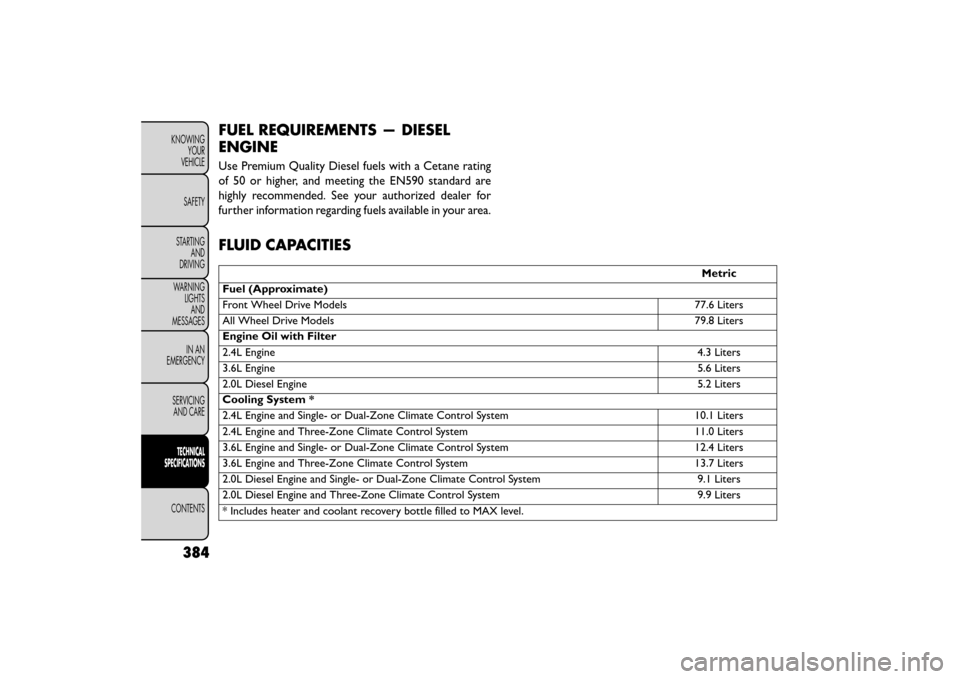
FLUID CAPACITIES
Metric
Fuel (Approximate)
Front Wheel Drive Models 77.6 Liters
All Wheel Drive Models 79.8 Liters
Engine Oil with Filter
2.4L Engine 4.3 Liters
3.6L Engine 5.6 Liters
2.0L Diesel Engine 5.2 Liters
Cooling System *
2.4L Engine and Single- or Dual-Zone Climate Control System 10.1 Liters
2.4L Engine and Three-Zone Climate Control System 11.0 Liters
3.6L Engine and Single- or Dual-Zone Climate Control System 12.4 Liters
3.6L Engine and Three-Zone Climate Control System 13.7 Liters
2.0L Diesel Engine and Single- or Dual-Zone Climate Control System 9.1 Liters
2.0L Diesel Engine and Three-Zone Climate Control System 9.9 Liters
* Includes heater and coolant recovery bottle filled to MAX level.
384
KNOWING YOUR
VEHICLE
SAFETY
STARTING AND
DRIVING
WARNING LIGHTSAND
MESSAGES
IN AN
EMERGENCY
SERVICINGAND CARE
TECHNICAL
SPECIFICATIONS
CONTENTS
Page 391 of 412
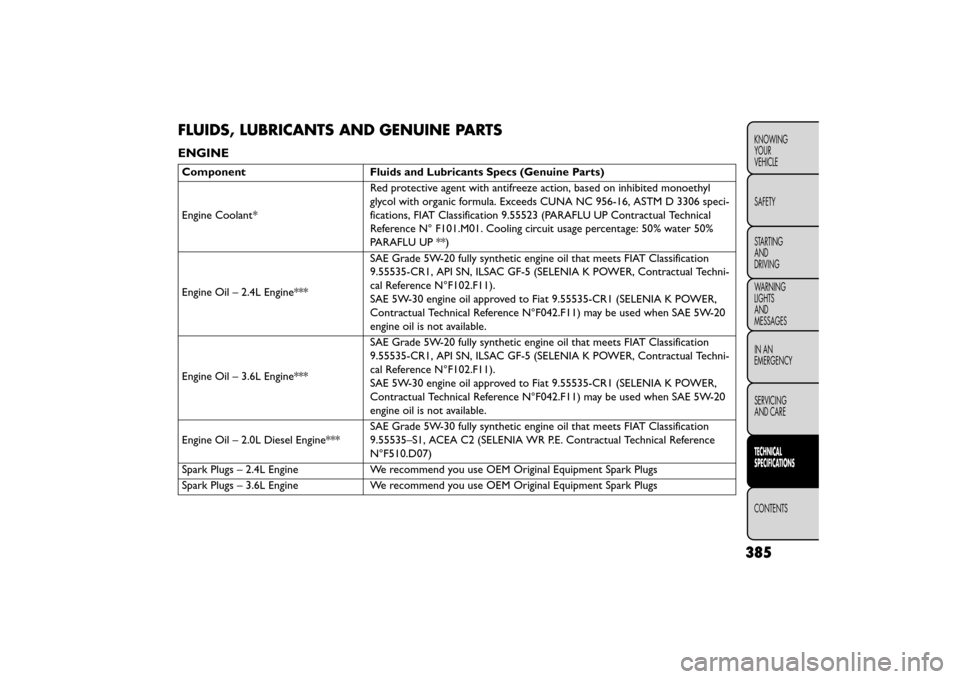
FLUIDS, LUBRICANTS AND GENUINE PARTS
ENGINE
ComponentFluids and Lubricants Specs (Genuine Parts)
Engine Coolant* Red protective agent with antifreeze action, based on inhibited monoethyl
glycol with organic formula. Exceeds CUNA NC 956-16, ASTM D 3306 speci-
fications, FIAT Classification 9.55523 (PARAFLU UP Contractual Technical
Reference N° F101.M01. Cooling circuit usage percentage: 50% water 50%
PARAFLU UP **)
Engine Oil – 2.4L Engine*** SAE Grade 5W-20 fully synthetic engine oil that meets FIAT Classification
9.55535-CR1, API SN, ILSAC GF-5 (SELENIA K POWER, Contractual Techni-
cal Reference N°F102.F11).
SAE 5W-30 engine oil approved to Fiat 9.55535-CR1 (SELENIA K POWER,
Contractual Technical Reference N°F042.F11) may be used when SAE 5W-20
engine oil is not available.
Engine Oil – 3.6L Engine*** SAE Grade 5W-20 fully synthetic engine oil that meets FIAT Classification
9.55535-CR1, API SN, ILSAC GF-5 (SELENIA K POWER, Contractual Techni-
cal Reference N°F102.F11).
SAE 5W-30 engine oil approved to Fiat 9.55535-CR1 (SELENIA K POWER,
Contractual Technical Reference N°F042.F11) may be used when SAE 5W-20
engine oil is not available.
Engine Oil – 2.0L Diesel Engine*** SAE Grade 5W-30 fully synthetic engine oil that meets FIAT Classification
9.55535–S1, ACEA C2 (SELENIA WR P.E. Contractual Technical Reference
N°F510.D07)
Spark Plugs – 2.4L Engine We recommend you use OEM Original Equipment Spark Plugs
Spark Plugs – 3.6L Engine We recommend you use OEM Original Equipment Spark Plugs
385
KNOWING
YOUR
VEHICLE
SAFETY
STARTING
AND
DRIVING
WARNING
LIGHTS
AND
MESSAGES
IN AN
EMERGENCY
SERVICING
AND CARE
TECHNICAL
SPECIFICATIONS
CONTENTS
Page 397 of 412
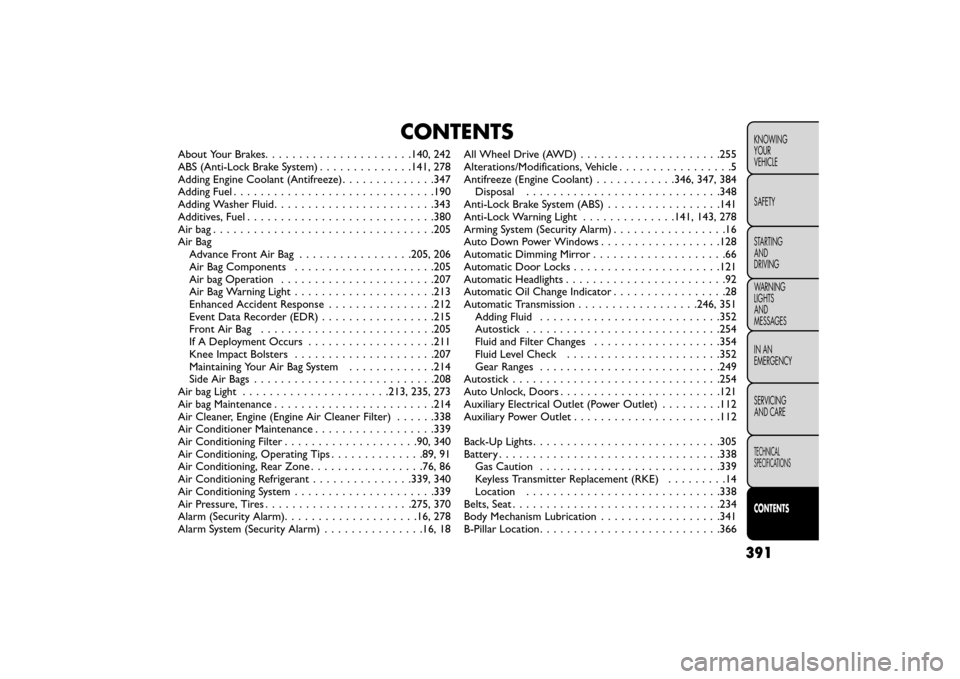
CONTENTS
About Your Brakes..................... .140, 242
ABS (Anti-Lock Brake System) . . . . . .........141, 278
Adding Engine Coolant (Antifreeze) . . ............347
Adding Fuel ............................. .190
Adding Washer Fluid . . . .................... .343
Additives, Fuel . .......................... .380
Airbag................................ .205
Air Bag Advance Front Air Bag . ................205, 206
Air Bag Components . ................... .205
Air bag Operation ...................... .207
Air Bag Warning Light . ................... .213
Enhanced Accident Response . . . . ............212
Event Data Recorder (EDR) . . . . . ............215
FrontAirBag ......................... .205
If A Deployment Occurs . . . . . . .............211
Knee Impact Bolsters . . . . . . . . .............207
Maintaining Your Air Bag System .............214
Side Air Bags . . . . . . . . .................. .208
Air bag Light ..................... .213, 235, 273
Air bag Maintenance ....................... .214
Air Cleaner, Engine (Engine Air Cleaner Filter) ......338
Air Conditioner Maintenance . . . . . . . ...........339
Air Conditioning Filter . . . .................90, 340
Air Conditioning, Operating Tips . . . . ..........89, 91
Air Conditioning, Rear Zone . . . . . . . . .........76, 86
Air Conditioning Refrigerant . . . ............339, 340
Air Conditioning System . ................... .339
Air Pressure, Tires ..................... .275, 370
Alarm (Security Alarm) ................... .16, 278
Alarm System (Security Alarm) ...............16, 18All Wheel Drive (AWD)
.................... .255
Alterations/Modifications, Vehicle .................5
Antifreeze (Engine Coolant) ............346, 347, 384
Disposal ............................ .348
Anti-Lock Brake System (ABS) .................141
Anti-Lock War
ning Light ..............141, 143, 278
Arming System (Security Alarm) .................16
Auto Down Power Windows ..................128
Automatic Dimming Mirror ....................66
Automatic Door Locks ..................... .121
Automatic Headlights ........................92
Automatic Oil Change Indicator .................28
Automatic Transmission ................. .246, 351
Adding Fluid .......................... .352
Autostick ............................ .254
Fluid and Filter Changes .................. .354
Fluid Level Check ...................... .352
Gear Ranges .......................... .249
Autostick .............................. .254
Auto Unlock, Doors ....................... .121
Auxiliary Electrical Outlet (Power Outlet) .........112
Auxiliary Power Outlet ..................... .112
Back-Up Lights ........................... .305
Battery ................................ .338
Gas Caution .......................... .339
Keyless Transmitter Replacement (RKE) .........14
Location ............................ .338
Belts, Seat .............................. .234
Body Mechanism Lubrication ..................341
B-Pillar Location .......................... .366
391
KNOWING
YOUR
VEHICLE
SAFETY
STARTING
AND
DRIVING
WARNING
LIGHTS
AND
MESSAGES
IN AN
EMERGENCY
SERVICING
AND CARE
TECHNICAL
SPECIFICATIONS
CONTENTS