automatic transmission FIAT FREEMONT 2015 1.G Owner's Guide
[x] Cancel search | Manufacturer: FIAT, Model Year: 2015, Model line: FREEMONT, Model: FIAT FREEMONT 2015 1.GPages: 412, PDF Size: 3.37 MB
Page 330 of 412
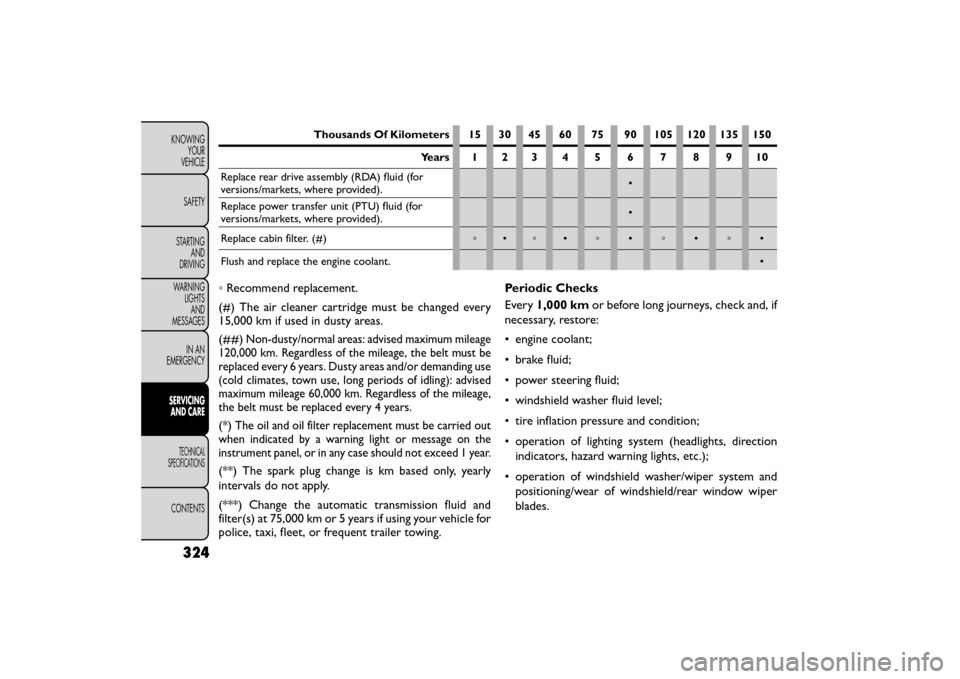
Thousands Of Kilometers 15 30 45 60 75 90 105 120 135 150Years 1 2 3 4 5678910
Replace rear drive assembly (RDA) fluid (for
versions/markets, where provided). •
Replace power transfer unit (PTU) fluid (for
versions/markets, where provided). •
Replace cabin filter. (#) ◦•◦ • ◦ •◦•◦•
Flush and replace the engine coolant. •
◦Recommend replacement.
(#) The air cleaner cartridge must be changed every
15,000 km if used in dusty areas.
(##)
Non-dusty/normal areas: advised maximum mileage
120,000 km. Regardless of the mileage, the belt must be
replaced every 6 years. Dusty areas and/or demanding use
(cold climates, town use, long periods of idling): advised
maximum mileage 60,000 km. Regardless of the mileage,
the belt must be replaced every 4 years.
(*)The oil and oil filter replacement must be carried out
when indicated by a warning light or message on the
instrument panel, or in any case should not exceed 1 year.
(**) The spark plug change is km based only, yearly
intervals do not apply.
(***) Change the automatic transmission fluid and
filter(s) at 75,000 km or 5 years if using your vehicle for
police, taxi, fleet, or frequent trailer towing. Periodic Checks
Every
1,000 km or before long journeys, check and, if
necessary, restore:
• engine coolant;
• brake fluid;
• power steering fluid;
• windshield washer fluid level;
• tire inflation pressure and condition;
• operation of lighting system (headlights, direction indicators, hazard warning lights, etc.);
• operation of windshield washer/wiper system and positioning/wear of windshield/rear window wiper
blades.
324
KNOWING YOUR
VEHICLE
SAFETY
STARTING AND
DRIVING
WARNING LIGHTSAND
MESSAGES
IN AN
EMERGENCY
SERVICINGAND C ARE
TECHNICAL
SPECIFICATIONS
CONTENTS
Page 331 of 412
Every3,000 km, check and top up, if required, the
engine oil level and automatic transmission fluid level
(four-speed automatic only).
Heavy-Duty Use Of The Car
If the car is used mainly under one of the following
conditions:
• towing a trailer or caravan;
• dusty roads;
• short, repeated journeys (less than 7-8 km) at sub- zero outside temperatures;
• engine often idling or driving long distances at low speeds or long periods of idleness.
You should perform the following inspections more
frequently than shown on the Scheduled Servicing Plan:
• check front disc brake pad conditions and wear;
• check cleanliness of hood and trunk locks, cleanli- ness and lubrication of linkage;
• visually inspect conditions of: engine, transmission, pipes and hoses (exhaust - fuel system - brakes) and
rubber elements (boots - sleeves - bushes - etc.);
• check battery charge and battery fluid level (electro- lyte); • visually inspect condition of the accessory drive
belts;
• check and, if necessary, change engine oil and replace oil filter;
• check and, if necessary, replace pollen filter;
• check and, if necessary, replace air cleaner.
MAINTENANCE SCHEDULE — DIESEL
ENGINE
To help you have the best driving experience possible,
the manufacturer has identified the specific vehicle
maintenance service intervals that are required to keep
your vehicle operating properly and safely.
The manufacturer recommends that these mainte-
nance intervals be performed at your selling dealer. The
technicians at your dealership know your vehicle best,
and have access to factory trained information, genuine
FIAT parts, and specially designed electronic and me-
chanical tools that can help prevent future costly re-
pairs.
The maintenance intervals shown should be performed
as indicated in this section.
325
KNOWING
YOUR
VEHICLE
SAFETY
STARTING
AND
DRIVING
WARNING
LIGHTS
AND
MESSAGES
IN AN
EMERGENCY
SERVICING
AND C ARE
TECHNICAL
SPECIFICATIONS
CONTENTS
Page 335 of 412
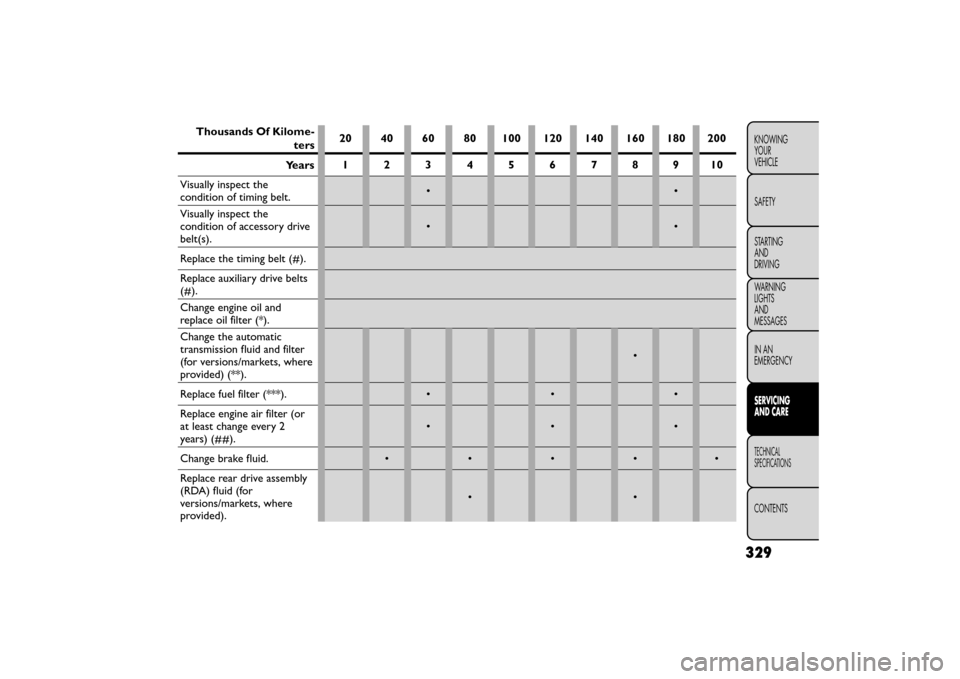
Thousands Of Kilome-
ters20 40 60 80 100 120 140 160 180 200
12345678910
Visually inspect the
condition of timing belt.••
Visually inspect the
condition of accessory drive
belt(s).
••
Replace the timing belt (#).
Replace auxiliary drive belts
(#).
Change engine oil and
replace oil filter (*).
Change the automatic
transmission fluid and filter
(for versions/markets, where
provided) (**).
•
Replace fuel filter (***). • • •
Replace engine air filter (or
at least change every 2
years) (##).
•••
Change brake fluid. • • • • •
Replace rear drive assembly
(RDA) fluid (for
versions/markets, where
provided).
••
329
KNOWING YOURVEHICLE
SAFETY
STARTING ANDDRIVING
WARNING LIGHTSANDMESSAGES
IN AN EMERGENCY
SERVICING AND CARE
TECHNICALSPECIFICATIONS
CONTENTS
Years
Page 336 of 412
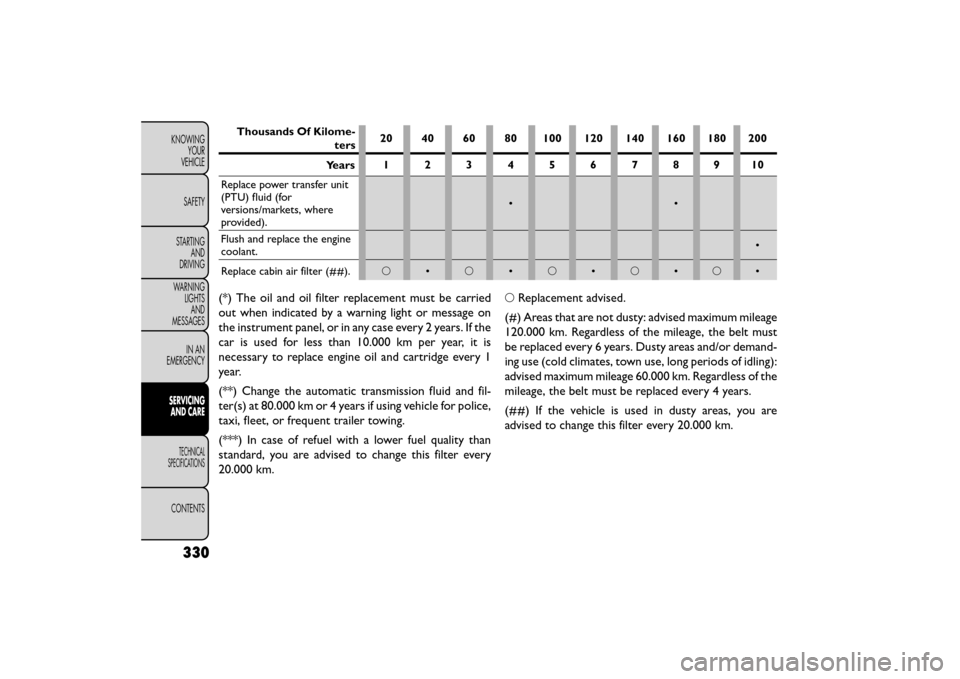
Thousands Of Kilome-
ters20 40 60 80 100 120 140 160 180 200
12345678910
Replace power transfer unit
(PTU) fluid (for
versions/markets, where
provided).
••
Flush and replace the engine
coolant.•
Replace cabin air filter (##).○•○•○•○•○•
(*) The oil and oil filter replacement must be carried
out when indicated by a warning light or message on
the instrument panel, or in any case every 2 years. If the
car is used for less than 10.000 km per year, it is
necessary to replace engine oil and cartridge every 1
year.
(**) Change the automatic transmission fluid and fil-
ter(s) at 80.000 km or 4 years if using vehicle for police,
taxi, fleet, or frequent trailer towing.
(***) In case of refuel with a lower fuel quality than
standard, you are advised to change this filter every
20.000 km.
○Replacement advised.
(#) Areas that are not dusty: advised maximum mileage
120.000 km. Regardless of the mileage, the belt must
be replaced every 6 years. Dusty areas and/or demand-
ing use (cold climates, town use, long periods of idling):
advised maximum mileage 60.000 km. Regardless of the
mileage, the belt must be replaced every 4 years.
(##) If the vehicle is used in dusty areas, you are
advised to change this filter every 20.000 km.
330
KNOWINGYOURVEHICLE
SAFETY
STARTINGANDDRIVING
WARNINGLIGHTSANDMESSAGES
IN ANEMERGENCY
SERVICINGAND CARE
TECHNICALSPECIFICATIONS
CONTENTS
Years
Page 338 of 412
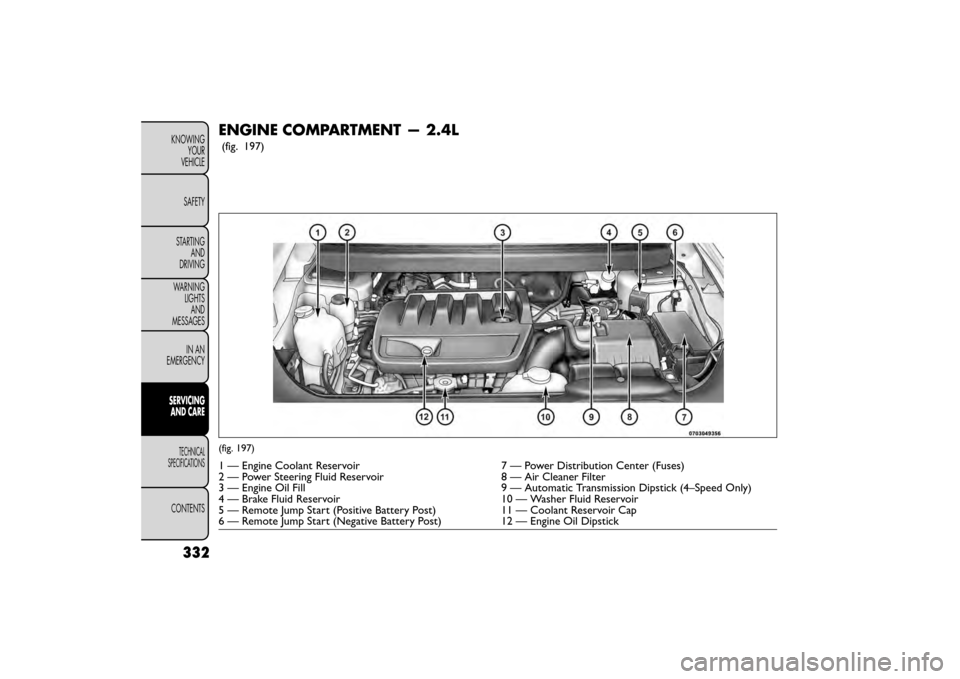
ENGINE COMPARTMENT — 2.4L
(fig. 197)
(fig. 197)
1 — Engine Coolant Reservoir7 — Power Distribution Center (Fuses)
2 — Power Steering Fluid Reservoir 8 — Air Cleaner Filter
3 — Engine Oil Fill 9 — Automatic Transmission Dipstick (4–Speed Only)
4 — Brake Fluid Reservoir 10 — Washer Fluid Reservoir
5 — Remote Jump Start (Positive Battery Post) 11 — Coolant Reservoir Cap
6 — Remote Jump Start (Negative Battery Post) 12 — Engine Oil Dipstick
332
KNOWING
YOUR
VEHICLE
SAFETY
STARTING AND
DRIVING
WARNING LIGHTSAND
MESSAGES
IN AN
EMERGENCY
SERVICINGAND C ARE
TECHNICAL
SPECIFICATIONS
CONTENTS
Page 357 of 412
WARNING! (Continued)
• To avoid contamination from foreign matter or
moisture, use only new brake fluid or fluid that
has been in a tightly closed container. Keep the
master cylinder reservoir cap secured at all
times. Brake fluid in a open container absorbs
moisture from the air resulting in a lower boiling
point . This may cause it to boil unexpectedly
during hard or prolonged braking, resulting in
sudden brake failure. This could result in a acci-
dent .
• Overfilling the brake fluid reservoir can result
in spilling brake fluid on hot engine parts, causing
the brake fluid to catch fire. Brake fluid can also
damage painted and vinyl surfaces, care should
be taken to avoid its contact with these surfaces.
• Do not allow petroleum based fluid to con-
taminate the brake fluid. Brake seal components
could be damaged, causing partial or complete
brake failure.This could result in an accident . AUTOMATIC TRANSMISSION (for
versions/markets, where provided)
Selection Of Lubricant
It is important to use the proper transmission fluid to
ensure optimum transmission performance and life.
Use only the manufacturer’s specified transmission
fluid. Refer to “Fluids, Lubricants, and Genuine Parts”
in “Technical Specifications” for fluid specifications. It is
important to maintain the transmission fluid at the
correct level using the recommended fluid. No chemi-
cal flushes should be used in any transmission; only the
approved lubricant should be used.
Using a transmission fluid other than the
manufacturer ’s recommended fluid may
cause deterioration in transmission shift
quality and/or torque converter shudder, and will
require more frequent fluid and filter changes.
Refer to “Fluids, Lubricants, and Genuine Parts” in
"Technical Specifications" for fluid specifica-
tions.
351
KNOWING
YOUR
VEHICLE
SAFETY
STARTING
AND
DRIVING
WARNING
LIGHTS
AND
MESSAGES
IN AN
EMERGENCY
SERVICING
AND C ARE
TECHNICAL
SPECIFICATIONS
CONTENTS
Page 358 of 412
Special Additives
The manufacturer strongly recommends against using any
special additives in the transmission. Automatic Transmis-
sion Fluid (ATF) is an engineered product and its perfor-
mance may be impaired by supplemental additives. There-
fore, do not add any fluid additives to the transmission.
The only exception to this policy is the use of special dyes
for diagnosing fluid leaks. Avoid using transmission sealers
as they may adversely affect seals.
Do not use chemical flushes in your
transmission as the chemicals can dam-
age your transmission components. Such
damage is not covered by the New Vehicle Limited
Warranty.
Fluid Level Check - Six-Speed Transmission
The fluid level is preset at the factory and does not
require adjustment under normal operating conditions.
Routine fluid level checks are not required, therefore
the transmission filler tube is capped and no dipstick is
provided. Your authorized dealer can check your trans-
mission fluid level using a special service dipstick. If you
notice fluid leakage or transmission malfunction, visit
your authorized dealer immediately to have the trans-
mission fluid level checked. Operating the vehicle with
an improper fluid level can cause severe transmission
damage.
If a transmission fluid leak occurs, visit
your authorized dealer immediately. Se-
vere transmission damage may occur.
Your authorized dealer has the proper tools to
adjust the fluid level accurately.
Car maintenance should be done at a
FIAT Dealership. For routine and minor
maintenance operations you wish to
carry out yourself, we do recommend you have
the proper equipment , genuine FIAT spare parts
and the necessary fluids; do not however carry out
these operations if you have no experience.
Fluid Level Check — Four-Speed Automatic
Use the following procedure to check the transmission
fluid level properly:
1. Park the vehicle on level ground.
2. Run the engine at normal idle speed for at least 60 seconds, and leave the engine running for the rest of
this procedure.
3. Fully apply the parking brake, and press the brake pedal.
352
KNOWING YOUR
VEHICLE
SAFETY
STARTING AND
DRIVING
WARNING LIGHTSAND
MESSAGES
IN AN
EMERGENCY
SERVICINGAND C ARE
TECHNICAL
SPECIFICATIONS
CONTENTS
Page 393 of 412
CHASSIS
ComponentFluids and Lubricants Specs (Genuine Parts)
Automatic Transmission (for
versions/markets, where provided) Totally synthetic lubricant that meets FIAT Classification 9.55550-AV4
(TUTELA TRANSMISSION FORCE4, Contractual Technical Reference
No F108.F11).
Manual Transmission (for versions/
markets, where provided) Grade SAE 75W synthetic lubricant that meets FIAT Classification 9.55550-
MZ6 (TUTELA TRANSMISSION GEARFORCE Contractual Technical Refer-
ence N° F002.F10)
Brake/Clutch Master Cylinder Synthetic fluid that meets FIAT Classification 9.55597, FMVSS n° 116, DOT 4,
ISO 4925, SAE J-1704 (TUTELA TOP 4, Contractual Technical Reference
N° F001.A93)
Power Steering Reservoir Totally synthetic lubricant that meets FIAT Classification 9.55550-AV4
(TUTELA TRANSMISSION FORCE4, Contractual Technical Reference
N° F108.F11)
Windshield/Rear Window Washer
Fluid Mixture of alcohol, water and surfactants that meets FIAT Classification
9.55522, CUNA NC 956-11 (TUTELA PROFESSIONAL SC35, Contractual
Technical Reference N° F201.D02)
387
KNOWING
YOUR
VEHICLE
SAFETY
STARTING
AND
DRIVING
WARNING
LIGHTS
AND
MESSAGES
IN AN
EMERGENCY
SERVICING
AND CARE
TECHNICAL
SPECIFICATIONS
CONTENTS
Page 397 of 412
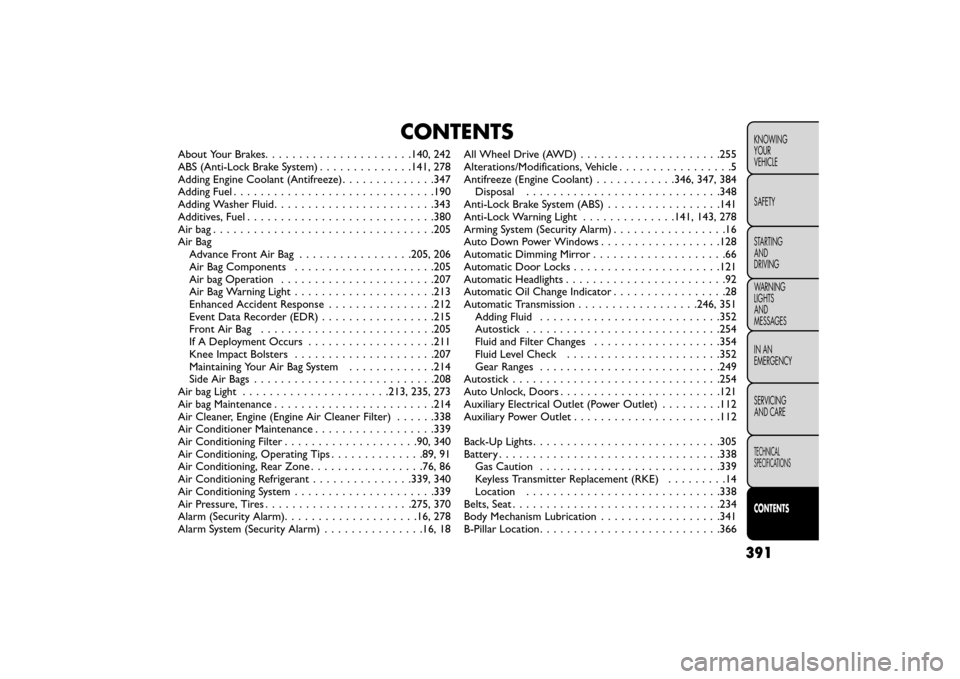
CONTENTS
About Your Brakes..................... .140, 242
ABS (Anti-Lock Brake System) . . . . . .........141, 278
Adding Engine Coolant (Antifreeze) . . ............347
Adding Fuel ............................. .190
Adding Washer Fluid . . . .................... .343
Additives, Fuel . .......................... .380
Airbag................................ .205
Air Bag Advance Front Air Bag . ................205, 206
Air Bag Components . ................... .205
Air bag Operation ...................... .207
Air Bag Warning Light . ................... .213
Enhanced Accident Response . . . . ............212
Event Data Recorder (EDR) . . . . . ............215
FrontAirBag ......................... .205
If A Deployment Occurs . . . . . . .............211
Knee Impact Bolsters . . . . . . . . .............207
Maintaining Your Air Bag System .............214
Side Air Bags . . . . . . . . .................. .208
Air bag Light ..................... .213, 235, 273
Air bag Maintenance ....................... .214
Air Cleaner, Engine (Engine Air Cleaner Filter) ......338
Air Conditioner Maintenance . . . . . . . ...........339
Air Conditioning Filter . . . .................90, 340
Air Conditioning, Operating Tips . . . . ..........89, 91
Air Conditioning, Rear Zone . . . . . . . . .........76, 86
Air Conditioning Refrigerant . . . ............339, 340
Air Conditioning System . ................... .339
Air Pressure, Tires ..................... .275, 370
Alarm (Security Alarm) ................... .16, 278
Alarm System (Security Alarm) ...............16, 18All Wheel Drive (AWD)
.................... .255
Alterations/Modifications, Vehicle .................5
Antifreeze (Engine Coolant) ............346, 347, 384
Disposal ............................ .348
Anti-Lock Brake System (ABS) .................141
Anti-Lock War
ning Light ..............141, 143, 278
Arming System (Security Alarm) .................16
Auto Down Power Windows ..................128
Automatic Dimming Mirror ....................66
Automatic Door Locks ..................... .121
Automatic Headlights ........................92
Automatic Oil Change Indicator .................28
Automatic Transmission ................. .246, 351
Adding Fluid .......................... .352
Autostick ............................ .254
Fluid and Filter Changes .................. .354
Fluid Level Check ...................... .352
Gear Ranges .......................... .249
Autostick .............................. .254
Auto Unlock, Doors ....................... .121
Auxiliary Electrical Outlet (Power Outlet) .........112
Auxiliary Power Outlet ..................... .112
Back-Up Lights ........................... .305
Battery ................................ .338
Gas Caution .......................... .339
Keyless Transmitter Replacement (RKE) .........14
Location ............................ .338
Belts, Seat .............................. .234
Body Mechanism Lubrication ..................341
B-Pillar Location .......................... .366
391
KNOWING
YOUR
VEHICLE
SAFETY
STARTING
AND
DRIVING
WARNING
LIGHTS
AND
MESSAGES
IN AN
EMERGENCY
SERVICING
AND CARE
TECHNICAL
SPECIFICATIONS
CONTENTS
Page 398 of 412
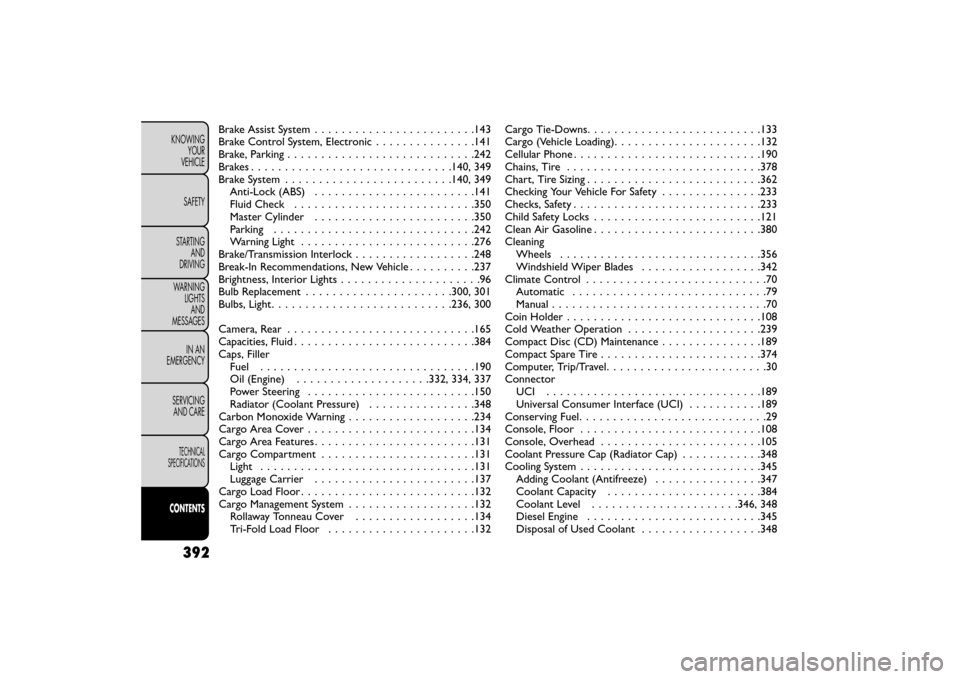
Brake Assist System . . . . . . ..................143
Brake Control System, Electronic ...............141
Brake, Parking ........................... .242
Brakes . . . . . . . . . . . . . . . . . .............140, 349
Brake System . . . ..................... .140, 349
Anti-Lock (ABS) . . . . . . . .................141
Fluid Check . . . . . . . ................... .350
Master Cylinder . ...................... .350
Parking ............................. .242
Warning Light . . . . . . . . ..................276
Brake/Transmission Interlock . .................248
Break-In Recommendations, New Vehicle ..........237
Brightness, Interior Lights . . . ..................96
Bulb Replacement . . ................... .300, 301
Bulbs, Light .......................... .236, 300
Camera, Rear . . ......................... .165
Capacities, Fluid .......................... .384
Caps, Filler Fuel ............................... .190
Oil (Engine) . . . . ............... .332, 334, 337
Power Steering . . . . .................... .150
Radiator (Coolant Pressure) ................348
Carbon Monoxide Warning . . .................234
Cargo Area Cover . . . . .................... .134
Cargo Area Features . . . . . ...................131
Cargo Compartment . . .................... .131
Light ............................... .131
Luggage Carrier . . . . . .................. .137
Cargo Load Floor . . ....................... .132
Cargo Management System . ..................132
Rollaway Tonneau Cover . .................134
Tri-Fold Load Floor . . . . . .................132Cargo Tie-Downs
......................... .133
Cargo (Vehicle Loading) ..................... .132
Cellular Phone ........................... .190
Chains, Tire ............................ .378
Char
t, Tire Sizing ......................... .362
Checking Your Vehicle For Safety ...............233
Checks, Safety ........................... .233
Child Safety Locks ........................ .121
Clean Air Gasoline ........................ .380
Cleaning Wheels ............................. .356
Windshield Wiper Blades ..................342
Climate Control ...........................70
Automatic .............................79
Manual................................70
Coin Holder ............................ .108
Cold Weather Operation ................... .239
Compact Disc (CD) Maintenance ...............189
Compact Spare Tire ....................... .374
Computer, Trip/Travel ........................30
Connector UCI ............................... .189
Universal Consumer Interface (UCI) ...........189
Conserving Fuel ............................29
Console, Floor .......................... .108
Console, Overhead ....................... .105
Coolant Pressure Cap (Radiator Cap) ............348
Cooling System .......................... .345
Adding Coolant (Antifreeze) ................347
Coolant Capacity ...................... .384
Coolant Level ..................... .346, 348
Diesel Engine ......................... .345
Disposal of Used Coolant ..................348
392
KNOWING
YOUR
VEHICLE
SAFETY
STARTING AND
DRIVING
WARNING LIGHTSAND
MESSAGES
IN AN
EMERGENCY
SERVICINGAND CARE
TECHNICAL
SPECIFICATIONS
CONTENTS