transmission oil FIAT FREEMONT 2016 1.G User Guide
[x] Cancel search | Manufacturer: FIAT, Model Year: 2016, Model line: FREEMONT, Model: FIAT FREEMONT 2016 1.GPages: 412, PDF Size: 3.36 MB
Page 331 of 412
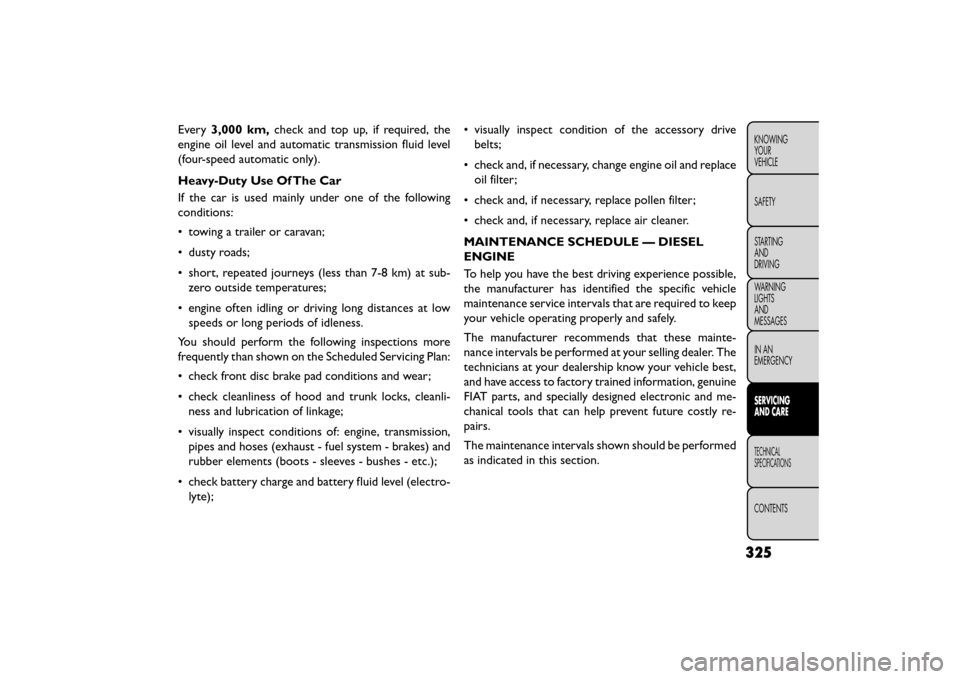
Every3,000 km, check and top up, if required, the
engine oil level and automatic transmission fluid level
(four-speed automatic only).
Heavy-Duty Use Of The Car
If the car is used mainly under one of the following
conditions:
• towing a trailer or caravan;
• dusty roads;
• short, repeated journeys (less than 7-8 km) at sub- zero outside temperatures;
• engine often idling or driving long distances at low speeds or long periods of idleness.
You should perform the following inspections more
frequently than shown on the Scheduled Servicing Plan:
• check front disc brake pad conditions and wear;
• check cleanliness of hood and trunk locks, cleanli- ness and lubrication of linkage;
• visually inspect conditions of: engine, transmission, pipes and hoses (exhaust - fuel system - brakes) and
rubber elements (boots - sleeves - bushes - etc.);
• check battery charge and battery fluid level (electro- lyte); • visually inspect condition of the accessory drive
belts;
• check and, if necessary, change engine oil and replace oil filter;
• check and, if necessary, replace pollen filter;
• check and, if necessary, replace air cleaner.
MAINTENANCE SCHEDULE — DIESEL
ENGINE
To help you have the best driving experience possible,
the manufacturer has identified the specific vehicle
maintenance service intervals that are required to keep
your vehicle operating properly and safely.
The manufacturer recommends that these mainte-
nance intervals be performed at your selling dealer. The
technicians at your dealership know your vehicle best,
and have access to factory trained information, genuine
FIAT parts, and specially designed electronic and me-
chanical tools that can help prevent future costly re-
pairs.
The maintenance intervals shown should be performed
as indicated in this section.
325
KNOWING
YOUR
VEHICLE
SAFETY
STARTING
AND
DRIVING
WARNING
LIGHTS
AND
MESSAGES
IN AN
EMERGENCY
SERVICING
AND C ARE
TECHNICAL
SPECIFICATIONS
CONTENTS
Page 335 of 412
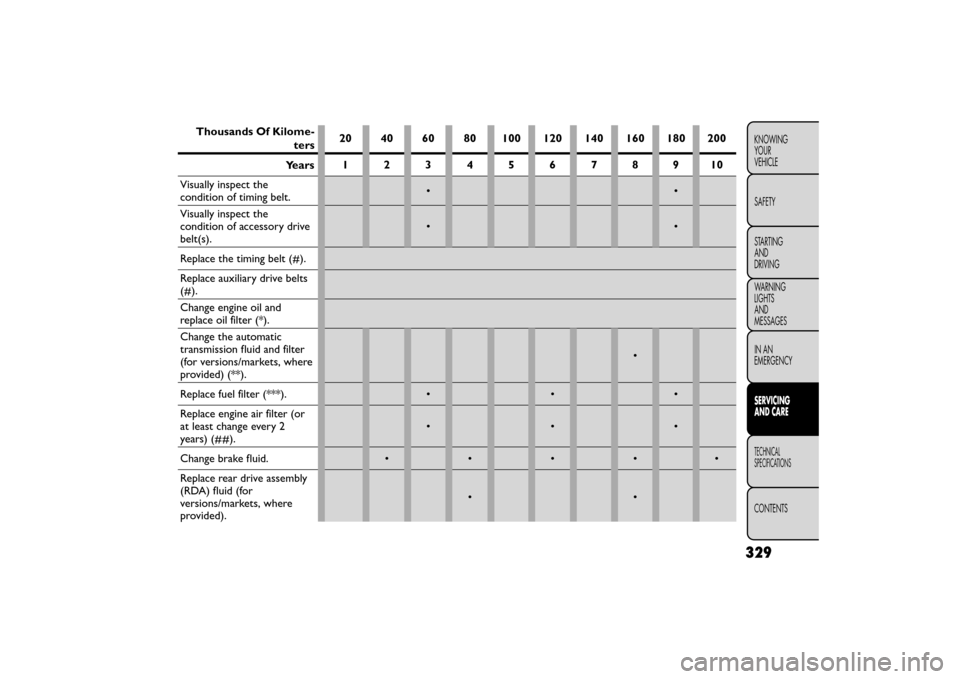
Thousands Of Kilome-
ters20 40 60 80 100 120 140 160 180 200
12345678910
Visually inspect the
condition of timing belt.••
Visually inspect the
condition of accessory drive
belt(s).
••
Replace the timing belt (#).
Replace auxiliary drive belts
(#).
Change engine oil and
replace oil filter (*).
Change the automatic
transmission fluid and filter
(for versions/markets, where
provided) (**).
•
Replace fuel filter (***). • • •
Replace engine air filter (or
at least change every 2
years) (##).
•••
Change brake fluid. • • • • •
Replace rear drive assembly
(RDA) fluid (for
versions/markets, where
provided).
••
329
KNOWING YOURVEHICLE
SAFETY
STARTING ANDDRIVING
WARNING LIGHTSANDMESSAGES
IN AN EMERGENCY
SERVICING AND CARE
TECHNICALSPECIFICATIONS
CONTENTS
Years
Page 336 of 412
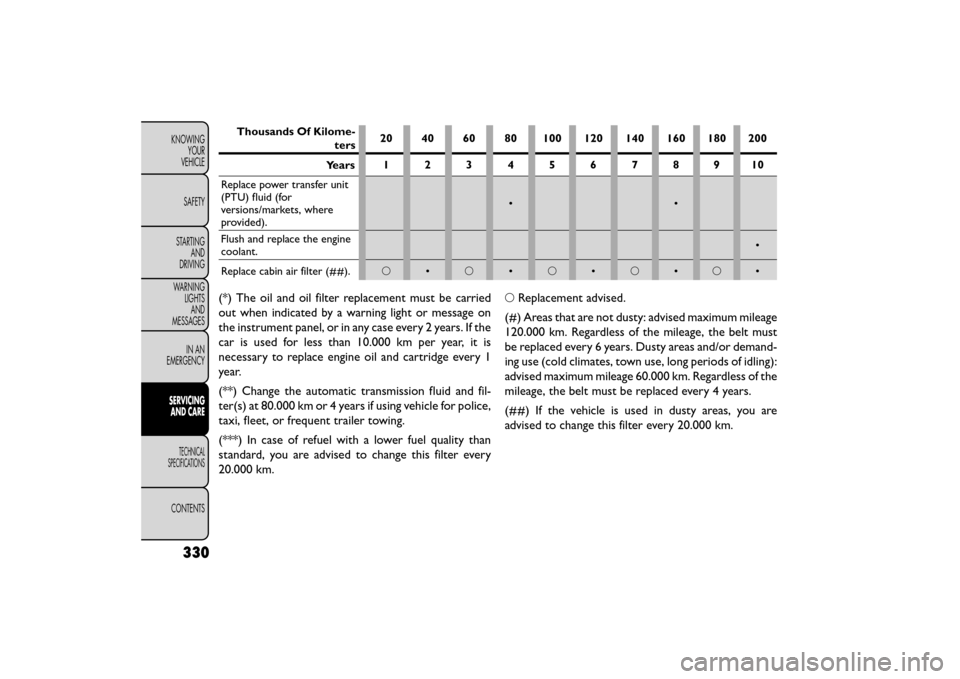
Thousands Of Kilome-
ters20 40 60 80 100 120 140 160 180 200
12345678910
Replace power transfer unit
(PTU) fluid (for
versions/markets, where
provided).
••
Flush and replace the engine
coolant.•
Replace cabin air filter (##).○•○•○•○•○•
(*) The oil and oil filter replacement must be carried
out when indicated by a warning light or message on
the instrument panel, or in any case every 2 years. If the
car is used for less than 10.000 km per year, it is
necessary to replace engine oil and cartridge every 1
year.
(**) Change the automatic transmission fluid and fil-
ter(s) at 80.000 km or 4 years if using vehicle for police,
taxi, fleet, or frequent trailer towing.
(***) In case of refuel with a lower fuel quality than
standard, you are advised to change this filter every
20.000 km.
○Replacement advised.
(#) Areas that are not dusty: advised maximum mileage
120.000 km. Regardless of the mileage, the belt must
be replaced every 6 years. Dusty areas and/or demand-
ing use (cold climates, town use, long periods of idling):
advised maximum mileage 60.000 km. Regardless of the
mileage, the belt must be replaced every 4 years.
(##) If the vehicle is used in dusty areas, you are
advised to change this filter every 20.000 km.
330
KNOWINGYOURVEHICLE
SAFETY
STARTINGANDDRIVING
WARNINGLIGHTSANDMESSAGES
IN ANEMERGENCY
SERVICINGAND CARE
TECHNICALSPECIFICATIONS
CONTENTS
Years
Page 337 of 412
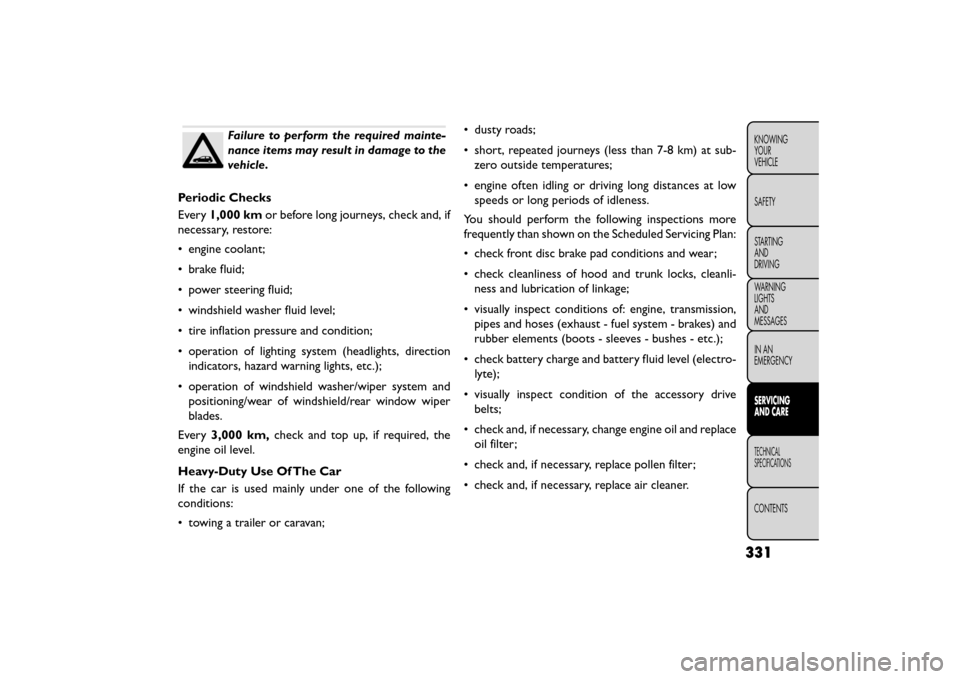
Failure to perform the required mainte-
nance items may result in damage to the
vehicle.
Periodic Checks
Every 1,000 km or before long journeys, check and, if
necessary, restore:
• engine coolant;
• brake fluid;
• power steering fluid;
• windshield washer fluid level;
• tire inflation pressure and condition;
• operation of lighting system (headlights, direction indicators, hazard warning lights, etc.);
• operation of windshield washer/wiper system and positioning/wear of windshield/rear window wiper
blades.
Every 3,000 km, check and top up, if required, the
engine oil level.
Heavy-Duty Use Of The Car
If the car is used mainly under one of the following
conditions:
• towing a trailer or caravan; • dusty roads;
• short, repeated journeys (less than 7-8 km) at sub-
zero outside temperatures;
• engine often idling or driving long distances at low speeds or long periods of idleness.
You should perform the following inspections more
frequently than shown on the Scheduled Servicing Plan:
• check front disc brake pad conditions and wear;
• check cleanliness of hood and trunk locks, cleanli- ness and lubrication of linkage;
• visually inspect conditions of: engine, transmission, pipes and hoses (exhaust - fuel system - brakes) and
rubber elements (boots - sleeves - bushes - etc.);
• check battery charge and battery fluid level (electro- lyte);
• visually inspect condition of the accessory drive belts;
• check and, if necessary, change engine oil and replace oil filter;
• check and, if necessary, replace pollen filter;
• check and, if necessary, replace air cleaner.
331
KNOWING
YOUR
VEHICLE
SAFETY
STARTING
AND
DRIVING
WARNING
LIGHTS
AND
MESSAGES
IN AN
EMERGENCY
SERVICING
AND C ARE
TECHNICAL
SPECIFICATIONS
CONTENTS
Page 338 of 412
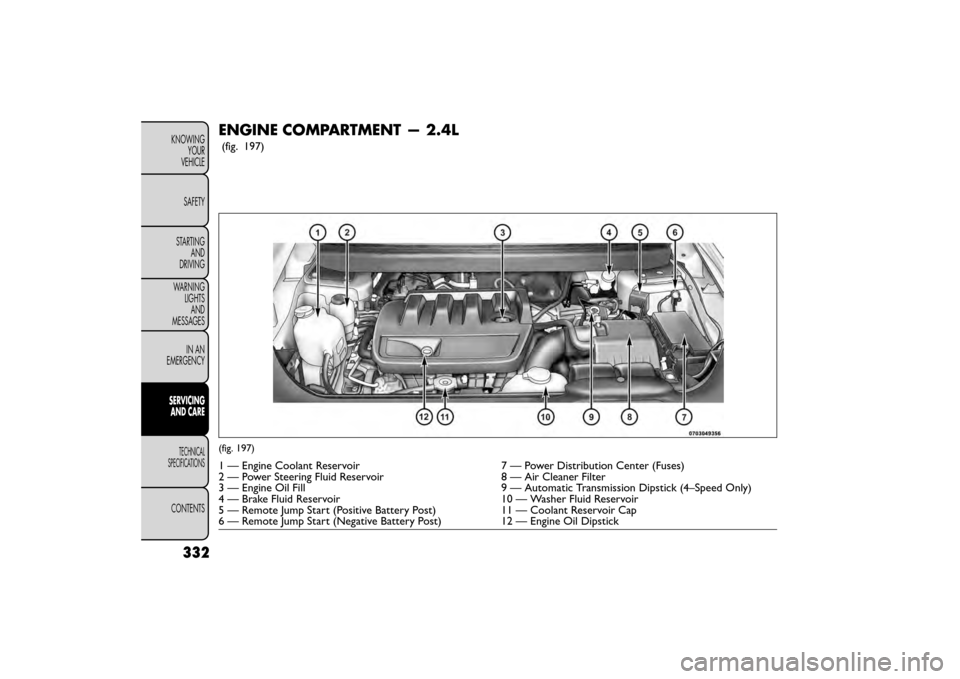
ENGINE COMPARTMENT — 2.4L
(fig. 197)
(fig. 197)
1 — Engine Coolant Reservoir7 — Power Distribution Center (Fuses)
2 — Power Steering Fluid Reservoir 8 — Air Cleaner Filter
3 — Engine Oil Fill 9 — Automatic Transmission Dipstick (4–Speed Only)
4 — Brake Fluid Reservoir 10 — Washer Fluid Reservoir
5 — Remote Jump Start (Positive Battery Post) 11 — Coolant Reservoir Cap
6 — Remote Jump Start (Negative Battery Post) 12 — Engine Oil Dipstick
332
KNOWING
YOUR
VEHICLE
SAFETY
STARTING AND
DRIVING
WARNING LIGHTSAND
MESSAGES
IN AN
EMERGENCY
SERVICINGAND C ARE
TECHNICAL
SPECIFICATIONS
CONTENTS
Page 351 of 412
NOTE:Intentional tampering with emissions control
systems can result in civil penalties being assessed
against you.
WARNING!
A hot exhaust system can start a fire if you
park over materials that can burn. Such
materials might be grass or leaves coming into
contact with your exhaust system. Do not park or
operate your vehicle in areas where your exhaust
system can contact anything that can burn.
In unusual situations involving grossly malfunctioning
engine operation, a scorching odor may indicate severe
and abnormal catalyst overheating. If this occurs, safely
bring the vehicle to a complete stop, shut the engine
OFF, and allow the vehicle to cool. Thereafter, obtain
service, including a tune-up to manufacturer’s specifi-
cations immediately.
To minimize the possibility of catalyst damage:
• Do not shut OFF the engine or interrupt the ignition when the transmission is in gear and the vehicle is in
motion.
• Do not try to start the engine by pushing or towing the vehicle.
• Do not idle the engine with any ignition coil connec- tors disconnected for prolonged periods. COOLING SYSTEM
WARNING!
• When working near the radiator cool-
in g
fan, disconnect the fan motor lead or
turn the ignition switch to the LOCK position.The
fan is temperature controlled and can start at
any time the ignition switch is in the ON position.
• You or others can be badly burned by hot
engine coolant (antifreeze) or steam from your
radiator. If you see or hear steam coming from
under the hood, do not open the hood until the
radiator has had time to cool. Never tr y to open a
cooling system pressure cap when the radiator is
hot .
Car maintenance should be done at a
FIAT Dealership. For routine and minor
maintenance operations you wish to
carry out yourself, we do recommend you have
the proper equipment , genuine FIAT spare parts
and the necessary fluids; do not however carry out
these operations if you have no experience.
345
KNOWING
YOUR
VEHICLE
SAFETY
STARTING
AND
DRIVING
WARNING
LIGHTS
AND
MESSAGES
IN AN
EMERGENCY
SERVICING
AND C ARE
TECHNICAL
SPECIFICATIONS
CONTENTS
Page 357 of 412
WARNING! (Continued)
• To avoid contamination from foreign matter or
moisture, use only new brake fluid or fluid that
has been in a tightly closed container. Keep the
master cylinder reservoir cap secured at all
times. Brake fluid in a open container absorbs
moisture from the air resulting in a lower boiling
point . This may cause it to boil unexpectedly
during hard or prolonged braking, resulting in
sudden brake failure. This could result in a acci-
dent .
• Overfilling the brake fluid reservoir can result
in spilling brake fluid on hot engine parts, causing
the brake fluid to catch fire. Brake fluid can also
damage painted and vinyl surfaces, care should
be taken to avoid its contact with these surfaces.
• Do not allow petroleum based fluid to con-
taminate the brake fluid. Brake seal components
could be damaged, causing partial or complete
brake failure.This could result in an accident . AUTOMATIC TRANSMISSION (for
versions/markets, where provided)
Selection Of Lubricant
It is important to use the proper transmission fluid to
ensure optimum transmission performance and life.
Use only the manufacturer’s specified transmission
fluid. Refer to “Fluids, Lubricants, and Genuine Parts”
in “Technical Specifications” for fluid specifications. It is
important to maintain the transmission fluid at the
correct level using the recommended fluid. No chemi-
cal flushes should be used in any transmission; only the
approved lubricant should be used.
Using a transmission fluid other than the
manufacturer ’s recommended fluid may
cause deterioration in transmission shift
quality and/or torque converter shudder, and will
require more frequent fluid and filter changes.
Refer to “Fluids, Lubricants, and Genuine Parts” in
"Technical Specifications" for fluid specifica-
tions.
351
KNOWING
YOUR
VEHICLE
SAFETY
STARTING
AND
DRIVING
WARNING
LIGHTS
AND
MESSAGES
IN AN
EMERGENCY
SERVICING
AND C ARE
TECHNICAL
SPECIFICATIONS
CONTENTS
Page 359 of 412
4. Place the shift lever momentarily into each gearposition (allowing time for the transmission to fully
engage in each position), ending with the transmis-
sion in PARK.
5. Wipe the area around the dipstick clean to prevent dirt from entering the transmission.
6. Remove the dipstick and determine if the fluid is hot or cold. Hot fluid is approximately 82° C, which
is the normal operating temperature after the ve-
hicle is driven at least 24 km. Hot fluid cannot be
held comfortably between the fingertips. Cold fluid
is at a temperature of approximately 27° C.
7. Wipe the dipstick clean and reinsert it until seated. Then, remove the dipstick and note the fluid level
on both sides. The fluid level reading is only valid if
there is a solid coating of oil on both sides of the
dipstick. Note that the holes in the dipstick will be
full of fluid if the actual level is at or above the hole.
• If the fluid is hot, the fluid level should be in the crosshatched area marked “HOT” (between the up-
per two holes in the dipstick).
• If the fluid is cold, the fluid level should be between the lower two holes in the area marked “COLD.” • If the fluid level is low, add fluid through the dipstick
tube to bring it to the proper level. Do not overfill.
After adding any quantity of oil through the dipstick
tube, wait at least two minutes for the oil to fully
drain into the transmission before rechecking the
fluid level.
8. Check for leaks. Release the parking brake.
To prevent dirt and water from entering the transmis-
sion after checking or replenishing fluid, make sure that
the dipstick cap is properly re-seated.
• Using a transmission fluid other than
the manufacturer ’s recommended fluid
may cause deterioration in transmission
shift quality and/or torque converter shudder, and
will require more frequent fluid and filter
changes. Refer to “Fluids, Lubricants, and Genuine
Parts” in "Technical Specifications" for fluid
specifications.
• Dirt and water in the transmission can cause
serious damage. To prevent dirt and water from
entering the transmission after checking or re-
plenishing fluid, make sure that the dipstick cap is
re-seated properly.
353
KNOWING
YOUR
VEHICLE
SAFETY
STARTING
AND
DRIVING
WARNING
LIGHTS
AND
MESSAGES
IN AN
EMERGENCY
SERVICING
AND C ARE
TECHNICAL
SPECIFICATIONS
CONTENTS
Page 360 of 412
Fluid And Filter Changes
Refer to the “Maintenance Schedule” for the proper
maintenance intervals.
In addition, change the fluid and filter if the fluid
becomes contaminated (with water, etc.), or if the
transmission is disassembled for any reason.
MANUAL TRANSMISSION (for versions/
markets, where provided)
Lubricant Selection
Use only manufacturers recommended transmission
fluid. Do not add any materials (other than leak detec-
tion dyes). Refer to “Fluids, Lubricants, and Genuine
Parts” in “Technical Specifications” for further informa-
tion.
Frequency Of Fluid Change
Change the manual transmission fluid at the intervals
shown in the “Maintenance Schedule” in this manual.
REAR DRIVE ASSEMBLY (RDA) – AWD
MODELS ONLY
Lubricant Selection
Use only the manufacturer's recommended fluid. Refer
to “Fluids, Lubricants, and Genuine Parts” in “Technical
Specifications” for further information.Fluid Level Check
Visually inspect the unit at each oil change for leakage.
If leakage is detected, check the fluid level by removing
the fill plug. The fluid level should be maintained be-
tween the bottom of the fill hole to 4 mm below the fill
hole.
Add fluid, if necessary, to maintain the proper level.
Frequency Of Fluid Change
Refer to the “Maintenance Schedule” for the proper
maintenance intervals.
POWER TRANSFER UNIT (PTU) – AWD
MODELS ONLY
Lubricant Selection
Use only the manufacturer's recommended fluid. Refer
to “Fluids, Lubricants, and Genuine Parts” in “Technical
Specifications” for further information.
Fluid Level Check
Visually inspect the unit at each oil change for leakage.
If leakage is detected, Check the fluid level by removing
the fill plug. The fluid level should be maintained be-
tween the bottom of the fill hole to 4 mm below the fill
hole.
Add fluid, if necessary, to maintain the proper level.
354
KNOWING
YOUR
VEHICLE
SAFETY
STARTING AND
DRIVING
WARNING LIGHTSAND
MESSAGES
IN AN
EMERGENCY
SERVICINGAND C ARE
TECHNICAL
SPECIFICATIONS
CONTENTS
Page 397 of 412
CONTENTS
About Your Brakes..................... .140, 242
ABS (Anti-Lock Brake System) . . . . . .........141, 278
Adding Engine Coolant (Antifreeze) . . ............347
Adding Fuel ............................. .190
Adding Washer Fluid . . . .................... .343
Additives, Fuel . .......................... .380
Airbag................................ .205
Air Bag Advance Front Air Bag . ................205, 206
Air Bag Components . ................... .205
Air bag Operation ...................... .207
Air Bag Warning Light . ................... .213
Enhanced Accident Response . . . . ............212
Event Data Recorder (EDR) . . . . . ............215
FrontAirBag ......................... .205
If A Deployment Occurs . . . . . . .............211
Knee Impact Bolsters . . . . . . . . .............207
Maintaining Your Air Bag System .............214
Side Air Bags . . . . . . . . .................. .208
Air bag Light ..................... .213, 235, 273
Air bag Maintenance ....................... .214
Air Cleaner, Engine (Engine Air Cleaner Filter) ......338
Air Conditioner Maintenance . . . . . . . ...........339
Air Conditioning Filter . . . .................90, 340
Air Conditioning, Operating Tips . . . . ..........89, 91
Air Conditioning, Rear Zone . . . . . . . . .........76, 86
Air Conditioning Refrigerant . . . ............339, 340
Air Conditioning System . ................... .339
Air Pressure, Tires ..................... .275, 370
Alarm (Security Alarm) ................... .16, 278
Alarm System (Security Alarm) ...............16, 18All Wheel Drive (AWD)
.................... .255
Alterations/Modifications, Vehicle .................5
Antifreeze (Engine Coolant) ............346, 347, 384
Disposal ............................ .348
Anti-Lock Brake System (ABS) .................141
Anti-Lock War
ning Light ..............141, 143, 278
Arming System (Security Alarm) .................16
Auto Down Power Windows ..................128
Automatic Dimming Mirror ....................66
Automatic Door Locks ..................... .121
Automatic Headlights ........................92
Automatic Oil Change Indicator .................28
Automatic Transmission ................. .246, 351
Adding Fluid .......................... .352
Autostick ............................ .254
Fluid and Filter Changes .................. .354
Fluid Level Check ...................... .352
Gear Ranges .......................... .249
Autostick .............................. .254
Auto Unlock, Doors ....................... .121
Auxiliary Electrical Outlet (Power Outlet) .........112
Auxiliary Power Outlet ..................... .112
Back-Up Lights ........................... .305
Battery ................................ .338
Gas Caution .......................... .339
Keyless Transmitter Replacement (RKE) .........14
Location ............................ .338
Belts, Seat .............................. .234
Body Mechanism Lubrication ..................341
B-Pillar Location .......................... .366
391
KNOWING
YOUR
VEHICLE
SAFETY
STARTING
AND
DRIVING
WARNING
LIGHTS
AND
MESSAGES
IN AN
EMERGENCY
SERVICING
AND CARE
TECHNICAL
SPECIFICATIONS
CONTENTS