parking brake FIAT FREEMONT 2016 1.G Owner's Manual
[x] Cancel search | Manufacturer: FIAT, Model Year: 2016, Model line: FREEMONT, Model: FIAT FREEMONT 2016 1.GPages: 412, PDF Size: 3.36 MB
Page 302 of 412
WARNING! (Continued)
• Take care not to allow the contents of Tire
Service Kit to come in contact with hair, eyes, or
clothing. Tire Service Kit is harmful if inhaled,
swallowed, or absorbed through the skin. It
causes skin, eye, and respiratory irritation. Flush
immediately with plenty of water if there is any
contact with eyes or skin. Change clothing as
soon as possible, if there is any contact with
clothing.
• Tire Service Kit Sealant solution contains latex.
In case of an allergic reaction or rash, consult a
physician immediately. Keep Tire Service Kit out
of reach of children. If swallowed, rinse mouth
immediately with plenty of water and drink
plenty of water. Do not induce vomiting! Consult
a physician immediately.
SEALING A TIRE WITH TIRE SERVICE KIT
(A) Whenever You Stop To Use Tire Service
Kit:
1. Pull over to a safe location and turn on the vehicle’s Hazard Warning flashers.
2. Verify that the valve stem (on the wheel with the deflated tire) is in a position that is near to the
ground. This will allow the Tire Service Kit Hoses (6) and (7) to reach the valve stem and keep the Tire
Service Kit flat on the ground. This will provide the
best positioning of the kit when injecting the sealant
into the deflated tire and running the air pump.
Move the vehicle as necessary to place the valve
stem in this position before proceeding.
3. Place the transmission in PARK (auto transmission) or in Gear (manual transmission) and turn Off the
ignition.
4. Set the parking brake.
(B) Setting Up To Use Tire Service Kit:
1. Push in the Mode Select Knob (5) and turn to the Sealant Mode position.
2. Uncoil the Sealant Hose (6) and then remove the cap from the fitting at the end of the hose.
3. Place the Tire Service Kit flat on the ground next to the deflated tire.
4. Remove the cap from the valve stem and then screw the fitting at the end of the Sealant Hose (6) onto
the valve stem.
5. Uncoil the Power Plug (8) and insert the plug into the vehicle’s 12 Volt power outlet.
296
KNOWING YOUR
VEHICLE
SAFETY
STARTING AND
DRIVING
WARNING LIGHTSAND
MESSAGES
IN AN
EMERGENCY
SER VICING
AND
CARE
TECHNICAL
SPECIFICATIONS
CONTENTS
Page 303 of 412
NOTE:Do not remove foreign objects (e.g., screws or
nails) from the tire.
(C) Injecting Tire Service Kit Sealant Into The
Deflated Tire:
• Always start the engine before turning ON the Tire Service Kit.
NOTE: Manual transmission vehicles must have the
parking brake engaged and the shift lever in NEUTRAL.
• After pressing the Power Button (4), the sealant (white fluid) will flow from the Sealant Bottle (1)
through the Sealant Hose (6) and into the tire.
NOTE: Sealant may leak out through the puncture in
the tire.
If the sealant (white fluid) does not flow within 0
– 10 seconds through the Sealant Hose (6):
1. Press the Power Button (4) to turn Off the Tire Service Kit. Disconnect the Sealant Hose (6) from
the valve stem. Make sure the valve stem is free of
debris. Reconnect the Sealant Hose (6) to the valve
stem. Check that the Mode Select Knob (5) is in the
Sealant Mode position and not Air Mode. Press the
Power Button (4) to turn On the Tire Service Kit. 2. Connect the Power Plug (8) to a different 12 Volt
power outlet in your vehicle or another vehicle, if
available. Make sure the engine is running before
turning ON the Tire Service Kit.
3. The Sealant Bottle (1) may be empty due to previ- ous use. Call for assistance.
NOTE: If the Mode Select Knob (5) is on Air Mode
and the pump is operating, air will dispense from the
Air Pump Hose (7) only, not the Sealant Hose (6).
If the sealant (white fluid) does flow through the
Sealant Hose (6):
1. Continue to operate the pump until sealant is no longer flowing through hose (typically takes 30 - 70
seconds). As the sealant flows through the Sealant
Hose (6), the Pressure Gauge (3) can read as high as
4.8 Bar. The Pressure Gauge (3) will decrease
quickly from approximately 4.8 Bar to the actual tire
pressure when the Sealant Bottle (1) is empty.
2. The pump will start to inject air into the tire immediately after the Sealant Bottle (1) is empty.
Continue to operate the pump and inflate the tire
to the pressure indicated on the tire pressure label
on the driver-side latch pillar (recommended pres-
sure). Check the tire pressure by looking at the
Pressure Gauge (3).
297
KNOWING
YOUR
VEHICLE
SAFETY
STARTING
AND
DRIVING
WARNING
LIGHTS
AND
MESSAGES
IN AN
EMERGENCY
SER VICING
AND
CARE
TECHNICAL
SPECIFICATIONS
CONTENTS
Page 319 of 412
SHIFT LEVER OVERRIDE
If a malfunction occurs and the shift lever cannot be
moved out of the PARK position, you can use the
following procedure to temporarily move the shift
lever :
1. Turn the engine OFF.
2. Firmly apply the parking brake.
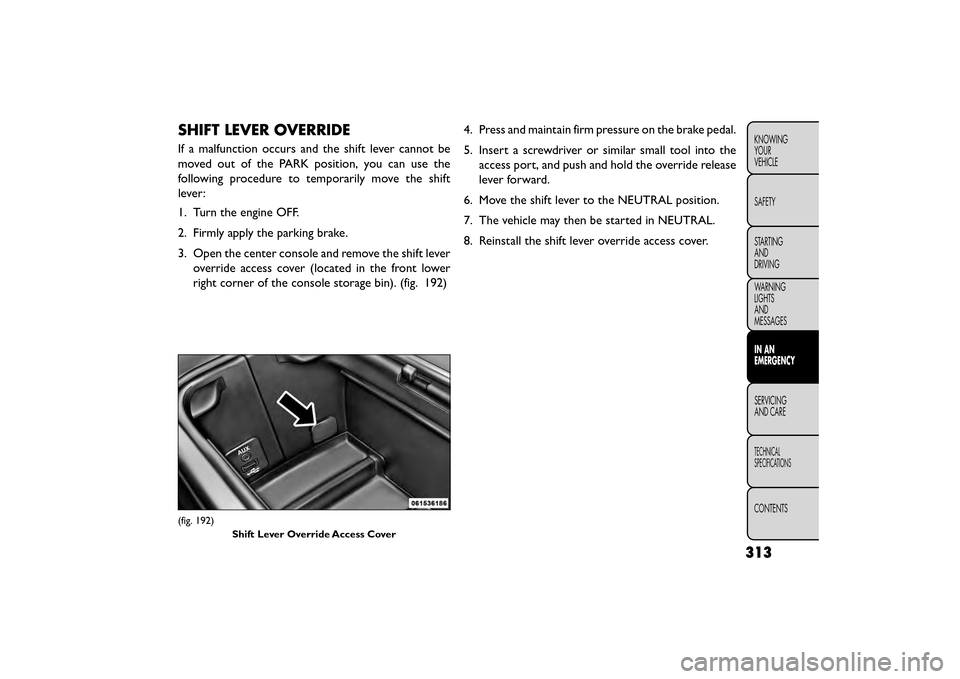
3. Open the center console and remove the shift leveroverride access cover (located in the front lower
right corner of the console storage bin). (fig. 192) 4. Press and maintain firm pressure on the brake pedal.
5. Insert a screwdriver or similar small tool into the
access port, and push and hold the override release
lever forward.
6. Move the shift lever to the NEUTRAL position.
7. The vehicle may then be started in NEUTRAL.
8. Reinstall the shift lever override access cover.
(fig. 192) Shift Lever Override Access Cover
313
KNOWING
YOUR
VEHICLE
SAFETY
STARTING
AND
DRIVING
WARNING
LIGHTS
AND
MESSAGES
IN AN
EMERGENCY
SERVICING
AND
CARE
TECHNICAL
SPECIFICATIONS
CONTENTS
Page 328 of 412
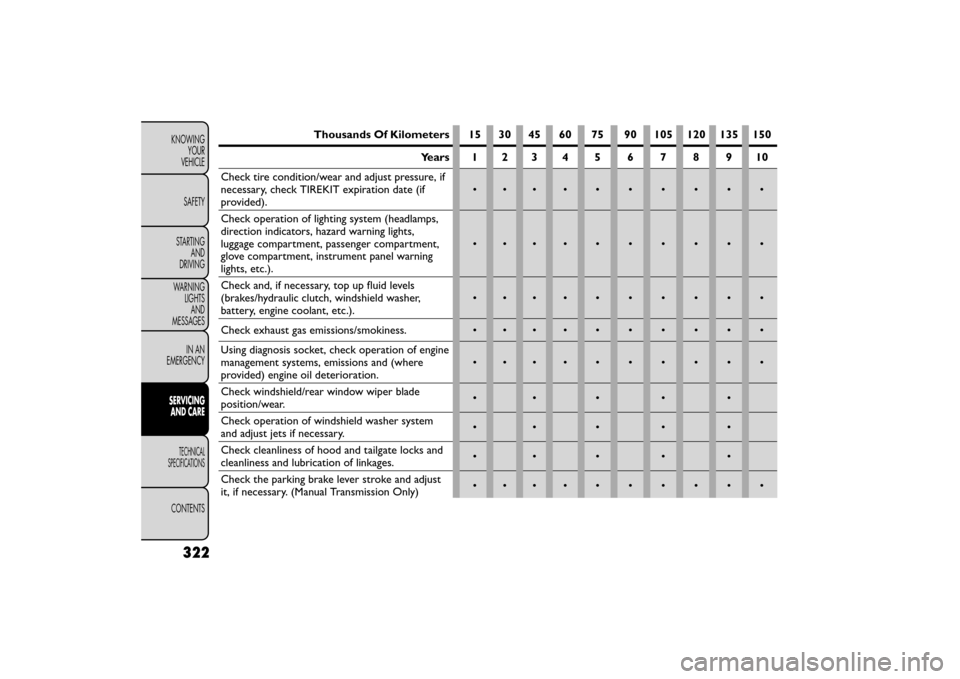
Thousands Of Kilometers 15 30 45 60 75 90 105 120 135 150Years 1 2 3 4 5678910
Check tire condition/wear and adjust pressure, if
necessary, check TIREKIT expiration date (if
provided). ••••••••••
Check operation of lighting system (headlamps,
direction indicators, hazard warning lights,
luggage compartment, passenger compartment,
glove compartment, instrument panel warning
lights, etc.). ••••••••••
Check and, if necessary, top up fluid levels
(brakes/hydraulic clutch, windshield washer,
battery, engine coolant, etc.). ••••••••••
Check exhaust gas emissions/smokiness. • • • • ••••••
Using diagnosis socket, check operation of engine
management systems, emissions and (where
provided) engine oil deterioration. ••••••••••
Check windshield/rear window wiper blade
position/wear. •••••
Check operation of windshield washer system
and adjust jets if necessary. •••••
Check cleanliness of hood and tailgate locks and
cleanliness and lubrication of linkages. •••••
Check the parking brake lever stroke and adjust
it, if necessary. (Manual Transmission Only) ••••••••••
322
KNOWING
YOUR
VEHICLE
SAFETY
STARTING AND
DRIVING
WARNING LIGHTSAND
MESSAGES
IN AN
EMERGENCY
SERVICINGAND C ARE
TECHNICAL
SPECIFICATIONS
CONTENTS
Page 334 of 412
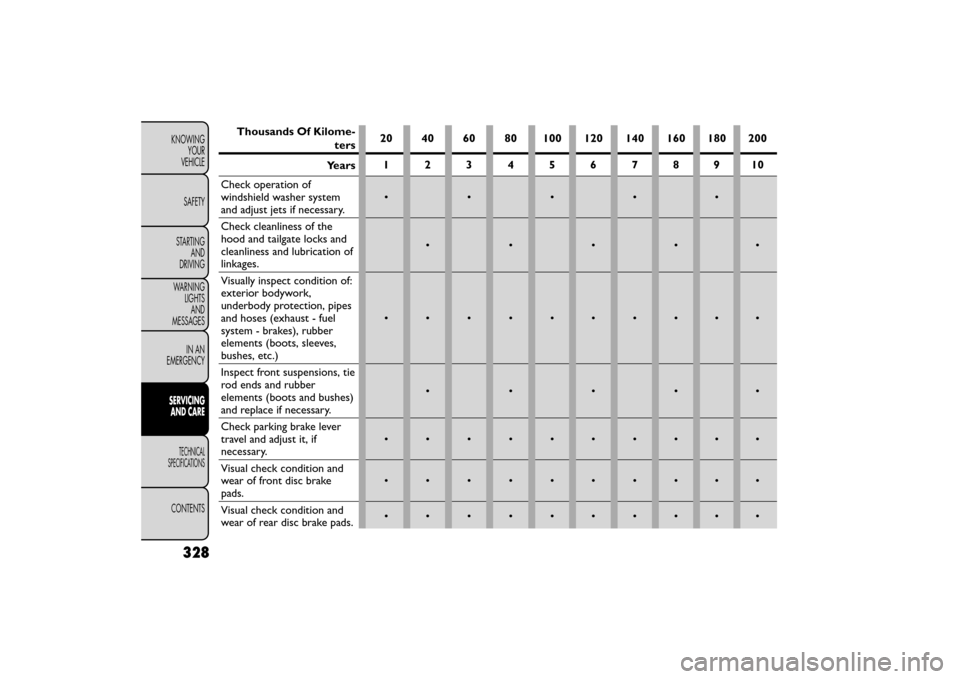
Thousands Of Kilome-
ters20 40 60 80 100 120 140 160 180 200
12345678910
Check operation of
windshield washer system
and adjust jets if necessary.
•••••
Check cleanliness of the
hood and tailgate locks and
cleanliness and lubrication of
linkages.
•••••
Visually inspect condition of:
exterior bodywork,
underbody protection, pipes
and hoses (exhaust - fuel
system - brakes), rubber
elements (boots, sleeves,
bushes, etc.)
••••••••••
Inspect front suspensions, tie
rod ends and rubber
elements (boots and bushes)
and replace if necessary.
•••••
Check parking brake lever
travel and adjust it, if
necessary.
••••••••••
Visual check condition and
wear of front disc brake
pads.
••••••••••
Visual check condition and
wear of rear disc brake pads.••••••••••
328
KNOWINGYOURVEHICLE
SAFETY
STARTINGANDDRIVING
WARNINGLIGHTSANDMESSAGES
IN ANEMERGENCY
SERVICINGAND CARE
TECHNICALSPECIFICATIONS
CONTENTS
Years
Page 358 of 412
Special Additives
The manufacturer strongly recommends against using any
special additives in the transmission. Automatic Transmis-
sion Fluid (ATF) is an engineered product and its perfor-
mance may be impaired by supplemental additives. There-
fore, do not add any fluid additives to the transmission.
The only exception to this policy is the use of special dyes
for diagnosing fluid leaks. Avoid using transmission sealers
as they may adversely affect seals.
Do not use chemical flushes in your
transmission as the chemicals can dam-
age your transmission components. Such
damage is not covered by the New Vehicle Limited
Warranty.
Fluid Level Check - Six-Speed Transmission
The fluid level is preset at the factory and does not
require adjustment under normal operating conditions.
Routine fluid level checks are not required, therefore
the transmission filler tube is capped and no dipstick is
provided. Your authorized dealer can check your trans-
mission fluid level using a special service dipstick. If you
notice fluid leakage or transmission malfunction, visit
your authorized dealer immediately to have the trans-
mission fluid level checked. Operating the vehicle with
an improper fluid level can cause severe transmission
damage.
If a transmission fluid leak occurs, visit
your authorized dealer immediately. Se-
vere transmission damage may occur.
Your authorized dealer has the proper tools to
adjust the fluid level accurately.
Car maintenance should be done at a
FIAT Dealership. For routine and minor
maintenance operations you wish to
carry out yourself, we do recommend you have
the proper equipment , genuine FIAT spare parts
and the necessary fluids; do not however carry out
these operations if you have no experience.
Fluid Level Check — Four-Speed Automatic
Use the following procedure to check the transmission
fluid level properly:
1. Park the vehicle on level ground.
2. Run the engine at normal idle speed for at least 60 seconds, and leave the engine running for the rest of
this procedure.
3. Fully apply the parking brake, and press the brake pedal.
352
KNOWING YOUR
VEHICLE
SAFETY
STARTING AND
DRIVING
WARNING LIGHTSAND
MESSAGES
IN AN
EMERGENCY
SERVICINGAND C ARE
TECHNICAL
SPECIFICATIONS
CONTENTS
Page 359 of 412
4. Place the shift lever momentarily into each gearposition (allowing time for the transmission to fully
engage in each position), ending with the transmis-
sion in PARK.
5. Wipe the area around the dipstick clean to prevent dirt from entering the transmission.
6. Remove the dipstick and determine if the fluid is hot or cold. Hot fluid is approximately 82° C, which
is the normal operating temperature after the ve-
hicle is driven at least 24 km. Hot fluid cannot be
held comfortably between the fingertips. Cold fluid
is at a temperature of approximately 27° C.
7. Wipe the dipstick clean and reinsert it until seated. Then, remove the dipstick and note the fluid level
on both sides. The fluid level reading is only valid if
there is a solid coating of oil on both sides of the
dipstick. Note that the holes in the dipstick will be
full of fluid if the actual level is at or above the hole.
• If the fluid is hot, the fluid level should be in the crosshatched area marked “HOT” (between the up-
per two holes in the dipstick).
• If the fluid is cold, the fluid level should be between the lower two holes in the area marked “COLD.” • If the fluid level is low, add fluid through the dipstick
tube to bring it to the proper level. Do not overfill.
After adding any quantity of oil through the dipstick
tube, wait at least two minutes for the oil to fully
drain into the transmission before rechecking the
fluid level.
8. Check for leaks. Release the parking brake.
To prevent dirt and water from entering the transmis-
sion after checking or replenishing fluid, make sure that
the dipstick cap is properly re-seated.
• Using a transmission fluid other than
the manufacturer ’s recommended fluid
may cause deterioration in transmission
shift quality and/or torque converter shudder, and
will require more frequent fluid and filter
changes. Refer to “Fluids, Lubricants, and Genuine
Parts” in "Technical Specifications" for fluid
specifications.
• Dirt and water in the transmission can cause
serious damage. To prevent dirt and water from
entering the transmission after checking or re-
plenishing fluid, make sure that the dipstick cap is
re-seated properly.
353
KNOWING
YOUR
VEHICLE
SAFETY
STARTING
AND
DRIVING
WARNING
LIGHTS
AND
MESSAGES
IN AN
EMERGENCY
SERVICING
AND C ARE
TECHNICAL
SPECIFICATIONS
CONTENTS
Page 398 of 412
Brake Assist System . . . . . . ..................143
Brake Control System, Electronic ...............141
Brake, Parking ........................... .242
Brakes . . . . . . . . . . . . . . . . . .............140, 349
Brake System . . . ..................... .140, 349
Anti-Lock (ABS) . . . . . . . .................141
Fluid Check . . . . . . . ................... .350
Master Cylinder . ...................... .350
Parking ............................. .242
Warning Light . . . . . . . . ..................276
Brake/Transmission Interlock . .................248
Break-In Recommendations, New Vehicle ..........237
Brightness, Interior Lights . . . ..................96
Bulb Replacement . . ................... .300, 301
Bulbs, Light .......................... .236, 300
Camera, Rear . . ......................... .165
Capacities, Fluid .......................... .384
Caps, Filler Fuel ............................... .190
Oil (Engine) . . . . ............... .332, 334, 337
Power Steering . . . . .................... .150
Radiator (Coolant Pressure) ................348
Carbon Monoxide Warning . . .................234
Cargo Area Cover . . . . .................... .134
Cargo Area Features . . . . . ...................131
Cargo Compartment . . .................... .131
Light ............................... .131
Luggage Carrier . . . . . .................. .137
Cargo Load Floor . . ....................... .132
Cargo Management System . ..................132
Rollaway Tonneau Cover . .................134
Tri-Fold Load Floor . . . . . .................132Cargo Tie-Downs
......................... .133
Cargo (Vehicle Loading) ..................... .132
Cellular Phone ........................... .190
Chains, Tire ............................ .378
Char
t, Tire Sizing ......................... .362
Checking Your Vehicle For Safety ...............233
Checks, Safety ........................... .233
Child Safety Locks ........................ .121
Clean Air Gasoline ........................ .380
Cleaning Wheels ............................. .356
Windshield Wiper Blades ..................342
Climate Control ...........................70
Automatic .............................79
Manual................................70
Coin Holder ............................ .108
Cold Weather Operation ................... .239
Compact Disc (CD) Maintenance ...............189
Compact Spare Tire ....................... .374
Computer, Trip/Travel ........................30
Connector UCI ............................... .189
Universal Consumer Interface (UCI) ...........189
Conserving Fuel ............................29
Console, Floor .......................... .108
Console, Overhead ....................... .105
Coolant Pressure Cap (Radiator Cap) ............348
Cooling System .......................... .345
Adding Coolant (Antifreeze) ................347
Coolant Capacity ...................... .384
Coolant Level ..................... .346, 348
Diesel Engine ......................... .345
Disposal of Used Coolant ..................348
392
KNOWING
YOUR
VEHICLE
SAFETY
STARTING AND
DRIVING
WARNING LIGHTSAND
MESSAGES
IN AN
EMERGENCY
SERVICINGAND CARE
TECHNICAL
SPECIFICATIONS
CONTENTS
Page 404 of 412
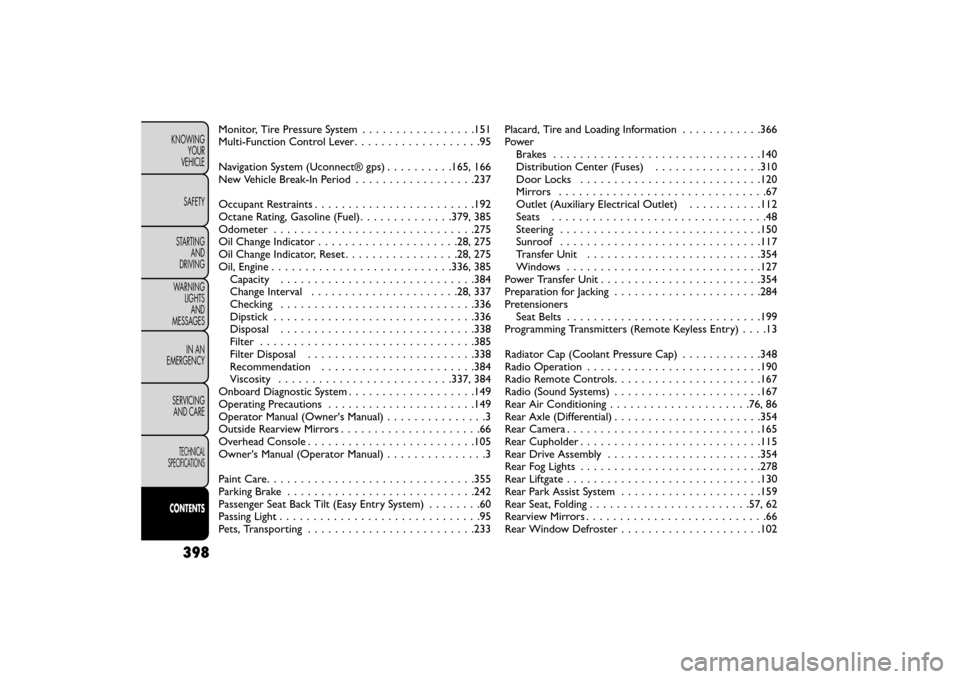
Monitor, Tire Pressure System.................151
Multi-Function Control Lever ...................95
Navigation System (Uconnect® gps) ..........165, 166
New Vehicle Break-In Period ..................237
Occupant Restraints ....................... .192
Octane Rating, Gasoline (Fuel) ..............379, 385
Odometer . . . .......................... .275
Oil Change Indicator . . . . . . . ..............28, 275
Oil Change Indicator, Reset . . . ..............28, 275
Oil, Engine . . . . . . . . . . . . . ..............336, 385
Capacity . . . . . ....................... .384
Change Interval ..................... .28, 337
Checking ............................ .336
Dipstick . . . . . . . . ..................... .336
Disposal ............................ .338
Filter ............................... .385
Filter Disposal . . . . . ................... .338
Recommendation . . . . . ..................384
Viscosity . . . . . . . . . . . . . .............337, 384
Onboard Diagnostic System ...................149
Operating Precautions . . . . . .................149
Operator Manual (Owner's Manual) ...............3
Outside Rearview Mirrors . . . ..................66
Overhead Console ........................ .105
Owner's Manual (Operator Manual) ...............3
Paint Care. . . . . . . . . . . . ...................355
Parking Brake . .......................... .242
Passenger Seat Back Tilt (Easy Entry System) ........60
Passing Light . . . ...........................95
Pets, Transporting . . . . .................... .233Placard, Tire and Loading Information
............366
Power Brakes .............................. .140
Distribution Center (Fuses) ................310
Door Locks .......................... .120
Mirrors ...............................67
Outlet (Auxiliary Electrical Outlet) ...........112
Seats ................................48
Steering ............................. .150
Sunroof ............................. .117
T
ransfer Unit ......................... .354
Windows ............................ .127
Power Transfer Unit ....................... .354
Preparation for Jacking ..................... .284
Pretensioners Seat Belts ............................ .199
Programming Transmitters (Remote Keyless Entry) ....13
Radiator Cap (Coolant Pressure Cap) ............348
Radio Operation ......................... .190
Radio Remote Controls ..................... .167
Radio (Sound Systems) ..................... .167
Rear Air Conditioning .................... .76, 86
Rear Axle (Differential) ..................... .354
Rear Camera ............................ .165
Rear Cupholder .......................... .115
Rear Drive Assembly ...................... .354
Rear Fog Lights .......................... .278
RearLiftgate............................ .130
Rear Park Assist System .................... .159
Rear Seat, Folding ....................... .57, 62
RearviewMirrors...........................66
Rear Window Defroster .................... .102
398
KNOWING
YOUR
VEHICLE
SAFETY
STARTING AND
DRIVING
WARNING LIGHTSAND
MESSAGES
IN AN
EMERGENCY
SERVICINGAND CARE
TECHNICAL
SPECIFICATIONS
CONTENTS