phone FIAT FREEMONT 2016 1.G Owner's Manual
[x] Cancel search | Manufacturer: FIAT, Model Year: 2016, Model line: FREEMONT, Model: FIAT FREEMONT 2016 1.GPages: 412, PDF Size: 3.36 MB
Page 196 of 412
RADIO OPERATION AND MOBILE
PHONES
Under certain conditions, the mobile phone being on in
your vehicle can cause erratic or noisy performance
from your radio. This condition may be lessened or
eliminated by relocating the mobile phone antenna.
This condition is not harmful to the radio. If your radio
performance does not satisfactorily “clear” by the
repositioning of the antenna, it is recommended that
the radio volume be turned down or off during mobile
phone operation.
ADDING FUEL
FUEL FILLER CAP (GAS CAP)
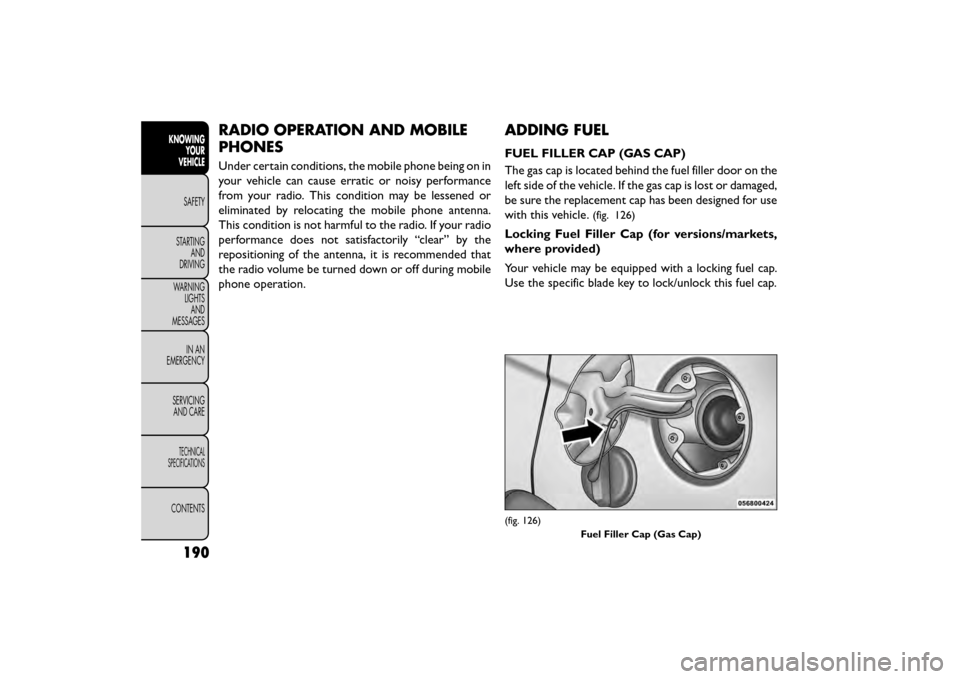
The gas cap is located behind the fuel filler door on the
left side of the vehicle. If the gas cap is lost or damaged,
be sure the replacement cap has been designed for use
with this vehicle.
(fig. 126)
Locking Fuel Filler Cap (for versions/markets,
where provided)
Your vehicle may be equipped with a locking fuel cap.
Use the specific blade key to lock/unlock this fuel cap.
(fig. 126)Fuel Filler Cap (Gas Cap)
190
KNOWINGYOUR
VEHICLE
SAFETY
STAR
TINGAND
DRIVING
WARNING LIGHTSAND
MESSAGES
IN AN
EMERGENCY
SERVICINGAND CARE
TECHNICAL
SPECIFICATIONS
CONTENTS
Page 199 of 412
6. All occupants should always wear their lap andshoulder belts properly.
7. The driver and front passenger seats should be moved back as far as practical to allow the Advanced
Front Air Bags room to inflate.
8. Do not lean against the door or window. If your vehicle has side air bags, and deployment occurs, the
side air bags will inflate forcefully into the space
between you and the door and you could be injured.
9. If the air bag system in this vehicle needs to be modified to accommodate a disabled person, con-
tact the Customer Center. Phone numbers are
provided under "If You Need Assistance."
WARNING!
• Never place a rear-facing child re-
s t
raint in front of an air bag. A deploying
Passenger Advanced Front Air Bag can cause
death or serious injury to a child 12 years or
younger, including a child in a rear-facing child
restraint .
• Only use rear-facing child restraint in a vehicle
with a rear seat . SEAT BELT SYSTEMS
Buckle up even though you are an excellent driver, even
on short trips. Someone on the road may be a poor
driver and could cause a collision that includes you.
This can happen far away from home or on your own
street.
Research has shown that seat belts save lives, and they
can reduce the seriousness of injuries in a collision.
Some of the worst injuries happen when people are
thrown from the vehicle. Seat belts reduce the possi-
bility of ejection and the risk of injury caused by striking
the inside of the vehicle. Everyone in a motor vehicle
should be belted at all times.
ENHANCED SEAT BELT USE REMINDER
SYSTEM (BeltAlert)BeltAlert is a feature intended to remind the driver
and outboard front passenger (if equipped with out-
board front passenger BeltAlert) to buckle their seat
belts. The feature is active whenever the ignition switch
is in the START or ON/RUN position. If the driver or
outboard front seat passenger is unbelted, the Seat
Belt Reminder Light will turn on and remain on until
both outboard front seat belts are buckled.
193
KNOWING
YOUR
VEHICLE
SAFETY
STARTING
AND
DRIVING
WARNING
LIGHTS
AND
MESSAGES
IN
AN
EMERGENCY
SERVICING
AND CARE
TECHNICAL
SPECIFICATIONS
CONTENTS
Page 287 of 412
4. Connect the opposite end of the negative(-)
jumper cable to the remote negative (-)post of the
vehicle with the discharged battery.
WARNING!
Do not connect the jumper cable to the
nega t
ive(-)post of the discharged bat-
tery. The resulting electrical spark could cause
the battery to explode and could result in per-
sonal injury. Only use the specific ground point ,
do not use any other exposed metal parts.
5. Start the engine in the vehicle that has the booster battery, let the engine idle a few minutes, and then
start the engine in the vehicle with the discharged
battery.
6. Once the engine is started, remove the jumper cables in the reverse sequence:
Disconnecting The Jumper Cables
1. Disconnect the negative (-)jumper cable from the
remote negative (-)post of the vehicle with the
discharged battery.
2. Disconnect the negative end (-)of the jumper cable
from the negative (-)post of the booster battery. 3. Disconnect the opposite end of the positive
(+)
jumper cable from the positive (+)post of the
booster battery.
4. Disconnect the positive (+)end of the jumper cable
from the remote positive (+)post of the discharged
vehicle.
5. Reinstall the protective cover over the remote posi- tive (+)battery post of the discharged vehicle.
If frequent jump-starting is required to start your
vehicle, you should have the battery and charging
system inspected at your authorized dealer.
Accessories plugged into the vehicle
power outlets draw power from the vehi-
cle’s battery, even when not in use (i.e.,
cellular phones, etc .). Eventually, if plugged in long
enough without engine operation, the vehicle’s
battery will discharge sufficiently to degrade bat-
tery life and/or prevent the engine from starting.
281
KNOWING
YOUR
VEHICLE
SAFETY
STARTING
AND
DRIVING
WARNING
LIGHTS
AND
MESSAGES
IN AN
EMERGENCY
SER VICING
AND
CARE
TECHNICAL
SPECIFICATIONS
CONTENTS
Page 394 of 412
ARRANGEMENTS FOR DEALING WITH THE VEHICLE AT THE END OF ITS LIFE
FIAT has been committed for many years to safeguarding the environment through the constant improvement of its
production processes and manufacturing products that are increasingly “eco-compatible”.
To give customers the best possible service in terms of respecting environmental laws and in response to European
Directive 2000/53/EC governing vehicles at the end of their life, FIAT is offering its customers the opportunity of handing
over their vehicle* at the end of its life without incurring any additional costs.
The European Directive sets out that when the vehicle is handed over the last keeper or owner should not incur any
expenses as a result of it having a zero or negative market value.
In all European Union countries, until 1st January 2007, only vehicles registered after 1st July 2002 were collected free of
charge, while since 2007 collection has been free of charge irrespective of the year of registration as long as the vehicle
contains its basic components (in particular, the engine and bodywork) and has no additional waste.
To hand your vehicle over at the end of its life without extra cost, go to one of our Dealerships or FIAT-authorized
collection and scrapping centres.
These centres have been carefully chosen to offer high quality service for the collection, treatment and recycling of unused
vehicles with respect to the environment.
You can find further information on these collection and scrapping centres either from a FIAT or FIAT Commercial Vehicle
Dealership or by calling the freephone number 00800 3428 0000 or by going on the FIAT website.
(*) Vehicle for transporting passengers with a maximum of nine seats and a total permitted weight of 3.5 t
388
Page 398 of 412
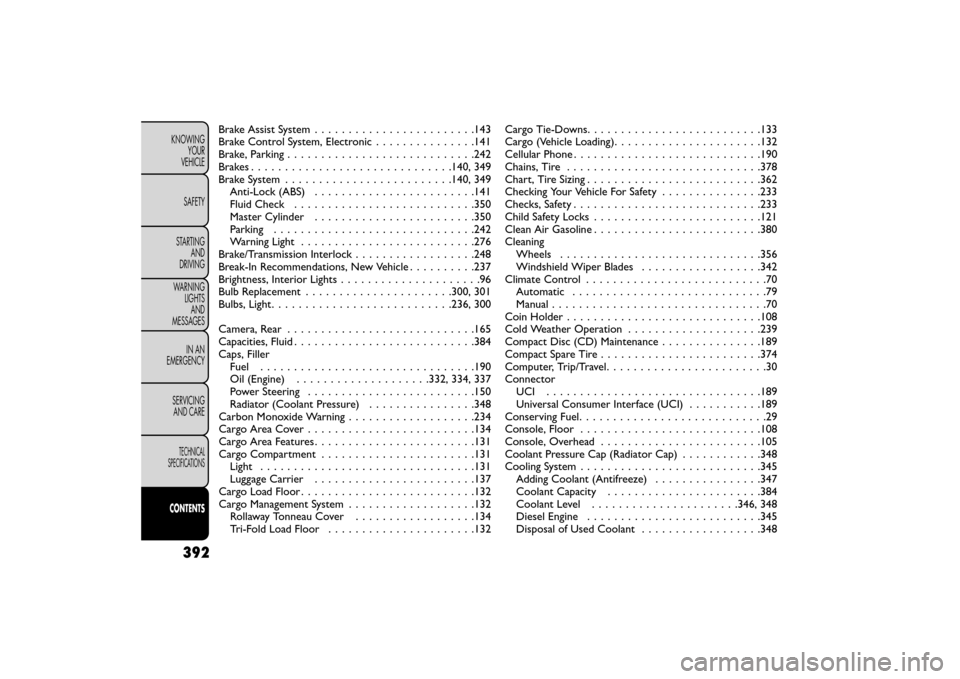
Brake Assist System . . . . . . ..................143
Brake Control System, Electronic ...............141
Brake, Parking ........................... .242
Brakes . . . . . . . . . . . . . . . . . .............140, 349
Brake System . . . ..................... .140, 349
Anti-Lock (ABS) . . . . . . . .................141
Fluid Check . . . . . . . ................... .350
Master Cylinder . ...................... .350
Parking ............................. .242
Warning Light . . . . . . . . ..................276
Brake/Transmission Interlock . .................248
Break-In Recommendations, New Vehicle ..........237
Brightness, Interior Lights . . . ..................96
Bulb Replacement . . ................... .300, 301
Bulbs, Light .......................... .236, 300
Camera, Rear . . ......................... .165
Capacities, Fluid .......................... .384
Caps, Filler Fuel ............................... .190
Oil (Engine) . . . . ............... .332, 334, 337
Power Steering . . . . .................... .150
Radiator (Coolant Pressure) ................348
Carbon Monoxide Warning . . .................234
Cargo Area Cover . . . . .................... .134
Cargo Area Features . . . . . ...................131
Cargo Compartment . . .................... .131
Light ............................... .131
Luggage Carrier . . . . . .................. .137
Cargo Load Floor . . ....................... .132
Cargo Management System . ..................132
Rollaway Tonneau Cover . .................134
Tri-Fold Load Floor . . . . . .................132Cargo Tie-Downs
......................... .133
Cargo (Vehicle Loading) ..................... .132
Cellular Phone ........................... .190
Chains, Tire ............................ .378
Char
t, Tire Sizing ......................... .362
Checking Your Vehicle For Safety ...............233
Checks, Safety ........................... .233
Child Safety Locks ........................ .121
Clean Air Gasoline ........................ .380
Cleaning Wheels ............................. .356
Windshield Wiper Blades ..................342
Climate Control ...........................70
Automatic .............................79
Manual................................70
Coin Holder ............................ .108
Cold Weather Operation ................... .239
Compact Disc (CD) Maintenance ...............189
Compact Spare Tire ....................... .374
Computer, Trip/Travel ........................30
Connector UCI ............................... .189
Universal Consumer Interface (UCI) ...........189
Conserving Fuel ............................29
Console, Floor .......................... .108
Console, Overhead ....................... .105
Coolant Pressure Cap (Radiator Cap) ............348
Cooling System .......................... .345
Adding Coolant (Antifreeze) ................347
Coolant Capacity ...................... .384
Coolant Level ..................... .346, 348
Diesel Engine ......................... .345
Disposal of Used Coolant ..................348
392
KNOWING
YOUR
VEHICLE
SAFETY
STARTING AND
DRIVING
WARNING LIGHTSAND
MESSAGES
IN AN
EMERGENCY
SERVICINGAND CARE
TECHNICAL
SPECIFICATIONS
CONTENTS