seats FIAT FREEMONT 2016 1.G Owner's Manual
[x] Cancel search | Manufacturer: FIAT, Model Year: 2016, Model line: FREEMONT, Model: FIAT FREEMONT 2016 1.GPages: 412, PDF Size: 3.36 MB
Page 139 of 412
CARGO TIE-DOWNS
WARNING!
Cargo tie-downs are not safe anchors for
a child seat
tether strap. In a sudden stop
or collision, a tie-down could pull loose and allow
the child seat to come loose. A child could be
badly injured. Use only the anchors provided for
child seat tethers.
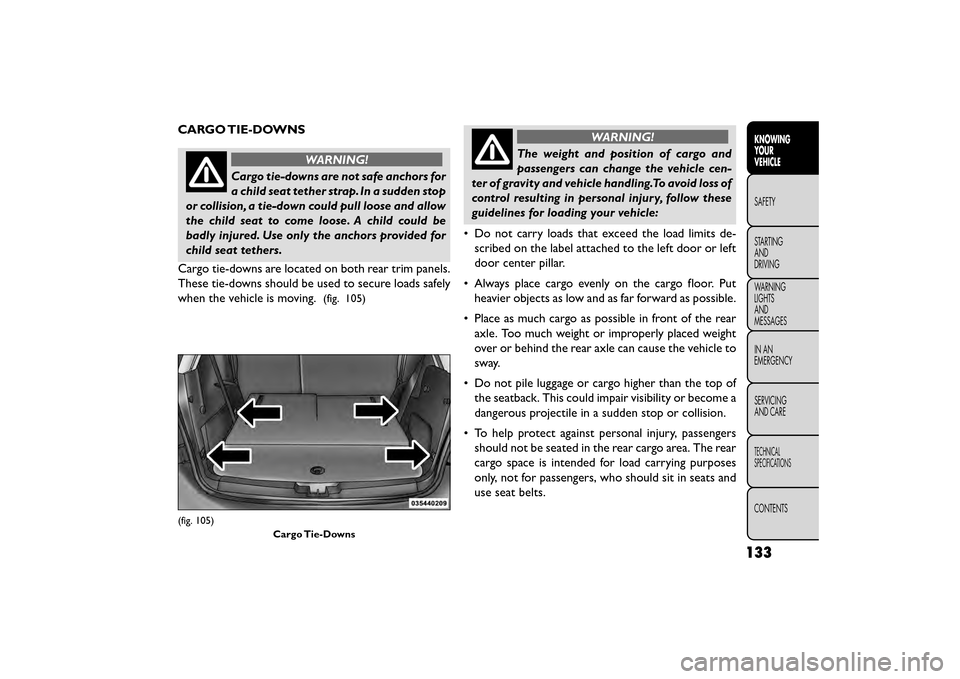
Cargo tie-downs are located on both rear trim panels.
These tie-downs should be used to secure loads safely
when the vehicle is moving.
(fig. 105)
WARNING!
The weight and position of cargo and
passenger s
can change the vehicle cen-
ter of gravity and vehicle handling.To avoid loss of
control resulting in personal injury, follow these
guidelines for loading your vehicle:
• Do not carry loads that exceed the load limits de- scribed on the label attached to the left door or left
door center pillar.
• Always place cargo evenly on the cargo floor. Put heavier objects as low and as far forward as possible.
• Place as much cargo as possible in front of the rear axle. Too much weight or improperly placed weight
over or behind the rear axle can cause the vehicle to
sway.
• Do not pile luggage or cargo higher than the top of the seatback. This could impair visibility or become a
dangerous projectile in a sudden stop or collision.
• To help protect against personal injury, passengers should not be seated in the rear cargo area. The rear
cargo space is intended for load carrying purposes
only, not for passengers, who should sit in seats and
use seat belts.
(fig. 105)
Cargo Tie-Downs
133
KNOWING
YOUR
VEHICLE
SAFETY
STAR
TING
AND
DRIVING
WARNING
LIGHTS
AND
MESSAGES
IN AN
EMERGENCY
SERVICING
AND CARE
TECHNICAL
SPECIFICATIONS
CONTENTS
Page 140 of 412
RETRACTABLE CARGO AREA COVER —
FIVE PASSENGER MODELS (for
versions/markets, where provided)
NOTE:The purpose of this cover is for privacy, not to
secure loads. It will not prevent cargo from shifting or
protect passengers from loose cargo.
The removable retractable cargo area cover mounts in
the cargo area behind the top of the rear seats.
The cover, when extended, covers the cargo area to
keep items out of sight. Notches in the trim panels near
the liftgate opening secure the extended cover in place.
The cover rolls away neatly inside its housing when not
in use. You can also remove the cover from the vehicle
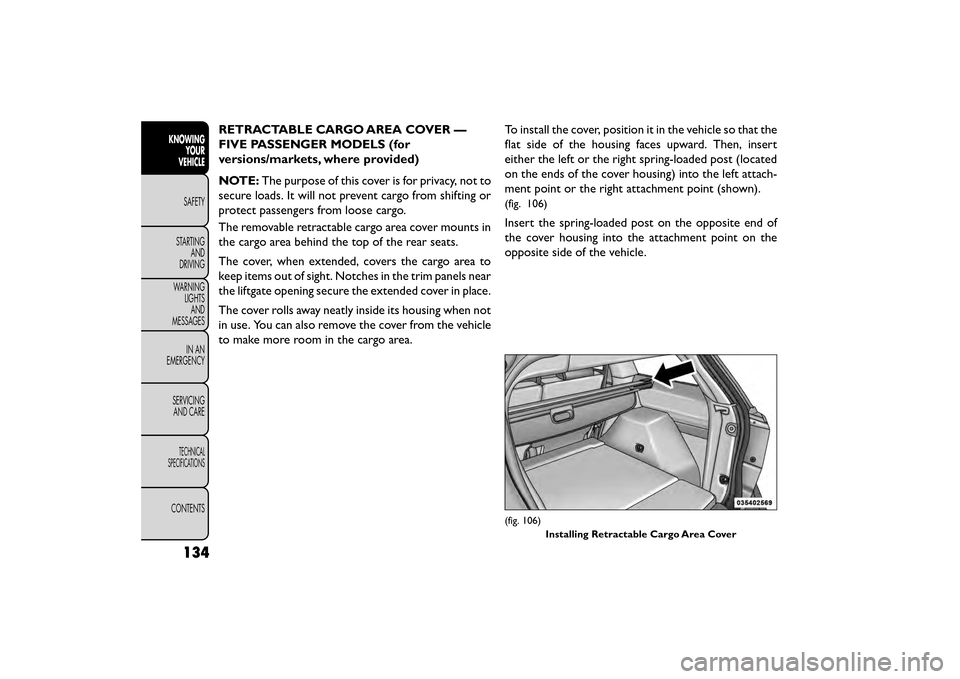
to make more room in the cargo area. To install the cover, position it in the vehicle so that the
flat side of the housing faces upward. Then, insert
either the left or the right spring-loaded post (located
on the ends of the cover housing) into the left attach-
ment point or the right attachment point (shown).
(fig. 106)
Insert the spring-loaded post on the opposite end of
the cover housing into the attachment point on the
opposite side of the vehicle.
(fig. 106)
Installing Retractable Cargo Area Cover
134
KNOWINGYOUR
VEHICLE
SAFETY
STAR
TINGAND
DRIVING
WARNING LIGHTSAND
MESSAGES
IN AN
EMERGENCY
SERVICINGAND CARE
TECHNICAL
SPECIFICATIONS
CONTENTS
Page 198 of 412
SAFETY
OCCUPANT RESTRAINT SYSTEMS
Some of the most important safety features in your
vehicle are the restraint systems:
• Seat Belt Systems
• Supplemental Restraint Systems (SRS) Air Bags
• Supplemental Active Head Restraints
• Active Hood System
• Child Restraints
IMPORTANT SAFETY PRECAUTIONS:
Please pay close attention to the information in this
section. It tells you how to use your restraint system
properly, to keep you and your passengers as safe as
possible.
Here are some simple steps you can take to minimize
the risk of harm from a deploying air bag:
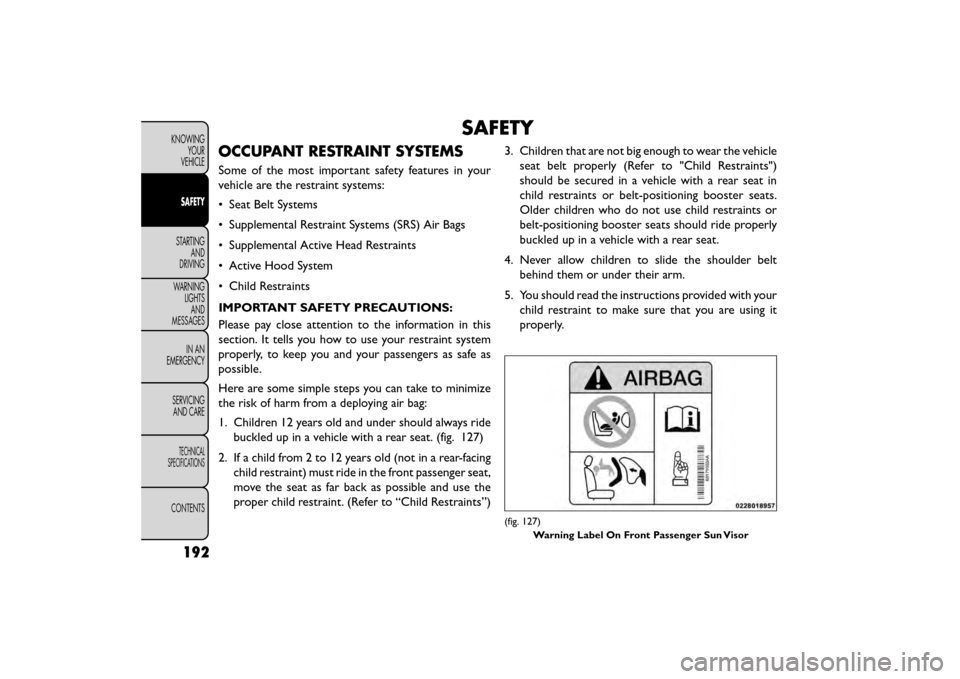
1. Children 12 years old and under should always ridebuckled up in a vehicle with a rear seat. (fig. 127)
2. If a child from 2 to 12 years old (not in a rear-facing child restraint) must ride in the front passenger seat,
move the seat as far back as possible and use the
proper child restraint. (Refer to “Child Restraints”) 3. Children that are not big enough to wear the vehicle
seat belt properly (Refer to "Child Restraints")
should be secured in a vehicle with a rear seat in
child restraints or belt-positioning booster seats.
Older children who do not use child restraints or
belt-positioning booster seats should ride properly
buckled up in a vehicle with a rear seat.
4. Never allow children to slide the shoulder belt behind them or under their arm.
5. You should read the instructions provided with your child restraint to make sure that you are using it
properly.
(fig. 127)
Warning Label On Front Passenger Sun Visor
192
KNOWINGYOUR
VEHICLE
SAFETY
STARTING AND
DRIVING
WARNING LIGHTSAND
MESSAGES
IN
AN
EMERGENCY
SERVICINGAND CARE
TECHNICAL
SPECIFICATIONS
CONTENTS
Page 199 of 412
6. All occupants should always wear their lap andshoulder belts properly.
7. The driver and front passenger seats should be moved back as far as practical to allow the Advanced
Front Air Bags room to inflate.
8. Do not lean against the door or window. If your vehicle has side air bags, and deployment occurs, the
side air bags will inflate forcefully into the space
between you and the door and you could be injured.
9. If the air bag system in this vehicle needs to be modified to accommodate a disabled person, con-
tact the Customer Center. Phone numbers are
provided under "If You Need Assistance."
WARNING!
• Never place a rear-facing child re-
s t
raint in front of an air bag. A deploying
Passenger Advanced Front Air Bag can cause
death or serious injury to a child 12 years or
younger, including a child in a rear-facing child
restraint .
• Only use rear-facing child restraint in a vehicle
with a rear seat . SEAT BELT SYSTEMS
Buckle up even though you are an excellent driver, even
on short trips. Someone on the road may be a poor
driver and could cause a collision that includes you.
This can happen far away from home or on your own
street.
Research has shown that seat belts save lives, and they
can reduce the seriousness of injuries in a collision.
Some of the worst injuries happen when people are
thrown from the vehicle. Seat belts reduce the possi-
bility of ejection and the risk of injury caused by striking
the inside of the vehicle. Everyone in a motor vehicle
should be belted at all times.
ENHANCED SEAT BELT USE REMINDER
SYSTEM (BeltAlert)BeltAlert is a feature intended to remind the driver
and outboard front passenger (if equipped with out-
board front passenger BeltAlert) to buckle their seat
belts. The feature is active whenever the ignition switch
is in the START or ON/RUN position. If the driver or
outboard front seat passenger is unbelted, the Seat
Belt Reminder Light will turn on and remain on until
both outboard front seat belts are buckled.
193
KNOWING
YOUR
VEHICLE
SAFETY
STARTING
AND
DRIVING
WARNING
LIGHTS
AND
MESSAGES
IN
AN
EMERGENCY
SERVICING
AND CARE
TECHNICAL
SPECIFICATIONS
CONTENTS
Page 201 of 412
WARNING! (Continued)
• In a collision, you and your passengers can
suffer much greater injuries if you are not prop-
erly buckled up.You can strike the interior of your
vehicle or other passengers, or you can be thrown
out of the vehicle. Always be sure you and others
in your vehicle are buckled up properly.
• It is dangerous to ride in a cargo area, inside or
outside of a vehicle. In a collision, people riding in
these areas are more likely to be seriously injured
or killed.
• Do not allow people to ride in any area of your
vehicle that is not equipped with seats and seat
belts.
• Be sure everyone in your vehicle is in a seat and
using a seat belt properly.
• Wearing your seat belt incorrectly could make
your injuries in a collision much worse.You might
suffer internal injuries, or you could even slide out
of the seat belt . Follow these instructions to wear
your seat belt safely and to keep your passengers
safe, too.
(Continued)WARNING! (Continued)
• Two people should never be belted into a single
seat belt . People belted together can crash into
one another in a collision, hurting one another
badly. Never use a lap/shoulder belt or a lap belt
for more than one person, no matter what their
size.
• A lap belt worn too high can increase the risk of
injury in a collision.The seat belt forces won’t be
at the strong hip and pelvic bones, but across
your abdomen. Always wear the lap part of your
seat belt as low as possible and keep it snug.
• A twisted seat belt may not protect you prop-
erly. In a collision, it could even cut into you. Be
sure the seat belt is flat against your body, with-
out twists. If you can’t straighten a seat belt in
your vehicle, take it to your authorized dealer
immediately and have it fixed.
• A seat belt that is buckled into the wrong
buckle will not protect you properly. The lap
portion could ride too high on your body, possibly
causing internal injuries. Always buckle your seat
belt into the buckle nearest you.
(Continued)
195
KNOWING
YOUR
VEHICLE
SAFETY
STARTING
AND
DRIVING
WARNING
LIGHTS
AND
MESSAGES
IN
AN
EMERGENCY
SERVICING
AND CARE
TECHNICAL
SPECIFICATIONS
CONTENTS
Page 204 of 412
3. Slide the latch plate upward over the folded web-bing. The folded webbing must enter the slot at the
top of the latch plate.
4. Continue to slide the latch plate up until it clears the folded webbing.
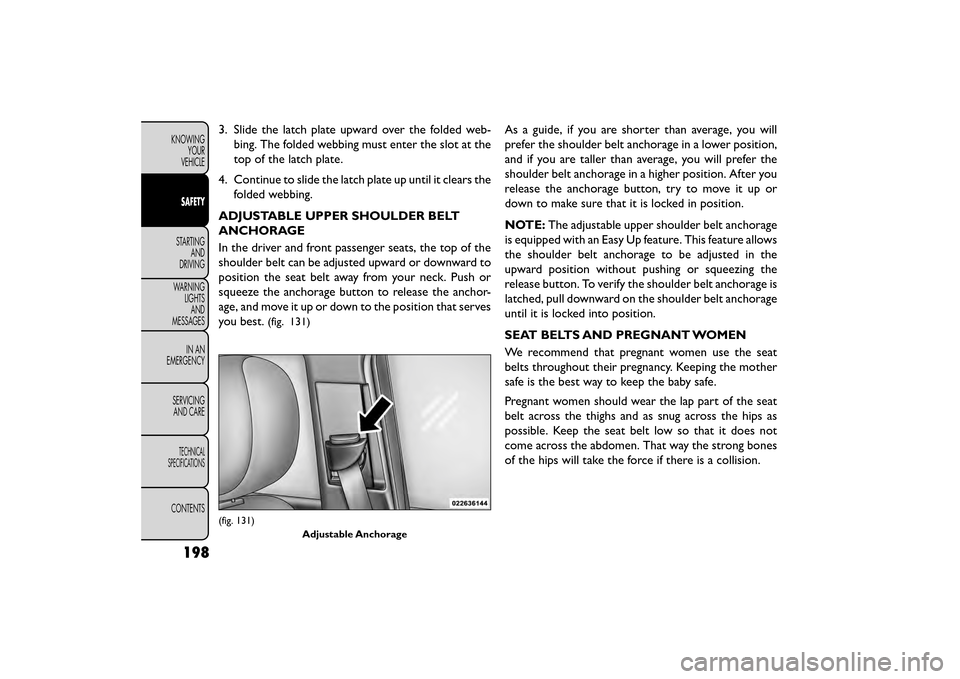
ADJUSTABLE UPPER SHOULDER BELT
ANCHORAGE
In the driver and front passenger seats, the top of the
shoulder belt can be adjusted upward or downward to
position the seat belt away from your neck. Push or
squeeze the anchorage button to release the anchor-
age, and move it up or down to the position that serves
you best.
(fig. 131)
As a guide, if you are shorter than average, you will
prefer the shoulder belt anchorage in a lower position,
and if you are taller than average, you will prefer the
shoulder belt anchorage in a higher position. After you
release the anchorage button, try to move it up or
down to make sure that it is locked in position.
NOTE: The adjustable upper shoulder belt anchorage
is equipped with an Easy Up feature. This feature allows
the shoulder belt anchorage to be adjusted in the
upward position without pushing or squeezing the
release button. To verify the shoulder belt anchorage is
latched, pull downward on the shoulder belt anchorage
until it is locked into position.
SEAT BELTS AND PREGNANT WOMEN
We recommend that pregnant women use the seat
belts throughout their pregnancy. Keeping the mother
safe is the best way to keep the baby safe.
Pregnant women should wear the lap part of the seat
belt across the thighs and as snug across the hips as
possible. Keep the seat belt low so that it does not
come across the abdomen. That way the strong bones
of the hips will take the force if there is a collision.
(fig. 131)
Adjustable Anchorage
198
KNOWINGYOUR
VEHICLE
SAFETY
STARTING AND
DRIVING
WARNING LIGHTSAND
MESSAGES
IN
AN
EMERGENCY
SERVICINGAND CARE
TECHNICAL
SPECIFICATIONS
CONTENTS
Page 214 of 412
SUPPLEMENTAL SIDE AIR BAGS
Your vehicle is equipped with two types of side air bags:
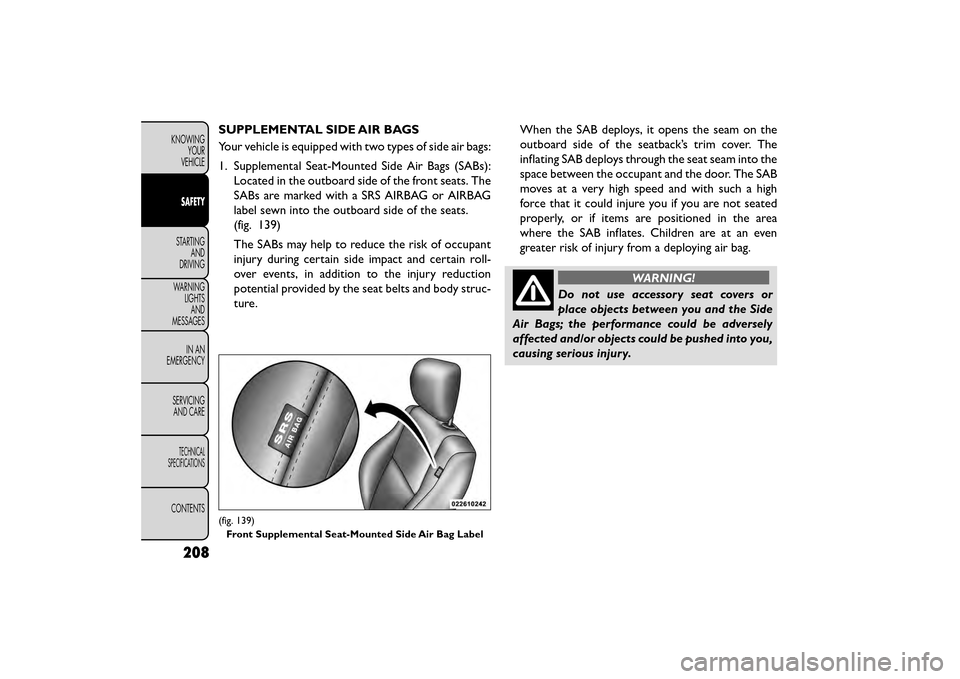
1. Supplemental Seat-Mounted Side Air Bags (SABs):Located in the outboard side of the front seats. The
SABs are marked with a SRS AIRBAG or AIRBAG
label sewn into the outboard side of the seats.
(fig. 139)
The SABs may help to reduce the risk of occupant
injury during certain side impact and certain roll-
over events, in addition to the injury reduction
potential provided by the seat belts and body struc-
ture. When the SAB deploys, it opens the seam on the
outboard side of the seatback’s trim cover. The
inflating SAB deploys through the seat seam into the
space between the occupant and the door. The SAB
moves at a very high speed and with such a high
force that it could injure you if you are not seated
properly, or if items are positioned in the area
where the SAB inflates. Children are at an even
greater risk of injury from a deploying air bag.
WARNING!
Do not use accessor y seat covers or
place obj
ects between you and the Side
Air Bags; the performance could be adversely
affected and/or objects could be pushed into you,
causing serious injury.
(fig. 139)
Front Supplemental Seat-Mounted Side Air Bag Label
208
KNOWING YOUR
VEHICLE
SAFETY
STARTING AND
DRIVING
WARNING LIGHTSAND
MESSAGES
IN
AN
EMERGENCY
SERVICINGAND CARE
TECHNICAL
SPECIFICATIONS
CONTENTS
Page 216 of 412
The SABICs and SABs (“Side Air Bags”) are designed to
activate in certain side impacts and certain rollover
events. The Occupant Restraint Controller (“ORC”)
determines whether the deployment of the Side Air
Bags in a particular side impact or rollover event is
appropriate, based on the severity and type of collision.
Vehicle damage by itself is not a good indicator of
whether or not Side Air Bags should have deployed.
Side Air Bags are a supplement to the seat belt restraint
system. Side Air Bags deploy in less time than it takes to
blink your eyes. Occupants, including children, who are
up against or very close to Side Air Bags can be
seriously injured or killed. Occupants, including chil-
dren, should never lean on or sleep against the door,
side windows, or area where the Side Air Bags inflate,
even if they are in an infant or child restraint.
Seat belts (and child restraints where appropriate) are
necessary for your protection in all collisions. They also
help keep you in position, away from inflating Side Air
Bags. To get the best protection from the Side Air Bags,
occupants must wear their seat belts properly and sit
upright with their backs against the seats. Children
must be properly restrained in a child restraint or
booster seat that is appropriate for the size of the child.WARNING!
• Side Air Bags need room to inflate. Do
n ot
lean against the door or window. Sit
upright in the center of the seat .
• Being too close to the Side Air Bags during
deployment could cause you to be severely in-
jured or killed.
• Relying on the Side Air Bags alone could lead to
more severe injuries in a collision. The Side Air
Bags work with your seat belt to restrain you
properly. In some collisions, Side Air Bags won’t
deploy at all. Always wear your seat belt even
though you have Side Air Bags.
NOTE: Air bag covers may not be obvious in the
interior trim, but they will open during air bag deploy-
ment.
Side Impacts
In side impacts, the side impact sensors aid the ORC in
determining the appropriate response to impact
events. The system is calibrated to deploy the Side Air
Bags on the impact side of the vehicle during impacts
that require Side Air Bag occupant protection. In side
impacts, the Side Air Bags deploy independently; a left
side impact deploys the left Side Air Bags only and a
right side impact deploys the right Side Air Bags only.
210
KNOWING YOUR
VEHICLE
SAFETY
STARTING AND
DRIVING
WARNING LIGHTSAND
MESSAGES
IN
AN
EMERGENCY
SERVICINGAND CARE
TECHNICAL
SPECIFICATIONS
CONTENTS
Page 222 of 412
CHILD RESTRAINTS - CARRYING
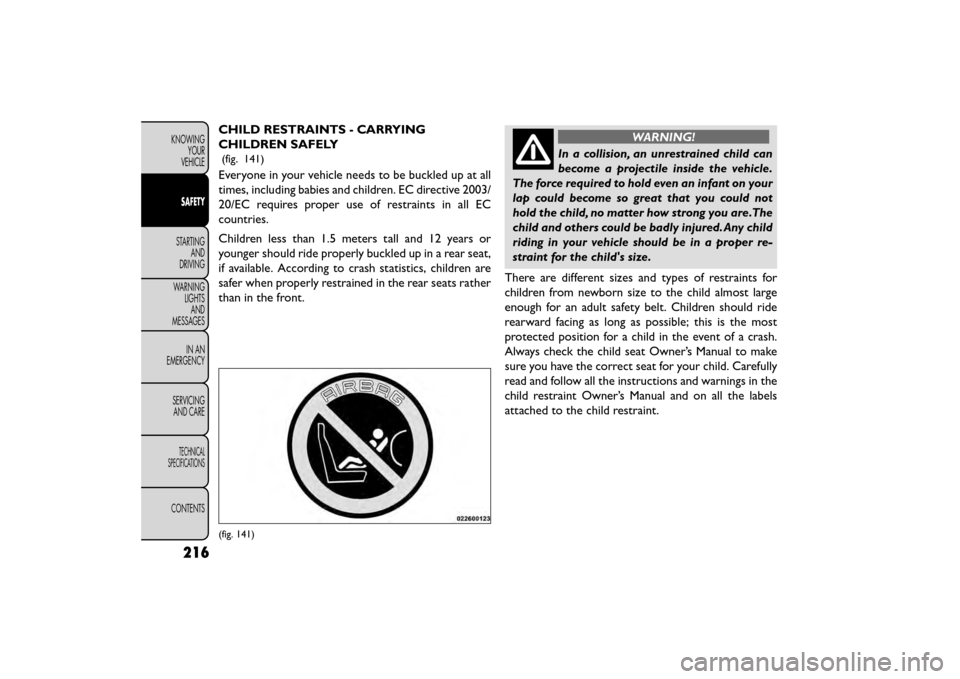
CHILDREN SAFELY
(fig. 141)
Everyone in your vehicle needs to be buckled up at all
times, including babies and children. EC directive 2003/
20/EC requires proper use of restraints in all EC
countries.
Children less than 1.5 meters tall and 12 years or
younger should ride properly buckled up in a rear seat,
if available. According to crash statistics, children are
safer when properly restrained in the rear seats rather
than in the front.
WARNING!
In a collision, an unrestrained child can
becom e
a projectile inside the vehicle.
The force required to hold even an infant on your
lap could become so great that you could not
hold the child, no matter how strong you are.The
child and others could be badly injured. Any child
riding in your vehicle should be in a proper re-
straint for the child's size.
There are different sizes and types of restraints for
children from newborn size to the child almost large
enough for an adult safety belt. Children should ride
rearward facing as long as possible; this is the most
protected position for a child in the event of a crash.
Always check the child seat Owner’s Manual to make
sure you have the correct seat for your child. Carefully
read and follow all the instructions and warnings in the
child restraint Owner’s Manual and on all the labels
attached to the child restraint.
(fig. 141)
216
KNOWING YOUR
VEHICLE
SAFETY
STARTING AND
DRIVING
WARNING LIGHTSAND
MESSAGES
IN
AN
EMERGENCY
SERVICINGAND CARE
TECHNICAL
SPECIFICATIONS
CONTENTS
Page 228 of 412
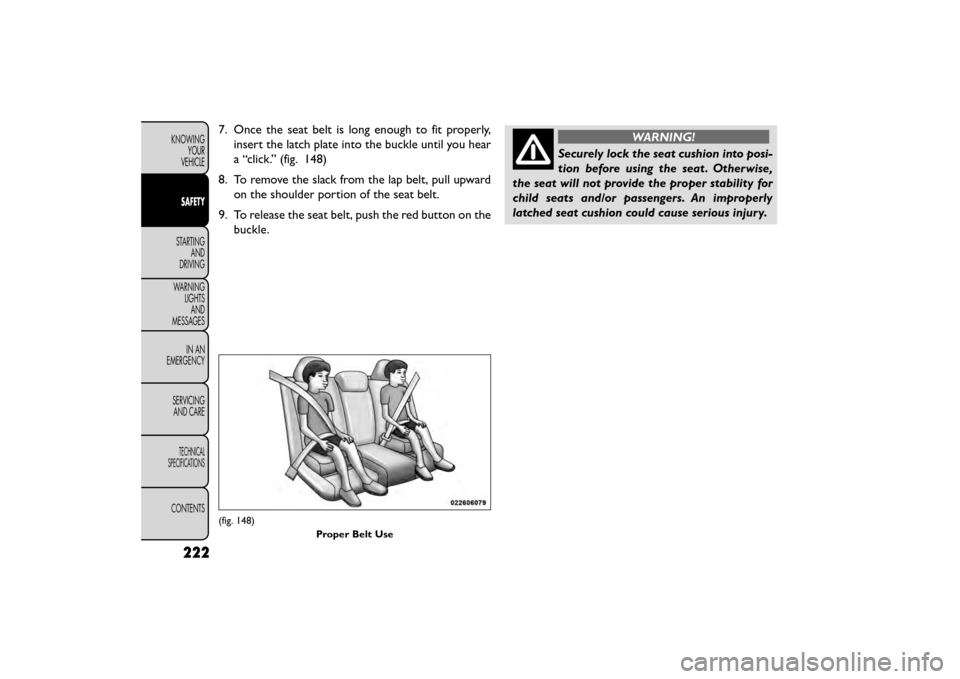
7. Once the seat belt is long enough to fit properly,insert the latch plate into the buckle until you hear
a “click.” (fig. 148)
8. To remove the slack from the lap belt, pull upward on the shoulder portion of the seat belt.
9. To release the seat belt, push the red button on the buckle.WARNING!
Securely lock the seat cushion into posi-
ti on
before using the seat . Otherwise,
the seat will not provide the proper stability for
child seats and/or passengers. An improperly
latched seat cushion could cause serious injury.
(fig. 148)
Proper Belt Use
222
KNOWINGYOUR
VEHICLE
SAFETY
STARTING AND
DRIVING
WARNING LIGHTSAND
MESSAGES
IN
AN
EMERGENCY
SERVICINGAND CARE
TECHNICAL
SPECIFICATIONS
CONTENTS