tow FIAT FREEMONT 2016 1.G Repair Manual
[x] Cancel search | Manufacturer: FIAT, Model Year: 2016, Model line: FREEMONT, Model: FIAT FREEMONT 2016 1.GPages: 412, PDF Size: 3.36 MB
Page 362 of 412
Special Care
• If you drive on salted or dusty roads or if you drivenear the ocean, hose off the undercarriage at least
once a month.
• It is important that the drain holes in the lower edges of the doors, rocker panels, and cargo area be kept
clear and open.
• If you detect any stone chips or scratches in the paint, touch them up immediately. The cost of such
repairs is considered the responsibility of the owner.
• If your vehicle is damaged due to an accident or similar cause, which destroys the paint and protec-
tive coating, have your vehicle repaired as soon as
possible. The cost of such repairs is considered the
responsibility of the owner.
• If you carry special cargo such as chemicals, fertiliz- ers, de-icer salt, etc., be sure that such materials are
well packaged and sealed.
• If a lot of driving is done on gravel roads, consider mud or stone shields behind each wheel.
• Use Touch Up Paint or equivalent on scratches as soon as possible. Your authorized dealer has touch
up paint to match the color of your vehicle. Wheel And Wheel Trim Care
All wheels and wheel trim, especially aluminum and
chrome-plated wheels should be cleaned regularly with
a mild soap and water to prevent corrosion. To remove
heavy soil and/or excessive brake dust, use a nonabra-
sive, non-acidic cleaner. Do not use scouring pads, steel
wool, a bristle brush, or metal polishes. Do not use
oven cleaner. Avoid automatic car washes that use
acidic solutions or harsh brushes that may damage the
wheels’ protective finish.
Stain Repel Fabric Cleaning Procedure (for
versions/markets, where provided)
Stain Repel seats may be cleaned in the following
manner:
• Remove as much of the stain as possible by blotting
with a clean, dry towel.
• Blot any remaining stain with a clean, damp towel.
• For tough stains, apply a mild soap solution to a clean, damp cloth and remove the stain. Use a fresh,
damp towel to remove soap residue.
•
For grease stains, apply a Multi-Purpose Cleaner or
equivalent to a clean, damp cloth and remove the stain.
Use a fresh, damp towel to remove soap residue.
• Do not use any harsh solvents or any other form of protectants on Stain Repel products.
356
KNOWING YOUR
VEHICLE
SAFETY
STARTING AND
DRIVING
WARNING LIGHTSAND
MESSAGES
IN AN
EMERGENCY
SERVICINGAND C ARE
TECHNICAL
SPECIFICATIONS
CONTENTS
Page 364 of 412
Glass Surfaces
All glass surfaces should be cleaned on a regular basis
with any commercial household-type glass cleaner.
Never use an abrasive type cleaner. Use caution when
cleaning the inside rear window equipped with an
electric defroster. Do not use scrapers or other sharp
instruments that may scratch the elements.
When cleaning the rear view mirror, spray cleaner on
the towel or rag that you are using. Do not spray
cleaner directly on the mirror.
Cleaning Plastic Instrument Cluster Lenses
The lenses in front of the instruments in this vehicle are
molded in clear plastic. When cleaning the lenses, care
must be taken to avoid scratching the plastic.
1. Clean with a wet soft rag. A mild soap solution maybe used, but do not use high alcohol content or
abrasive cleaners. If soap is used, wipe clean with a
clean damp rag.
2. Dry with a soft cloth. Seat Belt Maintenance
Do not bleach, dye or clean the belts with chemical
solvents or abrasive cleaners. This will weaken the
fabric. Sun damage can also weaken the fabric.
If the belts need cleaning, use a mild soap solution or
lukewarm water. Do not remove the belts from the car
to wash them. Dry with a soft cloth.
Replace the belts if they appear frayed or worn or if the
buckles do not work properly.
WARNING!
A frayed or torn belt could rip apart in a
collisi on
and leave you with no protec-
tion. Inspect the belt system periodically, check-
ing for cuts, frays, or loose parts. Damaged parts
must be replaced immediately. Do not disas-
semble or modify the system. Seat belt assem-
blies must be replaced after a collision if they
have been damaged (i.e., bent retractor, torn
webbing, etc .).
CLEANING THE CUP HOLDERS
Clean with a damp cloth or towel using a mild deter-
gent.
358
KNOWING YOUR
VEHICLE
SAFETY
STARTING AND
DRIVING
WARNING LIGHTSAND
MESSAGES
IN AN
EMERGENCY
SERVICINGAND C ARE
TECHNICAL
SPECIFICATIONS
CONTENTS
Page 373 of 412
NOTE:Under a maximum loaded vehicle condition,
gross axle weight ratings (GAWRs) for the front and
rear axles must not be exceeded. For further informa-
tion on GAWRs, vehicle loading, and trailer towing,
refer to “Vehicle Loading” in this section.
To determine the maximum loading conditions of your
vehicle, locate the statement “The combined weight of
occupants and cargo should never exceed XXX lbs or
XXX kg” on the Tire and Loading Information placard.
The combined weight of occupants, cargo/luggage and
trailer tongue weight (if applicable) should never ex-
ceed the weight referenced here.
Steps For Determining Correct Load Limit
1. Locate the statement “The combined weight of occupants and cargo should never exceed XXX lbs
or XXX kg” on your vehicle's placard.
2. Determine the combined weight of the driver and passengers that will be riding in your vehicle.
3. Subtract the combined weight of the driver and passengers from XXX kg. 4. The resulting figure equals the available amount of
cargo and luggage load capacity. For example, if
“XXX” amount equals 635 kg and there will be five
68 kg passengers in your vehicle, the amount of
available cargo and luggage load capacity is 295 kg
(since5x68kg=340kg,and635kg–340kg=
295 kg).
5. Determine the combined weight of luggage and cargo being loaded on the vehicle. That weight may
not safely exceed the available cargo and luggage
load capacity calculated in step 4.
NOTE:
• If your vehicle will be towing a trailer, load from your trailer will be transferred to your vehicle. The follow-
ing table shows examples on how to calculate total
load, cargo/luggage, and towing capacities of your
vehicle with varying seating configurations and num-
ber and size of occupants. This table is for illustration
purposes only and may not be accurate for the
seating and load carry capacity of your vehicle.
367
KNOWING
YOUR
VEHICLE
SAFETY
STARTING
AND
DRIVING
WARNING
LIGHTS
AND
MESSAGES
IN AN
EMERGENCY
SERVICING
AND CARE
TECHNICAL
SPECIFICATIONS
CONTENTS
Page 379 of 412
RUN FLAT TIRES (for versions/markets,
where provided)
Run Flat tires allow you the capability to drive 80 km at
80 km/h after a rapid loss of inflation pressure. This
rapid loss of inflation is referred to as the Run Flat
mode. A Run Flat mode occurs when the tire inflation
pressure is of/or below 0.96 bar. Once a Run Flat tire
reaches the run flat mode it has limited driving capa-
bilities and needs to be replaced immediately. A Run
Flat tire is not repairable.
It is not recommended driving a vehicle loaded at full
capacity or to tow a trailer while a tire is in the run flat
mode.
See the tire pressure monitoring section for more
information.
SPARE TIRES (for versions/markets, where
provided)
NOTE:For vehicles equipped with Tire Service Kit
instead of a spare tire, please refer to “Tire Service Kit”
in “What To Do In Emergencies” for further informa-
tion.Because of the reduced ground clear-
ance, do not take your vehicle through an
automatic car wash with a compact , full
size or limited-use temporary spare installed.
Damage to the vehicle may result .
Spare Tire Matching Original Equipped Tire
And Wheel (for versions/markets, where
provided)
Your vehicle may be equipped with a spare tire and
wheel equivalent in look and function to the original
equipment tire and wheel found on the front or rear
axle of your vehicle. This spare tire may be used in the
tire rotation for your vehicle. If your vehicle has this
option, refer to an authorized tire dealer for the
recommended tire rotation pattern.
373
KNOWING
YOUR
VEHICLE
SAFETY
STARTING
AND
DRIVING
WARNING
LIGHTS
AND
MESSAGES
IN AN
EMERGENCY
SERVICING
AND CARE
TECHNICAL
SPECIFICATIONS
CONTENTS
Page 386 of 412
Poor quality gasoline can cause problems such as hard
starting, stalling and stumble. If you experience these
problems, try another brand of gasoline before consid-
ering service for the vehicle.
CLEAN AIR GASOLINE
Many gasolines are now being blended to contribute to
cleaner air, especially in those areas where air pollution
levels are high. These new blends provide a cleaner
burning fuel and some are referred to as “reformulated
gasoline.”
The manufacturer supports these efforts toward
cleaner air. You can help by using these blends as they
become available.
MMT IN GASOLINE
MMT is a manganese containing metallic additive that is
blended into some gasoline to increase octane. Gaso-
line blended with MMT provides no performance ad-
vantage beyond gasoline of the same octane number
without MMT. Gasoline blended with MMT reducesspark plug life and reduces emission system perfor-
mance in some vehicles. The manufacturer recom-
mends that gasoline without MMT be used in your
vehicle. The MMT content of gasoline may not be
indicated on the gasoline pump; therefore, you should
ask your gasoline retailer whether or not his/her gaso-
line contains MMT.
MATERIALS ADDED TO FUEL
Besides using unleaded gasoline with the proper octane
rating, gasolines that contain detergents, corrosion and
stability additives are recommended. Using gasolines
that have these additives will help improve fuel
economy, reduce emissions, and maintain vehicle per-
formance.
Indiscriminate use of fuel system cleaning agents should
be avoided. Many of these materials intended for gum
and varnish removal may contain active solvents or
similar ingredients. These can harm fuel system gasket
and diaphragm materials.
380
KNOWING
YOUR
VEHICLE
SAFETY
STARTING AND
DRIVING
WARNING LIGHTSAND
MESSAGES
IN AN
EMERGENCY
SERVICINGAND CARE
TECHNICAL
SPECIFICATIONS
CONTENTS
Page 399 of 412
Drain, Flush, and Refill . . . . . . . .............346
Inspection ........................... .348
Points to Remember . . . . . . . . . ............349
Pressure Cap . . . . . . . . . . . . . . . ...........348
Radiator Cap ......................... .348
Selection of Coolant (Antifreeze) . . .346, 347, 384, 385
Temperature Gauge . ......................8
Corrosion Protection . . . ................... .355
Cupholders ............................. .115
Data Recorder, Event ...................... .215
Daytime Brightness, Interior Lights . ..............96
Defroster, Rear Window . . . . .................102
Defroster, Windshield ................... .83, 235
Delay (Intermittent) Wipers . . . . . ..............98
Diagnostic System, Onboard ..................149
Diesel Fuel . . . . . . . . .................. .384, 385
Diesel Fuel Requirements . . . . . . . . . ...........384
Dimmer Switch, Headlight .....................95
Dipsticks Automatic Transmission . . . ................352
Oil (Engine) . . . . . . . . . .................. .336
Power Steering . . . . . . . ..................150
Disabled Vehicle Towing . ................... .318
Disposal Antifreeze (Engine Coolant) . . . . . ...........348
Door Locks Door Locks ........................... .119
KeyFob ............................. .119
Remote . . . . . . . . . . . . . . . ...............119
Remote Keyless Entry (RKE) ................119
Door Locks, Automatic . . . . . . . . . . ............121
Downshifting . . . ......................... .246Driving
Through Flowing, Rising, or Shallow Standing Water. .257
Driving to Achieve Maximum Fuel Economy .........29
DVD Player (Video Entertainment System™) .......168
E-85 Fuel .............................. .381
Electrical Outlet, Auxiliary (Power Outlet) .........112
Electrical Power Outlets .................... .112
Electric Remote Mirrors ......................67
Electronic Brake Control System ...............141
Anti-Lock Brake System .................. .141
Brake Assist System ..................... .143
Electronic Roll Mitigation ..................144
Traction Control System ..................144
Electronic Roll Mitigation (ERM) ................144
Electronic Speed Control (Cruise Control) .........103
Electronic Stability Control (ESC) ...............144
Electronic Vehicle Information Center (EVIC) .....20, 165
Emergency, In Case of Freeing Vehicle When Stuck ................314
Hazard Warning Flasher .................. .107
Jump Starting ......................... .279
Towing ............................. .318
Engine .......................... .237, 332, 334
Air Cleaner ........................... .338
Break-In Recommendations .................237
Checking Oil Level ...................... .336
Compartment ...................... .332, 333
Compartment Identification .................333
Coolant (Antifreeze) ................. .346, 385
Cooling ............................. .345
Exhaust Gas Caution ................. .131, 234
Fails to Start .......................... .239
393
KNOWING
YOUR
VEHICLE
SAFETY
STARTING
AND
DRIVING
WARNING
LIGHTS
AND
MESSAGES
IN AN
EMERGENCY
SERVICING
AND CARE
TECHNICAL
SPECIFICATIONS
CONTENTS
Page 405 of 412
Rear Window Features . . . . . . . ...............101
Rear Wiper/Washer . . . . . . . . . . . . . ...........101
Reclining Front Seats . . . .....................52
Reclining Rear Seats ...................... .59, 62
Recorder, Event Data ...................... .215
Recreational Towing . . . . . . . . . ...............270
Refrigerant . . . .......................... .340
Release, Hood ........................... .136
Reminder, Lights On .........................94
Reminder, Seat Belt ....................... .193
Remote Keyless Entry (RKE) . . . . . . .............13
Programming Additional Key Fobs ..............14
Programming Additional Transmitters ...........14
Remote Sound System (Radio) Controls ...........167
Repeater Lights, Side ....................... .304
Replacement Bulbs ........................ .300
Replacement Keys . . . . ......................12
Replacement Tires ........................ .377
Resetting Oil Change Indicator . . . ...........28, 275
Restraint, Head . . ..........................54
Restraints, Occupant . . . ................... .192
Retractable Cargo Area Cover . . . . . . ...........134
Reverse Lights ........................... .305
Rocking Vehicle When Stuck . . . . . .............314
Roof Rack (Luggage Rack) . . . . ................137
Rotation, Tires. . . . ....................... .359
Safety Checks Inside Vehicle . . . . . . . ............234
Safety Checks Outside Vehicle .................236
Safety, Exhaust Gas . . . . . . . . .............131, 234
Safety Information, Tire . . ................... .361
Safety Tips . . . . . ........................ .233
Schedule, Maintenance . .................... .321Seat Belt
Adjustable Upper Shoulder Belt Anchorage ......198
BeltAlert ............................ .193
Energy Management Feature ................199
Lap/Shoulder Belts .......................194
Seat Belt Pr
etensioner ................... .199
Seat Belt Reminder ...................... .193
Seat Belt System ....................... .192
Seat Belt Maintenance ...................... .358
Seat Belt Reminder ........................ .193
Seat Belts ........................... .193, 234
Adjustable Shoulder Belt ..................198
Adjustable Upper Shoulder Anchorage .........198
Front Seat .................... .193, 194, 196
Inspection ........................... .234
Operating Instructions ................... .196
Pretensioners ......................... .199
Rear Seat ............................ .194
Reminder ............................ .276
Untwisting Procedure ................... .197
Seats ...................................48
Adjustment ............................48
Easy Entry .............................60
Heated ...............................50
Height Adjustment . . .................. .48, 53
Power ................................48
Rear Folding ........................ .57, 62
Reclining ..............................52
Reclining Rear ....................... .59, 62
Seatback Release ................... .53, 57, 62
Tilting ................................48
Security Alarm ........................ .16, 278
Selection of Coolant (Antifreeze) ........346, 347, 385
399
KNOWING
YOUR
VEHICLE
SAFETY
STARTING
AND
DRIVING
WARNING
LIGHTS
AND
MESSAGES
IN AN
EMERGENCY
SERVICING
AND CARE
TECHNICAL
SPECIFICATIONS
CONTENTS
Page 407 of 412
Replacement . . ....................... .377
Rotation . . . . . . . . . ................... .359
Safety ........................... .361, 369
Sizes ............................... .362
SnowTires ............................372
Spare Tire ........................... .284
Spinning . . . . . . ....................... .375
Trailer Towing ........................ .264
Tread Wear Indicators ................... .376
Tire Safety Information . .................... .361
Tire Service Kit .......................... .293
Tongue Weight/Trailer Weight . . . . . ............262
To Open Hood .......................... .136
Towing . ............................... .258
Disabled Vehicle . . . . . . . .................318
Guide . . . . . . . . . . . . . . . . ...............262
Recreational .......................... .270
Weight . . . . . . . . . . . . . .................262
Towing Eyes ............................ .315
Towing Vehicle Behind a Motorhome . ............270
Traction . . . . . . ......................... .256
Traction Control ......................... .144
Trailer Sway Control (TSC) . . . . . . . ............149
Trailer Towing ........................... .258
Cooling System Tips . . . . .................269
Hitches ............................. .269
Minimum Requirements . . . . ...............263
Tips ............................... .268
Trailer and Tongue Weight .................262
Wiring . . . . . . . . . . . . . . . ...............265
Trailer Towing Guide . . . . . . . . . . .............262
Trailer Weight . . . ........................ .262Transaxle
Manual ............................. .354
Transmission Automatic ........................ .246, 351
Filter ............................... .354
Fluid ............................... .354
Man
ual ............................. .245
Transmitter Battery Service (Remote Keyless Entry) . . .14
Transmitter Programming (Remote Keyless Entry) . .13, 14
Transmitter, Remote Keyless Entry (RKE) ..........13
Transporting Pets ......................... .233
Tread Wear Indicators ...................... .376
Trip Odometer .......................... .275
Turn Signals ....................... .95, 274, 305
UCI Connector .......................... .189
Uconnect® Screen Activated Features ...................31
Underhood Fuses ......................... .310
Universal Consumer Interface (UCI) Connector .....189
Unleaded Gasoline ........................ .379
Untwisting Procedure, Seat Belt ................197
Upholstery Care ......................... .357
Vanity Mirrors .............................69
Vehicle Identification Number (VIN) .............360
Vehicle Loading .......................... .366
Vehicle Modifications/Alterations .................5
Vehicle Security Alarm (Security Alarm) ............16
Vehicle Storage ........................ .89, 359
Video Entertainment System™ (Rear Seat Video System)...............................168
Viscosity, Engine Oil ....................... .337
401
KNOWING
YOUR
VEHICLE
SAFETY
STARTING
AND
DRIVING
WARNING
LIGHTS
AND
MESSAGES
IN AN
EMERGENCY
SERVICING
AND CARE
TECHNICAL
SPECIFICATIONS
CONTENTS
Page 408 of 412
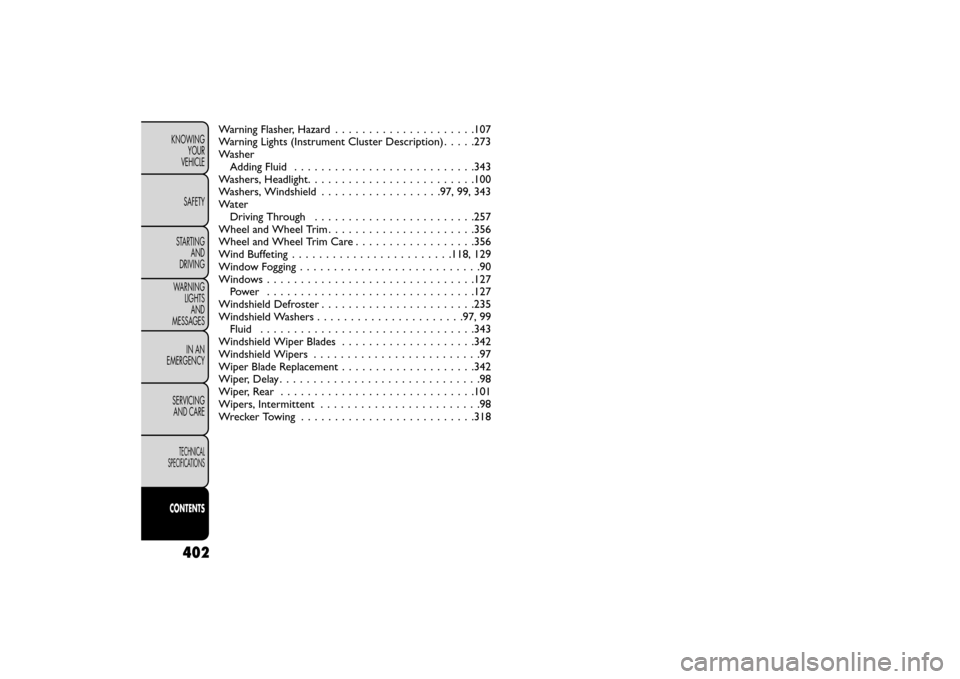
Warning Flasher, Hazard . . ...................107
Warning Lights (Instrument Cluster Description) .....273
Washer Adding Fluid . . . . . . . . . ..................343
Washers, Headlight. . ...................... .100
Washers, Windshield . . . . . . ............97, 99, 343
Wa te r Driving Through . . . . . .................. .257
Wheel and Wheel Trim . . . . . .................356
Wheel and Wheel Trim Care . .................356
Wind Buffeting . . ..................... .118, 129
Window Fogging ...........................90
Windows . ............................. .127
Power .............................. .127
Windshield Defroster . . . . . . .................235
Windshield Washers . . . . ..................97, 99
Fluid ............................... .343
Windshield Wiper Blades . . . .................342
Windshield Wipers .........................97
Wiper Blade Replacement . . . .................342
Wiper, Delay . . . . ..........................98
Wiper, Rear . . . . . . ...................... .101
Wipers, Intermittent . . . . . . ..................98
Wrecker Towing ......................... .318
402
KNOWING
YOUR
VEHICLE
SAFETY
STARTING AND
DRIVING
WARNING LIGHTSAND
MESSAGES
IN AN
EMERGENCY
SERVICINGAND CARE
TECHNICAL
SPECIFICATIONS
CONTENTS