air conditioning FIAT FULLBACK 2016 1.G User Guide
[x] Cancel search | Manufacturer: FIAT, Model Year: 2016, Model line: FULLBACK, Model: FIAT FULLBACK 2016 1.GPages: 312, PDF Size: 13.67 MB
Page 63 of 312
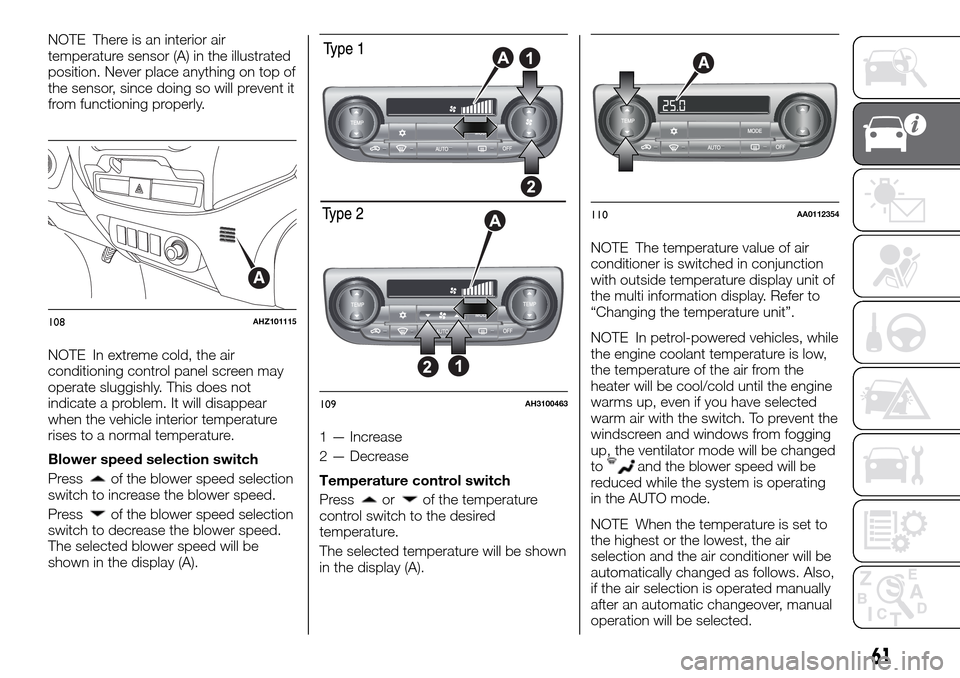
NOTE There is an interior air
temperature sensor (A) in the illustrated
position. Never place anything on top of
the sensor, since doing so will prevent it
from functioning properly.
NOTE In extreme cold, the air
conditioning control panel screen may
operate sluggishly. This does not
indicate a problem. It will disappear
when the vehicle interior temperature
rises to a normal temperature.
Blower speed selection switch
Press
of the blower speed selection
switch to increase the blower speed.
Press
of the blower speed selection
switch to decrease the blower speed.
The selected blower speed will be
shown in the display (A).1 — Increase
2 — Decrease
Temperature control switch
Pressorof the temperature
control switch to the desired
temperature.
The selected temperature will be shown
in the display (A).NOTE The temperature value of air
conditioner is switched in conjunction
with outside temperature display unit of
the multi information display. Refer to
“Changing the temperature unit”.
NOTE In petrol-powered vehicles, while
the engine coolant temperature is low,
the temperature of the air from the
heater will be cool/cold until the engine
warms up, even if you have selected
warm air with the switch. To prevent the
windscreen and windows from fogging
up, the ventilator mode will be changed
to
and the blower speed will be
reduced while the system is operating
in the AUTO mode.
NOTE When the temperature is set to
the highest or the lowest, the air
selection and the air conditioner will be
automatically changed as follows. Also,
if the air selection is operated manually
after an automatic changeover, manual
operation will be selected.
A
108AHZ101115
109AH3100463
A
110AA0112354
61
Page 64 of 312
Quick Heating(When the
temperature is set to the highest
setting): outside air will be introduced
and the air conditioner will stop.
Quick Cooling(When the
temperature is set to the lowest
setting): inside air will be recirculated
and the air conditioner will operate.
The settings described above are the
factory settings.
The air selection and air conditioning
switches can be customised (function
setting changed), and the automatic
switching of outside air and the air
conditioner according to operating
conditions can be changed as desired.
For further information, we recommend
you to consult a Fiat Dealership.
Refer to “Customising the air
conditioning switch” and to
“Customising the air selection”.Synchronized mode and dual mode
The driver’s side and the passenger’s
side temperature can be controlled
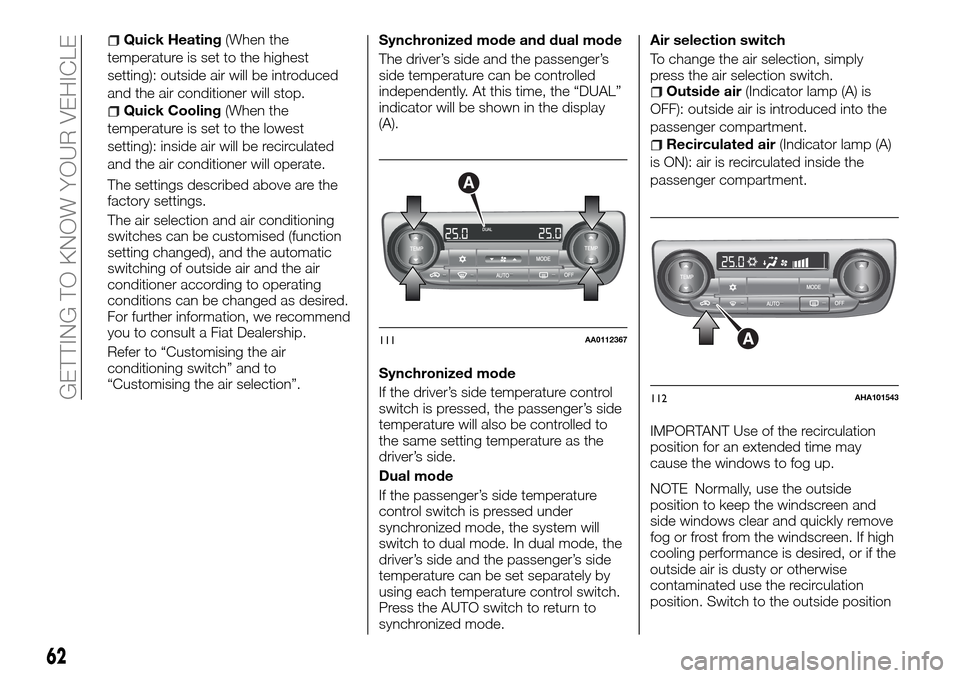
independently. At this time, the “DUAL”
indicator will be shown in the display
(A).
Synchronized mode
If the driver’s side temperature control
switch is pressed, the passenger’s side
temperature will also be controlled to
the same setting temperature as the
driver’s side.
Dual mode
If the passenger’s side temperature
control switch is pressed under
synchronized mode, the system will
switch to dual mode. In dual mode, the
driver’s side and the passenger’s side
temperature can be set separately by
using each temperature control switch.
Press the AUTO switch to return to
synchronized mode.Air selection switch
To change the air selection, simply
press the air selection switch.
Outside air(Indicator lamp (A) is
OFF): outside air is introduced into the
passenger compartment.
Recirculated air(Indicator lamp (A)
is ON): air is recirculated inside the
passenger compartment.
IMPORTANT Use of the recirculation
position for an extended time may
cause the windows to fog up.
NOTE Normally, use the outside
position to keep the windscreen and
side windows clear and quickly remove
fog or frost from the windscreen. If high
cooling performance is desired, or if the
outside air is dusty or otherwise
contaminated use the recirculation
position. Switch to the outside position
A
111AA0112367A
112AHA101543
62
GETTING TO KNOW YOUR VEHICLE
Page 65 of 312
periodically to increase ventilation so
that the windows do not become
fogged up.
NOTE When the engine coolant
temperature rises to a certain level, the
air selection is automatically switched to
the recirculation position and the
indicator lamp (A) comes on. At this
time, the system will not switch to the
outside position even if the air selection
switch is pushed.
Customising the air selection
Functions can be changed as desired,
as stated below.
Enable automatic air control When
the AUTO switch is pressed, the air
selection switch is also controlled
automatically.
Disable automatic air control Even
when the AUTO switch is pressed, the
air selection switch is not controlled
automatically.
Setting change method Hold down
the air selection switch for about
10 seconds or more.
1. When the setting is changed from
enable to disable 3 sounds are emitted
and the indicator lamp flashes 3 times.
2. When the setting is changed from
disable to enable 2 sounds are emitted
and the indicator lamp flashes 3 times.
NOTE The factory setting is “Enable
automatic air control”.NOTE When the demister switch is
pressed, in order to prevent misting of
the windows the ventilator automatically
switches to outside air even if “Disable
automatic air control” is set.
AUTO switch
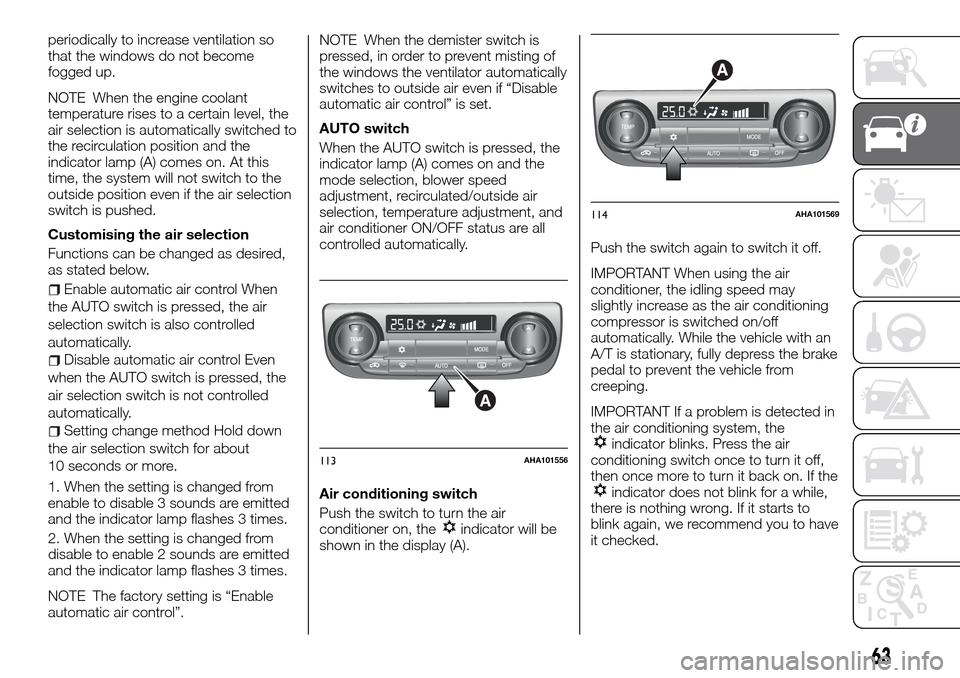
When the AUTO switch is pressed, the
indicator lamp (A) comes on and the
mode selection, blower speed
adjustment, recirculated/outside air
selection, temperature adjustment, and
air conditioner ON/OFF status are all
controlled automatically.
Air conditioning switch
Push the switch to turn the air
conditioner on, the
indicator will be
shown in the display (A).Push the switch again to switch it off.
IMPORTANT When using the air
conditioner, the idling speed may
slightly increase as the air conditioning
compressor is switched on/off
automatically. While the vehicle with an
A/T is stationary, fully depress the brake
pedal to prevent the vehicle from
creeping.
IMPORTANT If a problem is detected in
the air conditioning system, the
indicator blinks. Press the air
conditioning switch once to turn it off,
then once more to turn it back on. If the
indicator does not blink for a while,
there is nothing wrong. If it starts to
blink again, we recommend you to have
it checked.
A
113AHA101556
A
114AHA101569
63
Page 66 of 312
Customising the air conditioning
switch
Functions can be changed as desired,
as stated below.
Enable automatic air conditioning
control When the AUTO switch is
pressed, or the temperature control
switch is set to the minimum
temperature, the air conditioning switch
is controlled automatically.
Disable automatic air conditioning
control The air conditioning switch is
not controlled automatically as long as
the air conditioning switch is not
operated.
Setting change method Hold down
the air conditioning switch for about
10 seconds or more.
1. When the setting is changed from
enable to disable 3 sounds are emitted
and the
indicator flashes 3 times.
2. When the setting is changed from
disable to enable 2 sounds are emitted
and the
indicator flashes 3 times.
NOTE The factory setting is “Enable
automatic air conditioning control”.
NOTE When the demister switch is
pressed, in order to prevent misting of
the windows the air conditioner
operates automatically even if “Disable
automatic air conditioning control” is
set.OFF switch
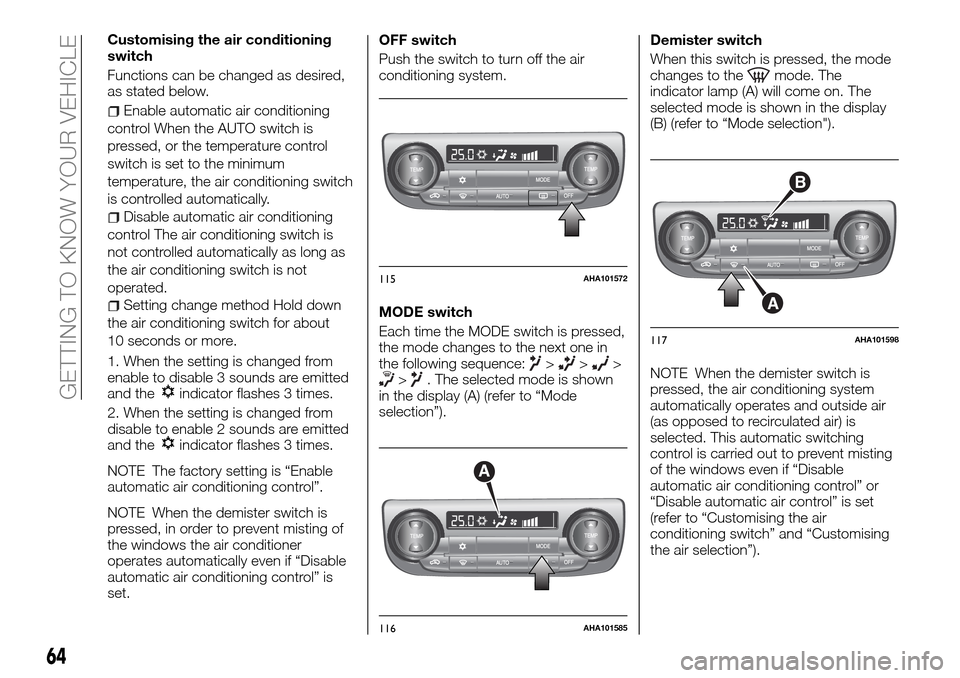
Push the switch to turn off the air
conditioning system.
MODE switch
Each time the MODE switch is pressed,
the mode changes to the next one in
the following sequence:
>>>>. The selected mode is shown
in the display (A) (refer to “Mode
selection”).Demister switch
When this switch is pressed, the mode
changes to the
mode. The
indicator lamp (A) will come on. The
selected mode is shown in the display
(B) (refer to “Mode selection").
NOTE When the demister switch is
pressed, the air conditioning system
automatically operates and outside air
(as opposed to recirculated air) is
selected. This automatic switching
control is carried out to prevent misting
of the windows even if “Disable
automatic air conditioning control” or
“Disable automatic air control” is set
(refer to “Customising the air
conditioning switch” and “Customising
the air selection”).
115AHA101572
A
116AHA101585
B
A
117AHA101598
64
GETTING TO KNOW YOUR VEHICLE
Page 67 of 312
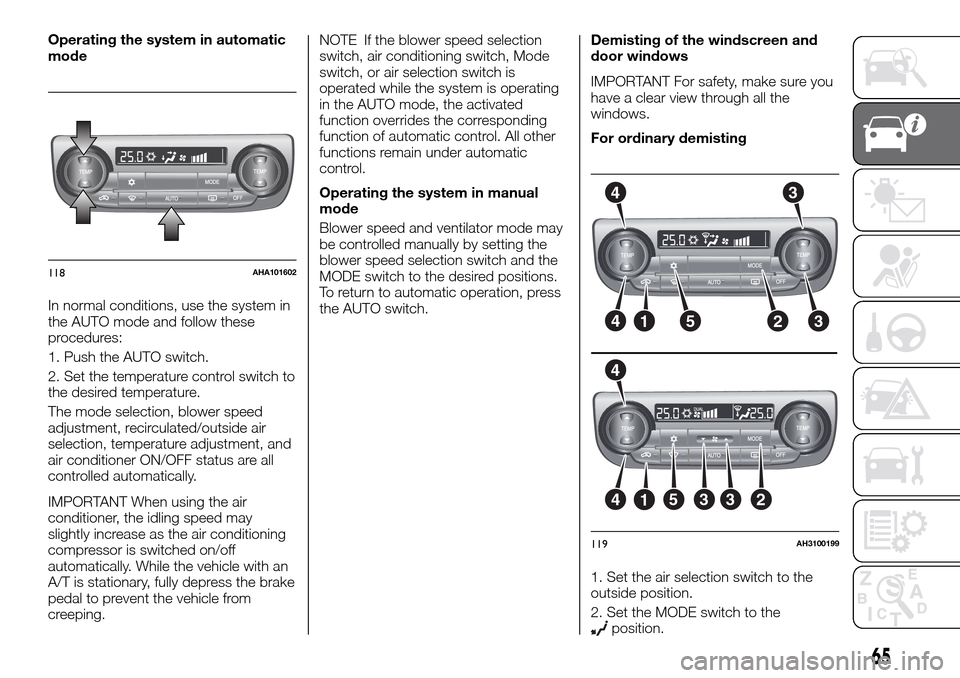
Operating the system in automatic
mode
In normal conditions, use the system in
the AUTO mode and follow these
procedures:
1. Push the AUTO switch.
2. Set the temperature control switch to
the desired temperature.
The mode selection, blower speed
adjustment, recirculated/outside air
selection, temperature adjustment, and
air conditioner ON/OFF status are all
controlled automatically.
IMPORTANT When using the air
conditioner, the idling speed may
slightly increase as the air conditioning
compressor is switched on/off
automatically. While the vehicle with an
A/T is stationary, fully depress the brake
pedal to prevent the vehicle from
creeping.NOTE If the blower speed selection
switch, air conditioning switch, Mode
switch, or air selection switch is
operated while the system is operating
in the AUTO mode, the activated
function overrides the corresponding
function of automatic control. All other
functions remain under automatic
control.
Operating the system in manual
mode
Blower speed and ventilator mode may
be controlled manually by setting the
blower speed selection switch and the
MODE switch to the desired positions.
To return to automatic operation, press
the AUTO switch.Demisting of the windscreen and
door windows
IMPORTANT For safety, make sure you
have a clear view through all the
windows.
For ordinary demisting
1. Set the air selection switch to the
outside position.
2. Set the MODE switch to the
position.
118AHA101602
4
4
3
41
452331
523
119AH3100199
65
Page 68 of 312
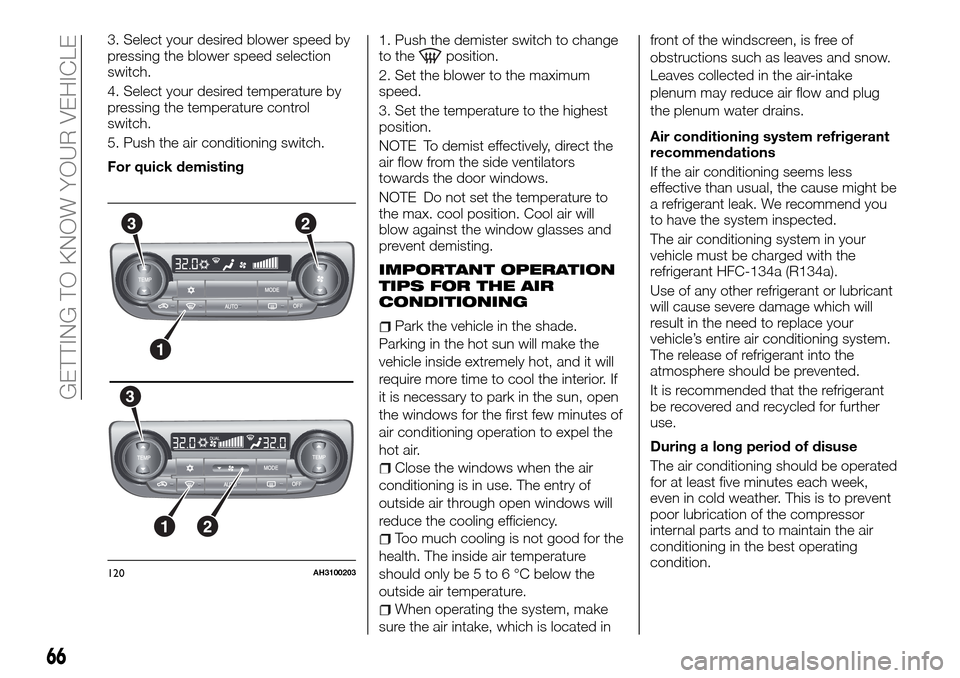
3. Select your desired blower speed by
pressing the blower speed selection
switch.
4. Select your desired temperature by
pressing the temperature control
switch.
5. Push the air conditioning switch.
For quick demisting1. Push the demister switch to change
to theposition.
2. Set the blower to the maximum
speed.
3. Set the temperature to the highest
position.
NOTE To demist effectively, direct the
air flow from the side ventilators
towards the door windows.
NOTE Do not set the temperature to
the max. cool position. Cool air will
blow against the window glasses and
prevent demisting.
IMPORTANT OPERATION
TIPS FOR THE AIR
CONDITIONING
Park the vehicle in the shade.
Parking in the hot sun will make the
vehicle inside extremely hot, and it will
require more time to cool the interior. If
it is necessary to park in the sun, open
the windows for the first few minutes of
air conditioning operation to expel the
hot air.
Close the windows when the air
conditioning is in use. The entry of
outside air through open windows will
reduce the cooling efficiency.
Too much cooling is not good for the
health. The inside air temperature
should only be 5 to 6 °C below the
outside air temperature.
When operating the system, make
sure the air intake, which is located infront of the windscreen, is free of
obstructions such as leaves and snow.
Leaves collected in the air-intake
plenum may reduce air flow and plug
the plenum water drains.
Air conditioning system refrigerant
recommendations
If the air conditioning seems less
effective than usual, the cause might be
a refrigerant leak. We recommend you
to have the system inspected.
The air conditioning system in your
vehicle must be charged with the
refrigerant HFC-134a (R134a).
Use of any other refrigerant or lubricant
will cause severe damage which will
result in the need to replace your
vehicle’s entire air conditioning system.
The release of refrigerant into the
atmosphere should be prevented.
It is recommended that the refrigerant
be recovered and recycled for further
use.
During a long period of disuse
The air conditioning should be operated
for at least five minutes each week,
even in cold weather. This is to prevent
poor lubrication of the compressor
internal parts and to maintain the air
conditioning in the best operating
condition.
3
3
2
1
12
120AH3100203
66
GETTING TO KNOW YOUR VEHICLE
Page 70 of 312
Setting change method Hold down
the rear window demister switch for
about 10 seconds or more. When the
setting is changed from enable to
disable 3 sounds are emitted and the
indicator lamp flashes 3 times. When
the setting is changed from disable to
enable 2 sounds are emitted and the
indicator lamp flashes 3 times.
NOTE The factory setting is “Disable
automatic rear window demister”.
WARNING
60)For safety, make sure you have a clear
view through all windows.
IMPORTANT
18)When using the air conditioning, the
idling speed may slightly increase as the air
conditioning compressor is switched on/off
automatically. While the vehicle with an
automatic transmission is stationary, fully
depress the brake pedal to prevent the
vehicle from creeping.
19)When using the mode selection dial
between the
andpositions, prevent
fogging by moving the air selection lever to
select outside air (refer to “Air selection
lever”).
20)Use of the
(recirculation) position
for extended time may cause the windows
to fog up.21)If the outside air is dusty or otherwise
contaminated, or if high cooling
performance is desired, set air selection
lever to the
(recirculation) position and
the temperature control dial all the way to
the right. Switch to the
(outside)
position periodically to increase ventilation
so that the windows do not become
fogged up.
IMPORTANT
2)The system uses a coolant that is
compatible with the laws in force in the
countries where the vehicle is sold, R134a
or R1234yf (indicated on a specific plate in
the engine compartment). The use of other
coolants affects the efficiency and condition
of the system. Also the compressor
coolants used must be compatible with the
indicated coolant.
WINDOW
MANUAL WINDOW
CONTROL
A — Open
B — Close
ELECTRIC WINDOW
CONTROL
(where provided)
61) 62) 63) 64) 65)
The electric windows can only be
operated with the ignition switch or the
operation mode in ON.
Electric window control switch
Each door window opens or closes
while the corresponding switch is
operated.
B
A
123AHA105495
68
GETTING TO KNOW YOUR VEHICLE
Page 135 of 312
ECONOMICAL
DRIVING
For economical driving, there are some
technical requirements that have to be
met. The prerequisite for low fuel
consumption is a properly adjusted
engine. In order to achieve longer life of
the vehicle and the most economical
operation, we recommend you to have
the vehicle checked at regular intervals
in accordance with the service
standards.
Fuel economy and generation of
exhaust gas and noise are highly
influenced by personal driving habits as
well as the particular operating
conditions. The following points should
be observed in order to minimize wear
of brakes, tyres and engine as well as
to reduce environmental pollution.
Starting the engine
Avoid sudden acceleration and sudden
starts, as they will increase fuel
consumption.
Shifting
Shift only at an appropriate speed and
engine speed. Always use the highest
shift position possible.
The transfer shift lever or the drive
modeselector should be set to “2H”
when driving 4WD vehicles on normal
roads and express ways to obtain best
possible fuel economy.City traffic
Frequent starting and stopping
increases the average fuel
consumption. Use roads with smooth
traffic flow whenever possible. When
driving on congested roads, avoid use
of a low shift position at high engine
speeds.
Idling
The vehicle consumes fuel even during
idling. Avoid extended idling whenever
possible.
Speed
At higher the vehicle speed, more fuel is
consumed. Avoid driving at full speed.
Even a slight release of the accelerator
pedal will save a significant amount of
fuel.
Tyre inflation pressure
Check the tyre inflation pressures at
regular intervals. Low tyre inflation
pressure increases road resistance and
fuel consumption. In addition, low tyre
pressures adversely affect tyre wear
and driving stability.Cargo loads
Do not drive with unnecessary articles
in the luggage compartment. Especially
during city driving where frequent
starting and stopping is necessary, the
increased weight of the vehicle will
greatly affect fuel consumption. Also
avoid driving with unnecessary luggage
or carriers, etc., on the roof; the
increased air resistance will increase
fuel consumption.
Cold engine starting
Starting of a cold engine consumes
more fuel. Unnecessary fuel
consumption is also caused by keeping
a hot engine running. After the engine is
started, commence driving as soon as
possible.
Cooler or air conditioning
The use of the air conditioner will
increase the fuel consumption.
133
Page 143 of 312
STARTING AND
STOPPING THE
ENGINE
Tips for starting
Except for vehicles equipped with
the keyless operation system
Do not operate the starter motor
continuously longer than 10 seconds;
doing so could run down the battery. If
the engine does not start, turn the
ignition switch back to “LOCK”, wait a
few seconds, and then try again. Trying
repeatedly with the starter motor still
turning will damage the starter
mechanism.
203)
79) 80) 81) 82) 83) 84)
For vehicles equipped with the
keyless operation system
The operation mode can be in any
mode to start the engine.
The starter motor will be turning for up
to approximately 15 seconds if the
engine switch is released at once.
Pressing the engine switch again while
the starter motor is still turning will stop
the starter motor. The starter motor will
be turning for up to approximately
30 seconds while the engine switch is
pressed. If the engine does not start,
wait for a while and then attempt to
start the engine again. Trying repeatedly
with the starter motor still turning will
damage the starter mechanism.
203)
80) 81) 82)
Starting the engine (petrol-powered
vehicles)
Except for vehicles equipped with
the keyless operation system
Your vehicles equipped with an
electronically controlled fuel injection
system. When starting the engine, do
not depress the accelerator pedal.
The starting procedure is as follows:
Insert the ignition key and fasten the
seat belt.
Make sure the parking brake is
applied.
Depress and hold the brake pedal.
Depress the clutch pedal all the way
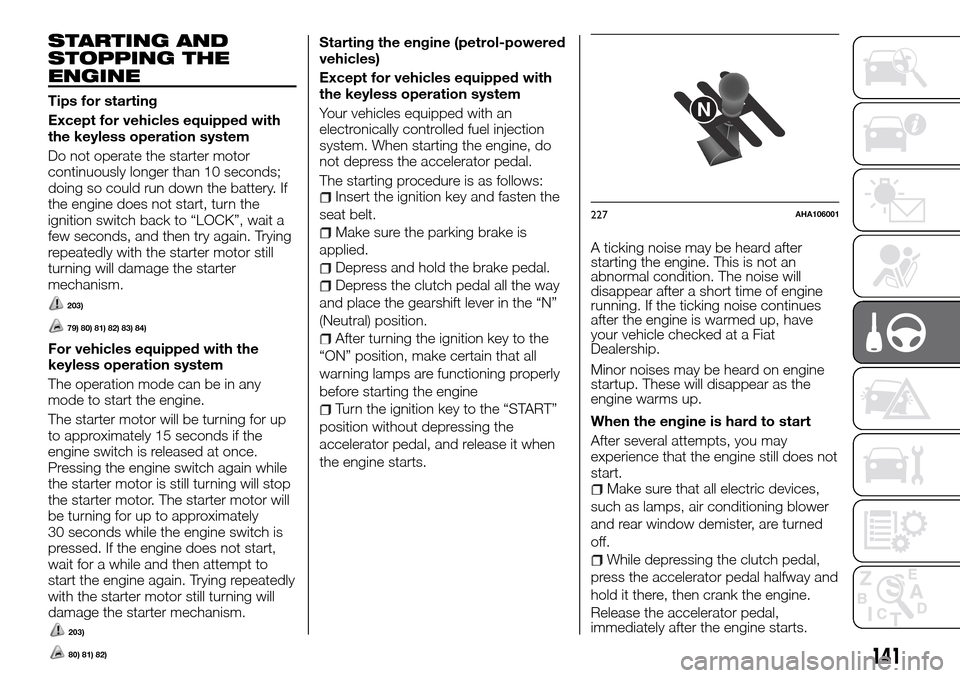
and place the gearshift lever in the “N”
(Neutral) position.
After turning the ignition key to the
“ON” position, make certain that all
warning lamps are functioning properly
before starting the engine
Turn the ignition key to the “START”
position without depressing the
accelerator pedal, and release it when
the engine starts.A ticking noise may be heard after
starting the engine. This is not an
abnormal condition. The noise will
disappear after a short time of engine
running. If the ticking noise continues
after the engine is warmed up, have
your vehicle checked at a Fiat
Dealership.
Minor noises may be heard on engine
startup. These will disappear as the
engine warms up.
When the engine is hard to start
After several attempts, you may
experience that the engine still does not
start.
Make sure that all electric devices,
such as lamps, air conditioning blower
and rear window demister, are turned
off.
While depressing the clutch pedal,
press the accelerator pedal halfway and
hold it there, then crank the engine.
Release the accelerator pedal,
N
227AHA106001
141
immediately after the engine starts.
Page 144 of 312
If the engine still will not start, the
engine could be flooded with too much
petrol. While depressing the clutch
pedal, push the accelerator pedal all the
way down and hold it there, then crank
the engine for 5 to 6 seconds. Return
the ignition switch to the “LOCK”
position and release the accelerator
pedal. Wait a few seconds, and then
crank the engine again for 5 to
6 seconds while depressing the clutch
pedal, but do not push the accelerator
pedal. Release the ignition key if the
engine starts. If the engine fails to start,
repeat these procedures. If the engine
still will not start, we recommend you to
have the vehicle checked.
To protect the engine, the high-speed
mode may not be selected while the
engine coolant temperature is low. In
such a case, the engine revolutions do
not rise to over 5,000 rpm even if the
accelerator pedal is depressed.For vehicles equipped with the
keyless operation system
Your vehicles equipped with an
electronically controlled fuel injection
system. When starting the engine, do
not depress the accelerator pedal.
The starting procedure is as follows:
Fasten the seat belt.
Make sure the parking brake is
applied.
Press and hold the brake pedal
down firmly with your right foot.
Depress the clutch pedal all the way
and place the gearshift lever in the “N”
(Neutral) position.
Press the engine switch.
Make certain that all warning lamps
are functioning properly.
When the engine is not started, it may
become hard to depress the brake
pedal and the vehicle may not be able
to detect the pedal operation. Therefore
the engine may not be started. In such
a case, depress the brake pedal more
firmly than usual.
A ticking noise may be heard after
starting the engine. This is not an
abnormal condition. The noise will
disappear after a short time of engine
running. If the ticking noise continues
after the engine is warmed up, have
your vehicle checked at a Fiat
Dealership.
Minor noises may be heard on engine
startup. These will disappear as the
engine warms up.When the engine is hard to start
After several attempts, you may
experience that the engine still does not
start.
Make sure that all electric devices,
such as lamps, air conditioning blower
and rear window demister, are turned
off.
While depressing the clutch pedal,
press the accelerator pedal halfway and
hold it there, then crank the engine.
Release the accelerator pedal,
immediately after the engine starts.
If the engine still will not start, the
engine could be flooded with too much
petrol. While depressing the clutch
pedal, push the accelerator pedal all the
way down and hold it there, then press
the engine switch to crank the engine. If
the engine does not start after 5 to
6 seconds, press the engine switch to
stop the engine, and release the
accelerator pedal. Put the operation
mode in OFF. Wait a few seconds, and
then press the engine switch to crank
the engine again while depressing the
brake pedal or the clutch pedal, but do
not push the accelerator pedal. If the
engine fails to start, repeat these
procedures. If the engine still will not
start, we recommend you to have the
vehicle checked.
To protect the engine, the high-speed
mode may not be selected while the
142
STARTING AND DRIVING