towing FIAT FULLBACK 2016 1.G User Guide
[x] Cancel search | Manufacturer: FIAT, Model Year: 2016, Model line: FULLBACK, Model: FIAT FULLBACK 2016 1.GPages: 312, PDF Size: 13.67 MB
Page 204 of 312
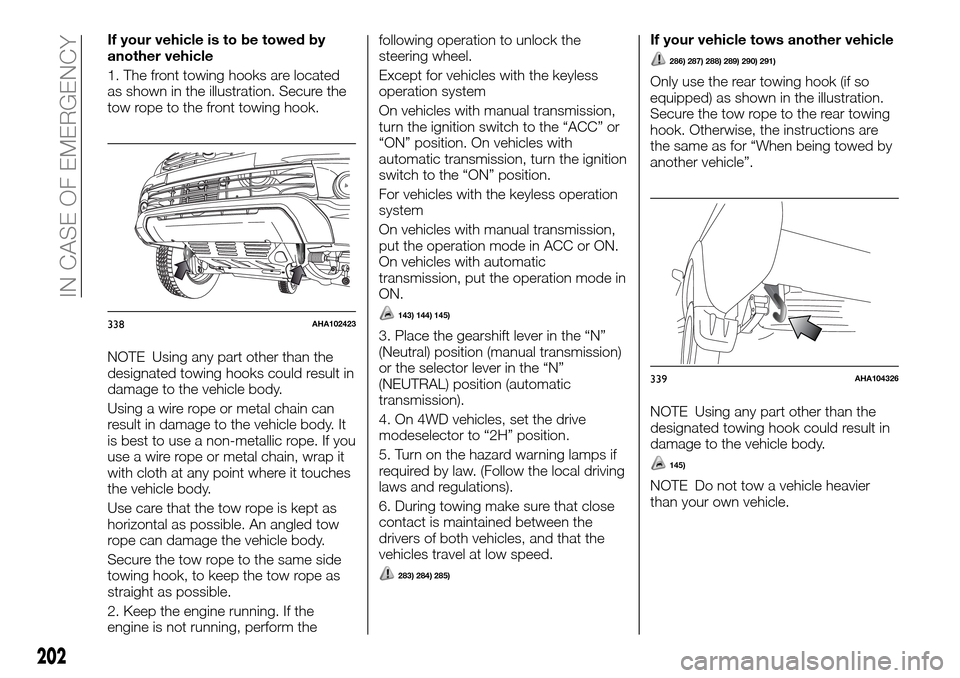
If your vehicle is to be towed by
another vehicle
1. The front towing hooks are located
as shown in the illustration. Secure the
tow rope to the front towing hook.
NOTE Using any part other than the
designated towing hooks could result in
damage to the vehicle body.
Using a wire rope or metal chain can
result in damage to the vehicle body. It
is best to use a non-metallic rope. If you
use a wire rope or metal chain, wrap it
with cloth at any point where it touches
the vehicle body.
Use care that the tow rope is kept as
horizontal as possible. An angled tow
rope can damage the vehicle body.
Secure the tow rope to the same side
towing hook, to keep the tow rope as
straight as possible.
2. Keep the engine running. If the
engine is not running, perform thefollowing operation to unlock the
steering wheel.
Except for vehicles with the keyless
operation system
On vehicles with manual transmission,
turn the ignition switch to the “ACC” or
“ON” position. On vehicles with
automatic transmission, turn the ignition
switch to the “ON” position.
For vehicles with the keyless operation
system
On vehicles with manual transmission,
put the operation mode in ACC or ON.
On vehicles with automatic
transmission, put the operation mode in
ON.
143) 144) 145)
3. Place the gearshift lever in the “N”
(Neutral) position (manual transmission)
or the selector lever in the “N”
(NEUTRAL) position (automatic
transmission).
4. On 4WD vehicles, set the drive
modeselector to “2H” position.
5. Turn on the hazard warning lamps if
required by law. (Follow the local driving
laws and regulations).
6. During towing make sure that close
contact is maintained between the
drivers of both vehicles, and that the
vehicles travel at low speed.
283) 284) 285)
If your vehicle tows another vehicle
286) 287) 288) 289) 290) 291)
Only use the rear towing hook (if so
equipped) as shown in the illustration.
Secure the tow rope to the rear towing
hook. Otherwise, the instructions are
the same as for “When being towed by
another vehicle”.
NOTE Using any part other than the
designated towing hook could result in
damage to the vehicle body.
145)
NOTE Do not tow a vehicle heavier
than your own vehicle.
338AHA102423
339AHA104326
202
IN CASE OF EMERGENCY
Page 205 of 312
WARNING
281)If the vehicle is towed with the ignition
switch in the “ON” position or the operation
mode in ON and only the front wheels or
only the rear wheels raised off the ground,
the active traction control system may
operate, resulting in an accident.
282)If your vehicle equipped with the
Active Stability & Traction Control system
(ASTC), if the vehicle is towed with the
ignition switch in the “ON” position or the
operation mode in ON and only the front
wheels or only the rear wheels raised off
the ground, the active traction control
system may operate, resulting in an
accident.
283)Avoid sudden braking, acceleration
and steering wheel movements; such
driving operation could cause damage to
the towing hook or towing rope. People in
the vicinity could be injured as a result.284)When going down a long slope, the
brakes may overheat, reducing
effectiveness. Have your vehicle transport
by a tow truck.
285)The person in the vehicle being towed
must pay attention to the brake lamps of
the towing vehicle and make sure the rope
never becomes slack.
286)Do not use flexible cables for towing
and avoid jerking. During towing
operations, make sure that the fastened
joint does not damage adjoining
components.
287)When towing the vehicle comply with
the specific rules of the Highway Code
regarding the towing device and the
behaviour on the road.
288)Do not start the engine while towing
the vehicle.
289)Towing must be made exclusively on
roads/streets; the device must not be used
to recover the vehicle if it got off the road.
290)Towing must not be made for getting
past significant obstacles on the road (e.g.
heaps of snow or material on the road
surface).
291)Towing must take place with the two
vehicles (one towing, the other towed)
aligned as much as possible; towing by
roadside assistance vehicles, too, must
take place with the two vehicles aligned as
much as possible.
IMPORTANT
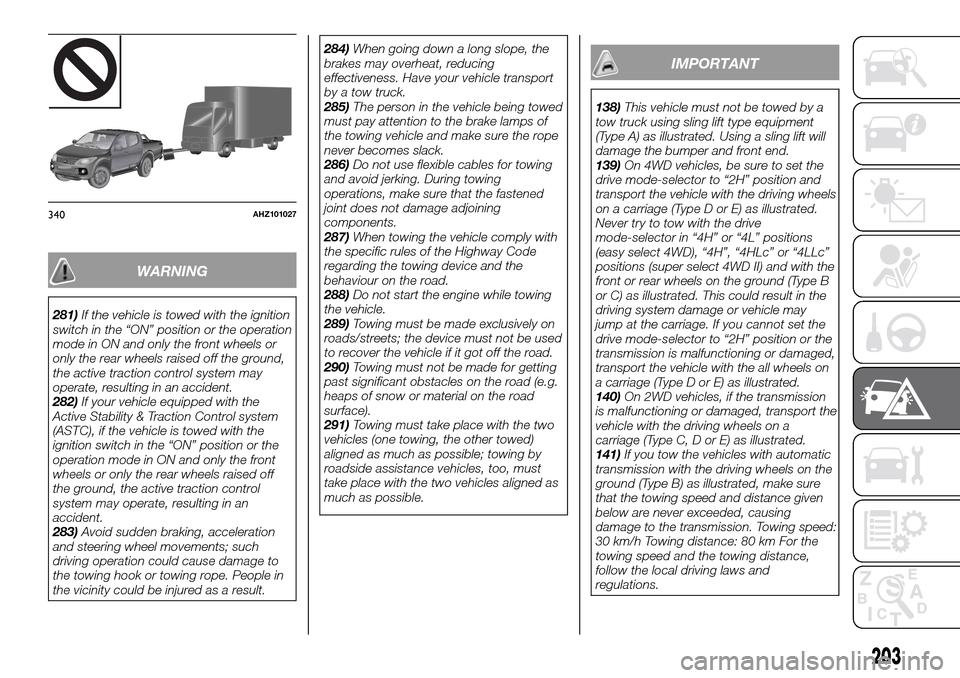
138)This vehicle must not be towed by a
tow truck using sling lift type equipment
(Type A) as illustrated. Using a sling lift will
damage the bumper and front end.
139)On 4WD vehicles, be sure to set the
drive mode-selector to “2H” position and
transport the vehicle with the driving wheels
on a carriage (Type D or E) as illustrated.
Never try to tow with the drive
mode-selector in “4H” or “4L” positions
(easy select 4WD), “4H”, “4HLc” or “4LLc”
positions (super select 4WD II) and with the
front or rear wheels on the ground (Type B
or C) as illustrated. This could result in the
driving system damage or vehicle may
jump at the carriage. If you cannot set the
drive mode-selector to “2H” position or the
transmission is malfunctioning or damaged,
transport the vehicle with the all wheels on
a carriage (Type D or E) as illustrated.
140)On 2WD vehicles, if the transmission
is malfunctioning or damaged, transport the
vehicle with the driving wheels on a
carriage (Type C, D or E) as illustrated.
141)If you tow the vehicles with automatic
transmission with the driving wheels on the
ground (Type B) as illustrated, make sure
that the towing speed and distance given
below are never exceeded, causing
damage to the transmission. Towing speed:
30 km/h Towing distance: 80 km For the
towing speed and the towing distance,
follow the local driving laws and
regulations.
340AHZ101027
203
Page 242 of 312
PERIODIC CHECKS
Before long journeys, check and, if
necessary, restore:
engine coolant level;
brake fluid level;
windscreen washer fluid level;
operation of lighting system
(headlamps, direction indicators, hazard
warning lights, etc.);
tyre inflation pressure and condition;
tyre alignment;
operation of screen washer/wiper
system and positioning/wear of
windscreen/rear window wiper blades.
To ensure that the vehicle is always
efficient and well maintained, it is
advisable to make sure that you carry
out the above operations regularly
(approximately every 1000 km and
every 3000 km for checking and
topping up engine oil is advisable).
DEMANDING
VEHICLE USE
If the vehicle is mostly used in one of
the following conditions:
towing a trailer or caravan;
dusty roads;
short, repeated journeys (less than
7-8 km) at sub-zero outside
temperatures;
engine often idling or driving long
distances at low speeds or long periods
of inactivity;
the following checks must be carried
out more often than indicated in the
Scheduled Servicing Plan:
check front disc brake pad
conditions and wear;
check cleanliness of bonnet and
boot locks, cleanliness and lubrication
of linkage;
visually inspect conditions of: engine,
gearbox, transmission, pipes and hoses
(exhaust - fuel system - brakes) and
rubber elements (boots - sleeves -
bushes - etc.);
check battery charge and battery
fluid level (electrolyte);
visually inspect condition of the
accessory drive belts;
check and, if necessary, change
engine oil and replace oil filter;
check and, if necessary, replace
pollen filter.
240
SERVICING AND MAINTENANCE
Page 310 of 312
Masking the headlamps.........45
Multi information display.........86
Operation under adverse driving
conditions...............204
Outside rearview mirror.........38
Parking..................140
Parking brake...............139
Periodic checks.............240
Power steering fluid...........251
Pretensioners...............106
Read this carefully.............2
Rear Differential lock..........166
Rear gate..................29
Rear seat..................32
Rear view camera............180
Rear window demister switch.....67
Rearview mirrors..............37
Refill capacities..............292
Removal of water from the fuel filter......................188
Replacement of lamp bulbs......213
Safe driving techniques........134
safety systems..............126
SBR system................105
Scheduled Servicing Plan.......225
Seat adjustment..............31
Seat belt reminder............105
Seat belts
Use ...................103
Seats.....................31
Service precautions...........224
Side airbags................122
Sport mode................149
Starting and stopping the engine. . .141
Steering wheel...............35
Steering wheel height and reach
adjustment................35
Steering wheel lock............36
Sun visors..................74
Super Select 4WD II...........162
Supplemental restraint system
airbag..................118Tools, jack and jack handle......189
Towing...................201
Turbocharger operation........145
Turn-signal lever..............43
Tyres ....................260
Tyres and wheels.............291
Use of the Owner Handbook......3
Vanity mirror................75
Vehicle care precautions........255
Vehicle changes/alterations........5
Vehicle dimensions...........271
Vehicle labeling..............266
Vehicle performance..........279
Ventilators..................52
Washer fluid...............249
Weights..................281
Window...................68
Windscreen wiper.............48
Wiper and washer switch........48
Wiper blade rubber replacement . . .254
FCA Italy S.p.A. - MOPAR - Technical Services - Service Engineering
Largo Senatore G. Agnelli, 3 - 10040 Volvera - Turin (Italy)
Print no.
INDEX
Manual transmission..........146
603.99.982 - 04/2016- Edition1