tyre pressure FIAT FULLBACK 2016 1.G User Guide
[x] Cancel search | Manufacturer: FIAT, Model Year: 2016, Model line: FULLBACK, Model: FIAT FULLBACK 2016 1.GPages: 312, PDF Size: 13.67 MB
Page 202 of 312
271)Mount the spare wheel with the valve
stem (J) facing outboard. If you cannot see
the valve stem (J), you have installed the
wheel backwards. Operating the vehicle
with the spare wheel installed backwards
can cause vehicle damage and result in an
accident.
272)Be sure to open the release valve
slowly. If it is opened quickly, the vehicle will
drop abruptly and the jack may come out
of position, causing a serious accident.
273)Never use your foot or a pipe
extension for extra force in the wheel nut
wrench. If you do so, you will tighten the
nut too much.
274)The tyre pressure should be
periodically checked and maintained at the
specified pressure while the tyre is stowed.
275)After changing the tyre and driving the
vehicle about 1,000 km, retighten the
wheel nuts to make sure that they have not
come loose.
276)If the steering wheel vibrates when
driving after changing the tyre, we
recommend you to have the tyres checked
for balance.
277)Do not mix one type of tyre with
another or use a different size from the one
listed. This would cause early wear and
poor handling.
278)The spare wheel should always be
securely in position. If a flat tyre is
changed, put the flat tyre in the spare
wheel mounting position with the wheel
outer surface upward, and use the wheel
nut wrench to secure it firmly.279)Never tamper with the inflation valve.
Never introduce tools of any kind between
rim and tyre. Check tyre and spare wheel
pressure regularly, referring to the values
shown in the "Technical specifications"
section.
280)The moving components of the jack
(screw and joints) can also cause injuries:
do not touch them. If you come into
contact with lubricating grease, clean
yourself thoroughly.
IMPORTANT
132)Avoid using different size tyres from
the one listed and the combined use of
different types of tyres, as this can affect
driving safety.
133)Even if a wheel has the same rim size
and offset as the specified type of wheel,
its shape may prevent it from being fitted
correctly. Consult an authorised Fiat
Dealership before using wheels that you
have.
134)When installing or removing the spare
wheel, please observe the followings. If you
do not follow them, it could result in break
the spare wheel carrier. Do not use the
power tool. Use the wheel nut wrench
stowed on the vehicle. Do not apply a force
of 400 N or more at the end of the wheel
nut wrench.
135)Never apply oil to either the wheel
bolts or the nuts or they will tighten too
much.
136)If the release valve is loosened too
much (2 or more turns) in the anticlockwise
direction, the jack’s oil will leak and the jack
cannot be used.137)Close the release valve slowly when
lowering the vehicle, or the valve may be
damaged.
200
IN CASE OF EMERGENCY
Page 206 of 312
142)Never tow an automatic transmission
vehicle with the front wheels up (and the
rear wheels on the ground) (Type B) when
the automatic transmission fluid level is low.
This may cause serious and expensive
damage to the transmission.
143)When the engine is not running, the
brake booster and power steering pump do
not operate. This means higher brake
depression force and higher steering effort
are required. Therefore, vehicle operation is
very difficult.
144)Do not leave the ignition switch in the
“LOCK” position or the operation mode in
OFF. The steering wheel will lock, causing
loss of control.
145)On vehicles with super select 4WD II,
when you are going to tow another vehicle,
set the drive mode-selector to “4H”
position. Selecting “2H” drive may increase
the differential oil temperature, resulting in
possible damage to the driving system.
Further, the drive train will be subjected to
excessive loading possibly leading to oil
leakage, component seizure, or other
serious faults.OPERATION UNDER
ADVERSE DRIVING
CONDITIONS
On a flooded road
Avoid flooded roads. Water could enter
the brake discs, resulting in temporarily
ineffective brakes. In such cases, lightly
depress the brake pedal to see if the
brakes operate properly. If they do not,
lightly depress the pedal several times
while driving in order to dry the brake
pads.
When driving in rain or on a road with
many puddles a layer of water may
form between the tyres and the road
surface. This reduces a tyre’s frictional
resistance on the road, resulting in loss
of steering stability and braking
capability.
To cope with this, observe the following
items:
(a) Drive your vehicle at a slow speed.
(b) Do not drive on worn tyres.
(c) Always maintain the specified tyre
inflation pressures.On a snow-covered or frozen road
When driving on a snow-covered or
frozen road, it is recommended that you
use snow tyres or snow traction device
(tyre chains). Refer to the “Snow tyres”
and “Snow traction device (tyre chains)”
sections.
Avoid high-speed operation, sudden
acceleration, abrupt brake application
and sharp cornering.
Depressing the brake pedal during
travel on snowy or icy roads may cause
tyre slippage and skidding. When
traction between the tyres and the road
is reduced the wheels may skid and the
vehicle cannot readily be brought to a
stop by conventional braking
techniques. Braking will differ,
depending upon whether you have
anti-lock brake system (ABS). If you do
have ABS, brake by pressing the brake
pedal hard, and keeping it pressed. If
you do not have ABS, pump the brake
pedal with short rapid jabs, each time
fully applying and fully releasing for
greatest effect.
Allow extra distance between your
vehicle and the vehicle in front of you,
and avoid sudden braking.
Accumulation of ice on the braking
system can cause the wheels to lock.
Pull away from a standstill slowly after
confirming safety around the vehicle.
292)
204
IN CASE OF EMERGENCY
Page 227 of 312
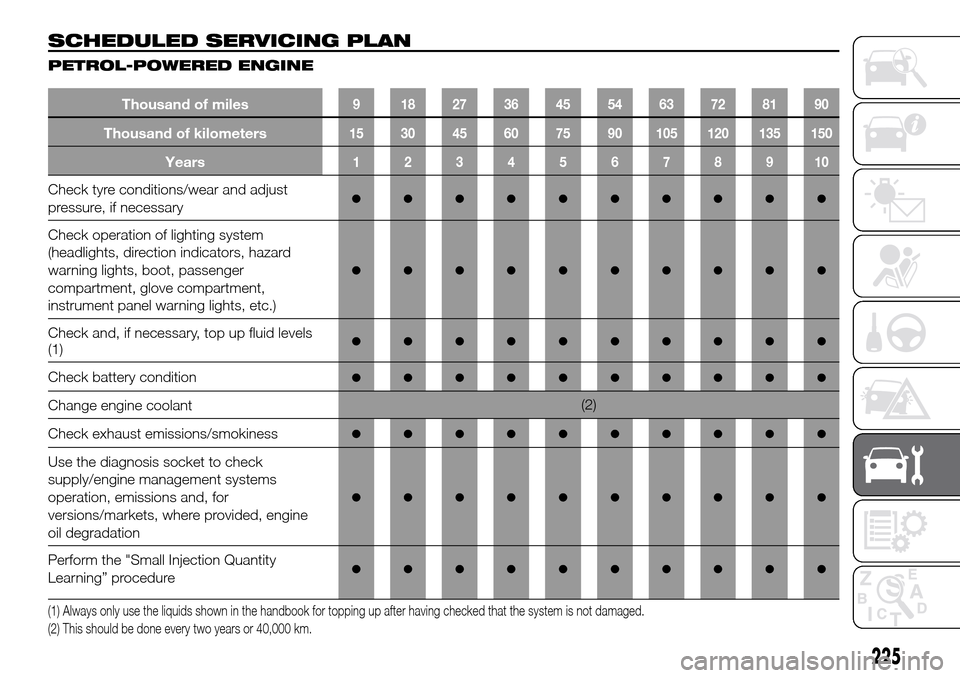
SCHEDULED SERVICING PLAN
PETROL-POWERED ENGINE
Thousand of miles9 182736455463728190
Thousand of kilometers15 30 45 60 75 90 105 120 135 150
Years12345678910
Check tyre conditions/wear and adjust
pressure, if necessary●●●●●●●●●●
Check operation of lighting system
(headlights, direction indicators, hazard
warning lights, boot, passenger
compartment, glove compartment,
instrument panel warning lights, etc.)
●●●●●●●●●●
Check and, if necessary, top up fluid levels
(1)●●●●●●●●●●
Check battery condition●●●●●●●●●●
Change engine coolant(2)
Check exhaust emissions/smokiness
●●●●●●●●●●
Use the diagnosis socket to check
supply/engine management systems
operation, emissions and, for
versions/markets, where provided, engine
oil degradation
●●●●●●●●●●
Perform the "Small Injection Quantity
Learning” procedure●●●●●●●●●●
(1) Always only use the liquids shown in the handbook for topping up after having checked that the system is not damaged.
(2) This should be done every two years or 40,000 km.
225
Page 232 of 312
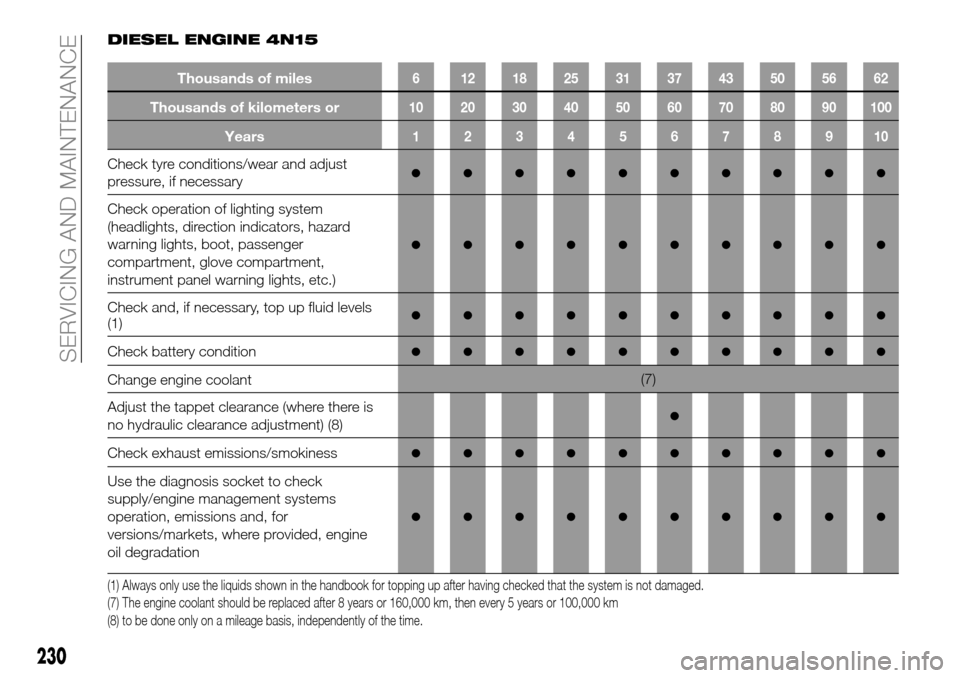
DIESEL ENGINE 4N15
Thousands of miles6 121825313743505662
Thousands of kilometers or10 20 30 40 50 60 70 80 90 100
Years12345678910
Check tyre conditions/wear and adjust
pressure, if necessary●●●●●●●●●●
Check operation of lighting system
(headlights, direction indicators, hazard
warning lights, boot, passenger
compartment, glove compartment,
instrument panel warning lights, etc.)
●●●●●●●●●●
Check and, if necessary, top up fluid levels
(1)●●●●●●●●●●
Check battery condition●●●●●●●●●●
Change engine coolant(7)
Adjust the tappet clearance (where there is
no hydraulic clearance adjustment) (8)
●
Check exhaust emissions/smokiness●●●●●●●●●●
Use the diagnosis socket to check
supply/engine management systems
operation, emissions and, for
versions/markets, where provided, engine
oil degradation
●●●●●●●●●●
(1) Always only use the liquids shown in the handbook for topping up after having checked that the system is not damaged.
(7) The engine coolant should be replaced after 8 years or 160,000 km, then every 5 years or 100,000 km
(8) to be done only on a mileage basis, independently of the time.
230
SERVICING AND MAINTENANCE
Page 237 of 312
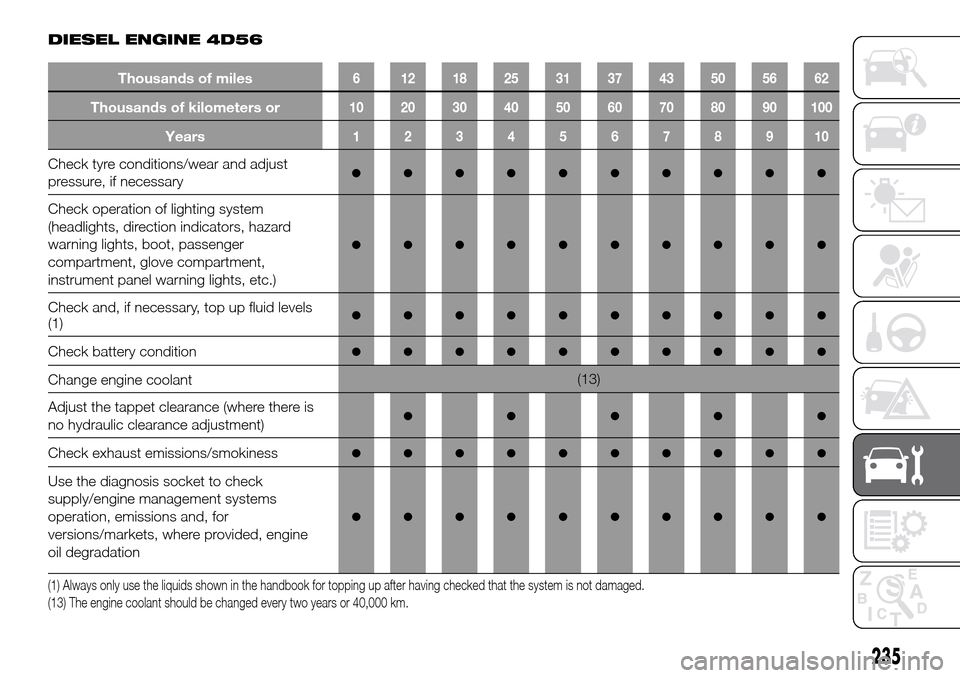
DIESEL ENGINE 4D56
Thousands of miles6 121825313743505662
Thousands of kilometers or10 20 30 40 50 60 70 80 90 100
Years12345678910
Check tyre conditions/wear and adjust
pressure, if necessary●●●●●●●●●●
Check operation of lighting system
(headlights, direction indicators, hazard
warning lights, boot, passenger
compartment, glove compartment,
instrument panel warning lights, etc.)
●●●●●●●●●●
Check and, if necessary, top up fluid levels
(1)●●●●●●●●●●
Check battery condition●●●●●●●●●●
Change engine coolant(13)
Adjust the tappet clearance (where there is
no hydraulic clearance adjustment)
●●●●●
Check exhaust emissions/smokiness●●●●●●●●●●
Use the diagnosis socket to check
supply/engine management systems
operation, emissions and, for
versions/markets, where provided, engine
oil degradation
●●●●●●●●●●
(1) Always only use the liquids shown in the handbook for topping up after having checked that the system is not damaged.
(13) The engine coolant should be changed every two years or 40,000 km.
235
Page 242 of 312
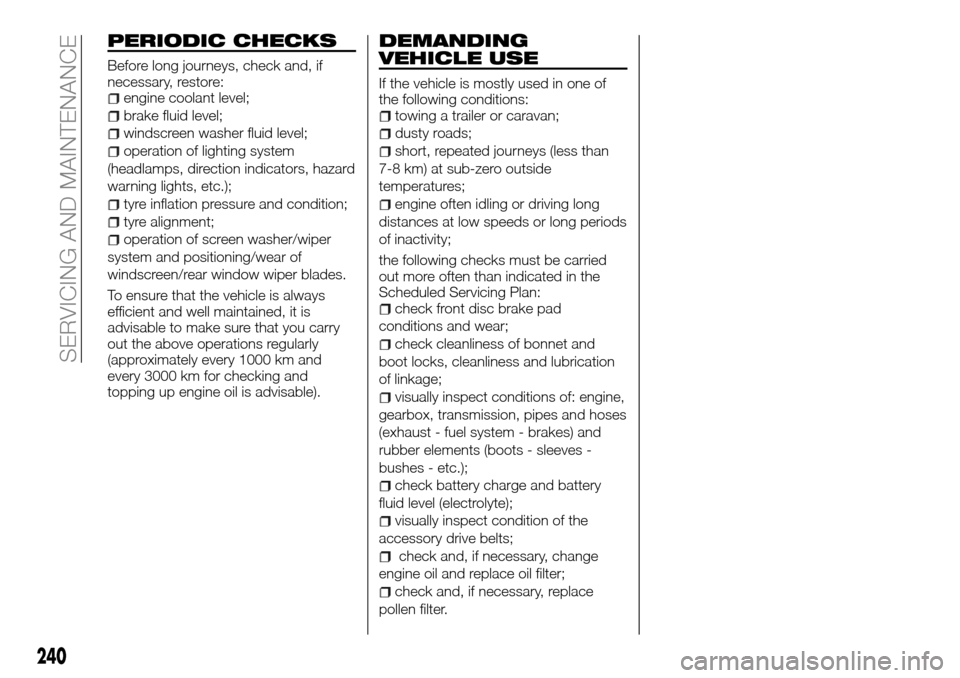
PERIODIC CHECKS
Before long journeys, check and, if
necessary, restore:
engine coolant level;
brake fluid level;
windscreen washer fluid level;
operation of lighting system
(headlamps, direction indicators, hazard
warning lights, etc.);
tyre inflation pressure and condition;
tyre alignment;
operation of screen washer/wiper
system and positioning/wear of
windscreen/rear window wiper blades.
To ensure that the vehicle is always
efficient and well maintained, it is
advisable to make sure that you carry
out the above operations regularly
(approximately every 1000 km and
every 3000 km for checking and
topping up engine oil is advisable).
DEMANDING
VEHICLE USE
If the vehicle is mostly used in one of
the following conditions:
towing a trailer or caravan;
dusty roads;
short, repeated journeys (less than
7-8 km) at sub-zero outside
temperatures;
engine often idling or driving long
distances at low speeds or long periods
of inactivity;
the following checks must be carried
out more often than indicated in the
Scheduled Servicing Plan:
check front disc brake pad
conditions and wear;
check cleanliness of bonnet and
boot locks, cleanliness and lubrication
of linkage;
visually inspect conditions of: engine,
gearbox, transmission, pipes and hoses
(exhaust - fuel system - brakes) and
rubber elements (boots - sleeves -
bushes - etc.);
check battery charge and battery
fluid level (electrolyte);
visually inspect condition of the
accessory drive belts;
check and, if necessary, change
engine oil and replace oil filter;
check and, if necessary, replace
pollen filter.
240
SERVICING AND MAINTENANCE
Page 262 of 312
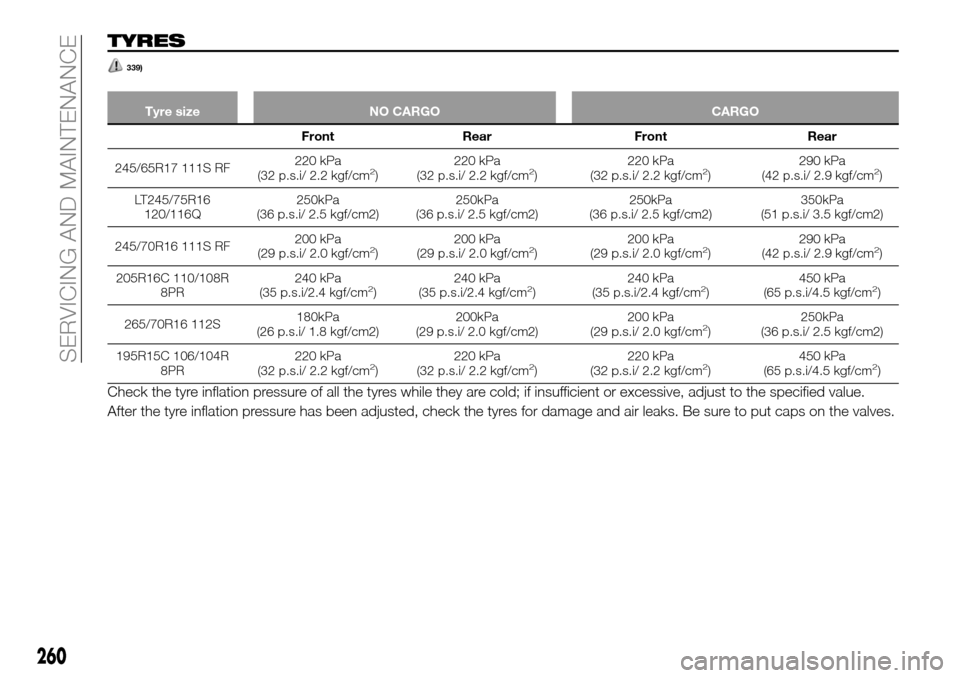
TYRES
339)
Tyre size NO CARGO CARGO
Front Rear Front Rear
245/65R17 111S RF220 kPa
(32 p.s.i/ 2.2 kgf/cm
2)220 kPa
(32 p.s.i/ 2.2 kgf/cm2)220 kPa
(32 p.s.i/ 2.2 kgf/cm2)290 kPa
(42 p.s.i/ 2.9 kgf/cm2)
LT245/75R16
120/116Q250kPa
(36 p.s.i/ 2.5 kgf/cm2)250kPa
(36 p.s.i/ 2.5 kgf/cm2)250kPa
(36 p.s.i/ 2.5 kgf/cm2)350kPa
(51 p.s.i/ 3.5 kgf/cm2)
245/70R16 111S RF200 kPa
(29 p.s.i/ 2.0 kgf/cm
2)200 kPa
(29 p.s.i/ 2.0 kgf/cm2)200 kPa
(29 p.s.i/ 2.0 kgf/cm2)290 kPa
(42 p.s.i/ 2.9 kgf/cm2)
205R16C 110/108R
8PR240 kPa
(35 p.s.i/2.4 kgf/cm
2)240 kPa
(35 p.s.i/2.4 kgf/cm2)240 kPa
(35 p.s.i/2.4 kgf/cm2)450 kPa
(65 p.s.i/4.5 kgf/cm2)
265/70R16 112S180kPa
(26 p.s.i/ 1.8 kgf/cm2)200kPa
(29 p.s.i/ 2.0 kgf/cm2)200 kPa
(29 p.s.i/ 2.0 kgf/cm
2)250kPa
(36 p.s.i/ 2.5 kgf/cm2)
195R15C 106/104R
8PR220 kPa
(32 p.s.i/ 2.2 kgf/cm
2)220 kPa
(32 p.s.i/ 2.2 kgf/cm2)220 kPa
(32 p.s.i/ 2.2 kgf/cm2)450 kPa
(65 p.s.i/4.5 kgf/cm2)
Check the tyre inflation pressure of all the tyres while they are cold; if insufficient or excessive, adjust to the specified value.
After the tyre inflation pressure has been adjusted, check the tyres for damage and air leaks. Be sure to put caps on the valves.
260
SERVICING AND MAINTENANCE
Page 263 of 312
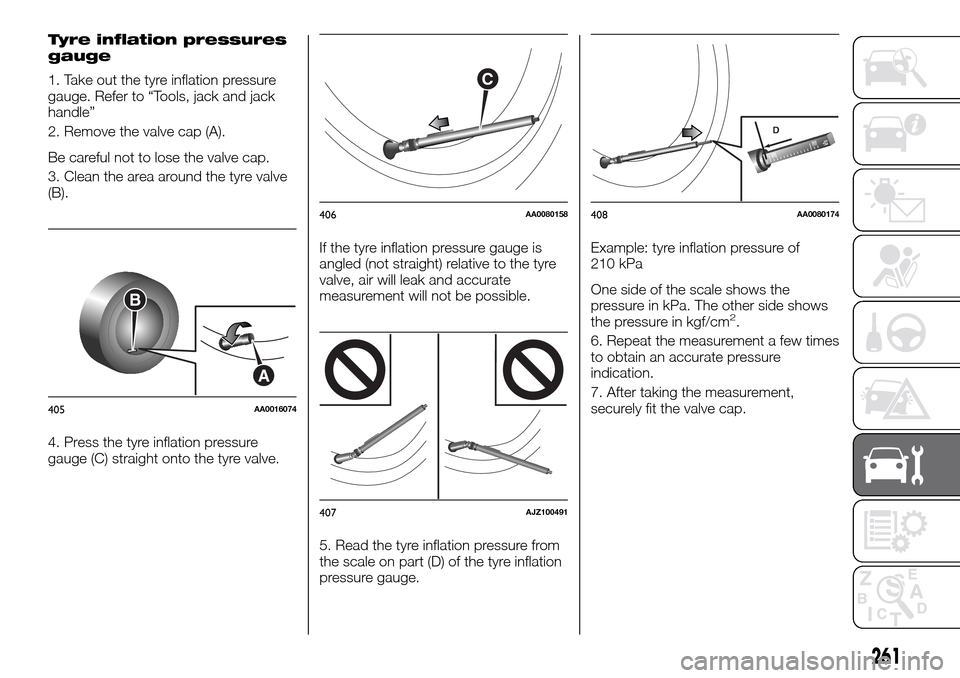
Tyre inflation pressures
gauge
1. Take out the tyre inflation pressure
gauge. Refer to “Tools, jack and jack
handle”
2. Remove the valve cap (A).
Be careful not to lose the valve cap.
3. Clean the area around the tyre valve
(B).
4. Press the tyre inflation pressure
gauge (C) straight onto the tyre valve.If the tyre inflation pressure gauge is
angled (not straight) relative to the tyre
valve, air will leak and accurate
measurement will not be possible.
5. Read the tyre inflation pressure from
the scale on part (D) of the tyre inflation
pressure gauge.Example: tyre inflation pressure of
210 kPa
One side of the scale shows the
pressure in kPa. The other side shows
the pressure in kgf/cm
2.
6. Repeat the measurement a few times
to obtain an accurate pressure
indication.
7. After taking the measurement,
securely fit the valve cap.
A
B
405AA0016074
C
406AA0080158
407AJZ100491
D
408AA0080174
261
Page 264 of 312
Wheel condition
340) 341) 342)
178)
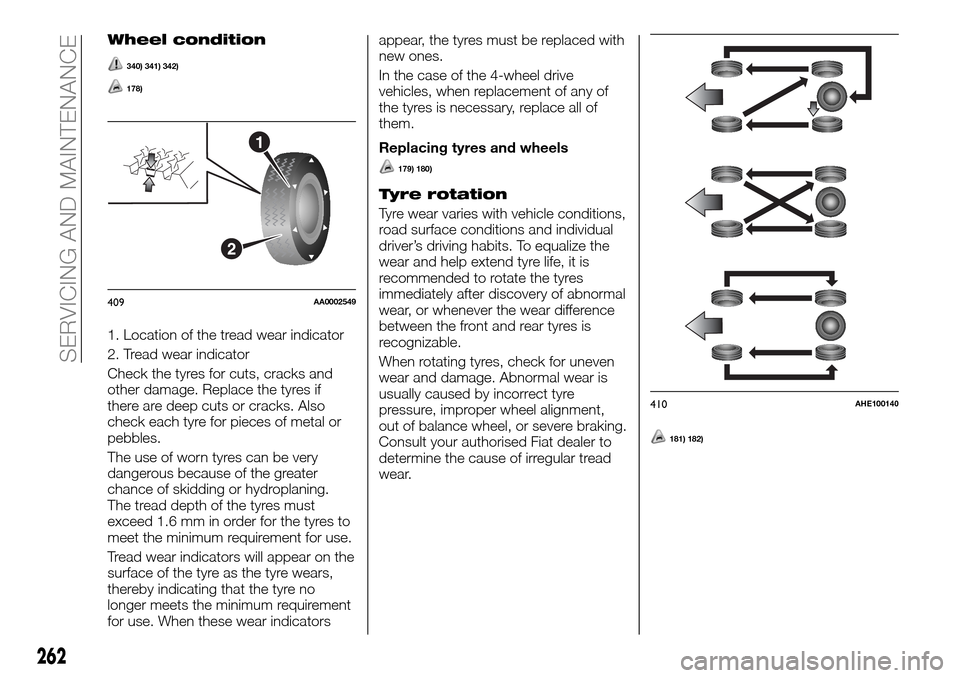
1. Location of the tread wear indicator
2. Tread wear indicator
Check the tyres for cuts, cracks and
other damage. Replace the tyres if
there are deep cuts or cracks. Also
check each tyre for pieces of metal or
pebbles.
The use of worn tyres can be very
dangerous because of the greater
chance of skidding or hydroplaning.
The tread depth of the tyres must
exceed 1.6 mm in order for the tyres to
meet the minimum requirement for use.
Tread wear indicators will appear on the
surface of the tyre as the tyre wears,
thereby indicating that the tyre no
longer meets the minimum requirement
for use. When these wear indicatorsappear, the tyres must be replaced with
new ones.
In the case of the 4-wheel drive
vehicles, when replacement of any of
the tyres is necessary, replace all of
them.
Replacing tyres and wheels
179) 180)
Tyre rotation
Tyre wear varies with vehicle conditions,
road surface conditions and individual
driver’s driving habits. To equalize the
wear and help extend tyre life, it is
recommended to rotate the tyres
immediately after discovery of abnormal
wear, or whenever the wear difference
between the front and rear tyres is
recognizable.
When rotating tyres, check for uneven
wear and damage. Abnormal wear is
usually caused by incorrect tyre
pressure, improper wheel alignment,
out of balance wheel, or severe braking.
Consult your authorised Fiat dealer to
determine the cause of irregular tread
wear.
181) 182)
1
2
409AA0002549
410AHE100140
262
SERVICING AND MAINTENANCE
Page 265 of 312
Snow tyres
183)
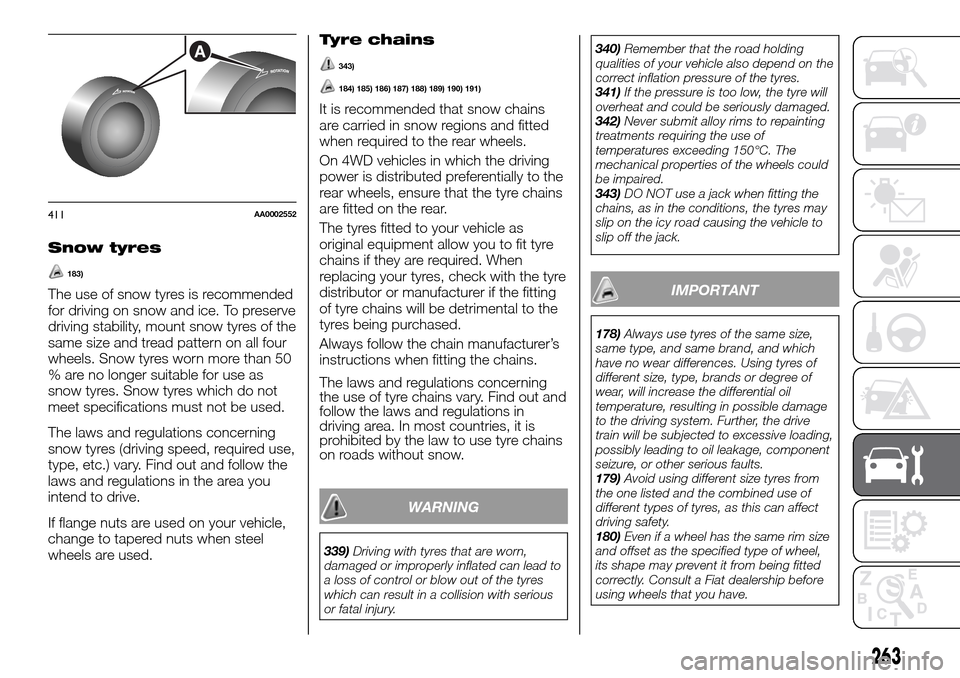
The use of snow tyres is recommended
for driving on snow and ice. To preserve
driving stability, mount snow tyres of the
same size and tread pattern on all four
wheels. Snow tyres worn more than 50
% are no longer suitable for use as
snow tyres. Snow tyres which do not
meet specifications must not be used.
The laws and regulations concerning
snow tyres (driving speed, required use,
type, etc.) vary. Find out and follow the
laws and regulations in the area you
intend to drive.
If flange nuts are used on your vehicle,
change to tapered nuts when steel
wheels are used.
Tyre chains
343)
184) 185) 186) 187) 188) 189) 190) 191)
It is recommended that snow chains
are carried in snow regions and fitted
when required to the rear wheels.
On 4WD vehicles in which the driving
power is distributed preferentially to the
rear wheels, ensure that the tyre chains
are fitted on the rear.
The tyres fitted to your vehicle as
original equipment allow you to fit tyre
chains if they are required. When
replacing your tyres, check with the tyre
distributor or manufacturer if the fitting
of tyre chains will be detrimental to the
tyres being purchased.
Always follow the chain manufacturer’s
instructions when fitting the chains.
The laws and regulations concerning
the use of tyre chains vary. Find out and
follow the laws and regulations in
driving area. In most countries, it is
prohibited by the law to use tyre chains
on roads without snow.
WARNING
339)Driving with tyres that are worn,
damaged or improperly inflated can lead to
a loss of control or blow out of the tyres
which can result in a collision with serious
or fatal injury.340)Remember that the road holding
qualities of your vehicle also depend on the
correct inflation pressure of the tyres.
341)If the pressure is too low, the tyre will
overheat and could be seriously damaged.
342)Never submit alloy rims to repainting
treatments requiring the use of
temperatures exceeding 150°C. The
mechanical properties of the wheels could
be impaired.
343)DO NOT use a jack when fitting the
chains, as in the conditions, the tyres may
slip on the icy road causing the vehicle to
slip off the jack.
IMPORTANT
178)Always use tyres of the same size,
same type, and same brand, and which
have no wear differences. Using tyres of
different size, type, brands or degree of
wear, will increase the differential oil
temperature, resulting in possible damage
to the driving system. Further, the drive
train will be subjected to excessive loading,
possibly leading to oil leakage, component
seizure, or other serious faults.
179)Avoid using different size tyres from
the one listed and the combined use of
different types of tyres, as this can affect
driving safety.
180)Even if a wheel has the same rim size
and offset as the specified type of wheel,
its shape may prevent it from being fitted
correctly. Consult a Fiat dealership before
using wheels that you have.
A
411AA0002552
263