check oil FIAT FULLBACK 2016 1.G Owner's Guide
[x] Cancel search | Manufacturer: FIAT, Model Year: 2016, Model line: FULLBACK, Model: FIAT FULLBACK 2016 1.GPages: 312, PDF Size: 13.67 MB
Page 250 of 312
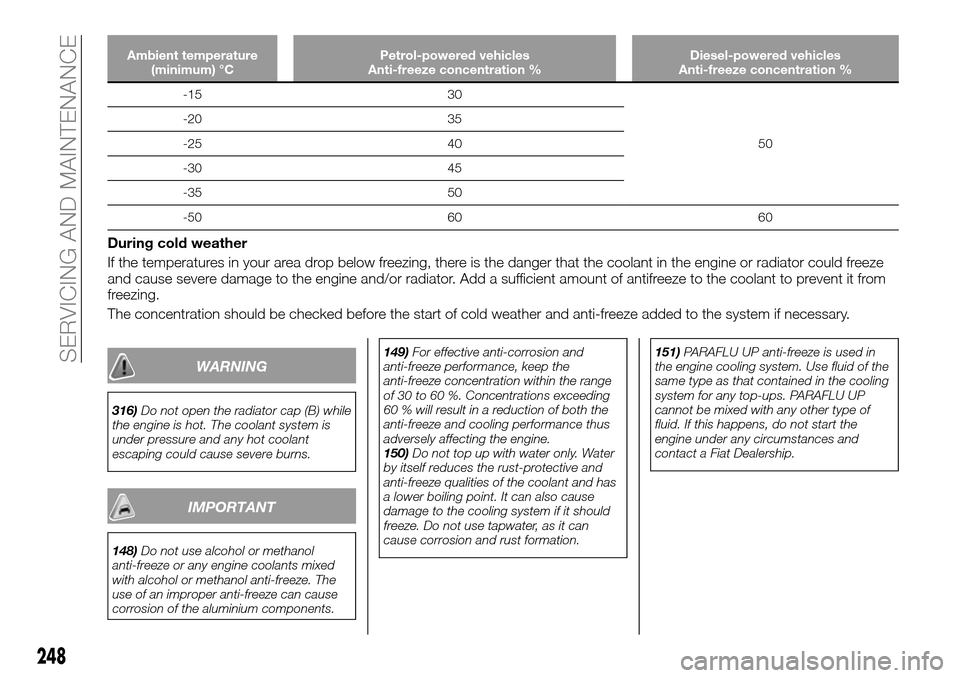
Ambient temperature
(minimum) °CPetrol-powered vehicles
Anti-freeze concentration %Diesel-powered vehicles
Anti-freeze concentration %
-15 30
50 -20 35
-25 40
-30 45
-35 50
-50 60 60
During cold weather
If the temperatures in your area drop below freezing, there is the danger that the coolant in the engine or radiator could freeze
and cause severe damage to the engine and/or radiator. Add a sufficient amount of antifreeze to the coolant to prevent it from
freezing.
The concentration should be checked before the start of cold weather and anti-freeze added to the system if necessary.
WARNING
316)Do not open the radiator cap (B) while
the engine is hot. The coolant system is
under pressure and any hot coolant
escaping could cause severe burns.
IMPORTANT
148)Do not use alcohol or methanol
anti-freeze or any engine coolants mixed
with alcohol or methanol anti-freeze. The
use of an improper anti-freeze can cause
corrosion of the aluminium components.149)For effective anti-corrosion and
anti-freeze performance, keep the
anti-freeze concentration within the range
of 30 to 60 %. Concentrations exceeding
60 % will result in a reduction of both the
anti-freeze and cooling performance thus
adversely affecting the engine.
150)Do not top up with water only. Water
by itself reduces the rust-protective and
anti-freeze qualities of the coolant and has
a lower boiling point. It can also cause
damage to the cooling system if it should
freeze. Do not use tapwater, as it can
cause corrosion and rust formation.151)PARAFLU UP anti-freeze is used in
the engine cooling system. Use fluid of the
same type as that contained in the cooling
system for any top-ups. PARAFLU UP
cannot be mixed with any other type of
fluid. If this happens, do not start the
engine under any circumstances and
contact a Fiat Dealership.
248
SERVICING AND MAINTENANCE
Page 257 of 312
GENERAL
MAINTENANCE
Fuel, engine coolant, oil and
exhaust gas leakage
Look under the body of your vehicle to
check for fuel, engine coolant, oil and
exhaust gas leaks.
Exterior and interior lamp operation
Operate the combination lamp switch
to check that all lamps are functioning
properly. If the lamps do not illuminate,
the probable cause is a blown fuse or
defective lamp bulb. Check the fuses
first. If there is no blown fuses, check
the lamp bulbs. For information
regarding the inspection and
replacement of the fuses and the bulbs,
refer to “Fuses” and “Replacement of
lamp bulbs”. If the fuses and bulbs are
all OK, we recommend you to have
your vehicle checked and repaired.
Meter, gauge and indicator/
warning lamps operation
Start the engine to check the operation
of all instruments, gauges, and indicator
and warning lamps. If there is anything
wrong, we recommend you to have
your vehicle inspected.
Hinges and latches lubrication
Check all latches and hinges, and, if
necessary, have them lubricated.
VEHICLE CARE
PRECAUTIONS
337)
161)
5)
In order to maintain the value of your
vehicle, it is necessary to perform
regular maintenance using the proper
procedures.
Always maintain your vehicle in
compliance with any environmental
pollution control regulations.
Carefully select the materials used for
washing, etc., to be sure that they do
not contain corrosives. If in doubt, we
recommend you to consult a specialist
for the selection of these materials.
WARNING
337)Cleaning products can be dangerous.
Always follow the instructions of the
cleaning product supplier.
IMPORTANT
161)To avoid damage, never use the
following to clean your vehicle: Petrol; Paint
Thinner; Benzine; Kerosene; Turpentine;
Naphtha; Lacquer Thinner; Carbon
Tetrachloride; Nail Polish Remover;
Acetone.
IMPORTANT
5)Detergents pollute the environment. Only
wash your vehicle in areas equipped to
collect and treat wastewater from this type
of activity.
255
Page 265 of 312
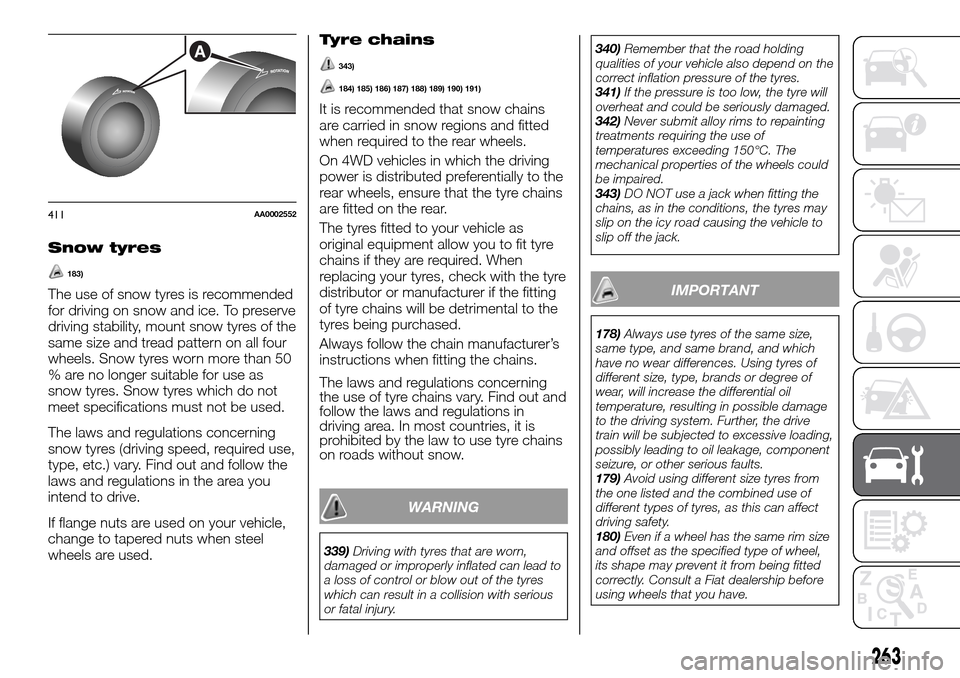
Snow tyres
183)
The use of snow tyres is recommended
for driving on snow and ice. To preserve
driving stability, mount snow tyres of the
same size and tread pattern on all four
wheels. Snow tyres worn more than 50
% are no longer suitable for use as
snow tyres. Snow tyres which do not
meet specifications must not be used.
The laws and regulations concerning
snow tyres (driving speed, required use,
type, etc.) vary. Find out and follow the
laws and regulations in the area you
intend to drive.
If flange nuts are used on your vehicle,
change to tapered nuts when steel
wheels are used.
Tyre chains
343)
184) 185) 186) 187) 188) 189) 190) 191)
It is recommended that snow chains
are carried in snow regions and fitted
when required to the rear wheels.
On 4WD vehicles in which the driving
power is distributed preferentially to the
rear wheels, ensure that the tyre chains
are fitted on the rear.
The tyres fitted to your vehicle as
original equipment allow you to fit tyre
chains if they are required. When
replacing your tyres, check with the tyre
distributor or manufacturer if the fitting
of tyre chains will be detrimental to the
tyres being purchased.
Always follow the chain manufacturer’s
instructions when fitting the chains.
The laws and regulations concerning
the use of tyre chains vary. Find out and
follow the laws and regulations in
driving area. In most countries, it is
prohibited by the law to use tyre chains
on roads without snow.
WARNING
339)Driving with tyres that are worn,
damaged or improperly inflated can lead to
a loss of control or blow out of the tyres
which can result in a collision with serious
or fatal injury.340)Remember that the road holding
qualities of your vehicle also depend on the
correct inflation pressure of the tyres.
341)If the pressure is too low, the tyre will
overheat and could be seriously damaged.
342)Never submit alloy rims to repainting
treatments requiring the use of
temperatures exceeding 150°C. The
mechanical properties of the wheels could
be impaired.
343)DO NOT use a jack when fitting the
chains, as in the conditions, the tyres may
slip on the icy road causing the vehicle to
slip off the jack.
IMPORTANT
178)Always use tyres of the same size,
same type, and same brand, and which
have no wear differences. Using tyres of
different size, type, brands or degree of
wear, will increase the differential oil
temperature, resulting in possible damage
to the driving system. Further, the drive
train will be subjected to excessive loading,
possibly leading to oil leakage, component
seizure, or other serious faults.
179)Avoid using different size tyres from
the one listed and the combined use of
different types of tyres, as this can affect
driving safety.
180)Even if a wheel has the same rim size
and offset as the specified type of wheel,
its shape may prevent it from being fitted
correctly. Consult a Fiat dealership before
using wheels that you have.
A
411AA0002552
263
Page 309 of 312
INDEX
4Wheel drive operation........170
Accessory socket............76
Active safety systems..........126
Air conditioning system.........52
Air purifier..................67
Ashtray....................75
Assist grip..................80
Automatic climate control air
conditioner................59
Automatic transmission.........149
Auxiliary driving system.........130
Battery..................252
Bleeding the fuel system........188
Bonnet....................72
Bottle holder................80
Brake fluid.................249
Cargo area.................74
Cargo loads.................74
Catalytic converter.........71,245
Central door locks.............28
Checking levels..............241
Child restraint...............107
Child restraint system..........110
Child-protection rear doors (Double
cab)....................29
Cigarette lighter..............76
.257.256
Clutch fluid................250
Coat hook..................80
Combination headlamps and
dipper switch..............40
Convenient hook.............80
Cooler Manual air conditioning.....55
Cruise control...............176
Cup holder.................79
Demanding vehicle use........240
Diesel particulate filter..........71
Digital clock.................77
Doors.....................26
Driving, alcohol and drugs.......134
Easy select 4WD............154
Economical driving...........133
Electric window control.........68
Electrical system.............289
Electronic immobilizer..........13
Emergency starting...........185
Engine compartment...........72
Engine coolant..............247
Engine oil.................245
Engine overheating...........187
Engine switch...............24
External Lights...............40
Fluids and Lubricants.........300Fog lamp switch..............44
Force limiter................106
Front seats.................31
Fuel selection................81
Fuses....................205
Fusible links................205
General maintenance.........255
Graphical index...............9
Handling of 4 wheel drive vehicles.173
Hazard warning flasher switch.....44
Head restraints...............34
Headlamp levelling switch........42
Heater Manual air conditioning.....55
How to change a tyre..........194
If the vehicle breaks down.......185
Ignition switch...............23
Important operation tips for the air
conditioning...............66
Inside rearview mirror...........37
Installing a child restraint system to
lower anchorage...........116
Instruments.................86
Interior features..............74
Interior lamps................47
ISOFIX positions.............110
Key number tag..............13
Keyless Entry System...........14
Keys.....................13
Cleaning the exterior of your vehicleCleaning the interior of your vehicle