CARGO FIAT FULLBACK 2016 1.G Owners Manual
[x] Cancel search | Manufacturer: FIAT, Model Year: 2016, Model line: FULLBACK, Model: FIAT FULLBACK 2016 1.GPages: 312, PDF Size: 13.67 MB
Page 12 of 312
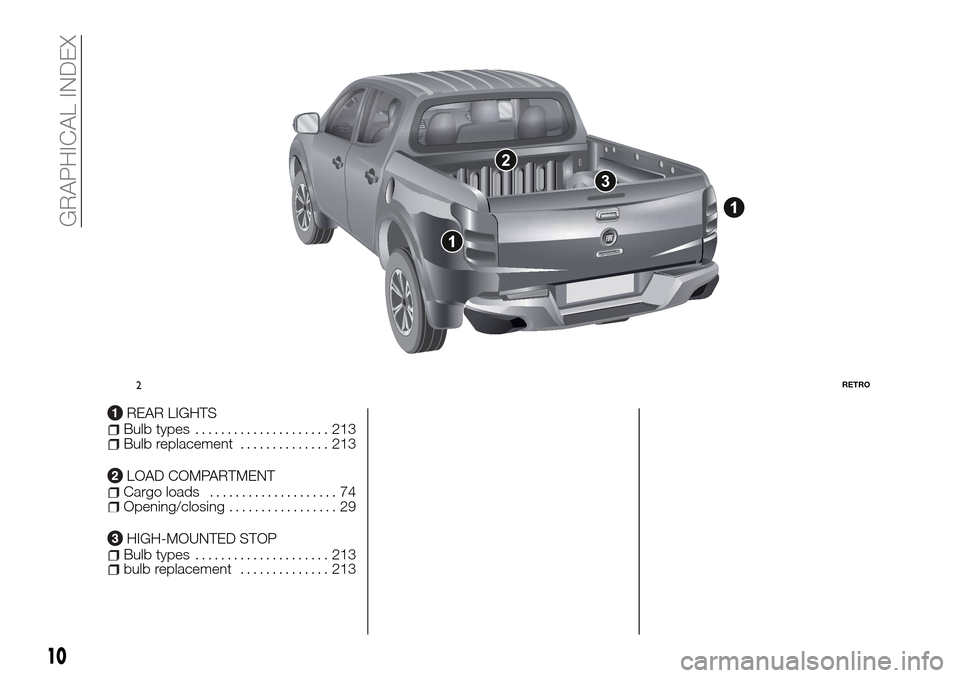
REAR LIGHTSBulb types..................... 213Bulb replacement.............. 213
LOAD COMPARTMENTCargo loads.................... 74Opening/closing................. 29
HIGH-MOUNTED STOPBulb types..................... 213bulb replacement.............. 213
2
3
1
1
2RETRO
10
GRAPHICAL INDEX
Page 14 of 312
GETTING TO KNOW YOUR VEHICLE
In-depth knowledge of your new vehicle
starts here.
The handbook that you are reading
simply and directly explains how it is
made and how it works.
That’s why we advise you to read it
seated comfortably on board, so that
you can see immediately what is
described here for yourself.KEYS....................13
IGNITION SWITCH............23
DOORS...................26
SEATS....................31
HEAD RESTRAINTS...........34
STEERING WHEEL............35
REARVIEW MIRRORS..........37
EXTERNAL LIGHTS...........40
INTERIOR LAMPS............47
WINDSCREEN WIPER..........48
AIR CONDITIONING SYSTEM.....52
WINDOW..................68
CATALYTIC CONVERTER........71
DIESEL PARTICULATE FILTER (DPF).71
ENGINE COMPARTMENT.......72
CARGO AREA...............74
INTERIOR FEATURES..........74
FUEL SELECTION............81
FILLING THE FUEL TANK........82
12
GETTING TO KNOW YOUR VEHICLE
Page 32 of 312
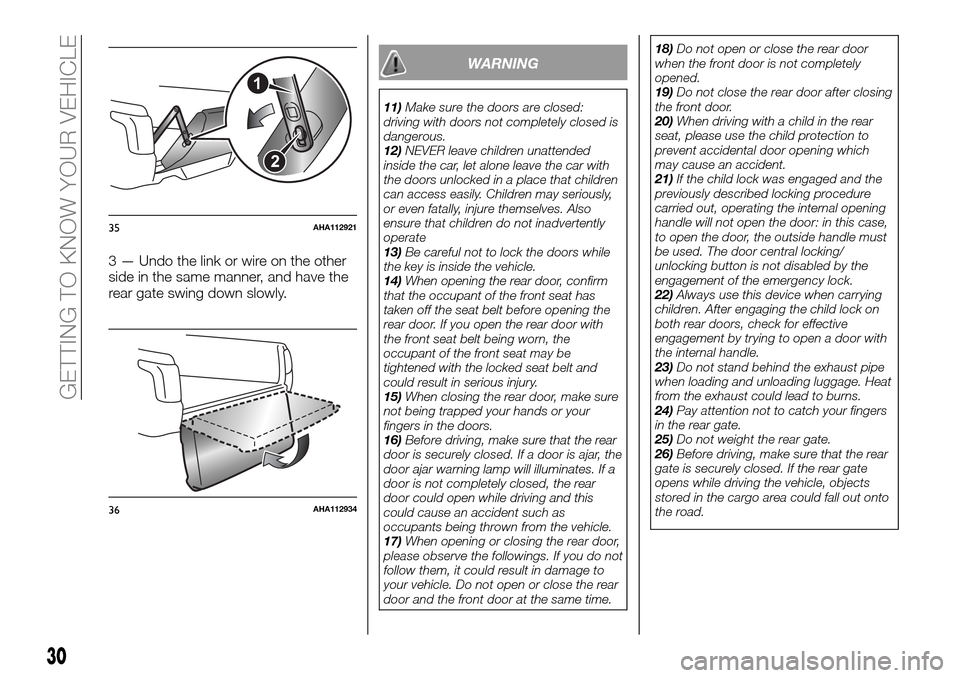
3 — Undo the link or wire on the other
side in the same manner, and have the
rear gate swing down slowly.
WARNING
11)Make sure the doors are closed:
driving with doors not completely closed is
dangerous.
12)NEVER leave children unattended
inside the car, let alone leave the car with
the doors unlocked in a place that children
can access easily. Children may seriously,
or even fatally, injure themselves. Also
ensure that children do not inadvertently
operate
13)Be careful not to lock the doors while
the key is inside the vehicle.
14)When opening the rear door, confirm
that the occupant of the front seat has
taken off the seat belt before opening the
rear door. If you open the rear door with
the front seat belt being worn, the
occupant of the front seat may be
tightened with the locked seat belt and
could result in serious injury.
15)When closing the rear door, make sure
not being trapped your hands or your
fingers in the doors.
16)Before driving, make sure that the rear
door is securely closed. If a door is ajar, the
door ajar warning lamp will illuminates. If a
door is not completely closed, the rear
door could open while driving and this
could cause an accident such as
occupants being thrown from the vehicle.
17)When opening or closing the rear door,
please observe the followings. If you do not
follow them, it could result in damage to
your vehicle. Do not open or close the rear
door and the front door at the same time.18)Do not open or close the rear door
when the front door is not completely
opened.
19)Do not close the rear door after closing
the front door.
20)When driving with a child in the rear
seat, please use the child protection to
prevent accidental door opening which
may cause an accident.
21)If the child lock was engaged and the
previously described locking procedure
carried out, operating the internal opening
handle will not open the door: in this case,
to open the door, the outside handle must
be used. The door central locking/
unlocking button is not disabled by the
engagement of the emergency lock.
22)Always use this device when carrying
children. After engaging the child lock on
both rear doors, check for effective
engagement by trying to open a door with
the internal handle.
23)Do not stand behind the exhaust pipe
when loading and unloading luggage. Heat
from the exhaust could lead to burns.
24)Pay attention not to catch your fingers
in the rear gate.
25)Do not weight the rear gate.
26)Before driving, make sure that the rear
gate is securely closed. If the rear gate
opens while driving the vehicle, objects
stored in the cargo area could fall out onto
the road.
1
2
35AHA112921
36AHA112934
30
GETTING TO KNOW YOUR VEHICLE
Page 35 of 312
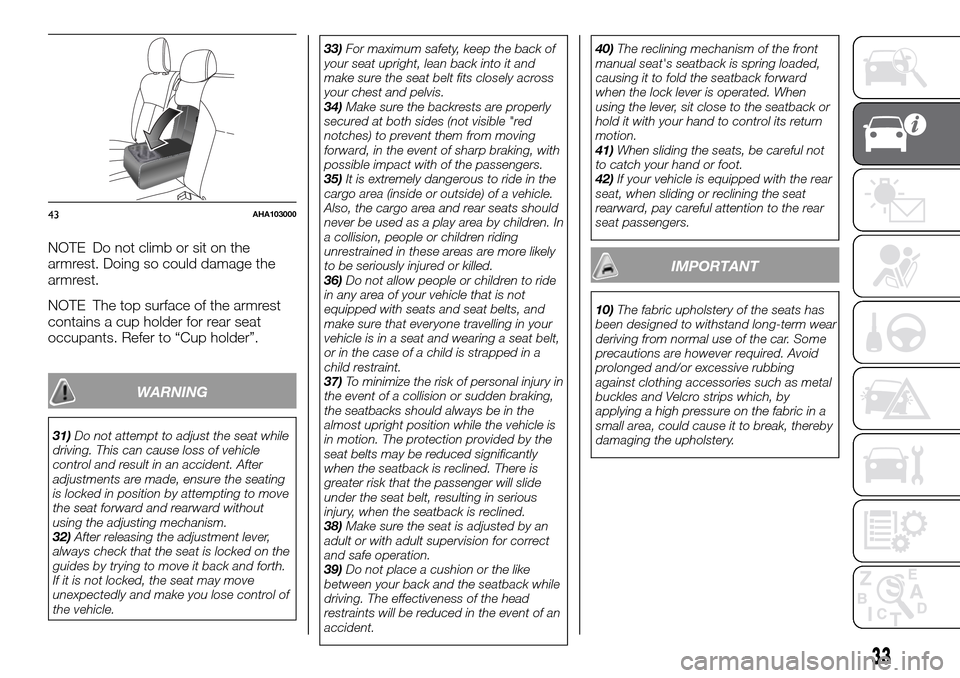
NOTE Do not climb or sit on the
armrest. Doing so could damage the
armrest.
NOTE The top surface of the armrest
contains a cup holder for rear seat
occupants. Refer to “Cup holder”.
WARNING
31)Do not attempt to adjust the seat while
driving. This can cause loss of vehicle
control and result in an accident. After
adjustments are made, ensure the seating
is locked in position by attempting to move
the seat forward and rearward without
using the adjusting mechanism.
32)After releasing the adjustment lever,
always check that the seat is locked on the
guides by trying to move it back and forth.
If it is not locked, the seat may move
unexpectedly and make you lose control of
the vehicle.33)For maximum safety, keep the back of
your seat upright, lean back into it and
make sure the seat belt fits closely across
your chest and pelvis.
34)Make sure the backrests are properly
secured at both sides (not visible "red
notches) to prevent them from moving
forward, in the event of sharp braking, with
possible impact with of the passengers.
35)It is extremely dangerous to ride in the
cargo area (inside or outside) of a vehicle.
Also, the cargo area and rear seats should
never be used as a play area by children. In
a collision, people or children riding
unrestrained in these areas are more likely
to be seriously injured or killed.
36)Do not allow people or children to ride
in any area of your vehicle that is not
equipped with seats and seat belts, and
make sure that everyone travelling in your
vehicle is in a seat and wearing a seat belt,
or in the case of a child is strapped in a
child restraint.
37)To minimize the risk of personal injury in
the event of a collision or sudden braking,
the seatbacks should always be in the
almost upright position while the vehicle is
in motion. The protection provided by the
seat belts may be reduced significantly
when the seatback is reclined. There is
greater risk that the passenger will slide
under the seat belt, resulting in serious
injury, when the seatback is reclined.
38)Make sure the seat is adjusted by an
adult or with adult supervision for correct
and safe operation.
39)Do not place a cushion or the like
between your back and the seatback while
driving. The effectiveness of the head
restraints will be reduced in the event of an
accident.40)The reclining mechanism of the front
manual seat's seatback is spring loaded,
causing it to fold the seatback forward
when the lock lever is operated. When
using the lever, sit close to the seatback or
hold it with your hand to control its return
motion.
41)When sliding the seats, be careful not
to catch your hand or foot.
42)If your vehicle is equipped with the rear
seat, when sliding or reclining the seat
rearward, pay careful attention to the rear
seat passengers.
IMPORTANT
10)The fabric upholstery of the seats has
been designed to withstand long-term wear
deriving from normal use of the car. Some
precautions are however required. Avoid
prolonged and/or excessive rubbing
against clothing accessories such as metal
buckles and Velcro strips which, by
applying a high pressure on the fabric in a
small area, could cause it to break, thereby
damaging the upholstery.
43AHA103000
33
Page 76 of 312
CARGO AREA
CARGO LOADS
77) 78)
Cargo loads precautions
When loading luggage, be careful to the
following.
Stow cargo and luggage in the cargo
area whenever possible.
Distribute cargo or luggage evenly
not to be unbalanced in weight of a
load.
Do not place cargo or luggage on
the instrument panel. Also, do not stack
up cargo or luggage on the front
passenger’s seat or the rear seat.
Having the driver’s vision blocked, and
your cargo being thrown inside the
cabin if you suddenly have to brake can
cause a serious accident or injury.
WARNING
77)If a vehicle is parked on a very steep
gradient or with a side gradient, opening
the rear door or side door could cause any
unsecured items to emerge suddenly.
78)If you wish to carry a reserve of petrol
in a can, observe the legal restrictions and
only use a can that is type-approved and
properly secured to the load anchorage
eyebolts. Anyway, by doing so, you
increase the risk of fire in the event of an
accident with your vehicle.
INTERIOR FEATURES
SUN VISORS
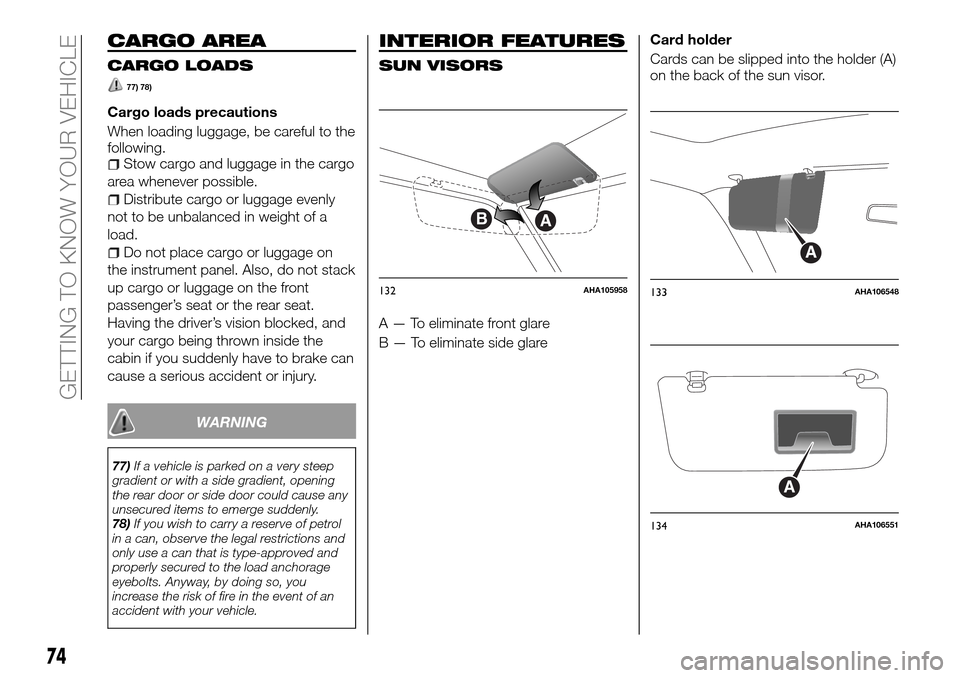
A — To eliminate front glare
B — To eliminate side glareCard holder
Cards can be slipped into the holder (A)
on the back of the sun visor.
AB
132AHA105958
A
133AHA106548
A
134AHA106551
74
GETTING TO KNOW YOUR VEHICLE
Page 135 of 312
ECONOMICAL
DRIVING
For economical driving, there are some
technical requirements that have to be
met. The prerequisite for low fuel
consumption is a properly adjusted
engine. In order to achieve longer life of
the vehicle and the most economical
operation, we recommend you to have
the vehicle checked at regular intervals
in accordance with the service
standards.
Fuel economy and generation of
exhaust gas and noise are highly
influenced by personal driving habits as
well as the particular operating
conditions. The following points should
be observed in order to minimize wear
of brakes, tyres and engine as well as
to reduce environmental pollution.
Starting the engine
Avoid sudden acceleration and sudden
starts, as they will increase fuel
consumption.
Shifting
Shift only at an appropriate speed and
engine speed. Always use the highest
shift position possible.
The transfer shift lever or the drive
modeselector should be set to “2H”
when driving 4WD vehicles on normal
roads and express ways to obtain best
possible fuel economy.City traffic
Frequent starting and stopping
increases the average fuel
consumption. Use roads with smooth
traffic flow whenever possible. When
driving on congested roads, avoid use
of a low shift position at high engine
speeds.
Idling
The vehicle consumes fuel even during
idling. Avoid extended idling whenever
possible.
Speed
At higher the vehicle speed, more fuel is
consumed. Avoid driving at full speed.
Even a slight release of the accelerator
pedal will save a significant amount of
fuel.
Tyre inflation pressure
Check the tyre inflation pressures at
regular intervals. Low tyre inflation
pressure increases road resistance and
fuel consumption. In addition, low tyre
pressures adversely affect tyre wear
and driving stability.Cargo loads
Do not drive with unnecessary articles
in the luggage compartment. Especially
during city driving where frequent
starting and stopping is necessary, the
increased weight of the vehicle will
greatly affect fuel consumption. Also
avoid driving with unnecessary luggage
or carriers, etc., on the roof; the
increased air resistance will increase
fuel consumption.
Cold engine starting
Starting of a cold engine consumes
more fuel. Unnecessary fuel
consumption is also caused by keeping
a hot engine running. After the engine is
started, commence driving as soon as
possible.
Cooler or air conditioning
The use of the air conditioner will
increase the fuel consumption.
133
Page 175 of 312
117)Never cross a stream where the water
is deep. Do not change gears while
crossing the stream. Frequent crossing of
streams can adversely affect the life span
of the vehicle; we recommend you to take
the necessary measures to prepare,
inspect, and repair the vehicle.
118)After crossing a stream, apply the
brakes to be sure they are functioning
properly. If the brakes are wet and not
functioning properly, dry them out by
driving slowly while lightly depressing the
brake pedal. Inspect each part of the
vehicle carefully.
WARNING
218)When attempting to rock your vehicle
out of a stuck position, be sure that the
area around the vehicle is clear of people
and physical objects. The rocking motion
may cause the vehicle to suddenly launch
forward or backward, causing injury or
damage to nearby people or objects.
219)Go straight up. Do not try to traverse
across a steep slope.
220)If you begin to lose traction, ease off
the accelerator pedal and gently turn the
steering wheel alternatively left and right to
regain adequate traction again.
221)Avoid snaking down a sharp grade.
Descend the grade as straight as possible.
CAUTIONS ON
HANDLING OF
4 WHEEL DRIVE
VEHICLES
Tyres and wheels
Since the driving torque can be applied
to the 4 wheels, the performance of the
vehicle when operating in 4-wheel drive
is greatly affected by the condition of
the tyres.
Pay close attention to the tyres.
Install specified tyres on all wheels.
Refer to “Tyres and wheels”.
Be sure to the appropriate tyre
inflation pressure according to no cargo
or cargo. Refer to “Tyre inflation
pressures”.
Be sure to fit all 4 tyres and wheels of
the same size and type. When
replacement of any of the tyres or
wheels is necessary, replace all of them.
All tyres should be rotated whenever
the wear difference between the front
and rear tyres is recognizable.
Good vehicle performance cannot be
expected if there is a difference in wear
between tyres. Refer to “Tyre rotation”.
Check the tyre inflation pressure
regularly.
119)
Towing
If towing is necessary, we recommend
you to have it done by a Fiat Dealership
or a commercial tow truck service. In
the following cases, transport the
vehicle using a tow truck.
The engine runs but the vehicle does
not move or abnormal noise is
produced.
Inspection of the vehicle’s underside
reveals that oil or some other fluid is
leaking.
Only when you cannot receive a towing
service from a Fiat Dealership or
commercial tow truck service, tow your
vehicle carefully in accordance with the
instructions given in “Towing”.
173
Page 196 of 312
HOW TO CHANGE A
TYRE
132) 133)
Before changing a tyre, first stop your
vehicle in a safe, flat location.
1. Park the vehicle on level and stable
ground, free of loose pebbles, etc.
2. Set the parking brake firmly.
3. On vehicles with manual
transmission, turn the ignition switch to
the “LOCK” position or put the
operation mode in OFF, and move the
gearshift lever to the “R” (Reverse)
position. On vehicles with automatic
transmission, move the selector lever to
the “P” (PARK) position, and turn the
ignition switch to the “LOCK” position
or put the operation mode in OFF.
4. Turn on the hazard flashers and set
up a warning triangle, flashing signal
lamp, etc., at an adequate distance
from the vehicle, and have all your
passengers leave the vehicle.
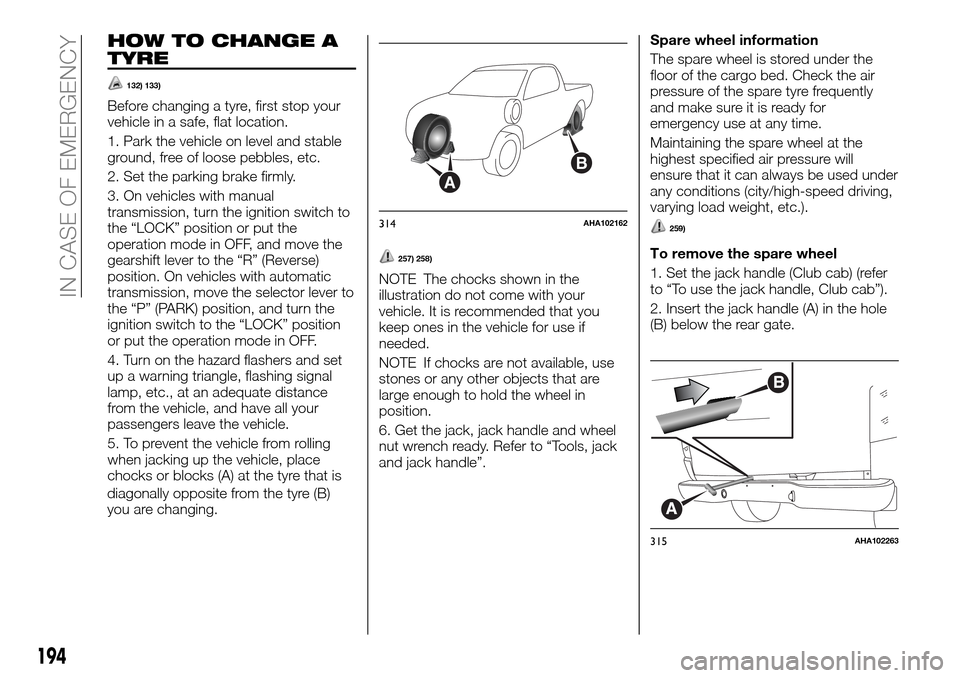
5. To prevent the vehicle from rolling
when jacking up the vehicle, place
chocks or blocks (A) at the tyre that is
diagonally opposite from the tyre (B)
you are changing.
257) 258)
NOTE The chocks shown in the
illustration do not come with your
vehicle. It is recommended that you
keep ones in the vehicle for use if
needed.
NOTE If chocks are not available, use
stones or any other objects that are
large enough to hold the wheel in
position.
6. Get the jack, jack handle and wheel
nut wrench ready. Refer to “Tools, jack
and jack handle”.Spare wheel information
The spare wheel is stored under the
floor of the cargo bed. Check the air
pressure of the spare tyre frequently
and make sure it is ready for
emergency use at any time.
Maintaining the spare wheel at the
highest specified air pressure will
ensure that it can always be used under
any conditions (city/high-speed driving,
varying load weight, etc.).
259)
To remove the spare wheel
1. Set the jack handle (Club cab) (refer
to “To use the jack handle, Club cab”).
2. Insert the jack handle (A) in the hole
(B) below the rear gate.
A
B
314AHA102162
A
B
315AHA102263
194
IN CASE OF EMERGENCY
Page 262 of 312
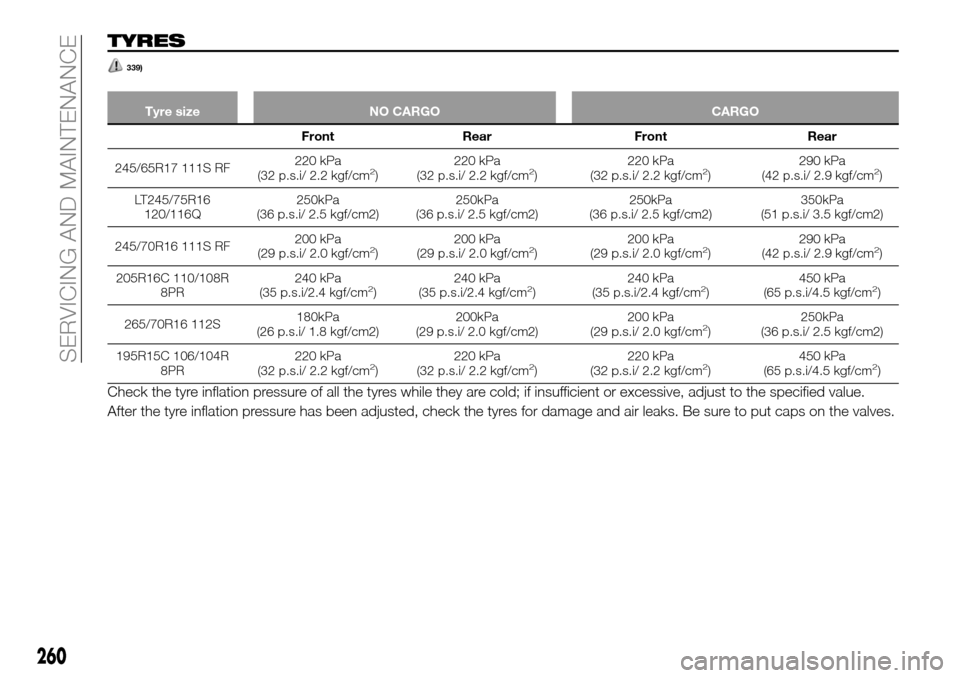
TYRES
339)
Tyre size NO CARGO CARGO
Front Rear Front Rear
245/65R17 111S RF220 kPa
(32 p.s.i/ 2.2 kgf/cm
2)220 kPa
(32 p.s.i/ 2.2 kgf/cm2)220 kPa
(32 p.s.i/ 2.2 kgf/cm2)290 kPa
(42 p.s.i/ 2.9 kgf/cm2)
LT245/75R16
120/116Q250kPa
(36 p.s.i/ 2.5 kgf/cm2)250kPa
(36 p.s.i/ 2.5 kgf/cm2)250kPa
(36 p.s.i/ 2.5 kgf/cm2)350kPa
(51 p.s.i/ 3.5 kgf/cm2)
245/70R16 111S RF200 kPa
(29 p.s.i/ 2.0 kgf/cm
2)200 kPa
(29 p.s.i/ 2.0 kgf/cm2)200 kPa
(29 p.s.i/ 2.0 kgf/cm2)290 kPa
(42 p.s.i/ 2.9 kgf/cm2)
205R16C 110/108R
8PR240 kPa
(35 p.s.i/2.4 kgf/cm
2)240 kPa
(35 p.s.i/2.4 kgf/cm2)240 kPa
(35 p.s.i/2.4 kgf/cm2)450 kPa
(65 p.s.i/4.5 kgf/cm2)
265/70R16 112S180kPa
(26 p.s.i/ 1.8 kgf/cm2)200kPa
(29 p.s.i/ 2.0 kgf/cm2)200 kPa
(29 p.s.i/ 2.0 kgf/cm
2)250kPa
(36 p.s.i/ 2.5 kgf/cm2)
195R15C 106/104R
8PR220 kPa
(32 p.s.i/ 2.2 kgf/cm
2)220 kPa
(32 p.s.i/ 2.2 kgf/cm2)220 kPa
(32 p.s.i/ 2.2 kgf/cm2)450 kPa
(65 p.s.i/4.5 kgf/cm2)
Check the tyre inflation pressure of all the tyres while they are cold; if insufficient or excessive, adjust to the specified value.
After the tyre inflation pressure has been adjusted, check the tyres for damage and air leaks. Be sure to put caps on the valves.
260
SERVICING AND MAINTENANCE
Page 274 of 312
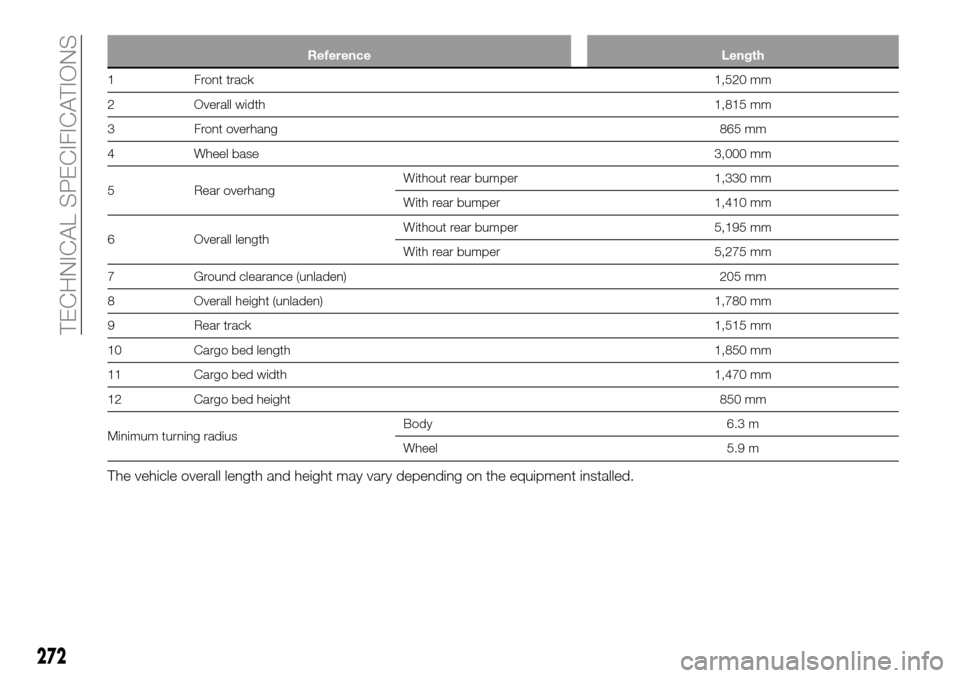
Reference Length
1 Front track1,520 mm
2 Overall width1,815 mm
3 Front overhang865 mm
4 Wheel base3,000 mm
5 Rear overhangWithout rear bumper 1,330 mm
With rear bumper 1,410 mm
6 Overall lengthWithout rear bumper 5,195 mm
With rear bumper 5,275 mm
7 Ground clearance (unladen) 205 mm
8 Overall height (unladen) 1,780 mm
9 Rear track1,515 mm
10 Cargo bed length1,850 mm
11 Cargo bed width1,470 mm
12 Cargo bed height850 mm
Minimum turning radiusBody 6.3 m
Wheel 5.9 m
The vehicle overall length and height may vary depending on the equipment installed.
272
TECHNICAL SPECIFICATIONS