brake light FIAT FULLBACK 2016 1.G Owners Manual
[x] Cancel search | Manufacturer: FIAT, Model Year: 2016, Model line: FULLBACK, Model: FIAT FULLBACK 2016 1.GPages: 312, PDF Size: 13.67 MB
Page 4 of 312
READ THIS CAREFULLY
REFUELLING
Only refuel with automotive diesel conforming to the European specification EN590. The use of other products or mixtures may damage the
engine beyond repair and consequently invalidate the warranty, due to the damage caused.
STARTING THE ENGINE
Make sure that the handbrake is engaged; set the gear lever to neutral; fully depress the clutch pedal without pressing the accelerator, then
turn the ignition key to MAR-ON and wait for the warning lightsandto switch off; turn the ignition key to AVV and release it as soon as
the engine has started.
PARKING ON FLAMMABLE MATERIAL
The catalytic converter develops high temperatures during operation. Do not park on grass, dry leaves, pine needles or other flammable
material: fire hazard.
RESPECTING THE ENVIRONMENT
The vehicle is fitted with a system that allows continuous diagnosis of the emission-related components in order to help protect the
environment.
ELECTRICAL ACCESSORIES
If, after buying the vehicle, you decide to add electrical accessories (with the risk of gradually draining the battery), visit a Fiat Dealership. They
can calculate the overall electrical requirement and check that the vehicle's electrical system can support the required load.
SCHEDULED SERVICING
Correct maintenance enables the vehicle to perfectly maintain performance and safety characteristics, its environmental friendliness and low
running costs over time.
Page 65 of 312
periodically to increase ventilation so
that the windows do not become
fogged up.
NOTE When the engine coolant
temperature rises to a certain level, the
air selection is automatically switched to
the recirculation position and the
indicator lamp (A) comes on. At this
time, the system will not switch to the
outside position even if the air selection
switch is pushed.
Customising the air selection
Functions can be changed as desired,
as stated below.
Enable automatic air control When
the AUTO switch is pressed, the air
selection switch is also controlled
automatically.
Disable automatic air control Even
when the AUTO switch is pressed, the
air selection switch is not controlled
automatically.
Setting change method Hold down
the air selection switch for about
10 seconds or more.
1. When the setting is changed from
enable to disable 3 sounds are emitted
and the indicator lamp flashes 3 times.
2. When the setting is changed from
disable to enable 2 sounds are emitted
and the indicator lamp flashes 3 times.
NOTE The factory setting is “Enable
automatic air control”.NOTE When the demister switch is
pressed, in order to prevent misting of
the windows the ventilator automatically
switches to outside air even if “Disable
automatic air control” is set.
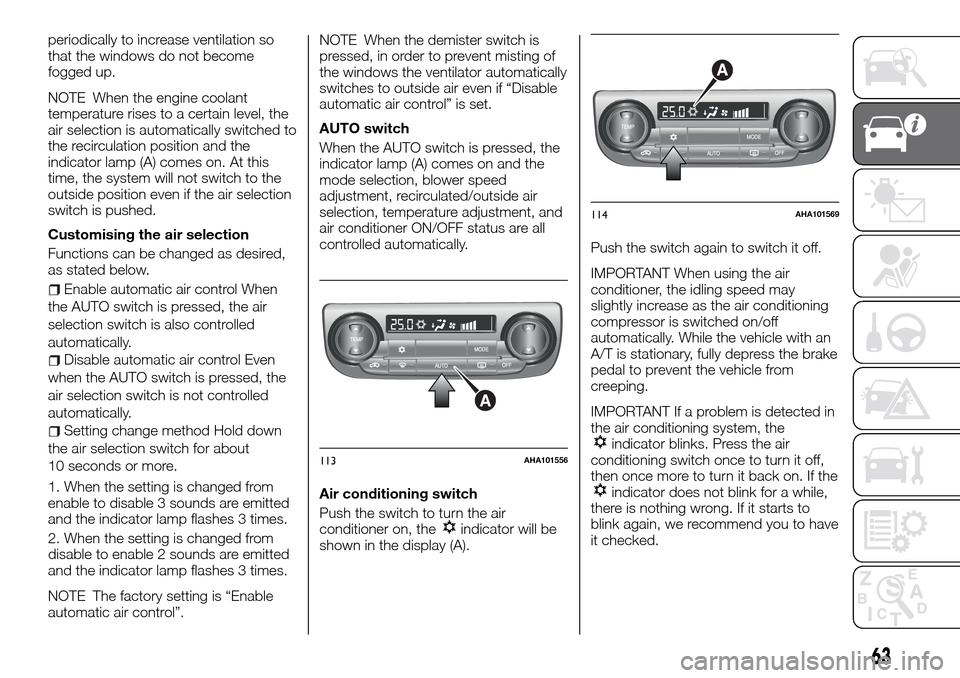
AUTO switch
When the AUTO switch is pressed, the
indicator lamp (A) comes on and the
mode selection, blower speed
adjustment, recirculated/outside air
selection, temperature adjustment, and
air conditioner ON/OFF status are all
controlled automatically.
Air conditioning switch
Push the switch to turn the air
conditioner on, the
indicator will be
shown in the display (A).Push the switch again to switch it off.
IMPORTANT When using the air
conditioner, the idling speed may
slightly increase as the air conditioning
compressor is switched on/off
automatically. While the vehicle with an
A/T is stationary, fully depress the brake
pedal to prevent the vehicle from
creeping.
IMPORTANT If a problem is detected in
the air conditioning system, the
indicator blinks. Press the air
conditioning switch once to turn it off,
then once more to turn it back on. If the
indicator does not blink for a while,
there is nothing wrong. If it starts to
blink again, we recommend you to have
it checked.
A
113AHA101556
A
114AHA101569
63
Page 67 of 312
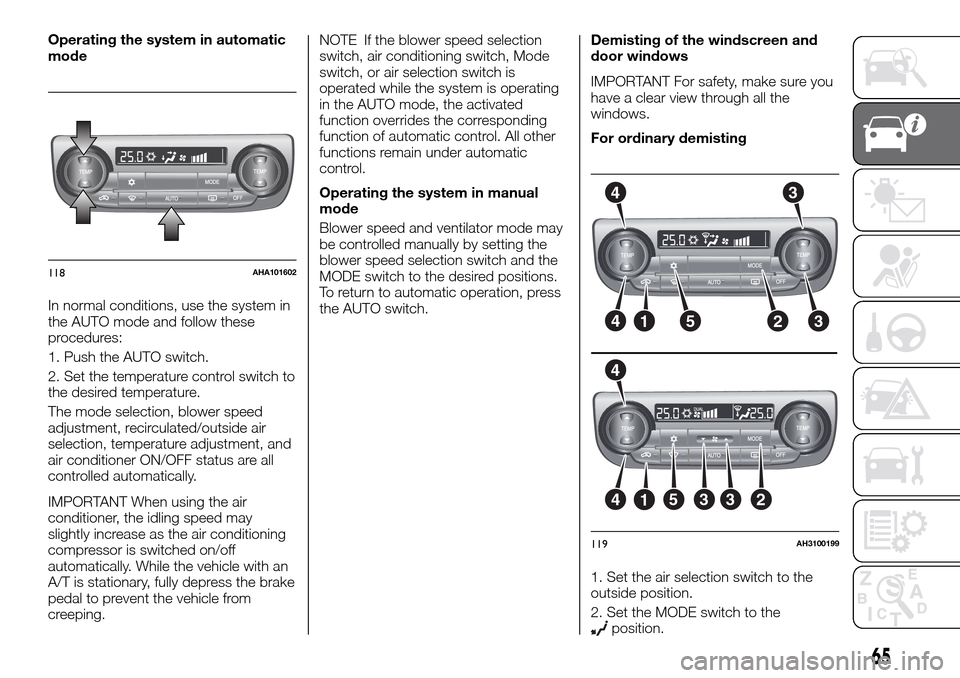
Operating the system in automatic
mode
In normal conditions, use the system in
the AUTO mode and follow these
procedures:
1. Push the AUTO switch.
2. Set the temperature control switch to
the desired temperature.
The mode selection, blower speed
adjustment, recirculated/outside air
selection, temperature adjustment, and
air conditioner ON/OFF status are all
controlled automatically.
IMPORTANT When using the air
conditioner, the idling speed may
slightly increase as the air conditioning
compressor is switched on/off
automatically. While the vehicle with an
A/T is stationary, fully depress the brake
pedal to prevent the vehicle from
creeping.NOTE If the blower speed selection
switch, air conditioning switch, Mode
switch, or air selection switch is
operated while the system is operating
in the AUTO mode, the activated
function overrides the corresponding
function of automatic control. All other
functions remain under automatic
control.
Operating the system in manual
mode
Blower speed and ventilator mode may
be controlled manually by setting the
blower speed selection switch and the
MODE switch to the desired positions.
To return to automatic operation, press
the AUTO switch.Demisting of the windscreen and
door windows
IMPORTANT For safety, make sure you
have a clear view through all the
windows.
For ordinary demisting
1. Set the air selection switch to the
outside position.
2. Set the MODE switch to the
position.
118AHA101602
4
4
3
41
452331
523
119AH3100199
65
Page 70 of 312
Setting change method Hold down
the rear window demister switch for
about 10 seconds or more. When the
setting is changed from enable to
disable 3 sounds are emitted and the
indicator lamp flashes 3 times. When
the setting is changed from disable to
enable 2 sounds are emitted and the
indicator lamp flashes 3 times.
NOTE The factory setting is “Disable
automatic rear window demister”.
WARNING
60)For safety, make sure you have a clear
view through all windows.
IMPORTANT
18)When using the air conditioning, the
idling speed may slightly increase as the air
conditioning compressor is switched on/off
automatically. While the vehicle with an
automatic transmission is stationary, fully
depress the brake pedal to prevent the
vehicle from creeping.
19)When using the mode selection dial
between the
andpositions, prevent
fogging by moving the air selection lever to
select outside air (refer to “Air selection
lever”).
20)Use of the
(recirculation) position
for extended time may cause the windows
to fog up.21)If the outside air is dusty or otherwise
contaminated, or if high cooling
performance is desired, set air selection
lever to the
(recirculation) position and
the temperature control dial all the way to
the right. Switch to the
(outside)
position periodically to increase ventilation
so that the windows do not become
fogged up.
IMPORTANT
2)The system uses a coolant that is
compatible with the laws in force in the
countries where the vehicle is sold, R134a
or R1234yf (indicated on a specific plate in
the engine compartment). The use of other
coolants affects the efficiency and condition
of the system. Also the compressor
coolants used must be compatible with the
indicated coolant.
WINDOW
MANUAL WINDOW
CONTROL
A — Open
B — Close
ELECTRIC WINDOW
CONTROL
(where provided)
61) 62) 63) 64) 65)
The electric windows can only be
operated with the ignition switch or the
operation mode in ON.
Electric window control switch
Each door window opens or closes
while the corresponding switch is
operated.
B
A
123AHA105495
68
GETTING TO KNOW YOUR VEHICLE
Page 75 of 312
NOTE Only open the bonnet when the
wipers are in the parked position.
Failure to do so may cause damage to
the bonnet, wiper arms or front
windscreen.
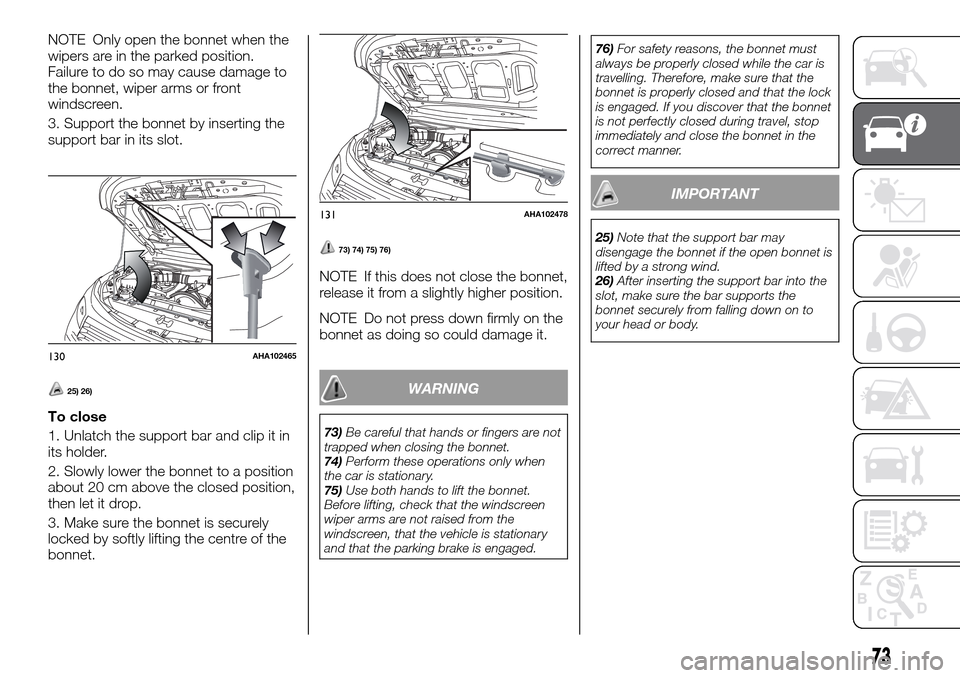
3. Support the bonnet by inserting the
support bar in its slot.
25) 26)
To close
1. Unlatch the support bar and clip it in
its holder.
2. Slowly lower the bonnet to a position
about 20 cm above the closed position,
then let it drop.
3. Make sure the bonnet is securely
locked by softly lifting the centre of the
bonnet.
73) 74) 75) 76)
NOTE If this does not close the bonnet,
release it from a slightly higher position.
NOTE Do not press down firmly on the
bonnet as doing so could damage it.
WARNING
73)Be careful that hands or fingers are not
trapped when closing the bonnet.
74)Perform these operations only when
the car is stationary.
75)Use both hands to lift the bonnet.
Before lifting, check that the windscreen
wiper arms are not raised from the
windscreen, that the vehicle is stationary
and that the parking brake is engaged.76)For safety reasons, the bonnet must
always be properly closed while the car is
travelling. Therefore, make sure that the
bonnet is properly closed and that the lock
is engaged. If you discover that the bonnet
is not perfectly closed during travel, stop
immediately and close the bonnet in the
correct manner.
IMPORTANT
25)Note that the support bar may
disengage the bonnet if the open bonnet is
lifted by a strong wind.
26)After inserting the support bar into the
slot, make sure the bar supports the
bonnet securely from falling down on to
your head or body.
130AHA102465
131AHA102478
73
Page 102 of 312
WARNING
102)In the following situations, brake
performance may be compromised or the
vehicle may become unstable if brakes are
applied suddenly; consequently, avoid
driving at high speeds or applying the
brakes suddenly. Furthermore, immediately
the vehicle should be brought to a stop in a
safe location and we recommend you to
have it checked. 1 – The brake warning
lamp does not illuminate when the parking
brake is applied or does not turn off when
the parking brake is released.2–The
brake warning lamp and the ABS warning
lamp illuminate at the same time. For
details, refer to “ABS warning lamp”. 3 –
The brake warning lamp remains
illuminated while driving.
103)The vehicle should be brought to a
halt in the following manner when brake
performance has deteriorated. 1 – Depress
the brake pedal harder than usual. Even if
the brake pedal moves down to the very
end of its possible stroke, keep it pressed
down hard. 2 – Should the brakes fail, use
engine braking to reduce your speed and
carefully pull the parking brake lever.
Depress the brake pedal to operate the
stop lamp to alert the vehicles behind you.
IMPORTANT
42)This warning lightwill flash after
starting or during prolonged cranking to
indicate a fault with the glow plug heating
system. If the engine starts, the vehicle can
be used as normal, but a Fiat Dealership
must be contacted as soon as possible.
43)If the diesel preheat indicator lamp
comes on after the engine is started, the
engine speed may not rise above the idling
speed because of fuel freezing. In this case,
keep the engine idling for about
10 minutes, then turn off the ignition switch
or put in OFF the operation mode, and
immediately turn it on or put in ON again to
confirm that the diesel preheat indicator
lamp is off.
44)When the ignition switch is turned to
the “ON” position or the operation mode is
put in ON, the warning lamp does not
come on or it remains on and does not go
off . The warning lamp comes on while
driving.
45)When this indicator lamp blinks, active
stability control function or active traction
control function is operating, which means
that the road is slippery or that your
vehicle’s wheels are beginning to slip. If this
happens, drive slower with less accelerator
input.46)If an abnormal condition occurs in the
system while driving, the
indicator lamp
will illuminate. In these cases, follow these
procedures:1–Ifthetemperature in the
braking system continues to increase due
to continuous brake control on a slippery
road surface, the
indicator lamp will
blink, and operation of the active traction
control function will be suspended to
protect the brake system (the engine
control of the traction control function and
normal brake operation will not be
affected.) Park your vehicle in a safe place.
When the temperature in the braking
system has come down, the indicator lamp
will go off and the active stability control
function and active traction control function
will start operating again.2–Ifthe
indicator lamp does not go out even
through the above procedure is followed,
there could be a problem in the system.
Stop the engine and start the engine again
and check whether the
indicator lamp
goes out. If the indicator lamp goes out,
there is no abnormal condition.3–Ifthe
indicator lamp illuminates even after
your vehicle is driven a short distance after
re-starting the engine, we recommend you
to have your vehicle checked as soon as
possible.
100
KNOWING THE INSTRUMENT PANEL
Page 128 of 312
176)Do not modify your steering wheel,
seat belt retractor or any other SRS
components. For example, replacement of
the steering wheel, or modifications to the
front bumper or body structure can
adversely affect SRS performance and lead
to possible injury.
177)If your vehicle has received any
damage, we recommend you to have the
SRS inspected to ensure it is in proper
working order.
178)On vehicles with the side airbag, do
not modify your front seats, centre pillar
and centre console. It can adversely affect
SRS performance and lead to possible
injury.
179)If you found any tear, scratch, crack
or damage to the portion where the airbag
is stored, you should have the SRS
inspected by a Fiat Dealership.ACTIVE SAFETY
SYSTEMS
Brake assist system (where
provided)
The brake assist system is a device
assisting drivers who cannot depress
the brake pedal firmly such as in
emergency stop situations and provides
greater braking force.
If the brake pedal is depressed
suddenly, the brakes will be applied
with more force than usual.
180)
NOTE Once the brake assist system is
operational, it maintains great braking
force even if the brake pedal is lightly
released. To stop its operation,
completely remove your foot from the
brake pedal.
NOTE When the brake assist system is
in use while driving, you may feel the
brake pedal attempt to resist, the pedal
moves in small motions in conjunction
with the operation noise, or the vehicle
body and the steering wheel vibrate.
This occurs when the brake assist
system is operating normally and does
not indicate faulty operation. Continue
to depress the brake pedal.
NOTE When the active stability &
traction control (ASTC) indicator lamp is
illuminated, the brake assist system
may not function.Anti-lock brake system (ABS)
(where provided)
The anti-lock brake system (ABS) helps
prevent the wheels from locking up
when braking. This helps maintain
vehicle drivability and steering wheel
handling.
Driving hints
Always keep a safe distance from the
vehicle in front of you. Even if your
vehicle is equipped with the ABS, leave
a greater braking distance when:
Driving on gravel or snow-covered
roads.
Driving with tyre chains installed.
Driving on roads where the road
surface is pitted or has other
differences in surface height.
Driving on uneven road surfaces.
Operation of ABS is not restricted
situations where brakes are applied
suddenly. This system may also prevent
the wheels from locking when you drive
over manholes, steel roadwork plates,
road markings, or any uneven road
surface.
When the ABS is in use, you may feel
the brake pedal pulsation and the
vibrations of the vehicle body and
steering wheel. It may also feel as if the
pedal resists being pressed.
In this situation, simply hold the brake
pedal down firmly. Do not pump the
brake, which will result in reduced
braking performance.
126
SAFETY
Page 135 of 312
ECONOMICAL
DRIVING
For economical driving, there are some
technical requirements that have to be
met. The prerequisite for low fuel
consumption is a properly adjusted
engine. In order to achieve longer life of
the vehicle and the most economical
operation, we recommend you to have
the vehicle checked at regular intervals
in accordance with the service
standards.
Fuel economy and generation of
exhaust gas and noise are highly
influenced by personal driving habits as
well as the particular operating
conditions. The following points should
be observed in order to minimize wear
of brakes, tyres and engine as well as
to reduce environmental pollution.
Starting the engine
Avoid sudden acceleration and sudden
starts, as they will increase fuel
consumption.
Shifting
Shift only at an appropriate speed and
engine speed. Always use the highest
shift position possible.
The transfer shift lever or the drive
modeselector should be set to “2H”
when driving 4WD vehicles on normal
roads and express ways to obtain best
possible fuel economy.City traffic
Frequent starting and stopping
increases the average fuel
consumption. Use roads with smooth
traffic flow whenever possible. When
driving on congested roads, avoid use
of a low shift position at high engine
speeds.
Idling
The vehicle consumes fuel even during
idling. Avoid extended idling whenever
possible.
Speed
At higher the vehicle speed, more fuel is
consumed. Avoid driving at full speed.
Even a slight release of the accelerator
pedal will save a significant amount of
fuel.
Tyre inflation pressure
Check the tyre inflation pressures at
regular intervals. Low tyre inflation
pressure increases road resistance and
fuel consumption. In addition, low tyre
pressures adversely affect tyre wear
and driving stability.Cargo loads
Do not drive with unnecessary articles
in the luggage compartment. Especially
during city driving where frequent
starting and stopping is necessary, the
increased weight of the vehicle will
greatly affect fuel consumption. Also
avoid driving with unnecessary luggage
or carriers, etc., on the roof; the
increased air resistance will increase
fuel consumption.
Cold engine starting
Starting of a cold engine consumes
more fuel. Unnecessary fuel
consumption is also caused by keeping
a hot engine running. After the engine is
started, commence driving as soon as
possible.
Cooler or air conditioning
The use of the air conditioner will
increase the fuel consumption.
133
Page 141 of 312
PARKING BRAKE
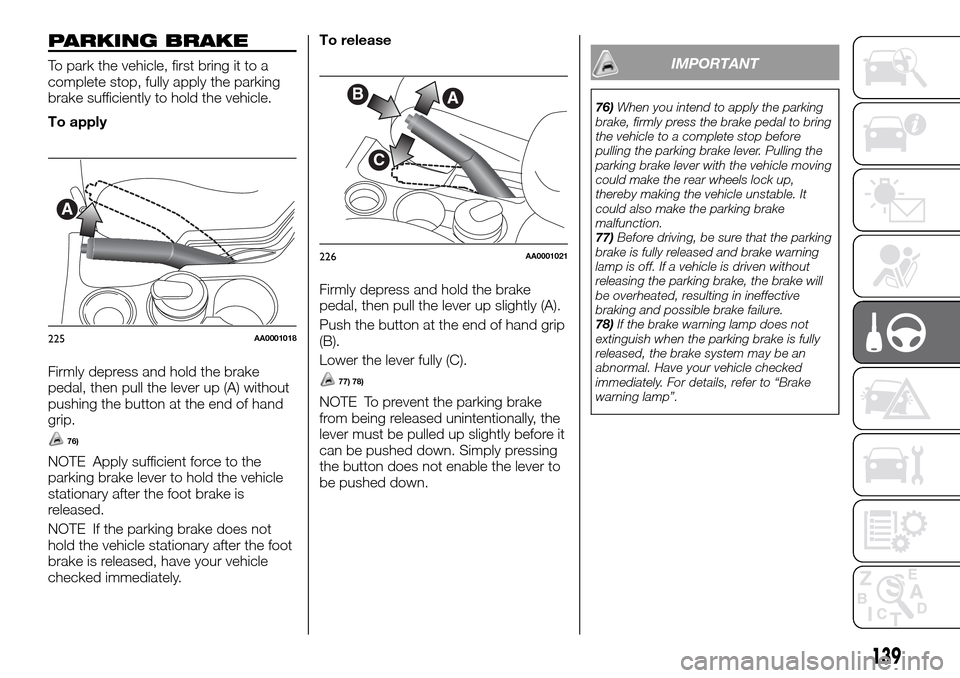
To park the vehicle, first bring it to a
complete stop, fully apply the parking
brake sufficiently to hold the vehicle.
To apply
Firmly depress and hold the brake
pedal, then pull the lever up (A) without
pushing the button at the end of hand
grip.
76)
NOTE Apply sufficient force to the
parking brake lever to hold the vehicle
stationary after the foot brake is
released.
NOTE If the parking brake does not
hold the vehicle stationary after the foot
brake is released, have your vehicle
checked immediately.To release
Firmly depress and hold the brake
pedal, then pull the lever up slightly (A).
Push the button at the end of hand grip
(B).
Lower the lever fully (C).
77) 78)
NOTE To prevent the parking brake
from being released unintentionally, the
lever must be pulled up slightly before it
can be pushed down. Simply pressing
the button does not enable the lever to
be pushed down.
IMPORTANT
76)When you intend to apply the parking
brake, firmly press the brake pedal to bring
the vehicle to a complete stop before
pulling the parking brake lever. Pulling the
parking brake lever with the vehicle moving
could make the rear wheels lock up,
thereby making the vehicle unstable. It
could also make the parking brake
malfunction.
77)Before driving, be sure that the parking
brake is fully released and brake warning
lamp is off. If a vehicle is driven without
releasing the parking brake, the brake will
be overheated, resulting in ineffective
braking and possible brake failure.
78)If the brake warning lamp does not
extinguish when the parking brake is fully
released, the brake system may be an
abnormal. Have your vehicle checked
immediately. For details, refer to “Brake
warning lamp”.
A
225AA0001018
AB
C
226AA0001021
139
Page 146 of 312
Minor noises may be heard on engine
startup. These will disappear as the
engine warms up.
Stopping the engine
Except for vehicles equipped with
the keyless operation system
1. Bring the vehicle to a complete stop.
2. Fully engage the parking brake while
depressing the brake pedal.
3. For vehicles equipped with M/T, turn
the ignition switch to the “LOCK”
position to stop the engine, and then
move the gearshift lever to the 1st (on a
uphill) or “R” (Reverse) (on a downhill)
position. For vehicles equipped with
A/T, place the selector lever in the “P”
(PARK) position, and stop the engine.
For vehicles equipped with the
keyless operation system
204)
If you have to bring the engine to an
emergency stop while driving, press
and hold the engine switch for
3 seconds or more, or press it quickly
3 times or more. The engine will stop
and the operation mode will go to ACC.
Do not stop the engine with the selector
lever in any position other than the “P”
(PARK) position (A/T). If the engine is
stopped with the selector lever in any
position other than the “P” (PARK)
position, the operation mode will go to
ACC rather than OFF. Put the operationmode in OFF after placing the selector
lever in the “P” (PARK) position.
1. Stop the vehicle
2. Fully engage the parking brake while
depressing the brake pedal.
3. On vehicles with M/T, press the
engine switch to stop the engine, move
the gearshift lever to the 1st (on a uphill)
or “R” (Reverse) (on a downhill) position.
On vehicles with A/T, move the selector
lever to the “P” (PARK) position, press
the engine switch to stop the engine.
Fuel injection amount learning
process
To keep exhaust emissions and engine
noise low, the engine very occasionally
performs a learning process for the fuel
injection amount.
The engine sounds slightly different
from usual while the learning process is
taking place. The change in the engine
sound does not indicate a fault.
If the keyless operation key is not
operating properly
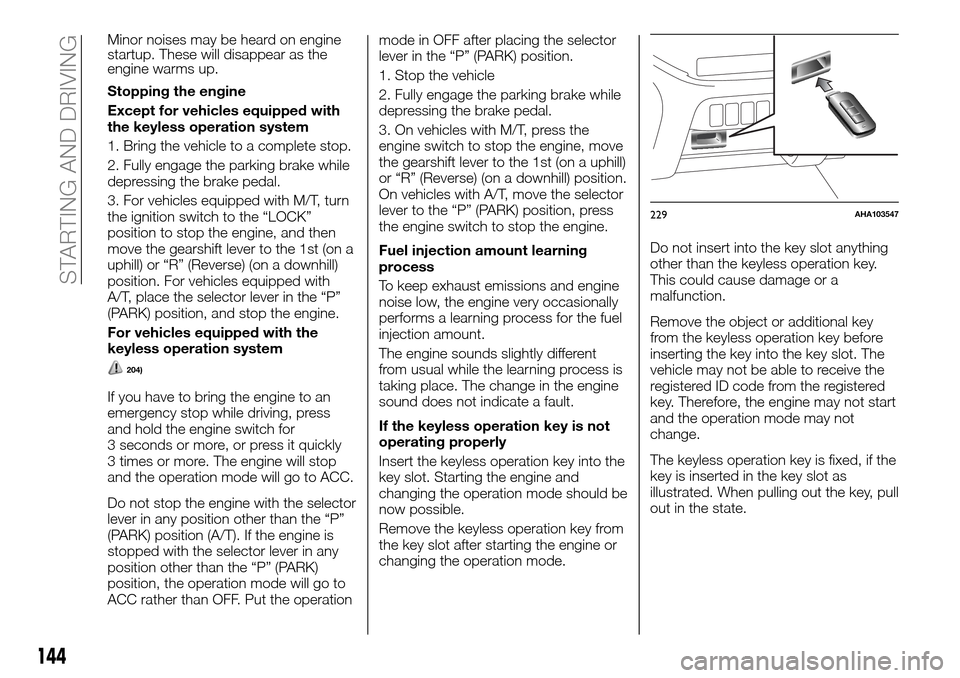
Insert the keyless operation key into the
key slot. Starting the engine and
changing the operation mode should be
now possible.
Remove the keyless operation key from
the key slot after starting the engine or
changing the operation mode.Do not insert into the key slot anything
other than the keyless operation key.
This could cause damage or a
malfunction.
Remove the object or additional key
from the keyless operation key before
inserting the key into the key slot. The
vehicle may not be able to receive the
registered ID code from the registered
key. Therefore, the engine may not start
and the operation mode may not
change.
The keyless operation key is fixed, if the
key is inserted in the key slot as
illustrated. When pulling out the key, pull
out in the state.
229AHA103547
144
STARTING AND DRIVING