brake light FIAT GRANDE PUNTO ACTUAL 2015 1.G User Guide
[x] Cancel search | Manufacturer: FIAT, Model Year: 2015, Model line: GRANDE PUNTO ACTUAL, Model: FIAT GRANDE PUNTO ACTUAL 2015 1.GPages: 216, PDF Size: 3.66 MB
Page 90 of 216
89
SAFETY
STARTING
AND DRIVING
WARNING
LIGHTS AND
MESSAGES
IN AN
EMERGENCY
SERVICE
AND CARE
TECHNICAL
SPECIFICATIONS
INDEX
CONTROLS
AND DEVICES
RADIO TRANSMITTERS
ANDMOBILEPHONES
Radio transmitter equipment (vehicle mo-
bile phones, CB radios, amateur radio etc.)
shall not be used inside the car unless
a separate aerial is mounted on the roof.
IMPORTANT The use of these devices in-
side the passenger compartment (without
a separate aerial) may cause the vehicle
electrical systems to malfunction. This
could compromise safety in addition to
constituting a potential hazard for pas-
sengers’ health.
In addition, transmission and reception of
these devices may be affected by the
shielding effect of the car body.
With regard to EC-approved mobile
phones (GSM, GPRS, UMTS), you should
adhere strictly to the instructions provid-
ed by the mobile phone’s manufacturer.
Take care when fitting addi-
tional spoilers, alloy wheels
or non-standard wheel hubs: they
could reduce the ventilation of the
brakes and affect efficiency under
sharp, repeated braking or on long
descents. Make sure that nothing ob-
structs the pedals (mats, etc.)
WARNINGINSTALLING ELECTRICAL/
ELECTRONIC DEVICES
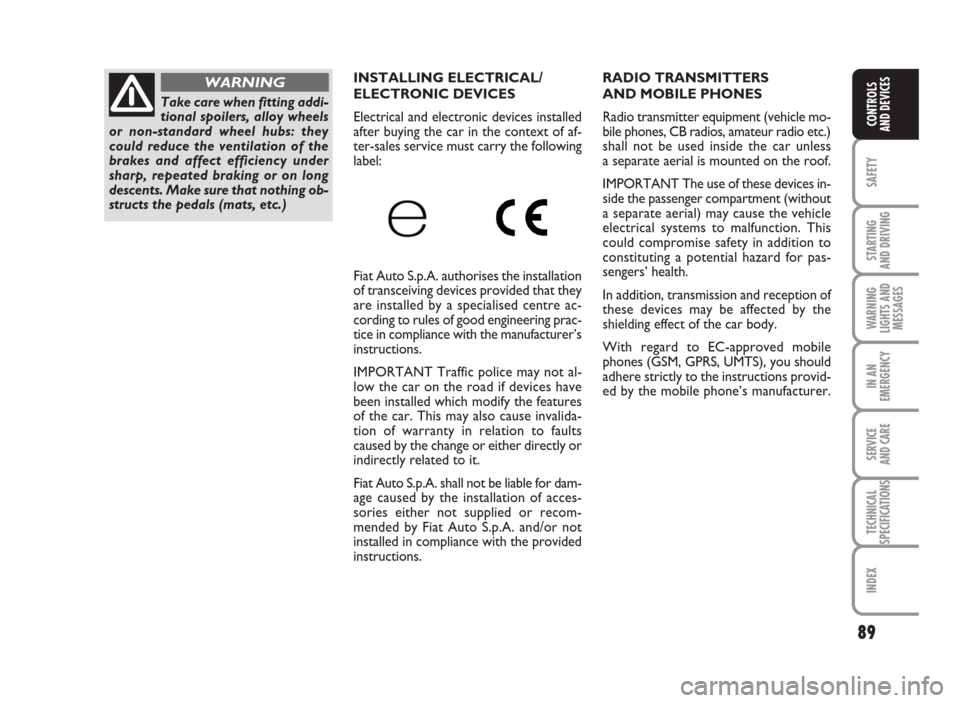
Electrical and electronic devices installed
after buying the car in the context of af-
ter-sales service must carry the following
label:
Fiat Auto S.p.A. authorises the installation
of transceiving devices provided that they
are installed by a specialised centre ac-
cording to rules of good engineering prac-
tice in compliance with the manufacturer’s
instructions.
IMPORTANT Traffic police may not al-
low the car on the road if devices have
been installed which modify the features
of the car. This may also cause invalida-
tion of warranty in relation to faults
caused by the change or either directly or
indirectly related to it.
Fiat Auto S.p.A. shall not be liable for dam-
age caused by the installation of acces-
sories either not supplied or recom-
mended by Fiat Auto S.p.A. and/or not
installed in compliance with the provided
instructions.
072-092 ACTUAL 1ed EN 26-07-2010 10:55 Pagina 89
Page 113 of 216
112
SAFETY
WARNING
LIGHTS AND
MESSAGES
IN AN
EMERGENCY
SERVICE
AND CARE
TECHNICAL
SPECIFICATIONS
INDEX
CONTROLS
AND DEVICES
STARTING
AND DRIVING
STARTING THE ENGINE
The car is fitted with an electronic engine
lock device: if the engine fails to start, see
the paragraph on “The Fiat CODE sys-
tem” in the “Dashboard and controls”
section.
The engine may be noisier during the first
few seconds of operation, particularly af-
ter a long period of inactivity. This is a fea-
ture of hydraulic tappets, the timing sys-
tem chosen to reduce the number of
servicing interventions, and effects neither
functionality nor reliability.
We recommend that during
the initial period you do not
drive to full car performance
(e.g. excessive acceleration,
long journeys at top speed, sharp brak-
ing etc.).
When the engine is switched
off, never leave the key in
the ignition switch to prevent
draining the battery.
It is dangerous to have the
engine running indoors. The
engine consumes oxygen and pro-
duces carbon dioxide, carbon monox-
ide and other toxic gases.
WARNING
Remember that the brake
booster and power steering
are not operational until the engine
has been started, therefore you need
to apply much more force than usu-
al to the brake pedal and steering
wheel.
WARNING
STARTING PROCEDURE
FOR PETROL VERSIONS
Proceed as follows:
❒ensure that the handbrake is on;
❒put the gear lever into neutral;
❒press the clutch pedal all the way down
without touching the accelerator;
❒turn the ignition key to AVVand re-
lease it the moment the engine starts.
If the engine does not start at the first at-
tempt, return the ignition key to STOP
before repeating the starting procedure.
111-122 ACTUAL 1ed EN 20-07-2010 16:10 Pagina 112
Page 114 of 216
113
SAFETY
WARNING
LIGHTS AND
MESSAGES
IN AN
EMERGENCY
SERVICE
AND CARE
TECHNICAL
SPECIFICATIONS
INDEX
CONTROLS
AND DEVICES
STARTING
AND DRIVING
If, when the ignition key is at MAR, the in-
strument panel warning light
Yremains
lit together with warning light U, turn the
key to STOPand then back to MAR; if
the warning lights remain on, try using the
other keys provided with the car.
IMPORTANT If the instrument panel
warning light
Ystays on permanently,
contact a Fiat Dealership immediately.
IMPORTANT Never leave the ignition key
at MARwhen the engine is off.STARTING PROCEDURE
FOR DIESEL VERSIONS
Proceed as follows:
❒ensure that the handbrake is on;
❒put the gear lever into neutral;
❒turn the ignition key to MAR: the
warning lights
mand Yon the in-
strument panel will turn on;
❒wait for the warning lights Yand mto turn off. The hotter the engine is, the
quicker this will happen;
❒press the clutch pedal all the way down
without touching the accelerator;
❒turn the ignition key to AVVas soon
as the warning light
mturns off. Wait-
ing too long will waste the work done
by the heater plugs. Release the key as
soon as the engine starts.If the engine does not start at the first at-
tempt, return the ignition key to STOP
before repeating the starting procedure.
If, when the ignition key is at MAR, the in-
strument panel warning light
Yremains
lit together with warning light
m, turn
the key to STOPand then back to MAR;
if the warning lights remain on, try using
the other keys provided with the car.
IMPORTANT If the instrument panel
warning light
Ystays on permanently,
contact a Fiat Dealership immediately.
IMPORTANT Never leave the ignition key
at MARwhen the engine is off.
Warning light
mwill blink
for 60 seconds after starting
or during prolonged cranking
to indicate a fault with the
glow plug system. Use the car as nor-
mal if the engine starts, but go to a Fiat
Dealership as soon as possible.
111-122 ACTUAL 1ed EN 20-07-2010 16:10 Pagina 113
Page 115 of 216
114
SAFETY
WARNING
LIGHTS AND
MESSAGES
IN AN
EMERGENCY
SERVICE
AND CARE
TECHNICAL
SPECIFICATIONS
INDEX
CONTROLS
AND DEVICES
STARTING
AND DRIVING
STOPPING THE ENGINE
Turn the ignition to STOPwhile the
engine is idling.
IMPORTANT After a long drive, you
should allow the engine to “catch its
breath” before turning it off by letting it
idle to allow the temperature in the en-
gine compartment to fall.
A quick burst on the acceler-
ator before turning off the en-
gine serves absolutely no
practical purpose; it wastes
fuel and is especially damaging to tur-
bocharged engines.WARMING UP THE ENGINE
AFTER IT HAS JUST STARTED
(petrol and diesel versions)
Proceed as follows:
❒drive off slowly at medium revs, and ac-
celerate smoothly;
❒do not demand maximum performance
for the first few kilometres. Wait until
the engine coolant gauge starts moving.
Remember that the brake
booster and power steering
are not operational until the
engine has been started, so
you need to apply much more force
than usual to the brake pedal and
steering wheel.
Never jump start the engine
by pushing, towing or driving
downhill. This could cause fu-
el to flow into the catalytic
converter and damage it beyond repair.
111-122 ACTUAL 1ed EN 20-07-2010 16:10 Pagina 114
Page 116 of 216
115
SAFETY
WARNING
LIGHTS AND
MESSAGES
IN AN
EMERGENCY
SERVICE
AND CARE
TECHNICAL
SPECIFICATIONS
INDEX
CONTROLS
AND DEVICES
STARTING
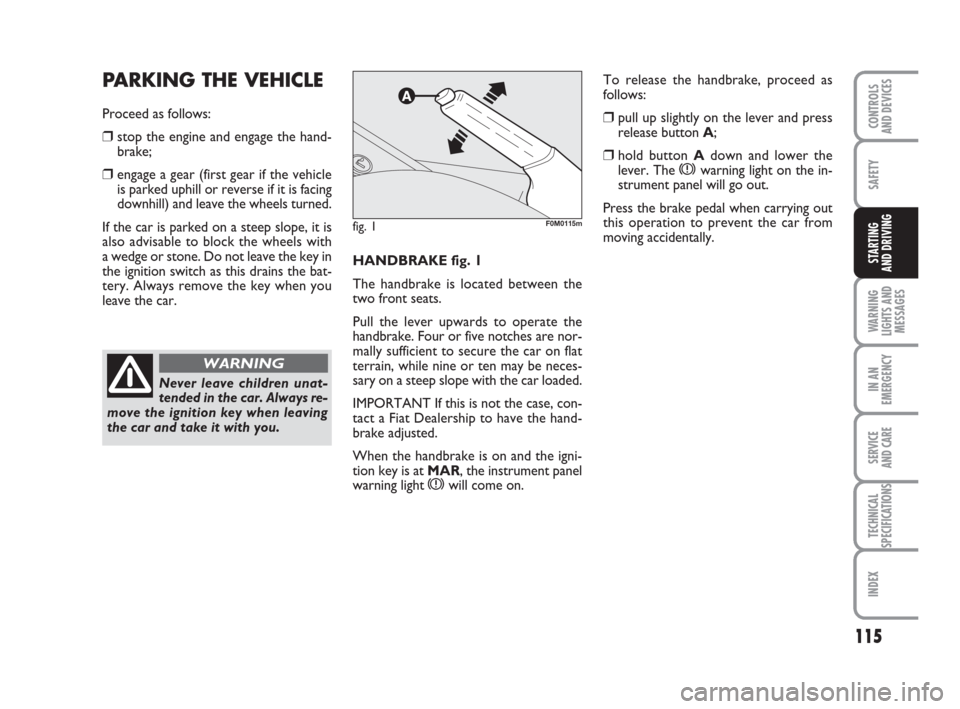
AND DRIVINGHANDBRAKE fig. 1
The handbrake is located between the
two front seats.
Pull the lever upwards to operate the
handbrake. Four or five notches are nor-
mally sufficient to secure the car on flat
terrain, while nine or ten may be neces-
sary on a steep slope with the car loaded.
IMPORTANT If this is not the case, con-
tact a Fiat Dealership to have the hand-
brake adjusted.
When the handbrake is on and the igni-
tion key is at MAR, the instrument panel
warning light
xwill come on.
PARKING THE VEHICLE
Proceed as follows:
❒stop the engine and engage the hand-
brake;
❒engage a gear (first gear if the vehicle
is parked uphill or reverse if it is facing
downhill) and leave the wheels turned.
If the car is parked on a steep slope, it is
also advisable to block the wheels with
a wedge or stone. Do not leave the key in
the ignition switch as this drains the bat-
tery. Always remove the key when you
leave the car.
Never leave children unat-
tended in the car. Always re-
move the ignition key when leaving
the car and take it with you.
WARNING
fig. 1F0M0115m
To release the handbrake, proceed as
follows:
❒pull up slightly on the lever and press
release button A;
❒hold button Adown and lower the
lever. The xwarning light on the in-
strument panel will go out.
Press the brake pedal when carrying out
this operation to prevent the car from
moving accidentally.
111-122 ACTUAL 1ed EN 20-07-2010 16:10 Pagina 115
Page 119 of 216
118
SAFETY
WARNING
LIGHTS AND
MESSAGES
IN AN
EMERGENCY
SERVICE
AND CARE
TECHNICAL
SPECIFICATIONS
INDEX
CONTROLS
AND DEVICES
STARTING
AND DRIVING
CONDITIONS OF USE
Cold starting
Short distances and frequent cold start-
ups will prevent the engine from reach-
ing optimal running temperature. Conse-
quently, both fuel consumption (from +15
to +30% on the urban cycle) and emis-
sions will increase.
Traffic and road
conditions
Heavy traffic, for instance when travelling
in a queue with frequent use of low gears
or in cities with lots of traffic lights, caus-
es fairly high fuel consumption. Mountain
roads and uneven surfaces also have a neg-
ative effect on consumption.
Traffic hold-ups
During prolonged hold-ups (e.g. at level
crossings) the engine should be switched
off.TOWING TRAILERS
IMPORTANT NOTES
The car must be equipped with an ap-
proved tow hook and adequate electrical
system to tow caravans or trailers. Instal-
lation must be performed by specialised
personnel who will issue the required pa-
pers for travelling on roads.
Install any specific and/or additional rear
view mirrors in accordance with the high-
way code of the country in which you are
travelling.
Remember that, when towing a trailer,
steep hills are harder to climb, braking dis-
tances increase and overtaking takes
longer relative to the overall weight of the
trailer.
Engage a low gear when driving downhill,
rather than constantly using the brake.
The weight of the trailer on the car’s tow
hook will reduce the load capacity of the
car by the same amount. Consider the
weight of the trailer fully laden, including
accessories and luggage, to make sure you
do not exceed the maximum towable
weight (shown on the vehicle registration
document). Top speed
Fuel consumption considerably increases
as speed increases. Keep your speed as
even as possible, avoiding unnecessary
braking and acceleration, which cause ex-
cessive fuel consumption and increased
emissions.
Acceleration
Accelerating violently severely affects con-
sumption and emissions: acceleration
should be gradual and should not exceed
the maximum torque.
111-122 ACTUAL 1ed EN 20-07-2010 16:10 Pagina 118
Page 120 of 216
119
SAFETY
WARNING
LIGHTS AND
MESSAGES
IN AN
EMERGENCY
SERVICE
AND CARE
TECHNICAL
SPECIFICATIONS
INDEX
CONTROLS
AND DEVICES
STARTING
AND DRIVING
INSTALLING THE TOW HOOK
The towing device should be fastened to
the body by specialised personnel in ac-
cordance with any additional information
supplied by the manufacturer of the device.
The towing device must meet current reg-
ulations with reference to Directive
94/20/EC and subsequent amendments.
For any version the towing device used
must be right for the towable weight of
the car on which it is to be installed.
For the electric connection a unified con-
nector should be used, which is generally
placed on a special bracket fastened to the
towing device, and a special ECU should
be installed on the car to control the trail-
er’s exterior lights.
Seven- or 13-pin 12VDC connections
should be used (CUNA/UNI and ISO/DIN
Standards). Follow any instructions pro-
vided by the car manufacturer and/or the
towing device manufacturer.An electric brake or winch should be pow-
ered directly by the battery through a ca-
ble with a cross-section of no less than
2.5 mm
2.
IMPORTANT The engine must be running
to use the electric brake or winch.
In addition to the electrical appliances, the
car’s electrical system may be connected
only to the supply cable for an electric
brake and the cable for a light inside the
trailer with a wattage of no more than
15 W.
For connections, use the preset control
unit with a battery cable no less than
2.5 mm
2. Respect each country’s specific speed lim-
its for vehicles towing trailers. The top
speed must not exceed 100 km/h at any
time.
You should fit a suitable stabiliser to the
trailer.
The ABS with which the car
may be equipped will not
control the braking system of the
trailer. Particular caution is therefore
required on slippery roads.
WARNING
Never modify the braking
system of the car to control
the trailer brake. The trailer braking
system must be fully independent
from the hydraulic system of the car.
WARNING
111-122 ACTUAL 1ed EN 20-07-2010 16:10 Pagina 119
Page 123 of 216
122
SAFETY
WARNING
LIGHTS AND
MESSAGES
IN AN
EMERGENCY
SERVICE
AND CARE
TECHNICAL
SPECIFICATIONS
INDEX
CONTROLS
AND DEVICES
STARTING
AND DRIVING
CAR INACTIVITY
If the car is to be left inactive for longer
than a month, the following precautions
should be observed:
❒park the car in covered, dry and, if pos-
sible, well-ventilated premises;
❒engage a gear;
❒check that the handbrake is engaged;
❒disconnect the clip for the negative bat-
tery terminal and check battery charge.
Repeat this check once every three
months during storage. Recharge the
battery if the indicator is dark and the
middle area is not green;
❒clean and protect the painted parts us-
ing protective wax;
❒clean and protect the shiny metal parts
using special compounds readily avail-
able;
❒sprinkle talcum powder on the rubber
windscreen and rear window wiper
blades and lift them off the glass;
❒open the windows slightly;
❒cover the car with a fabric or perfo-
rated plastic sheet. Do not use compact
plastic sheets which do not allow hu-
midity to evaporate from the surface of
the car;
❒inflate tyres to a pressure of +0.5 bar
above the normal specified pressure
and check regularly;
❒if you don’t disconnect the battery from
the electrical system, check its charge
every month and recharge it if the in-
dicator shows a dark colour without
the central green area;
❒do not drain the engine cooling system.
IMPORTANT Where relevant, switch off
the car alarm with the remote control.
Keep your speed down when
snow chains are fitted – do
not exceed 50 km/h. Avoid
potholes, steps and pave-
ments and also avoid driving
for long distances on roads
not covered with snow to avoid dam-
aging the car and the road surface.
WARNING
111-122 ACTUAL 1ed EN 20-07-2010 16:10 Pagina 122
Page 124 of 216
123
SAFETY
STARTING
AND DRIVING
IN AN
EMERGENCY
SERVICE
AND CARE
TECHNICAL
SPECIFICATIONS
INDEX
CONTROLS
AND DEVICES
WARNING
LIGHTS AND
MESSAGES
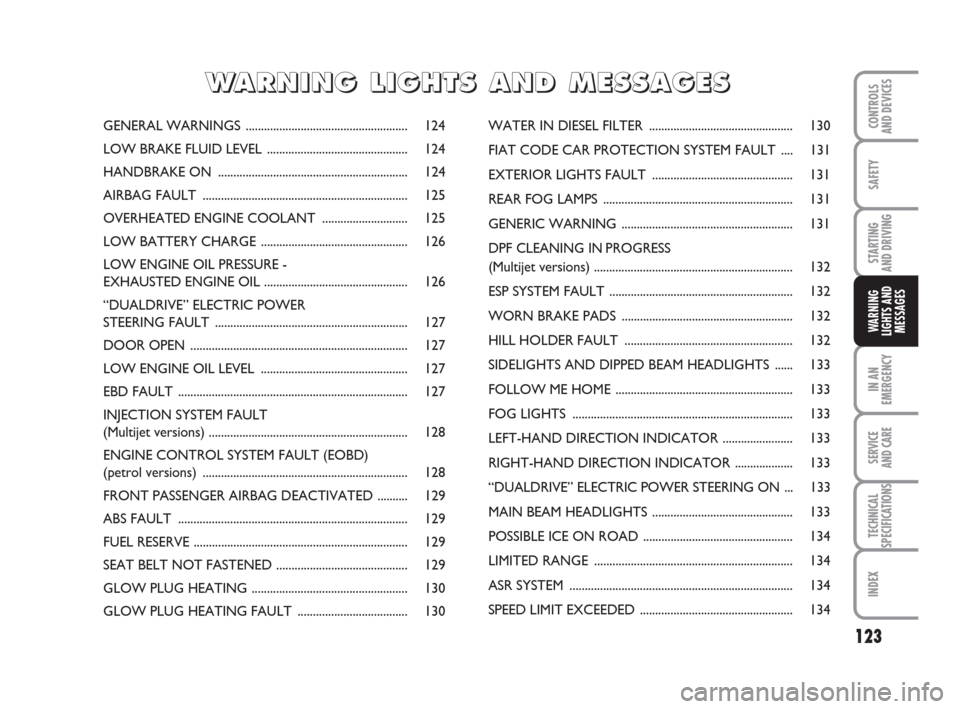
GENERAL WARNINGS ..................................................... 124
LOW BRAKE FLUID LEVEL .............................................. 124
HANDBRAKE ON .............................................................. 124
AIRBAG FAULT ................................................................... 125
OVERHEATED ENGINE COOLANT ............................ 125
LOW BATTERY CHARGE ................................................ 126
LOW ENGINE OIL PRESSURE -
EXHAUSTED ENGINE OIL ............................................... 126
“DUALDRIVE” ELECTRIC POWER
STEERING FAULT ............................................................... 127
DOOR OPEN ....................................................................... 127
LOW ENGINE OIL LEVEL ................................................ 127
EBD FAULT ........................................................................... 127
INJECTION SYSTEM FAULT
(Multijet versions) ................................................................. 128
ENGINE CONTROL SYSTEM FAULT (EOBD)
(petrol versions) ................................................................... 128
FRONT PASSENGER AIRBAG DEACTIVATED .......... 129
ABS FAULT ........................................................................... 129
FUEL RESERVE ...................................................................... 129
SEAT BELT NOT FASTENED ........................................... 129
GLOW PLUG HEATING ................................................... 130
GLOW PLUG HEATING FAULT .................................... 130WATER IN DIESEL FILTER ............................................... 130
FIAT CODE CAR PROTECTION SYSTEM FAULT .... 131
EXTERIOR LIGHTS FAULT .............................................. 131
REAR FOG LAMPS .............................................................. 131
GENERIC WARNING ........................................................ 131
DPF CLEANING IN PROGRESS
(Multijet versions) ................................................................. 132
ESP SYSTEM FAULT ............................................................ 132
WORN BRAKE PADS ........................................................ 132
HILL HOLDER FAULT ....................................................... 132
SIDELIGHTS AND DIPPED BEAM HEADLIGHTS ...... 133
FOLLOW ME HOME .......................................................... 133
FOG LIGHTS ........................................................................ 133
LEFT-HAND DIRECTION INDICATOR ....................... 133
RIGHT-HAND DIRECTION INDICATOR ................... 133
“DUALDRIVE” ELECTRIC POWER STEERING ON ... 133
MAIN BEAM HEADLIGHTS .............................................. 133
POSSIBLE ICE ON ROAD ................................................. 134
LIMITED RANGE ................................................................. 134
ASR SYSTEM ......................................................................... 134
SPEED LIMIT EXCEEDED .................................................. 134
W W
A A
R R
N N
I I
N N
G G
L L
I I
G G
H H
T T
S S
A A
N N
D D
M M
E E
S S
S S
A A
G G
E E
S S
123-134 ACTUAL 1ed EN 31-08-2010 9:23 Pagina 123
Page 125 of 216
124
SAFETY
STARTING
AND DRIVING
IN AN
EMERGENCY
SERVICE
AND CARE
TECHNICAL
SPECIFICATIONS
INDEX
CONTROLS
AND DEVICES
WARNING
LIGHTS AND
MESSAGES
WARNING LIGHTS
AND MESSAGES
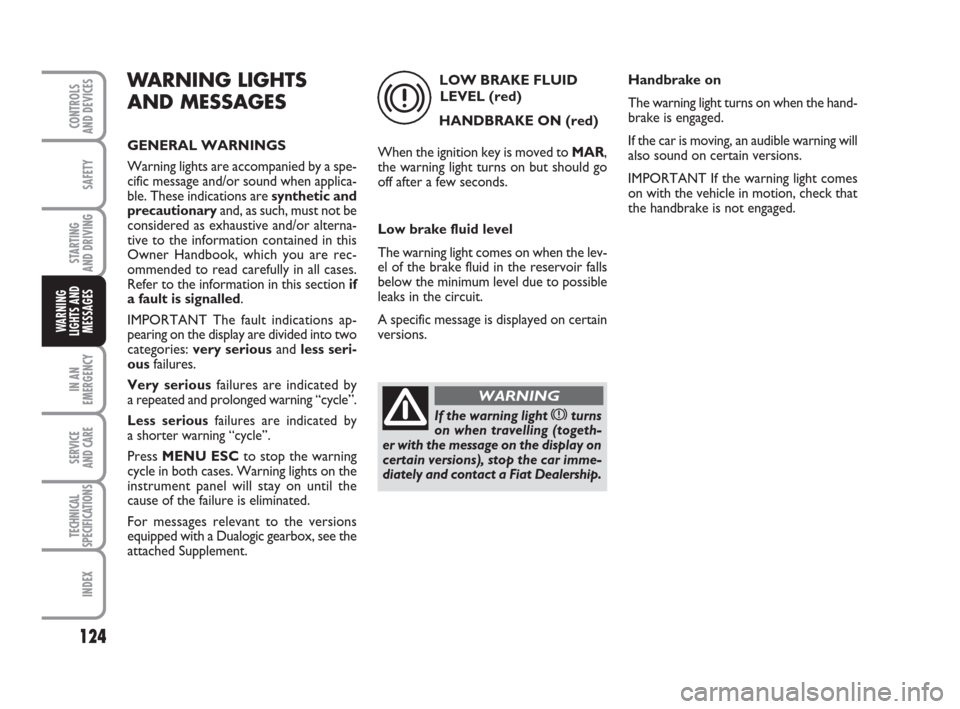
GENERAL WARNINGS
Warning lights are accompanied by a spe-
cific message and/or sound when applica-
ble. These indications are synthetic and
precautionaryand, as such, must not be
considered as exhaustive and/or alterna-
tive to the information contained in this
Owner Handbook, which you are rec-
ommended to read carefully in all cases.
Refer to the information in this sectionif
a fault is signalled.
IMPORTANT The fault indications ap-
pearing on the display are divided into two
categories: very seriousand less seri-
ousfailures.
Very seriousfailures are indicated by
a repeated and prolonged warning “cycle”.
Less seriousfailures are indicated by
a shorter warning “cycle”.
Press MENU ESCto stop the warning
cycle in both cases. Warning lights on the
instrument panel will stay on until the
cause of the failure is eliminated.
For messages relevant to the versions
equipped with a Dualogic gearbox, see the
attached Supplement.LOW BRAKE FLUID
LEVEL (red)
HANDBRAKE ON (red)
When the ignition key is moved to MAR,
the warning light turns on but should go
off after a few seconds.
Low brake fluid level
The warning light comes on when the lev-
el of the brake fluid in the reservoir falls
below the minimum level due to possible
leaks in the circuit.
A specific message is displayed on certain
versions.
x
If the warning light xturns
on when travelling (togeth-
er with the message on the display on
certain versions), stop the car imme-
diately and contact a Fiat Dealership.
WARNING
Handbrake on
The warning light turns on when the hand-
brake is engaged.
If the car is moving, an audible warning will
also sound on certain versions.
IMPORTANT If the warning light comes
on with the vehicle in motion, check that
the handbrake is not engaged.
123-134 ACTUAL 1ed EN 31-08-2010 9:23 Pagina 124