wheel FIAT GRANDE PUNTO ACTUAL 2015 1.G Owner's Manual
[x] Cancel search | Manufacturer: FIAT, Model Year: 2015, Model line: GRANDE PUNTO ACTUAL, Model: FIAT GRANDE PUNTO ACTUAL 2015 1.GPages: 216, PDF Size: 3.66 MB
Page 113 of 216

112
SAFETY
WARNING
LIGHTS AND
MESSAGES
IN AN
EMERGENCY
SERVICE
AND CARE
TECHNICAL
SPECIFICATIONS
INDEX
CONTROLS
AND DEVICES
STARTING
AND DRIVING
STARTING THE ENGINE
The car is fitted with an electronic engine
lock device: if the engine fails to start, see
the paragraph on “The Fiat CODE sys-
tem” in the “Dashboard and controls”
section.
The engine may be noisier during the first
few seconds of operation, particularly af-
ter a long period of inactivity. This is a fea-
ture of hydraulic tappets, the timing sys-
tem chosen to reduce the number of
servicing interventions, and effects neither
functionality nor reliability.
We recommend that during
the initial period you do not
drive to full car performance
(e.g. excessive acceleration,
long journeys at top speed, sharp brak-
ing etc.).
When the engine is switched
off, never leave the key in
the ignition switch to prevent
draining the battery.
It is dangerous to have the
engine running indoors. The
engine consumes oxygen and pro-
duces carbon dioxide, carbon monox-
ide and other toxic gases.
WARNING
Remember that the brake
booster and power steering
are not operational until the engine
has been started, therefore you need
to apply much more force than usu-
al to the brake pedal and steering
wheel.
WARNING
STARTING PROCEDURE
FOR PETROL VERSIONS
Proceed as follows:
❒ensure that the handbrake is on;
❒put the gear lever into neutral;
❒press the clutch pedal all the way down
without touching the accelerator;
❒turn the ignition key to AVVand re-
lease it the moment the engine starts.
If the engine does not start at the first at-
tempt, return the ignition key to STOP
before repeating the starting procedure.
111-122 ACTUAL 1ed EN 20-07-2010 16:10 Pagina 112
Page 115 of 216

114
SAFETY
WARNING
LIGHTS AND
MESSAGES
IN AN
EMERGENCY
SERVICE
AND CARE
TECHNICAL
SPECIFICATIONS
INDEX
CONTROLS
AND DEVICES
STARTING
AND DRIVING
STOPPING THE ENGINE
Turn the ignition to STOPwhile the
engine is idling.
IMPORTANT After a long drive, you
should allow the engine to “catch its
breath” before turning it off by letting it
idle to allow the temperature in the en-
gine compartment to fall.
A quick burst on the acceler-
ator before turning off the en-
gine serves absolutely no
practical purpose; it wastes
fuel and is especially damaging to tur-
bocharged engines.WARMING UP THE ENGINE
AFTER IT HAS JUST STARTED
(petrol and diesel versions)
Proceed as follows:
❒drive off slowly at medium revs, and ac-
celerate smoothly;
❒do not demand maximum performance
for the first few kilometres. Wait until
the engine coolant gauge starts moving.
Remember that the brake
booster and power steering
are not operational until the
engine has been started, so
you need to apply much more force
than usual to the brake pedal and
steering wheel.
Never jump start the engine
by pushing, towing or driving
downhill. This could cause fu-
el to flow into the catalytic
converter and damage it beyond repair.
111-122 ACTUAL 1ed EN 20-07-2010 16:10 Pagina 114
Page 116 of 216

115
SAFETY
WARNING
LIGHTS AND
MESSAGES
IN AN
EMERGENCY
SERVICE
AND CARE
TECHNICAL
SPECIFICATIONS
INDEX
CONTROLS
AND DEVICES
STARTING
AND DRIVINGHANDBRAKE fig. 1
The handbrake is located between the
two front seats.
Pull the lever upwards to operate the
handbrake. Four or five notches are nor-
mally sufficient to secure the car on flat
terrain, while nine or ten may be neces-
sary on a steep slope with the car loaded.
IMPORTANT If this is not the case, con-
tact a Fiat Dealership to have the hand-
brake adjusted.
When the handbrake is on and the igni-
tion key is at MAR, the instrument panel
warning light
xwill come on.
PARKING THE VEHICLE
Proceed as follows:
❒stop the engine and engage the hand-
brake;
❒engage a gear (first gear if the vehicle
is parked uphill or reverse if it is facing
downhill) and leave the wheels turned.
If the car is parked on a steep slope, it is
also advisable to block the wheels with
a wedge or stone. Do not leave the key in
the ignition switch as this drains the bat-
tery. Always remove the key when you
leave the car.
Never leave children unat-
tended in the car. Always re-
move the ignition key when leaving
the car and take it with you.
WARNING
fig. 1F0M0115m
To release the handbrake, proceed as
follows:
❒pull up slightly on the lever and press
release button A;
❒hold button Adown and lower the
lever. The xwarning light on the in-
strument panel will go out.
Press the brake pedal when carrying out
this operation to prevent the car from
moving accidentally.
111-122 ACTUAL 1ed EN 20-07-2010 16:10 Pagina 115
Page 122 of 216

121
SAFETY
WARNING
LIGHTS AND
MESSAGES
IN AN
EMERGENCY
SERVICE
AND CARE
TECHNICAL
SPECIFICATIONS
INDEX
CONTROLS
AND DEVICES
STARTING
AND DRIVING
IMPORTANT When snow tyres are used
with a maximum speed index below the
one that can be reached by the car (in-
creased by 5%), place a notice in the pas-
senger compartment, plainly in view, which
states the maximum permissible speed of
the snow tyres (as per an EC Directive).
All four tyres should be the same (brand
and profile) to ensure greater safety when
driving and braking as well as making the
car more responsive.
Remember that you should not change the
rotation direction of the tyres.SNOW CHAINS
The use of snow chains should be in com-
pliance with local regulations.
Snow chains may be fitted only to the
front wheel tyres (drive wheels). Use of
Lineaccessori Fiat snow chains is recom-
mended.
Check the tension of the chains after the
first few metres have been driven.
IMPORTANT When the snow chains are
on, use the accelerator with extreme
care to prevent, or to limit as much as
possible, the driving wheels from skid-
ding. This could cause the chains to
break, resulting in damage to the vehicle
body or mechanical components.
IMPORTANT Use compact 9 mm snow
chains.
SNOW TYRES
Use snow tyres of the same size as the
normal tyres provided with the car.
A Fiat Dealership will be happy to provide
advice concerning the most suitable type
of tyre for the customer’s requirements.
For the type, pressures and specifications
of the snow tyre to be used, follow care-
fully the instructions given in the “Wheels”
paragraph of the “Technical specifications”
section.
The performance of these tyres is con-
siderably reduced when the tread depth
is less than 4 mm. If this is the case, replace
them.
Due to their specific features, the perfor-
mance of snow tyres is much lower than
that of standard tyres in normal condi-
tions or on long motorway stretches. You
should therefore use them only in the
conditions for which they were designed.
The maximum speed for
snow tyres marked “Q” is
160 km/h, while it is 190 km/h for “T”
tyres and 210 km/h for “H” tyres. You
should, however, always stick to the
speed limits of the highway code.
WARNING
111-122 ACTUAL 1ed EN 20-07-2010 16:10 Pagina 121
Page 128 of 216
127
SAFETY
STARTING
AND DRIVING
IN AN
EMERGENCY
SERVICE
AND CARE
TECHNICAL
SPECIFICATIONS
INDEX
CONTROLS
AND DEVICES
WARNING
LIGHTS AND
MESSAGES
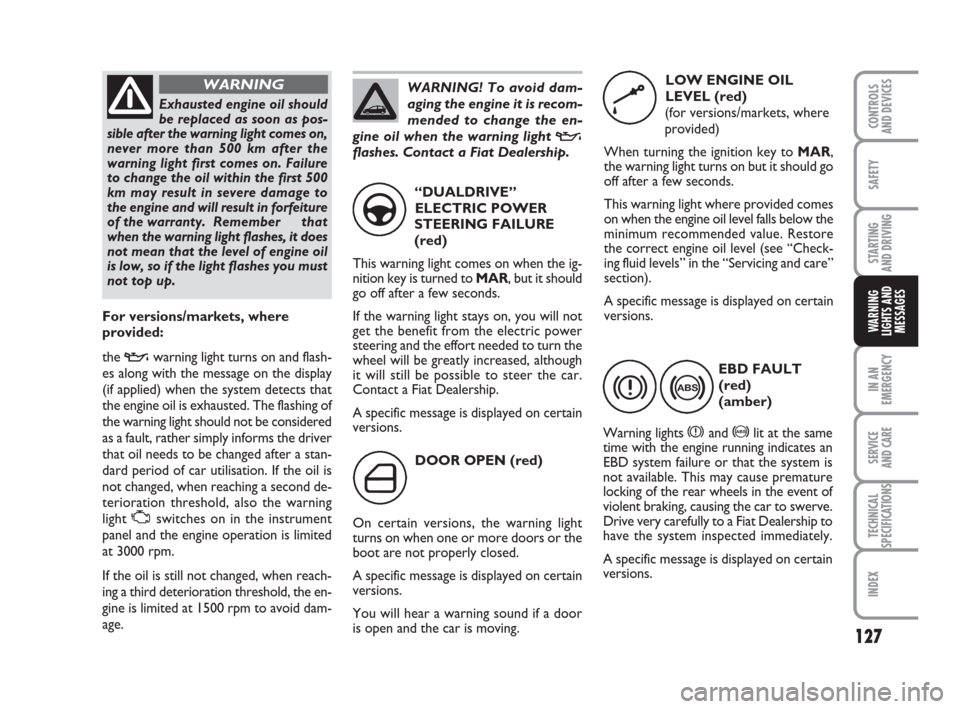
DOOR OPEN (red)
On certain versions, the warning light
turns on when one or more doors or the
boot are not properly closed.
A specific message is displayed on certain
versions.
You will hear a warning sound if a door
is open and the car is moving.
´
“DUALDRIVE”
ELECTRIC POWER
STEERING FAILURE
(red)
This warning light comes on when the ig-
nition key is turned to MAR, but it should
go off after a few seconds.
If the warning light stays on, you will not
get the benefit from the electric power
steering and the effort needed to turn the
wheel will be greatly increased, although
it will still be possible to steer the car.
Contact a Fiat Dealership.
A specific message is displayed on certain
versions.
g
EBD FAULT
(red)
(amber)
Warning lights
xand >lit at the same
time with the engine running indicates an
EBD system failure or that the system is
not available. This may cause premature
locking of the rear wheels in the event of
violent braking, causing the car to swerve.
Drive very carefully to a Fiat Dealership to
have the system inspected immediately.
A specific message is displayed on certain
versions.
x>
LOW ENGINE OIL
LEVEL (red)
(for versions/markets, where
provided)
When turning the ignition key to MAR,
the warning light turns on but it should go
off after a few seconds.
This warning light where provided comes
on when the engine oil level falls below the
minimum recommended value. Restore
the correct engine oil level (see “Check-
ing fluid levels” in the “Servicing and care”
section).
A specific message is displayed on certain
versions.
kExhausted engine oil should
be replaced as soon as pos-
sible after the warning light comes on,
never more than 500 km after the
warning light first comes on. Failure
to change the oil within the first 500
km may result in severe damage to
the engine and will result in forfeiture
of the warranty. Remember that
when the warning light flashes, it does
not mean that the level of engine oil
is low, so if the light flashes you must
not top up.
WARNING
For versions/markets, where
provided:
the
vwarning light turns on and flash-
es along with the message on the display
(if applied) when the system detects that
the engine oil is exhausted. The flashing of
the warning light should not be considered
as a fault, rather simply informs the driver
that oil needs to be changed after a stan-
dard period of car utilisation. If the oil is
not changed, when reaching a second de-
terioration threshold, also the warning
light
Uswitches on in the instrument
panel and the engine operation is limited
at 3000 rpm.
If the oil is still not changed, when reach-
ing a third deterioration threshold, the en-
gine is limited at 1500 rpm to avoid dam-
age.
WARNING! To avoid dam-
aging the engine it is recom-
mended to change the en-
gine oil when the warning light
v
flashes. Contact a Fiat Dealership.
123-134 ACTUAL 1ed EN 31-08-2010 9:23 Pagina 127
Page 137 of 216

136
SAFETY
STARTING
AND DRIVING
WARNING
LIGHTS AND
MESSAGES
SERVICE
AND CARE
TECHNICAL
SPECIFICATIONS
INDEX
CONTROLS
AND DEVICES
IN AN
EMERGENCY
STARTING THE ENGINE
EMERGENCY START-UP
If the instrument panel warning light
Ystays on permanently, contact a Fiat
Dealership immediately.
JUMP STARTING fig. 1
If the battery is flat, the engine may be
started using an auxiliary battery with an
equal or slightly higher capacity than the
flat one. Proceed as follows to start the car:
❒connect the positive terminals (+near
the terminal) of the two batteries with
a jump lead;
❒with a second lead, connect the nega-
tive terminal (–) of the auxiliary battery
to an earthing point
Eon the engine or
the gearbox of the car to be started;
❒start the engine.
❒when the engine has been started, fol-
low the sequence above in reverse or-
der to remove the leads.
If after a few attempts the engine does not
start, do not keep trying but contact a Fiat
Dealership.IMPORTANT Do not directly connect the
negative terminals of the two batteries:
sparks could ignite explosive gas released
from the battery. If the auxiliary battery is
installed on another car, prevent acciden-
tal contact between metallic parts of the
two cars.
IMPORTANT For cars with Start&Stop
system, in case of starting by booster bat-
tery, refer to "Dashboard and controls"
chapter, paragraph "Start&Stop system".
BUMP STARTING
Never bump start the engine by pushing,
towing or driving downhill. This could
cause fuel to flow into the catalytic con-
verter and damage it beyond repair.
IMPORTANT Remember that the brake
booster and the power steering system
are not active until the engine is started,
so you will need to apply much more force
to the brake pedal or steering wheel.
This procedure must be per-
formed by expert personnel
because incorrect actions may cause
considerable electrical discharge. Fur-
thermore, battery fluid is poisonous
and corrosive: avoid contact with skin
and eyes. Keep naked flames and lit
cigarettes away from the battery. Do
not create sparks.
WARNING
fig. 1F0M0414m
135-166 ACTUAL 1ed EN 26-07-2010 16:00 Pagina 136
Page 138 of 216

137
SAFETY
STARTING
AND DRIVING
WARNING
LIGHTS AND
MESSAGES
SERVICE
AND CARE
TECHNICAL
SPECIFICATIONS
INDEX
CONTROLS
AND DEVICES
IN AN
EMERGENCY
CHANGING A TYRE
GENERAL INSTRUCTIONS
Wheel changing and correct use of the
jack and spare wheel call for some pre-
cautions, as listed below.
Use your hazard lights,
warning triangle, etc to show
that your car is stationary. Passengers
should get out of the car, particular-
ly if it is heavily loaded, and wait for
the wheel to be changed away from
the traffic. Apply the handbrake.
WARNING
The spare wheel provided is
specific for your vehicle.
Therefore, it must not be used on dif-
ferent models and you should not use
spare wheels from other models on
your vehicle. The wheel bolts are spe-
cific for your vehicle: do not use them
on different models and do not use
bolts from other models on your car.
WARNING
Repair and refit the standard
wheel as soon as possible.
Do not apply grease to the bolt
threads before assembly: they might
spontaneously unscrew.
WARNING
The jack may be used to re-
place wheels only on the car
which it equips or other cars of the
same model. Never use the jack for
other purposes, such as lifting other
models. Never use the jack to carry
out repairs under the car. Incorrect
positioning of the jack may cause the
car to fall. Do not use the jack for
loads higher than the one shown on
its label.
WARNING
Incorrect hub cap assembly
may cause it to come off
when the car is moving. Never tam-
per with the inflation valve. Never in-
troduce tools of any kind between the
rim and the tyre. Check tyre and
spare wheel pressure regularly, refer-
ring to the values shown in the “Tech-
nical specifications” section.
WARNING
135-166 ACTUAL 1ed EN 26-07-2010 16:00 Pagina 137
Page 139 of 216
138
SAFETY
STARTING
AND DRIVING
WARNING
LIGHTS AND
MESSAGES
SERVICE
AND CARE
TECHNICAL
SPECIFICATIONS
INDEX
CONTROLS
AND DEVICES
IN AN
EMERGENCY
To change a wheel proceed
as follows:
❒stop the car where it is not a danger to
other road users and you can replace
the wheel safely. The ground should be
flat and solid;
❒turn the engine off and pull up the hand-
brake.
❒engage first gear or reverse;
❒ wear the reflective safety jacket (com-
pulsory by law in certain countries) be-
fore getting out of the car;
❒open the boot and lift the carpet or re-
move the cargo box (for versions/mar-
kets, where provided);
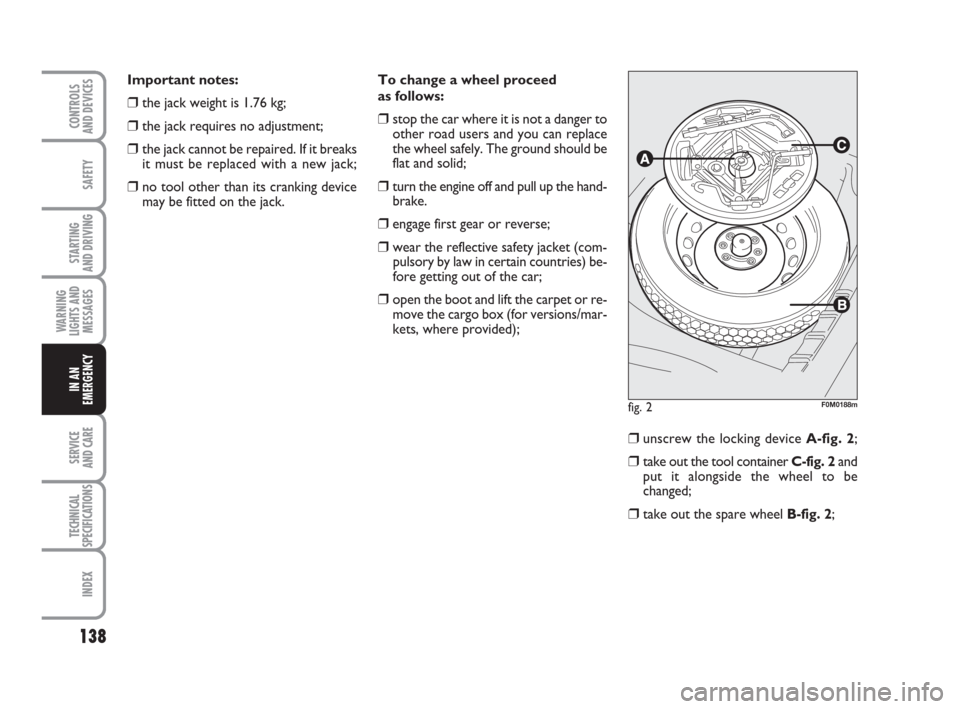
❒unscrew the locking device A-fig. 2;
❒take out the tool container C-fig. 2and
put it alongside the wheel to be
changed;
❒take out the spare wheel B-fig. 2;
fig. 2F0M0188m
Important notes:
❒the jack weight is 1.76 kg;
❒the jack requires no adjustment;
❒the jack cannot be repaired. If it breaks
it must be replaced with a new jack;
❒no tool other than its cranking device
may be fitted on the jack.
135-166 ACTUAL 1ed EN 26-07-2010 16:00 Pagina 138
Page 140 of 216

139
SAFETY
STARTING
AND DRIVING
WARNING
LIGHTS AND
MESSAGES
SERVICE
AND CARE
TECHNICAL
SPECIFICATIONS
INDEX
CONTROLS
AND DEVICES
IN AN
EMERGENCY
❒loosen the bolts of the wheel to be re-
placed by about one turn with the
wrench provided E-fig. 3; if you have
alloy wheels, rock the car to make it
easier to separate the rim from the
wheel hub;
❒ operate device F-fig. 4to extend the
jack until the top of the jack G-fig. 4fits
correctly into jacking point H-fig. 4;
❒ warn anybody nearby that the car is
about to be lifted. They must stay clear
and not touch the car until it is back on
the ground;
❒fit the handle L-fig. 4to operate the
jack and lift the car until the wheel is
several centimetres off the ground;
fig. 3F0M0362m
fig. 4F0M0191m
135-166 ACTUAL 1ed EN 26-07-2010 16:00 Pagina 139
Page 141 of 216

140
SAFETY
STARTING
AND DRIVING
WARNING
LIGHTS AND
MESSAGES
SERVICE
AND CARE
TECHNICAL
SPECIFICATIONS
INDEX
CONTROLS
AND DEVICES
IN AN
EMERGENCY
❒ for versions with hub caps, remove the
cap after unscrewing the 3 fastening
bolts and finally unscrew the fourth bolt
L-fig. 5and remove the wheel;
❒make sure the contact surfaces be-
tween spare wheel and hub are clean
so that the fastening bolts will not come
loose;
❒fit the spare wheel by inserting the first
bolt two threads into the hole closest
to the inflation valve;
❒fit the hub cap by aligning the crescent
hole with the bolt you have fitted us-
ing the wrench;
❒tighten the fastening bolts;
❒turn the jack handle L-fig. 4to lower
the car and remove the jack;
❒use the wrench provided to fasten the
bolts completely in a criss-cross fash-
ion as per the order illustrated in fig. 6;
❒if you are replacing an alloy wheel and
wish to store it temporarily in the spare
wheel compartment, you should posi-
tion it upside down.REFITTING A STANDARD
WHEEL
Following the procedure described previ-
ously, raise the car and remove the spare
wheel.
fig. 5F0M0192mfig. 6F0M0194m
135-166 ACTUAL 1ed EN 26-07-2010 16:00 Pagina 140