child seat FIAT IDEA 2007 1.G User Guide
[x] Cancel search | Manufacturer: FIAT, Model Year: 2007, Model line: IDEA, Model: FIAT IDEA 2007 1.GPages: 314, PDF Size: 4.78 MB
Page 166 of 314
Below is a summary
of the rules of safety
to be followed for carrying children:
❒The recommended position for installing children’s
seat is on the rear seat, as it is the most protected
in the case of a crash.
❒If the passenger’s air bag is deactivated (where
required) always check the amber yellow warning
light Fon the cluster to make sure that it has
actually been deactivated.
❒Attain to the instructions for fastening the specific
child restraint system which you are using. These
instructions must be provided by the manufacturer.
Keep the child restraint system installation
instructions with the car documents and this
Handbook. Never use a child restraint system
without installation instructions.
❒Always check the seat belt is well fastened by
pulling the webbing.❒Only one child is to be strapped to each retaining
system.
❒Always check the seat belts do not fit around the
child’s throat.
❒While travelling, do not let the child sit incorrectly
or release the belts.
❒Passengers should never carry children on their
laps. No-one, however strong they are, can hold a
child in the event of a crash.
❒In case of an accident, replace the seat with a new
one.
165
CORRECT USE
OF THE CAR
WARNING
LIGHTS AND
MESSAGES
IN AN
EMERGENCY
CAR
MAINTENANCE
TECHNICAL
SPECIFICATIONS
INDEX
DASHBOARD
AND CONTROLS
SAFETY
DEVICES
WARNINGWith passenger’s air bag active, never place child’s seats with the cradle facing
backwards since the air bag activation could cause to the child serious injuries,
even mortal, regardless of the seriousness of the crash that triggered it. You are
advised to carry children always with proper restraint systems on the rear seats, as
this is the most protected position in the case of a crash.
Page 167 of 314
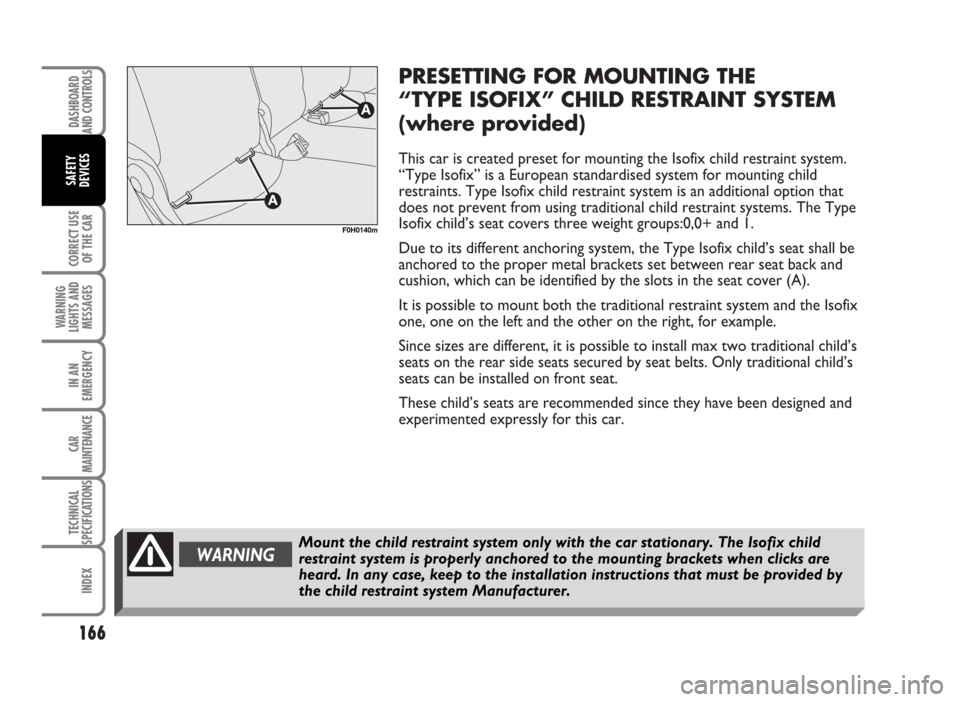
PRESETTING FOR MOUNTING THE
“TYPE ISOFIX” CHILD RESTRAINT SYSTEM
(where provided)
This car is created preset for mounting the Isofix child restraint system.
“Type Isofix” is a European standardised system for mounting child
restraints. Type Isofix child restraint system is an additional option that
does not prevent from using traditional child restraint systems. The Type
Isofix child’s seat covers three weight groups:0,0+ and 1.
Due to its different anchoring system, the Type Isofix child’s seat shall be
anchored to the proper metal brackets set between rear seat back and
cushion, which can be identified by the slots in the seat cover (A).
It is possible to mount both the traditional restraint system and the Isofix
one, one on the left and the other on the right, for example.
Since sizes are different, it is possible to install max two traditional child’s
seats on the rear side seats secured by seat belts. Only traditional child’s
seats can be installed on front seat.
These child’s seats are recommended since they have been designed and
experimented expressly for this car.
166
CORRECT USE
OF THE CAR
WARNING
LIGHTS AND
MESSAGES
IN AN
EMERGENCY
CAR
MAINTENANCE
TECHNICAL
SPECIFICATIONS
INDEX
DASHBOARD
AND CONTROLS
SAFETY
DEVICES
F0H0140m
WARNINGMount the child restraint system only with the car stationary. The Isofix child
restraint system is properly anchored to the mounting brackets when clicks are
heard. In any case, keep to the installation instructions that must be provided by
the child restraint system Manufacturer.
Page 168 of 314
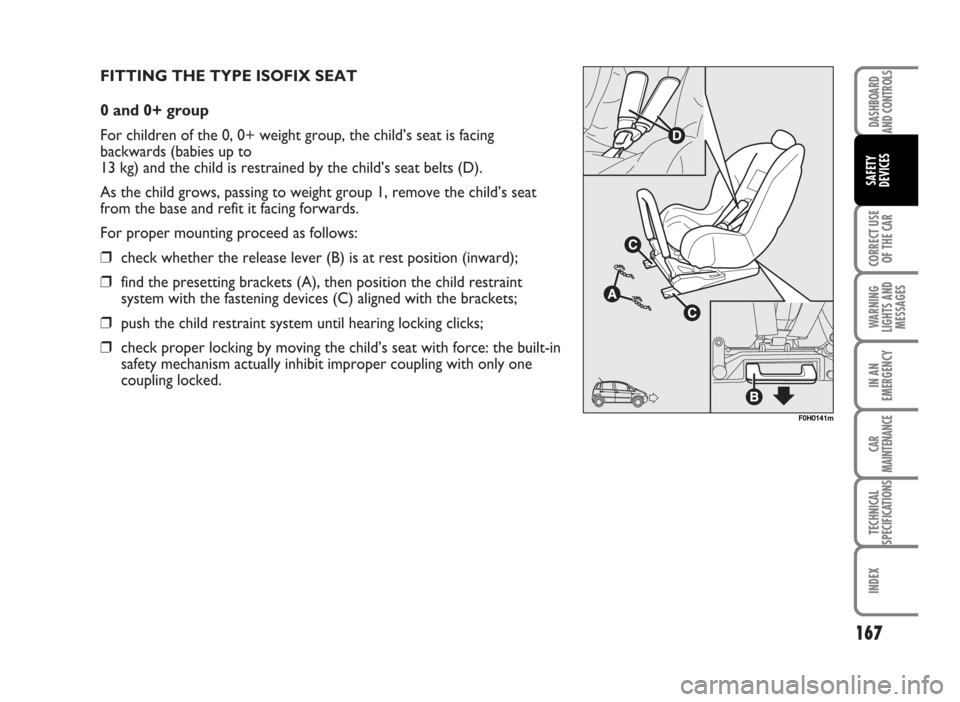
FITTING THE TYPE ISOFIX SEAT
0 and 0+ group
For children of the 0, 0+ weight group, the child’s seat is facing
backwards (babies up to
13 kg) and the child is restrained by the child’s seat belts (D).
As the child grows, passing to weight group 1, remove the child’s seat
from the base and refit it facing forwards.
For proper mounting proceed as follows:
❒check whether the release lever (B) is at rest position (inward);
❒find the presetting brackets (A), then position the child restraint
system with the fastening devices (C) aligned with the brackets;
❒push the child restraint system until hearing locking clicks;
❒check proper locking by moving the child’s seat with force: the built-in
safety mechanism actually inhibit improper coupling with only one
coupling locked.
167
CORRECT USE
OF THE CAR
WARNING
LIGHTS AND
MESSAGES
IN AN
EMERGENCY
CAR
MAINTENANCE
TECHNICAL
SPECIFICATIONS
INDEX
DASHBOARD
AND CONTROLS
SAFETY
DEVICES
F0H0141m
Page 169 of 314
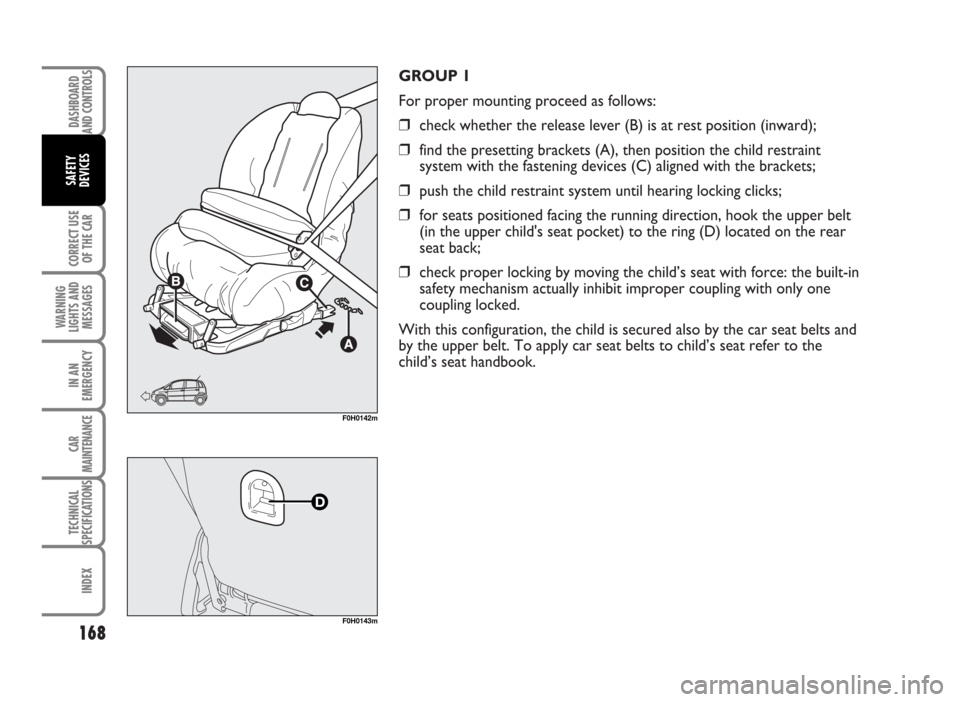
GROUP 1
For proper mounting proceed as follows:
❒check whether the release lever (B) is at rest position (inward);
❒find the presetting brackets (A), then position the child restraint
system with the fastening devices (C) aligned with the brackets;
❒push the child restraint system until hearing locking clicks;
❒for seats positioned facing the running direction, hook the upper belt
(in the upper child's seat pocket) to the ring (D) located on the rear
seat back;
❒check proper locking by moving the child’s seat with force: the built-in
safety mechanism actually inhibit improper coupling with only one
coupling locked.
With this configuration, the child is secured also by the car seat belts and
by the upper belt. To apply car seat belts to child’s seat refer to the
child’s seat handbook.
168
CORRECT USE
OF THE CAR
WARNING
LIGHTS AND
MESSAGES
IN AN
EMERGENCY
CAR
MAINTENANCE
TECHNICAL
SPECIFICATIONS
INDEX
DASHBOARD
AND CONTROLS
SAFETY
DEVICES
F0H0142m
F0H0143m
Page 172 of 314
171
CORRECT USE
OF THE CAR
WARNING
LIGHTS AND
MESSAGES
IN AN
EMERGENCY
CAR
MAINTENANCE
TECHNICAL
SPECIFICATIONS
INDEX
DASHBOARD
AND CONTROLS
SAFETY
DEVICES
F0H0144m
F0H0145m
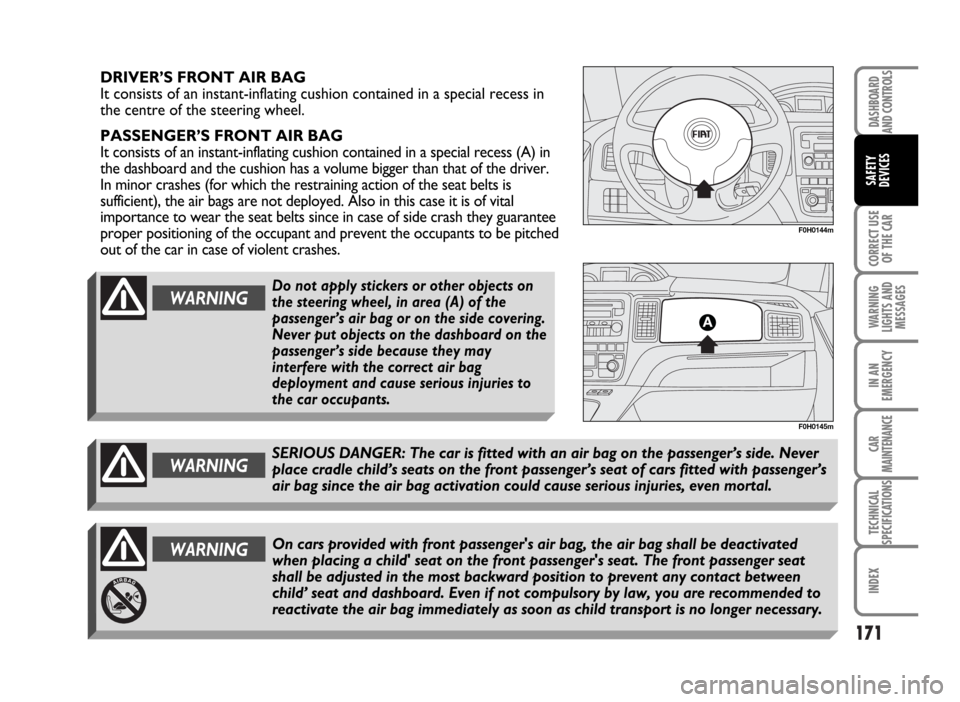
DRIVER’S FRONT AIR BAG
It consists of an instant-inflating cushion contained in a special recess in
the centre of the steering wheel.
PASSENGER’S FRONT AIR BAG
It consists of an instant-inflating cushion contained in a special recess (A) in
the dashboard and the cushion has a volume bigger than that of the driver.
In minor crashes (for which the restraining action of the seat belts is
sufficient), the air bags are not deployed. Also in this case it is of vital
importance to wear the seat belts since in case of side crash they guarantee
proper positioning of the occupant and prevent the occupants to be pitched
out of the car in case of violent crashes.
WARNINGOn cars provided with front passenger's air bag, the air bag shall be deactivated
when placing a child' seat on the front passenger's seat. The front passenger seat
shall be adjusted in the most backward position to prevent any contact between
child’ seat and dashboard. Even if not compulsory by law, you are recommended to
reactivate the air bag immediately as soon as child transport is no longer necessary.
WARNINGDo not apply stickers or other objects on
the steering wheel, in area (A) of the
passenger’s air bag or on the side covering.
Never put objects on the dashboard on the
passenger’s side because they may
interfere with the correct air bag
deployment and cause serious injuries to
the car occupants.
WARNINGSERIOUS DANGER: The car is fitted with an air bag on the passenger’s side. Never
place cradle child’s seats on the front passenger’s seat of cars fitted with passenger’s
air bag since the air bag activation could cause serious injuries, even mortal.
Page 173 of 314
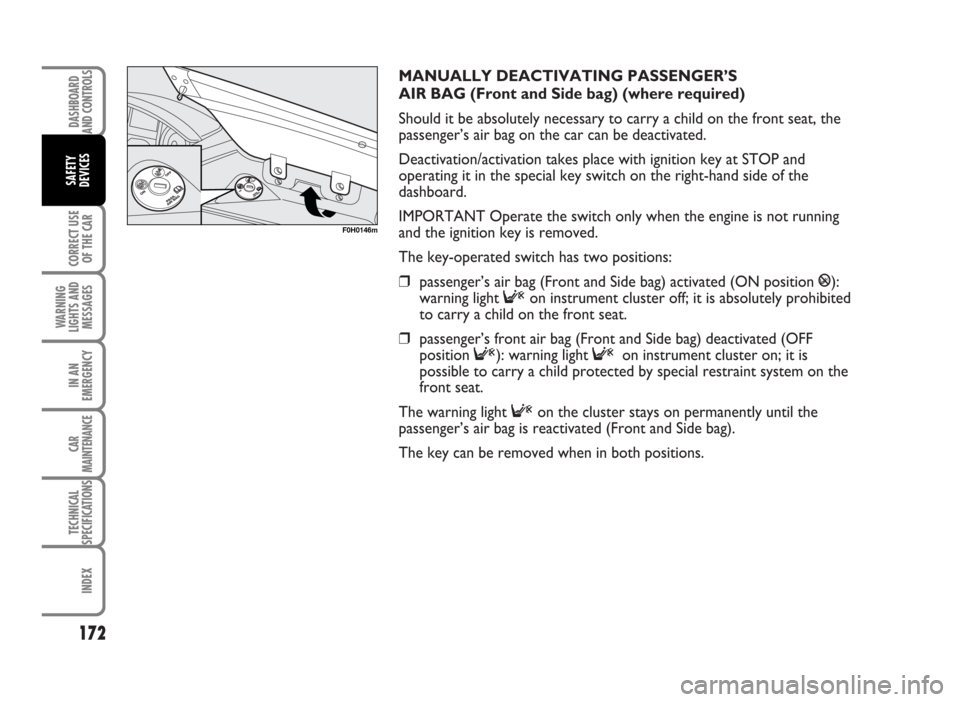
MANUALLY DEACTIVATING PASSENGER’S
AIR BAG (Front and Side bag) (where required)
Should it be absolutely necessary to carry a child on the front seat, the
passenger’s air bag on the car can be deactivated.
Deactivation/activation takes place with ignition key at STOP and
operating it in the special key switch on the right-hand side of the
dashboard.
IMPORTANT Operate the switch only when the engine is not running
and the ignition key is removed.
The key-operated switch has two positions:
❒passenger’s air bag (Front and Side bag) activated (ON position P):
warning light Fon instrument cluster off; it is absolutely prohibited
to carry a child on the front seat.
❒passenger’s front air bag (Front and Side bag) deactivated (OFF
position F): warning light Fon instrument cluster on; it is
possible to carry a child protected by special restraint system on the
front seat.
The warning light Fon the cluster stays on permanently until the
passenger’s air bag is reactivated (Front and Side bag).
The key can be removed when in both positions.
172
CORRECT USE
OF THE CAR
WARNING
LIGHTS AND
MESSAGES
IN AN
EMERGENCY
CAR
MAINTENANCE
TECHNICAL
SPECIFICATIONS
INDEX
DASHBOARD
AND CONTROLS
SAFETY
DEVICES
F0H0146m
Page 176 of 314
175
CORRECT USE
OF THE CAR
WARNING
LIGHTS AND
MESSAGES
IN AN
EMERGENCY
CAR
MAINTENANCE
TECHNICAL
SPECIFICATIONS
INDEX
DASHBOARD
AND CONTROLS
SAFETY
DEVICES
GENERAL WARNINGS
WARNING
If warning light ¬does not come on when turning the key to MAR or if it stays on
when travelling it could indicate a failure in restraint systems; in this case air bags
or pretensioners could not trigger in the event of an accident, or in a restricted
numbers of cases they could trigger accidentally. Stop the car and contact Fiat
Dealership to have the system checked immediately.WARNING
WARNINGAlways keep your hands on the steering wheel rim when driving, so that if the air
bag is triggered, it can inflate without meeting any obstacles which could cause
serious harm to you. Do not drive with the body bent forwards, keep the seat back
rest in the erect position and lean your back well against it. Do not cover the back rest of front seats with trims or covers there are not set for
the use of side bags.
If the car has been stolen or an attempt to steal it has been made, if it has been
subjected to vandals or floods, have the air bag system checked by Fiat Dealership.WARNING
WARNINGRemember that with the key engaged and in the MAR position, even with the
engine not running, the air bags may be triggered on a stationary vehicle if it is
bumped by another moving car. Therefore, never seat children on the front seat
even when the vehicle is stationary. On the other hand remember that if the key is
at STOP, no safety system (air bags or pretensioners) is triggered in the event of an
impact; in these case, failure to come into action cannot be considered as a sign
that the system is not working properly.
Page 182 of 314
PARKING
Proceed as follows:
❒stop the engine and engage the handbrake;
❒engage a gear (on a slope, engage first gear if the car is faced uphill or
reverse if it is faced downhill) and leave the wheels steered.
Block the wheels with a wedge or a stone if the car is parked on a steep
slope. Avoid leaving the car parked with a wheel on the sidewalk or
steered against the kerb. Do not leave the ignition key at MAR to
prevent draining the battery. Always remove the key when you leave
the car.
181
SAFETY
DEVICES
WARNING
LIGHTS AND
MESSAGES
IN AN
EMERGENCY
CAR
MAINTENANCE
TECHNICAL
SPECIFICATIONS
INDEX
DASHBOARD
AND CONTROLS
CORRECT USE
OF THE CAR
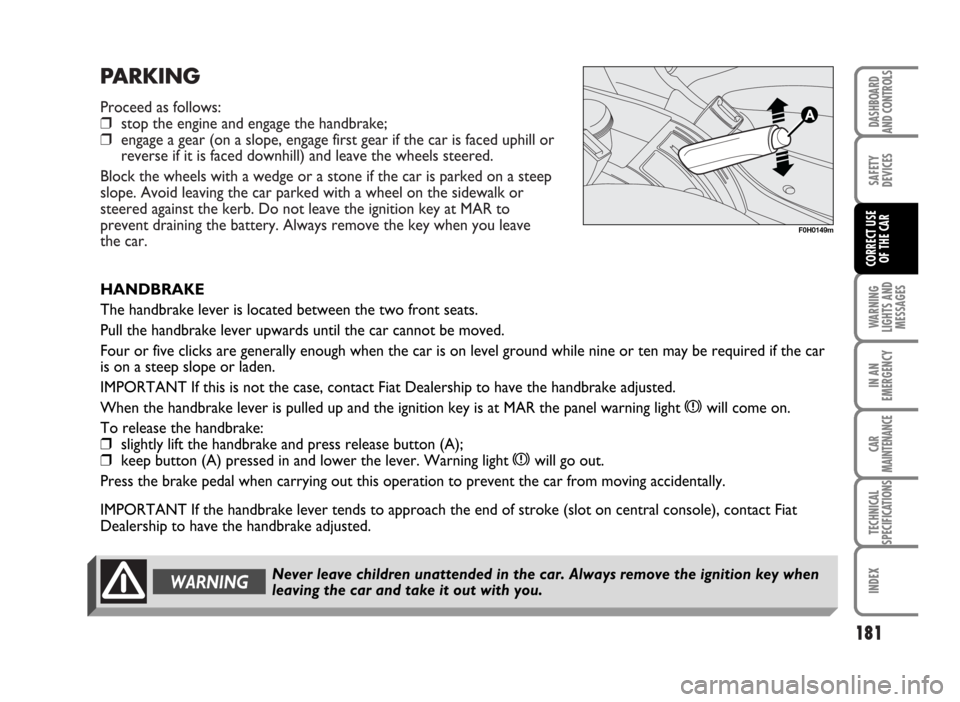
HANDBRAKE
The handbrake lever is located between the two front seats.
Pull the handbrake lever upwards until the car cannot be moved.
Four or five clicks are generally enough when the car is on level ground while nine or ten may be required if the car
is on a steep slope or laden.
IMPORTANT If this is not the case, contact Fiat Dealership to have the handbrake adjusted.
When the handbrake lever is pulled up and the ignition key is at MAR the panel warning light xwill come on.
To release the handbrake:
❒slightly lift the handbrake and press release button (A);
❒keep button (A) pressed in and lower the lever. Warning light xwill go out.
Press the brake pedal when carrying out this operation to prevent the car from moving accidentally.
IMPORTANT If the handbrake lever tends to approach the end of stroke (slot on central console), contact Fiat
Dealership to have the handbrake adjusted.
WARNINGNever leave children unattended in the car. Always remove the ignition key when
leaving the car and take it out with you.
F0H0149m