climate control FIAT IDEA 2007 1.G Owner's Manual
[x] Cancel search | Manufacturer: FIAT, Model Year: 2007, Model line: IDEA, Model: FIAT IDEA 2007 1.GPages: 314, PDF Size: 4.78 MB
Page 184 of 314
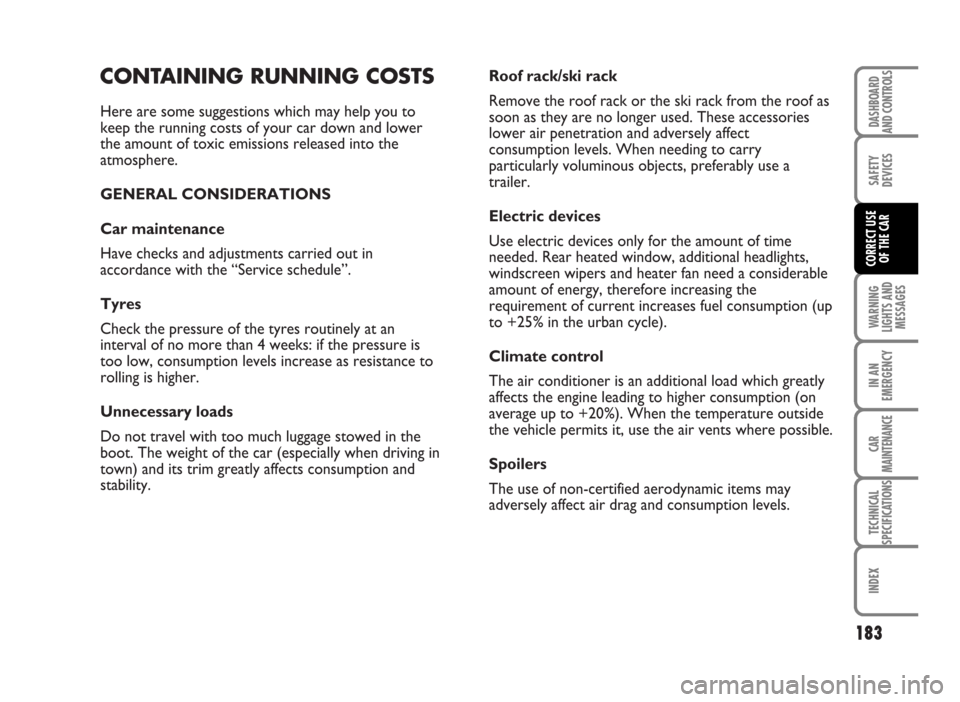
CONTAINING RUNNING COSTS
Here are some suggestions which may help you to
keep the running costs of your car down and lower
the amount of toxic emissions released into the
atmosphere.
GENERAL CONSIDERATIONS
Car maintenance
Have checks and adjustments carried out in
accordance with the “Service schedule”.
Tyres
Check the pressure of the tyres routinely at an
interval of no more than 4 weeks: if the pressure is
too low, consumption levels increase as resistance to
rolling is higher.
Unnecessary loads
Do not travel with too much luggage stowed in the
boot. The weight of the car (especially when driving in
town) and its trim greatly affects consumption and
stability.Roof rack/ski rack
Remove the roof rack or the ski rack from the roof as
soon as they are no longer used. These accessories
lower air penetration and adversely affect
consumption levels. When needing to carry
particularly voluminous objects, preferably use a
trailer.
Electric devices
Use electric devices only for the amount of time
needed. Rear heated window, additional headlights,
windscreen wipers and heater fan need a considerable
amount of energy, therefore increasing the
requirement of current increases fuel consumption (up
to +25% in the urban cycle).
Climate control
The air conditioner is an additional load which greatly
affects the engine leading to higher consumption (on
average up to +20%). When the temperature outside
the vehicle permits it, use the air vents where possible.
Spoilers
The use of non-certified aerodynamic items may
adversely affect air drag and consumption levels.
183
SAFETY
DEVICES
WARNING
LIGHTS AND
MESSAGES
IN AN
EMERGENCY
CAR
MAINTENANCE
TECHNICAL
SPECIFICATIONS
INDEX
DASHBOARD
AND CONTROLS
CORRECT USE
OF THE CAR
Page 253 of 314
252
SAFETY
DEVICES
CORRECT USE
OF THE CAR
WARNING
LIGHTS AND
MESSAGES
CAR
MAINTENANCE
TECHNICAL
SPECIFICATIONS
INDEX
DASHBOARD
AND CONTROLS
IN AN
EMERGENCY
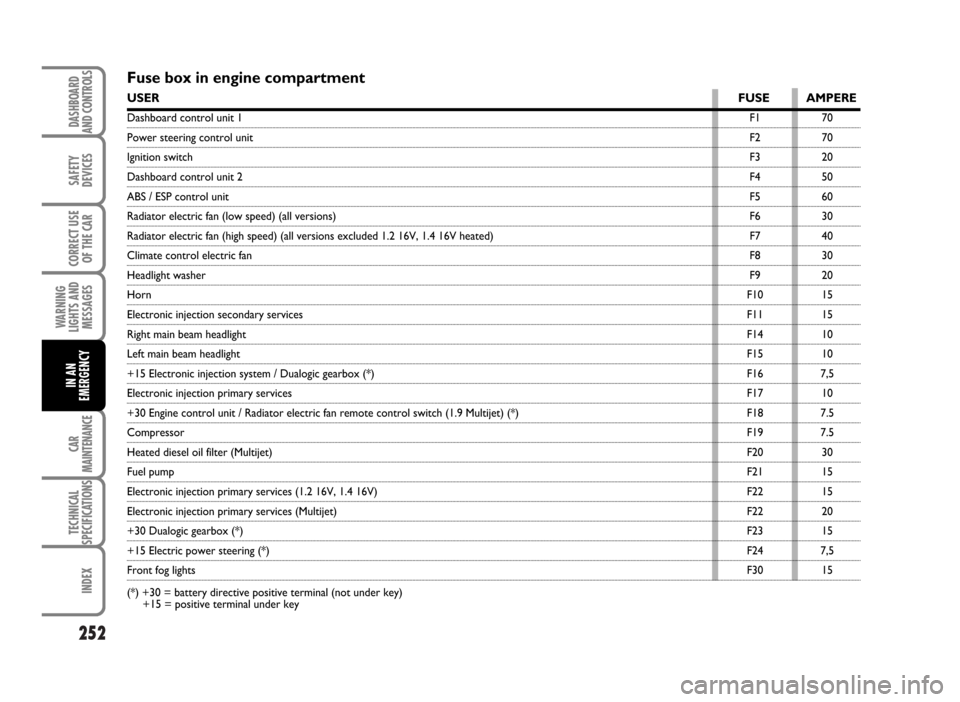
Fuse box in engine compartment
USERFUSE AMPERE
Dashboard control unit 1F1 70
Power steering control unitF2 70
Ignition switchF3 20
Dashboard control unit 2F4 50
ABS / ESP control unitF5 60
Radiator electric fan (low speed) (all versions)F6 30
Radiator electric fan (high speed) (all versions excluded 1.2 16V, 1.4 16V heated) F7 40
Climate control electric fanF8 30
Headlight washerF9 20
HornF10 15
Electronic injection secondary servicesF11 15
Right main beam headlightF14 10
Left main beam headlightF15 10
+15 Electronic injection system / Dualogic gearbox (*)F16 7,5
Electronic injection primary servicesF17 10
+30 Engine control unit / Radiator electric fan remote control switch (1.9 Multijet) (*) F18 7.5
CompressorF19 7.5
Heated diesel oil filter (Multijet)F20 30
Fuel pumpF21 15
Electronic injection primary services (1.2 16V, 1.4 16V)F22 15
Electronic injection primary services (Multijet)F22 20
+30 Dualogic gearbox (*)F23 15
+15 Electric power steering (*)F24 7,5
Front fog lightsF30 15
(*) +30 = battery directive positive terminal (not under key)
+15 = positive terminal under key
Page 262 of 314
261
SAFETY
DEVICES
CORRECT USE
OF THE CAR
WARNING
LIGHTS AND
MESSAGES
IN AN
EMERGENCY
TECHNICAL
SPECIFICATIONS
INDEX
DASHBOARD
AND CONTROLS
CAR
MAINTENANCE
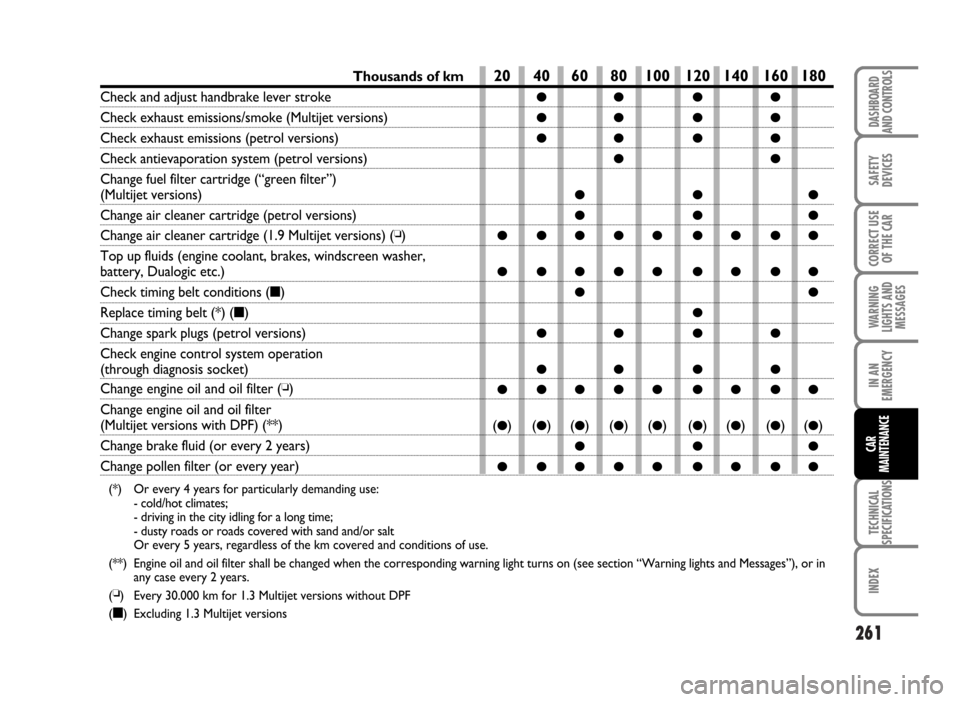
Thousands of km
Check and adjust handbrake lever stroke
Check exhaust emissions/smoke (Multijet versions)
Check exhaust emissions (petrol versions)
Check antievaporation system (petrol versions)
Change fuel filter cartridge (“green filter”)
(Multijet versions)
Change air cleaner cartridge (petrol versions)
Change air cleaner cartridge (1.9 Multijet versions) (❏)
Top up fluids (engine coolant, brakes, windscreen washer,
battery, Dualogic etc.)
Check timing belt conditions (■)
Replace timing belt (*) (■)
Change spark plugs (petrol versions)
Check engine control system operation
(through diagnosis socket)
Change engine oil and oil filter (❏)
Change engine oil and oil filter
(Multijet versions with DPF) (**)
Change brake fluid (or every 2 years)
Change pollen filter (or every year)
(*) Or every 4 years for particularly demanding use:
- cold/hot climates;
- driving in the city idling for a long time;
- dusty roads or roads covered with sand and/or salt
Or every 5 years, regardless of the km covered and conditions of use.
(**) Engine oil and oil filter shall be changed when the corresponding warning light turns on (see section “Warning lights and Messages”), or in
any case every 2 years.
(
❏) Every 30.000 km for 1.3 Multijet versions without DPF
(
■) Excluding 1.3 Multijet versions
20 40 60 80 100 120 140 160 180
●● ● ●
●● ● ●
●● ● ●
●●
●●●
●●●
●●●●● ●●●●
●●●●● ●●●●
●●
●
●● ● ●
●● ● ●
●●●●● ●●●●
(●)(●)(●)(●)(●)(●)(●)(●)(●)
●●●
●●●●● ●●●●
Page 265 of 314
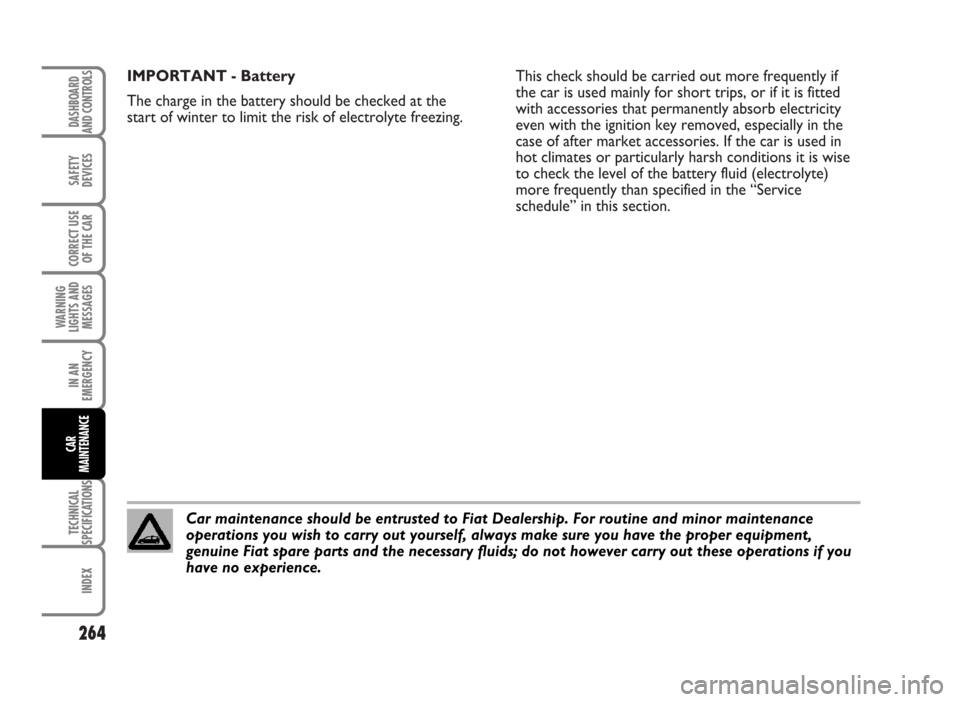
IMPORTANT - Battery
The charge in the battery should be checked at the
start of winter to limit the risk of electrolyte freezing.This check should be carried out more frequently if
the car is used mainly for short trips, or if it is fitted
with accessories that permanently absorb electricity
even with the ignition key removed, especially in the
case of after market accessories. If the car is used in
hot climates or particularly harsh conditions it is wise
to check the level of the battery fluid (electrolyte)
more frequently than specified in the “Service
schedule” in this section.
264
SAFETY
DEVICES
CORRECT USE
OF THE CAR
WARNING
LIGHTS AND
MESSAGES
IN AN
EMERGENCY
TECHNICAL
SPECIFICATIONS
INDEX
DASHBOARD
AND CONTROLS
CAR
MAINTENANCE
Car maintenance should be entrusted to Fiat Dealership. For routine and minor maintenance
operations you wish to carry out yourself, always make sure you have the proper equipment,
genuine Fiat spare parts and the necessary fluids; do not however carry out these operations if you
have no experience.
Page 283 of 314
282
SAFETY
DEVICES
CORRECT USE
OF THE CAR
WARNING
LIGHTS AND
MESSAGES
IN AN
EMERGENCY
TECHNICAL
SPECIFICATIONS
INDEX
DASHBOARD
AND CONTROLS
CAR
MAINTENANCE
BODYWORK
PROTECTION FROM ATMOSPHERIC
AGENTS
The main causes of corrosion are the following:
❒atmospheric pollution;
❒salty air and humidity (coastal areas, or hot humid
climates);
❒seasonal environment conditions.
Not to be underestimated is also the abrasive action
of wind-borne atmospheric dust and sand and mud and
gravel raised by other vehicles.
On your Fiat Idea, Fiat implemented the best
manufacturing technologies to effectively protect the
bodywork against corrosion.
These include:
❒Painting products and systems which give the car
particular resistance to corrosion and abrasion;
❒Use of galvanised (or pretreated) steel sheets, with
high resistance to corrosion;
❒Spraying of plastic parts, with a protective function,
in the more exposed points: underdoor, inner
fender parts, edges, etc.;
❒Use of “open” boxed sections to prevent
condensation and pockets of moisture from
triggering rust inside.BODY AND UNDERBODY
WARRANTY
Your Fiat Idea is covered by warranty against
perforation due to rust of any original element of the
structure or body. For the general terms of this
warranty, refer to “FIAT WARRANTY” booklet.
ADVICE FOR PRESERVING THE
BODYWORK
Paint
Paintwork does not only serve an aestethic purpose,
but also protects the underlying sheet metal.
In the case of deep scrapes or scores, you are advised
to have the necessary touching up carried out
immediately to avoid the formation of rust. Use only
original paint products for touching up (see
“Bodywork paint identification plate” in section
“Technical specification”).
Normal paint maintenance consists in washing at
intervals depending on the conditions and environment
of use. For example, in highly polluted areas, or if the
roads are sprayed with salt, it is wise to wash the car
more frequently.
To correctly wash the car:
❒remove the aerial from the roof to prevent damage
to it if the car is washed in an automatic system;
❒wash the body using a low pressure jet of water;
Page 304 of 314
303
SAFETY
DEVICES
CORRECT USE
OF THE CAR
WARNING
LIGHTS AND
MESSAGES
IN AN
EMERGENCY
CAR
MAINTENANCE
INDEX
DASHBOARD
AND CONTROLS
TECHNICAL
SPECIFICATIONS
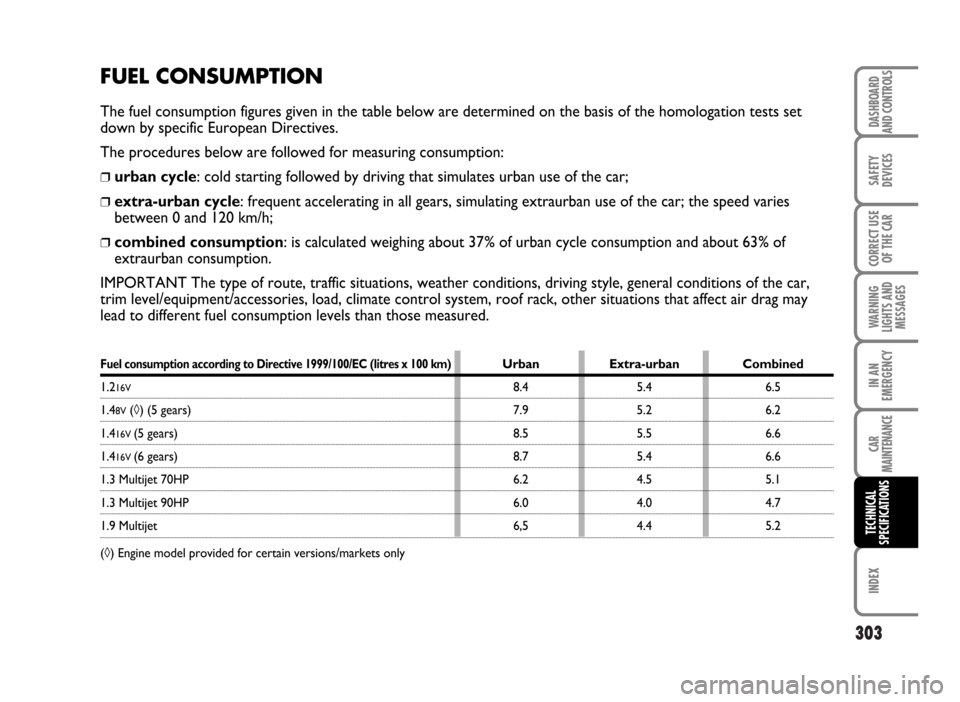
FUEL CONSUMPTION
The fuel consumption figures given in the table below are determined on the basis of the homologation tests set
down by specific European Directives.
The procedures below are followed for measuring consumption:
❒urban cycle: cold starting followed by driving that simulates urban use of the car;
❒extra-urban cycle: frequent accelerating in all gears, simulating extraurban use of the car; the speed varies
between 0 and 120 km/h;
❒combined consumption: is calculated weighing about 37% of urban cycle consumption and about 63% of
extraurban consumption.
IMPORTANT The type of route, traffic situations, weather conditions, driving style, general conditions of the car,
trim level/equipment/accessories, load, climate control system, roof rack, other situations that affect air drag may
lead to different fuel consumption levels than those measured.
Fuel consumption according to Directive 1999/100/EC (litres x 100 km)Urban Extra-urban Combined
1.216V8.4 5.4 6.5
1.48V(◊) (5 gears) 7.9 5.2 6.2
1.416V (5 gears) 8.5 5.5 6.6
1.416V (6 gears) 8.7 5.4 6.6
1.3 Multijet 70HP 6.2 4.5 5.1
1.3 Multijet 90HP 6.0 4.0 4.7
1.9 Multijet 6,5 4.4 5.2
(◊) Engine model provided for certain versions/markets only
Page 306 of 314
305
SAFETY
DEVICES
CORRECT USE
OF THE CAR
WARNING
LIGHTS AND
MESSAGES
IN AN
EMERGENCY
CAR
MAINTENANCE
TECHNICAL
SPECIFICATIONS
DASHBOARD
AND CONTROLS
INDEX
I I
N N
D D
E E
X X
ABS (system) ............................. 138
Accessories purchased by the
user ............................................... 143
Air bags (front)........................... 166
– driver's air bag ...................... 168
– passenger's front air bag .... 168
– passenger's front air bag
manual deactivation ........... 169
- Side bags .................................. 170
Air cleaner................................... 263
Air vents ..................................... 80-81
Ashtray (Smokers' kit) ............ 122
At the filling station ................... 148
Automatic two-zone climate
control system............................ 89
Battery
– checking the charge............. 273
– jump starting ......................... 223
– recharging .............................. 254
– replacing ............................... 274
Bodywork
– maintenance ......................... 282
– version codes........................ 289
Bonnet ......................................... 134Boot ............................................. 128
– extension ............................... 131
– light ......................................... 256
Brake lights
– bulb replacement ................. 244
Brakes
– fluid level ............................... 271
– handbrake ............................. 181
– service and emergency ....... 293
Bulb (replacement) ................... 237
Capacities ................................... 300
Car inactivity ............................. 190
Car maintenance ........................ 258
– additional checks.................. 262
– Annual Inspection Schedule 262
– scheduled service................. 259
– Service Schedule .................. 260
Cargo box ................................... 119
Carrying children safely ............ 159
Ceiling lights ................................ 111
– bulb replacement ................. 246
Cellular telephones
– presetting............................... 141Checking fluid levels ............... 265
Child lock ................................... 11
Cigar lighter (Smokers' kit) ..... 122
Clutch .......................................... 292
CO
2emissions .......................... 304
Containing running costs ......... 183
Correct use of the car ............ 177
Cruise Control .......................... 108
Current sockets ......................... 121
Dashboard and controls ......... 4-21
Diesel fuel filter ......................... 272
Dimensions ............................... 297
Dipped beam headlights
– bulb replacement ................. 241
– control .................................. 100
Direction indicators ................. 101
– bulb replacement ................. 242
– control .................................. 101
Door pockets ............................. 117
Doors ........................................... 7-221
Emergency device for locking
doors from the outside ......... 12
Dualdrive
(electric power steering) ...... 144
Page 308 of 314

307
SAFETY
DEVICES
CORRECT USE
OF THE CAR
WARNING
LIGHTS AND
MESSAGES
IN AN
EMERGENCY
CAR
MAINTENANCE
TECHNICAL
SPECIFICATIONS
DASHBOARD
AND CONTROLS
INDEX
– control .................................. 101
– flashing .................................... 101
Manual climate control
system ......................................... 85
Multifunction display (on
comfort instrument panel) ..... 35
- controls ..................................... 36
Multifunction display (on
modal instrument panel) ......... 27
- controls ..................................... 28
Number plate light
– bulb replacement ................ 223
Oddment compartments ........ 118
- roof console ............................. 119
- upper.......................................... 117
Outlets ......................................... 121
Parking ....................................... 181
Parking sensors .......................... 146
Performance................................ 298
Plates ........................................... 287
Pollen filter ................................. 263
Power windows ......................... 125
Pretensioners.............................. 156
Prolonged car inactivity .......... 190
Protecting the environment .... 150
Radio transmitters and
cellular telephones..................... 141
Rain sensor ................................ 105
Rear fog lights
– bulb replacement ................. 244
– control button ...................... 115
Rear window washer
– control .................................. 104
– fluid level ............................... 270
Rear window wipers
– control .................................. 104
– smart washing ....................... 105
– blades .................................... 279
– nozzles.................................... 281
Rearview mirrors....................... 78
Rev counter ................................ 25
Reversing light
– bulb replacement ................. 244
Rims ............................................. 295
Roof racks ................................. 136
Rubber tubing ............................. 279
Safety devices ............................ 151
Seat belts
– general instructions ............ 152
– height adjustment ............... 154– maintenance ......................... 159
– S.B.R. system ......................... 153
– use .......................................... 152
Seats .............................................. 69
Side/taillights
– bulb replacement ........... 243-244
– control .................................. 100
Smart washing............................. 105
Snow chains ............................... 189
Sound system
– installation ............................ 141
– preset system ...................... 141
Spark plugs .................................. 290
Speedometer .............................. 25
Starting the engine
– bump starting ........................ 224
– emergency start-up ............. 222
– ignition switch ..................... 20
– jump starting ........................ 223
– Multijet engines .................... 179
– petrol engines ...................... 178
– stopping the engine ............. 180
– warming up the engine ...... 180
Steering . ...................................... 293
Steering lock .............................. 20
Steering wheel (adjustment) ... 68