seats FIAT IDEA 2009 1.G User Guide
[x] Cancel search | Manufacturer: FIAT, Model Year: 2009, Model line: IDEA, Model: FIAT IDEA 2009 1.GPages: 210, PDF Size: 3.62 MB
Page 97 of 210
96
STARTING
AND DRIVING
WARNING
LIGHTS AND
MESSAGES
IN AN
EMERGENCY
MAINTENANCE
AND CARE
TECHNICAL
SPECIFICATIONS
ALPHABETICAL
INDEX
DASHBOARD
AND
CONTROLS
SAFETY
fig. 5F0H0311m
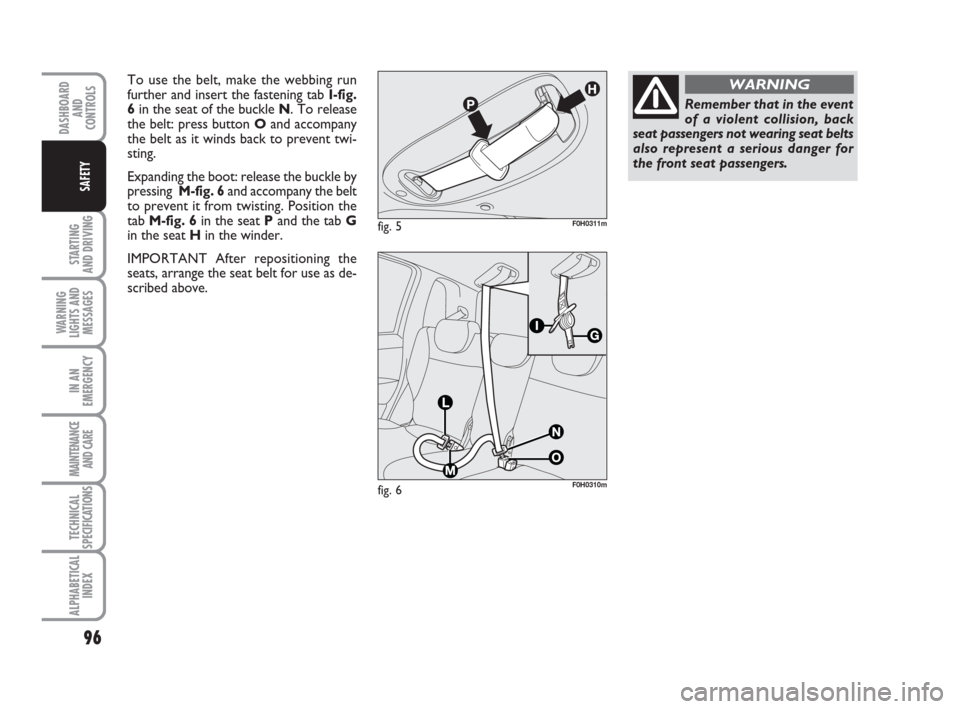
To use the belt, make the webbing run
further and insert the fastening tab I-fig.
6in the seat of the buckle N. To release
the belt: press button Oand accompany
the belt as it winds back to prevent twi-
sting.
Expanding the boot: release the buckle by
pressing M-fig. 6and accompany the belt
to prevent it from twisting. Position the
tab M-fig. 6in the seat Pand the tab G
in the seat Hin the winder.
IMPORTANT After repositioning the
seats, arrange the seat belt for use as de-
scribed above.
fig. 6F0H0310m
Remember that in the event
of a violent collision, back
seat passengers not wearing seat belts
also represent a serious danger for
the front seat passengers.
WARNING
Page 99 of 210
98
STARTING
AND DRIVING
WARNING
LIGHTS AND
MESSAGES
IN AN
EMERGENCY
MAINTENANCE
AND CARE
TECHNICAL
SPECIFICATIONS
ALPHABETICAL
INDEX
DASHBOARD
AND
CONTROLS
SAFETY
fig. 7F0H0133mfig. 8F0H0134mfig. 9F0H0135m
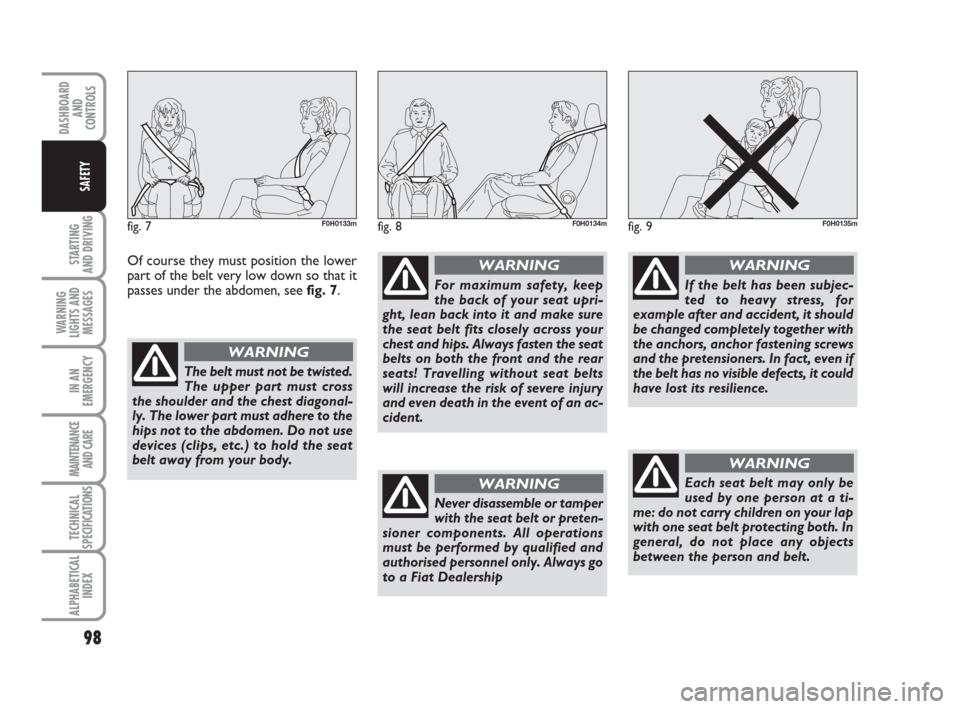
The belt must not be twisted.
The upper part must cross
the shoulder and the chest diagonal-
ly. The lower part must adhere to the
hips not to the abdomen. Do not use
devices (clips, etc.) to hold the seat
belt away from your body.
WARNING
For maximum safety, keep
the back of your seat upri-
ght, lean back into it and make sure
the seat belt fits closely across your
chest and hips. Always fasten the seat
belts on both the front and the rear
seats! Travelling without seat belts
will increase the risk of severe injury
and even death in the event of an ac-
cident.
WARNING
Never disassemble or tamper
with the seat belt or preten-
sioner components. All operations
must be performed by qualified and
authorised personnel only. Always go
to a Fiat Dealership
WARNING
If the belt has been subjec-
ted to heavy stress, for
example after and accident, it should
be changed completely together with
the anchors, anchor fastening screws
and the pretensioners. In fact, even if
the belt has no visible defects, it could
have lost its resilience.
WARNING
Each seat belt may only be
used by one person at a ti-
me: do not carry children on your lap
with one seat belt protecting both. In
general, do not place any objects
between the person and belt.
WARNING
Of course they must position the lower
part of the belt very low down so that it
passes under the abdomen, see fig. 7.
Page 103 of 210
102
STARTING
AND DRIVING
WARNING
LIGHTS AND
MESSAGES
IN AN
EMERGENCY
MAINTENANCE
AND CARE
TECHNICAL
SPECIFICATIONS
ALPHABETICAL
INDEX
DASHBOARD
AND
CONTROLS
SAFETY
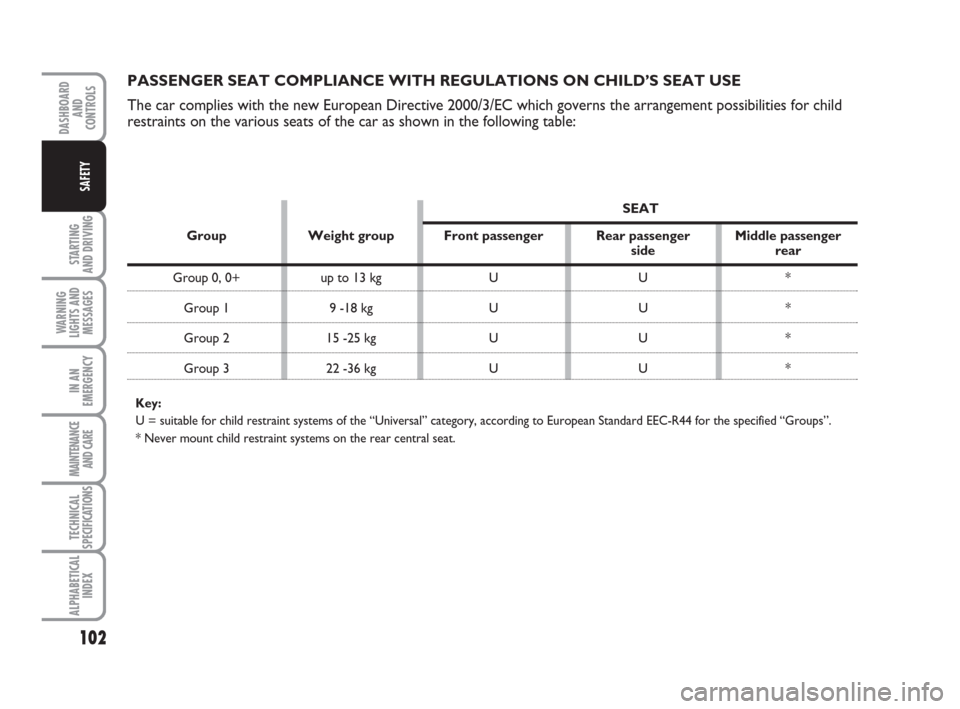
PASSENGER SEAT COMPLIANCE WITH REGULATIONS ON CHILD’S SEAT USE
The car complies with the new European Directive 2000/3/EC which governs the arrangement possibilities for child
restraints on the various seats of the car as shown in the following table:
SEAT
Group Weight group Front passenger Rear passenger Middle passenger
side rear
Group 0, 0+ up to 13 kg U U *
Group 1 9 -18 kg U U *
Group 2 15 -25 kg U U *
Group 3 22 -36 kg U U *
Key:
U = suitable for child restraint systems of the “Universal” category, according to European Standard EEC-R44 for the specified “Groups”.
* Never mount child restraint systems on the rear central seat.
Page 104 of 210
103
STARTING
AND DRIVING
WARNING
LIGHTS AND
MESSAGES
IN AN
EMERGENCY
MAINTENANCE
AND CARE
TECHNICAL
SPECIFICATIONS
ALPHABETICAL
INDEX
DASHBOARD
AND
CONTROLS
SAFETY
Below is a summary of the
rules of safety to be followed for
carrying children:
❒The recommended position for in-
stalling child’s seat is on the rear seat,
as it is the most protected in the ca-
se of a crash.
❒If the passenger’s air bag is deactivated
always check the amber warning light
“on the cluster to make sure that it
has actually been deactivated.
❒Carefully follow the instructions sup-
plied with the child restraint system
which are mandatory by law. Keep the
instructions in the car along with the
other papers and this handbook. Do
not use child seats without instruc-
tions.
❒Always check the seat belt is well fa-
stened by pulling the webbing.
❒Only one child is to be strapped to ea-
ch retaining system.
❒Always check the seat belts do not fit
around the child’s throat.
❒While travelling, do not let the child
sit incorrectly or release the belts.
❒Never carry children on your lap, even
newborns. No-one, however strong,
can hold a child in the event of an ac-
cident.
❒In case of an accident, replace the
child’s seat with a new one.
Do not place a cradle seat
facing backwards on the
front seat if the passenger side airbag
is on. Deployment of the airbag in an
accident could cause fatal injuries to
the baby regardless of the severity of
the collision. It is advisable to carry
children in an appropriate restraint
system on the rear seat which is the
most protected position in the event
of an accident.
WARNING
“ISOFIX” CHILD
RESTRAINT
ASSEMBLY SETUP
This car is preset for mounting the Uni-
versal Isofix child restraint system, a new
European standardised system for carrying
children safely.
It is possible to fit either traditional re-
straint systems and “Isofix” restraint sy-
stems.
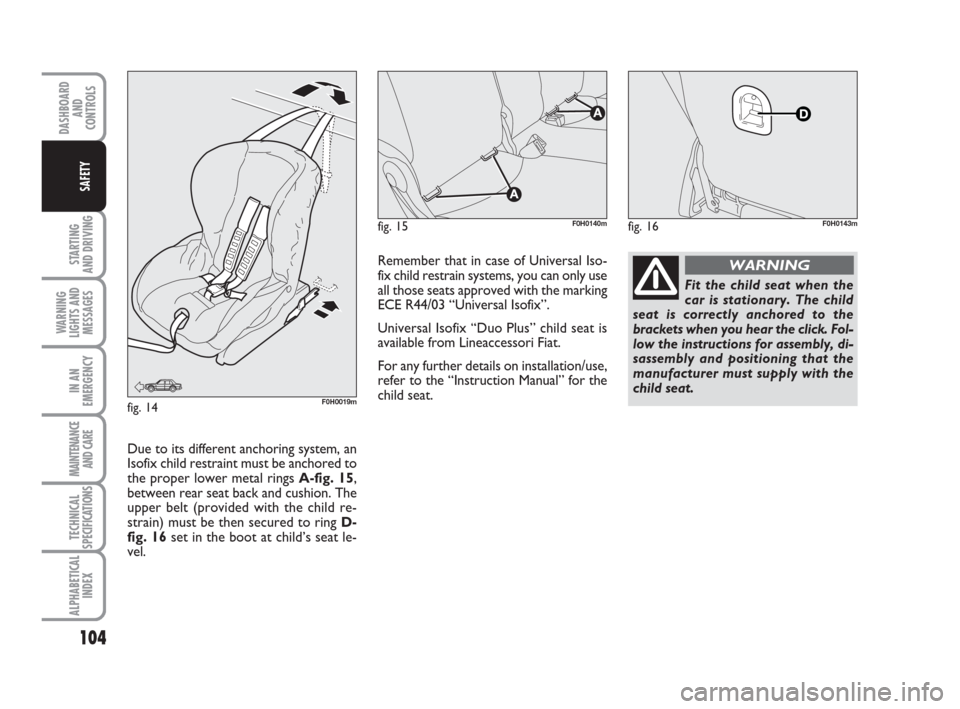
An example of child seat is shown in
Fig. 14.
The Universal Isofix child’s seat covers
weight group: 1.
Specific Isofix systems are provided for the
other weight classes and may be used only
if specifically designed, tested and appro-
ved for use on this car (see list of cars at-
tached to the child restraint).
Page 105 of 210
104
STARTING
AND DRIVING
WARNING
LIGHTS AND
MESSAGES
IN AN
EMERGENCY
MAINTENANCE
AND CARE
TECHNICAL
SPECIFICATIONS
ALPHABETICAL
INDEX
DASHBOARD
AND
CONTROLS
SAFETY
fig. 15F0H0140m
Fit the child seat when the
car is stationary. The child
seat is correctly anchored to the
brackets when you hear the click. Fol-
low the instructions for assembly, di-
sassembly and positioning that the
manufacturer must supply with the
child seat.
WARNING
fig. 14F0H0019m
Due to its different anchoring system, an
Isofix child restraint must be anchored to
the proper lower metal rings A-fig. 15,
between rear seat back and cushion. The
upper belt (provided with the child re-
strain) must be then secured to ring D-
fig. 16set in the boot at child’s seat le-
vel.
fig. 16F0H0143m
Remember that in case of Universal Iso-
fix child restrain systems, you can only use
all those seats approved with the marking
ECE R44/03 “Universal Isofix”.
Universal Isofix “Duo Plus” child seat is
available from Lineaccessori Fiat.
For any further details on installation/use,
refer to the “Instruction Manual” for the
child seat.
Page 106 of 210

105
STARTING
AND DRIVING
WARNING
LIGHTS AND
MESSAGES
IN AN
EMERGENCY
MAINTENANCE
AND CARE
TECHNICAL
SPECIFICATIONS
ALPHABETICAL
INDEX
DASHBOARD
AND
CONTROLS
SAFETY
PASSENGER SEAT COMPLIANCE WITH REGULATIONS ON UNIVERSAL ISOFIX CHILD SEAT USE
The table below, according to ECE 16 European Directive, shows the different installation possibilities of Isofix restraint systems
on seats fitted with Universal Isofix fasteners.
Weight group Orientation Isofix position class
seat Isofix size side rear
Group 0 to 10 kg
Group 0+ up to 13 kg
Group I from 9
up to 18 kg
Facing backwards
Facing backwards
Facing backwards
Facing backwards
Facing backwards
Facing backwards
Facing forwards
Facing forwards
Facing forwardsE
E
D
C
D
C
B
B1
AIL
IL
IL
IL (*)
IL
IL (*)
IUF
IUF
IUF
IUF suitable for Isofix child restraint systems to be set facing forwards, universal class (fitted with third upper fastener), ap-
proved for the weight group.
IL: suitable for special child restraint systems. Isofix type suitable and tested for this type of car. The seat may be installed by
moving the front seat forward.
(*) Arrange the Isofix seat with the front seat in all up position.
Page 109 of 210
108
STARTING
AND DRIVING
WARNING
LIGHTS AND
MESSAGES
IN AN
EMERGENCY
MAINTENANCE
AND CARE
TECHNICAL
SPECIFICATIONS
ALPHABETICAL
INDEX
DASHBOARD
AND
CONTROLS
SAFETY
To deactivate the passen-
ger’s front air bag and the si-
de bag (where provided), refer to
“”Multifunctional display” paragraph
in the “Dashboard and controls”
chapter.
WARNING
MANUAL DEACTIVATION OF
PASSENGER’S FRONT AIRBAG
AND SIDE BAG
(where provided)
Should it be absolutely necessary to carry
a child on the front seat, the passenger’s
front air bag and the Side Bag (where pro-
vided) can be deactivated.
The instrument panel warning light
“ill
stay on glowing steadily until reactiva-
ting the passenger’s front air bag and the
Side Bag (where provided).
SIDE AIRBAGS (Side
bags - Window bags)
(where provided)
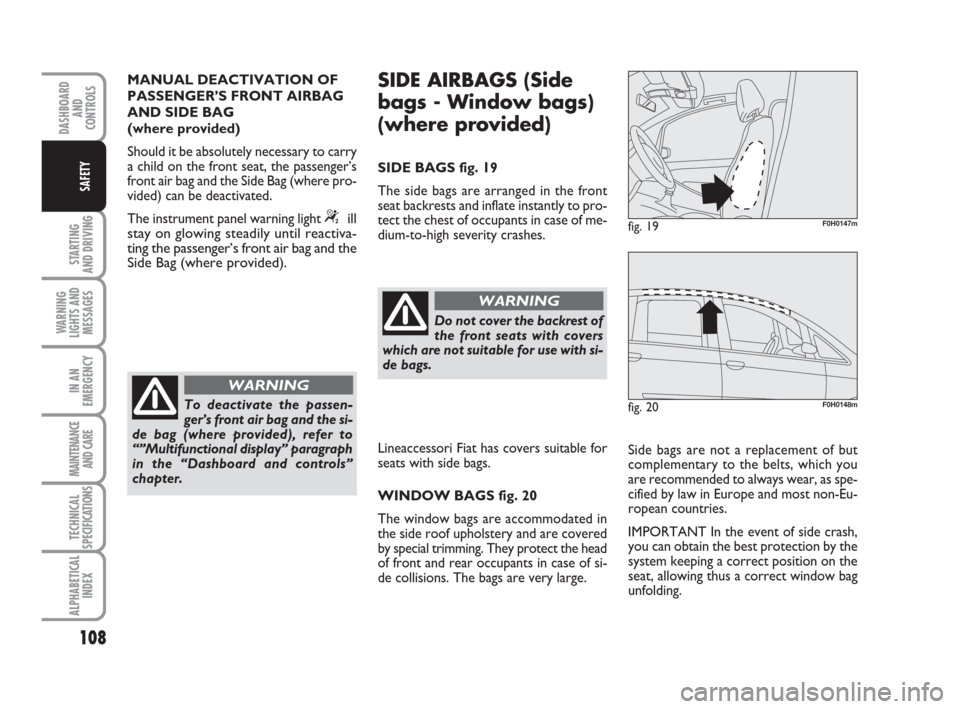
SIDE BAGS fig. 19
The side bags are arranged in the front
seat backrests and inflate instantly to pro-
tect the chest of occupants in case of me-
dium-to-high severity crashes.
Side bags are not a replacement of but
complementary to the belts, which you
are recommended to always wear, as spe-
cified by law in Europe and most non-Eu-
ropean countries.
IMPORTANT In the event of side crash,
you can obtain the best protection by the
system keeping a correct position on the
seat, allowing thus a correct window bag
unfolding.
Do not cover the backrest of
the front seats with covers
which are not suitable for use with si-
de bags.
WARNING
Lineaccessori Fiat has covers suitable for
seats with side bags.
WINDOW BAGS fig. 20
The window bags are accommodated in
the side roof upholstery and are covered
by special trimming. They protect the head
of front and rear occupants in case of si-
de collisions. The bags are very large.
fig. 19F0H0147m
fig. 20F0H0148m
Page 110 of 210
109
STARTING
AND DRIVING
WARNING
LIGHTS AND
MESSAGES
IN AN
EMERGENCY
MAINTENANCE
AND CARE
TECHNICAL
SPECIFICATIONS
ALPHABETICAL
INDEX
DASHBOARD
AND
CONTROLS
SAFETY
IMPORTANT The front air bags and/or si-
de bags may be deployed if the car is
subject to heavy knocks or accidents in-
volving the underbody area, such as for
example violent shocks, against steps,
kerbs or low obstacles, falling of the car in
big holes or sags in the road.
IMPORTANT A small amount of dust will
be released when the airbags are de-
ployed. The dust is not harmful and does
not indicate the beginning of a fire.
Furthermore, the surface of the deployed
bag and the interior of the car may be co-
vered in a dusty residue: This dust may ir-
ritate the skin and the eyes. Wash with
mild soap and water in the event of ex-
posure.
The airbag system expires after 14 years
(charge) and 10 years (clock contact). Go
to a Fiat Dealership to have the devices
replaced when the expiration date ap-
proaches.
IMPORTANT Should an accident occur in
which any of the safety devices is activa-
ted, take the car to a Fiat Dealership to
have the devices activated replaced and to
have the system checked.
Every control, repair and replacement
operations concerning the air bags must
only be carried out c/o Fiat Dealership.If you are having the car scrapped, have
the air bag system deactivated at a Fiat
Dealership first. If the car changes ow-
nership, the new owner must be informed
of the method of use of air bags and the
above warnings and also be given this
“Owner‘s Handbook”.
IMPORTANT Pretensioners, front airbags
and front side bags are deployed differen-
tly according to the type of collision. Non
deployment of one of the devices does not
therefore indicate a system fault.
Do not rest your head, arms
or elbows on the door, on
the windows and in the window bag
area to prevent injury in case of de-
ployment.
WARNING
Never lean head, arms and
elbows out of window.
WARNING
If when turning the key to
MAR the warning light
¬does not turn on or stays on whilst
driving (together with the message in
the multifunctional display, where
provided), a failure may have occur-
red in the restraint systems. In this ca-
se the air bags or pretensioners may
not be deployed after an impact or,
in a minor number of cases, they may
be deployed accidentally. Contact a
Fiat Dealership immediately to have
the system checked.
WARNING
GENERAL WARNINGS
Do not cover the backrest of
the front seats with covers
which are not suitable for use with si-
de bags.
WARNING
Always drive holding your
hands on the steering wheel
rim so that the airbag can inflate
freely in the case of need. Do not dri-
ve with your body bent forward. Keep
your back straight against the back
rest.
WARNING
Page 111 of 210
110
STARTING
AND DRIVING
WARNING
LIGHTS AND
MESSAGES
IN AN
EMERGENCY
MAINTENANCE
AND CARE
TECHNICAL
SPECIFICATIONS
ALPHABETICAL
INDEX
DASHBOARD
AND
CONTROLS
SAFETY
Have the airbag system
checked by a Fiat Dealership
if the car was stolen, if theft was at-
tempted, or if the car was subjected
to vandalism or flooding.
WARNING
Airbags may be deployed if
another vehicle crashes if the
key is inserted and at MAR also if the
engine is not running and the car is
stationary. For this reason, children
must never sit on the front seat, even
if the car is not moving. On the other
hand, if the key is inserted and at
STOP, none of the safety devices (air-
bag or pretensioners) will be deployed
in a collision. Non deployment of the
devices in this case does not indicate
a system fault.
WARNING
Do not travel carrying
objects in your lap, in front
of your chest or between your lips (pi-
pe, pencils, etc.): they could cause se-
vere injury if the airbag is deployed.
WARNING
When the ignition key is tur-
ned to MAR, the warning li-
ght
“(with passenger’s front air bag
active) turns on and flashes for few
seconds to remind that passenger’s air
bag will be deployed in a crash, af-
ter which it should go off.
WARNING
Do not wash the seats with
water or steam under pres-
sure (by hand or in automatic wa-
shing station for seats).
WARNING
Front air bag deployment
takes place at a higher level
of impact than the pretensioners. For
collisions in the range between the
two thresholds, it is normal for only
the pretensioners to be activated.
WARNING
Do not attach rigid objects
to the coat hooks and sup-
port handles.
WARNING
An airbag is not a replace-
ment for the seat belts but
increases their efficiency. Furthermo-
re, since front air bags are not de-
ployed in low speed collisions, side
collisions, rear-end shunts or roll-
overs, the passengers are only pro-
tected by the seat belts which must
be fastened at all times.
WARNING
Page 115 of 210
114
WARNING
LIGHTS AND
MESSAGES
IN AN
EMERGENCY
MAINTENANCE
AND CARE
TECHNICAL
SPECIFICATIONS
ALPHABETICAL
INDEX
DASHBOARD
AND
CONTROLS
SAFETY
STARTING
AND DRIVING
PARKING THE VEHICLE
Proceed as follows:
❒Stop the engine and engage the hand-
brake;
❒Engage a gear (on a slope, engage fir-
st gear if the vehicle is faced uphill or
reverse if it is faced downhill) and lea-
ve the wheels steered.
If the car is parked on a steep slope, it is
further advisable to block the wheels with
a wedge or stone. Avoid parking for a long
time with one wheel on the pavement or
steered against the kerb. Do not leave the
key in the ignition switch at MARto pre-
vent draining the battery. Always remo-
ve the key when you leave the car.
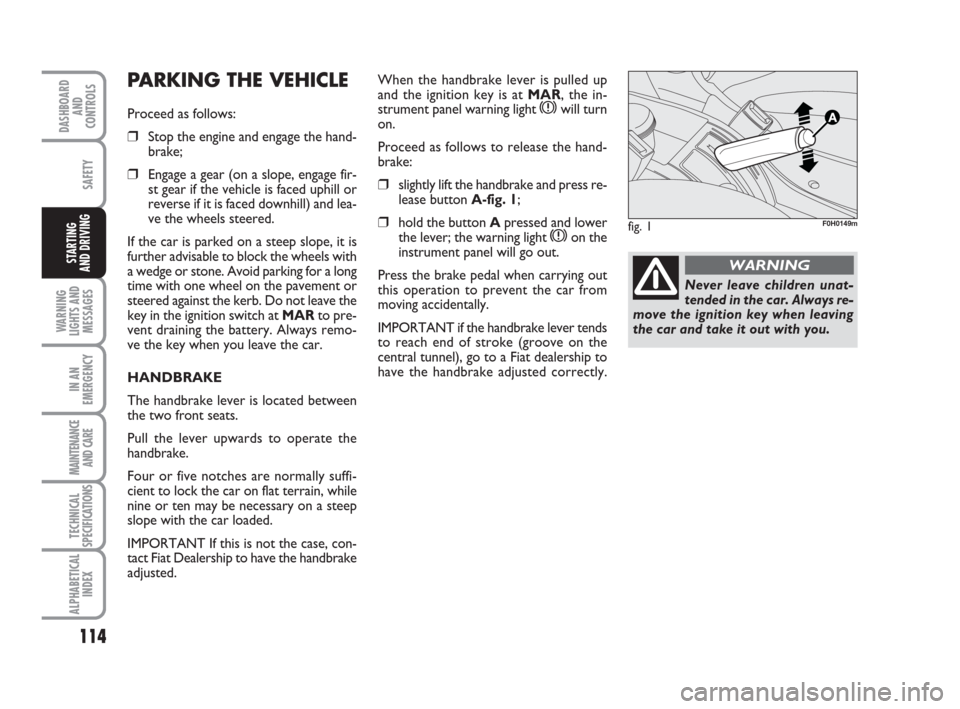
HANDBRAKE
The handbrake lever is located between
the two front seats.
Pull the lever upwards to operate the
handbrake.
Four or five notches are normally suffi-
cient to lock the car on flat terrain, while
nine or ten may be necessary on a steep
slope with the car loaded.
IMPORTANT If this is not the case, con-
tact Fiat Dealership to have the handbrake
adjusted.When the handbrake lever is pulled up
and the ignition key is at MAR, the in-
strument panel warning light
xwill turn
on.
Proceed as follows to release the hand-
brake:
❒slightly lift the handbrake and press re-
lease button A-fig. 1;
❒hold the button Apressed and lower
the lever; the warning light
xon the
instrument panel will go out.
Press the brake pedal when carrying out
this operation to prevent the car from
moving accidentally.
IMPORTANT if the handbrake lever tends
to reach end of stroke (groove on the
central tunnel), go to a Fiat dealership to
have the handbrake adjusted correctly.fig. 1F0H0149m
Never leave children unat-
tended in the car. Always re-
move the ignition key when leaving
the car and take it out with you.
WARNING