oil level FIAT IDEA 2009 1.G Owners Manual
[x] Cancel search | Manufacturer: FIAT, Model Year: 2009, Model line: IDEA, Model: FIAT IDEA 2009 1.GPages: 210, PDF Size: 3.62 MB
Page 32 of 210
31
SAFETY
STARTING
AND DRIVING
WARNING
LIGHTS AND
MESSAGES
IN AN
EMERGENCY
MAINTENANCE
AND CARE
TECHNICAL
SPECIFICATIONS
ALPHABETICAL
INDEX
DASHBOARD
AND CONTROLS
Adjust the button volume
(Button Vol.)
This function is used to set the volume of
the roger-beep accompanying the activa-
tion of buttons MODE, +e –through 8
levels.
To set the desired volume, proceed as fol-
lows:
– briefly press button MODE: the previ-
ously set volume “level” starts flashing on
the display;
– press button +or –to set;
– briefly press button MODEto go back
to the menu screen or press the button
for a prolonged time to go back to the
standard screen without storing the set-
tings.
S.B.R. buzzer reactivation (Belt
Buzzer) (where provided)
This function can be only displayed after a
Fiat Dealership has deactivated the S.B.R.
system (see paragraph “S.B.R. system” in
section “Safety devices”).The indications will appear more fre-
quently where there are 200 km left. For
1.3 Multijet versions, refer to the “Service
Schedule” in the “Maintenance and care”
chapter for replacing the air cleaner, the
engine oil and the engine oil filter. The in-
dication will appear in kilometres or miles
according to the settings. When the next
scheduled service operation is approach-
ing, the message “Service” will appear on
the display followed by the number of kilo-
metres or miles left when the key is
turned to MAR. The “Service Schedule”
information is provided with kilometres
(km)/miles (mi) or days (dd), according to
the deadline which appears first. Go to a
Fiat Dealership where the “Scheduled Ser-
vice” operations will be performed and the
message will be reset. Scheduled Servicing (Service)
This function may be used to display in-
formation connected to proper car ser-
vicing in terms of kilometres or days.
This information can be consulted as fol-
lows:
–briefly press button MODE: service in
km or mi, according to previous setting,
will be displayed (see paragraph “Units”);
– press button +or –to set deadline in
days;
– briefly press button MODEto go back
to the menu screen or hold the button
pressed to go back to the standard screen.
Note The “Service Schedule” requires the
car to be services every 20,000 km (or
equivalent distance in miles) or once a
year. This message will appear automati-
cally with key at MARafter 2,000 km (or
equivalent distance in miles) or 30 before
the deadline and will appear every 200 km
(or equivalent distance in miles) or 3 days.
Page 117 of 210
116
WARNING
LIGHTS AND
MESSAGES
IN AN
EMERGENCY
MAINTENANCE
AND CARE
TECHNICAL
SPECIFICATIONS
ALPHABETICAL
INDEX
DASHBOARD
AND
CONTROLS
SAFETY
STARTING
AND DRIVING
CONTAINING
RUNNING COSTS
Here are some suggestions which may
help you to keep the running costs of your
vehicle down and lower the amount of
toxic emissions released into the atmo-
sphere.
GENERAL CONSIDERATIONS
Car maintenance
Have checks and adjustments carried out
in accordance with the “Service schedu-
le”.
Tyres
Check tyre pressure regularly, at least on-
ce every four weeks: excessively low pres-
sure will increase fuel consumption be-
cause rolling resistance will be higher.
Unnecessary loads
Do not travel with an overloaded boot.
Do not travel with too much luggage
stowed in the boot. The weight of the car
(especially when driving in town) and its
trim greatly affects consumption and sta-
bility.Roof rack/ski rack
Remove the roof rack or the ski rack from
the roof after use. These accessories de-
crease aerodynamic penetration of the car
and have a negative effect on consumption.
It is better to use a trailer to transport
particularly bulky objects.
Electrical devices
Use electrical devices only for the amount
of time needed. Rear heated window, ad-
ditional headlights, windscreen wipers and
heater fan need a considerable amount of
energy, therefore increasing the require-
ment of current increases fuel consump-
tion (up to +25% in the urban cycle).
Climate control
The climate control system requires hi-
gher fuel consumption (up to +20% in ave-
rage): use the air vents when the exter-
nal temperature allows to.
Spoilers
The use of non-certified aerodynamic
items may adversely affect air drag and fuel
consumption levels.DRIVING STYLE
Starting
Do not warm the engine up with the car
standing: the engine warms up very slowly
in these conditions, increasing fuel con-
sumption and emissions. It is advisable to
start off immediately and slowly keeping
the engine speed down: the engine will
warm up much faster this way.
Unnecessary actions
Avoid revving up when starting at traffic
lights or before stopping the engine. The
latter action, like doubling the clutch, is un-
necessary and causes increase of con-
sumption and pollution.
Gear selection
Use a higher gear as soon as traffic and
road conditions allow. Using a low gear
for faster acceleration will increase fuel
consumption.
In the same way improper use of a high
gear increases consumption, emissions an
engine wear.
Page 124 of 210
123
STARTING
AND DRIVING
IN AN
EMERGENCY
MAINTENANCE
AND CARE
TECHNICAL
SPECIFICATIONS
ALPHABETICAL
INDEX
DASHBOARD
AND
CONTROLS
SAFETY
WARNING
LIGHTS AND
MESSAGES
GENERAL WARNINGS ...................................................... 124
LOW BRAKE FLUID LEVEL ............................................... 124
HANDBRAKE APPLIED ...................................................... 124
AIRBAG FAILURE ................................................................. 124
HOT ENGINE COOLANT ............................................... 125
LOW BATTERY CHARGE................................................. 125
LOW ENGINE OIL PRESSURE -
EXHAUSTED OIL .............................................................. 126
“DUALDRIVE” ELECTRIC POWER STEERING
SYSTEM ................................................................................... 126
DOOR OPEN ........................................................................ 126
SEAT BELTS NOT FASTENED ........................................ 126
EBD FAILURE......................................................................... 127
EOBD/INJECTION SYSTEM FAILURE ............................ 127
FRONT PASSENGER AIRBAG DEACTIVATED ......... 128
ABS FAILURE ......................................................................... 128
FUEL RESERVE....................................................................... 128
GLOW PLUGS ...................................................................... 129
GLOW PLUG FAILURE ...................................................... 129
WATER IN DIESEL FUEL FILTER ..................................... 129
CAR PROTECTION SYSTEM
FAILURE - FIAT CODE ...................................................... 129
REAR FOG LIGHTS ............................................................. 129
GENERIC INDICATION .................................................... 130
WORN BRAKE PADS ......................................................... 131
W W
A A
R R
N N
I I
N N
G G
L L
I I
G G
H H
T T
S S
A A
N N
D D
M M
E E
S S
S S
A A
G G
E E
S S
OBSTRUCTED PARTICULATE TRAP ............................ 131
SIDE/TAIL LIGHTS AND
DIPPED BEAM HEADLIGHTS - FOLLOW ME HOME 131
FOG LIGHTS ......................................................................... 131
LEFT-HAND DIRECTION INDICATOR ....................... 131
RIGHT-HAND DIRECTION INDICATOR ................... 131
“DUALDRIVE” ELECTRIC POWER STEERING
SYSTEM ON .......................................................................... 132
CRUISE CONTROL ............................................................ 132
MAIN BEAM HEADLIGHTS............................................... 132
POSSIBLE ICE ON ROAD.................................................. 132
LIMITED RANGE .................................................................. 132
Page 166 of 210
165
STARTING
AND DRIVING
IN AN
EMERGENCY
TECHNICAL
SPECIFICATIONS
ALPHABETICAL
INDEX
DASHBOARD
AND
CONTROLS
SAFETY
WARNING
LIGHTS AND
MESSAGES
MAINTENANCE
AND CARE
YEARLY INSPECTION
PLAN
The following yearly inspection plan is re-
commended for cars clocking less than
20,000 km a year (e.g. approximately
15.000 km):
❒check tyre conditions/wear and pres-
sure (included spare wheel)
❒check lighting system operation (head-
lights, direction indicators, hazard li-
ghts, boot, passenger compartment,
instrument panel warning lights, etc.)
❒check windscreen wiper/washer
(nozzle direction and blade wear)
❒check front disk brake pad conditions
and wear;
❒visually inspect the conditions of: en-
gine, gearbox, flexible and stiff piping
(exhaust, fuel feed, brakes), rubber
parts (boots, sleeves, bushings, etc.)
❒check cleanness of locks, bonnet and
boot and lever cleanness and lubrica-
tion
❒check battery charge;
❒visually check the various drive belt
conditions;
❒check and top up liquids if required
(engine coolant, brakes, windscreen
washer, battery, etc.)
❒change engine oil;
❒change engine oil filter;
❒change pollen filter (where provided).
ADDITIONAL
INTERVENTIONS
Every 1,000 km or before long journeys,
check and, if necessary, top up:
❒engine coolant fluid level;
❒brake fluid level;
❒windscreen washer fluid level;
❒tyre pressure and conditions.
Every 3,000 km check and, if necessary,
top up: engine oil level.
You are recommended to use FL Selenia
products, designed and produced specifi-
cally for Fiat cars (see table “Capacities”
in section “Technical specifications”).
Page 167 of 210
166
STARTING
AND DRIVING
IN AN
EMERGENCY
TECHNICAL
SPECIFICATIONS
ALPHABETICAL
INDEX
DASHBOARD
AND
CONTROLS
SAFETY
WARNING
LIGHTS AND
MESSAGES
MAINTENANCE
AND CARE
IMPORTANT - Engine oil
Should prevailing use of the car be under
one of the following specially heavy con-
ditions:
❒trailer or caravan towing;
❒dusty roads;
❒short repeated distances (less than 7-
8 km) and with external temperatures
below zero;
❒frequently idling engines or long di-
stance low speed driving (e.g. taxis or
door-to-door deliveries) or in case of
a long term inactivity;
change engine oil more frequently than
shown on the “Service Schedule”.
IMPORTANT - Air cleaner
When the car is used on dusty roads,
change the air cleaner more frequently
than shown on the “Service Schedule”.
Call a Fiat Dealership for doubts regarding
engine oil and air cleaner replacement.IMPORTANT - Pollen filter
It is advisable to replace the filtering ele-
ment more frequently if the car is used in
dusty or very polluted places. Specifical-
ly, replace if a lower air flow into the pas-
senger compartment is found.
IMPORTANT - Diesel filter
Using diesel not complying with European
Specification EN590 may lead to the need
to replace the diesel fuel filter more fre-
quently than shown in the “Service Sche-
dule”.IMPORTANT - Battery
Check the battery charge once a year,
preferably before the beginning to winter,
to prevent freezing of the electrolyte.
Perform this inspection more frequently
if the car is mainly used for short distan-
ces or if electrical devices running with the
key off are installed, particularly after-
market. Check the battery level (elec-
trolyte) more frequently than shown on
the “Service Schedule” if the car is used in
hot climates or in particularly demanding
conditions.
Take the car to a Fiat Dea-
lership for servicing. Make su-
re you have the right equip-
ment, genuine Fiat spare
parts and consumables for ordinary,
minor interventions. Do not attempt
the operations if you lack the expe-
rience.
Page 168 of 210
167
STARTING
AND DRIVING
IN AN
EMERGENCY
TECHNICAL
SPECIFICATIONS
ALPHABETICAL
INDEX
DASHBOARD
AND
CONTROLS
SAFETY
WARNING
LIGHTS AND
MESSAGES
MAINTENANCE
AND CARE
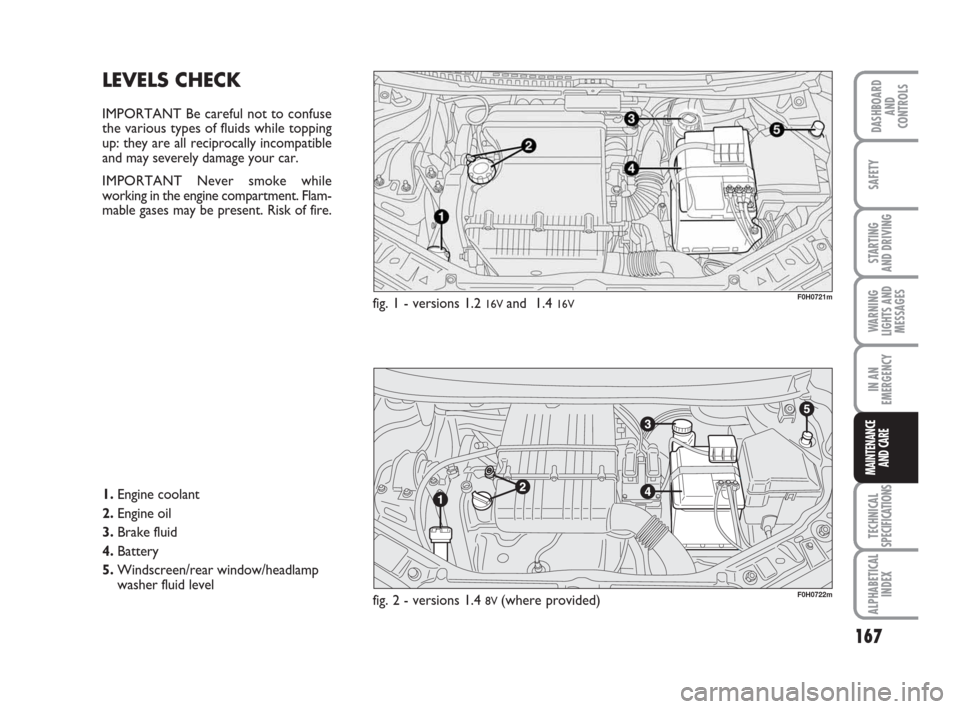
LEVELS CHECK
IMPORTANT Be careful not to confuse
the various types of fluids while topping
up: they are all reciprocally incompatible
and may severely damage your car.
IMPORTANT Never smoke while
working in the engine compartment. Flam-
mable gases may be present. Risk of fire.
F0H0721mfig. 1 - versions 1.2 16V and 1.4 16V
F0H0722mfig. 2 - versions 1.4 8V (where provided) 1. Engine coolant
2. Engine oil
3. Brake fluid
4. Battery
5.Windscreen/rear window/headlamp
washer fluid level
Page 169 of 210
168
STARTING
AND DRIVING
IN AN
EMERGENCY
TECHNICAL
SPECIFICATIONS
ALPHABETICAL
INDEX
DASHBOARD
AND
CONTROLS
SAFETY
WARNING
LIGHTS AND
MESSAGES
MAINTENANCE
AND CARE
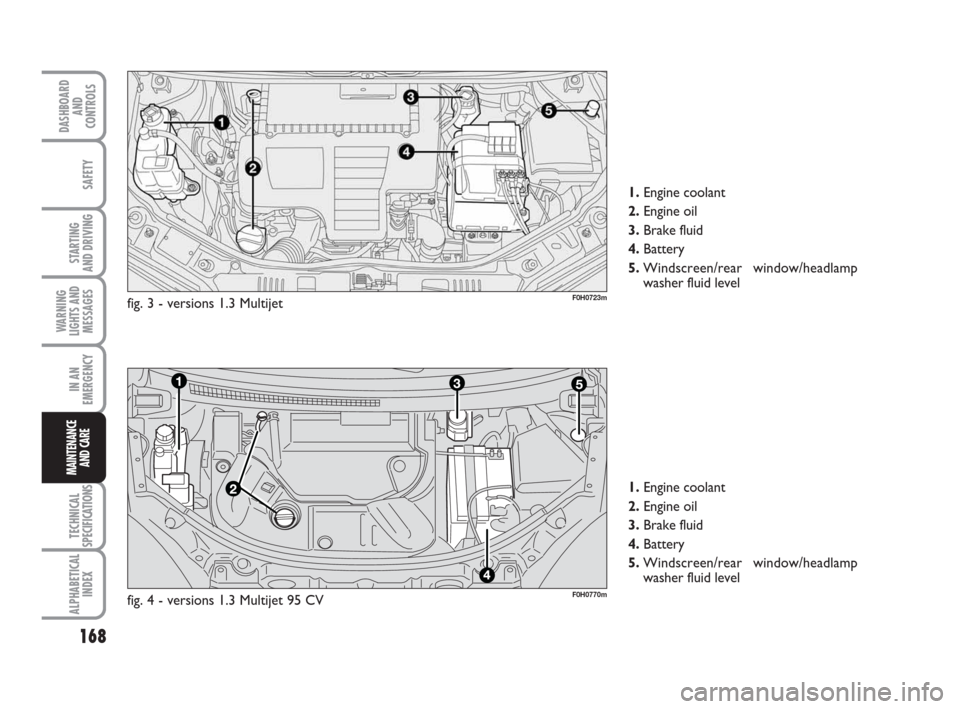
F0H0723mfig. 3 - versions 1.3 Multijet 1. Engine coolant
2. Engine oil
3. Brake fluid
4. Battery
5.Windscreen/rear window/headlamp
washer fluid level
F0H0770mfig. 4 - versions 1.3 Multijet 95 CV 1. Engine coolant
2.Engine oil
3. Brake fluid
4. Battery
5.Windscreen/rear window/headlamp
washer fluid level
Page 170 of 210
169
STARTING
AND DRIVING
IN AN
EMERGENCY
TECHNICAL
SPECIFICATIONS
ALPHABETICAL
INDEX
DASHBOARD
AND
CONTROLS
SAFETY
WARNING
LIGHTS AND
MESSAGES
MAINTENANCE
AND CARE
3
12
45
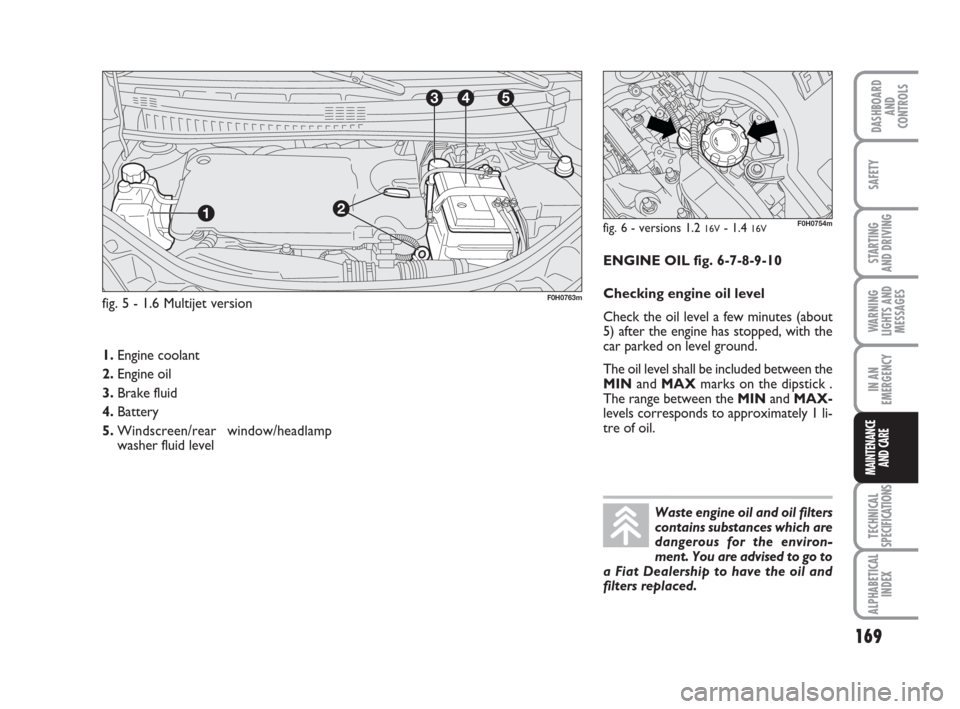
F0H0763mfig. 5 - 1.6 Multijet version
1. Engine coolant
2. Engine oil
3. Brake fluid
4. Battery
5.Windscreen/rear window/headlamp
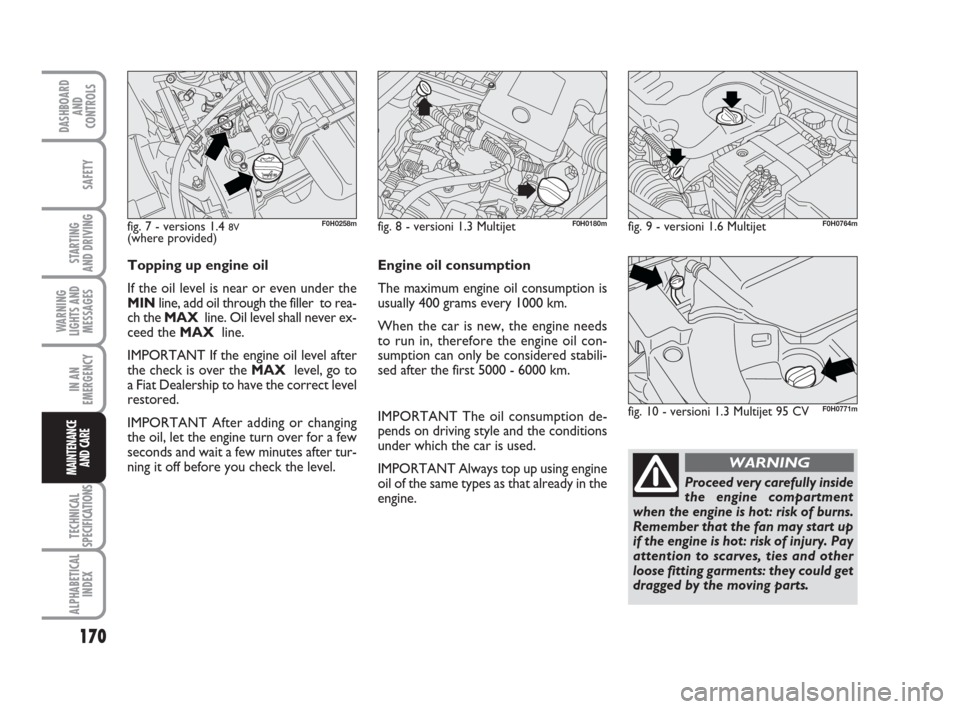
washer fluid levelENGINE OIL fig. 6-7-8-9-10
Checking engine oil level
Check the oil level a few minutes (about
5) after the engine has stopped, with the
car parked on level ground.
The oil level shall be included between the
MINand MAXmarks on the dipstick .
The range between the MINand MAX-
levels corresponds to approximately 1 li-
tre of oil.
fig. 6 - versions 1.2 16V- 1.4 16VF0H0754m
Waste engine oil and oil filters
contains substances which are
dangerous for the environ-
ment. You are advised to go to
a Fiat Dealership to have the oil and
filters replaced.
Page 171 of 210
170
STARTING
AND DRIVING
IN AN
EMERGENCY
TECHNICAL
SPECIFICATIONS
ALPHABETICAL
INDEX
DASHBOARD
AND
CONTROLS
SAFETY
WARNING
LIGHTS AND
MESSAGES
MAINTENANCE
AND CAREProceed very carefully inside
the engine compartment
when the engine is hot: risk of burns.
Remember that the fan may start up
if the engine is hot: risk of injury. Pay
attention to scarves, ties and other
loose fitting garments: they could get
dragged by the moving parts.
WARNING
Engine oil consumption
The maximum engine oil consumption is
usually 400 grams every 1000 km.
When the car is new, the engine needs
to run in, therefore the engine oil con-
sumption can only be considered stabili-
sed after the first 5000 - 6000 km.
IMPORTANT The oil consumption de-
pends on driving style and the conditions
under which the car is used.
IMPORTANT Always top up using engine
oil of the same types as that already in the
engine.
fig. 8 - versioni 1.3 MultijetF0H0180mfig. 9 - versioni 1.6 MultijetF0H0764m
fig. 10 - versioni 1.3 Multijet 95 CV F0H0771m
fig. 7 - versions 1.4 8V(where provided)
F0H0258m
Topping up engine oil
If the oil level is near or even under the
MINline, add oil through the filler to rea-
ch the MAXline. Oil level shall never ex-
ceed the MAXline.
IMPORTANT If the engine oil level after
the check is over the MAXlevel, go to
a Fiat Dealership to have the correct level
restored.
IMPORTANT After adding or changing
the oil, let the engine turn over for a few
seconds and wait a few minutes after tur-
ning it off before you check the level.
Page 202 of 210
201
STARTING
AND DRIVING
IN AN
EMERGENCY
MAINTENANCE
AND CARE
DASHBOARD
AND
CONTROLS
SAFETY
WARNING
LIGHTS AND
MESSAGES
TECHNICAL
SPECIFICATIONS
ALPHABETICAL
INDEX
Dipped beam headlights
- bulb replacement .................. 148
- controls .................................... 58
Direction indicators .................... 59
Direction indicators
- bulb replacement .................. 148
- controls .................................... 59
Door pockets ................................ 69
Doors
- emergency device for
opening the doors from
the outside ........................ 17-134
Dualdrive
(electric power steering) ......... 87
EBD
(electronic brake distributor) ... 83
Emergency device for opening
the doors from the outside ..... 134
Engine compartment ......... 167-168
Engine coolant gauge .................. 19
Engine cooling system fluid level 170
Engine oil consumption .............. 169Engine oil level .............................. 169
Engine oil
- level check ............................... 169
- technical specifications .......... 195
Engine
- cranking ........................... 18-112
- features ..................................... 185
- identification code ................ 184
- power supply ............................ 187
Environment protection.............. 92
EOBD (system) ............................ 84
Exterior lights ............................... 58
Fiat CODE (The system) .......... 9
Fix&GO (quick tyre repair kit) . 136
Flashing the headlights ................ 58
Fluids and lubricants .................... 196
Fog lights
- bulb replacement .................. 149
- control buttons ....................... 66
Follow me home (device) ........... 59FPS (Fire Protection System) .... 67
Front air bags ................................. 106
- driver's front airbag................. 106
- front airbag passenger side.... 107
- manual deactivation of front
and side passenger airbags ... 108
Fuel cap .......................................... 91
Fuel consumption ........................ 116
Fuel savings..................................... 116
Fuel
- consumption ............................. 116
- fuel gauge .................................. 19
- inertia fuel switch ................... 67
Fuses ............................................... 153
Gearbox (use) ............................ 115
GSI system...................................... 84
Hazard warning lights
- controls .................................... 66
Head restraints ............................ 41
Headlamp alignment corrector 82