instrument panel FIAT IDEA 2010 1.G User Guide
[x] Cancel search | Manufacturer: FIAT, Model Year: 2010, Model line: IDEA, Model: FIAT IDEA 2010 1.GPages: 210, PDF Size: 4.4 MB
Page 88 of 210
87
SAFETY
STARTING
AND DRIVING
WARNING
LIGHTS AND
MESSAGES
IN AN
EMERGENCY
MAINTENANCE
AND CARE
TECHNICAL
SPECIFICATIONS
ALPHABETICAL
INDEX
DASHBOARD
AND CONTROLS
DUALDRIVE ELECTRIC
POWER STEERING
The car is provided with an electric pow-
er steering system which only works with
the key at MARand the engine running.
The system called “Dualdrive” allows to
customise the effort required to turn the
steering wheel according to driving con-
ditions.
ON/OFF (CITY function)
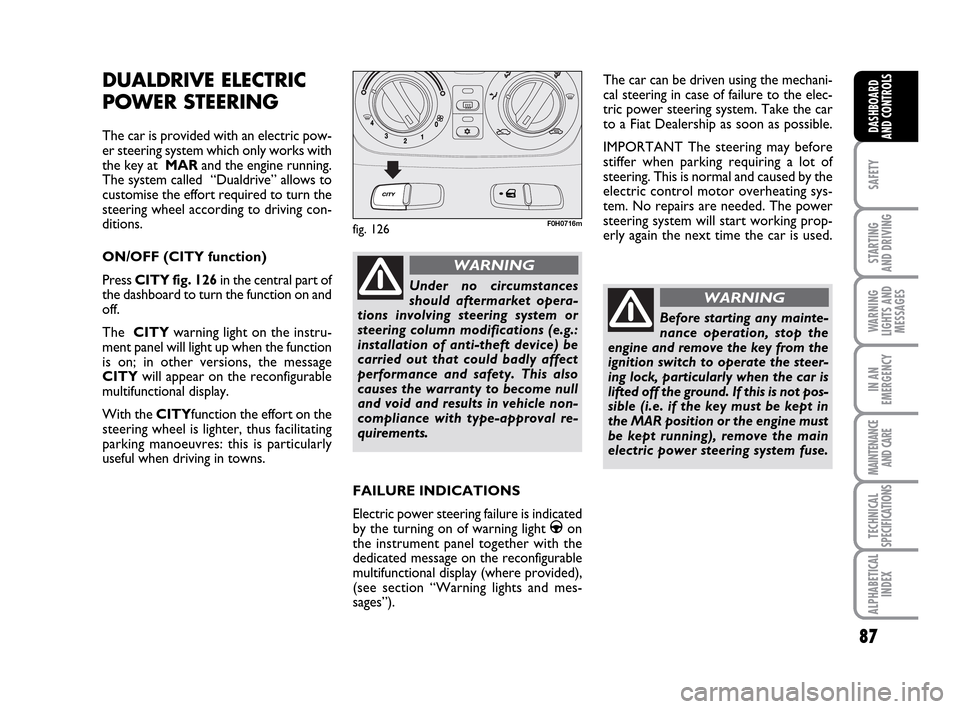
Press CITY fig. 126in the central part of
the dashboard to turn the function on and
off.
The CITYwarning light on the instru-
ment panel will light up when the function
is on; in other versions, the message
CITYwill appear on the reconfigurable
multifunctional display.
With the CITYfunction the effort on the
steering wheel is lighter, thus facilitating
parking manoeuvres: this is particularly
useful when driving in towns.
fig. 126F0H0716m
Under no circumstances
should aftermarket opera-
tions involving steering system or
steering column modifications (e.g.:
installation of anti-theft device) be
carried out that could badly affect
performance and safety. This also
causes the warranty to become null
and void and results in vehicle non-
compliance with type-approval re-
quirements.
WARNING
The car can be driven using the mechani-
cal steering in case of failure to the elec-
tric power steering system. Take the car
to a Fiat Dealership as soon as possible.
IMPORTANT The steering may before
stiffer when parking requiring a lot of
steering. This is normal and caused by the
electric control motor overheating sys-
tem. No repairs are needed. The power
steering system will start working prop-
erly again the next time the car is used.
Before starting any mainte-
nance operation, stop the
engine and remove the key from the
ignition switch to operate the steer-
ing lock, particularly when the car is
lifted off the ground. If this is not pos-
sible (i.e. if the key must be kept in
the MAR position or the engine must
be kept running), remove the main
electric power steering system fuse.
WARNING
FAILURE INDICATIONS
Electric power steering failure is indicated
by the turning on of warning light
gon
the instrument panel together with the
dedicated message on the reconfigurable
multifunctional display (where provided),
(see section “Warning lights and mes-
sages”).
036-092 LUM IDEA GB 2 ed.qxd 14-01-2010 12:15 Pagina 87
Page 109 of 210
108
STARTING
AND DRIVING
WARNING
LIGHTS AND
MESSAGES
IN AN
EMERGENCY
MAINTENANCE
AND CARE
TECHNICAL
SPECIFICATIONS
ALPHABETICAL
INDEX
DASHBOARD
AND
CONTROLS
SAFETY
To deactivate the passen-
ger’s front air bag and the
side bag (where provided), refer to
“”Multifunctional display” paragraph
in the “Dashboard and controls”
chapter.
WARNING
MANUAL DEACTIVATION OF
PASSENGER’S FRONT AIRBAG
AND SIDE BAG
(where provided)
Should it be absolutely necessary to car-
ry a child on the front seat, the passenger’s
front air bag and the Side Bag (where pro-
vided) can be deactivated.
The instrument panel warning light
“ill
stay on glowing steadily until reactivat-
ing the passenger’s front air bag and the
Side Bag (where provided).
SIDE AIRBAGS (Side
bags - Window bags)
(where provided)
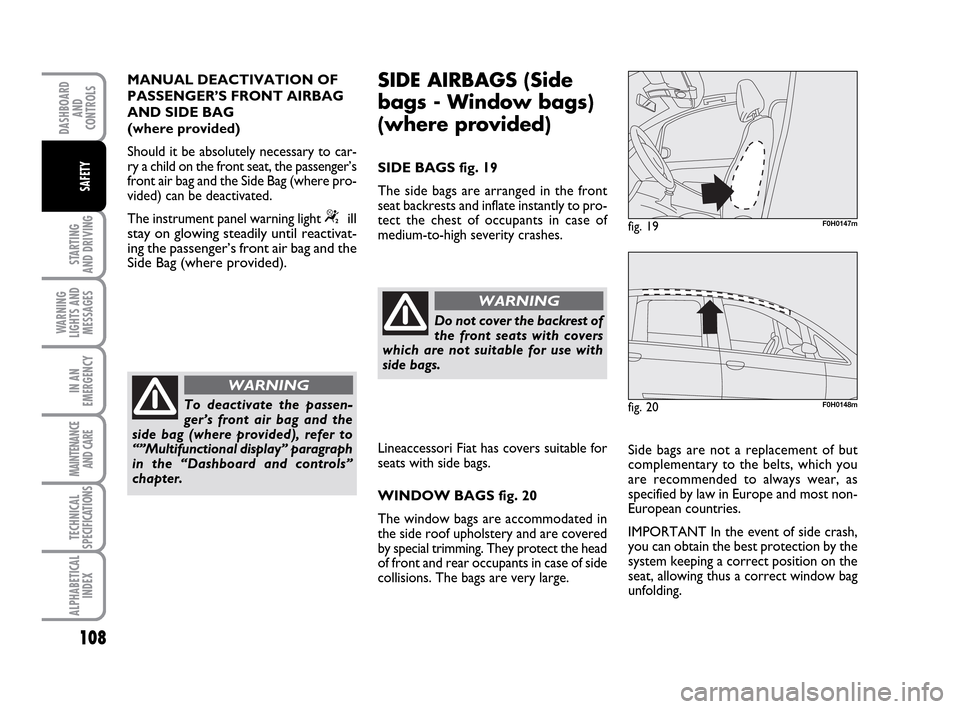
SIDE BAGS fig. 19
The side bags are arranged in the front
seat backrests and inflate instantly to pro-
tect the chest of occupants in case of
medium-to-high severity crashes.
Side bags are not a replacement of but
complementary to the belts, which you
are recommended to always wear, as
specified by law in Europe and most non-
European countries.
IMPORTANT In the event of side crash,
you can obtain the best protection by the
system keeping a correct position on the
seat, allowing thus a correct window bag
unfolding.
Do not cover the backrest of
the front seats with covers
which are not suitable for use with
side bags.
WARNING
Lineaccessori Fiat has covers suitable for
seats with side bags.
WINDOW BAGS fig. 20
The window bags are accommodated in
the side roof upholstery and are covered
by special trimming. They protect the head
of front and rear occupants in case of side
collisions. The bags are very large.
fig. 19F0H0147m
fig. 20F0H0148m
093-110 LUM IDEA GB 2 ed.qxd 14-01-2010 12:16 Pagina 108
Page 114 of 210
113
WARNING
LIGHTS AND
MESSAGES
IN AN
EMERGENCY
MAINTENANCE
AND CARE
TECHNICAL
SPECIFICATIONS
ALPHABETICAL
INDEX
DASHBOARD
AND
CONTROLS
SAFETY
STARTING
AND DRIVING
❒turn the ignition key to AVVas soon
as the warning light mturns off.
Waiting too long will waste the work
done by the heater plugs. Release the
key as soon as the engine starts.
IMPORTANT With the engine cold, the
accelerator must be entirely released
when turning the ignition key to position
AVV.
If the engine does not start at the first at-
tempt, return the ignition key to STOP
before repeating starting.
If, when the ignition key is at MAR, the
instrument panel warning light
Yre-
mains lit, turn the key to STOPand then
back to MAR; if the warning lights remain
on, try with the other keys provided with
the car.
Contact a Fiat Dealership if you still can-
not start the engine.
IMPORTANT Never leave the ignition key
to MARwhen the engine is off. Warning light
mwill blink
for 60 seconds after starting
or during prolonged cranking
to indicate a fault to the glow
plug heating system. Use the car nor-
mally if the engine starts and go to a
Fiat Dealership as soon as possible.
HOW TO WARM UP THE
ENGINE AFTER IT HAS JUST
STARTED (petrol and Multijet
engines)
Proceed as follows:
❒drive off slowly, letting the engine turn
at medium speed. Do not accelerate
abruptly;
❒do not demand maximum perfor-
mance for the first few kilometres.
Wait until the engine coolant gauge
starts moving.
STOPPING THE ENGINE
Turn the ignition to STOPwhile the en-
gine is idling.
IMPORTANT After a taxing drive, you
should allow the engine to “catch its
breath” before turning it off by letting it
idle to allow the temperature in the en-
gine compartment to fall. Never jump start the engine
by pushing, towing or driving
downhill. This could cause a
flow of fuel into the catalyt-
ic converter and damage it beyond re-
pair.
A quick burst on the acceler-
ator before turning off the en-
gine serves absolutely no
practical purpose, it wastes
fuel and is damaging especially to tur-
bocharged engines.
Remember that the brake
booster and power steering
are not operational until the engine
has been started, therefore much ef-
fort than usual is required on the
brake pedal and steering wheel.
WARNING
111-122 LUM IDEA GB 2 ed.qxd 14-01-2010 12:32 Pagina 113
Page 115 of 210
114
WARNING
LIGHTS AND
MESSAGES
IN AN
EMERGENCY
MAINTENANCE
AND CARE
TECHNICAL
SPECIFICATIONS
ALPHABETICAL
INDEX
DASHBOARD
AND
CONTROLS
SAFETY
STARTING
AND DRIVING
PARKING THE VEHICLE
Proceed as follows:
❒Stop the engine and engage the hand-
brake;
❒Engage a gear (on a slope, engage first
gear if the vehicle is faced uphill or re-
verse if it is faced downhill) and leave
the wheels steered.
If the car is parked on a steep slope, it is
further advisable to block the wheels with
a wedge or stone. Avoid parking for a long
time with one wheel on the pavement or
steered against the kerb. Do not leave the
key in the ignition switch at MARto pre-
vent draining the battery. Always remove
the key when you leave the car.
HANDBRAKE
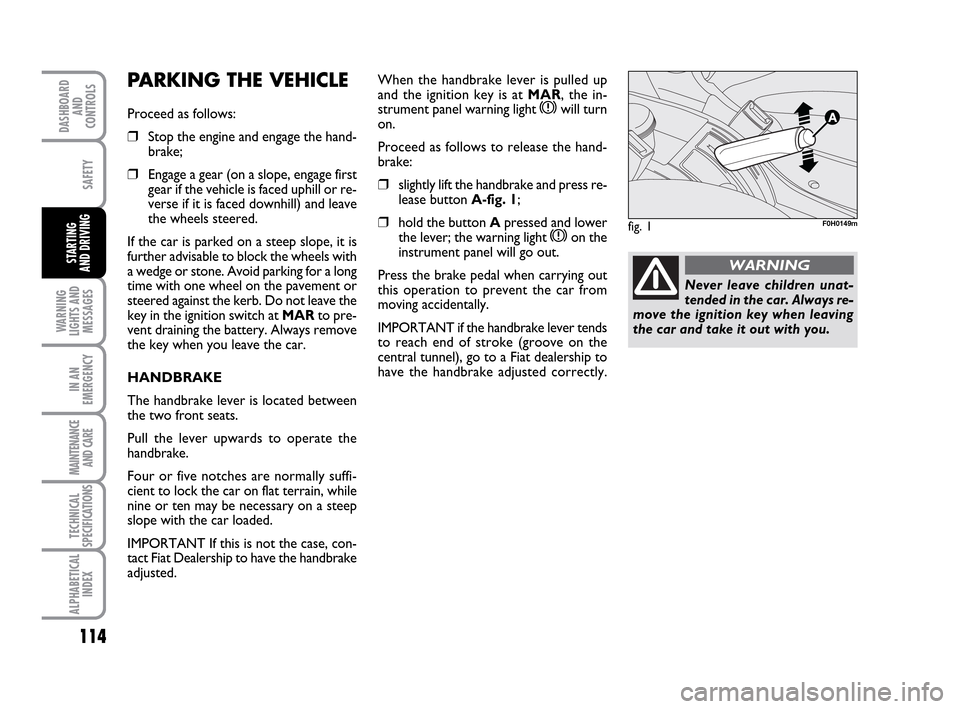
The handbrake lever is located between
the two front seats.
Pull the lever upwards to operate the
handbrake.
Four or five notches are normally suffi-
cient to lock the car on flat terrain, while
nine or ten may be necessary on a steep
slope with the car loaded.
IMPORTANT If this is not the case, con-
tact Fiat Dealership to have the handbrake
adjusted.When the handbrake lever is pulled up
and the ignition key is at MAR, the in-
strument panel warning light
xwill turn
on.
Proceed as follows to release the hand-
brake:
❒slightly lift the handbrake and press re-
lease button A-fig. 1;
❒hold the button Apressed and lower
the lever; the warning light xon the
instrument panel will go out.
Press the brake pedal when carrying out
this operation to prevent the car from
moving accidentally.
IMPORTANT if the handbrake lever tends
to reach end of stroke (groove on the
central tunnel), go to a Fiat dealership to
have the handbrake adjusted correctly.fig. 1F0H0149m
Never leave children unat-
tended in the car. Always re-
move the ignition key when leaving
the car and take it out with you.
WARNING
111-122 LUM IDEA GB 2 ed.qxd 14-01-2010 12:32 Pagina 114
Page 157 of 210
156
STARTING
AND DRIVING
MAINTENANCE
AND CARE
TECHNICAL
SPECIFICATIONS
ALPHABETICAL
INDEX
DASHBOARD
AND
CONTROLS
SAFETY
WARNING
LIGHTS AND
MESSAGES
IN AN
EMERGENCY
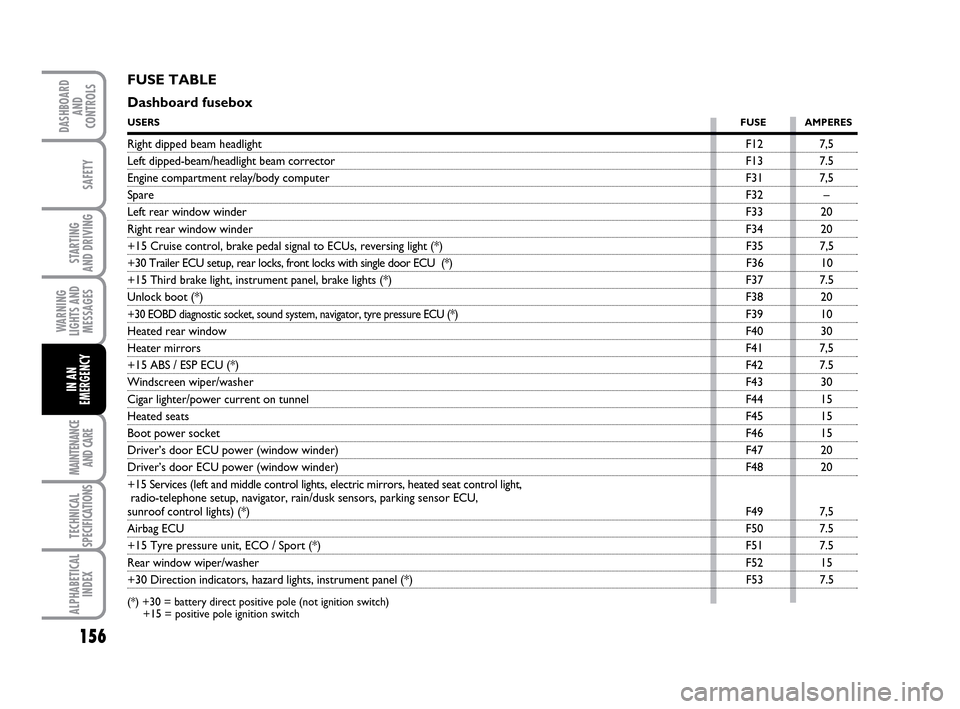
FUSE TABLE
Dashboard fusebox
USERSFUSE AMPERES
Right dipped beam headlightF12 7,5
Left dipped-beam/headlight beam correctorF13 7.5
Engine compartment relay/body computerF31 7,5
SpareF32 –
Left rear window winderF33 20
Right rear window winderF34 20
+15 Cruise control, brake pedal signal to ECUs, reversing light (*) F35 7,5
+30 Trailer ECU setup, rear locks, front locks with single door ECU (*) F36 10
+15 Third brake light, instrument panel, brake lights (*) F37 7.5
Unlock boot (*)F38 20
+30 EOBD diagnostic socket, sound system, navigator, tyre pressure ECU (*)F39 10
Heated rear windowF40 30
Heater mirrorsF41 7,5
+15 ABS / ESP ECU (*)F42 7.5
Windscreen wiper/washerF43 30
Cigar lighter/power current on tunnelF44 15
Heated seatsF45 15
Boot power socketF46 15
Driver’s door ECU power (window winder)F47 20
Driver’s door ECU power (window winder)F48 20
+15 Services (left and middle control lights, electric mirrors, heated seat control light,
radio-telephone setup, navigator, rain/dusk sensors, parking sensor ECU,
sunroof control lights) (*)F49 7,5
Airbag ECUF50 7.5
+15 Tyre pressure unit, ECO / Sport (*)F51 7.5
Rear window wiper/washerF52 15
+30 Direction indicators, hazard lights, instrument panel (*) F53 7.5
(*) +30 = battery direct positive pole (not ignition switch)
+15 = positive pole ignition switch
133-160 LUM IDEA GB 2 ed.qxd 14-01-2010 13:50 Pagina 156
Page 164 of 210
163
STARTING
AND DRIVING
IN AN
EMERGENCY
TECHNICAL
SPECIFICATIONS
ALPHABETICAL
INDEX
DASHBOARD
AND
CONTROLS
SAFETY
WARNING
LIGHTS AND
MESSAGES
MAINTENANCE
AND CARE
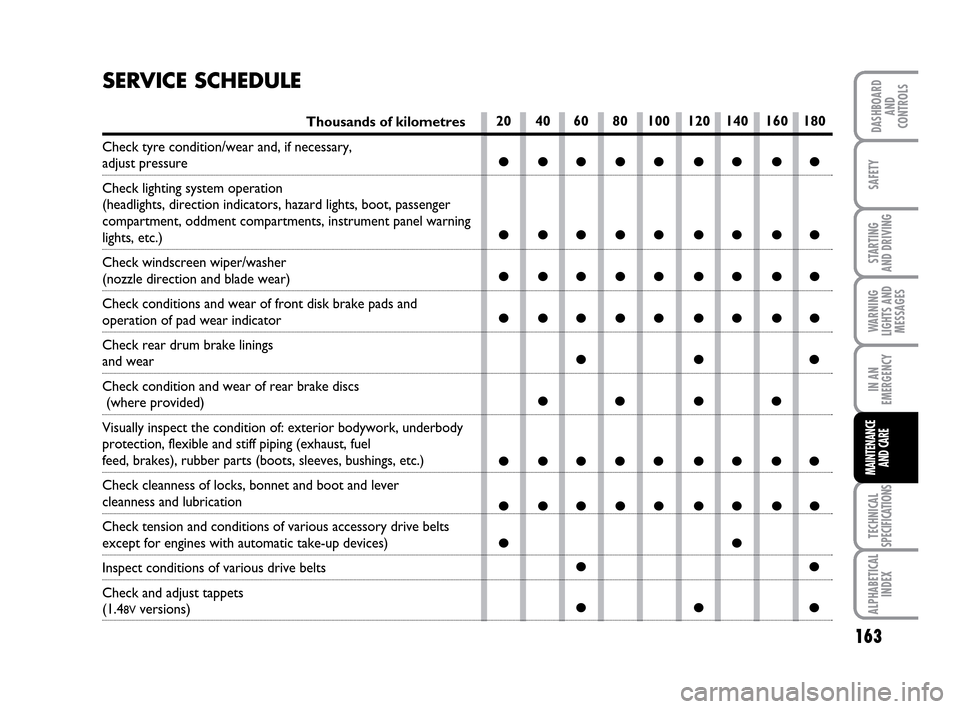
20 40 60 80 100 120 140 160 180
●●●●● ●●●●
●●●●● ●●●●
●●●●● ●●●●
●●●●● ●●●●
●●●
●● ● ●
●●●●● ●●●●
●●●●● ●●●●
●●
●●
●●●
SERVICE SCHEDULE
Thousands of kilometres
Check tyre condition/wear and, if necessary,
adjust pressure
Check lighting system operation
(headlights, direction indicators, hazard lights, boot, passenger
compartment, oddment compartments, instrument panel warning
lights, etc.)
Check windscreen wiper/washer
(nozzle direction and blade wear)
Check conditions and wear of front disk brake pads and
operation of pad wear indicator
Check rear drum brake linings
and wear
Check condition and wear of rear brake discs
(where provided)
Visually inspect the condition of: exterior bodywork, underbody
protection, flexible and stiff piping (exhaust, fuel
feed, brakes), rubber parts (boots, sleeves, bushings, etc.)
Check cleanness of locks, bonnet and boot and lever
cleanness and lubrication
Check tension and conditions of various accessory drive belts
except for engines with automatic take-up devices)
Inspect conditions of various drive belts
Check and adjust tappets
(1.48Vversions)
161-180 LUM IDEA GB 2 ed.qxd 14-01-2010 13:52 Pagina 163
Page 165 of 210
164
STARTING
AND DRIVING
IN AN
EMERGENCY
TECHNICAL
SPECIFICATIONS
ALPHABETICAL
INDEX
DASHBOARD
AND
CONTROLS
SAFETY
WARNING
LIGHTS AND
MESSAGES
MAINTENANCE
AND CARE
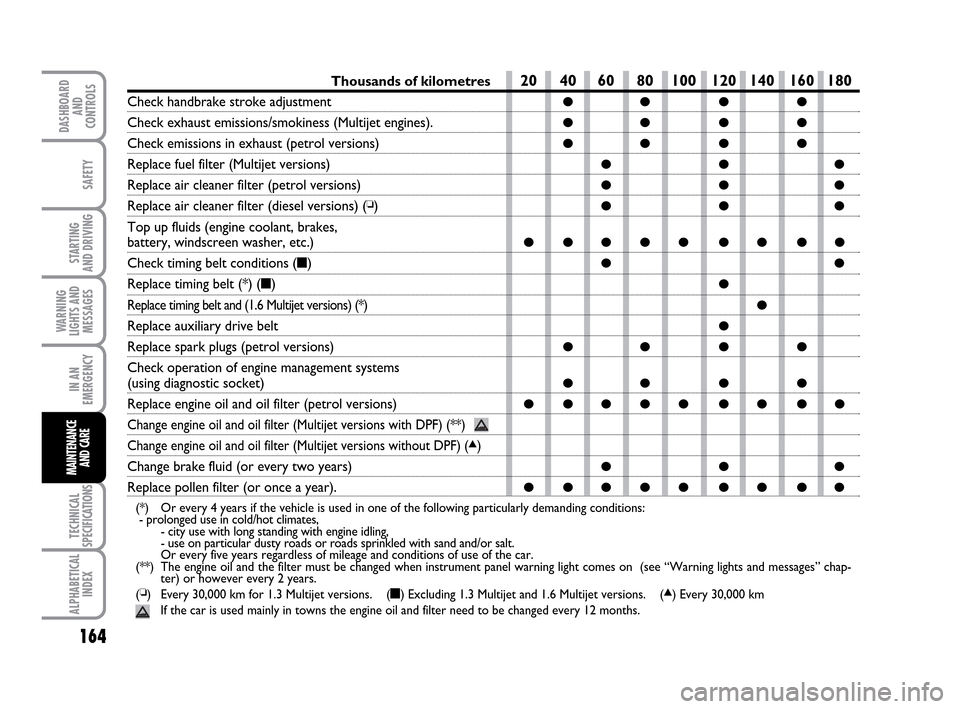
Thousands of kilometres
Check handbrake stroke adjustment
Check exhaust emissions/smokiness (Multijet engines).
Check emissions in exhaust (petrol versions)
Replace fuel filter (Multijet versions)
Replace air cleaner filter (petrol versions)
Replace air cleaner filter (diesel versions) (❏)
Top up fluids (engine coolant, brakes,
battery, windscreen washer, etc.)
Check timing belt conditions (■)
Replace timing belt (*) (■)
Replace timing belt and (1.6 Multijet versions) (*)
Replace auxiliary drive belt
Replace spark plugs (petrol versions)
Check operation of engine management systems
(using diagnostic socket)
Replace engine oil and oil filter (petrol versions)
Change engine oil and oil filter (Multijet versions with DPF) (**)
Change engine oil and oil filter (Multijet versions without DPF) (▲)
Change brake fluid (or every two years)
Replace pollen filter (or once a year).
(*) Or every 4 years if the vehicle is used in one of the following particularly demanding conditions:
- prolonged use in cold/hot climates,
- city use with long standing with engine idling,
- use on particular dusty roads or roads sprinkled with sand and/or salt.
Or every five years regardless of mileage and conditions of use of the car.
(**) The engine oil and the filter must be changed when instrument panel warning light comes on (see “Warning lights and messages” chap-
ter) or however every 2 years.
(
❏) Every 30,000 km for 1.3 Multijet versions. (■) Excluding 1.3 Multijet and 1.6 Multijet versions. (▲) Every 30,000 km
If the car is used mainly in towns the engine oil and filter need to be changed every 12 months.
20 40 60 80 100 120 140 160 180
●● ● ●
●● ● ●
●● ● ●
●●●
●●●
●●●
●●●●● ●●●●
●●
●
●
●
●● ● ●
●● ● ●
●●●●● ●●●●
●●●
●●●●● ●●●●
161-180 LUM IDEA GB 2 ed.qxd 14-01-2010 13:52 Pagina 164
Page 166 of 210
165
STARTING
AND DRIVING
IN AN
EMERGENCY
TECHNICAL
SPECIFICATIONS
ALPHABETICAL
INDEX
DASHBOARD
AND
CONTROLS
SAFETY
WARNING
LIGHTS AND
MESSAGES
MAINTENANCE
AND CARE
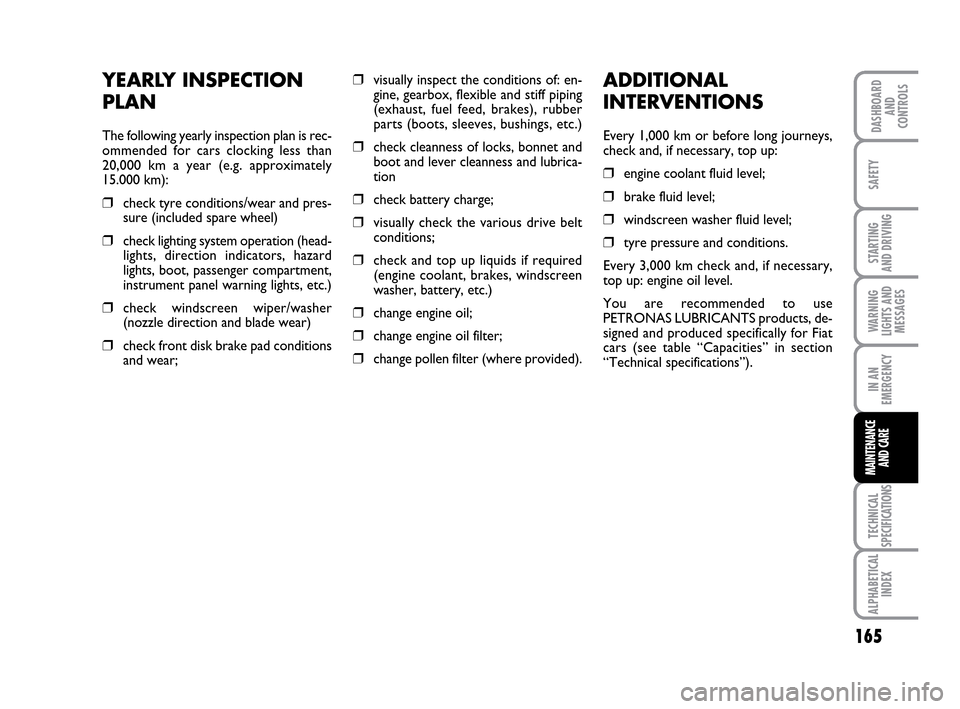
YEARLY INSPECTION
PLAN
The following yearly inspection plan is rec-
ommended for cars clocking less than
20,000 km a year (e.g. approximately
15.000 km):
❒check tyre conditions/wear and pres-
sure (included spare wheel)
❒check lighting system operation (head-
lights, direction indicators, hazard
lights, boot, passenger compartment,
instrument panel warning lights, etc.)
❒check windscreen wiper/washer
(nozzle direction and blade wear)
❒check front disk brake pad conditions
and wear;
❒visually inspect the conditions of: en-
gine, gearbox, flexible and stiff piping
(exhaust, fuel feed, brakes), rubber
parts (boots, sleeves, bushings, etc.)
❒check cleanness of locks, bonnet and
boot and lever cleanness and lubrica-
tion
❒check battery charge;
❒visually check the various drive belt
conditions;
❒check and top up liquids if required
(engine coolant, brakes, windscreen
washer, battery, etc.)
❒change engine oil;
❒change engine oil filter;
❒change pollen filter (where provided).
ADDITIONAL
INTERVENTIONS
Every 1,000 km or before long journeys,
check and, if necessary, top up:
❒engine coolant fluid level;
❒brake fluid level;
❒windscreen washer fluid level;
❒tyre pressure and conditions.
Every 3,000 km check and, if necessary,
top up: engine oil level.
You are recommended to use
PETRONAS LUBRICANTS products, de-
signed and produced specifically for Fiat
cars (see table “Capacities” in section
“Technical specifications”).
161-180 LUM IDEA GB 2 ed.qxd 14-01-2010 13:52 Pagina 165
Page 181 of 210
180
STARTING
AND DRIVING
IN AN
EMERGENCY
TECHNICAL
SPECIFICATIONS
ALPHABETICAL
INDEX
DASHBOARD
AND
CONTROLS
SAFETY
WARNING
LIGHTS AND
MESSAGES
MAINTENANCE
AND CARE
INTERIORS
Periodically check that water is not
trapped under the mats (due to water
dripping off shoes, umbrellas, etc.) which
could cause oxidisation of the sheet met-
al.
CLEANING SEATS AND FABRIC
PARTS
Remove dust with a soft brush or a vacu-
um cleaner. It is advisable to use a moist
brush on velvet upholstery.
Rub the seats with a sponge moistened
with a solution of water and neutral de-
tergent.
LEATHER SEATS
Remove dry dirt with a moist chamois
leather or cloth without pressing too hard.
Remove stains of liquid or grease with a
dry absorbing cloth. Do not rub. Then
wipe with a soft cloth or chamois leather
dipped in water and mild soap.
Use specific products for persistent stains
paying attention to instructions for use.
IMPORTANT Never use alcohol. Make
sure that the products used do not con-
tain alcohol or derivates, even in low con-
centrations. INTERIOR PLASTIC PARTS
It is advisable to clean interior parts with
a moist cloth and a solution of water and
mild soap. Use specific products for clean-
ing plastic, without solvents and specifically
designed to prevent damage to the ap-
pearance and colour of the treated parts
to remove grease and tough stains.
IMPORTANT Never use spirit or petro-
leum to clean the instrument panel trans-
parent cover or other plastic parts.
Do not keep aerosol cans in
the car: risk of explosion.
Aerosol cans must not be exposed to
a temperature exceeding 50°C. When
the vehicle is exposed to sunlight, in-
ner temperature can greatly exceed
this value.
WARNING
The fabric upholstery of your
car is designed to withstand
the normal wear and tear of
your car for a long time.
Some precautions are however need-
ed. Avoid prolonged rubbing against
clothing accessories, such as metal
buckles, Velcro strips and the like,
which by applying a high pressure on
the fabric in a small area could cause
the breakage of some threads and
damage the upholstery.
LEATHER STEERING
WHEEL/GEAR KNOB
These components must be cleaned with
mild soap and water only. Never use spir-
it and/or alcohol based products. Read
the product label carefully before using
specific products for cleaning the interi-
ors: make sure the product does not con-
tain alcohol or alcohol based substances.
If window cleaner accidentally drips onto
the steering wheel or gear lever knob,
wipe away immediately and then wash the
concerned area with mild soap and water.
IMPORTANT Be careful when arranging
a steering wheel lock device, where ap-
plicable, to prevent damaging the leather
upholstery by rubbing.
161-180 LUM IDEA GB 2 ed.qxd 14-01-2010 13:53 Pagina 180
Page 203 of 210
202
STARTING
AND DRIVING
IN AN
EMERGENCY
MAINTENANCE
AND CARE
DASHBOARD
AND
CONTROLS
SAFETY
WARNING
LIGHTS AND
MESSAGES
TECHNICAL
SPECIFICATIONS
ALPHABETICAL
INDEX
Headlight beam corrector
(electric corrector) .................. 82
Headlights ...................................... 82
Heated rear window ...... 45-48-52
Heating and ventilation................ 45
Identification data ....................... 182
Ignition switch .............................. 18
In an emergency ........................... 133
inertia fuel switch.......................... 67
Instrument panel .......................... 7
Interior ........................................... 180
Interior equipment
- card holder................................ 69
- cup/can holder.......................... 69
- current socket.......................... 70
- glove compartment ................. 68
- oddment compartments
(upper) ....................................... 68
- oddment shelf on roof ........... 70
- rear door compartment
- unit on roof ............................ 68Isofix child seat ............................. 103
Jack ................................................. 141
Key and door locking kit ........... 10
Keys ................................................. 11
Levels
- checking ................................... 167
Light buttons ................................. 66
Load limiters ................................. 97
Lubricants (features) .................... 196
Main beam headlights
- bulb replacement .................. 147
- controls .................................... 58
- flashing ...................................... 58
Manual climate control ............... 48
Mobile phone
- setup .......................................... 85
Multifunctional display
(on comfort panel) ..................... 23
Multifunctional display
(on modal panel) ........................ 20
Number plate light
- bulb replacement .................. 151
Oddment compartments
(upper) ......................................... 68
On board instruments ................ 19
Parking sensors ............................ 88
Performance ................................. 193
Plates .............................................. 182
Power socket................................. 70
Power windows
- electric ..................................... 74
- rear manual ............................... 75
Protecting the environment ...... 92
Radio transmitters and mobile
phones ......................................... 86
Rain sensor ................................... 61
Raising the vehicle ....................... 158
Rear fog light
- bulb replacement .................. 150
- control buttons ....................... 66
200-208 LUM IDEA GB 2 ed.qxd 14-01-2010 13:59 Pagina 202