roof FIAT IDEA 2010 1.G User Guide
[x] Cancel search | Manufacturer: FIAT, Model Year: 2010, Model line: IDEA, Model: FIAT IDEA 2010 1.GPages: 210, PDF Size: 4.4 MB
Page 108 of 210
107
STARTING
AND DRIVING
WARNING
LIGHTS AND
MESSAGES
IN AN
EMERGENCY
MAINTENANCE
AND CARE
TECHNICAL
SPECIFICATIONS
ALPHABETICAL
INDEX
DASHBOARD
AND
CONTROLS
SAFETY
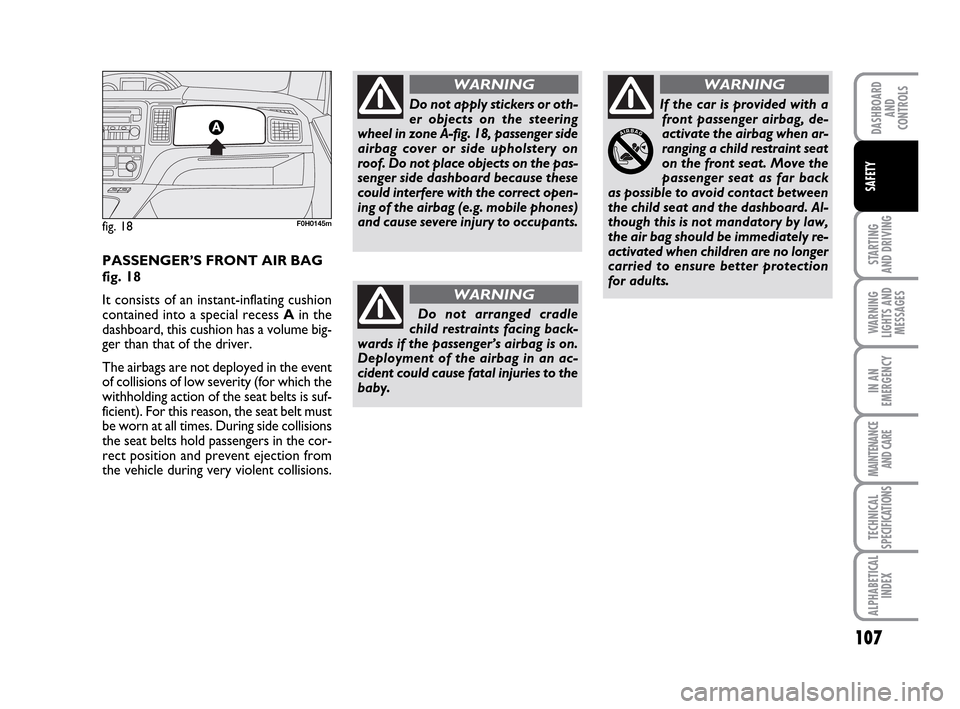
fig. 18F0H0145m
PASSENGER’S FRONT AIR BAG
fig. 18
It consists of an instant-inflating cushion
contained into a special recess Ain the
dashboard, this cushion has a volume big-
ger than that of the driver.
The airbags are not deployed in the event
of collisions of low severity (for which the
withholding action of the seat belts is suf-
ficient). For this reason, the seat belt must
be worn at all times. During side collisions
the seat belts hold passengers in the cor-
rect position and prevent ejection from
the vehicle during very violent collisions.
Do not apply stickers or oth-
er objects on the steering
wheel in zone A-fig. 18, passenger side
airbag cover or side upholstery on
roof. Do not place objects on the pas-
senger side dashboard because these
could interfere with the correct open-
ing of the airbag (e.g. mobile phones)
and cause severe injury to occupants.
WARNING
Do not arranged cradle
child restraints facing back-
wards if the passenger’s airbag is on.
Deployment of the airbag in an ac-
cident could cause fatal injuries to the
baby.
WARNING
If the car is provided with a
front passenger airbag, de-
activate the airbag when ar-
ranging a child restraint seat
on the front seat. Move the
passenger seat as far back
as possible to avoid contact between
the child seat and the dashboard. Al-
though this is not mandatory by law,
the air bag should be immediately re-
activated when children are no longer
carried to ensure better protection
for adults.
WARNING
093-110 LUM IDEA GB 2 ed.qxd 14-01-2010 12:16 Pagina 107
Page 109 of 210
108
STARTING
AND DRIVING
WARNING
LIGHTS AND
MESSAGES
IN AN
EMERGENCY
MAINTENANCE
AND CARE
TECHNICAL
SPECIFICATIONS
ALPHABETICAL
INDEX
DASHBOARD
AND
CONTROLS
SAFETY
To deactivate the passen-
ger’s front air bag and the
side bag (where provided), refer to
“”Multifunctional display” paragraph
in the “Dashboard and controls”
chapter.
WARNING
MANUAL DEACTIVATION OF
PASSENGER’S FRONT AIRBAG
AND SIDE BAG
(where provided)
Should it be absolutely necessary to car-
ry a child on the front seat, the passenger’s
front air bag and the Side Bag (where pro-
vided) can be deactivated.
The instrument panel warning light
“ill
stay on glowing steadily until reactivat-
ing the passenger’s front air bag and the
Side Bag (where provided).
SIDE AIRBAGS (Side
bags - Window bags)
(where provided)
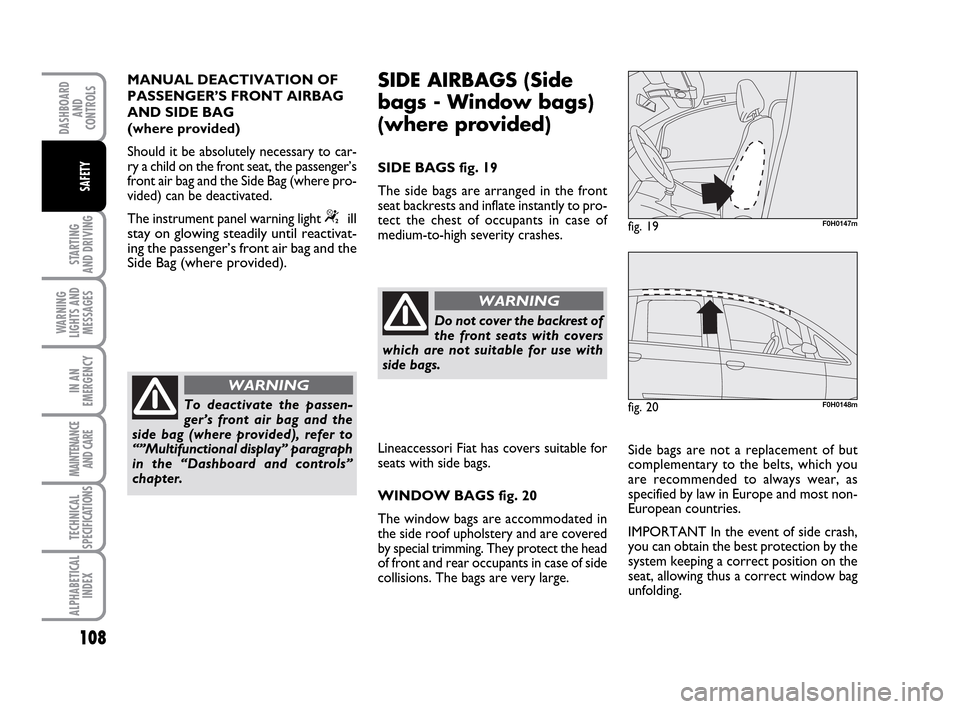
SIDE BAGS fig. 19
The side bags are arranged in the front
seat backrests and inflate instantly to pro-
tect the chest of occupants in case of
medium-to-high severity crashes.
Side bags are not a replacement of but
complementary to the belts, which you
are recommended to always wear, as
specified by law in Europe and most non-
European countries.
IMPORTANT In the event of side crash,
you can obtain the best protection by the
system keeping a correct position on the
seat, allowing thus a correct window bag
unfolding.
Do not cover the backrest of
the front seats with covers
which are not suitable for use with
side bags.
WARNING
Lineaccessori Fiat has covers suitable for
seats with side bags.
WINDOW BAGS fig. 20
The window bags are accommodated in
the side roof upholstery and are covered
by special trimming. They protect the head
of front and rear occupants in case of side
collisions. The bags are very large.
fig. 19F0H0147m
fig. 20F0H0148m
093-110 LUM IDEA GB 2 ed.qxd 14-01-2010 12:16 Pagina 108
Page 117 of 210
116
WARNING
LIGHTS AND
MESSAGES
IN AN
EMERGENCY
MAINTENANCE
AND CARE
TECHNICAL
SPECIFICATIONS
ALPHABETICAL
INDEX
DASHBOARD
AND
CONTROLS
SAFETY
STARTING
AND DRIVING
CONTAINING
RUNNING COSTS
Here are some suggestions which may
help you to keep the running costs of your
vehicle down and lower the amount of
toxic emissions released into the atmos-
phere.
GENERAL CONSIDERATIONS
Car maintenance
Have checks and adjustments carried out
in accordance with the “Service schedule”.
Tyres
Check tyre pressure regularly, at least
once every four weeks: excessively low
pressure will increase fuel consumption
because rolling resistance will be higher.
Unnecessary loads
Do not travel with an overloaded boot.
Do not travel with too much luggage
stowed in the boot. The weight of the car
(especially when driving in town) and its
trim greatly affects consumption and sta-
bility.Roof rack/ski rack
Remove the roof rack or the ski rack from
the roof after use. These accessories de-
crease aerodynamic penetration of the car
and have a negative effect on consumption.
It is better to use a trailer to transport
particularly bulky objects.
Electrical devices
Use electrical devices only for the amount
of time needed. Rear heated window, ad-
ditional headlights, windscreen wipers and
heater fan need a considerable amount of
energy, therefore increasing the require-
ment of current increases fuel consump-
tion (up to +25% in the urban cycle).
Climate control
The climate control system requires high-
er fuel consumption (up to +20% in av-
erage): use the air vents when the exter-
nal temperature allows to.
Spoilers
The use of non-certified aerodynamic
items may adversely affect air drag and fu-
el consumption levels.DRIVING STYLE
Starting
Do not warm the engine up with the car
standing: the engine warms up very slow-
ly in these conditions, increasing fuel con-
sumption and emissions. It is advisable to
start off immediately and slowly keeping
the engine speed down: the engine will
warm up much faster this way.
Unnecessary actions
Avoid revving up when starting at traffic
lights or before stopping the engine. The
latter action, like doubling the clutch, is un-
necessary and causes increase of con-
sumption and pollution.
Gear selection
Use a higher gear as soon as traffic and
road conditions allow. Using a low gear
for faster acceleration will increase fuel
consumption.
In the same way improper use of a high
gear increases consumption, emissions an
engine wear.
111-122 LUM IDEA GB 2 ed.qxd 14-01-2010 12:32 Pagina 116
Page 147 of 210
146
STARTING
AND DRIVING
MAINTENANCE
AND CARE
TECHNICAL
SPECIFICATIONS
ALPHABETICAL
INDEX
DASHBOARD
AND
CONTROLS
SAFETY
WARNING
LIGHTS AND
MESSAGES
IN AN
EMERGENCY
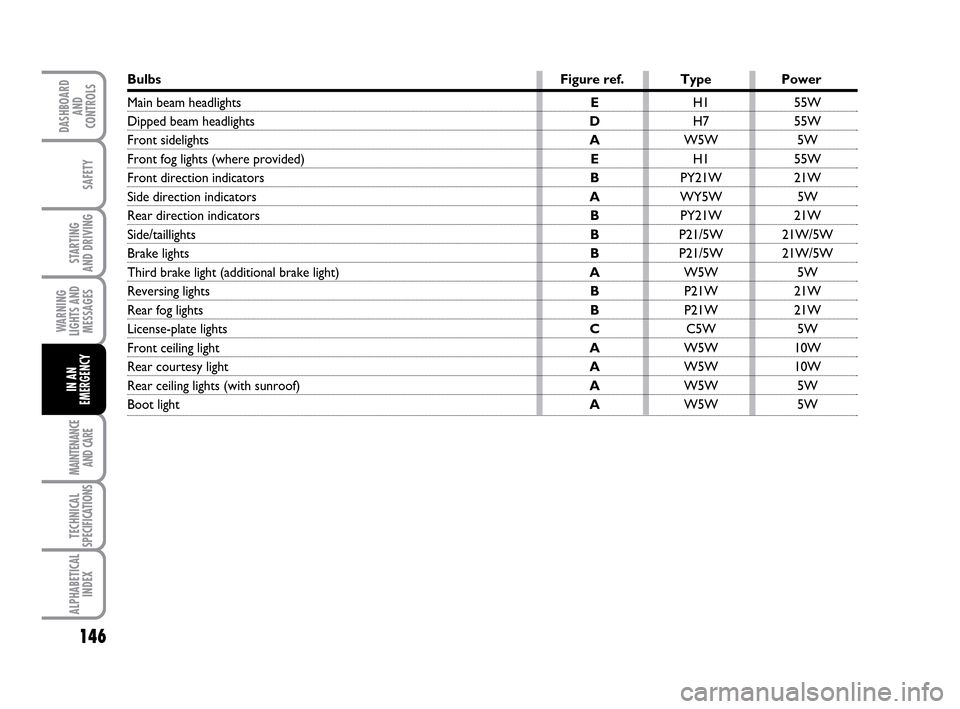
Bulbs Figure ref. Type Power
Main beam headlightsEH1 55W
Dipped beam headlights DH7 55W
Front sidelights AW5W 5W
Front fog lights (where provided)EH1 55W
Front direction indicators BPY21W 21W
Side direction indicators AWY5W 5W
Rear direction indicators BPY21W 21W
Side/taillights BP21/5W 21W/5W
Brake lights BP21/5W 21W/5W
Third brake light (additional brake light) AW5W 5W
Reversing lights BP21W 21W
Rear fog lights BP21W 21W
License-plate lights CC5W 5W
Front ceiling lightAW5W 10W
Rear courtesy lightAW5W 10W
Rear ceiling lights (with sunroof)AW5W 5W
Boot light AW5W 5W
133-160 LUM IDEA GB 2 ed.qxd 14-01-2010 13:50 Pagina 146
Page 157 of 210
156
STARTING
AND DRIVING
MAINTENANCE
AND CARE
TECHNICAL
SPECIFICATIONS
ALPHABETICAL
INDEX
DASHBOARD
AND
CONTROLS
SAFETY
WARNING
LIGHTS AND
MESSAGES
IN AN
EMERGENCY
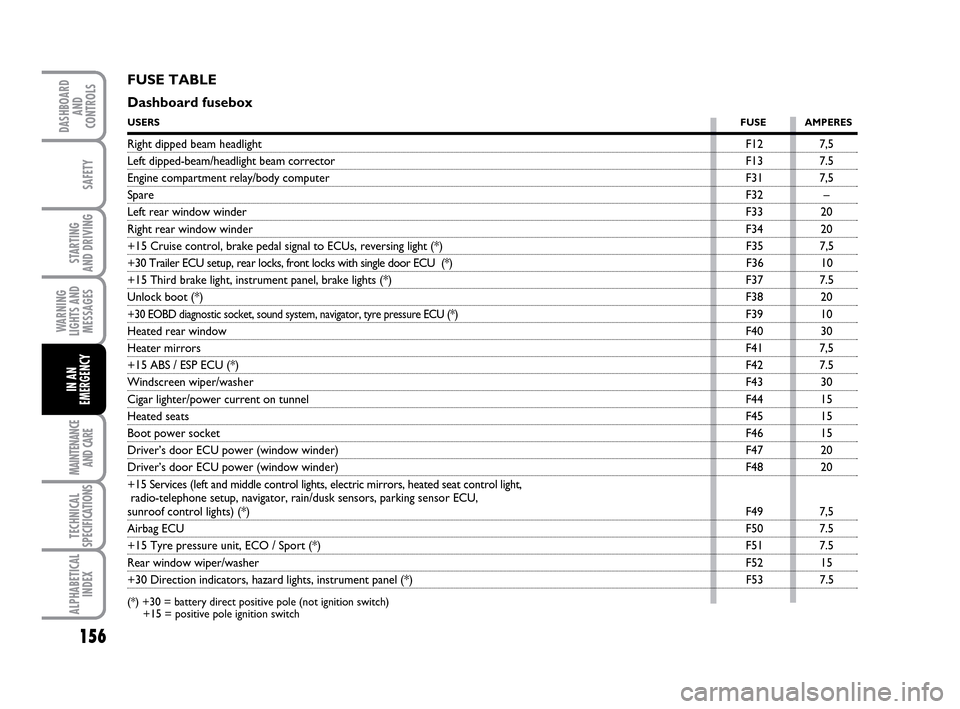
FUSE TABLE
Dashboard fusebox
USERSFUSE AMPERES
Right dipped beam headlightF12 7,5
Left dipped-beam/headlight beam correctorF13 7.5
Engine compartment relay/body computerF31 7,5
SpareF32 –
Left rear window winderF33 20
Right rear window winderF34 20
+15 Cruise control, brake pedal signal to ECUs, reversing light (*) F35 7,5
+30 Trailer ECU setup, rear locks, front locks with single door ECU (*) F36 10
+15 Third brake light, instrument panel, brake lights (*) F37 7.5
Unlock boot (*)F38 20
+30 EOBD diagnostic socket, sound system, navigator, tyre pressure ECU (*)F39 10
Heated rear windowF40 30
Heater mirrorsF41 7,5
+15 ABS / ESP ECU (*)F42 7.5
Windscreen wiper/washerF43 30
Cigar lighter/power current on tunnelF44 15
Heated seatsF45 15
Boot power socketF46 15
Driver’s door ECU power (window winder)F47 20
Driver’s door ECU power (window winder)F48 20
+15 Services (left and middle control lights, electric mirrors, heated seat control light,
radio-telephone setup, navigator, rain/dusk sensors, parking sensor ECU,
sunroof control lights) (*)F49 7,5
Airbag ECUF50 7.5
+15 Tyre pressure unit, ECO / Sport (*)F51 7.5
Rear window wiper/washerF52 15
+30 Direction indicators, hazard lights, instrument panel (*) F53 7.5
(*) +30 = battery direct positive pole (not ignition switch)
+15 = positive pole ignition switch
133-160 LUM IDEA GB 2 ed.qxd 14-01-2010 13:50 Pagina 156
Page 158 of 210
157
STARTING
AND DRIVING
MAINTENANCE
AND CARE
TECHNICAL
SPECIFICATIONS
ALPHABETICAL
INDEX
DASHBOARD
AND
CONTROLS
SAFETY
WARNING
LIGHTS AND
MESSAGES
IN AN
EMERGENCY
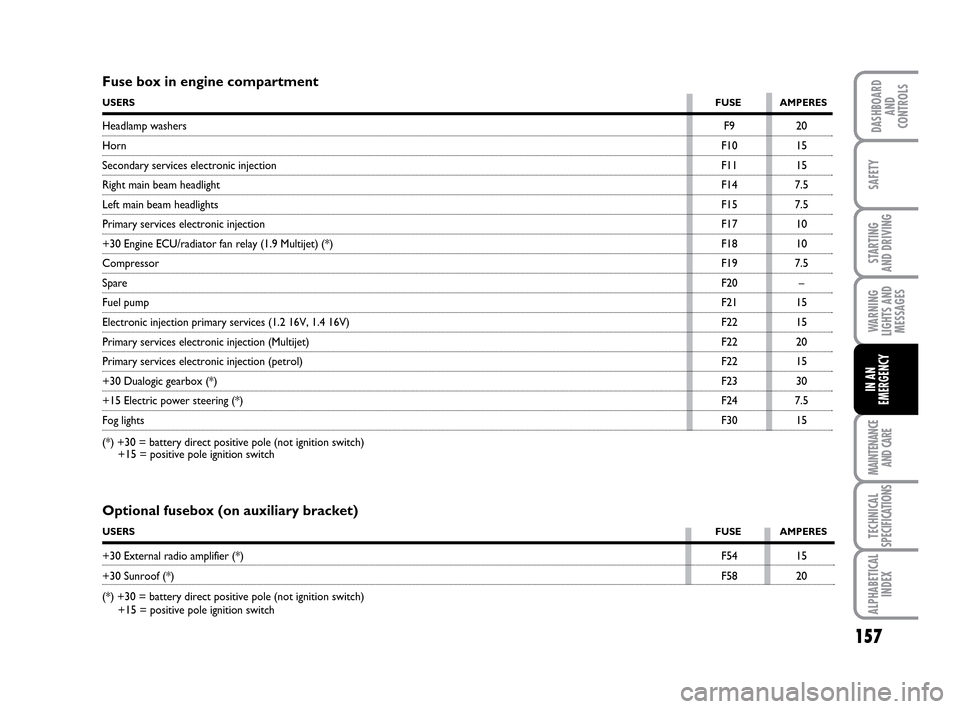
Fuse box in engine compartment
USERSFUSE AMPERES
Headlamp washersF9 20
HornF10 15
Secondary services electronic injectionF11 15
Right main beam headlightF14 7.5
Left main beam headlightsF15 7.5
Primary services electronic injectionF17 10
+30 Engine ECU/radiator fan relay (1.9 Multijet) (*)F18 10
CompressorF19 7.5
SpareF20 –
Fuel pumpF21 15
Electronic injection primary services (1.2 16V, 1.4 16V)F22 15
Primary services electronic injection (Multijet)F22 20
Primary services electronic injection (petrol)F22 15
+30 Dualogic gearbox (*)F23 30
+15 Electric power steering (*)F24 7.5
Fog lightsF30 15
(*) +30 = battery direct positive pole (not ignition switch)
+15 = positive pole ignition switch
Optional fusebox (on auxiliary bracket)
USERSFUSE AMPERES
+30 External radio amplifier (*)F54 15
+30 Sunroof (*)F58 20
(*) +30 = battery direct positive pole (not ignition switch)
+15 = positive pole ignition switch
133-160 LUM IDEA GB 2 ed.qxd 14-01-2010 13:50 Pagina 157
Page 179 of 210
178
STARTING
AND DRIVING
IN AN
EMERGENCY
TECHNICAL
SPECIFICATIONS
ALPHABETICAL
INDEX
DASHBOARD
AND
CONTROLS
SAFETY
WARNING
LIGHTS AND
MESSAGES
MAINTENANCE
AND CARE
BODYWORK
PROTECTION FROM
ATMOSPHERIC AGENTS
The main causes of corrosion are the fol-
lowing:
❒atmospheric pollution;
❒salty air and humidity (coastal areas,
or hot humid climates);
❒seasonal environment conditions.
Not to be underestimated is also the abra-
sive action of wind-borne atmospheric
dust and sand and mud and gravel raised
by other cars.
On your car, Fiat implemented the best
manufacturing technologies to effectively
protect the bodywork against corrosion.
These are the most important:
❒painting products and systems which
give the car particular resistance to
corrosion and abrasion;
❒use of galvanised (or pre-treated) steel
sheets, with high resistance to corro-
sion;
❒spraying of plastic parts with a pro-
tective function in the more exposed
points: under door, inner wing parts,
edges, etc.;
❒boxed parts are designed to prevent
condensation and pooling of water
which can cause corrosion from the
inside.BODY AND UNDERBODY
WARRANTY
Your car is covered by warranty against
perforation due to rust of any original el-
ement of the structure or body. For the
general terms of this warranty, refer to
your “FIAT SERVICE” Booklet.
ADVICE FOR PRESERVING THE
BODYWORK
Paint
Paintwork does not only serve an aes-
thetic purpose, but also protects the un-
derlying sheet metal.
Touch up abrasions and scratches imme-
diately to prevent the formation of rust.
Only use genuine spare paint products for
touch-ups (see “Bodywork paint identifi-
cation plate” in the “Technical Specifica-
tions” section).Normal maintenance of paintwork con-
sists in washing the vehicle: the frequen-
cy depends on the conditions and envi-
ronment where the vehicle is used. For
example, it is advisable to wash the car
more often in areas with a high environ-
mental pollution or on roads sprinkled
with salt.
To correctly wash the car:
❒remove the aerial from the roof to
prevent damage to it if the car is
washed in an automatic system;
❒wash the body using a low pressure jet
of water;
❒wipe a sponge with a slightly soapy so-
lution over the bodywork, frequently
rinsing with the sponge;
❒rinse well with water and dry with a
jet of air or a chamois leather.
Dry the parts less in sight particularly care-
fully, such as the door frames and the
headlight frames, where water may stag-
nate more easily. It is a good idea to leave
the car in the open for a while after wash-
ing it to give time for the water to evap-
orate.
Do not wash the car after it has been
parked in the sun or when the engine is
bonnet is hot: this could take the shine off
the paint.
161-180 LUM IDEA GB 2 ed.qxd 14-01-2010 13:53 Pagina 178
Page 194 of 210
193
STARTING
AND DRIVING
IN AN
EMERGENCY
MAINTENANCE
AND CARE
ALPHABETICAL
INDEX
DASHBOARD
AND
CONTROLS
SAFETY
WARNING
LIGHTS AND
MESSAGES
TECHNICAL
SPECIFICATIONS
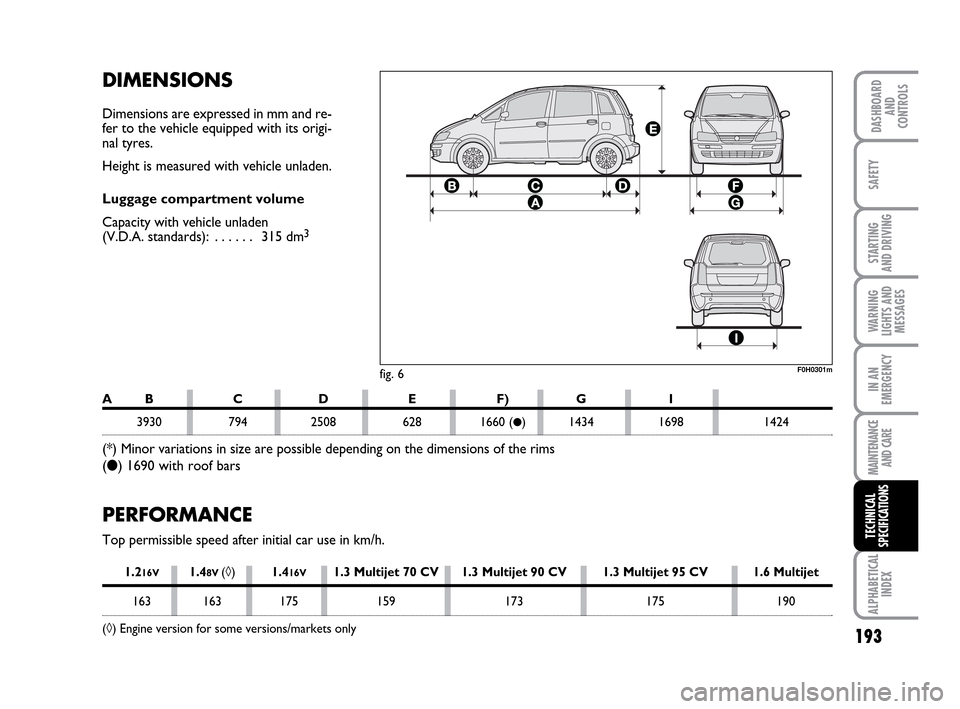
DIMENSIONS
Dimensions are expressed in mm and re-
fer to the vehicle equipped with its origi-
nal tyres.
Height is measured with vehicle unladen.
Luggage compartment volume
Capacity with vehicle unladen
(V.D.A. standards): . . . . . . 315 dm
3
F0H0301m
AB C D E F) G I
3930 794 2508 628 1660 (●) 1434 1698 1424
(*) Minor variations in size are possible depending on the dimensions of the rims
(●) 1690 with roof bars
fig. 6
PERFORMANCE
Top permissible speed after initial car use in km/h.
1.216V1.48V (◊)1.416V1.3 Multijet 70 CV 1.3 Multijet 90 CV 1.3 Multijet 95 CV 1.6 Multijet
163 163 175 159 173 175 190
(◊) Engine version for some versions/markets only
181-199 LUM IDEA GB 2 ed.qxd 14-01-2010 13:56 Pagina 193
Page 195 of 210
194
STARTING
AND DRIVING
IN AN
EMERGENCY
MAINTENANCE
AND CARE
ALPHABETICAL
INDEX
DASHBOARD
AND
CONTROLS
SAFETY
WARNING
LIGHTS AND
MESSAGES
TECHNICAL
SPECIFICATIONS
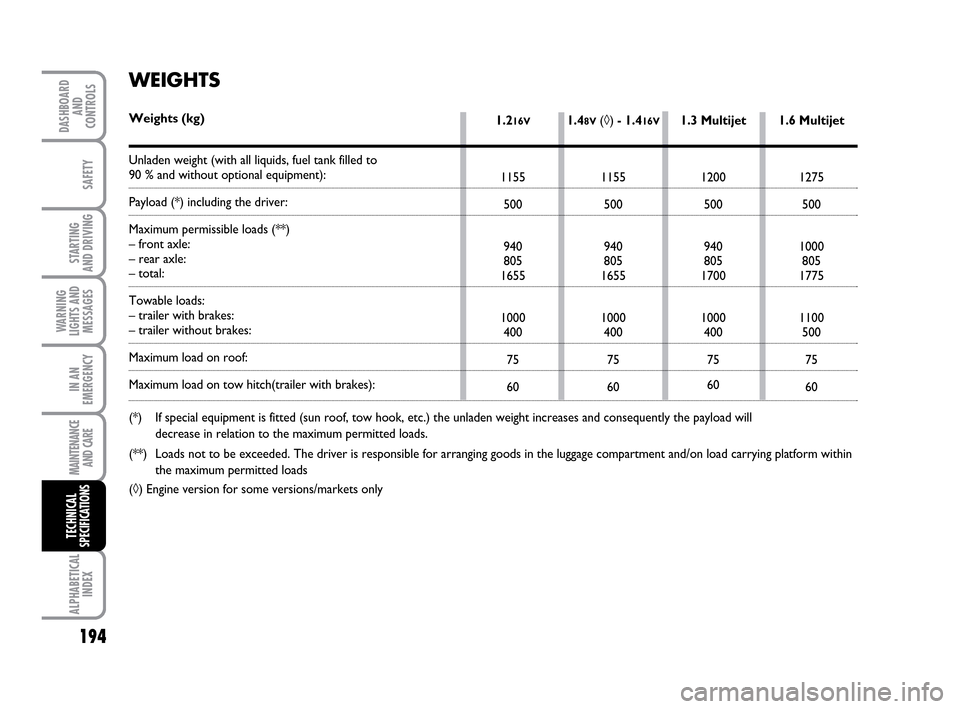
WEIGHTS
Weights (kg)
Unladen weight (with all liquids, fuel tank filled to 90 % and without optional equipment):
Payload (*) including the driver:
Maximum permissible loads (**)
– front axle:
– rear axle:
– total:
Towable loads:
– trailer with brakes:
– trailer without brakes:
Maximum load on roof:
Maximum load on tow hitch(trailer with brakes):
(*) If special equipment is fitted (sun roof, tow hook, etc.) the unladen weight increases and consequently the payload will
decrease in relation to the maximum permitted loads.
(**) Loads not to be exceeded. The driver is responsible for arranging goods in the luggage compartment and/on load carrying platform within
the maximum permitted loads
(◊) Engine version for some versions/markets only1.2
16V
1155
500
940
805
1655
1000
400
75
601.4
8V(◊) - 1.416V
1155
500
940
805
1655
1000
400
75
601.3 Multijet
1200
500
940
805
1700
1000
400
75
601.6 Multijet
1275
500
1000
805
1775
1100
500
75
60
181-199 LUM IDEA GB 2 ed.qxd 14-01-2010 13:56 Pagina 194
Page 199 of 210
198
STARTING
AND DRIVING
IN AN
EMERGENCY
MAINTENANCE
AND CARE
ALPHABETICAL
INDEX
DASHBOARD
AND
CONTROLS
SAFETY
WARNING
LIGHTS AND
MESSAGES
TECHNICAL
SPECIFICATIONS
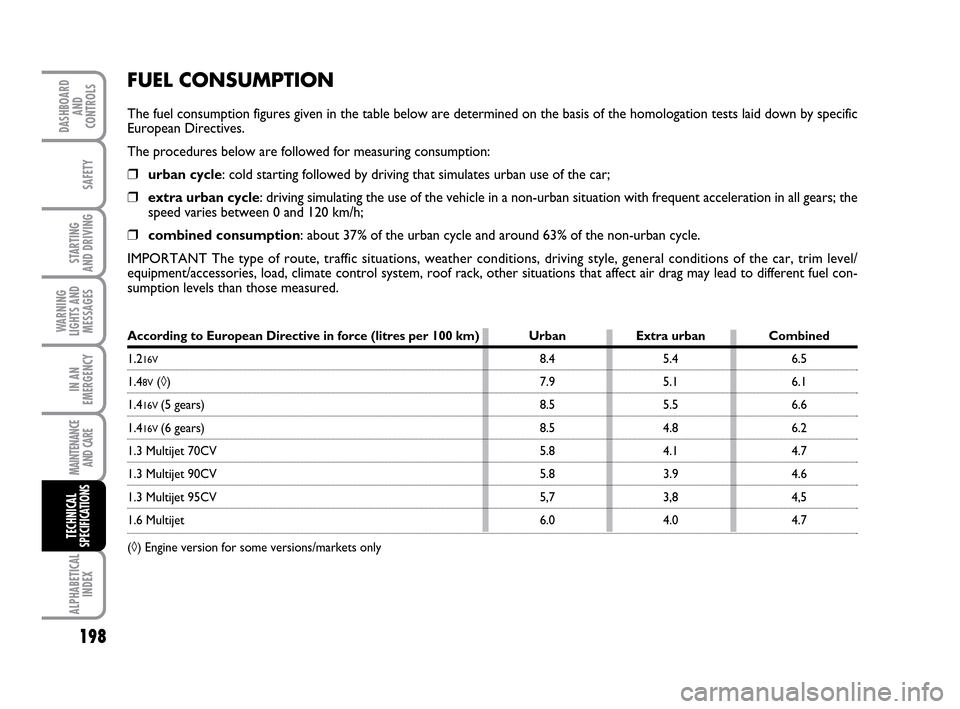
FUEL CONSUMPTION
The fuel consumption figures given in the table below are determined on the basis of the homologation tests laid down by specific
European Directives.
The procedures below are followed for measuring consumption:
❒urban cycle: cold starting followed by driving that simulates urban use of the car;
❒extra urban cycle: driving simulating the use of the vehicle in a non-urban situation with frequent acceleration in all gears; the
speed varies between 0 and 120 km/h;
❒combined consumption: about 37% of the urban cycle and around 63% of the non-urban cycle.
IMPORTANT The type of route, traffic situations, weather conditions, driving style, general conditions of the car, trim level/
equipment/accessories, load, climate control system, roof rack, other situations that affect air drag may lead to different fuel con-
sumption levels than those measured.
According to European Directive in force (litres per 100 km) Urban Extra urban Combined
1.216V8.4 5.4 6.5
1.48V(◊) 7.9 5.1 6.1
1.416V (5 gears) 8.5 5.5 6.6
1.416V (6 gears) 8.5 4.8 6.2
1.3 Multijet 70CV 5.8 4.1 4.7
1.3 Multijet 90CV 5.8 3.9 4.6
1.3 Multijet 95CV 5,7 3,8 4,5
1.6 Multijet 6.0 4.0 4.7
(◊) Engine version for some versions/markets only
181-199 LUM IDEA GB 2 ed.qxd 14-01-2010 13:56 Pagina 198