battery FIAT IDEA 2010 1.G Owner's Manual
[x] Cancel search | Manufacturer: FIAT, Model Year: 2010, Model line: IDEA, Model: FIAT IDEA 2010 1.GPages: 210, PDF Size: 4.4 MB
Page 157 of 210
156
STARTING
AND DRIVING
MAINTENANCE
AND CARE
TECHNICAL
SPECIFICATIONS
ALPHABETICAL
INDEX
DASHBOARD
AND
CONTROLS
SAFETY
WARNING
LIGHTS AND
MESSAGES
IN AN
EMERGENCY
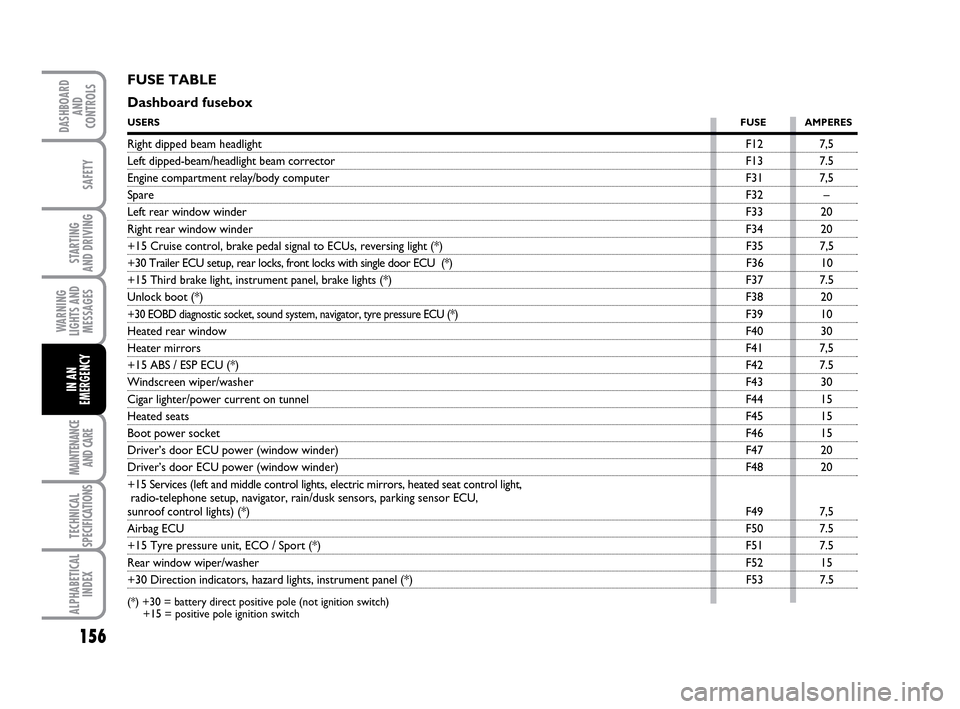
FUSE TABLE
Dashboard fusebox
USERSFUSE AMPERES
Right dipped beam headlightF12 7,5
Left dipped-beam/headlight beam correctorF13 7.5
Engine compartment relay/body computerF31 7,5
SpareF32 –
Left rear window winderF33 20
Right rear window winderF34 20
+15 Cruise control, brake pedal signal to ECUs, reversing light (*) F35 7,5
+30 Trailer ECU setup, rear locks, front locks with single door ECU (*) F36 10
+15 Third brake light, instrument panel, brake lights (*) F37 7.5
Unlock boot (*)F38 20
+30 EOBD diagnostic socket, sound system, navigator, tyre pressure ECU (*)F39 10
Heated rear windowF40 30
Heater mirrorsF41 7,5
+15 ABS / ESP ECU (*)F42 7.5
Windscreen wiper/washerF43 30
Cigar lighter/power current on tunnelF44 15
Heated seatsF45 15
Boot power socketF46 15
Driver’s door ECU power (window winder)F47 20
Driver’s door ECU power (window winder)F48 20
+15 Services (left and middle control lights, electric mirrors, heated seat control light,
radio-telephone setup, navigator, rain/dusk sensors, parking sensor ECU,
sunroof control lights) (*)F49 7,5
Airbag ECUF50 7.5
+15 Tyre pressure unit, ECO / Sport (*)F51 7.5
Rear window wiper/washerF52 15
+30 Direction indicators, hazard lights, instrument panel (*) F53 7.5
(*) +30 = battery direct positive pole (not ignition switch)
+15 = positive pole ignition switch
133-160 LUM IDEA GB 2 ed.qxd 14-01-2010 13:50 Pagina 156
Page 158 of 210
157
STARTING
AND DRIVING
MAINTENANCE
AND CARE
TECHNICAL
SPECIFICATIONS
ALPHABETICAL
INDEX
DASHBOARD
AND
CONTROLS
SAFETY
WARNING
LIGHTS AND
MESSAGES
IN AN
EMERGENCY
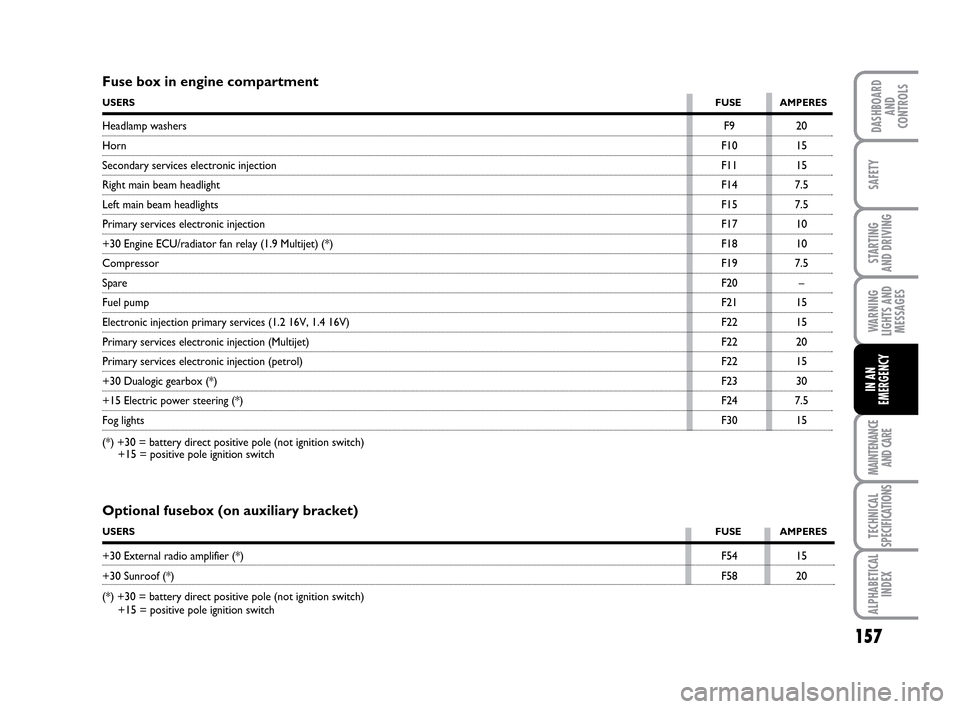
Fuse box in engine compartment
USERSFUSE AMPERES
Headlamp washersF9 20
HornF10 15
Secondary services electronic injectionF11 15
Right main beam headlightF14 7.5
Left main beam headlightsF15 7.5
Primary services electronic injectionF17 10
+30 Engine ECU/radiator fan relay (1.9 Multijet) (*)F18 10
CompressorF19 7.5
SpareF20 –
Fuel pumpF21 15
Electronic injection primary services (1.2 16V, 1.4 16V)F22 15
Primary services electronic injection (Multijet)F22 20
Primary services electronic injection (petrol)F22 15
+30 Dualogic gearbox (*)F23 30
+15 Electric power steering (*)F24 7.5
Fog lightsF30 15
(*) +30 = battery direct positive pole (not ignition switch)
+15 = positive pole ignition switch
Optional fusebox (on auxiliary bracket)
USERSFUSE AMPERES
+30 External radio amplifier (*)F54 15
+30 Sunroof (*)F58 20
(*) +30 = battery direct positive pole (not ignition switch)
+15 = positive pole ignition switch
133-160 LUM IDEA GB 2 ed.qxd 14-01-2010 13:50 Pagina 157
Page 159 of 210
158
STARTING
AND DRIVING
MAINTENANCE
AND CARE
TECHNICAL
SPECIFICATIONS
ALPHABETICAL
INDEX
DASHBOARD
AND
CONTROLS
SAFETY
WARNING
LIGHTS AND
MESSAGES
IN AN
EMERGENCY
IF THE BATTERY IS FLAT
IMPORTANT The battery recharging pro-
cedure is provided as an example only.
You are recommended to go to a Fiat
Dealership to have this operation per-
formed.
We recommend recharging the battery
slowly for approximately 24 hours at low
amperage. A long charge could damage the
battery. Proceed as follows to charge the
battery:
❒disconnect battery negative terminal;
❒connect the charger cables to the bat-
tery terminals, observing the poles;
❒turn on the charger;
❒when you have finished, turn the
charger off before disconnecting the
battery;
❒reconnect battery negative terminal.
IMPORTANT If the car is equipped with
an alarm system, disarm the alarm system
by means of the remote control (see
“Alarm” paragraph in “Dashboard and
controls”).
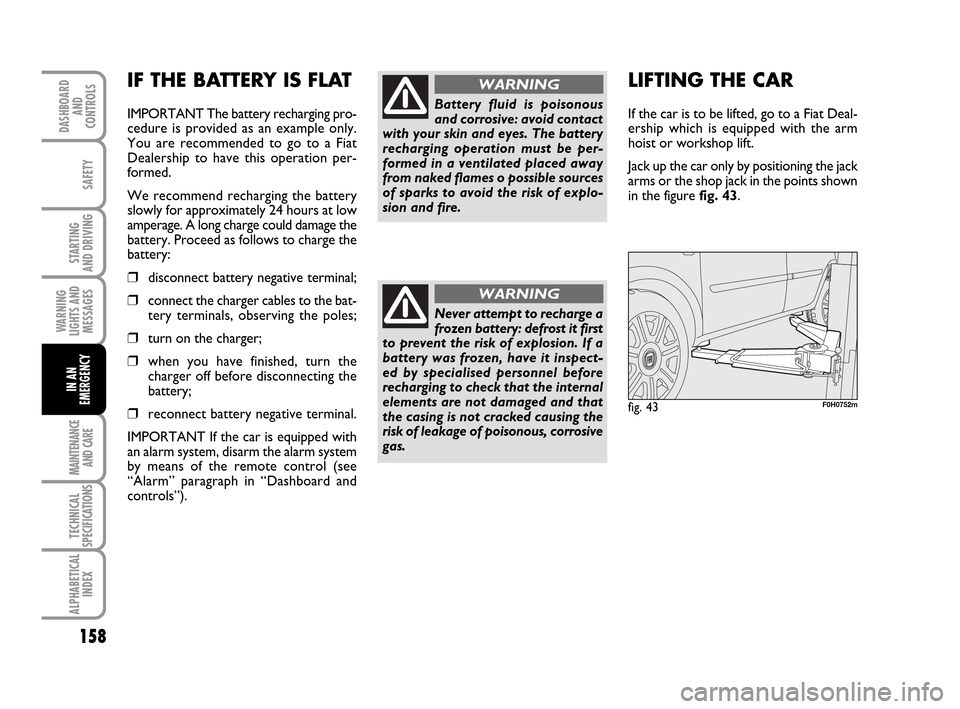
LIFTING THE CAR
If the car is to be lifted, go to a Fiat Deal-
ership which is equipped with the arm
hoist or workshop lift.
Jack up the car only by positioning the jack
arms or the shop jack in the points shown
in the figure fig. 43.Battery fluid is poisonous
and corrosive: avoid contact
with your skin and eyes. The battery
recharging operation must be per-
formed in a ventilated placed away
from naked flames o possible sources
of sparks to avoid the risk of explo-
sion and fire.
WARNING
Never attempt to recharge a
frozen battery: defrost it first
to prevent the risk of explosion. If a
battery was frozen, have it inspect-
ed by specialised personnel before
recharging to check that the internal
elements are not damaged and that
the casing is not cracked causing the
risk of leakage of poisonous, corrosive
gas.
WARNING
fig. 43F0H0752m
133-160 LUM IDEA GB 2 ed.qxd 14-01-2010 13:50 Pagina 158
Page 162 of 210
161
STARTING
AND DRIVING
IN AN
EMERGENCY
TECHNICAL
SPECIFICATIONS
ALPHABETICAL
INDEX
DASHBOARD
AND
CONTROLS
SAFETY
WARNING
LIGHTS AND
MESSAGES
MAINTENANCE
AND CARE
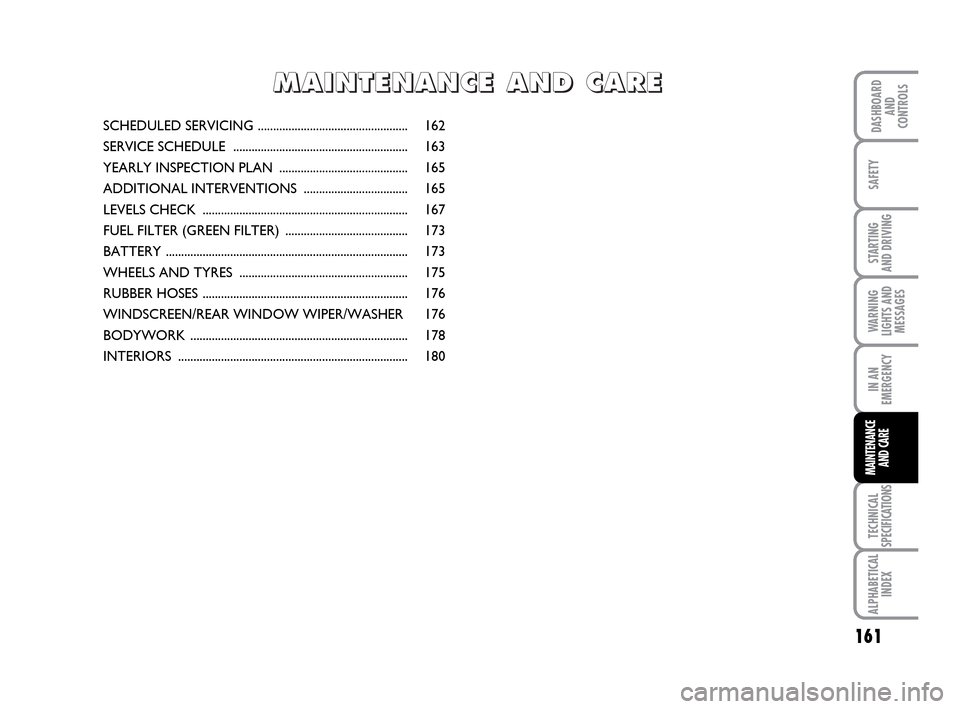
SCHEDULED SERVICING ................................................. 162
SERVICE SCHEDULE ......................................................... 163
YEARLY INSPECTION PLAN .......................................... 165
ADDITIONAL INTERVENTIONS .................................. 165
LEVELS CHECK ................................................................... 167
FUEL FILTER (GREEN FILTER) ........................................ 173
BATTERY ............................................................................... 173
WHEELS AND TYRES ....................................................... 175
RUBBER HOSES ................................................................... 176
WINDSCREEN/REAR WINDOW WIPER/WASHER 176
BODYWORK ....................................................................... 178
INTERIORS ........................................................................... 180
M M
A A
I I
N N
T T
E E
N N
A A
N N
C C
E E
A A
N N
D D
C C
A A
R R
E E
161-180 LUM IDEA GB 2 ed.qxd 14-01-2010 13:52 Pagina 161
Page 165 of 210
164
STARTING
AND DRIVING
IN AN
EMERGENCY
TECHNICAL
SPECIFICATIONS
ALPHABETICAL
INDEX
DASHBOARD
AND
CONTROLS
SAFETY
WARNING
LIGHTS AND
MESSAGES
MAINTENANCE
AND CARE
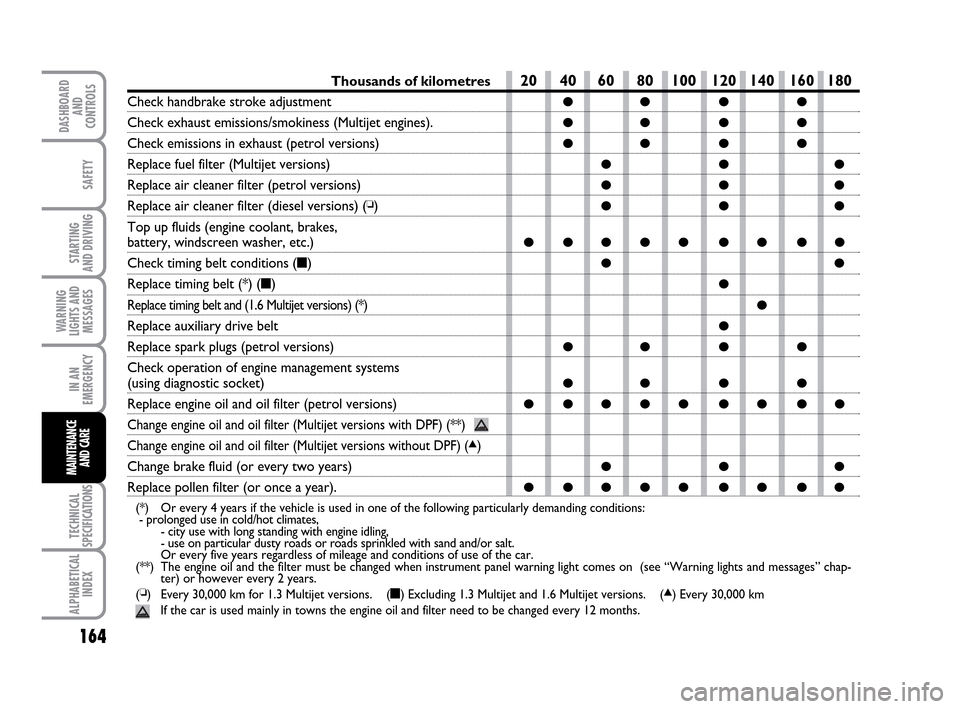
Thousands of kilometres
Check handbrake stroke adjustment
Check exhaust emissions/smokiness (Multijet engines).
Check emissions in exhaust (petrol versions)
Replace fuel filter (Multijet versions)
Replace air cleaner filter (petrol versions)
Replace air cleaner filter (diesel versions) (❏)
Top up fluids (engine coolant, brakes,
battery, windscreen washer, etc.)
Check timing belt conditions (■)
Replace timing belt (*) (■)
Replace timing belt and (1.6 Multijet versions) (*)
Replace auxiliary drive belt
Replace spark plugs (petrol versions)
Check operation of engine management systems
(using diagnostic socket)
Replace engine oil and oil filter (petrol versions)
Change engine oil and oil filter (Multijet versions with DPF) (**)
Change engine oil and oil filter (Multijet versions without DPF) (▲)
Change brake fluid (or every two years)
Replace pollen filter (or once a year).
(*) Or every 4 years if the vehicle is used in one of the following particularly demanding conditions:
- prolonged use in cold/hot climates,
- city use with long standing with engine idling,
- use on particular dusty roads or roads sprinkled with sand and/or salt.
Or every five years regardless of mileage and conditions of use of the car.
(**) The engine oil and the filter must be changed when instrument panel warning light comes on (see “Warning lights and messages” chap-
ter) or however every 2 years.
(
❏) Every 30,000 km for 1.3 Multijet versions. (■) Excluding 1.3 Multijet and 1.6 Multijet versions. (▲) Every 30,000 km
If the car is used mainly in towns the engine oil and filter need to be changed every 12 months.
20 40 60 80 100 120 140 160 180
●● ● ●
●● ● ●
●● ● ●
●●●
●●●
●●●
●●●●● ●●●●
●●
●
●
●
●● ● ●
●● ● ●
●●●●● ●●●●
●●●
●●●●● ●●●●
161-180 LUM IDEA GB 2 ed.qxd 14-01-2010 13:52 Pagina 164
Page 166 of 210
165
STARTING
AND DRIVING
IN AN
EMERGENCY
TECHNICAL
SPECIFICATIONS
ALPHABETICAL
INDEX
DASHBOARD
AND
CONTROLS
SAFETY
WARNING
LIGHTS AND
MESSAGES
MAINTENANCE
AND CARE
YEARLY INSPECTION
PLAN
The following yearly inspection plan is rec-
ommended for cars clocking less than
20,000 km a year (e.g. approximately
15.000 km):
❒check tyre conditions/wear and pres-
sure (included spare wheel)
❒check lighting system operation (head-
lights, direction indicators, hazard
lights, boot, passenger compartment,
instrument panel warning lights, etc.)
❒check windscreen wiper/washer
(nozzle direction and blade wear)
❒check front disk brake pad conditions
and wear;
❒visually inspect the conditions of: en-
gine, gearbox, flexible and stiff piping
(exhaust, fuel feed, brakes), rubber
parts (boots, sleeves, bushings, etc.)
❒check cleanness of locks, bonnet and
boot and lever cleanness and lubrica-
tion
❒check battery charge;
❒visually check the various drive belt
conditions;
❒check and top up liquids if required
(engine coolant, brakes, windscreen
washer, battery, etc.)
❒change engine oil;
❒change engine oil filter;
❒change pollen filter (where provided).
ADDITIONAL
INTERVENTIONS
Every 1,000 km or before long journeys,
check and, if necessary, top up:
❒engine coolant fluid level;
❒brake fluid level;
❒windscreen washer fluid level;
❒tyre pressure and conditions.
Every 3,000 km check and, if necessary,
top up: engine oil level.
You are recommended to use
PETRONAS LUBRICANTS products, de-
signed and produced specifically for Fiat
cars (see table “Capacities” in section
“Technical specifications”).
161-180 LUM IDEA GB 2 ed.qxd 14-01-2010 13:52 Pagina 165
Page 167 of 210
166
STARTING
AND DRIVING
IN AN
EMERGENCY
TECHNICAL
SPECIFICATIONS
ALPHABETICAL
INDEX
DASHBOARD
AND
CONTROLS
SAFETY
WARNING
LIGHTS AND
MESSAGES
MAINTENANCE
AND CARE
IMPORTANT - Engine oil
Should prevailing use of the car be under
one of the following specially heavy con-
ditions:
❒trailer or caravan towing;
❒dusty roads;
❒short repeated distances (less than 7-
8 km) and with external temperatures
below zero;
❒frequently idling engines or long dis-
tance low speed driving (e.g. taxis or
door-to-door deliveries) or in case of
a long term inactivity;
change engine oil more frequently than
shown on the “Service Schedule”.
IMPORTANT - Air cleaner
When the car is used on dusty roads,
change the air cleaner more frequently
than shown on the “Service Schedule”.
Call a Fiat Dealership for doubts regard-
ing engine oil and air cleaner replacement.IMPORTANT - Pollen filter
It is advisable to replace the filtering ele-
ment more frequently if the car is used in
dusty or very polluted places. Specifical-
ly, replace if a lower air flow into the pas-
senger compartment is found.
IMPORTANT - Diesel filter
Using diesel not complying with European
Specification EN590 may lead to the need
to replace the diesel fuel filter more fre-
quently than shown in the “Service Sched-
ule”.IMPORTANT - Battery
Check the battery charge once a year,
preferably before the beginning to winter,
to prevent freezing of the electrolyte.
Perform this inspection more frequently
if the car is mainly used for short distances
or if electrical devices running with the key
off are installed, particularly after-market.
Check the battery level (electrolyte) more
frequently than shown on the “Service
Schedule” if the car is used in hot climates
or in particularly demanding conditions.
Take the car to a Fiat Deal-
ership for servicing. Make
sure you have the right equip-
ment, genuine Fiat spare
parts and consumables for ordinary,
minor interventions. Do not attempt
the operations if you lack the experi-
ence.
161-180 LUM IDEA GB 2 ed.qxd 14-01-2010 13:52 Pagina 166
Page 168 of 210
167
STARTING
AND DRIVING
IN AN
EMERGENCY
TECHNICAL
SPECIFICATIONS
ALPHABETICAL
INDEX
DASHBOARD
AND
CONTROLS
SAFETY
WARNING
LIGHTS AND
MESSAGES
MAINTENANCE
AND CARE
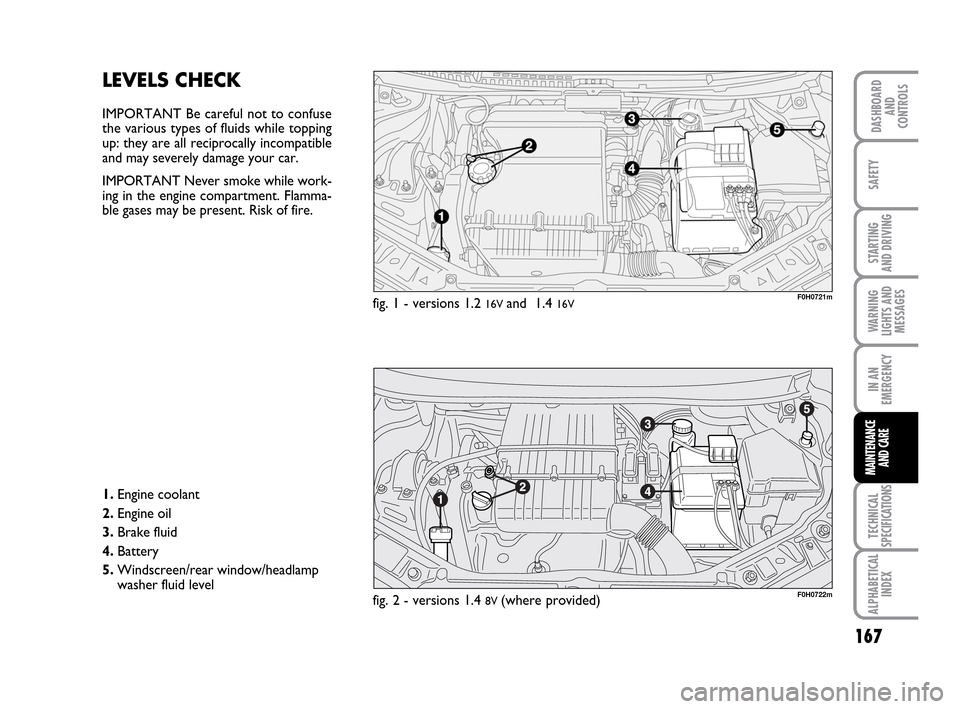
LEVELS CHECK
IMPORTANT Be careful not to confuse
the various types of fluids while topping
up: they are all reciprocally incompatible
and may severely damage your car.
IMPORTANT Never smoke while work-
ing in the engine compartment. Flamma-
ble gases may be present. Risk of fire.
F0H0721mfig. 1 - versions 1.2 16V and 1.4 16V
F0H0722mfig. 2 - versions 1.4 8V (where provided) 1. Engine coolant
2. Engine oil
3. Brake fluid
4. Battery
5.Windscreen/rear window/headlamp
washer fluid level
161-180 LUM IDEA GB 2 ed.qxd 14-01-2010 13:52 Pagina 167
Page 169 of 210
168
STARTING
AND DRIVING
IN AN
EMERGENCY
TECHNICAL
SPECIFICATIONS
ALPHABETICAL
INDEX
DASHBOARD
AND
CONTROLS
SAFETY
WARNING
LIGHTS AND
MESSAGES
MAINTENANCE
AND CARE
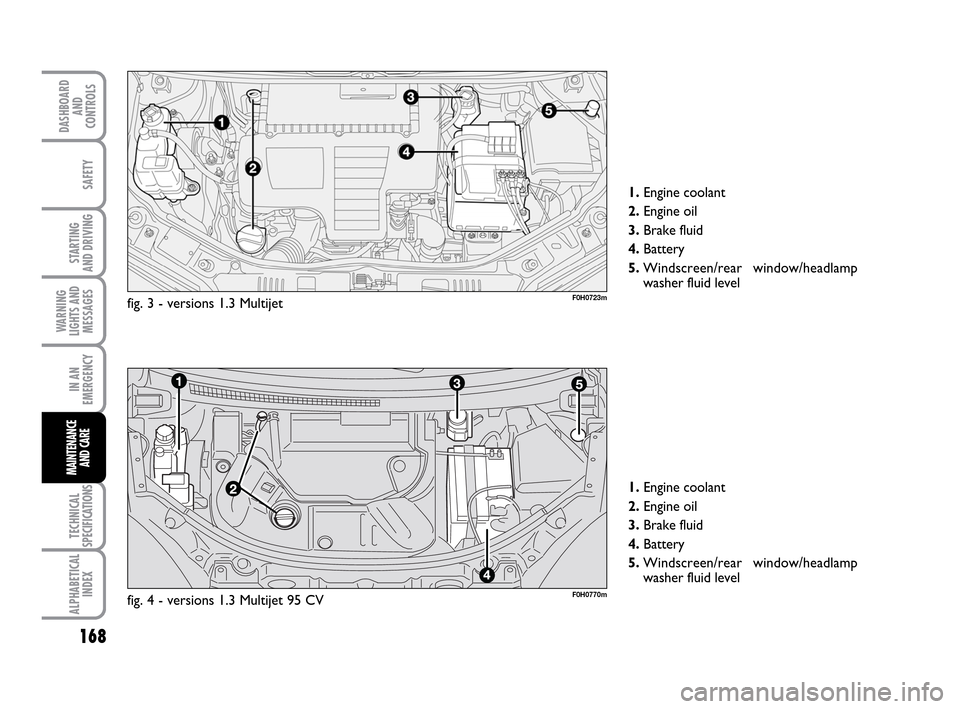
F0H0723mfig. 3 - versions 1.3 Multijet 1. Engine coolant
2. Engine oil
3. Brake fluid
4. Battery
5.Windscreen/rear window/headlamp
washer fluid level
F0H0770mfig. 4 - versions 1.3 Multijet 95 CV 1. Engine coolant
2.Engine oil
3. Brake fluid
4. Battery
5.Windscreen/rear window/headlamp
washer fluid level
161-180 LUM IDEA GB 2 ed.qxd 14-01-2010 13:52 Pagina 168
Page 170 of 210
169
STARTING
AND DRIVING
IN AN
EMERGENCY
TECHNICAL
SPECIFICATIONS
ALPHABETICAL
INDEX
DASHBOARD
AND
CONTROLS
SAFETY
WARNING
LIGHTS AND
MESSAGES
MAINTENANCE
AND CARE
3
12
45
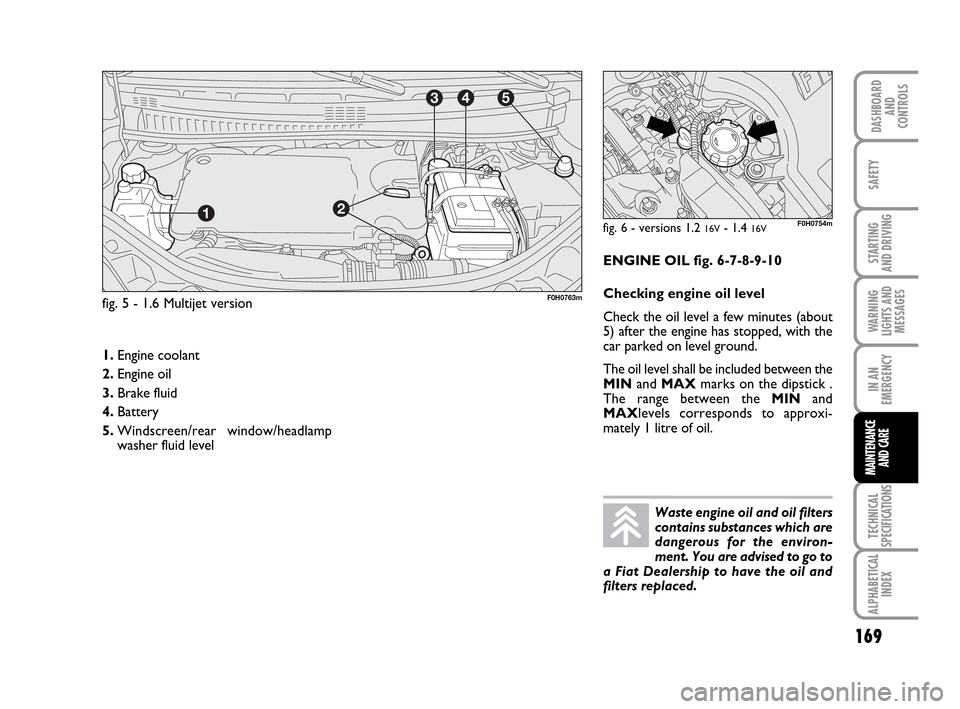
F0H0763mfig. 5 - 1.6 Multijet version
1. Engine coolant
2. Engine oil
3. Brake fluid
4. Battery
5.Windscreen/rear window/headlamp
washer fluid levelENGINE OIL fig. 6-7-8-9-10
Checking engine oil level
Check the oil level a few minutes (about
5) after the engine has stopped, with the
car parked on level ground.
The oil level shall be included between the
MINand MAXmarks on the dipstick .
The range between the MINand
MAXlevels corresponds to approxi-
mately 1 litre of oil.
fig. 6 - versions 1.2 16V- 1.4 16VF0H0754m
Waste engine oil and oil filters
contains substances which are
dangerous for the environ-
ment. You are advised to go to
a Fiat Dealership to have the oil and
filters replaced.
161-180 LUM IDEA GB 2 ed.qxd 14-01-2010 13:52 Pagina 169