lock FIAT IDEA 2010 1.G Owner's Manual
[x] Cancel search | Manufacturer: FIAT, Model Year: 2010, Model line: IDEA, Model: FIAT IDEA 2010 1.GPages: 210, PDF Size: 4.4 MB
Page 51 of 210
50
SAFETY
STARTING
AND DRIVING
WARNING
LIGHTS AND
MESSAGES
IN AN
EMERGENCY
MAINTENANCE
AND CARE
TECHNICAL
SPECIFICATIONS
ALPHABETICAL
INDEX
DASHBOARD
AND CONTROLS
❒turn ring Eto -or to position ƒif the windows are not demisted.
IMPORTANT The climate control system
is very useful for demisting the windows:
simply pressDto operate the system and
demist the windows.
HEATED REAR WINDOW AND
DOOR MIRROR
DEMISTING/DEFROSTING
(where provided)
Press button C-fig. 61to activate the
function. The LED in the button will light
up when the function is on.
The function is timed and automatically
deactivated by the system after a given
time. Press Cagain to switch it off before.
IMPORTANT Do not apply stickers on
the inside of the rear window over the
heating filaments to avoid damage that
might cause it to stop working properly.AIR CONDITIONING
(cooling and dehumidifying)
Proceed as follows:
❒turn the ring B-fig. 61to the blue
sector to select the temperature;
❒turn knob Ato the required speed;
❒turn the ring Eto «;
❒turn the knob Fto …
❒press button D√(the LED on the but-
ton will light up).
Cooling
Proceed as follows:
❒stop internal air recirculation by turn-
ing knob F-fig. 61to Ú.
❒turn ring Bclockwise to increase the
temperature;
❒turn knob Aanticlockwise to reduce
the fan speed.
LOOKING AFTER THE SYSTEM
Run the climate control system for at least
10 minutes every month during the win-
ter. Have the system inspected at a Fiat
Dealership before the summer.
036-092 LUM IDEA GB 2 ed.qxd 14-01-2010 12:14 Pagina 50
Page 54 of 210
53
SAFETY
STARTING
AND DRIVING
WARNING
LIGHTS AND
MESSAGES
IN AN
EMERGENCY
MAINTENANCE
AND CARE
TECHNICAL
SPECIFICATIONS
ALPHABETICAL
INDEX
DASHBOARD
AND CONTROLS
Manual intervention is only required for
the following functions during fully auto-
matic operation.
❒MONOto uniform the temperature
and the air distribution on front pas-
senger or rear passenger zones to the
driver’s zone;
❒…air recirculation, to keep it always
on or off;
❒-to speed up demisting/defrosting of
windscreen, side windows, rear window
and door mirrors;
❒(to demist/defrost the heated rear
window and the external rearview
mirrors.
During completely automatic system op-
eration, you can vary the set temperature,
the air distribution and the fan speed us-
ing the corresponding buttons or knobs
at any time: the system will automatically
change settings to adapt to the new re-
quest.
During fully automatic operation (FULL
AUTO), the word FULLwill dissapear
if the air distribution, air speed, compres-
sor and/or recirculation settings are
changed. In this way, the functions will
switch from automatic to manual control until AUTOis pressed again. The fan
speed is the same in all the zones of the
passenger compartment.
With on or more manually set functions,
the introduced air temperature is still
managed automatically by the system, ex-
cept for when the compressor is off: in the
case, the air introduced into the passen-
ger compartment cannot be cooler than
the outside air.
CONTROLS FOR
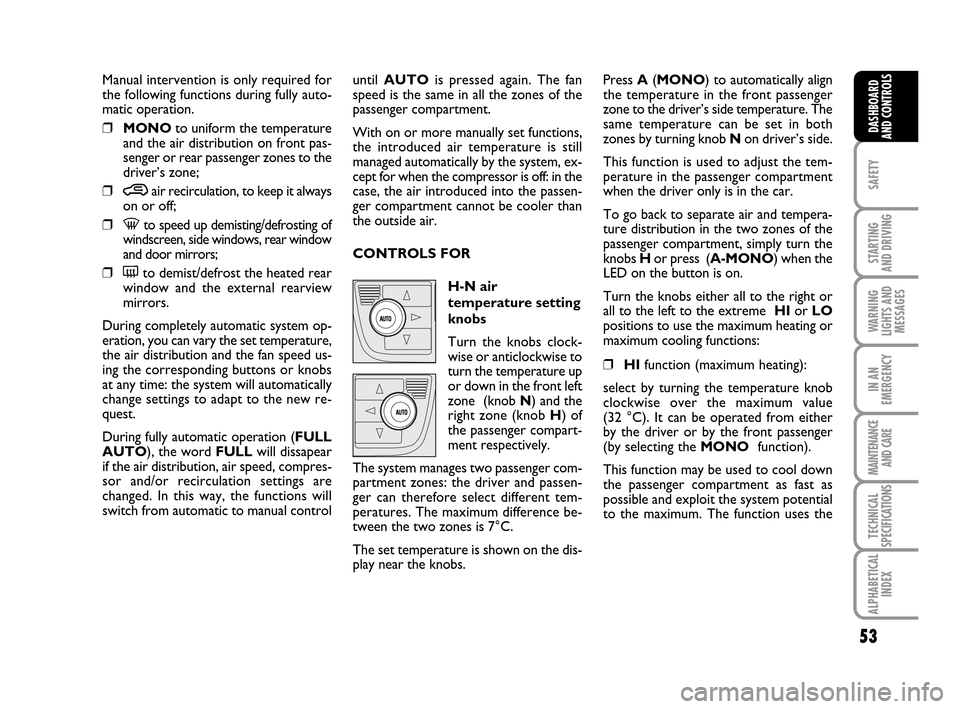
H-N air
temperature setting
knobs
Turn the knobs clock-
wise or anticlockwise to
turn the temperature up
or down in the front left
zone (knob N) and the
right zone (knob H) of
the passenger compart-
ment respectively.
The system manages two passenger com-
partment zones: the driver and passen-
ger can therefore select different tem-
peratures. The maximum difference be-
tween the two zones is 7°C.
The set temperature is shown on the dis-
play near the knobs.Press A(MONO) to automatically align
the temperature in the front passenger
zone to the driver’s side temperature. The
same temperature can be set in both
zones by turning knob N on driver’s side.
This function is used to adjust the tem-
perature in the passenger compartment
when the driver only is in the car.
To go back to separate air and tempera-
ture distribution in the two zones of the
passenger compartment, simply turn the
knobs H or press (A-MONO) when the
LED on the button is on.
Turn the knobs either all to the right or
all to the left to the extreme HIor LO
positions to use the maximum heating or
maximum cooling functions:
❒HIfunction (maximum heating):
select by turning the temperature knob
clockwise over the maximum value
(32 °C). It can be operated from either
by the driver or by the front passenger
(by selecting the MONOfunction).
This function may be used to cool down
the passenger compartment as fast as
possible and exploit the system potential
to the maximum. The function uses the
036-092 LUM IDEA GB 2 ed.qxd 14-01-2010 12:14 Pagina 53
Page 55 of 210
54
SAFETY
STARTING
AND DRIVING
WARNING
LIGHTS AND
MESSAGES
IN AN
EMERGENCY
MAINTENANCE
AND CARE
TECHNICAL
SPECIFICATIONS
ALPHABETICAL
INDEX
DASHBOARD
AND CONTROLS
maximum coolant temperature while air
and fan speed distribution are managed
by the system according to conditions.
Specifically, if the heating fluid is not
warm enough, the fan will not start up at
the maximum speed immediately to limit
introducing excessively cool air into the
passenger compartment.
All manual settings will be allowed when
this function is on.
To switch the function off, simply turn
the temperature knob anticlockwise and
set the required temperature.
❒LOfunction (maximum cooling):
select by turning the temperature knob
anticlockwise beyond the minimum
value (16 °C). It can be operated from
either by the driver or by the front pas-
senger (by selecting the MONOfunc-
tion).
This function may be used to cool down
the passenger compartment as fast as
possible and exploit the system potential
to the maximum. The function activates
air recirculation and the climate control
compressor, air distribution and fan
speed are managed by the system
according to environmental conditions. All manual settings will be allowed when
this function is on.
To switch the function off, simply turn
the temperature knob clockwise and set
the required temperature.
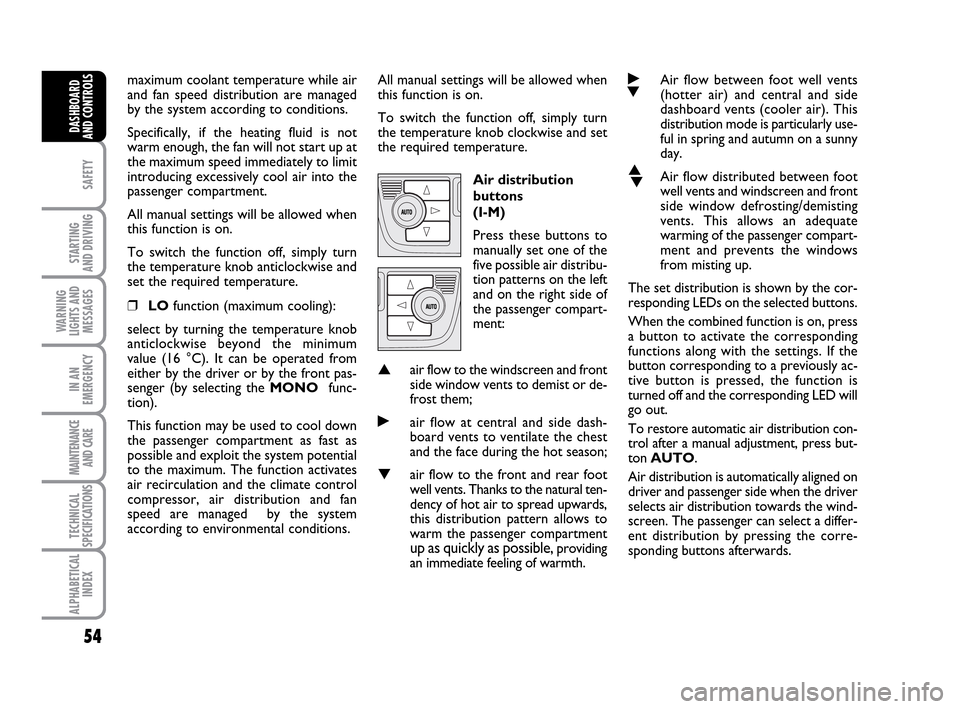
Air distribution
buttons
(I-M)
Press these buttons to
manually set one of the
five possible air distribu-
tion patterns on the left
and on the right side of
the passenger compart-
ment:
▲air flow to the windscreen and front
side window vents to demist or de-
frost them;
˙air flow at central and side dash-
board vents to ventilate the chest
and the face during the hot season;
▼air flow to the front and rear foot
well vents. Thanks to the natural ten-
dency of hot air to spread upwards,
this distribution pattern allows to
warm the passenger compartment
up as quickly as possible, providing
an immediate feeling of warmth.
˙
▼Air flow between foot well vents
(hotter air) and central and side
dashboard vents (cooler air). This
distribution mode is particularly use-
ful in spring and autumn on a sunny
day.
▲
▼Air flow distributed between foot
well vents and windscreen and front
side window defrosting/demisting
vents. This allows an adequate
warming of the passenger compart-
ment and prevents the windows
from misting up.
The set distribution is shown by the cor-
responding LEDs on the selected buttons.
When the combined function is on, press
a button to activate the corresponding
functions along with the settings. If the
button corresponding to a previously ac-
tive button is pressed, the function is
turned off and the corresponding LED will
go out.
To restore automatic air distribution con-
trol after a manual adjustment, press but-
ton AUTO.
Air distribution is automatically aligned on
driver and passenger side when the driver
selects air distribution towards the wind-
screen. The passenger can select a differ-
ent distribution by pressing the corre-
sponding buttons afterwards.
036-092 LUM IDEA GB 2 ed.qxd 14-01-2010 12:14 Pagina 54
Page 66 of 210
65
SAFETY
STARTING
AND DRIVING
WARNING
LIGHTS AND
MESSAGES
IN AN
EMERGENCY
MAINTENANCE
AND CARE
TECHNICAL
SPECIFICATIONS
ALPHABETICAL
INDEX
DASHBOARD
AND CONTROLS
fig. 77F0H0078mfig. 78F0H0079m
fig. 79F0H0254m
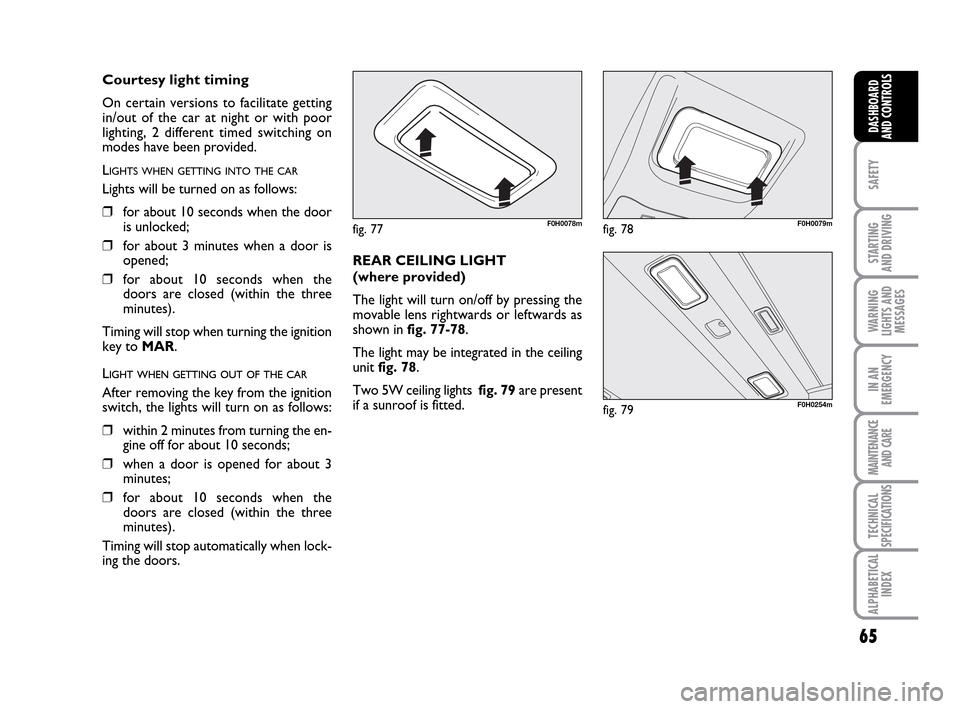
REAR CEILING LIGHT
(where provided)
The light will turn on/off by pressing the
movable lens rightwards or leftwards as
shown in fig. 77-78.
The light may be integrated in the ceiling
unit fig. 78.
Two 5W ceiling lights fig. 79are present
if a sunroof is fitted.
Courtesy light timing
On certain versions to facilitate getting
in/out of the car at night or with poor
lighting, 2 different timed switching on
modes have been provided.
L
IGHTS WHEN GETTING INTO THE CAR
Lights will be turned on as follows:
❒for about 10 seconds when the door
is unlocked;
❒for about 3 minutes when a door is
opened;
❒for about 10 seconds when the
doors are closed (within the three
minutes).
Timing will stop when turning the ignition
key to MAR.
LIGHT WHEN GETTING OUT OF THE CAR
After removing the key from the ignition
switch, the lights will turn on as follows:
❒within 2 minutes from turning the en-
gine off for about 10 seconds;
❒when a door is opened for about 3
minutes;
❒for about 10 seconds when the
doors are closed (within the three
minutes).
Timing will stop automatically when lock-
ing the doors.
036-092 LUM IDEA GB 2 ed.qxd 14-01-2010 12:15 Pagina 65
Page 74 of 210
73
SAFETY
STARTING
AND DRIVING
WARNING
LIGHTS AND
MESSAGES
IN AN
EMERGENCY
MAINTENANCE
AND CARE
TECHNICAL
SPECIFICATIONS
ALPHABETICAL
INDEX
DASHBOARD
AND CONTROLS
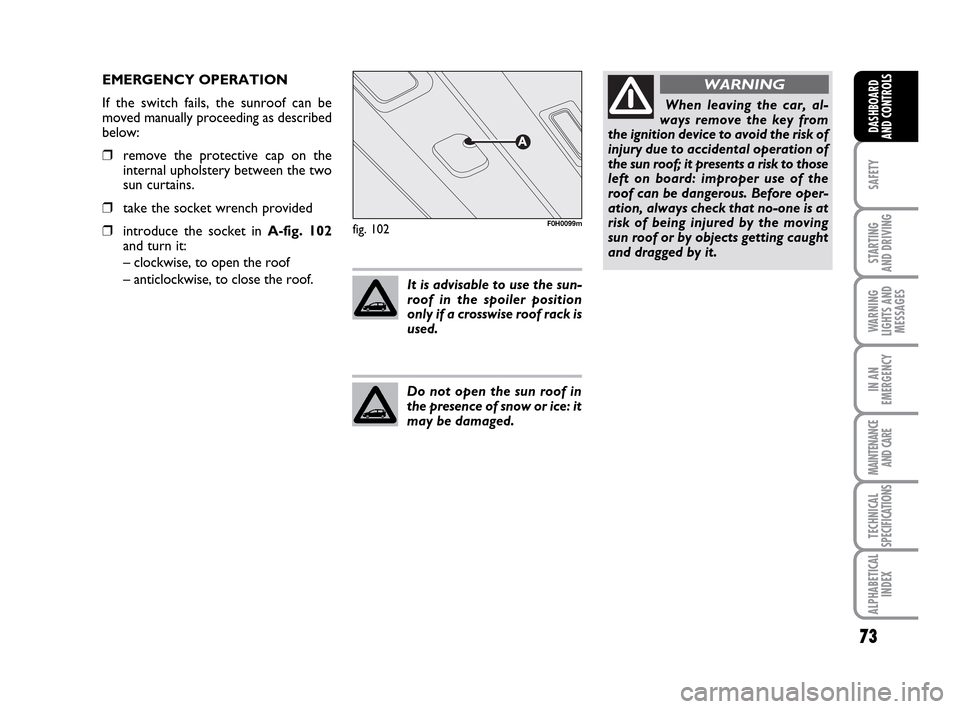
fig. 102F0H0099m
EMERGENCY OPERATION
If the switch fails, the sunroof can be
moved manually proceeding as described
below:
❒remove the protective cap on the
internal upholstery between the two
sun curtains.
❒take the socket wrench provided
❒introduce the socket in A-fig. 102
and turn it:
– clockwise, to open the roof
– anticlockwise, to close the roof.
It is advisable to use the sun-
roof in the spoiler position
only if a crosswise roof rack is
used.
Do not open the sun roof in
the presence of snow or ice: it
may be damaged.
When leaving the car, al-
ways remove the key from
the ignition device to avoid the risk of
injury due to accidental operation of
the sun roof; it presents a risk to those
left on board: improper use of the
roof can be dangerous. Before oper-
ation, always check that no-one is at
risk of being injured by the moving
sun roof or by objects getting caught
and dragged by it.
WARNING
036-092 LUM IDEA GB 2 ed.qxd 14-01-2010 12:15 Pagina 73
Page 77 of 210
76
SAFETY
STARTING
AND DRIVING
WARNING
LIGHTS AND
MESSAGES
IN AN
EMERGENCY
MAINTENANCE
AND CARE
TECHNICAL
SPECIFICATIONS
ALPHABETICAL
INDEX
DASHBOARD
AND CONTROLS
BOOT
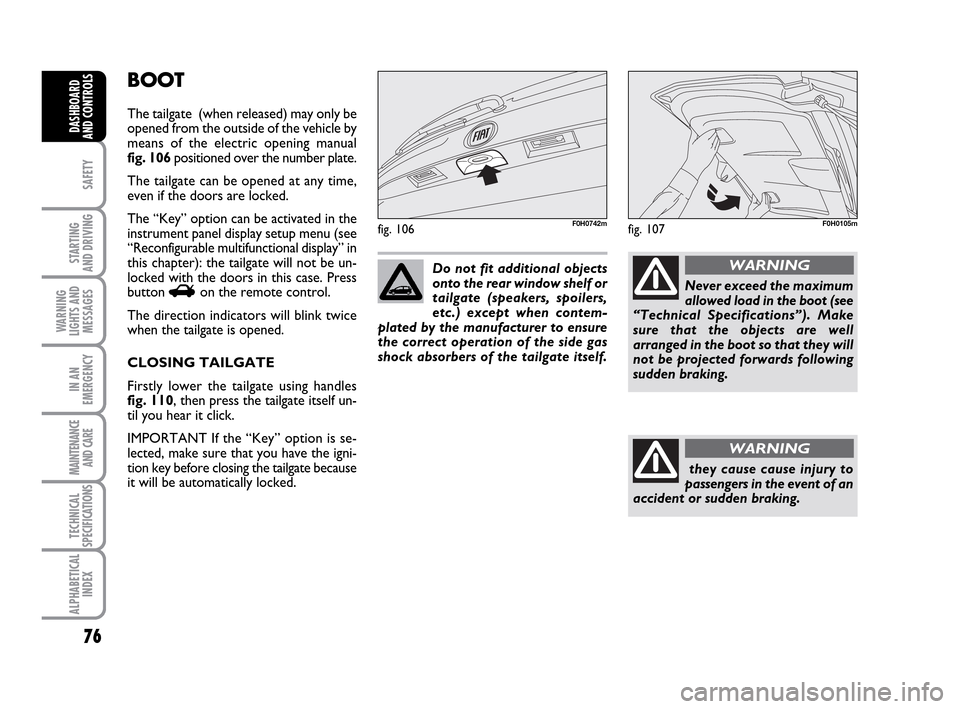
The tailgate (when released) may only be
opened from the outside of the vehicle by
means of the electric opening manual
fig. 106 positioned over the number plate.
The tailgate can be opened at any time,
even if the doors are locked.
The “Key” option can be activated in the
instrument panel display setup menu (see
“Reconfigurable multifunctional display” in
this chapter): the tailgate will not be un-
locked with the doors in this case. Press
button
Ron the remote control.
The direction indicators will blink twice
when the tailgate is opened.
CLOSING TAILGATE
Firstly lower the tailgate using handles
fig. 110, then press the tailgate itself un-
til you hear it click.
IMPORTANT If the “Key” option is se-
lected, make sure that you have the igni-
tion key before closing the tailgate because
it will be automatically locked.
fig. 106F0H0742m
Do not fit additional objects
onto the rear window shelf or
tailgate (speakers, spoilers,
etc.) except when contem-
plated by the manufacturer to ensure
the correct operation of the side gas
shock absorbers of the tailgate itself.
Never exceed the maximum
allowed load in the boot (see
“Technical Specifications”). Make
sure that the objects are well
arranged in the boot so that they will
not be projected forwards following
sudden braking.
WARNING
they cause cause injury to
passengers in the event of an
accident or sudden braking.
WARNING
fig. 107F0H0105m
036-092 LUM IDEA GB 2 ed.qxd 14-01-2010 12:15 Pagina 76
Page 78 of 210
77
SAFETY
STARTING
AND DRIVING
WARNING
LIGHTS AND
MESSAGES
IN AN
EMERGENCY
MAINTENANCE
AND CARE
TECHNICAL
SPECIFICATIONS
ALPHABETICAL
INDEX
DASHBOARD
AND CONTROLS
EMERGENCY TAILGATE
OPENING
To open the tailgate from the inside, if the
battery is run down or after a problem in
the actual tailgate electric lock, proceed
as follows:
❒remove the protective caps;
❒fold the backrests to table position;
❒fold the rear seat cushion/backrest
completely;
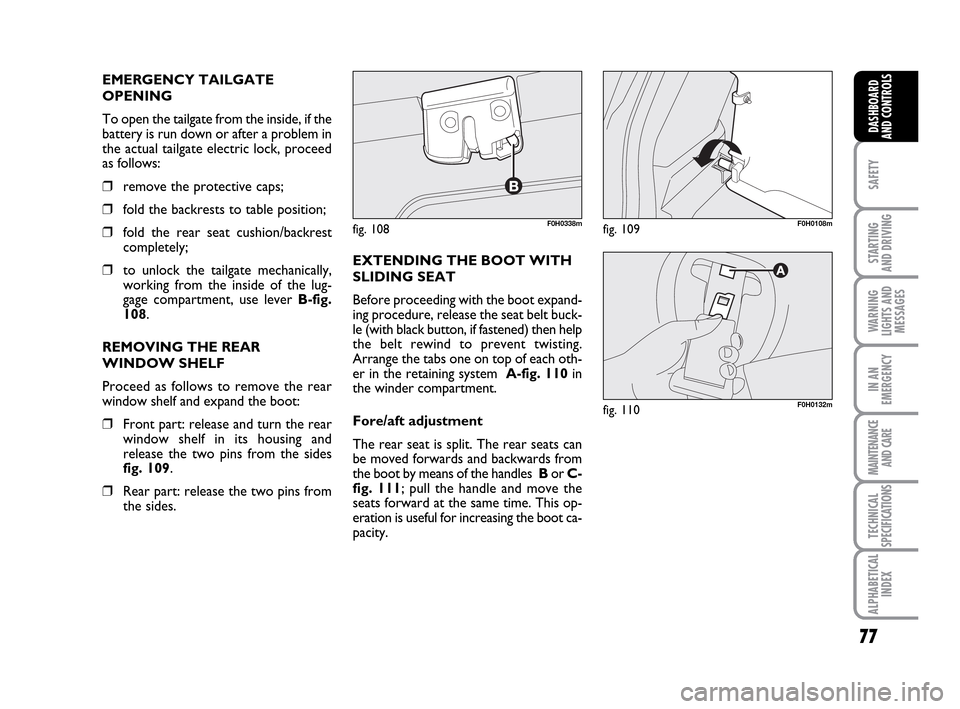
❒to unlock the tailgate mechanically,
working from the inside of the lug-
gage compartment, use lever B-fig.
108.
REMOVING THE REAR
WINDOW SHELF
Proceed as follows to remove the rear
window shelf and expand the boot:
❒Front part: release and turn the rear
window shelf in its housing and
release the two pins from the sides
fig. 109.
❒Rear part: release the two pins from
the sides.EXTENDING THE BOOT WITH
SLIDING SEAT
Before proceeding with the boot expand-
ing procedure, release the seat belt buck-
le (with black button, if fastened) then help
the belt rewind to prevent twisting.
Arrange the tabs one on top of each oth-
er in the retaining system A-fig. 110in
the winder compartment.
Fore/aft adjustment
The rear seat is split. The rear seats can
be moved forwards and backwards from
the boot by means of the handles Bor C-
fig. 111; pull the handle and move the
seats forward at the same time. This op-
eration is useful for increasing the boot ca-
pacity.
fig. 108F0H0338mfig. 109F0H0108m
fig. 110F0H0132m
036-092 LUM IDEA GB 2 ed.qxd 14-01-2010 12:15 Pagina 77
Page 81 of 210
80
SAFETY
STARTING
AND DRIVING
WARNING
LIGHTS AND
MESSAGES
IN AN
EMERGENCY
MAINTENANCE
AND CARE
TECHNICAL
SPECIFICATIONS
ALPHABETICAL
INDEX
DASHBOARD
AND CONTROLS
BONNET
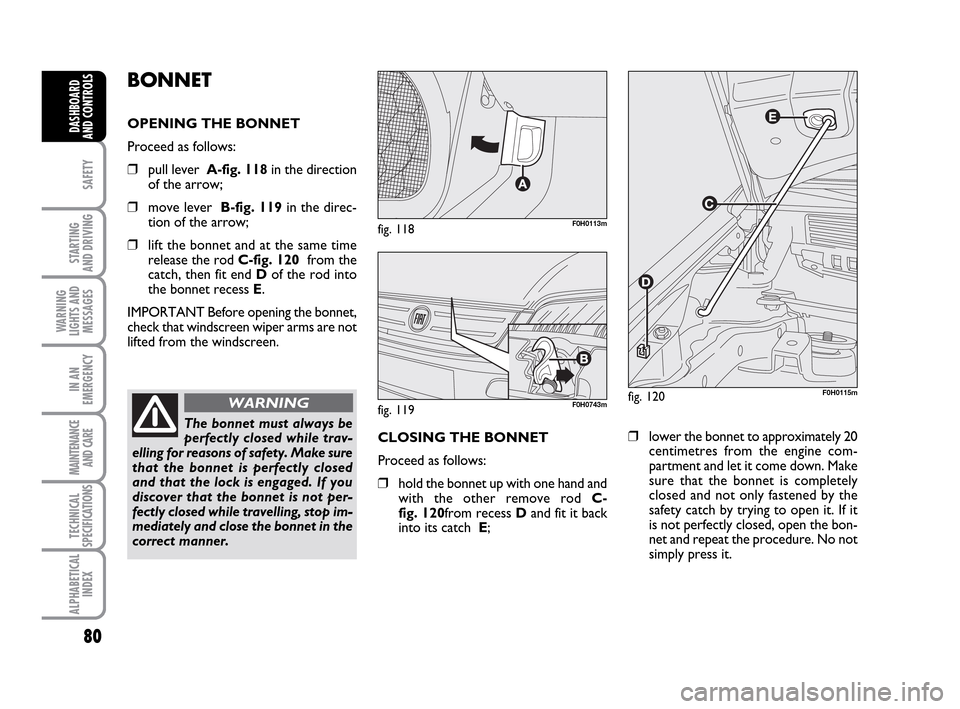
OPENING THE BONNET
Proceed as follows:
❒pull lever A-fig. 118in the direction
of the arrow;
❒move lever B-fig. 119 in the direc-
tion of the arrow;
❒lift the bonnet and at the same time
release the rod C-fig. 120from the
catch, then fit end Dof the rod into
the bonnet recess E.
IMPORTANT Before opening the bonnet,
check that windscreen wiper arms are not
lifted from the windscreen.
The bonnet must always be
perfectly closed while trav-
elling for reasons of safety. Make sure
that the bonnet is perfectly closed
and that the lock is engaged. If you
discover that the bonnet is not per-
fectly closed while travelling, stop im-
mediately and close the bonnet in the
correct manner.
WARNING
fig. 118F0H0113m
fig. 119F0H0743mfig. 120F0H0115m
CLOSING THE BONNET
Proceed as follows:
❒hold the bonnet up with one hand and
with the other remove rod C-
fig. 120from recess Dand fit it back
into its catch E;❒lower the bonnet to approximately 20
centimetres from the engine com-
partment and let it come down. Make
sure that the bonnet is completely
closed and not only fastened by the
safety catch by trying to open it. If it
is not perfectly closed, open the bon-
net and repeat the procedure. No not
simply press it.
036-092 LUM IDEA GB 2 ed.qxd 14-01-2010 12:15 Pagina 80
Page 84 of 210
83
SAFETY
STARTING
AND DRIVING
WARNING
LIGHTS AND
MESSAGES
IN AN
EMERGENCY
MAINTENANCE
AND CARE
TECHNICAL
SPECIFICATIONS
ALPHABETICAL
INDEX
DASHBOARD
AND CONTROLS
ABS SYSTEM
If you have never driven a vehicle with
ABS before, it is advisable to perform a
few tests on slippery ground, naturally in
conditions of safety and respecting the
Highway Code of the country where you
are driving. Read the following informa-
tion carefully.
The car is fitted with an ABS braking sys-
tem, which prevents the wheels from lock-
ing when braking, makes the most of road
grip and gives the best control when
emergency braking under difficulty road
conditions.
System is completed by EBD (Electronic
Braking force Distribution), which dis-
tributes the braking action between front
and rear wheels.
IMPORTANT The braking system needs
to settle for approximately 500 km: dur-
ing this time, avoid sudden, repeated and
prolonged braking.ABS SYSTEM INTERVENTION
Intervention of the ABS is detected by a
slight pulsing of the brake pedal accom-
panied by noise: such an event indicates
that you need to adjust your speed to the
type of road on which you are travelling.
When the ABS intervenes it means that
you are approaching the grip limit be-
tween tyres and road: slow down to ex-
ploit all the available grip.
FAILURE INDICATIONS
ABS failure
ABS failure is indicated by the turning on
of warning light
>on the instrument pan-
el together with the dedicated message on
the multifunctional display (where pro-
vided), (see section “Warning lights and
messages”). In the case, the braking sys-
tem will work as normal without the ex-
tra potentials offered by the ABS system.
Drive carefully to the nearest Fiat Deal-
ership to have the system checked.EBD failure
ABS failure is indicated by the turning on
of warning light >and xon the instru-
ment panel together with the dedicated
message on the multifunctional display
(where provided), (see section “Warning
lights and messages”). In this case, the rear
wheels may suddenly lock and the vehi-
cle may swerve when braking sharply. Dri-
ve carefully to the nearest Fiat Dealership
to have the system checked.
When the ABS intervenes it
means that you are ap-
proaching the grip limit between tyres
and road: slow down to exploit all the
available grip.
WARNING
The ABS exploits the tyre-
road grip at the best, but it
cannot improve it; you should there-
fore take every care when driving on
slippery surfaces without taking un-
necessary risks.
WARNING
When the ABS cuts in, and
you feel the brake pedal pul-
sating, do not remove your foot, but
keep it pressed; in doing so you will
stop in the shortest amount of space
possible under the current road con-
ditions.
WARNING
036-092 LUM IDEA GB 2 ed.qxd 14-01-2010 12:15 Pagina 83
Page 88 of 210
87
SAFETY
STARTING
AND DRIVING
WARNING
LIGHTS AND
MESSAGES
IN AN
EMERGENCY
MAINTENANCE
AND CARE
TECHNICAL
SPECIFICATIONS
ALPHABETICAL
INDEX
DASHBOARD
AND CONTROLS
DUALDRIVE ELECTRIC
POWER STEERING
The car is provided with an electric pow-
er steering system which only works with
the key at MARand the engine running.
The system called “Dualdrive” allows to
customise the effort required to turn the
steering wheel according to driving con-
ditions.
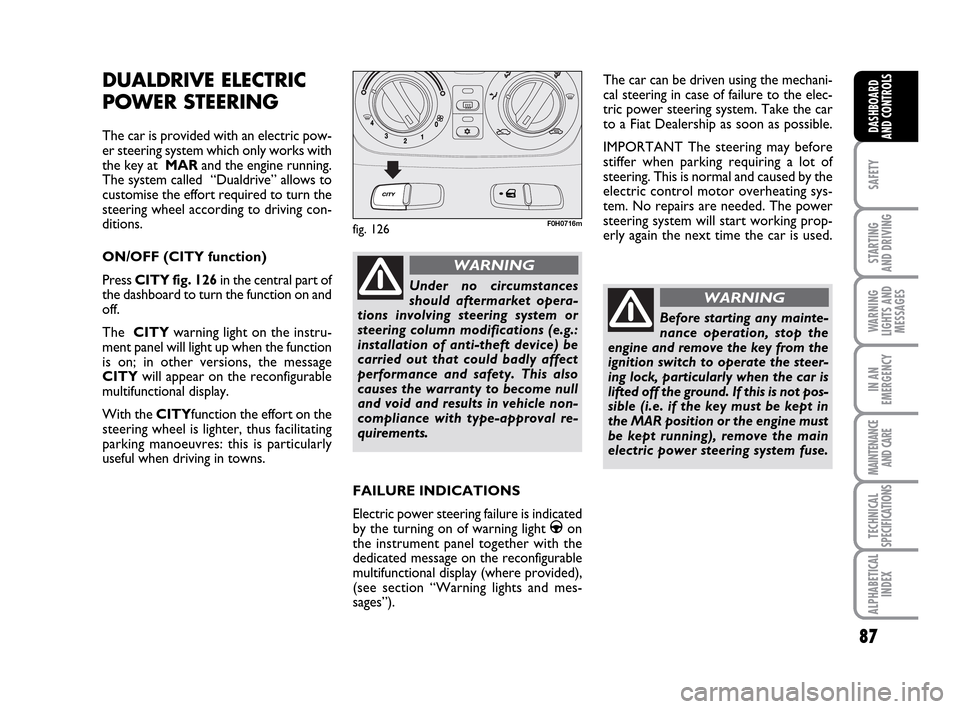
ON/OFF (CITY function)
Press CITY fig. 126in the central part of
the dashboard to turn the function on and
off.
The CITYwarning light on the instru-
ment panel will light up when the function
is on; in other versions, the message
CITYwill appear on the reconfigurable
multifunctional display.
With the CITYfunction the effort on the
steering wheel is lighter, thus facilitating
parking manoeuvres: this is particularly
useful when driving in towns.
fig. 126F0H0716m
Under no circumstances
should aftermarket opera-
tions involving steering system or
steering column modifications (e.g.:
installation of anti-theft device) be
carried out that could badly affect
performance and safety. This also
causes the warranty to become null
and void and results in vehicle non-
compliance with type-approval re-
quirements.
WARNING
The car can be driven using the mechani-
cal steering in case of failure to the elec-
tric power steering system. Take the car
to a Fiat Dealership as soon as possible.
IMPORTANT The steering may before
stiffer when parking requiring a lot of
steering. This is normal and caused by the
electric control motor overheating sys-
tem. No repairs are needed. The power
steering system will start working prop-
erly again the next time the car is used.
Before starting any mainte-
nance operation, stop the
engine and remove the key from the
ignition switch to operate the steer-
ing lock, particularly when the car is
lifted off the ground. If this is not pos-
sible (i.e. if the key must be kept in
the MAR position or the engine must
be kept running), remove the main
electric power steering system fuse.
WARNING
FAILURE INDICATIONS
Electric power steering failure is indicated
by the turning on of warning light
gon
the instrument panel together with the
dedicated message on the reconfigurable
multifunctional display (where provided),
(see section “Warning lights and mes-
sages”).
036-092 LUM IDEA GB 2 ed.qxd 14-01-2010 12:15 Pagina 87